




Joint Optimization of Digital Twin Synchronization Performance for ISAC-Enabled Low-Altitude UAV Systems
-
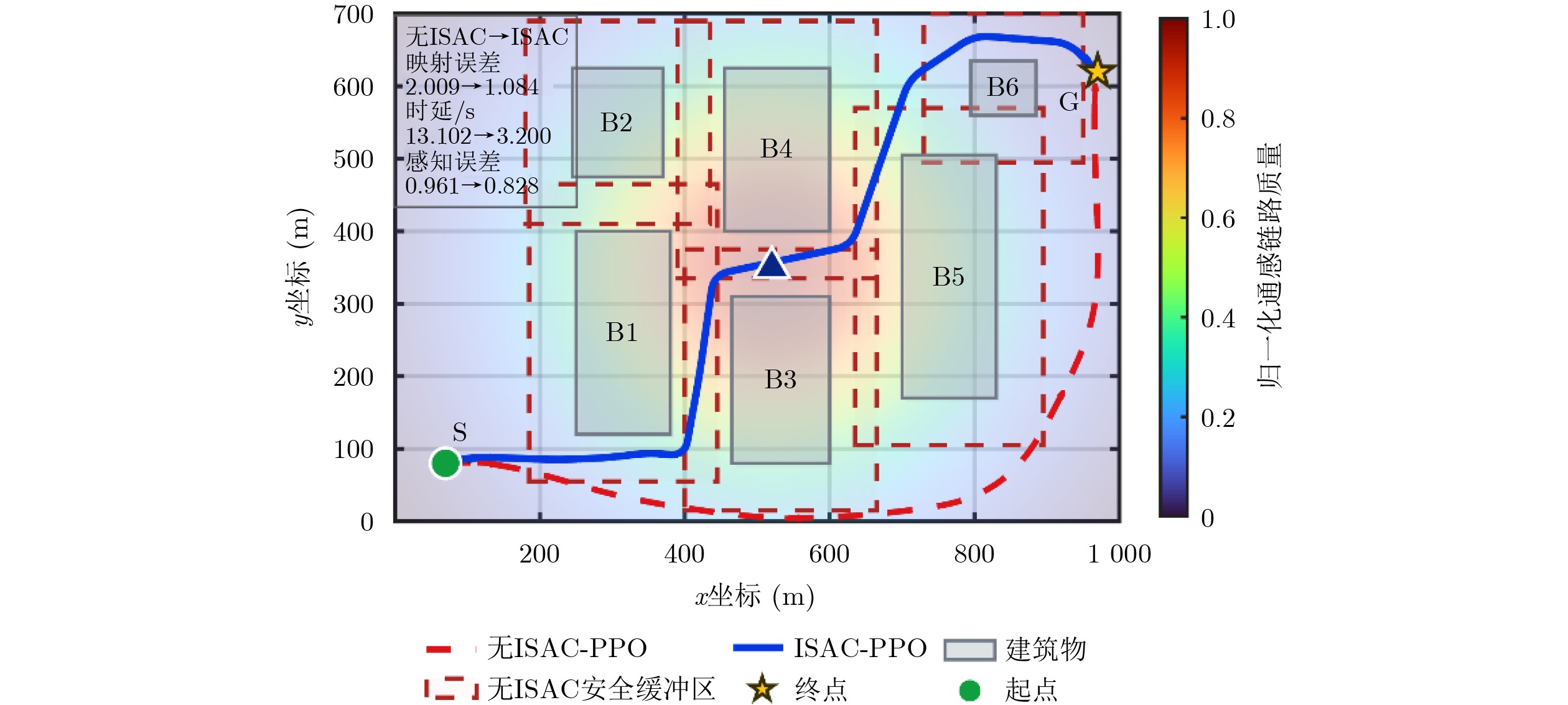
摘要: 针对低空无人机数字孪生(Digital Twin, DT)系统中感知与通信分离设计导致频谱资源利用率较低、状态更新时延较大以及虚实映射精度受限的问题,提出一种通感一体化(Integrated Sensing and Communication,ISAC)赋能的数字孪生同步性能联合优化方法。首先,构建由物理s层、ISAC模块和DT层组成的低空无人机数字孪生闭环架构,并建立通信时延、感知误差和数字孪生同步性能模型。在此基础上,分析带宽、发射功率与无人机轨迹之间的耦合关系,以数字孪生映射误差和更新时间的加权和最小为目标,建立长期联合优化问题。考虑到无人机轨迹控制属于长期序列决策,而带宽和发射功率配置需要在单个时隙内完成,设计一种由面向数字孪生的近端策略优化和交替资源优化模块组成的协同求解方法。其中,DT-aware PPO(Proximal Policy Optimization, PPO)用于优化无人机的长期飞行轨迹,资源优化模块根据当前轨迹和信道状态配置带宽与发射功率,并将数字孪生同步性能反馈给轨迹控制模块。在给定仿真参数下,与非ISAC PPO方案相比,所提方法将数字孪生映射误差由2.009降低至1.084,将平均通信时延由13.102 s降低至3.200 s。与随机轨迹、资源均分等资源分配及典型路径规划算法相比,所提方法能够进一步降低系统综合代价,并在动态扰动下保持较好的决策效率和稳定性。Abstract:
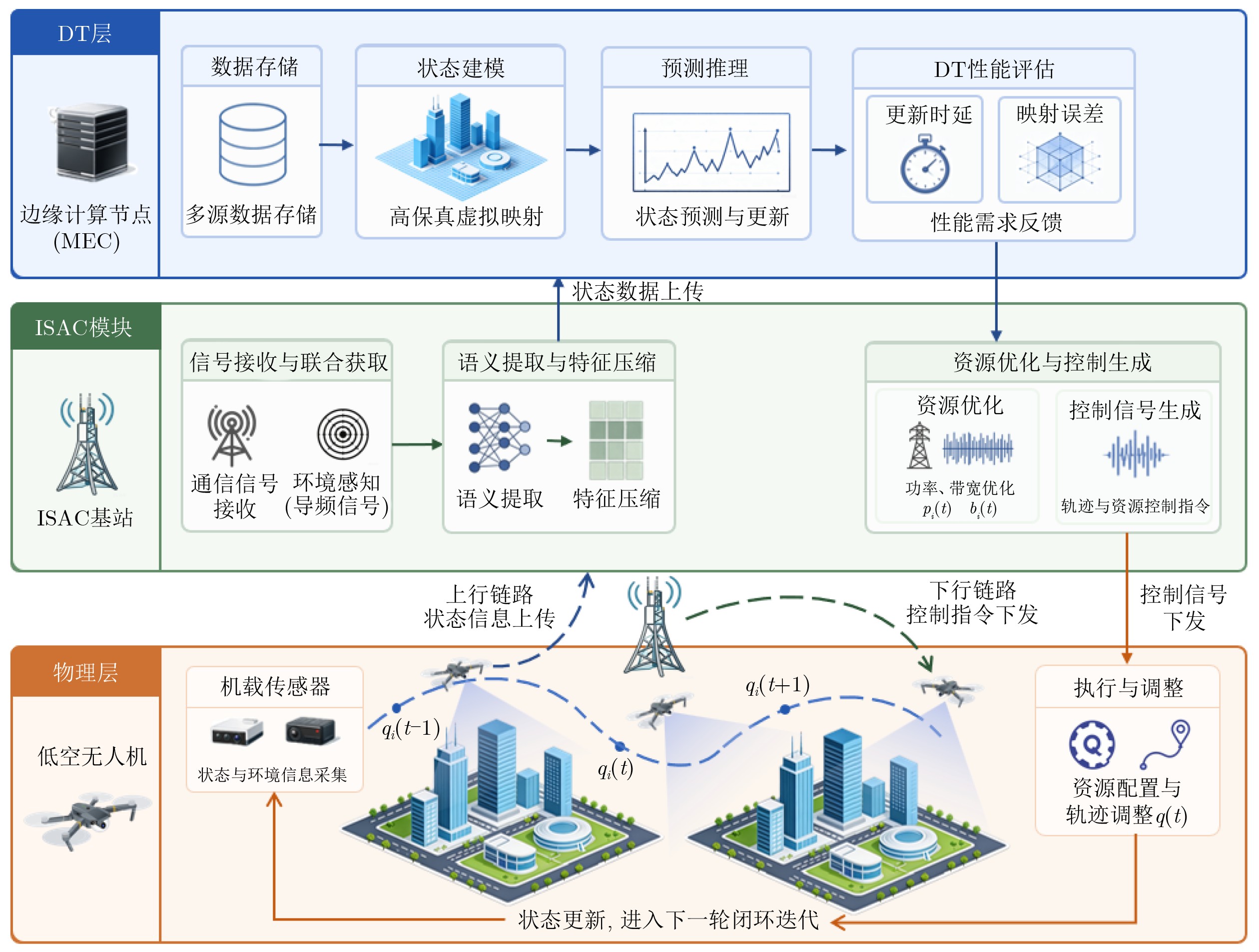
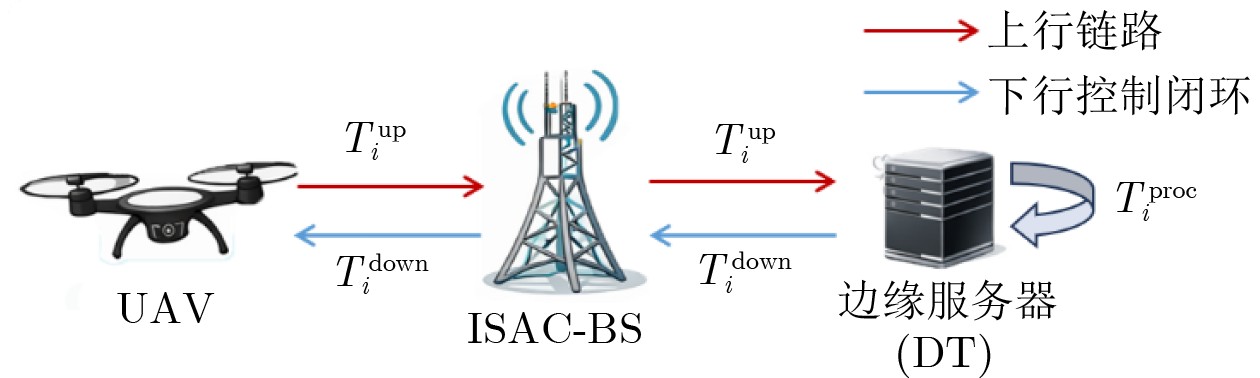
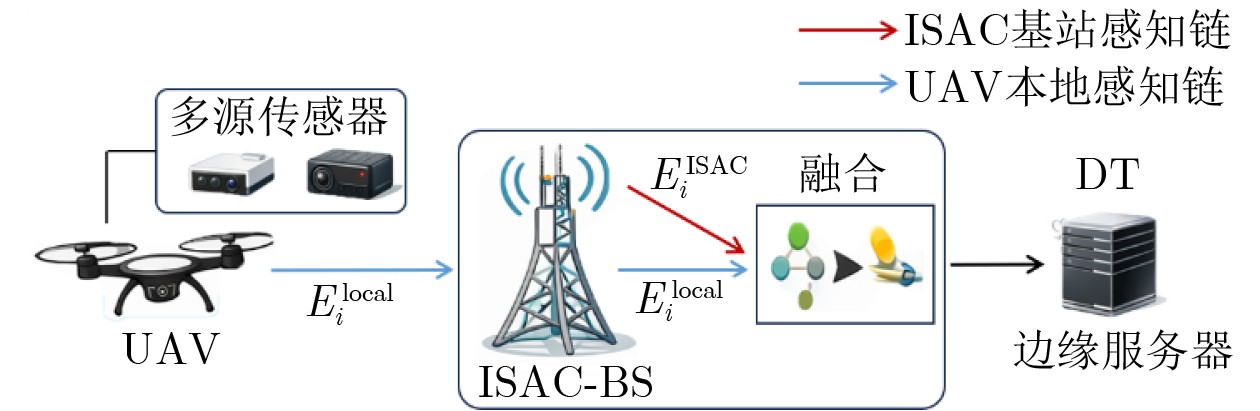
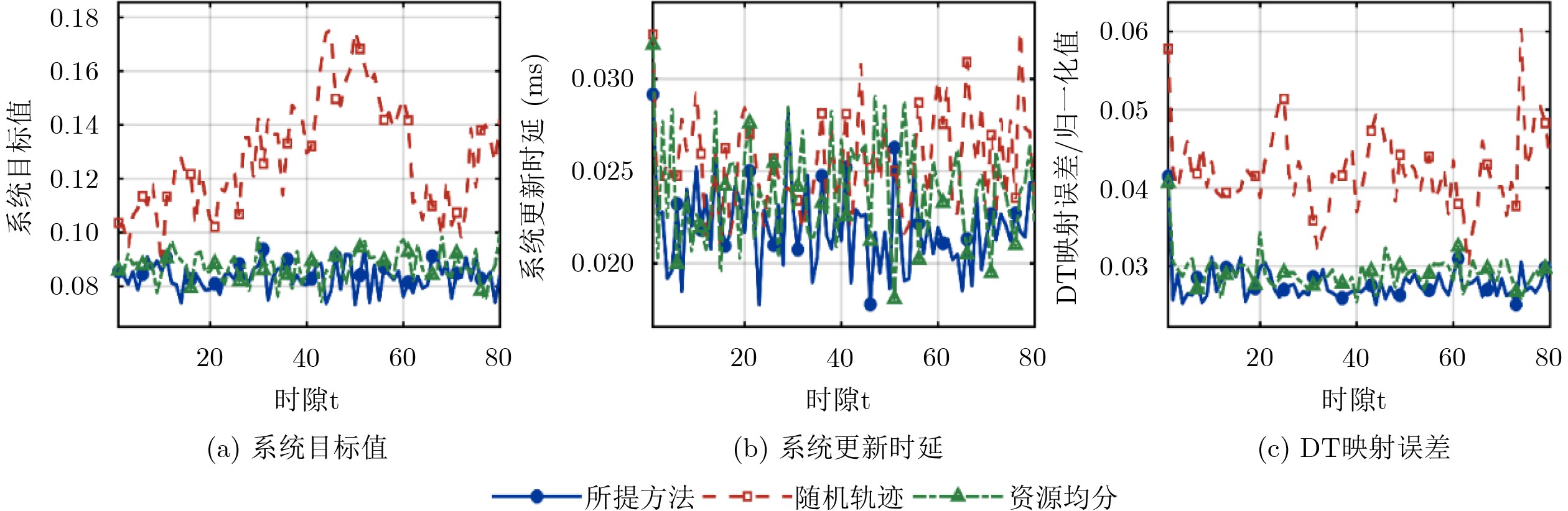
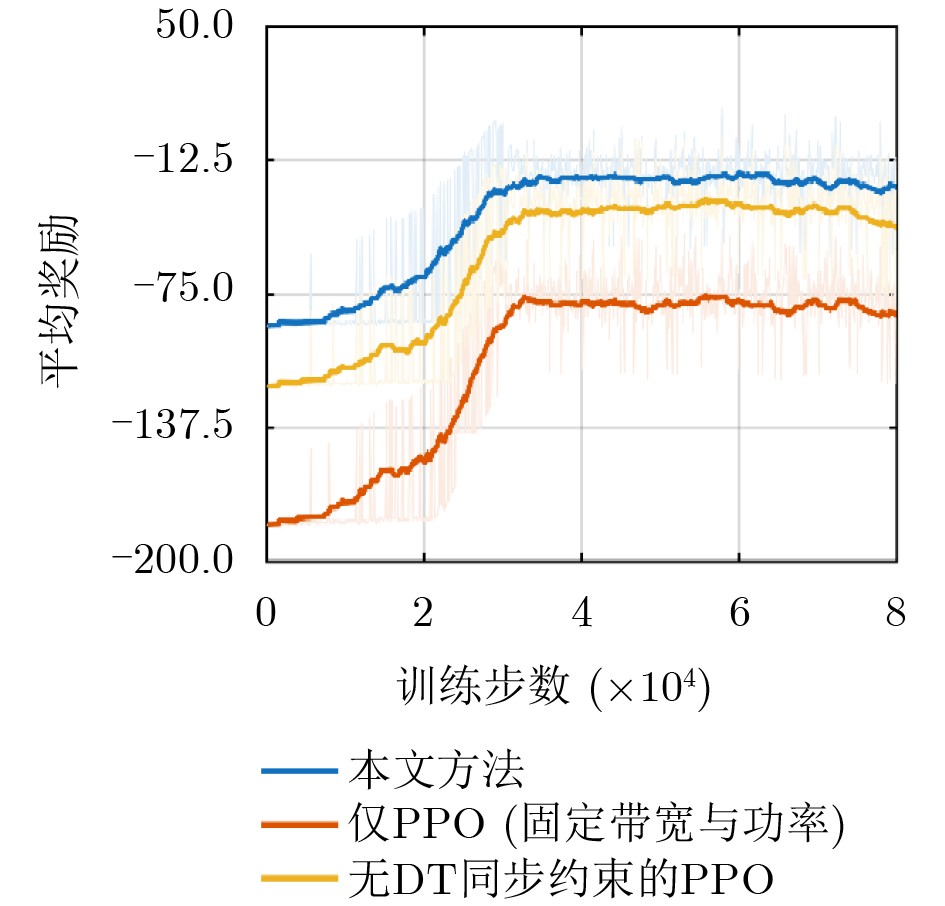
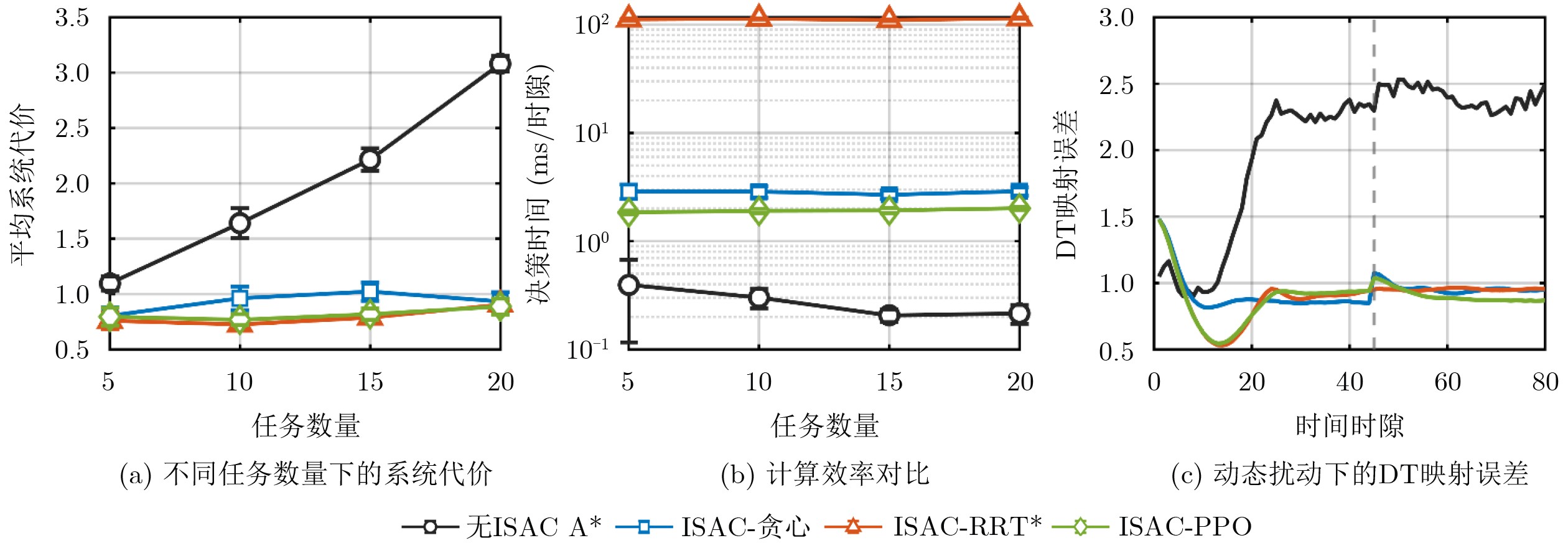
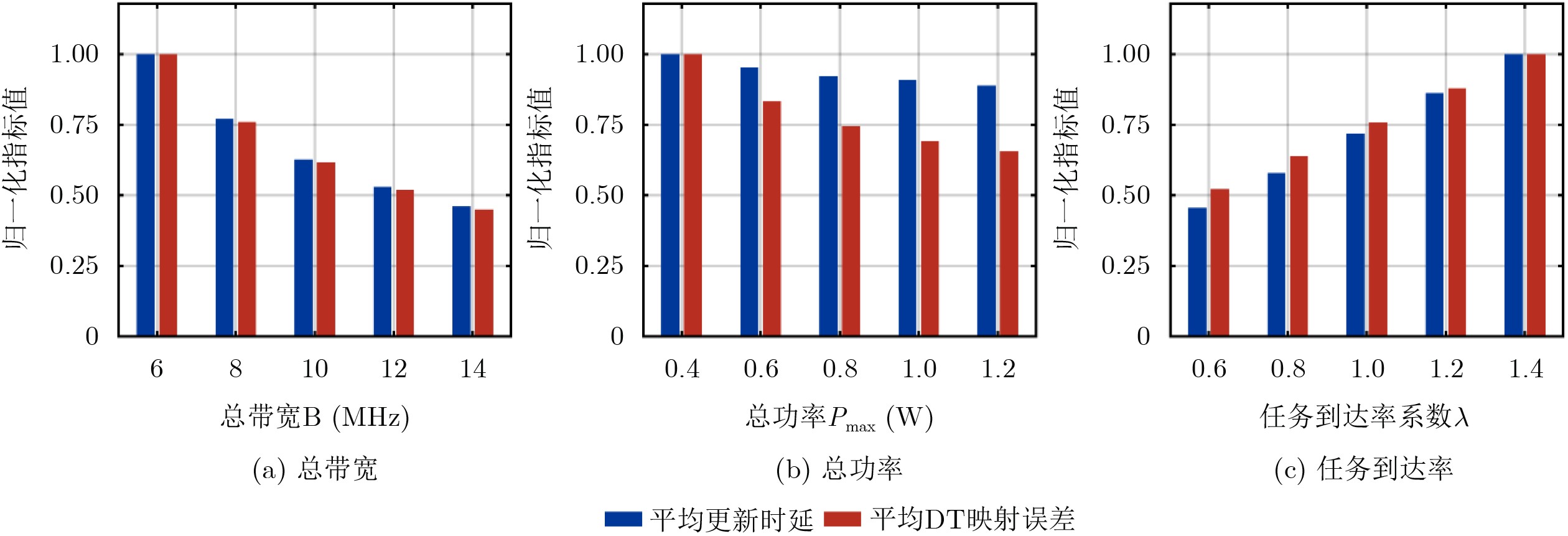
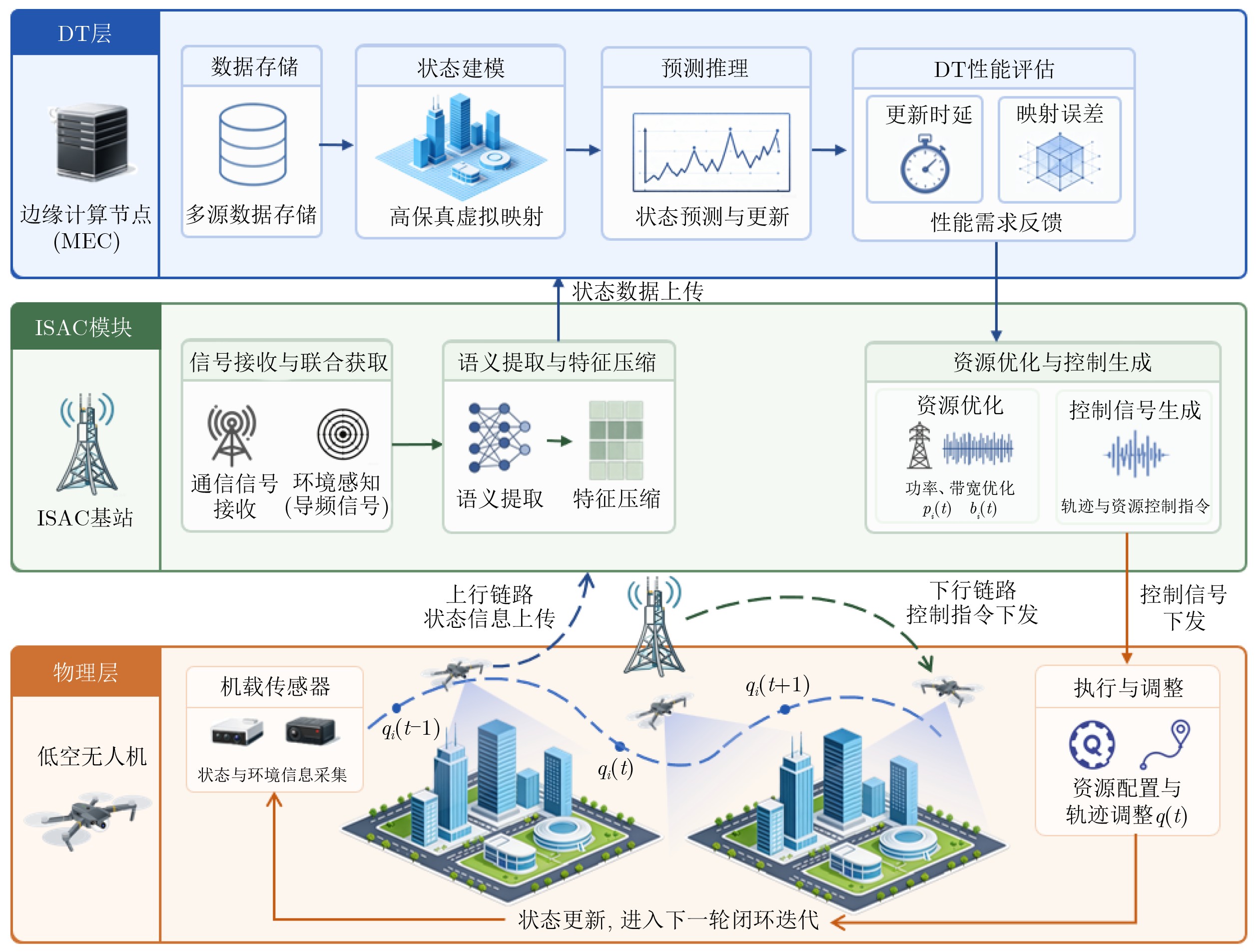
Objective With the rapid development of low-altitude intelligent networks, uncrewed aerial vehicles (UAVs) are increasingly used in inspection, logistics, and emergency response. These applications require continuous state sensing, wireless transmission, and interaction with digital twin (DT) models to support real-time decision-making. However, existing UAV DT systems generally separate sensing and communication, resulting in inefficient resource utilization, increased update latency, and limited synchronization accuracy. Integrated Sensing and Communication (ISAC) enables sensing and communication to share spectrum, transmit power, and hardware resources. Nevertheless, the coupling among UAV trajectory control, ISAC resource allocation, and DT synchronization performance remains insufficiently investigated. Therefore, this paper investigates the joint optimization of DT synchronization performance in ISAC-enabled low-altitude UAV systems. Methods An ISAC-enabled low-altitude UAV DT architecture consisting of the physical layer, ISAC module, and DT layer deployed on a mobile edge computing (MEC) server is established. Communication latency, sensing error, and DT mapping error models are developed to characterize the coupling among bandwidth allocation, transmit power, channel conditions, UAV trajectory, and synchronization performance. A joint optimization problem is formulated to minimize the long-term average DT mapping error subject to UAV mobility, wireless resource, and synchronization delay constraints. To solve the resulting non-convex problem, a collaborative framework integrating Digital Twin-aware Proximal Policy Optimization (DT-aware PPO) and Alternating Optimization (AO) is proposed. DT-aware PPO optimizes long-term UAV trajectory decisions, while the AO-based resource optimization module dynamically allocates bandwidth and transmit power at each time slot. The resulting DT synchronization performance is fed back to the PPO agent to coordinate long-term trajectory control and short-term resource allocation. Results and Discussions Simulation experiments are conducted on a MATLAB-based low-altitude UAV digital twin platform under a dynamic inspection scenario. Compared with the Non-ISAC-PPO scheme, the proposed method reduces the DT mapping error from 2.009 to 1.084 and the average communication delay from 13.102 s to 3.200 s ( Fig. 4 ). Compared with the Random Trajectory and Equal Resource Allocation schemes, the proposed method achieves lower system objective value, synchronization delay, and DT mapping error by jointly optimizing UAV trajectory and wireless resources (Fig. 5 ). The average reward gradually converges during training, indicating stable learning of the DT-aware PPO policy (Fig. 6 ). Compared with Non-ISAC A*, ISAC-Greedy, and ISAC-RRT*, the proposed method achieves lower system cost, faster decision making, and improved performance recovery under dynamic disturbances (Fig. 7 ). Parameter sensitivity analysis further shows that increasing bandwidth and transmit power improves DT synchronization performance, whereas excessive task arrival rates degrade performance due to queue accumulation (Fig. 8 ).Conclusions This paper proposes a joint optimization method for DT synchronization in ISAC-enabled low-altitude UAV systems. A unified communication-sensing-DT coupling model is established to characterize the interactions among UAV trajectory, wireless resource allocation, communication latency, sensing accuracy, and DT synchronization performance. A collaborative framework integrating DT-aware PPO and AO-based resource allocation is developed for long-term trajectory control and short-term resource allocation. Simulation results demonstrate that the proposed method effectively reduces DT mapping error and communication latency while maintaining stable learning and a certain degree of adaptability to dynamic disturbances. -
表 1 DT-aware PPO与资源优化协同算法
输入: 系统参数、Actor网络参数 $ \theta $、Critic网络参数 $ \phi $、最大
训练回合数E。输出:优化后的无人机控制策略。 (1) 初始化Actor网络、Critic网络及资源优化模块参数; (2) for episode = 1,2,···,E do (3) 初始化无人机状态 $ {s}_{t}=\{{\boldsymbol{q}}_{t},{\boldsymbol{v}}_{t},{\boldsymbol{h}}_{t},{\boldsymbol{L}}_{t}\} $; (4) for t = 1,2,···,T do (5) 根据策略$ {\pi }_{\theta }({s}_{t}) $生成控制动作$ {a}_{t} $,并执行约束投影满足
加速度限制;(6) 根据无人机运动模型更新位置$ {\boldsymbol{q}}_{t+1}=f\left({\boldsymbol{q}}_{t},{\boldsymbol{a}}_{t}\right) $; (7) 固定无人机轨迹$ {\boldsymbol{q}}_{t} $,求解通信感知资源优化问题(式14); (8) 根据资源配置结果计算DT同步性能 $ {E}^{\text{DT}}(t) $ 与
$ {T}^{\text{DT}}(t) $;(9) 根据DT同步反馈计算奖励(式18); (10) 更新Actor-Critic网络。 (11) end for (12) end for (13) return优化后的飞行控制策略  下载: 导出CSV
表 2 仿真参数
参数名称 符号 数值 参数名称 符号 数值 无人机数量 N 3 时隙长度 $ {\varDelta }t $ 1 s 无人机飞行高度 H 100 m 任务到达率 λ 默认1.0 无人机最大飞行速度 $ {V}_{\max } $ 30 m/s 本地感知误差方差 $ \sigma _{\text{local}}^{2} $ 0.05 无人机最大加速度[13] $ {a}_{\max } $ 5 m/$ {s}^{2} $ 状态漂移率系数 $ {\alpha }_{i} $ 0.1 载波频率[7] $ {f}_{c} $ 2.4GHz 最大允许同步时延 $ {T}_{\max } $ 8s 参考距离信道增益[1] $ {\beta }_{0} $ -30dB 单个任务数据量 $ {D}_{\text{task}} $ 1 Mbit 路径损耗指数[14] ζ 2.2 正惩罚系数 $ {C}_{\text{penalty}} $ 100 噪声功率谱密度[14] $ {N}_{0} $ –174 dBm/Hz PPO训练参数 $ \gamma ,{\lambda }_{\text{GAE}},{\epsilon }_{\text{clip}} $ 0.99,0.95,0.2 系统总带宽 B 默认10 MHz 系统最大发射功率 $ {P}_{\max } $ 默认0.8 W
下载: 导出CSV
-
[1] 王云涛, 苏洲, 高源, 等. 低空智联网架构、安全与优化关键技术[J]. 电子与信息学报, 2026, 48(3): 889–913. doi: 10.11999/JEIT250947.WANG Yuntao, SU Zhou, GAO Yuan, et al. Key technologies for low-altitude intelligent networks: Architecture, security, and optimization[J]. Journal of Electronics & Information Technology, 2026, 48(3): 889–913. doi: 10.11999/JEIT250947. [2] XU Youzhi, SUN Yi, SHEN Huan, et al. Development of a digital twin system for inspection UAV in fusion reactors[J]. Nuclear Engineering and Technology, 2025, 57(12): 103826. doi: 10.1016/j.net.2025.103826. [3] VALENCIA E, TOAPANTA F, OÑA G, et al. An open-source UAV digital twin framework: A case study on remote sensing in the Andean mountains[J]. Journal of Intelligent & Robotic Systems, 2025, 111(2): 71. doi: 10.1007/s10846-025-02276-7. [4] YUAN Jieting, LI Lanhua, GONG Shimin, et al. Digital twin enabled simultaneous learning and modeling for UAV-assisted secure wireless sensing in unknown environment[C]. ICC 2025 - IEEE International Conference on Communications, Montreal, Canada, 2025: 1524–1529. doi: 10.1109/ICC52391.2025.11161977. [5] BAE C, CHOI E, KANG S, et al. Digital twin platform for real-time data communication in UAV environment[J]. Future Generation Computer Systems, 2026, 175: 108078. doi: 10.1016/j.future.2025.108078. [6] AN D, JOO H, and KIM H. Enabling low-latency digital twins for large-scale UAV networks using MQTT-based communication framework[J]. ICT Express, 2025, 11(2): 264–269. doi: 10.1016/j.icte.2025.01.001. [7] BAE C, CHOI E, KANG S, et al. Digital twin platform for real-time data communication in UAV environment[J]. Future Generation Computer Systems, 2026, 175: 108078. doi: 10.1016/j.future.2025.108078. [8] 王嘉琳, 孙语瞳, 于力, 等. 数字孪生信道赋能低空智联网的高可靠通信: 框架和关键技术[J]. 移动通信, 2026, 50(2): 81–89. doi: 10.3969/j.issn.1006-1010.20251208-0001.WANG Jialin, SUN Yutong, YU Li, et al. Digital twin channel empowering high-reliability communication for low-altitude intelligent networks: Framework and technologies[J]. Mobile Communications, 2026, 50(2): 81–89. doi: 10.3969/j.issn.1006-1010.20251208-0001. [9] 王新奕, 费泽松, 周一青, 等. 面向物联网的通感算智融合: 关键技术与未来展望[J]. 电子与信息学报, 2025, 47(4): 888–908. doi: 10.11999/JEIT240806.WANG Xinyi, FEI Zesong, ZHOU Yiqing, et al. Integrated sensing, communication, computation, and intelligence towards IoT: Key technologies and future directions[J]. Journal of Electronics & Information Technology, 2025, 47(4): 888–908. doi: 10.11999/JEIT240806. [10] 李松, 李顺, 王博文, 等. 数字孪生边缘网络端到端时延优化的任务卸载与资源分配方法[J]. 电子与信息学报, 2025, 47(3): 633–644. doi: 10.11999/JEIT240344.LI Song, LI Shun, WANG Bowen, et al. Task offloading and resource allocation method for end-to-end delay optimization in digital twin edge networks[J]. Journal of Electronics & Information Technology, 2025, 47(3): 633–644. doi: 10.11999/JEIT240344. [11] 李斌, 杨蓉蓉. 无人机辅助反向散射通信计算任务卸载与资源分配[J]. 电子与信息学报, 2023, 45(7): 2334–2341. doi: 10.11999/JEIT221062.LI Bin and YANG Rongrong. Computing task offloading and resource allocation in UAV-enabled backscatter communications[J]. Journal of Electronics & Information Technology, 2023, 45(7): 2334–2341. doi: 10.11999/JEIT221062. [12] HUANG Zhe, WAN Yubo, LIU An, et al. From Cramér–Rao to Barankin: Fundamental trade-off in OFDM integrated sensing and communication systems[J]. IEEE Journal on Selected Areas in Communications, 2026, 44: 62–75. doi: 10.1109/JSAC.2025.3612931. [13] 王侃, 曹铁林, 李旭杰, 等. 无人机辅助边缘计算网络轨迹规划与资源分配研究综述[J]. 电子与信息学报, 2025, 47(5): 1266–1281. doi: 10.11999/JEIT241071.WANG Kan, CAO Tielin, LI Xujie, et al. A survey on trajectory planning and resource allocation in unmanned aerial vehicle-assisted edge computing networks[J]. Journal of Electronics & Information Technology, 2025, 47(5): 1266–1281. doi: 10.11999/JEIT241071. [14] 颜志, 陆元媛, 丁聪, 等. 面向用户移动场景的无人机中继功率分配与轨迹设计[J]. 电子与信息学报, 2024, 46(5): 1896–1907. doi: 10.11999/JEIT231337.YAN Zhi, LU Yuanyuan, DING Cong, et al. Power allocation and trajectory design for unmanned aerial vehicle relay network with mobile users[J]. Journal of Electronics & Information Technology, 2024, 46(5): 1896–1907. doi: 10.11999/JEIT231337. [15] DOU Chenglong, HUANG Ning, WU Yuan, et al. Channel sharing aided integrated sensing and communication: An energy-efficient sensing scheduling approach[J]. IEEE Transactions on Wireless Communications, 2024, 23(5): 4802–4814. doi: 10.1109/TWC.2023.3322680. [16] HU Shisheng, GAO Jie, QIN Xue, et al. Drift-adaptive slicing-based resource management for cooperative ISAC networks[J]. IEEE Transactions on Cognitive Communications and Networking, 2026, 12: 2631–2646. doi: 10.1109/TCCN.2025.3584934. [17] WU Mengru, WU Haonan, LU Weidang, et al. Security-aware designs of multi-UAV deployment, task offloading and service placement in edge computing networks[J]. IEEE Transactions on Mobile Computing, 2025, 24(10): 11046–11060. doi: 10.1109/TMC.2025.3574061. [18] WU Mengru, WU Haonan, LU Weidang, et al. Energy-constrained multidimensional optimization for UAV-aided secure data collection with cooperative jamming[J]. IEEE Transactions on Vehicular Technology, 2025, 74(12): 18529–18542. doi: 10.1109/TVT.2025.3586655. [19] 邱显宜, 文锦柏, 康嘉文, 等. 面向车载元宇宙智能孪生体全局迁移的可靠服务链选择方案[J]. 电子与信息学报, 2026, 48(2): 673–685. doi: 10.11999/JEIT250612.QIU Xianyi, WEN Jinbo, KANG Jiawen, et al. A reliable service chain option for global migration of intelligent twins in vehicular metaverses[J]. Journal of Electronics & Information Technology, 2026, 48(2): 673–685. doi: 10.11999/JEIT250612. [20] 闫莉, 岳涛, 方旭明. 铁路应急场景下无人机通信感知一体化无线网络资源智能分配算法[J]. 电子与信息学报, 2024, 46(9): 3510–3519. doi: 10.11999/JEIT240254.YAN Li, YUE Tao, and FANG Xuming. Intelligent wireless resource allocation algorithm for unmanned aerial vehicle integrated communication and sensing networks in railway emergency scenarios[J]. Journal of Electronics & Information Technology, 2024, 46(9): 3510–3519. doi: 10.11999/JEIT240254. -

 下载:

图(8) / 表(2)
计量
- 文章访问数: 19
- HTML全文浏览量: 4
- PDF下载量: 1
- 被引次数: 0
