




Computation and Trajectory Optimization in Multi-UAV Edge Networks under Position Uncertainty
-
摘要: 针对无人机边缘计算网络实际部署中无人机轨迹扰动和用户位置误差导致空地链路状态不确定、任务传输与计算开销增加的问题,该文提出一种融合语义提取机制的多无人机协同辅助计算卸载与轨迹优化方法。首先,通过联合优化无人机轨迹、任务执行变量、语义提取因子和计算资源分配,构建以系统加权平均能耗最小化为目标的网络模型。其次,针对该问题的非凸性和场景动态性,将其分解为无人机轨迹控制及卸载决策与资源配置两个子问题,分别采用软演员-评论家算法和交替优化方法求解。仿真结果表明,与基线方案相比,所提方法系统能耗最高降低约32.0%,其中相较于无语义提取方案降低约10.7%,并在不确定环境下表现出良好的稳定性与鲁棒性。Abstract:
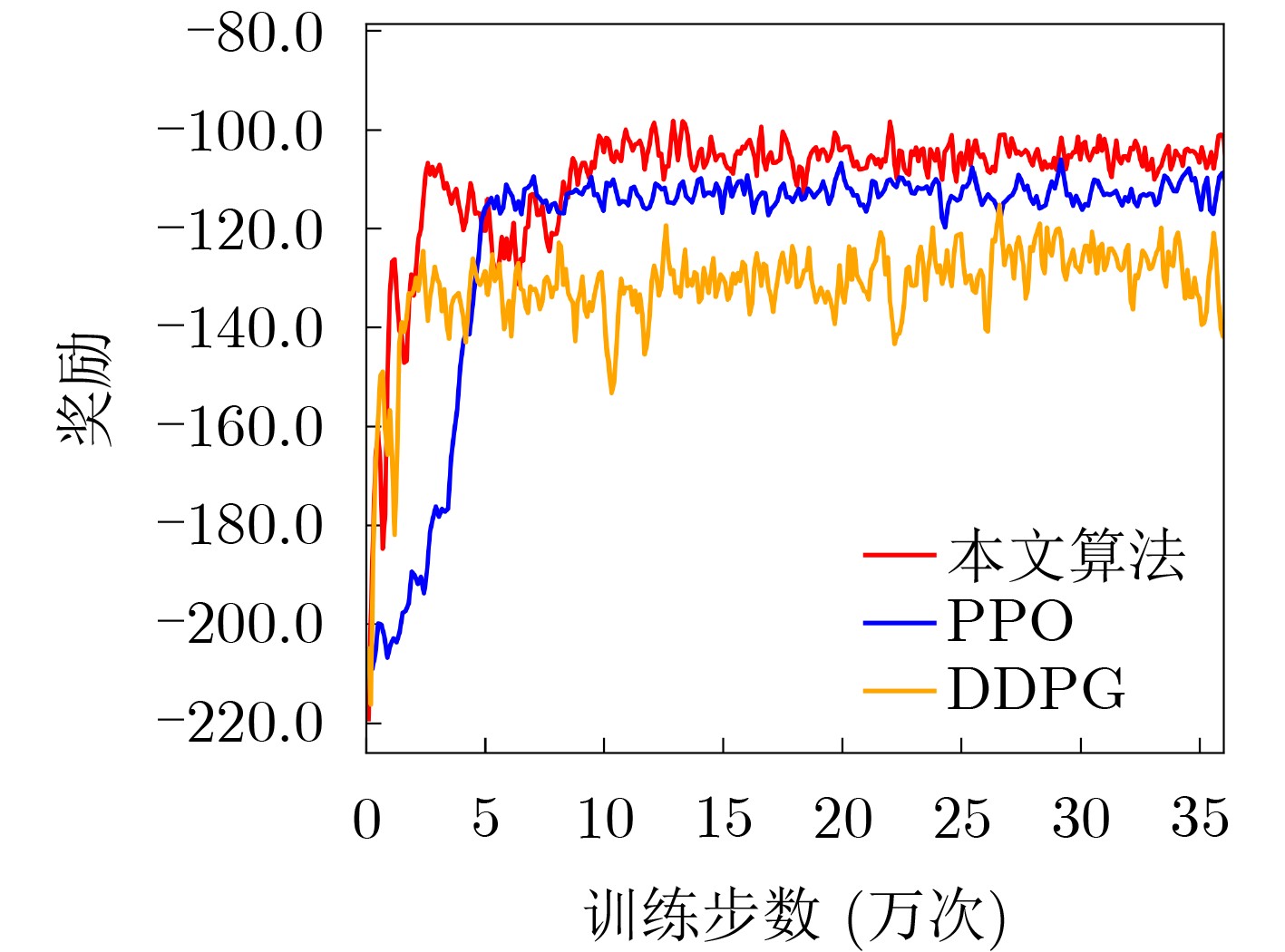
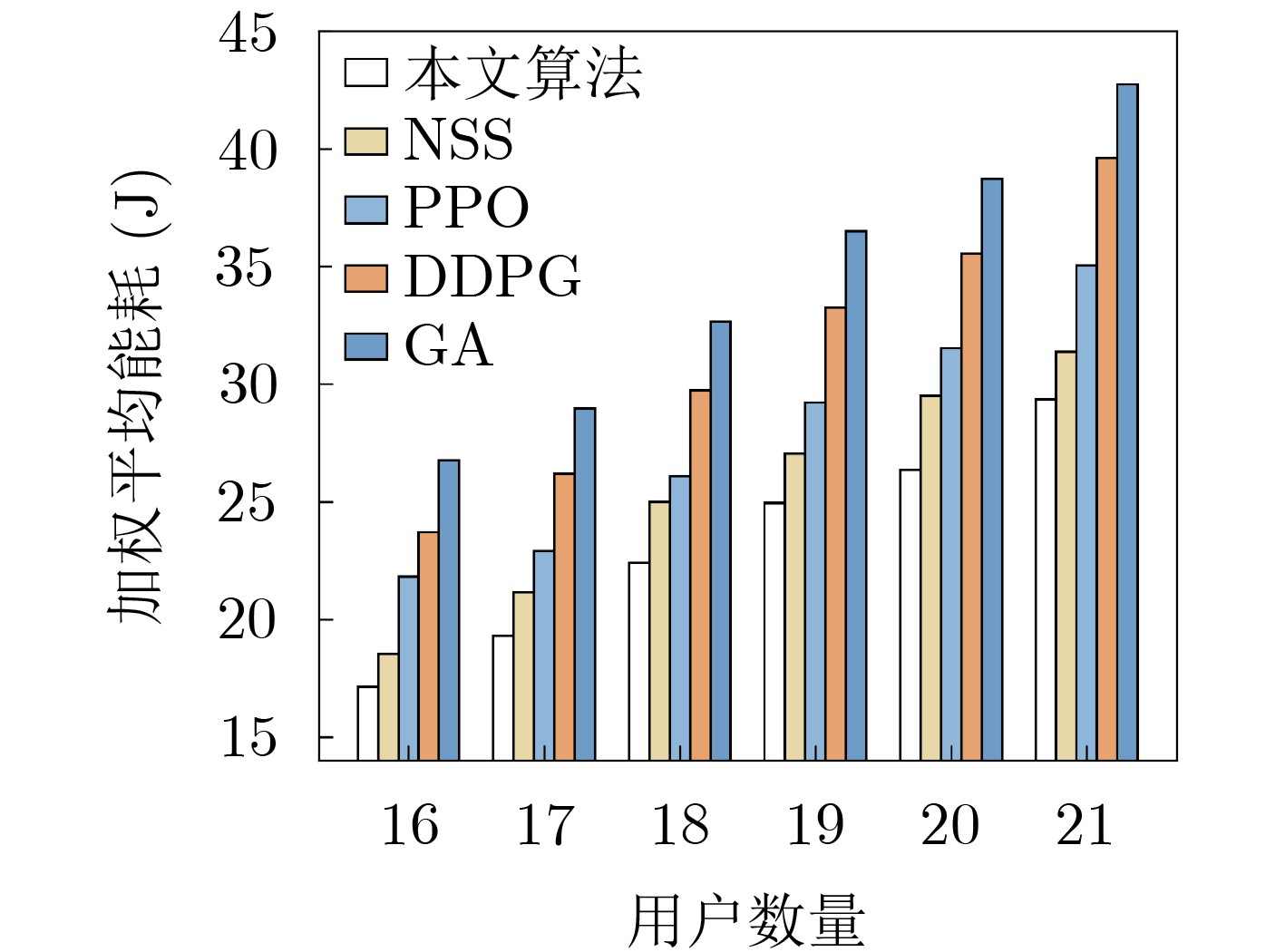
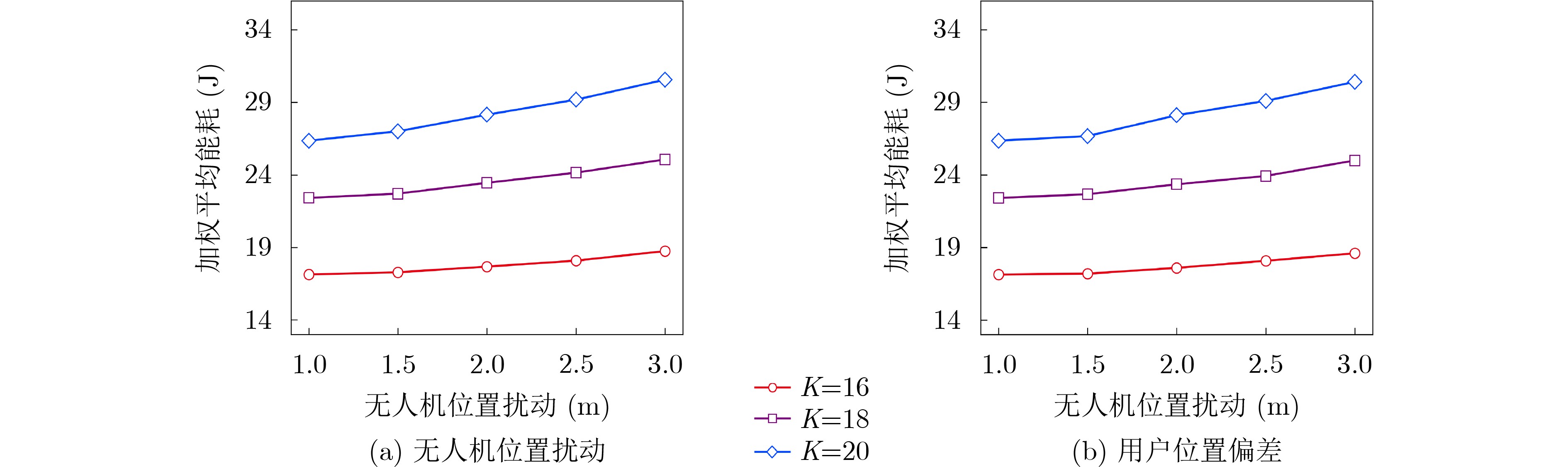
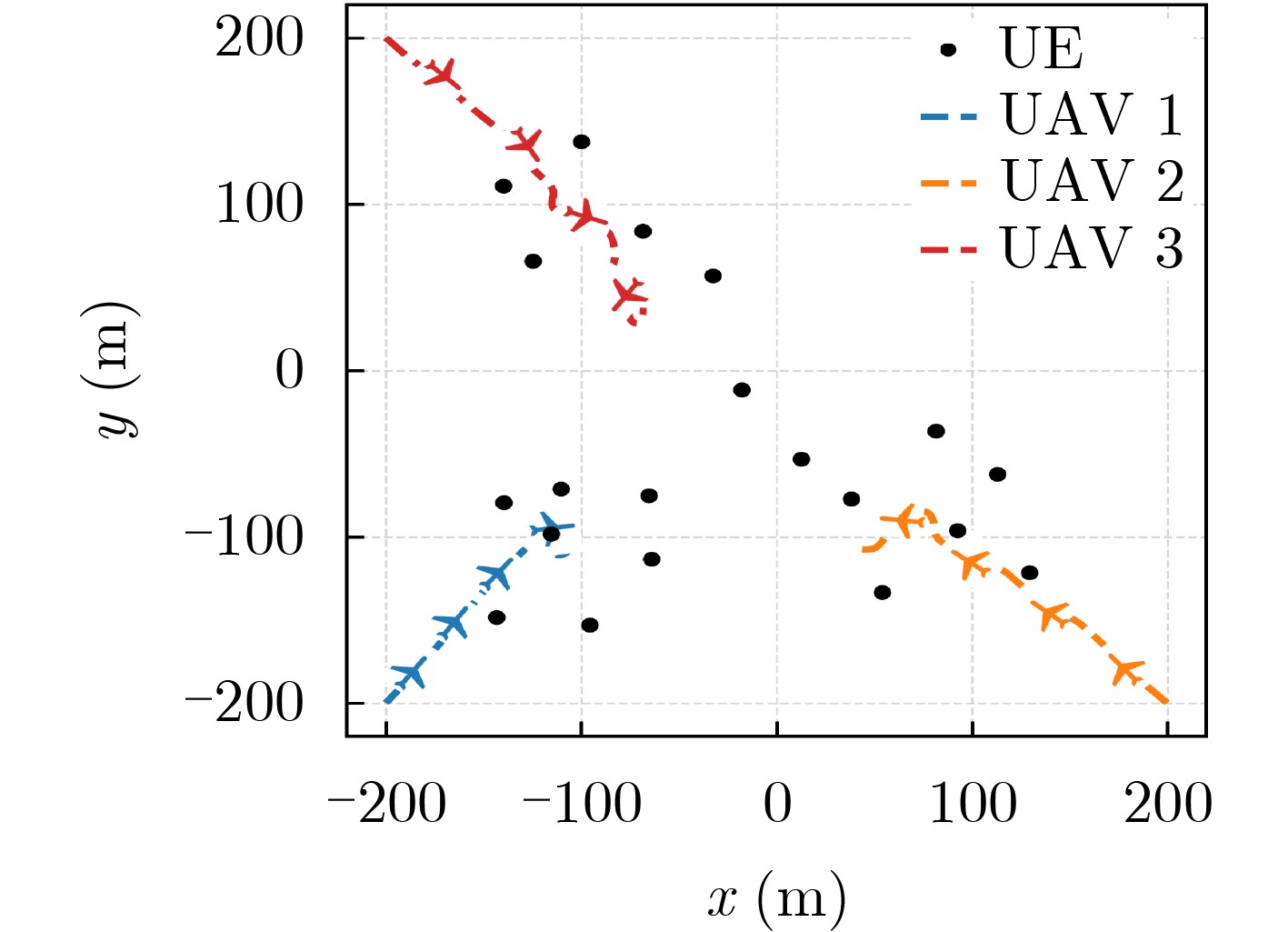
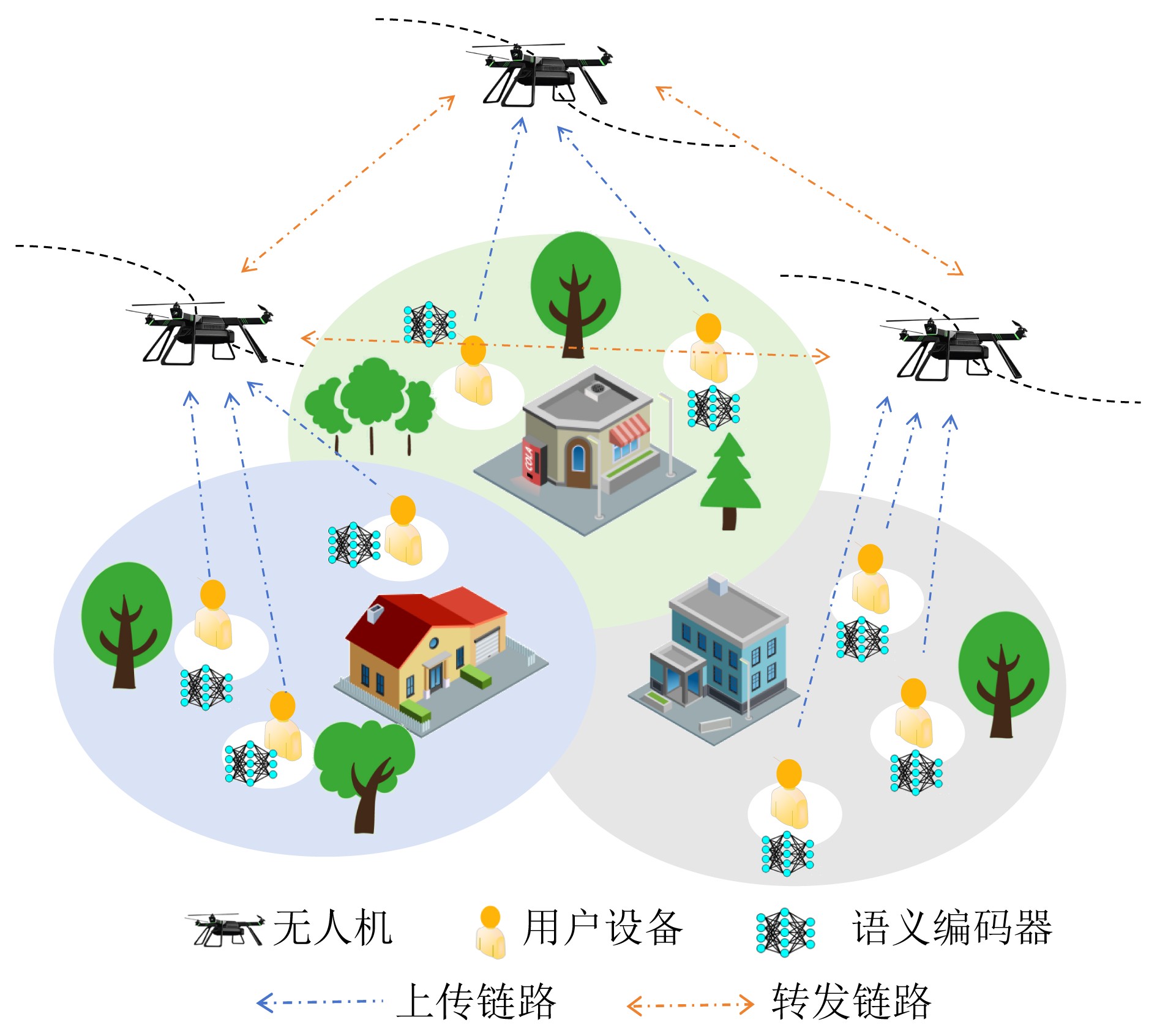
Objective Unmanned Aerial Vehicle (UAV)-assisted Mobile Edge Computing (MEC) networks provide flexible computing services for user equipment. However, existing methods are generally optimized based on ideal position information and complete task data processing, making it difficult to effectively control transmission and computation overhead under UAV trajectory perturbations and user position uncertainties. To address these issues, semantic extraction is introduced, and an energy optimization problem under position uncertainty is investigated for multi-UAV cooperative MEC networks. Methods The non-convex energy minimization problem considering location uncertainty is decomposed into two coupled subproblems, namely UAV trajectory control and computation offloading-resource optimization. For the first subproblem, SAC is adopted to learn a continuous UAV control policy under location uncertainty. For the second subproblem, given the UAV positions, the task-upload UAV for each user is determined according to the predefined distance-based access rule. The continuous variables are then optimized using convex-optimization methods, while the task-execution variables are updated user by user via coordinate descent, resulting in the offloading decision and resource optimization algorithm (Algorithm 1). Algorithm 1 is further integrated with SAC to form the overall solution procedure (Algorithm 2). Results and Discussions The performance of the proposed scheme is evaluated through simulations. The reward convergence results show that the proposed SAC-based method achieves higher rewards and better convergence stability than DDPG and PPO algorithms ( Fig. 2 ). For system energy consumption, the proposed scheme consistently achieves lower weighted average energy consumption under different user numbers compared with PPO, DDPG, GA, and the non-semantic scheme, confirming the effectiveness of semantic extraction in reducing task processing overhead (Fig. 3 ). The robustness against UAV position perturbations and user location deviations is further validated, where the energy consumption increases only slightly with increasing uncertainty levels (Fig. 4 ). The trajectory visualization results indicate that the UAVs can adjust their flight paths according to user distributions and achieve coordinated coverage, thereby improving energy efficiency in multi-UAV networks (Fig. 5 ).Conclusions An energy optimization scheme is proposed for UAV edge computing scenarios under position uncertainty, where semantic extraction is incorporated to reduce communication and computation overhead. The original optimization problem is divided into two parts, namely UAV trajectory control and task offloading with resource allocation, and solved by combining SAC with alternating optimization. Simulation results show that the proposed scheme maintains relatively stable performance under UAV position perturbations and user location deviations, demonstrating its effectiveness and robustness. -
1 卸载决策与资源优化算法
(1) 初始化卸载决策$ {\boldsymbol{X}}^{\left(0\right)} $,语义提取因子$ {\boldsymbol{\phi }}^{\left(0\right)} $; (2) 设定最大迭代次数$ {I}_{\max } $和收敛阈值$ {\varepsilon }_{\phi } $,令$ r=0 $; (3) 根据接入规则确定各用户任务上传节点; (4) repeat (5) for 每个用户$ k $ do (6) for 每个候选执行位置$ m\in {{\mathcal{M}}}^{+} $ do (7) 令$ {x}_{k,m}[n]=1,{x}_{k,j}[n]=0,\forall j\in {\mathcal{M}}^{+}\text{,j}\neq m $; (8) 若$ m\neq 0 $根据式(34)计算对应的$ \boldsymbol{F} $; (9) 若约束满足,计算对应的系统能耗; (10) end for (11) 选择能耗最小的可行候选,更新用户$ k $的任务执行变量; (12) end for (13) 令$ l=0 $; (14) repeat (15) 根据式(34)更新$ \boldsymbol{F} $; (16) 采用CVX求解问题$ \text{P}5 $,更新$ {\boldsymbol{\phi }}^{\left(r+1\right)} $; (17) 令$ l=l+1 $; (18) until $ \left|\left|{\boldsymbol{\phi }}^{\left(l\right)}-{\phi }^{\left(l-1\right)}\right|\right|\leq {\varepsilon }_{\boldsymbol{\phi }} $ (19) 令$ {\boldsymbol{\phi }}^{\left(r+1\right)}={\boldsymbol{\phi }}^{\left(l\right)} $,$ r=r+1$; (20) until $ {\boldsymbol{X}}^{\left(r\right)}={\boldsymbol{X}}^{\left(r-1\right)} $或 $ r\geq {I}_{\max } $  下载: 导出CSV
2 基于SAC的整体求解算法
(1) 初始化环境、经验回放缓冲区及 SAC 网络参数; (2) 对每个训练周期执行: (3) 对每个环境交互步骤执行: (4) 根据策略分布$ {\pi }_{\theta }({a}_{n}|{s}_{n}) $采样动作$ {a}_{n} $; (5) 执行动作$ {a}_{n} $,更新无人机位置; (6) 调用算法1,获得卸载决策与资源优化结果; (7) 获得奖励$ {r}_{n} $,并观测下一状态$ {s}_{n+1} $; (8) 将状态转移元组$ ({s}_{n},{a}_{n},{r}_{n},{s}_{n+1}) $存入经验回放池$ D $; (9) 对每个梯度更新步骤执行: (10) 从$ D $中随机采样一批经验样本; (11) 更新 Critic 网络、Actor 网络和温度系数; (12) 对目标 Critic 网络进行软更新;
下载: 导出CSV
表 1 参数设置
参数 设置 参数 设置 桨叶叶尖速度$ {U}_{\text{tip}} $ 120 m/s 叶片功率$ {P}_{0} $ 59.03 W 悬停功率$ {P}_{1} $ 79.07 W 旋翼速度$ {v}_{0} $ 3.6 m/s 旋翼面积$ A $ 0.5030 m2无人机最大飞行速度$ {v}_{\text{max}} $ 20 m/s 无人机最低高度$ {z}_{\min } $ 100 m 无人机最高高度$ {z}_{\max } $ 150 m 用户总带宽$ {B}_{1} $ 20 MHz 无人机带宽$ {B}_{2} $ 3 MHz 用户设备计算能力$ {F}_{k} $ 1.5 GHz 无人机最大计算能力$ F_{\mathrm{m}}^{\text{max}} $ 30 GHz 无人机最小安全距离$ {d}_{\text{min}} $ 5 m 信道高斯白噪声功率$ {\sigma }^{2} $ –100 dBm
下载: 导出CSV
-
[1] 王侃, 曹铁林, 李旭杰, 等. 无人机辅助边缘计算网络轨迹规划与资源分配研究综述[J]. 电子与信息学报, 2025, 47(5): 1266–1281. doi: 10.11999/JEIT241071.WANG Kan, CAO Tielin, LI Xujie, et al. A survey on trajectory planning and resource allocation in unmanned aerial vehicle-assisted edge computing networks[J]. Journal of Electronics & Information Technology, 2025, 47(5): 1266–1281. doi: 10.11999/JEIT241071. [2] 卢先领, 李德康. 面向大规模多接入边缘计算场景的任务卸载算法[J]. 电子与信息学报, 2025, 47(1): 116–127. doi: 10.11999/JEIT240624.LU Xianling and LI Dekang. Task offloading algorithm for large-scale multi-access edge computing scenarios[J]. Journal of Electronics & Information Technology, 2025, 47(1): 116–127. doi: 10.11999/JEIT240624. [3] LIU Wenshuai, LI Bin, XIE Wancheng, et al. Energy efficient computation offloading in aerial edge networks with multi-agent cooperation[J]. IEEE Transactions on Wireless Communications, 2023, 22(9): 5725–5739. doi: 10.1109/TWC.2023.3235997. [4] 朱政宇, 温鑫平, 李兴旺, 等. 面向低空经济的通感一体化关键技术[J]. 电子与信息学报, 2026, 48(2): 471–486. doi: 10.11999/JEIT250747.ZHU Zhengyu, WEN Xinping, LI Xingwang, et al. An overview on integrated sensing and communication for low altitude economy[J]. Journal of Electronics & Information Technology, 2026, 48(2): 471–486. doi: 10.11999/JEIT250747. [5] WANG Zhiying, WEI Tianxi, SUN Gang, et al. Multi-UAV enabled MEC networks: Optimizing delay through intelligent 3-D trajectory planning and resource allocation[J]. IEEE Transactions on Intelligent Transportation Systems, 2025, 26(11): 20897–20911. doi: 10.1109/TITS.2025.3586874. [6] XU Wenlong, ZHANG Tiankui, MU Xidong, et al. Trajectory planning and resource allocation for multi-UAV cooperative computation[J]. IEEE Transactions on Communications, 2024, 72(7): 4305–4318. doi: 10.1109/TCOMM.2024.3361536. [7] ZHAO Mingxiong, ZHANG Rongqian, HE Zhenli, et al. Joint optimization of trajectory, offloading, caching, and migration for UAV-assisted MEC[J]. IEEE Transactions on Mobile Computing, 2025, 24(3): 1981–1998. doi: 10.1109/TMC.2024.3486995. [8] LI Bin, ZHU Xiao, and WANG Junyi. Robust trajectory design and task scheduling with data compression in industrial Internet of Things assisted by UAV[J]. IEEE Internet of Things Journal, 2025, 12(9): 12501–12511. doi: 10.1109/JIOT.2024.3522127. [9] SUN Geng, WANG Yixian, SUN Zemin, et al. Multi-objective optimization for multi-UAV-assisted mobile edge computing[J]. IEEE Transactions on Mobile Computing, 2024, 23(12): 14803–14820. doi: 10.1109/TMC.2024.3446819. [10] WANG Yuhui, FAROOQ J, GHAZZAI H, et al. Joint positioning and computation offloading in multi-UAV MEC for low latency applications: A proximal policy optimization approach[J]. IEEE Transactions on Mobile Computing, 2025, 24(10): 9584–9598. doi: 10.1109/TMC.2025.3562806. [11] ZHENG Jun and LIU Kai. 3D UAV trajectory planning with obstacle avoidance for UAV-enabled time-constrained data collection systems[J]. IEEE Transactions on Vehicular Technology, 2025, 74(1): 1460–1474. doi: 10.1109/TVT.2024.3419842. [12] LI Bin, YANG Dongdong, LIU Lei, et al. Aerial RIS-enhanced communications: Joint UAV trajectory, altitude control, and phase shift design[J]. IEEE Transactions on Wireless Communications, 2026, 25: 5830–5845. doi: 10.1109/TWC.2025.3621306. [13] YANG Yinchao, ZHOU Jingxuan, YANG Zhaohui, et al. Fluid antenna-enabled near-field integrated sensing, computing, and semantic communication for emerging applications[J]. IEEE Transactions on Cognitive Communications and Networking, 2025, 11(5): 3062–3078. doi: 10.1109/TCCN.2025.3592294. [14] LIU Jiajia, LU Yunlong, WU Hao, et al. Joint task coding and transfer optimization for edge computing power networks[J]. IEEE Transactions on Network Science and Engineering, 2025, 12(4): 2783–2796. doi: 10.1109/TNSE.2025.3554100. [15] TANG Jianhang, NIE Jiangtian, BAI Jingpan, et al. UAV-assisted digital-twin synchronization with tiny-machine-learning-based semantic communications[J]. IEEE Internet of Things Journal, 2024, 11(17): 28437–28451. doi: 10.1109/JIOT.2024.3401229. [16] LIU Boyang, WAN Yiyao, ZHOU Fuhui, et al. Resource allocation and trajectory design for MISO UAV-assisted MEC networks[J]. IEEE Transactions on Vehicular Technology, 2022, 71(5): 4933–4948. doi: 10.1109/TVT.2022.3140833. [17] LIN Na, TANG Hailun, ZHAO Liang, et al. A PDDQNLP algorithm for energy efficient computation offloading in UAV-assisted MEC[J]. IEEE Transactions on Wireless Communications, 2023, 22(12): 8876–8890. doi: 10.1109/TWC.2023.3266497. -

 下载:

图(5) / 表(3)
计量
- 文章访问数: 22
- HTML全文浏览量: 3
- PDF下载量: 3
- 被引次数: 0
