




Artificial-Noise-Aided Secure Transmission Optimization Method for UAV Relay Communications
-
摘要: 无人机(UAV)凭借机动性强、成本低、易部署等优势,已成为低空通信网络中的重要研究对象,其通信安全问题也随之受到广泛关注。针对地面基站与用户直达链路受阻条件下UAV中继通信系统的物理层安全问题,该文研究一种人工噪声(AN)辅助的安全传输优化方法。首先,构建了零空间AN辅助的联合安全传输优化框架,在扰乱窃听者的同时避免对合法用户产生额外干扰。然后,以系统和保密速率最大化为目标,联合优化UAV位置、基站预编码和AN设计,实现信息传输与AN之间的空间和功率资源协同配置。针对目标问题非凸性强且优化变量高度耦合的特点,构建交替优化框架,将原问题分解为UAV位置优化子问题和基站预编码与AN联合优化子问题。依次采用多策略改进粒子群优化算法、连续凸近似和半正定松弛方法求解上述子问题。仿真结果表明,所提算法在不同条件下均优于现有的对比方案,有效提升了系统的物理层安全性能。Abstract:
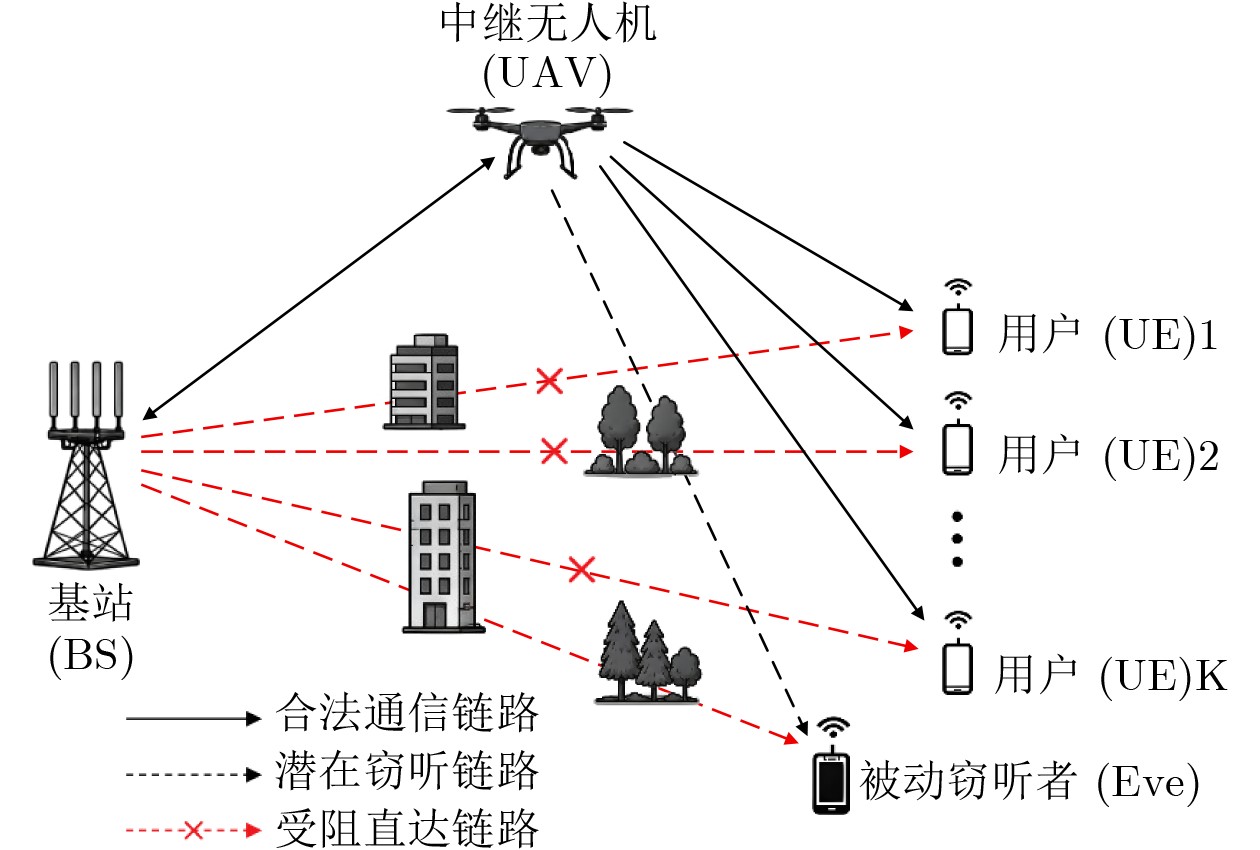
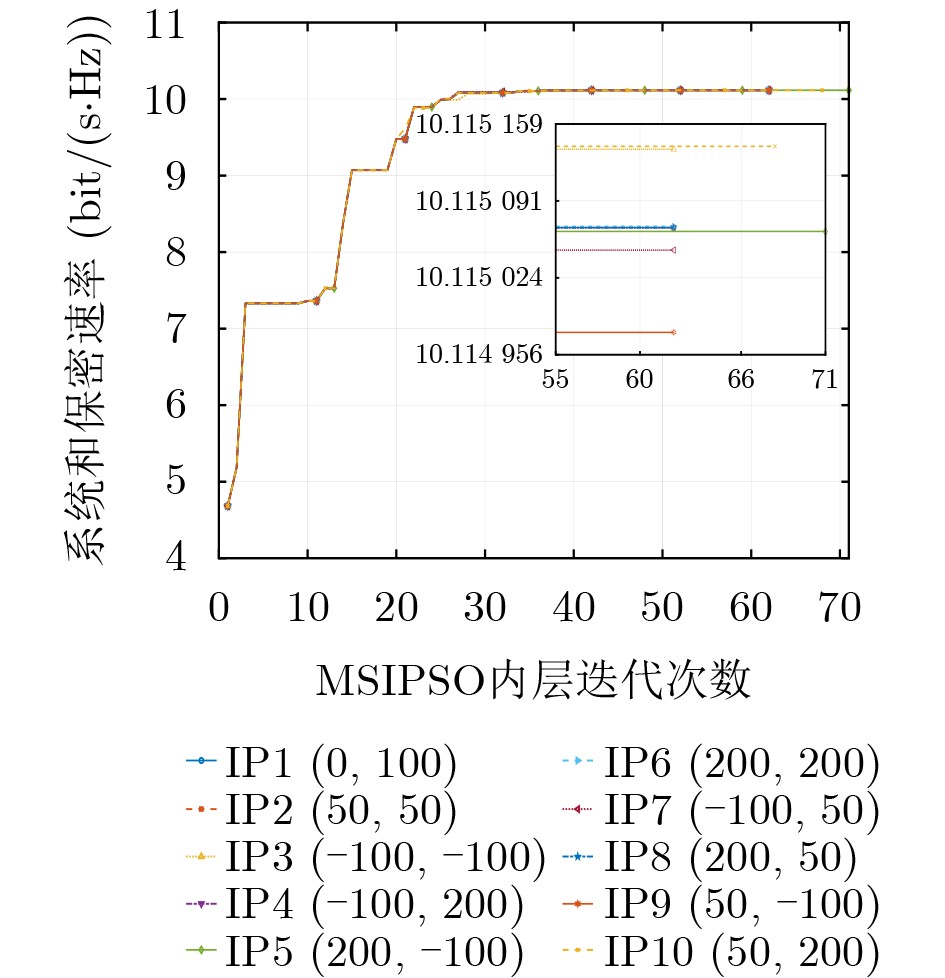
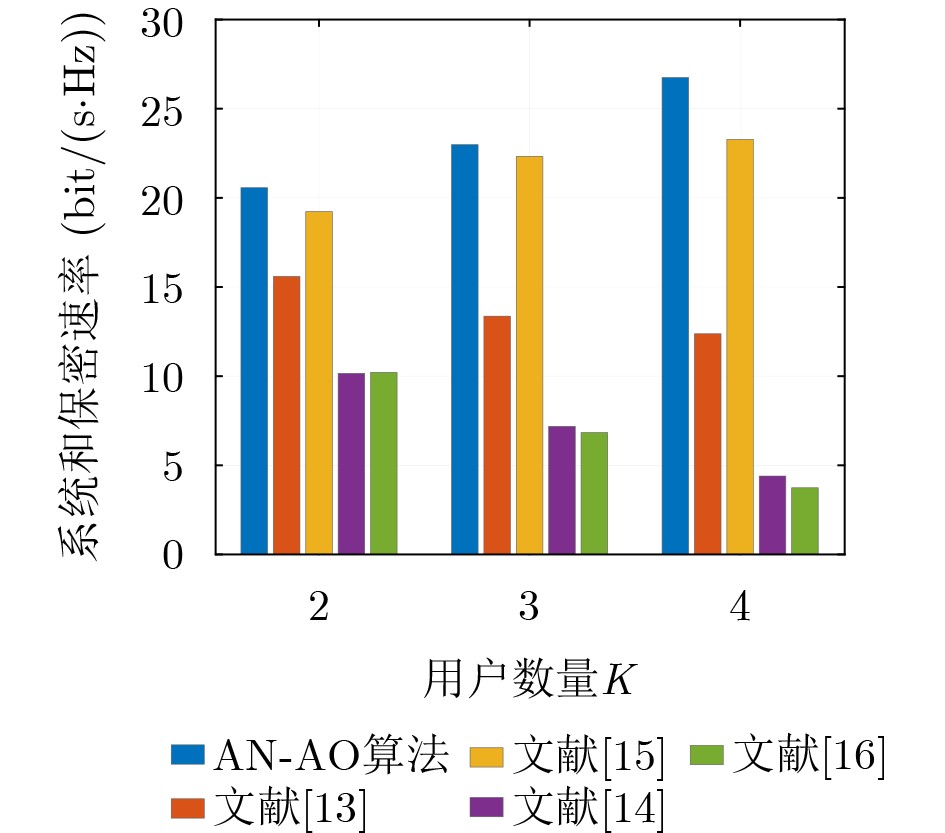
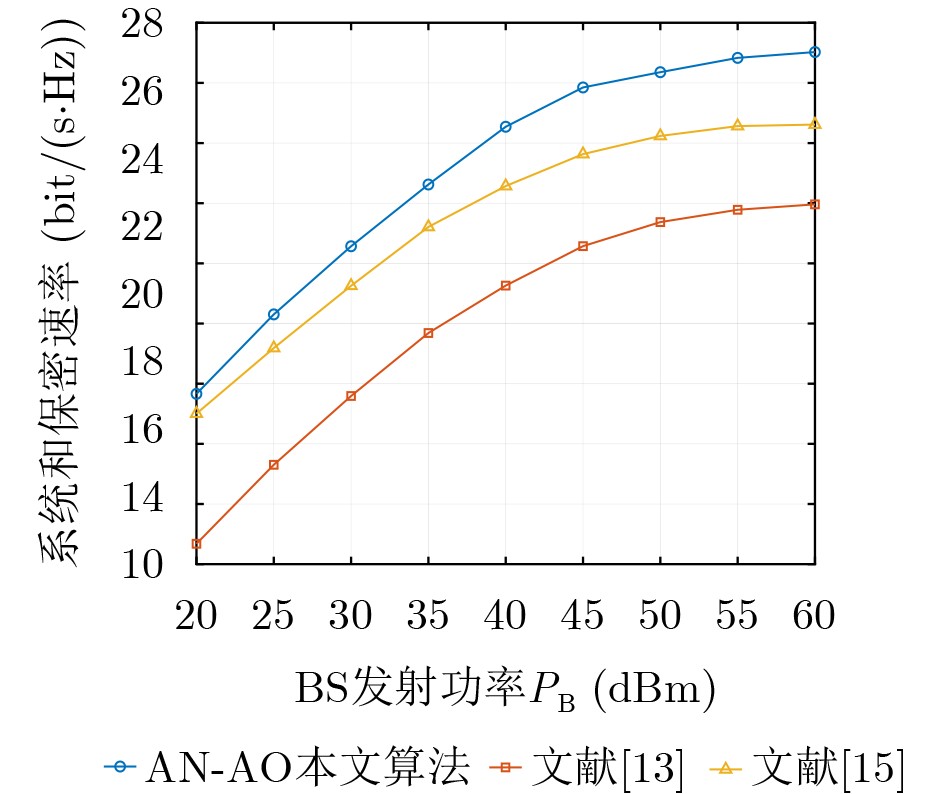
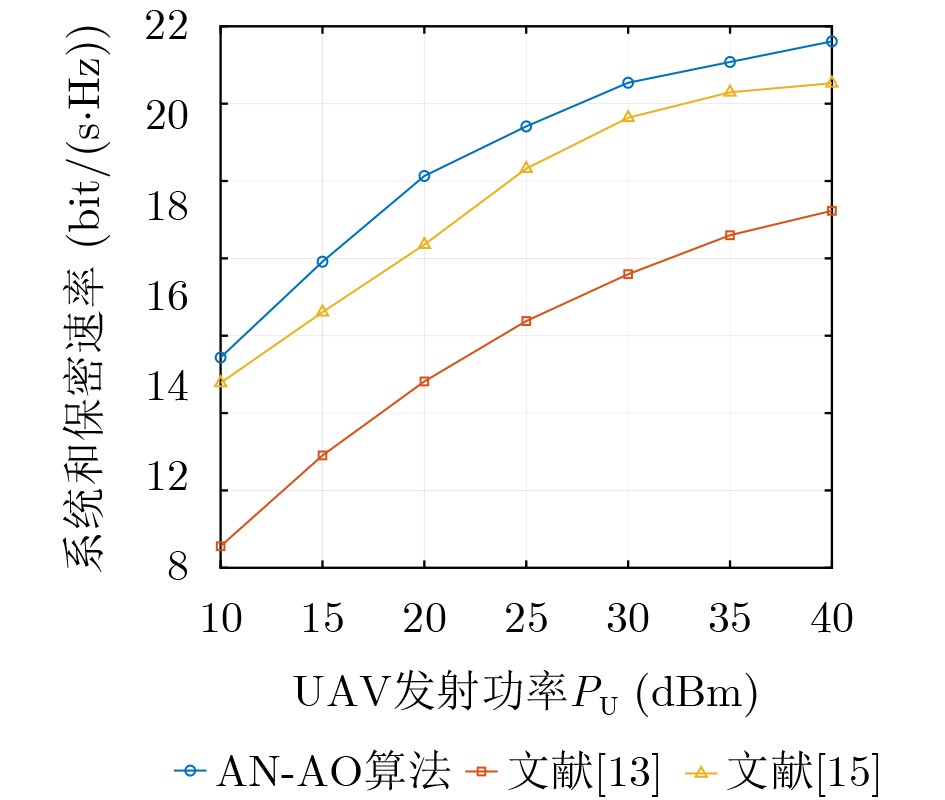
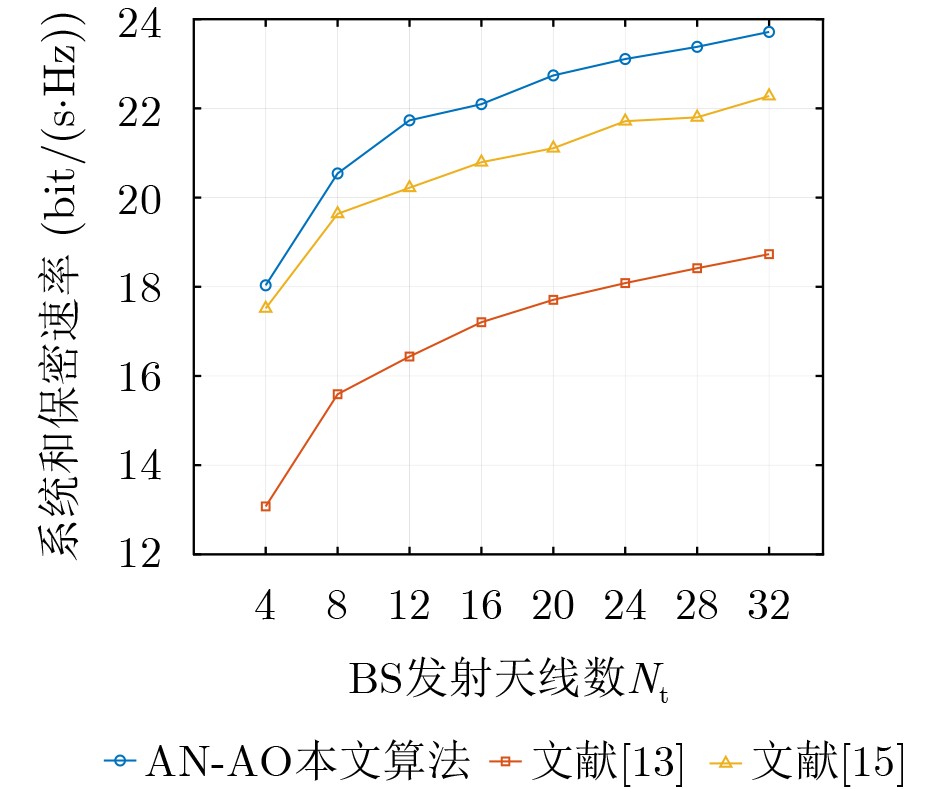
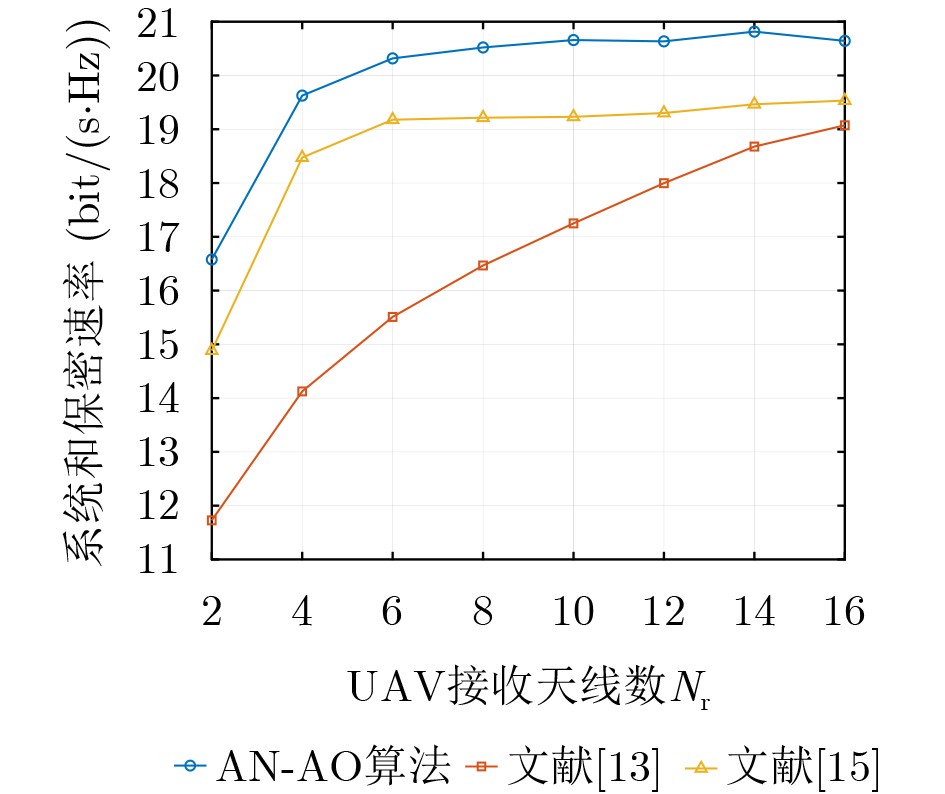
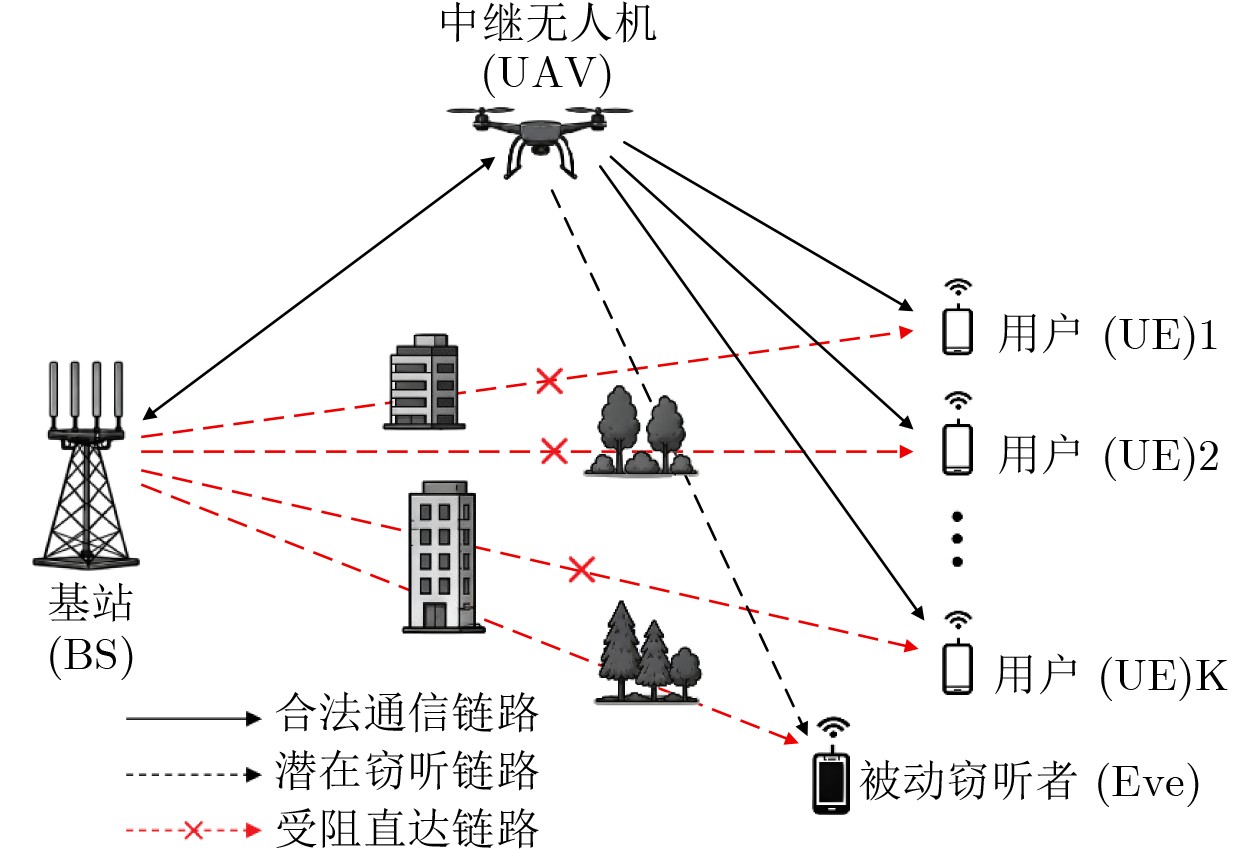
Objective When the direct links between a ground base station (BS) and the user equipments (UEs) are unavailable because of blockage, an unmanned aerial vehicle (UAV) can be deployed as an amplify-and-forward (AF) aerial relay to improve the transmission conditions between the BS and legitimate UEs. However, the predominantly line-of-sight (LoS) propagation of air–ground links may enhance not only the legitimate links but also the signal reception at an eavesdropper, thereby increasing the risk of information leakage. Existing studies on physical-layer security in UAV relay communications have primarily focused on single-user or single-antenna scenarios, whereas joint interference management and secure transmission in multi-user multi-antenna systems remain insufficiently investigated. Moreover, only subsets of the design variables are typically jointly optimized, and the coupling among UAV placement, information transmission, and jamming resource allocation has not been adequately addressed. Therefore, an artificial-noise-aided secure transmission optimization method is proposed for UAV relay communications. Null-space artificial-noise (AN) is designed, and the UAV position, BS precoding, and AN are jointly optimized to maximize the system sum secrecy rate. Methods A secure UAV relay communication model is established, consisting of a ground BS, a UAV relay, multiple legitimate UEs, and one passive eavesdropper, denoted as Eve. The direct links between the BS and all ground nodes are assumed to be unavailable. The UAV moves at a fixed altitude and employs an ideal full-duplex scalar AF protocol. The BS transmits information through linear precoding while simultaneously injecting AN to suppress the eavesdropping link. To eliminate the direct interference caused by AN to the legitimate UEs, the AN is projected onto the null space of the cascaded channels associated with the legitimate UEs. A joint optimization problem involving the UAV position, BS precoding, and AN design is then formulated to maximize the system sum secrecy rate. Because the optimization variables are highly coupled and the resulting problem is nonconvex, an alternating optimization (AO) framework is developed. The original problem is decomposed into a UAV position optimization subproblem and a joint BS precoding and AN design subproblem. For the UAV position optimization subproblem, a multi-strategy improved particle swarm optimization (MSIPSO) algorithm is employed to determine a near-optimal hovering position. For the joint BS precoding and AN design subproblem, successive convex approximation (SCA) and semidefinite relaxation (SDR) are applied to transform the nonconvex objective function and constraints into tractable convex forms. The resulting problem is solved iteratively to obtain a feasible approximate solution that satisfies the system constraints. Results and Discussions The simulation results demonstrate that the proposed algorithm achieves a higher system sum secrecy rate than the benchmark schemes, including the fixed-UAV-position scheme, the scheme without AN, the zero-forcing null-space AN (ZF-NSAN) scheme, and the maximum-ratio-transmission null-space AN (MRT-NSAN) scheme. Moreover, its performance improves as the number of users increases, validating the effectiveness of jointly optimizing the UAV position, BS precoding, and AN design for multi-user secure transmission ( Fig. 3 ). The fixed-UAV-position scheme cannot fully exploit the spatial deployment flexibility of the UAV, whereas the scheme without AN lacks an active mechanism for suppressing the eavesdropping link. In addition, the ZF-NSAN and MRT-NSAN schemes employ predetermined information precoding structures and therefore cannot jointly configure the information precoding and the AN design. By contrast, the proposed algorithm jointly optimizes the UAV position, BS precoding, and AN design. Consequently, the spatial deployment flexibility and multi-antenna resources are more effectively utilized to strengthen the legitimate links while suppressing the eavesdropping link. As the transmit power of the BS or UAV increases, the system sum secrecy rate achieved by all schemes generally increases. The proposed algorithm consistently maintains its performance advantage, indicating that joint resource optimization enables more efficient allocation of the available transmit power. However, the improvement in the sum secrecy rate gradually diminishes in the high-power regime. This result indicates that an increase in transmit power may also strengthen the eavesdropping link. Therefore, a substantial and sustained security gain cannot be achieved solely by increasing the transmit power (Figs. 4 &5 ). As the number of BS transmit antennas increases, the null-space dimension available for AN transmission is enlarged for a fixed number of legitimate users, thereby enhancing the system security performance (Fig. 6 ). Meanwhile, increasing the number of UAV receive antennas improves the receive array gain and spatial combining capability, leading to a higher system sum secrecy rate. However, the performance gain gradually saturates when the number of receive antennas becomes sufficiently large (Fig. 7 ). These results verify the effectiveness of jointly optimizing the UAV position, BS precoding, and AN design in improving the physical-layer security performance of the system.Conclusions To address the physical-layer security problem in UAV relay communication systems where the direct links between the ground BS and the UEs are blocked, an AN-aided secure transmission optimization method is proposed. The UAV position, BS precoding, and AN design are incorporated into a unified system sum secrecy rate maximization framework. Through their coordinated optimization, the spatial deployment flexibility of the UAV and the multi-antenna resources of the BS are jointly exploited. As a result, the transmission quality of the legitimate links is improved, while the eavesdropper’s capability to intercept confidential information is suppressed. The simulation results confirm that the joint optimization of the UAV position, BS precoding, and AN design effectively enhances the secure transmission performance of the system. The proposed method provides a feasible resource optimization approach for information security in UAV relay communications. Future studies may further consider imperfect channel state information, residual self-interference at the full-duplex UAV, dynamic UAV trajectory optimization, and multiple eavesdroppers to improve the applicability of the proposed method to more general secure communication scenarios. -
表 1 UAV安全传输相关研究现状
主要文献 系统场景 主要优化变量 主要技术/优化方法 存在不足 [10] 地面基站直传与多天线UAV中继并存的多用户安全通信 用户关联、多用户波束、UAV轨迹、移动空中中继功率 加权最小均方误差、深度Q学习 未考虑AN设计 [13] 多天线辅助的ISAC安全通信 信息波束、AN波束 两阶段优化、SDR、
一维搜索未考虑UAV中继及多用户场景 [16] MU-MIMO窃听信道 多用户信息预编码、
AN协方差平滑近似、非线性特征
值求解未考虑UAV中继及其空间位置
带来的自由度[19] UAV移动中继短包安全通信 两跳块长、发射功率、
UAV三维轨迹分块逐次凸近似 侧重短包中继中的轨迹与通信资源配置,未考虑多用户预编码与AN设计 [20] SAGIN全双工UAV
中继安全通信子信道、功率、AN 遗传算法、贝叶斯优化 侧重子信道与功率配置,未未联合优化UAV轨迹与卫星/UAV波束成形 [23] RIS辅助非地面网络UAV
中继安全通信卫星/UAV波束、RIS相移、UAV轨迹 双层双延迟深度确定性
策略梯度算法依赖RIS技术及卫星-UAV-地面架构 [24] MA辅助多用户安全通信 用户调度、UAV波束、
MA位置、UAV轨迹块坐标下降 依赖于MA等额外新型硬件  下载: 导出CSV
1 基于MSIPSO的UAV位置优化算法
输入:$ W $、$ \boldsymbol{Q} $、UAV可行域$ \mathrm{\Re } $、最大搜索迭代次数$ {T}_{\max } $、粒子数$ {N}_{p} $。 输出:UAV水平位置$ {\boldsymbol{p}}^{*}={[{x_{\text{U}}^{*}},{y_{\text{U}}^{*}}]}^{T} $。 1:随机初始化粒子位置$ \boldsymbol{p}_{i}^{0}\in \mathrm{\Re } $、速度$ \boldsymbol{v}_{i}^{0} $、个体最优位置$ \boldsymbol{a}_{i}^{0} $和全局最优位置$ {\boldsymbol{b}}^{0} $; 2:根据$ \boldsymbol{p}_{i}^{0} $计算各链路信道、SINR和$ R_{\text{sum}}^{\text{sec}}(\boldsymbol{p}_{i}^{0}) $,并计算适应度$ F(\boldsymbol{p}_{i}^{0}) $; 3:对$ t=1,2,\cdots ,{T}_{\max } $执行以下步骤: 4: 根据非线性自适应公式更新$ \omega (t) $、$ {c}_{1}(t) $和$ {c}_{2}(t) $; 5: 判断粒子群是否满足局部死锁条件;若满足,则采用局部死锁跳出策略更新粒子速度和位置; 6: 若不满足局部死锁条件,则按照适应度对粒子排序,并划分为三类种群并分别更新; 7: 对粒子速度进行截断,并将位置投影到$ \mathrm{\Re } $; 8: 重新评价所有粒子,更新个体历史最优位置$ \boldsymbol{a}_{i}^{t} $和全局历史最优位置$ {\boldsymbol{b}}^{t} $; 9: 若达到最大迭代次数或满足收敛精度要求,则停止循环; 10:返回$ {\boldsymbol{p}}^{*} $。
下载: 导出CSV
2 基于SCA-SDR的基站预编码与AN联合优化算法
输入:UAV位置$ {\boldsymbol{q}}_{\text{U}} $,收敛阈值$ {\delta }_{1} $,最大迭代次数$ {N}_{\max } $。 输出:基站预编码向量$ {\boldsymbol{W}}^{*} $和AN协方差矩阵$ {{\tilde{\boldsymbol{Q}}}}^{*} $。 1:根据$ {\boldsymbol{q}}_{\text{U}} $计算$ {\boldsymbol{G}}_{k} $、$ {\boldsymbol{G}}_{\text{e}} $、$ \boldsymbol{M} $、$ {\boldsymbol{A}}_{\text{e}} $和$ {\boldsymbol{A}}_{\rho } $,初始化可行解$ \boldsymbol{X}_{k}^{0} $和$ {{\tilde{\boldsymbol{Q}}}}^{0} $,令$ n=0 $; 2:重复: 3: 根据$ \boldsymbol{X}_{k}^{(n)} $和$ {{\tilde{\boldsymbol{Q}}}}^{(n)} $计算公式(20)–(23); 4: 根据公式(27)构造约束$ \text{C}5.1 $; 5: 求解$ (\text{P}2.4) $,得到$ \boldsymbol{X}_{k}^{(n+1)} $、$ {{\tilde{\boldsymbol{Q}}}}^{(n+1)} $,$ n=n+1 $; 6:直到目标函数收敛或$ n\geq {N}_{\max } $; 7:对最终得到的$ \boldsymbol{X}_{k}^{*} $进行秩检验,若$ \text{rank}(\boldsymbol{X}_{k}^{*})=1 $,则通过特征值分解恢复$ \boldsymbol{w}_{k}^{*}=\sqrt{{\lambda }_{k}}{\boldsymbol{u}}_{k} $; 8:否则,采用高斯随机化方法恢复预编码向量; 9:返回$ {\boldsymbol{W}}^{*} $和$ {{\tilde{\boldsymbol{Q}}}}^{*} $。
下载: 导出CSV
3 AN辅助的联合安全传输AO算法
输入:系统和信道参数、功率约束、UAV可行区域、收敛阈值$ {\delta }_{2} $、最大外层迭代次数$ {J}_{\max } $。 输出:UAV位置$ \boldsymbol{q}_{\text{U}}^{*} $、基站预编码向量$ {\boldsymbol{W}}^{*} $和AN协方差矩阵$ {{\tilde{\boldsymbol{Q}}}}^{*} $。 1:初始化$ \boldsymbol{q}_{\text{U}}^{0} $、$ {\boldsymbol{W}}^{0} $和$ {{\tilde{\boldsymbol{Q}}}}^{0} $,并令$ j=0 $; 2:根据$ \boldsymbol{q}_{\text{U}}^{0} $计算初始级联信道、零空间基矩阵$ {\boldsymbol{V}}_{0} $以及系统和保密速率$ \boldsymbol{R}_{\text{sum}}^{\text{sec}}(\boldsymbol{q}_{\text{U}}^{0},{\boldsymbol{W}}^{0},{{\tilde{\boldsymbol{Q}}}}^{0}) $; 3:重复: 4: 给定$ {\boldsymbol{W}}^{\left(j\right)} $和$ {{\tilde{\boldsymbol{Q}}}}^{\left(j\right)} $的条件下,调用算法1求解子问题1,得到$ \boldsymbol{q}_{\text{U}}^{\left(j+1\right)} $; 5: 根据$ \boldsymbol{q}_{\text{U}}^{\left(j+1\right)} $更新各链路信道以及零空间基矩阵$ \boldsymbol{V}_{0}^{\left(j+1\right)} $; 6: 给定$ \boldsymbol{q}_{\text{U}}^{\left(j+1\right)} $条件下,调用算法2求解子问题2,得到$ {\boldsymbol{W}}^{\left(j+1\right)} $和$ {{\tilde{\boldsymbol{Q}}}}^{\left(j+1\right)} $; 7: 计算当前系统和保密速率$ \boldsymbol{R}_{\text{sum}}^{\text{sec}}(\boldsymbol{q}_{\text{U}}^{\left(j+1\right)},{\boldsymbol{W}}^{\left(j+1\right)},{{\tilde{\boldsymbol{Q}}}}^{\left(j+1\right)}) $,$ j=j+1 $; 8:直到目标函数收敛或$ j\geq {J}_{\max } $; 9:返回$ \boldsymbol{q}_{\text{U}}^{*}=\boldsymbol{q}_{\text{U}}^{(j)} $、$ {\boldsymbol{W}}^{*}={\boldsymbol{W}}^{(j)} $和$ {{\tilde{\boldsymbol{Q}}}}^{*}={{\tilde{\boldsymbol{Q}}}}^{\left(j\right)} $。
下载: 导出CSV
表 2 仿真参数设置
参数 数值 参数 数值 可行区域$ \mathrm{\Re }({10}^{2}\text{m}) $ $ (3\times 3) $ 路径损耗指数$ \alpha $ 2 BS位置$ {\boldsymbol{q}}_{\text{B}}({10}^{2}\text{m}) $ (0,0,0) 噪声功率$ \sigma _{k}^{2},\sigma _{r}^{2},\sigma _{\text{e}}^{2}(\text{dBm}) $ –110 Eve位置$ {\boldsymbol{q}}_{\text{e}}({10}^{2}\text{m}) $ (1.2,0.2,0) 收敛阈值$ {\delta }_{1},{\delta }_{2} $ $ 1\times {e}^{-3} $ UAV高度$ {h}_{\text{U}}({10}^{2}\text{m}) $ 1 粒子数$ {N}_{p} $ 100 UAV初始水平位置$ {\boldsymbol{q}}_{\text{U}}({10}^{2}\text{m}) $ (0,1) 最大迭代次数$ {T}_{\max } $ 200 天线半波长间距$ {d}_{a} $ 0.5 惯性权重$ ({w}_{\min },{w}_{\max }) $ (0.4,0.9) 莱斯因子$ \kappa $ 10 学习因子$ ({c}_{1\min },{c}_{1\max },{c}_{2\min },{c}_{2\max }) $ (0.5,2.5,0.5,2.5) 单位距离路径损耗$ {\beta }_{0}(\text{dB}) $ –60 最优适应度改善阈值$ {\varepsilon }_{R} $ $ 1\times {e}^{-4} $ 高斯随机化次数 600 死锁判定窗口长度$ \tau $ 8 外层最大迭代次数$ {J}_{\max } $ 30 Monte Carlo仿真次数 100
下载: 导出CSV
-
[1] 陈新颖, 盛敏, 李博, 等. 面向6G的无人机通信综述[J]. 电子与信息学报, 2022, 44(3): 781–789. doi: 10.11999/JEIT210789.CHEN Xinying, SHENG Min, LI Bo, et al. Survey on unmanned aerial vehicle communications for 6G[J]. Journal of Electronics & Information Technology, 2022, 44(3): 781–789. doi: 10.11999/JEIT210789. [2] ZENG Yong, WU Qingqing, and ZHANG Rui. Accessing from the sky: A tutorial on UAV communications for 5G and beyond[J]. Proceedings of the IEEE, 2019, 107(12): 2327–2375. doi: 10.1109/JPROC.2019.2952892. [3] 东润泽, 王布宏, 冯登国, 等. 无人机通信网络物理层安全传输技术[J]. 电子与信息学报, 2022, 44(3): 803–814. doi: 10.11999/JEIT211509.DONG Runze, WANG Buhong, FENG Dengguo, et al. Physical layer security transmission technology of UAV communication networks[J]. Journal of Electronics & Information Technology, 2022, 44(3): 803–814. doi: 10.11999/JEIT211509. [4] WEI Jianyu, GUO Yan, WANG Haichao, et al. UAV-enabled multi-user covert communications against active flying and ground wardens[J]. IEEE Transactions on Vehicular Technology, 2025, 74(5): 8303–8308. doi: 10.1109/TVT.2024.3525091. [5] WEI Jianyu, GUO Yan, WANG Haichao, et al. UAV covert communications in interweave cognitive radio network[J]. IEEE Transactions on Cognitive Communications and Networking, 2026, 12: 1025–1038. doi: 10.1109/TCCN.2025.3571916. [6] NIU Hong, XIAO Yue, LEI Xia, et al. A survey on artificial noise for physical layer security: Opportunities, technologies, guidelines, advances, and trends[J]. IEEE Communications Surveys & Tutorials, 2026, 28: 341–381. doi: 10.1109/COMST.2025.3610758. [7] WYNER A D. The wire-tap channel[J]. The Bell System Technical Journal, 1975, 54(8): 1355–1387. doi: 10.1002/j.1538-7305.1975.tb02040.x. [8] GOPALA P K, LAI Lifeng, and EL GAMAL H. On the secrecy capacity of fading channels[J]. IEEE Transactions on Information Theory, 2008, 54(10): 4687–4698. doi: 10.1109/TIT.2008.928990. [9] ZHANG Guangchi, WU Qingqing, CUI Miao, et al. Securing UAV communications via joint trajectory and power control[J]. IEEE Transactions on Wireless Communications, 2019, 18(2): 1376–1389. doi: 10.1109/TWC.2019.2892461. [10] ABDALLA A S, BEHFARNIA A, and MAROJEVIC V. UAV trajectory and multi-user beamforming optimization for clustered users against passive eavesdropping attacks with unknown CSI[J]. IEEE Transactions on Vehicular Technology, 2023, 72(11): 14426–14442. doi: 10.1109/TVT.2023.3285737. [11] SUN Geng, ZHENG Xiaoya, SUN Zemin, et al. UAV-enabled secure communications via collaborative beamforming with imperfect eavesdropper information[J]. IEEE Transactions on Mobile Computing, 2024, 23(4): 3291–3308. doi: 10.1109/TMC.2023.3273293. [12] GOEL S and NEGI R. Guaranteeing secrecy using artificial noise[J]. IEEE Transactions on Wireless Communications, 2008, 7(6): 2180–2189. doi: 10.1109/TWC.2008.060848. [13] HOU Kaiyue and ZHANG Shuowen. Optimal beamforming for secure integrated sensing and communication exploiting target location distribution[J]. IEEE Journal on Selected Areas in Communications, 2024, 42(11): 3125–3139. doi: 10.1109/JSAC.2024.3431573. [14] MAENG S J, YAPICI Y, GÜVENÇ İ, et al. Precoder design for physical-layer security and authentication in massive MIMO UAV communications[J]. IEEE Transactions on Vehicular Technology, 2022, 71(3): 2949–2964. doi: 10.1109/TVT.2022.3141055. [15] MAMAGHANI M T and HONG Yi. Joint trajectory and power allocation design for secure artificial noise aided UAV communications[J]. IEEE Transactions on Vehicular Technology, 2021, 70(3): 2850–2855. doi: 10.1109/TVT.2021.3057397. [16] CHOI E, OH M, CHOI J, et al. Joint precoding and artificial noise design for MU-MIMO wiretap channels[J]. IEEE Transactions on Communications, 2023, 71(3): 1564–1578. doi: 10.1109/TCOMM.2022.3227284. [17] SUN Guen, LI Na, TAO Xiaofeng, et al. Power allocation in UAV-enabled relaying systems for secure communications[J]. IEEE Access, 2019, 7: 119009–119017. doi: 10.1109/ACCESS.2019.2932780. [18] CHENG Fen, GUI Guan, ZHAO Nan, et al. UAV-relaying-assisted secure transmission with caching[J]. IEEE Transactions on Communications, 2019, 67(5): 3140–3153. doi: 10.1109/TCOMM.2019.2895088. [19] MAMAGHANI M T, ZHOU Xiangyun, YANG Nan, et al. Secure short-packet communications via UAV-enabled mobile relaying: Joint resource optimization and 3D trajectory design[J]. IEEE Transactions on Wireless Communications, 2024, 23(7): 7802–7815. doi: 10.1109/TWC.2023.3344802. [20] BUI T T, VAN HUYNH D, SHARMA V, et al. UAV-assisted physical layer security for space-air-ground integrated networks (SAGIN) with multiple eavesdroppers[J]. IEEE Journal on Selected Areas in Communications, 2026, 44: 1888–1902. doi: 10.1109/JSAC.2025.3637022. [21] 王正强, 孔维冬, 万晓榆, 等. IRS辅助的无人机RSMA系统安全速率最大化算法[J]. 电子与信息学报, 2026, 48(4): 1688–1697. doi: 10.11999/JEIT250452.WANG Zhengqiang, KONG Weidong, WAN Xiaoyu, et al. Secrecy rate maximization algorithm for IRS assisted UAV-RSMA systems[J]. Journal of Electronics & Information Technology, 2026, 48(4): 1688–1697. doi: 10.11999/JEIT250452. [22] WEN Yingkun, WANG Fengshuan, WANG Huiming, et al. Joint trajectory and power design with cooperative jamming UAV assistance based on reinforcement learning[J]. IEEE Transactions on Wireless Communications, 2026, 25: 1258–1271. doi: 10.1109/TWC.2025.3590170. [23] 徐可馨, 隆克平, 陆阳, 等. 可重构智能超表面辅助的非地面网络安全传输与轨迹优化[J]. 电子与信息学报, 2025, 47(2): 296–304. doi: 10.11999/JEIT240981.XU Kexin, LONG Keping, LU Yang, et al. Joint secure transmission and trajectory optimization for reconfigurable intelligent surface-aided non-terrestrial networks[J]. Journal of Electronics & Information Technology, 2025, 47(2): 296–304. doi: 10.11999/JEIT240981. [24] ZHAI Liangsen and LUO Xiaopu. Minimum secrecy rate maximization for UAV-mounted movable antenna empowered wireless networks[J]. IEEE Transactions on Wireless Communications, 2026, 25: 10405–10418. doi: 10.1109/TWC.2026.3651300. [25] YAO Jianping, YANG Zeyu, YANG Zai, et al. UAV-enabled secure ISAC against dual eavesdropping threats: Joint beamforming and trajectory design[J]. IEEE Wireless Communications Letters, 2025, 14(10): 3199–3203. doi: 10.1109/LWC.2025.3588758. [26] ZHANG Jiahao, HE Fangmin, LI Wei, et al. Self-interference cancellation: A comprehensive review from circuits and fields perspectives[J]. Electronics, 2022, 11(2): 172. doi: 10.3390/electronics11020172. [27] WEI Jianyu, GUO Yan, WANG Haichao, et al. Cognitive jamming-aided UAV multi-user covert communication[J]. IEEE Journal on Selected Areas in Communications, 2026, 44: 1873–1887. doi: 10.1109/JSAC.2025.3639012. [28] TAO Fazhan, CHEN Zezheng, WANG Zhikai, et al. Multistrategy improved particle swarm optimization algorithm for path planning of UAV in 3-D low altitude urban environment[J]. IEEE Internet of Things Journal, 2025, 12(19): 40470–40483. doi: 10.1109/JIOT.2025.3589644. -

 下载:

图(7) / 表(5)
计量
- 文章访问数: 17
- HTML全文浏览量: 3
- PDF下载量: 2
- 被引次数: 0
