




Open-Set GNSS Spoofing Detection Based on Post-Correlation Radio Frequency Fingerprinting
-
摘要: 针对全球导航卫星系统(GNSS)欺骗干扰检测中,现有基于射频指纹(RFF)的检测方法多工作于预相关域,微弱特征易被时变信道与热噪声湮没,且依赖封闭集识别而难以泛化未知类型欺骗干扰的问题,本文提出一种面向后相关域RFF的开放集GNSS欺骗检测方法。首先,构建高分辨率多相关器阵列与非对称时空子空间投影机制,逐级滤除时变信道与静态多径;其次,从幅度、频域、波形几何及跟踪环路四个类别提取11维低冗余、物理可解释性RFF特征向量;最后,将欺骗检测建模为开放集单类新颖性识别问题,仅利用真实卫星信号训练模型,基于异常得分的分位数设定恒虚警率阈值,实现对未知欺骗的泛化检测。基于TEXBAT数据集的实验表明,所提方法在静态大功率、小功率及匹配功率隐蔽欺骗场景下的AUC值分别达到98.5%、99.6%和91.8%,优于传统基于参数统计的检测算法和单一机器学习模型。该方法无需修改现有信号体制,为高泛化、高鲁棒的GNSS欺骗检测提供了有效技术途径。Abstract:
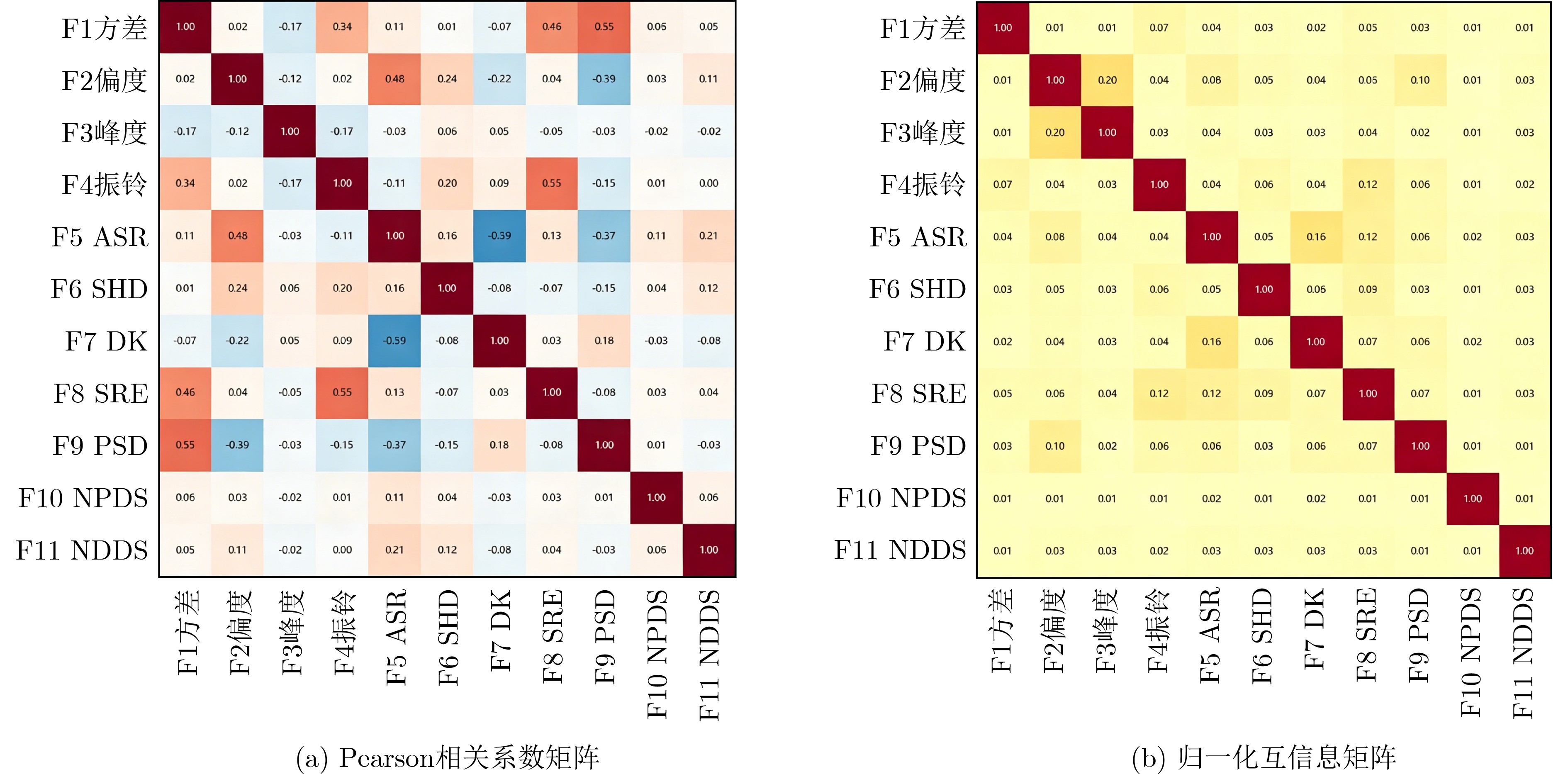
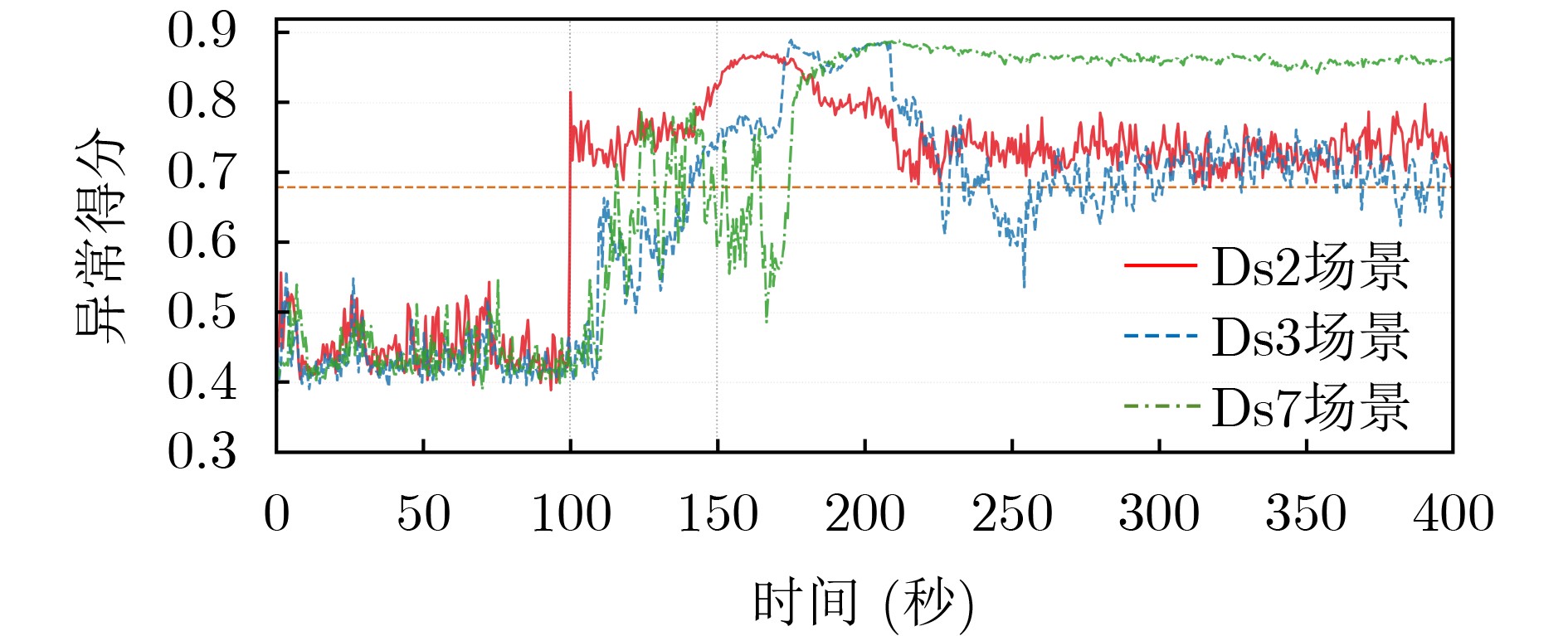
Objective The objective of this study is to overcome the limitations of existing pre correlation RFF based GNSS spoofing detection methods, which are prone to fingerprint suppression under time varying channel conditions and rely on closed set assumptions that fail to generalize to unknown spoofing attacks. To address these issues, we propose an open set GNSS spoofing detection framework based on post correlation radio frequency fingerprint features, aiming to achieve robust, generalizable, and low cost spoofing detection without modifying existing GNSS signal structures. Methods The proposed scheme comprises three stages. First, a high-resolution multi-correlator array captures fine-grained correlation peaks, followed by asymmetric spatiotemporal subspace projection via Singular Value Decomposition (SVD) to suppress time-varying noise. Static multipath is mitigated using an asymmetric weighting window leveraging the non-negative delay property. Second, an 11-dimensional physically interpretable RF fingerprint (RFF) set is constructed, encompassing amplitude-domain (residual variance, skewness, etc.), frequency-domain (harmonic distortion), waveform geometry (differential kurtosis, etc.), and tracking-loop features (PLL/DLL jitter). Third, spoofing detection is formulated as an open-set one-class novelty detection problem. A One-Class Support Vector Machine (OC-SVM) is trained exclusively on authentic signals using an RBF kernel, with a Constant False Alarm Rate (CFAR) threshold set at the 95th percentile of anomaly scores. A stacking ensemble integrating OC-SVM and Isolation Forest (IF) with a Logistic Regression (LR) meta-learner is introduced to enhance generalization. Results and Discussions Experiments were conducted on the publicly available TEXBAT dataset under three spoofing scenarios: static high power (Ds2), static low power (Ds3), and matched power covert spoofing (Ds7). The proposed stacking ensemble framework achieved area under the curve (AUC) values of 98.5 percent, 99.6 percent, and 91.8 percent, respectively, outperforming Mahalanobis distance, Hotellings T squared statistic, EllipticEnvelope, and single isolation forest models. Feature effectiveness was validated through kernel density estimation, showing clear mean shifts and kurtosis anomalies in spoofed signals. Redundancy analysis revealed low pairwise Pearson correlations, all below 0.6, and normalized mutual information below 0.2, confirming feature independence. Ablation studies demonstrated that removing any single feature category degraded performance, especially in the challenging Ds7 scenario, where the full feature AUC dropped from 91.8 percent to as low as 82.7 percent when tracking loop features were removed. Temporal analysis showed that the detector triggers alarms within approximately 5 seconds, 20 seconds, and 30 to 70 seconds under Ds2, Ds3, and Ds7 scenarios, respectively, demonstrating practical real time responsiveness. Conclusions This paper proposes a GNSS spoofing detection method based on robust post-correlation RFF extraction and one-class novelty detection, which uses a high-resolution multi-correlator array and asymmetric spatiotemporal subspace projection to filter out time-varying channel effects and static multipath, reconstruct hardware fingerprints, construct an 11-dimensional multi-class physically interpretable feature vector, and generalize to unknown spoofing using only authentic signal training; TEXBAT experiments show superior performance over traditional parametric statistical methods and single machine learning models. However, the one-class detector only identifies deviations from the normal feature distribution and cannot distinguish spoofing from benign disturbances such as strong multipath or ionospheric scintillation, and although SVD and asymmetric weighting suppress some multipath, residuals under low elevation, urban canyons, and high ionospheric activity may still cause false alarms; constrained by experimental conditions and TEXBAT annotations, benign disturbance discrimination is not deeply modeled. Future work will improve channel decoupling robustness in high-dynamic environments, incorporate multi-satellite consistency, elevation priors, scintillation indices, and multipath parameter estimation, and combine benign disturbance modeling, anomaly attribution, and deep generative models for end-to-end open-set spoofing recognition to further reduce false alarms in complex channels. -
表 1 所提11维RFF特征及其物理含义
类别 特征名称 物理含义 幅度域特征 残差方差 表征信号源带通滤波器群延迟导致整体波形畸变程度 残差偏度 表征PA非线性压缩引起的波形畸变不对称偏斜 残差峰度 量化DAC量化噪声与时钟抖动造成相关峰顶部平滑度瞬态缺陷 振铃能量 表征滤波器带外衰减特性激发的吉布斯波纹能量 斜率不对称比 量化信号源频谱非对称畸变导致的相关峰左右沿斜率差异 频域特征 谐波失真比 评估PA非线性产生的高次谐波能量占总能量的比例 波形几何特征 差分峰度 放大局部不规则跳变,表征信号源晶振抖动与原子钟稳定性差异 子段残差熵 表征不同频段通带纹波的能量分布复杂性 相关峰对称偏差 衡量带通滤波器群延迟频率响应不对称引起的波形左右镜像偏差 跟踪环路域特征 通道内归一化PLL抖动 量化欺骗信号引入的额外载波相位抖动,反映PLL跟踪异常 通道内归一化DLL抖动 量化欺骗信号引入的码相位跟踪误差,反映DLL跟踪异常  下载: 导出CSV
表 2 堆叠集成框架与其它欺骗检测算法的AUC数值
欺骗干扰场景 堆叠集成框架 马氏距离 Hotelling $ {\text{T}}^{2} $统计量 EllipticEnvelope算法 单一IF算法 Ds2场景 98.5% 88.2% 86.2% 94.9% 96.5% Ds3场景 99.6% 97.4% 97.0% 98.8% 99.1% Ds7场景 91.8% 85.8% 83.8% 92.0% 90.1%
下载: 导出CSV
表 3 四类别特征消融实验
全特征 消除幅度域特征 消除频域特征 消除波形几何特征 消除跟踪环路特征 Ds2场景 98.5% 98.0% 97.0% 99.0% 98.0% Ds3场景 99.6% 99.0% 99.7% 98.7% 99.7% Ds7场景 91.8% 91.4% 89.3% 86.2% 82.7%
下载: 导出CSV
表 4 相关器抽头数对AUC数值的影响
商用接收机 $ K=5 $ $ K=11 $ $ K=13 $ $ K=21 $ $ K=31 $ $ K=61 $ 等效分辨率 $ 0.5{T}_{c} $ $ 0.75{T}_{c} $ $ 0.3{T}_{c} $ $ 0.25{T}_{c} $ $ 0.15{T}_{c} $ $ 0.1{T}_{c} $ $ 0.05{T}_{c} $ Ds2场景 93.8% 82.9% 97.4% 98.4% 97.9% 98.2% 98.5% Ds3场景 98.8% 95.1% 99.6% 99.7% 99.8% 99.7% 99.6% Ds7场景 74.0% 72.8% 78.9% 77.8% 79.2% 82.8% 91.8%
下载: 导出CSV
表 5 衰减的起始位置对AUC数值的影响
$ {\tau }_{a}=-0.25{T}_{c} $ $ {\tau }_{a}=0{T}_{c} $ $ {\tau }_{a}=0.25{T}_{c} $ $ {\tau }_{a}=0.5{T}_{c} $ $ {\tau }_{a}=0.75{T}_{c} $ $ {\tau }_{a}={T}_{c} $ $ {\tau }_{a}=1.25{T}_{c} $ Ds2场景 97.5% 98.5% 98.4% 97.7% 97.8% 97.0% 96.1% Ds3场景 98.5% 99.6% 99.5% 98.7% 98.1% 97.5% 97.0% Ds7场景 88.7% 91.8% 89.3% 88.5% 87.2% 85.8% 84.3%
下载: 导出CSV
表 6 衰减指数对AUC数值的影响
$ p=0.25 $ $ p=0.5 $ $ p=1 $ $ p=2 $ $ p=4 $ Ds2场景 96.5% 97.6% 98.5% 98.7% 98.1% Ds3场景 98.8% 99.3% 99.6% 99.5% 99.5% Ds7场景 89.5% 90.7% 91.8% 89.4% 88.6%
下载: 导出CSV
-
[1] LU Zukun, SONG Jie, LI Xiangjun, et al. Achieving robust and adaptive antijamming for GNSS receivers based on CPCLMS[J]. IEEE Transactions on Aerospace and Electronic Systems, 2026, 62: 5396–5408. doi: 10.1109/TAES.2026.3653343. [2] 王璐, 王轩, 吴仁彪. 无人机平台单天线合成孔径全球导航卫星系统干扰源定位方法[J]. 电子与信息学报, 2025, 47(10): 3759–3771. doi: 10.11999/JEIT250169.WANG Lu, WANG Xuan, and WU Renbiao. Global navigation satellite system interference source localization algorithm via single-antenna synthetic aperture on the unmanned aerial vehicle platform[J]. Journal of Electronics & Information Technology, 2025, 47(10): 3759–3771. doi: 10.11999/JEIT250169. [3] 陈力超, 曾芳玲, 欧阳晓凤, 等. GNSS授时干扰技术发展综述[J]. 导航定位与授时, 2024, 11(6): 84–99. doi: 10.19306/j.cnki.2095-8110.2024.06.007.CHEN Lichao, ZENG Fangling, OUYANG Xiaofeng, et al. Overview of the development of GNSS timing interference technology[J]. Navigation Positioning and Timing, 2024, 11(6): 84–99. doi: 10.19306/j.cnki.2095-8110.2024.06.007. [4] SONG Jie, LU Zukun, ZHAO Xiaoyu, et al. GNSS multiple interference mitigation with TF-unet method based on high-resolution interference sensing[J]. IEEE Sensors Journal, 2026, 26(1): 1358–1369. doi: 10.1109/JSEN.2025.3623113. [5] ZENG Yejia, LU Zukun, ZHAO Xiaoyu, et al. GNSS jamming and spoofing threats in UAV navigation: Countermeasure status and challenges[J]. IEEE Communications Surveys & Tutorials, 2026, 28: 5909–5948. doi: 10.1109/comst.2026.3680438. [6] MARRANGHELLI E A, LA VALLE R L, and RONCAGLIOLO P A. Simple and effective GNSS spatial processing using a low-cost compact antenna array[J]. IEEE Transactions on Aerospace and Electronic Systems, 2021, 57(5): 3479–3491. doi: 10.1109/TAES.2021.3082669. [7] ZHANG Ke, LI Xiangjun, CHEN Lei, et al. Impact analysis of orthogonal circular-polarized interference on GNSS spatial anti-jamming array[J]. Remote Sensing, 2024, 16(23): 4506. doi: 10.3390/rs16234506. [8] FERNANDEZ-HERNANDEZ I, WINKEL J, O'DRISCOLL C, et al. Semiassisted signal authentication for Galileo: Proof of concept and results[J]. IEEE Transactions on Aerospace and Electronic Systems, 2023, 59(4): 4393–4404. doi: 10.1109/TAES.2023.3243587. [9] LO S, ROTHMAIER F, MIRALLES D, et al. Developing a practical GNSS spoofing detection thresholds for receiver power monitoring[C]. Proceedings of the 34th International Technical Meeting of the Satellite Division of the Institute of Navigation, St. Louis, USA, 2021: 803–815. doi: 10.33012/2021.17931. [10] 王森. UWB/GNSS/INS/LiDAR多源组合导航系统信息融合关键技术研究[D]. [博士论文], 山东大学, 2025. doi: 10.27272/d.cnki.gshdu.2025.001021.WANG Sen. Research on key technologies of information fusion for UWB/GNSS/INS/LiDAR multi-source integrated navigation system[D]. [Ph. D. dissertation], Shandong University, 2025. doi: 10.27272/d.cnki.gshdu.2025.001021. [11] WANG Hailin, CHENG Weihua, XU Chao, et al. Method for identifying pseudo GPS signal based on radio frequency fingerprint[C]. Proceedings of the 10th International Conference on Communications, Circuits and Systems, Chengdu, China, 2018: 354–358. doi: 10.1109/ICCCAS.2018.8769313. [12] 崔天舒, 赵文杰, 黄永辉, 等. 基于射频指纹的测控地面站身份识别方法[J]. 航天电子对抗, 2021, 37(3): 6–9,23. doi: 10.16328/j.htdz8511.2021.03.002.CUI Tianshu, ZHAO Wenjie, HUANG Yonghui, et al. Radio frequency fingerprint-based TT&C ground station identification method[J]. Aerospace Electronic Warfare, 2021, 37(3): 6–9,23. doi: 10.16328/j.htdz8511.2021.03.002. [13] PATEL K and SHAH M. Laboratory experiments for understanding effects of RF impairments on received signal in satellite link[C]. Proceedings of 2017 International Conference on Nascent Technologies in Engineering, Vashi, India, 2017: 1–7. doi: 10.1109/ICNTE.2017.7947956. [14] SHEN Guanxiong, ZHANG Junqing, MARSHALL A, et al. Radio frequency fingerprint identification for LoRa using deep learning[J]. IEEE Journal on Selected Areas in Communications, 2021, 39(8): 2604–2616. doi: 10.1109/JSAC.2021.3087250. [15] GURER G, DALVEREN Y, KARA A, et al. A radio frequency fingerprinting-based aircraft identification method using ADS-B transmissions[J]. Aerospace, 2024, 11(3): 235. doi: 10.3390/aerospace11030235. [16] 邢月秀. 无线设备指纹的提取与识别方法研究[D]. [博士论文], 东南大学, 2021. doi: 10.27014/d.cnki.gdnau.2021.000111.XING Yuexiu. Research on the fingerprint extraction and identification methods of wireless devices[D]. [Ph. D. dissertation], Southeast University, 2021. doi: 10.27014/d.cnki.gdnau.2021.000111. [17] WANG Wenbo, LOHAN E S, SANCHEZ I A, et al. Pre-correlation and post-correlation RF fingerprinting methods for GNSS spoofer identification with real-field measurement data[C]. Proceedings of 2022 10th Workshop on Satellite Navigation Technology, Noordwijk, Netherlands, 2022: 1–10. doi: 10.1109/NAVITEC53682.2022.9847540. [18] ZHANG Yuanyu, WANG Jianing, ZHENG Zhumeng, et al. Variational AutoEncoder-based radio frequency fingerprinting for GPS anti-spoofing[C]. Proceedings of 2024 International Conference on Networking and Network Applications, Yinchuan, China, 2024: 172–178. doi: 10.1109/NaNA63151.2024.00035. [19] GROVES P D, ZHONG Qiming, FARAGHER R, et al. Combining inertially-aided extended coherent integration (supercorrelation) with 3D-mapping-aided GNSS[C]. Proceedings of the 33rd International Technical Meeting of the Satellite Division of the Institute of Navigation, 2020: 2327–2346. doi: 10.33012/2020.17767. (查阅网上资料,未找到对应的出版地信息,请确认). [20] WANG Wenbo, SANCHEZ I A, CAPARRA G, et al. A survey of spoofer detection techniques via radio frequency fingerprinting with focus on the GNSS pre-correlation sampled data[J]. Sensors, 2021, 21(9): 3012. doi: 10.3390/s21093012. [21] HUMPHREYS T, BHATTI J, SHEPARD D, et al. The Texas spoofing test battery: Toward a standard for evaluating GPS signal authentication techniques[C]. Proceedings of the 25th International Technical Meeting of the Satellite Division of the Institute of Navigation, Nashville, USA, 2012: 3569–3583. -


 下载:





图(6) / 表(6)
计量
- 文章访问数: 8
- HTML全文浏览量: 1
- PDF下载量: 0
- 被引次数: 0
