




A Dynamic Scheduling Decoding Algorithm for Non-Binary LDPC Codes Using Stability and Reliability Metrics
-
摘要: 针对动态调度算法在非二进制低密度奇偶校验码的译码中,由于可靠信息传播速度慢,导致误码率性能不足和所需平均迭代次数较多的问题,本文基于扩展最小和(Extended Min-Sum, EMS)译码框架,提出一种改进的基于变量节点稳定性与可靠度(Improved Variable Node Stability and Reliability, IVSR)评估的动态调度译码算法。该算法首先将变量节点后验概率最大值与次大值的差异和连续两次迭代中变量节点的硬判决变化,作为稳定性度量指标。然后,针对每个变量节点,本文利用与其相连的正确校验节点数量和其他相邻变量节点的最小后验概率值作为可靠度评估指标,实现不同变量节点的可靠度等级划分。为了实现误码率性能和译码收敛速度的提高,本文进一步提出联合稳定性和可靠度评估的动态变量节点信息更新顺序策略。其中,针对传统EMS算法中信息截短导致的性能损失,本文特别优化不同可靠度的变量节点所对应的信息截短长度,以减少低可靠度变量节点带来的译码性能损失。仿真结果表明,与传统EMS算法相比,采用IVSR动态调度策略的分层EMS算法在(200,60)LDPC码中,不可靠或不稳定变量节点截断参数为(8,3)的时候,目标BER=1×10⁻⁴时误码率性能最大可提升约0.47 dB,译码所需的迭代次数最高可减少约73%,并且没有显著增加单次迭代下的计算复杂度。
-
关键词:
- 非二进制低密度奇偶校验码 /
- 扩展最小和 /
- 动态调度 /
- 动态截断
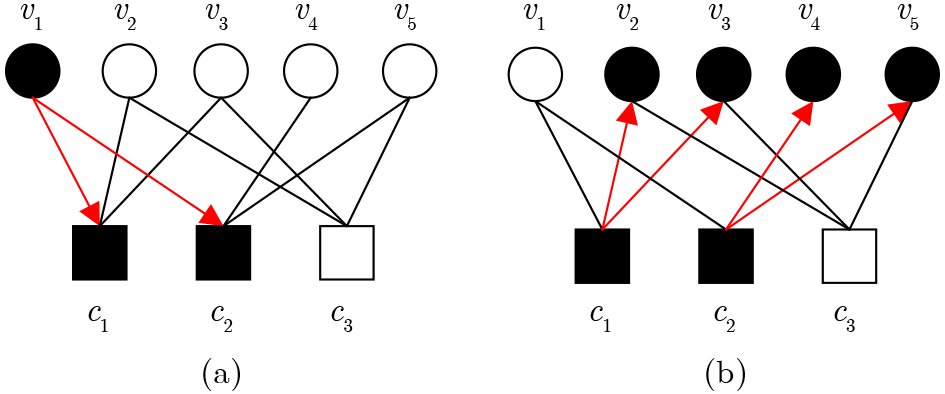
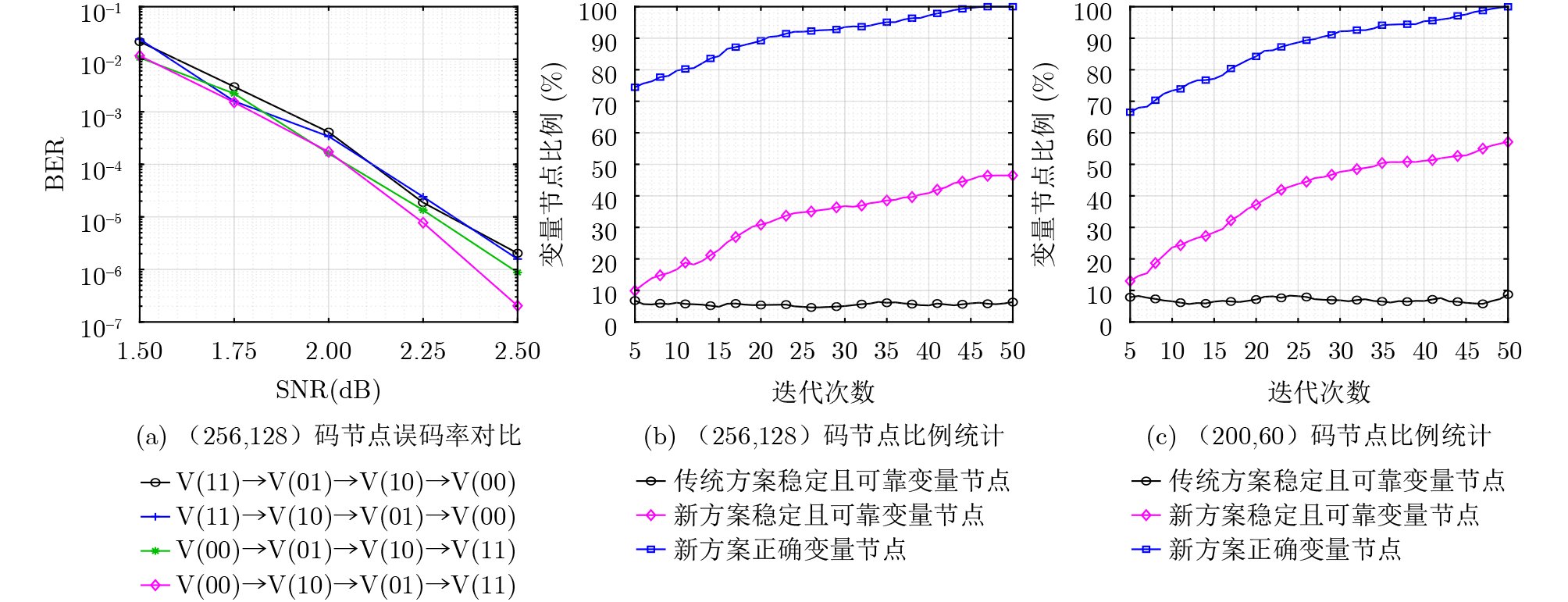
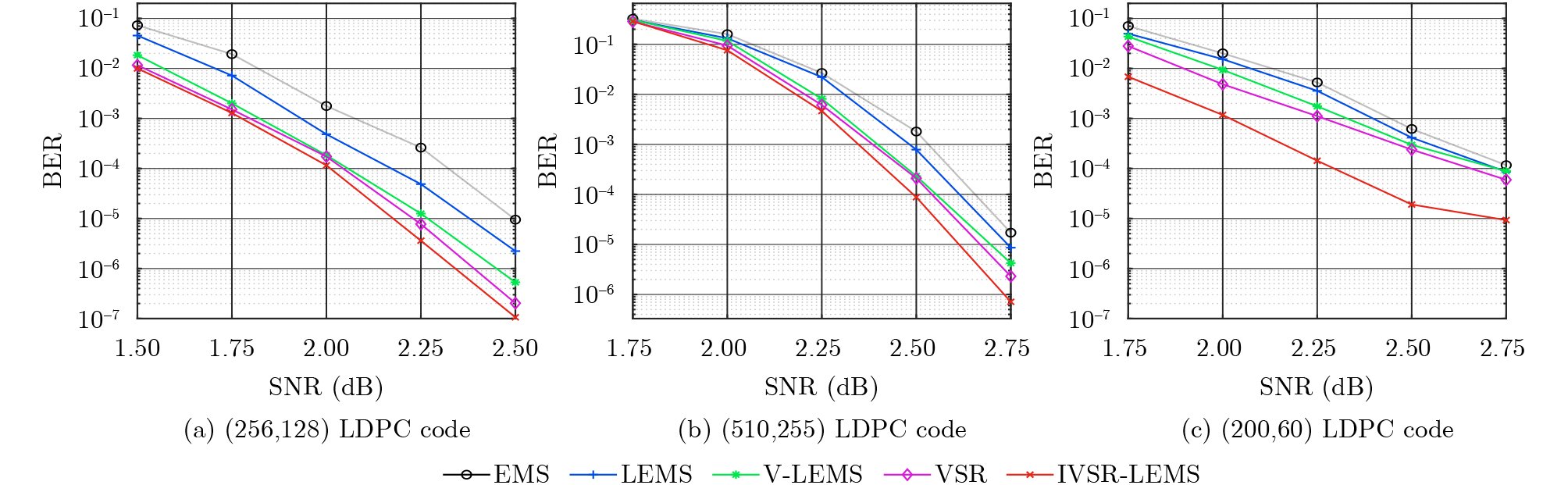
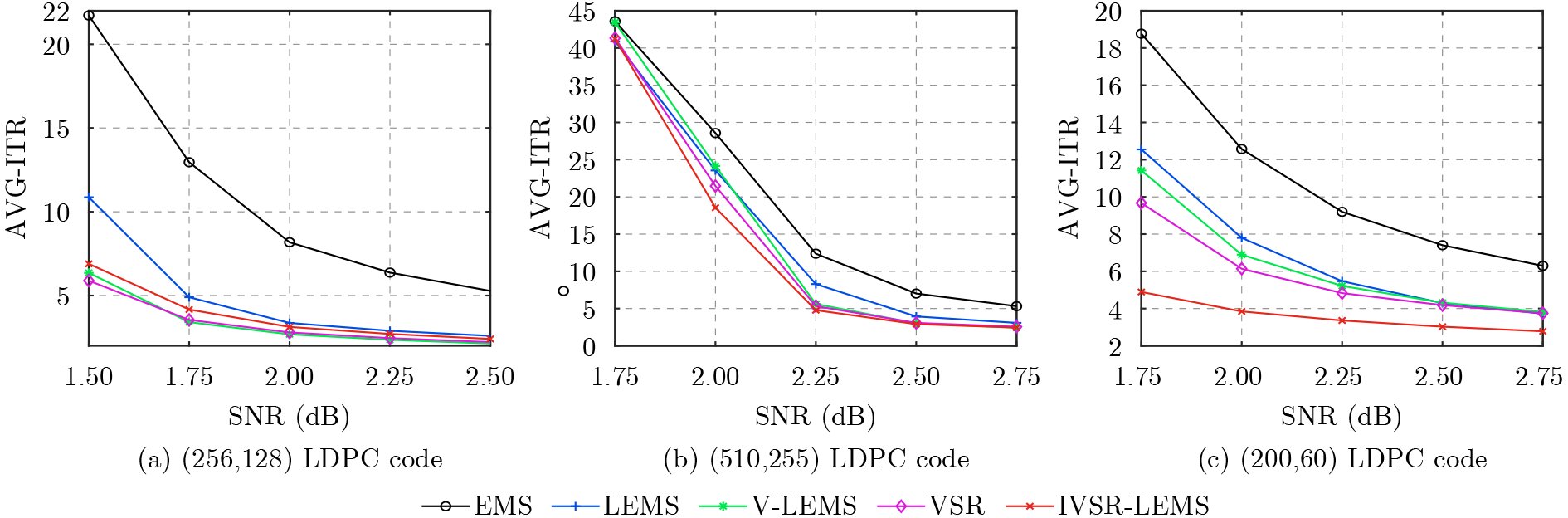
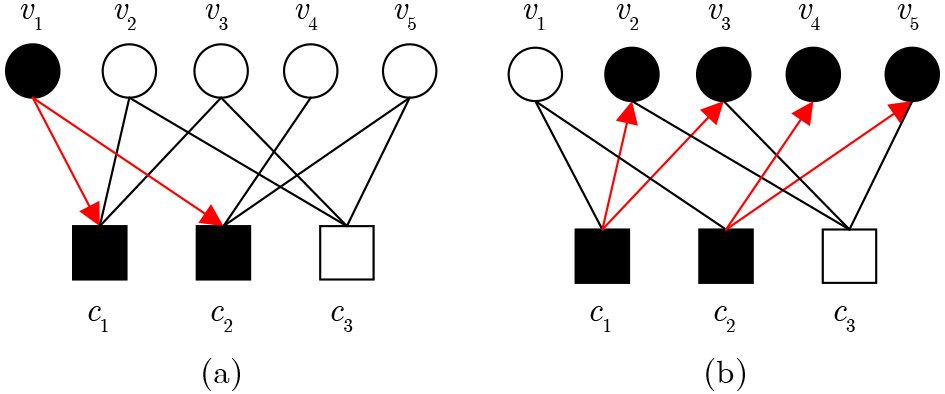
Abstract:Objective Dynamic scheduling adjusts the message-update order to accelerate the convergence of low-density parity-check (LDPC) decoding. In extended min-sum (EMS) decoding of non-binary LDPC (NB-LDPC) codes, however, reliable information may propagate slowly, while low-reliability messages may be updated before they are sufficiently corrected. This can impair bit-error-rate (BER) performance and increase the average iteration count. Existing dynamic schedules often require repeated residual calculations, target binary LDPC codes, or do not account for the information loss caused by EMS message truncation. Because EMS retains only a subset of finite-field symbols, the truncation length can also affect the value of each scheduled update. This study develops an improved variable-node stability and reliability (IVSR) scheduling method within a layered EMS decoder. It aims to improve the propagation of reliable information, BER performance, and convergence without a substantial increase in computational complexity per iteration. Methods The layered EMS framework updates the messages of connected check and variable nodes immediately after each variable-node update, reducing the propagation delay of flooding decoding ( Fig. 1 ). Variable-node stability is assessed from the gap between the largest and second-largest a posteriori symbol probabilities and from the change in hard decisions between successive iterations. The probability gap indicates how strongly the posterior favors one symbol, whereas the decision comparison identifies estimates that are still changing. A node is stable only when the gap exceeds a threshold and its hard decision remains unchanged. Check-node reliability is determined jointly by the parity-check result and the minimum posterior reliability of its neighboring variable nodes. A failed parity check marks the check node as unreliable; a satisfied check is reliable only if the neighboring reliability metric exceeds a threshold. A variable node is classified as reliable only when all its adjacent check nodes are reliable. These two node states define the update priority in the initial stability-and-reliability schedule: all variable nodes are updated, with reliable and stable nodes processed first. The nodes are sorted by priority at each iteration before their layered message updates. An update-order experiment for a (256, 128) code evaluates this rule, while the proportions of stable and reliable nodes and correctly decoded nodes are tracked for two codes (Fig. 2 ). The proposed IVSR layered EMS (IVSR-LEMS) algorithm then avoids repeated updates of nodes already classified as reliable. For the remaining nodes, the number of adjacent reliable check nodes provides a finer measure: few reliable neighbors indicate low reliability, while an intermediate count indicates moderate reliability. This yields three reliability levels when fully reliable nodes are included. Unstable or unreliable nodes receive higher update priority and a longer EMS truncation length, retaining more candidate symbols; stable nodes of moderate reliability use a shorter length. The node states and corresponding update sets are reassessed during decoding, so scheduling and truncation respond to the current information rather than applying one fixed message length (Algorithm 1). This arrangement directs extra symbol-list capacity toward uncertain nodes while avoiding unnecessary updates of reliable ones. Simulations use three irregular NB-LDPC codes over GF(16), with parameters (256, 128), (510, 255), and (200, 60), on an additive white Gaussian noise channel with binary phase-shift keying. The maximum iteration count is 50. Conventional EMS, layered EMS (LEMS), variable-node layered EMS (V-LEMS), the stability-and-reliability schedule with fixed truncation (VSR-LEMS), and IVSR-LEMS are compared in terms of BER, average iteration count, and per-iteration complexity. Their simulation settings and scheduling mechanisms are summarized inTables 1 and2 , respectively.Results and Discussions For the (256, 128) code, prioritizing stable and reliable nodes yields the best BER among the tested update orders; prioritizing unstable and unreliable nodes performs worst ( Fig. 2(a) ). In the selected frames, the proposed order also increases the proportions of stable and reliable nodes and correctly decoded nodes during iteration for both tested codes (Fig. 2(b) ,(c) ). These observations support the ordering rule without implying that the same node should continue to be updated after it becomes reliable. At a BER near 1.0 × 10⁻⁵, IVSR-LEMS gains approximately 0.31 dB over conventional EMS, 0.20 dB over LEMS, and 0.05 dB over VSR-LEMS for the (256, 128) code (Fig. 3(a) ). For the (510, 255) code, the corresponding gains over EMS and LEMS are approximately 0.17 and 0.13 dB at a BER near 1.7 × 10⁻⁵ (Fig. 3(b) ). For the (200, 60) code, IVSR-LEMS gains approximately 0.47, 0.42, and 0.35 dB over EMS, LEMS, and VSR-LEMS, respectively, at a BER near 1.1 × 10⁻⁴ (Fig. 3(c) ). The average iteration count is 54% and 58% lower than that of EMS for the (256, 128) and (510, 255) codes, respectively, at an SNR of 2.5 dB (Fig. 4(a) ,(b) ). For these two half-rate codes, however, V-LEMS, VSR-LEMS, and IVSR-LEMS have similar iteration counts, especially at low SNR, so the additional scheduling benefit depends on the code. For the (200, 60) code, IVSR-LEMS reduces the average iteration count relative to EMS by 73% at 1.75 dB and 56% at 2.75 dB (Fig. 4(c) ). At 1.75 dB, the reductions relative to LEMS, V-LEMS, and VSR-LEMS are approximately 61%, 57%, and 49%; the reduction relative to the layered baselines remains approximately 26% at 2.75 dB. Reliability assessment and queue construction add node-level operations, but avoiding redundant updates and assigning longer symbol lists only where needed limit the added work; the analysis indicates no substantial increase in per-iteration complexity.Conclusions IVSR-LEMS combines variable-node stability and reliability assessment with dynamic scheduling and reliability-dependent EMS truncation. The update-order experiment supports prioritizing reliable and stable messages when every node is updated; the final algorithm instead omits repeated updates of reliable nodes and devotes longer symbol lists to unstable or unreliable nodes. Across the three simulated codes, which cover two code rates, it improves BER relative to conventional EMS, with a maximum gain of approximately 0.47 dB for the (200, 60) code. The average iteration count falls by up to 73% for that code, while the gains for the two half-rate codes are smaller and depend on SNR. The measured benefits therefore should be interpreted by code configuration and operating point rather than as uniform gains. These improvements are obtained without a substantial increase in computational complexity per iteration, indicating that node-state-aware scheduling and truncation can improve the efficiency of short NB-LDPC decoding. -
Key words:
- Non-Binary LDPC Codes /
- Extended Min-Sum /
- Dynamic Scheduling /
- Dynamic Truncation
-
1 IVSR-LEMS译码算法
输入: $ \boldsymbol{y} $, $ {{I}}_{{max}} $ 输出:$ \hat{\boldsymbol{c}} $ 1. 计算$ {\boldsymbol{{p}}}_{{n}} (\boldsymbol{l}) $,通过公式(1) 2. 当 $ {i \lt }{{I}}_{{max}} $时,执行以下步骤 3. 计算$ {{S}}_{{{\boldsymbol{v}}_{\boldsymbol{n}}}} $, $ {R}_{{{v}}_{{n}}}^{\text{'}} $,通过公式 (10)(15) 4. 生成$ {\Omega }_{\text{large}} $与$ {\Omega }_{\text{small}} $ 5. 当$ \boldsymbol{n}\in {\Omega }_{\text{large}} $时,执行以下步骤 6. 更新$ \boldsymbol{q}_{{m}{n}}({l}) $,通过公式(6) 7. 使用参数 $ {({{\boldsymbol{n}}_{m}},{{\boldsymbol{n}}_{c}})}_{\text{large}} $更新$ \boldsymbol{r}_{{m}{n}'}({l}) $,通过公式(4)(5) 8. 当$ \boldsymbol{n}\in {\Omega }_{\text{small}} $时,执行以下步骤 9. 更新$ \boldsymbol{q}_{mn} ({l}) $,通过公式(6) 10. 使用参数$ {({{\boldsymbol{n}}_{m}},{{\boldsymbol{n}}_{c}})}_{\text{small}} $更新$ \boldsymbol{r}_{{m}{n}'}({l}) $,通过公式(4)(5) 11. 更新$ \boldsymbol{q}_{n}({l}) $,通过公式(7) 12. 码字判决得到$ {\hat{\boldsymbol{c}}}_{n} $ 13. 当$ \boldsymbol{H}\times \hat{\boldsymbol{c}}=0 $或者$ {i}={\boldsymbol{I}}_{\max } $ 时 14. 停止迭代并输出 $ \hat{\boldsymbol{c}} $  下载: 导出CSV
-
[1] GALLAGER R. Low-density parity-check codes[J]. IRE Transactions on Information Theory, 1962, 8(1): 21–28. doi: 10.1109/TIT.1962.1057683. [2] MACKAY D J C and NEAL R M. Near Shannon limit performance of low density parity check codes[J]. Electronics Letters, 1997, 33(6): 457–458. doi: 10.1049/el:19970362. [3] 周华, 周鸣, 张立康. 低密度奇偶校验码正则化神经网络归一化最小和译码算法[J]. 电子与信息学报, 2025, 47(5): 1486–1493. doi: 10.11999/JEIT240860.ZHOU Hua, ZHOU Ming, and ZHANG Likang. Regularized neural network-based normalized min-sum decoding for LDPC codes[J]. Journal of Electronics & Information Technology, 2025, 47(5): 1486–1493. doi: 10.11999/JEIT240860. [4] 梁济凡, 王千帆, 宋林琦, 等. 参数列表化置信传播-顺序统计译码算法[J]. 电子与信息学报, 2025, 47(11): 4254–4263. doi: 10.11999/JEIT250552.LIANG Jifan, WANG Qianfan, SONG Linqi, et al. Belief propagation-ordered statistics decoding algorithm with parameterized list structures[J]. Journal of Electronics & Information Technology, 2025, 47(11): 4254–4263. doi: 10.11999/JEIT250552. [5] 张国华, 秦煜, 娄蒙娟, 等. 围长为8的较大列重准循环低密度奇偶校验码的行重普适代数构造[J]. 电子与信息学报, 2024, 46(7): 3019–3025. doi: 10.11999/JEIT231111.ZHANG Guohua, QIN Yu, LOU Mengjuan, et al. Row-weight universal algebraic constructions of girth-8 quasi-cyclic low-density parity-check codes with large column weights[J]. Journal of Electronics & Information Technology, 2024, 46(7): 3019–3025. doi: 10.11999/JEIT231111. [6] REN Yuqing, HARB H, SHEN Yifei, et al. A generalized adjusted min-sum decoder for 5G LDPC codes: Algorithm and implementation[J]. IEEE Transactions on Circuits and Systems I: Regular Papers, 2024, 71(6): 2911–2924. doi: 10.1109/TCSI.2024.3368056. [7] 张小军, 宋鑫, 高健, 等. 用于5G超可靠低时延通信的LDPC码截断NMS列表译码算法[J]. 电子与信息学报, 2026, 48(6): 2551–2559. doi: 10.11999/JEIT250853.ZHANG Xiaojun, SONG Xin, GAO Jian, et al. A clipped NMS list decoding algorithm for LDPC codes in 5G URLLC[J]. Journal of Electronics & Information Technology, 2026, 48(6): 2551–2559. doi: 10.11999/JEIT250853. [8] YUAN Qing, LIU Haiyang, WANG Lixin, et al. Design and implementation of an LDPC encoder for satellite navigation system[J]. IEICE Electronics Express, 2024, 21(17): 20240322. doi: 10.1587/ELEX.21.20240322. [9] CAI Z, HAO J, TAN P H, et al. Efficient encoding of IEEE 802.11n LDPC codes[J]. Electronics Letters, 2006, 42(25): 1471–1472. doi: 10.1049/el:20063126. [10] SU Chongchong, KANG Peng, CHEN Pingping, et al. Layered SEMS decoding for non-binary LDPC-coded PNC systems[J]. IEEE Wireless Communications Letters, 2025, 14(3): 866–870. doi: 10.1109/LWC.2025.3526613. [11] LIN Dai, YI Fang, GUAN Yongliang, et al. Design of protograph LDPC-coded MIMO-VLC systems with generalized spatial modulation[J]. China Communications, 2024, 21(3): 118–136. doi: 10.23919/JCC.ja.2022-0784. [12] BATTAGLIONI M, CHIARALUCE F, BALDI M, et al. Optimizing quasi-cyclic spatially coupled LDPC codes by eliminating harmful objects[J]. EURASIP Journal on Wireless Communications and Networking, 2023, 2023(1): 67. doi: 10.1186/s13638-023-02273-0. [13] SETHU P S, GOPCHANDRAN K G, and SOLOMON S. Non-binary QC-LDPC codes for non-Gaussian optical channels[J]. Optical and Quantum Electronics, 2021, 53(11): 626. doi: 10.1007/s11082-021-03230-1. [14] BARNAULT L and DECLERCQ D. Fast decoding algorithm for LDPC over GF(2q)[C]. Proceedings 2003 IEEE Information Theory Workshop, Paris, France, 2003. doi: 10.1109/ITW.2003.1216697. [15] SONG Hongxin and CRUZ J R. Reduced-complexity decoding of Q-ary LDPC codes for magnetic recording[J]. IEEE Transactions on Magnetics, 2003, 39(2): 1081–1087. doi: 10.1109/TMAG.2003.808600. [16] DECLERCQ D and FOSSORIER M. Extended minsum algorithm for decoding LDPC codes over GF(q)[C]. Proceedings of the 2005 IEEE International Symposium on Information Theory, Adelaide, Australia, 2005. doi: 10.1109/ISIT.2005.1523377. [17] KINGSTON ROBERTS M, KUMARI S, and ANGURAJ P. Certain investigations on recent advances in the design of decoding algorithms using low-density parity-check codes and its applications[J]. International Journal of Communication Systems, 2021, 34(8): e4765. doi: 10.1002/dac.4765. [18] SHARON E, LITSYN S, and GOLDBERGER J. Efficient serial message-passing schedules for LDPC decoding[J]. IEEE Transactions on Information Theory, 2007, 53(11): 4076–4091. doi: 10.1109/TIT.2007.907507. [19] ZHOU Leixin, SHA Jin, CHEN Yun, et al. Memory efficient EMS decoding for non-binary LDPC codes[C]. 2013 IEEE International Symposium on Circuits and Systems, Beijing, China, 2013. doi: 10.1109/ISCAS.2013.6572101. [20] CASADO A I V, GRIOT M, and WESEL R D. Overcoming LDPC trapping sets with informed scheduling[C]. Proceedings of the Information Theory and Applications Workshop, San Diego, USA, 2007. [21] GONG Yi, LIU Xingcheng, YE Weicai, et al. Effective informed dynamic scheduling for belief propagation decoding of LDPC codes[J]. IEEE Transactions on Communications, 2011, 59(10): 2683–2691. doi: 10.1109/TCOMM.2011.072011.100438. [22] CHANG T C Y, WANG Pinhan, WENG Jianjia, et al. Belief-propagation decoding of LDPC codes with variable node-centric dynamic schedules[J]. IEEE Transactions on Communications, 2021, 69(8): 5014–5027. doi: 10.1109/TCOMM.2021.3078776. [23] HAN Guojun, GUAN Yongliang, and HUANG Xinmei. Check node reliability-based scheduling for BP decoding of non-binary LDPC codes[J]. IEEE Transactions on Communications, 2013, 61(3): 877–885. doi: 10.1109/TCOMM.2013.011613.120249. -

 下载:

图(4) / 表(3)
计量
- 文章访问数: 4
- HTML全文浏览量: 0
- PDF下载量: 0
- 被引次数: 0
