




Robust Adaptive Beamforming with Eigenspace Bases Transition for Mixed-Near-and-Far Field Scenarios
-
摘要: 自适应波束形成旨在设计一种能够根据环境变化自动提取期望信号并抑制干扰和噪声的空域滤波器。随着第六代(6G)移动通信、毫米波感知等技术的发展,远场源与近场源同时存在的混合远近场场景日益普遍。现有的单一远场或近场自适应波束形成算法在此类混合远近场场景中面临平面波与球面波模型失配导致的性能局限;同时,源位置参数未知且参数间存在耦合,进一步加剧了性能恶化。针对上述问题,本文基于子空间基变换框架,针对混合远近场中响应向量同时依赖于角度和距离的特点,提出一种面向混合远近场场景的稳健自适应波束形成算法。该算法的核心在于:首先,建立混合远近场信号模型,通过多起点L-BFGS-B优化策略求解空间距离最小化问题,实现混合远近场响应向量的高精度估计;其次,通过特征空间基变换方法重构干扰加噪声协方差矩阵—该方法在子空间基变换思想基础上,将基矩阵的构造从纯角度域拓展至角度-距离联合域,并通过基变换矩阵直接从样本协方差矩阵中去除期望信号成分,避免了传统方法中噪声功率估计引入的附加误差;最后,利用重构的干扰加噪声协方差矩阵修正导向向量,进而计算波束形成器的加权向量。仿真结果表明,所提算法在混合远近场场景下能够有效缓解源位置参数耦合导致的性能恶化,在高输入信噪比(Signal-to-Noise Ratio, SNR)条件下,输出信干噪比(Signal-to-Interference-and-Noise Ratio, SINR)与理论最优值的偏差保持在1 dB以内,显著优于所对比的七种算法。
-
关键词:
- 自适应波束形成 /
- 混合远近场 /
- 特征空间基变换 /
- L-BFGS-B优化 /
- 干扰加噪声协方差矩阵重构
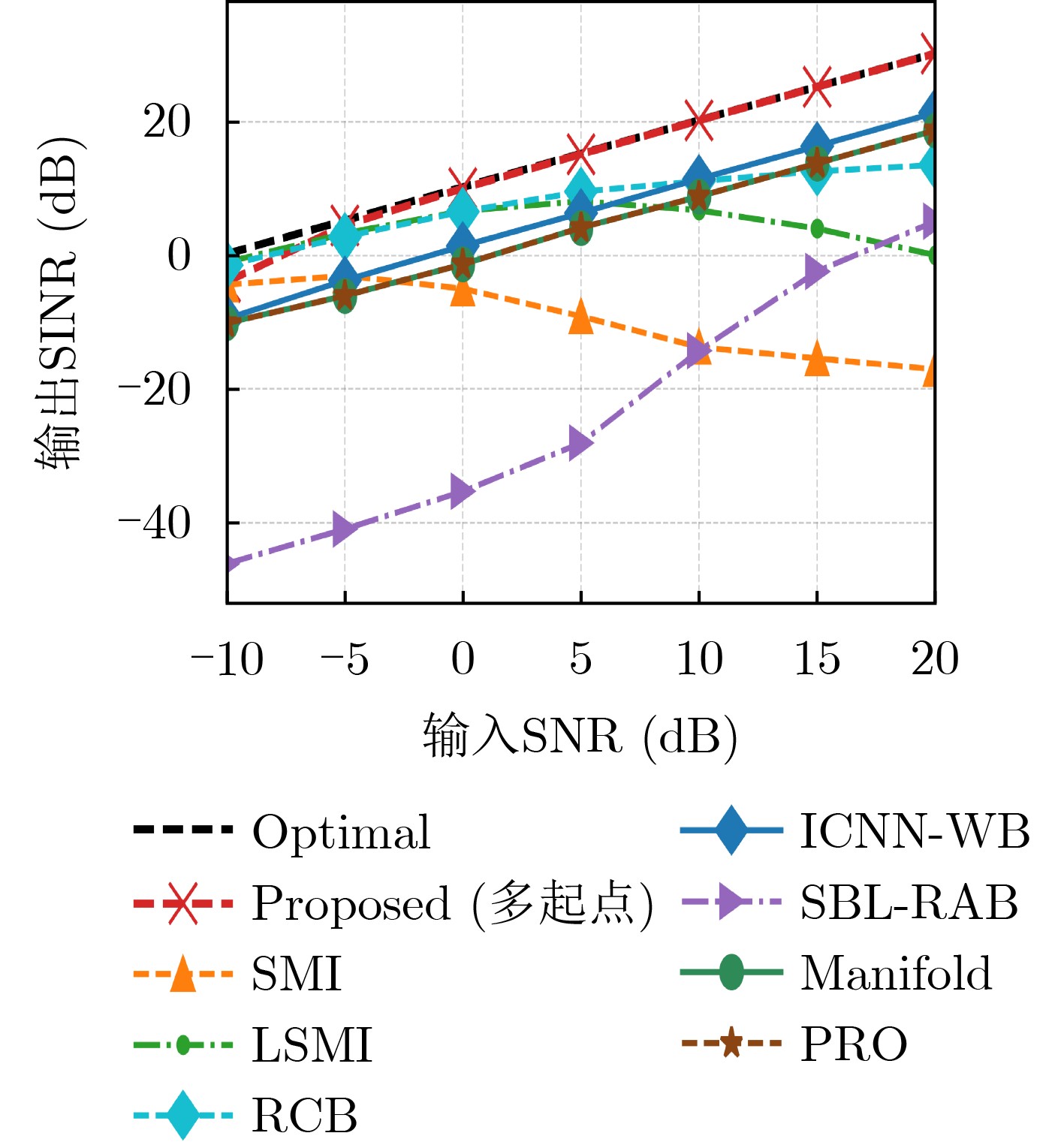
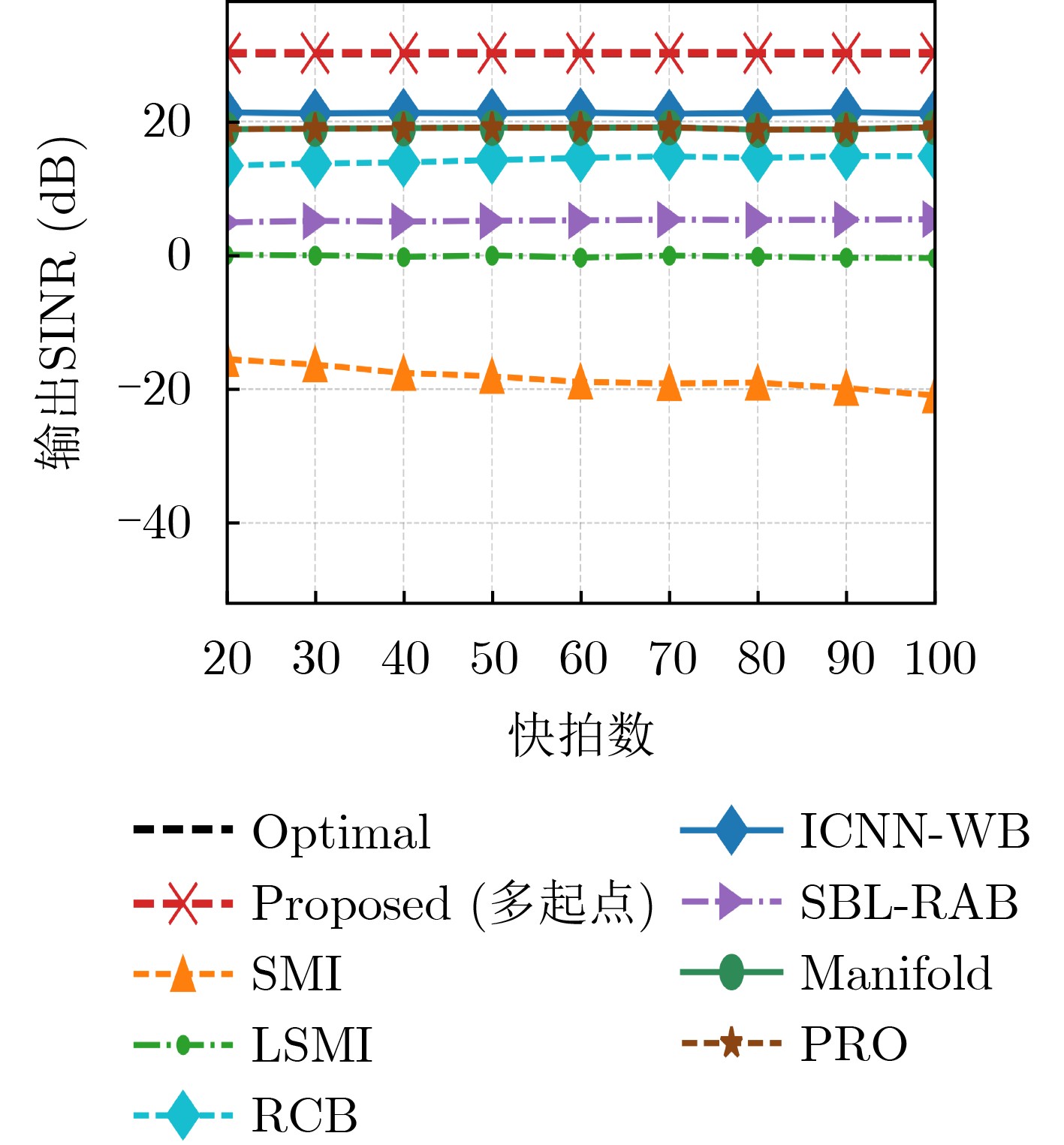
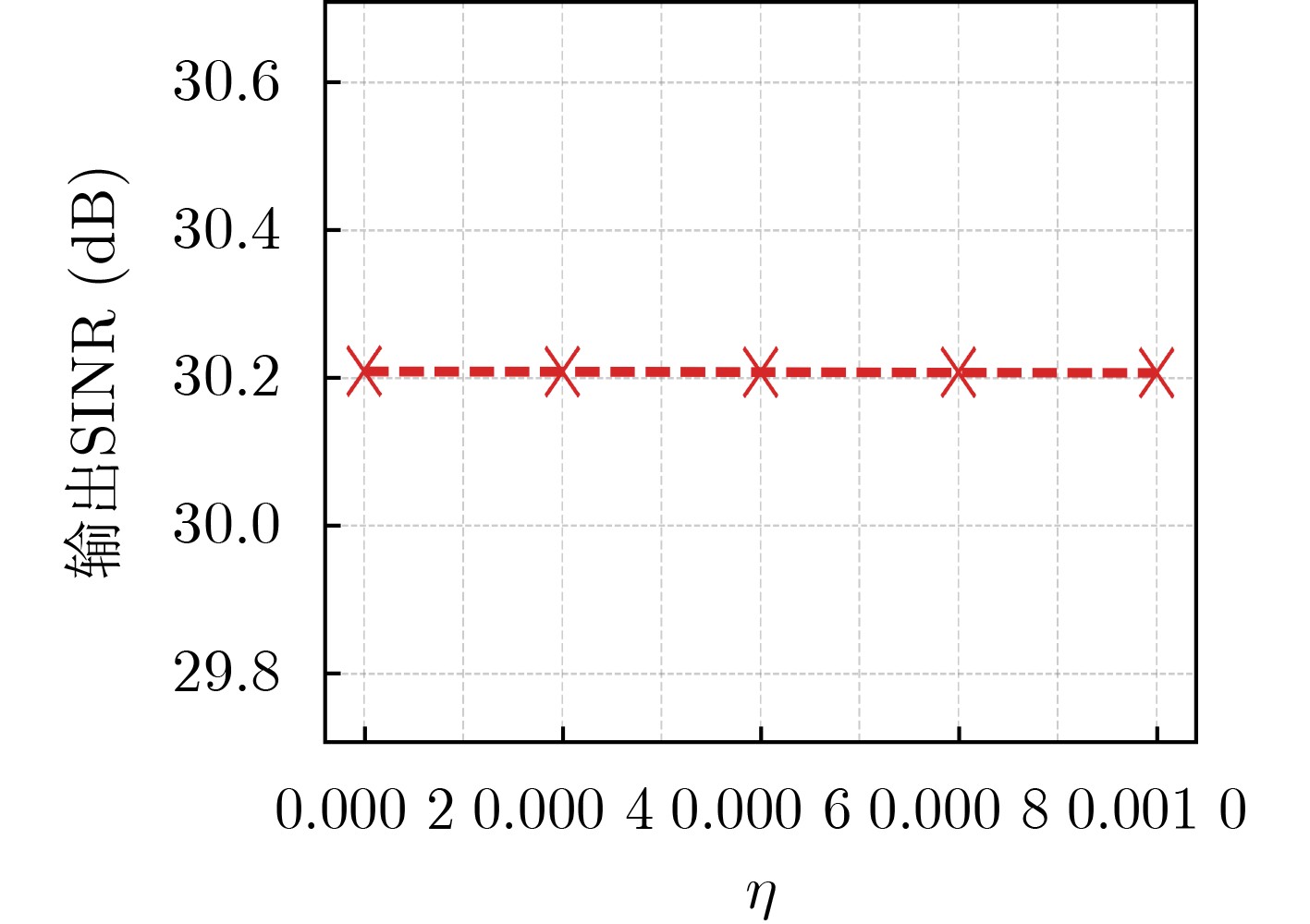
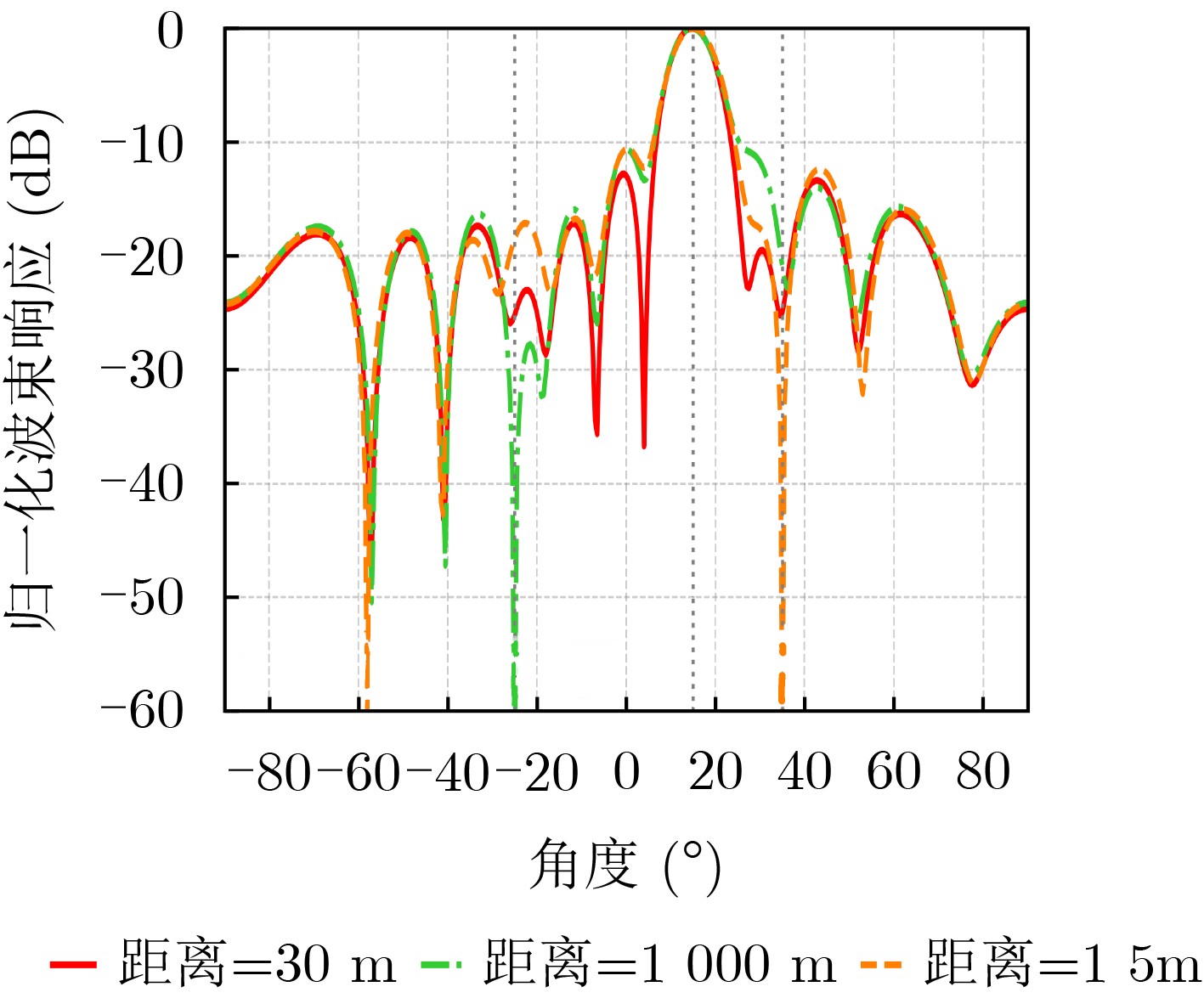
Abstract:Objective The rapid evolution of modern communication and sensing technologies, such as 6G communication-sensing integration, 5G ultra-dense networking, and indoor Internet of Things (IoT) applications, has rendered the operating environment of array antenna systems increasingly complex, and Mixed-Near-and-Far (MNF) field scenarios with the coexistence of far-field and near-field targets have become the norm. As the core technology of array signal processing, beamforming includes adaptive beamforming and static beamforming. Unlike static beamforming, adaptive beamforming can automatically adjust the weight vector according to changes in the actual environment, allowing the desired signal to pass without distortion while suppressing interference and noise. Existing adaptive beamforming algorithms tailored for either single far-field or single near-field scenarios are limited to signal processing in a single-distance scenario and suffer from performance limitations when addressing the filtering problem in MNF field scenarios. Therefore, it is imperative to carry out research on adaptive beamforming algorithms for the MNF field. Current studies on the MNF field mainly focus on source localization or communication precoding, while research on MNF-field beamforming for interference suppression remains insufficient. Moreover, the source position parameters are generally unknown and coupled, i.e., the response vector depends simultaneously on the angle and the distance, which causes traditional angle-only methods to suffer from significant model mismatch when processing near-field sources. Aiming at the degradation of beamforming performance caused by this coupling problem, this paper proposes a Robust Adaptive Beamforming Using Eigenspace Bases Transition in MNF field. Methods Consider a uniform linear array (ULA) composed of M isotropic sensor elements with a fixed spacing, which receives one desired signal, J interferences, and additive white Gaussian noise in the MNF field; the Fresnel first-order approximation is adopted for near-field sources. The algorithm reconstructs the interference-plus-noise covariance matrix (INCM) by estimating the eigenspace of the received data and directly removing the desired signal component from the Sample Covariance Matrix (SCM). Unlike the reconstruction algorithms based on subspace basis transition, the reconstruction algorithm based on eigenspace bases transition can avoid the direct estimation of the noise covariance matrix and improve the accuracy of INCM reconstruction. To tackle the issue of coupled source position parameters within the MNF field, a multi-start L-BFGS-B optimization strategy is employed to solve the space distance minimization problem, resulting in an estimated source response vector set (SRVS). Specifically, multiple initial points are randomly sampled within the search space bounded by nominal DOA prior information, and each point independently undergoes L-BFGS-B optimization to convergence; the solution with the minimum objective value among all runs is then selected as the parameter estimation result. This multi-start mechanism effectively overcomes the local minimum issue caused by permutation symmetry. Additionally, an eigenspace bases transition (EBT) method is proposed to compute the reconstructed INCM, thereby circumventing the need for power estimation of interference and noise. With the basis transition matrix, the reconstructed INCM is obtained by attenuating the desired-signal component and nulling the noise-subspace components through a diagonal attenuation matrix, and the noise-subspace term is then added back to compensate for the missing noise components. In typical scenarios with large arrays and controlled optimization parameters, the computational complexity of the proposed algorithm is on the same order as that of classical adaptive beamforming methods. Subsequently, the modified steering vector (SV) is derived through eigendecomposition of the desired signal covariance matrix, and the weighting vector for the MNF field beamformer is produced. Results and Discussions A series of simulation experiments are performed to evaluate the performance of the proposed EBT-based adaptive beamforming in the MNF field. In the simulations, an 11-element ULA with half-wavelength spacing is adopted, and the desired signal and two interferences are located at (15°, 30 m), (−25°, 1000 m), and (35°, 15 m), respectively, with an interference-to-noise ratio of 20 dB and 200 Monte Carlo trials. These experiments include the beamformer performance, the impact of L-BFGS-B parameter selection (number of starting points and maximum iterations) on the algorithm performance, and the impact of the attenuation coefficient on it. The results show that the proposed algorithm maintains stable mainlobe gain in the direction of the desired signal, while forming deep nulls in the direction of interference, which greatly suppresses interference (Fig.1 ). Under MNF field conditions, the existing near-field and far-field algorithms are mismatched with this scenario and suffer from significant performance degradation when processing the array-received data. In contrast, the proposed algorithm can effectively solve the problem of beamformer performance degradation caused by the aforementioned coupling situation. Meanwhile, under the condition of high input signal-to-noise ratio (SNR), the difference between the output signal-to-interference-plus-noise ratio (SINR) of the proposed algorithm and the theoretical optimal value is less than 1 dB (Fig.2 ,Fig.3 ). Moreover, the output SINR value of the proposed algorithm is much higher than that of other algorithms under different snapshot numbers and approaches the optimal upper bound. In the simulation analysis of L-BFGS-B parameter and attenuation coefficient selection, the proposed algorithm can ensure that the output SINR value remains relatively stable under reasonable parameter selection and close to the theoretical optimal value (Fig.4 ,Fig.5 ). Overall, the proposed algorithm can effectively solve the problem of beamformer performance degradation caused by the aforementioned coupling situation and outperforms the compared beamforming algorithms.Conclusions This paper addresses the performance degradation of beamformers in MNF field scenarios caused by unknown and coupled source position parameters. A robust adaptive beamforming algorithm using EBT is proposed. The method first estimates the source response vector set via the multi-start L-BFGS-B optimization strategy to handle parameter coupling. It then reconstructs the interference-plus-noise covariance matrix through the EBT method, eliminating the desired signal component and avoiding direct noise power estimation. Finally, the corrected steering vector and the optimal weight vector are derived. Simulation results demonstrate that the proposed algorithm effectively maintains mainlobe gain towards the desired signal while forming deep nulls at interference directions, significantly suppressing interference. The proposed algorithm achieves an output SINR close to the theoretical optimum, especially under high input SNR, and outperforms the compared far-field or near-field algorithms. The performance remains robust across different snapshot numbers and parameter selections. Therefore, the EBT-based algorithm provides an effective solution for robust adaptive beamforming in complex MNF field environments, enhancing system reliability in modern communication and sensing applications. -
[1] VAN VEEN B D and BUCKLEY K M. Beamforming: A versatile approach to spatial filtering[J]. IEEE ASSP Magazine, 1988, 5(2): 4–24. doi: 10.1109/53.665. [2] ELBIR A M, MISHRA K V, VOROBYOV S A, et al. Twenty-five years of advances in beamforming: From convex and nonconvex optimization to learning techniques[J]. IEEE Signal Processing Magazine, 2023, 40(4): 118–131. doi: 10.1109/MSP.2023.3262366. [3] 刘毅远, 张晓凯, 徐煜华, 等. 基于主特征向量提取与正交投影的稳健自适应波束成形算法[J]. 电子与信息学报, 2025, 47(12): 4926–4936. doi: 10.11999/JEIT251282.LIU Yiyuan, ZHANG Xiaokai, XU Yuhua, et al. Robust adaptive beamforming algorithm based on dominant eigenvector extraction and orthogonal projection[J]. Journal of Electronics & Information Technology, 2025, 47(12): 4926–4936. doi: 10.11999/JEIT251282. [4] 蒋伊琳, 李帅, 郑沛, 等. 基于双卷积自编码器的自适应波束形成[J]. 电子与信息学报, 2025, 47(2): 510–518. doi: 10.11999/JEIT240486.JIANG Yilin, LI Shuai, ZHENG Pei, et al. Adaptive beamforming based on dual convolutional autoencoder[J]. Journal of Electronics & Information Technology, 2025, 47(2): 510–518. doi: 10.11999/JEIT240486. [5] CAPON J. High-resolution frequency-wavenumber spectrum analysis[J]. Proceedings of the IEEE, 1969, 57(8): 1408–1418. doi: 10.1109/PROC.1969.7278. [6] COX H, ZESKIND R M, and OWEN M M. Robust adaptive beamforming[J]. IEEE Transactions on Acoustics, Speech, and Signal Processing, 1987, 35(10): 1365–1376. doi: 10.1109/TASSP.1987.1165054. [7] LI Jian, STOICA P, and WANG Zhisong. On robust Capon beamforming and diagonal loading[J]. IEEE Transactions on Signal Processing, 2003, 51(7): 1702–1715. doi: 10.1109/TSP.2003.812831. [8] VOROBYOV S A, GERSHMAN A B, and LUO Zhiquan. Robust adaptive beamforming using worst-case performance optimization: A solution to the signal mismatch problem[J]. IEEE Transactions on Signal Processing, 2003, 51(2): 313–324. doi: 10.1109/TSP.2002.806865. [9] VOROBYOV S A, CHEN Haihua, and GERSHMAN A B. On the relationship between robust minimum variance beamformers with probabilistic and worst-case distortionless response constraints[J]. IEEE Transactions on Signal Processing, 2008, 56(11): 5719–5724. doi: 10.1109/TSP.2008.929866. [10] GU Yujie and LESHEM A. Robust adaptive beamforming based on interference covariance matrix reconstruction and steering vector estimation[J]. IEEE Transactions on Signal Processing, 2012, 60(7): 3881–3885. doi: 10.1109/TSP.2012.2194289. [11] GU Yujie, GOODMAN N A, HONG Songhao, et al. Robust adaptive beamforming based on interference covariance matrix sparse reconstruction[J]. Signal Processing, 2014, 96: 375–381. doi: 10.1016/j.sigpro.2013.10.009. [12] HUANG Lei, ZHANG Jing, XU Xu, et al. Robust adaptive beamforming with a novel interference-plus-noise covariance matrix reconstruction method[J]. IEEE Transactions on Signal Processing, 2015, 63(7): 1643–1650. doi: 10.1109/TSP.2015.2396002. [13] ZHENG Zhi, SUN Jie, WANG Wenqin, et al. Classification and localization of mixed near-field and far-field sources using mixed-order statistics[J]. Signal Processing, 2018, 143: 134–139. doi: 10.1016/j.sigpro.2017.08.025. [14] CHEN Peng, YANG Yixin, WANG Yong, et al. Adaptive beamforming with sensor position errors using covariance matrix construction based on subspace bases transition[J]. IEEE Signal Processing Letters, 2019, 26(1): 19–23. doi: 10.1109/LSP.2018.2878948. [15] CHEN Peng, GAO Jingjie, and WANG Wei. Linear prediction-based covariance matrix reconstruction for robust adaptive beamforming[J]. IEEE Signal Processing Letters, 2021, 28: 1848–1852. doi: 10.1109/LSP.2021.3111582. [16] MOHAMMADZADEH S, NASCIMENTO V H, DE LAMARE R C, et al. Robust adaptive beamforming based on power method processing and spatial spectrum matching[C]. IEEE International Conference on Acoustics, Speech and Signal Processing, Singapore, Singapore, 2022: 4903–4907. doi: 10.1109/ICASSP43922.2022.9747915. [17] MOHAMMADZADEH S, NASCIMENTO V H, DE LAMARE R C, et al. Jammer tracking based on efficient covariance matrix reconstruction with iterative spatial spectrum sampling[J]. IEEE Transactions on Aerospace and Electronic Systems, 2023, 59(6): 8681–8695. doi: 10.1109/TAES.2023.3307507. [18] MOHAMMADZADEH S, NASCIMENTO V H, DE LAMARE R C, et al. Jammer tracking based on efficient covariance matrix reconstruction with iterative spatial spectrum sampling[J]. IEEE Transactions on Aerospace and Electronic Systems, 2023, 59(6): 8681–8695. doi: 10.1109/TAES.2023.3307507. [19] 范旭慧, 王宇翼, 王安义, 等. 鲁棒自适应稀疏阵列波束形成[J]. 电子与信息学报, 2026, 48(1): 202–211. doi: 10.11999/JEIT250952.FAN Xuhui, WANG Yuyi, WANG Anyi, et al. Robust adaptive beamforming for sparse arrays[J]. Journal of Electronics & Information Technology, 2026, 48(1): 202–211. doi: 10.11999/JEIT250952. [20] CHEN Peng and YANG Yixin. An uncertainty-set-shrinkage-based covariance matrix reconstruction algorithm for robust adaptive beamforming[J]. Multidimensional Systems and Signal Processing, 2021, 32(1): 263–279. doi: 10.1007/s11045-020-00737-w. [21] ZHU Wenjing, LI Jinhai, QIU Xin, et al. A robust adaptive beamforming algorithm based on diagonal loading and covariance matrix reconstruction[J]. IEICE Transactions on Communications, 2026, E109-B(4): 608–619. doi: 10.23919/transcom.2025EBP3096. [22] SU Leqiang, LIU Hongwei, XU Xu, et al. Robust adaptive beamforming algorithm for multipath coherent reception based on iterative adaptive approach and covariance matrix reconstruction[J]. Digital Signal Processing, 2026, 168: 105532. doi: 10.1016/j.dsp.2025.105532. [23] YANG Huichao and DONG Linjie. Robust adaptive beamforming via cross-weighted covariance matrix reconstruction[J]. Signal, Image and Video Processing, 2025, 19(16): 1354. doi: 10.1007/s11760-025-04907-w. [24] HOU Yudian and WANG Wenqin. Robust adaptive beamforming with interference-plus-noise covariance matrix reconstruction for FDA-MIMO radar[J]. Signal Processing, 2025, 232: 109929. doi: 10.1016/j.sigpro.2025.109929. [25] ZHANG Jieke, ZHENG Zhi, and WANG Cheng. Robust adaptive beamforming based on covariance matrix reconstruction with Gaussian random dimensionality reduction[J]. Circuits, Systems, and Signal Processing, 2024, 43(9): 6035–6046. doi: 10.1007/s00034-024-02742-x. [26] KHALIL F, JULLIEN J P, and GILLOIRE A. Microphone array for sound pickup in teleconference systems[J]. Journal of the Audio Engineering Society, 1994, 42(9): 691–700. [27] KUMAR L and HEGDE R M. Near-field acoustic source localization and beamforming in spherical harmonics domain[J]. IEEE Transactions on Signal Processing, 2016, 64(13): 3351–3361. doi: 10.1109/TSP.2016.2543201. [28] 张广驰, 谢志立, 崔苗, 等. 近场感知通信一体化系统的感知与通信性能帕累托优化[J]. 电子与信息学报, 2025, 47(10): 3528–3537. doi: 10.11999/JEIT250231.ZHANG Guangchi, XIE Zhili, CUI Miao, et al. Pareto optimization of sensing and communication performance of near-field integrated sensing and communication system[J]. Journal of Electronics & Information Technology, 2025, 47(10): 3528–3537. doi: 10.11999/JEIT250231. [29] CUI Mingyao, WU Zidong, LU Yu, et al. Near-field MIMO communications for 6G: Fundamentals, challenges, potentials, and future directions[J]. IEEE Communications Magazine, 2023, 61(1): 40–46. doi: 10.1109/MCOM.004.2200136. [30] HAN Chong, CHEN Yuhang, YAN Longfei, et al. Cross far- and near-field wireless communications in terahertz ultra-large antenna array systems[J]. IEEE Wireless Communications, 2024, 31(3): 148–154. doi: 10.1109/MWC.003.2300004. [31] LIANG Junli and LIU Ding. Passive localization of mixed near-field and far-field sources using two-stage MUSIC algorithm[J]. IEEE Transactions on Signal Processing, 2010, 58(1): 108–120. doi: 10.1109/TSP.2009.2029723. [32] HE Jin, SWAMY M N S, and AHMAD M O. Efficient application of MUSIC algorithm under the coexistence of far-field and near-field sources[J]. IEEE Transactions on Signal Processing, 2012, 60(4): 2066–2070. doi: 10.1109/TSP.2011.2180902. [33] HAN Ke, LIU Yun, DENG Zhongliang, et al. Direct positioning method of mixed far-field and near-field based on 5G massive MIMO system[J]. IEEE Access, 2019, 7: 72170–72181. doi: 10.1109/ACCESS.2019.2906330. [34] 邵凯, 花凡玉, 王光宇. 超大规模可重构智能表面混合远-近场信道估计[J]. 电子与信息学报, 2025, 47(11): 4231–4241. doi: 10.11999/JEIT250306.SHAO Kai, HUA Fanyu, and WANG Guangyu. Hybrid far-near field channel estimation for XL-RIS assisted communication systems[J]. Journal of Electronics & Information Technology, 2025, 47(11): 4231–4241. doi: 10.11999/JEIT250306. [35] LIU Fulai, QIN Dongbao, YANG Shuo, et al. WS-ICNN algorithm for robust adaptive beamforming[J]. Wireless Networks, 2024, 30(6): 5201–5210. doi: 10.1007/s11276-023-03260-5. [36] PAN Zihao, GUO Daoxing, ZHANG Bangning, et al. Robust adaptive beamforming in uncalibrated arrays: Sparsity-based array calibration for covariance matrix reconstruction[J]. Physical Communication, 2026, 74: 102924. doi: 10.1016/j.phycom.2025.102924. [37] JIA Yizhen, CHEN Hui, WANG Wenqin, et al. Robust adaptive beamforming based on manifold analysis for flexible conformal array of smart morphing wing aircraft[J]. IEEE Transactions on Aerospace and Electronic Systems, 2024, 60(4): 4753–4766. doi: 10.1109/TAES.2024.3381079. [38] YAN Jiajun, WU Y I, and CHEN Huawei. An analytically derived robust adaptive beamformer via interference-plus-noise covariance matrix reconstruction[J]. IEEE Transactions on Aerospace and Electronic Systems, 2025, 61(5): 11296–11307. doi: 10.1109/TAES.2025.3566361. -


 下载:
下载:


图(5)
计量
- 文章访问数: 21
- HTML全文浏览量: 3
- PDF下载量: 3
- 被引次数: 0
