




Study on Deployment Optimization of Reconfigurable Intelligent Surface for Troposcatter Communications
-
摘要: 针对山地环境下对流层散射通信中的“开门见山”工程难题,首次将可重构智能超表面(Reconfigurable Intelligent Surface, RIS)引入散射通信领域,构建RIS辅助的散射通信系统框架模型,并对RIS部署优化开展系统性研究。提出了包含越障固有约束、优化上界约束、辐射近场区约束及硬件有效工作角度约束等工程约束在内的三维部署可行区域模型;建立了卡塞格伦天线仰角动态增益衰减的量化模型,并结合散射传输损耗和自由空间路径损耗(Free Space Path Loss, FSPL),构建起RIS部署优化目标函数;提出并分析、验证目标函数的降维特性,将三维空间中的RIS部署优化问题降维至二维流形曲面求解;在此基础上,设计并提出带动量与自适应回溯线搜索的改进梯度下降(Gradient Descent, GD)算法IGD-M&ABLS,实现对RIS部署位置的高效解析寻优。理论分析和仿真实验测试结果表明,与基线算法相比,新算法能够稳定输出对应最佳目标函数值的RIS部署点位,且具有更低复杂度,其具体运行时间有数量级上的显著优势。Abstract:
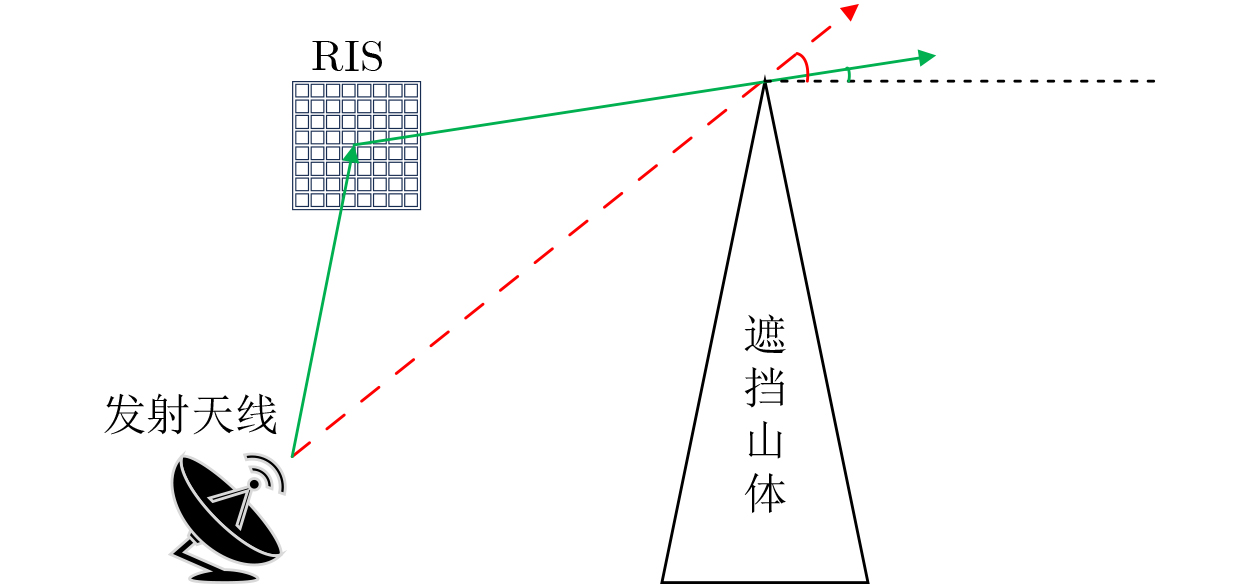
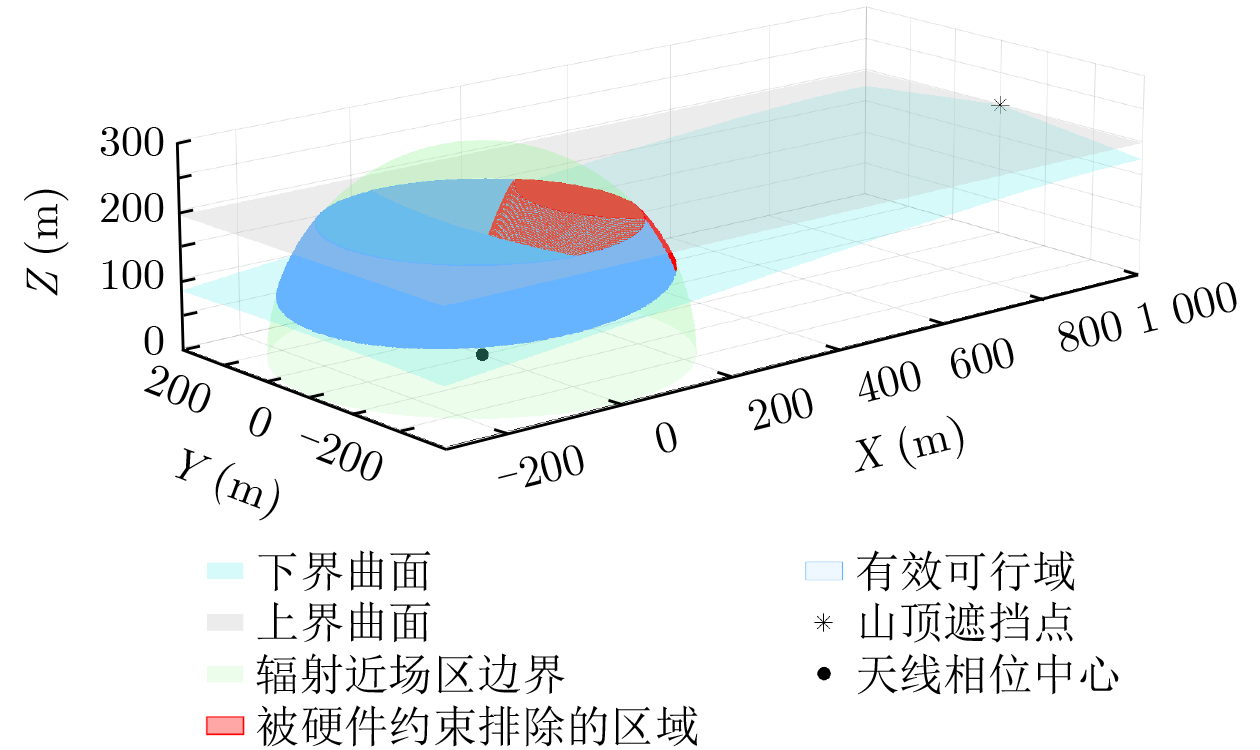
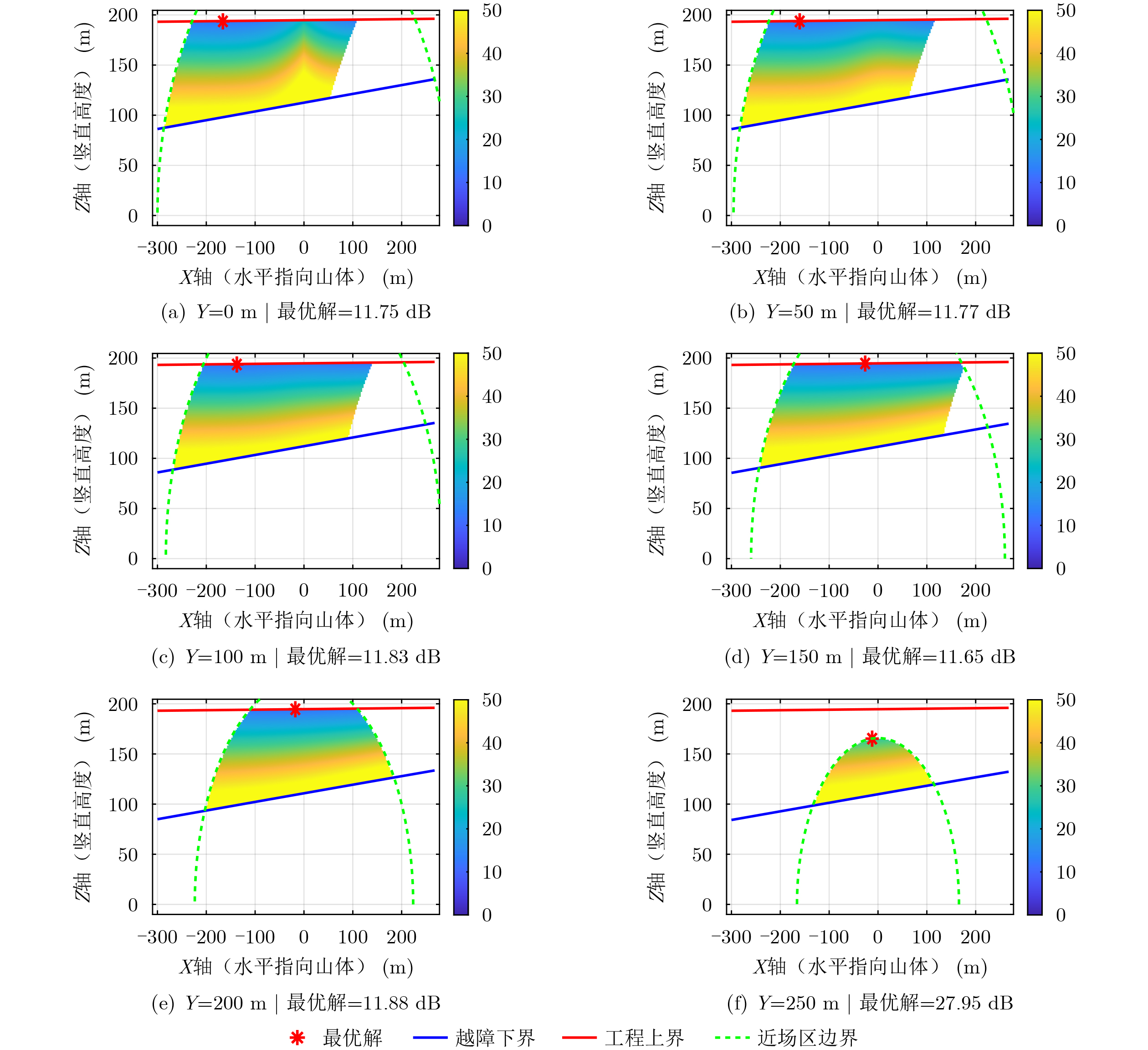
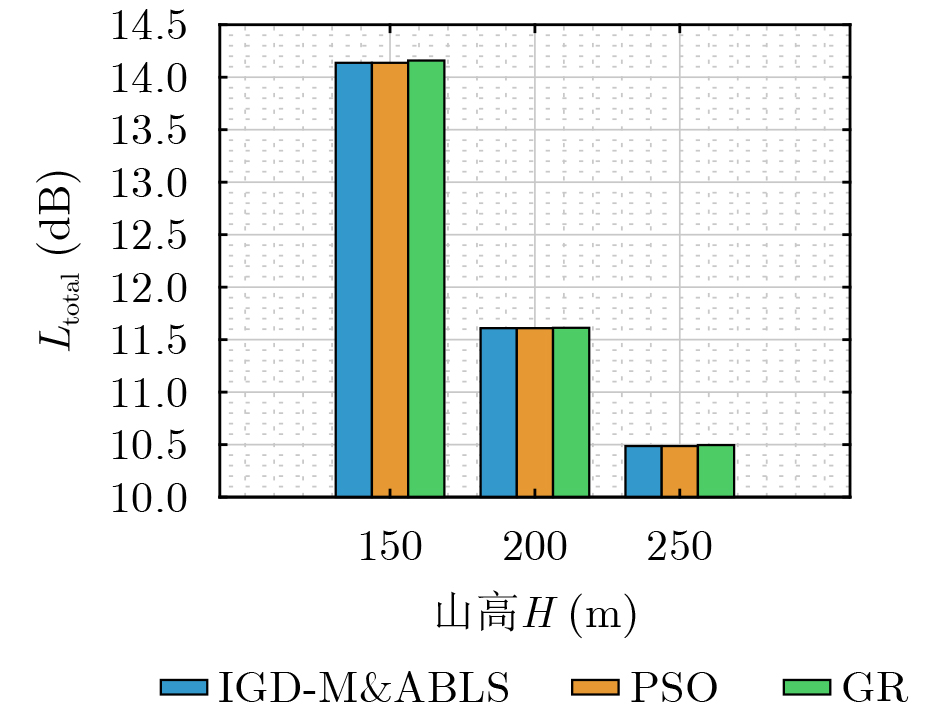
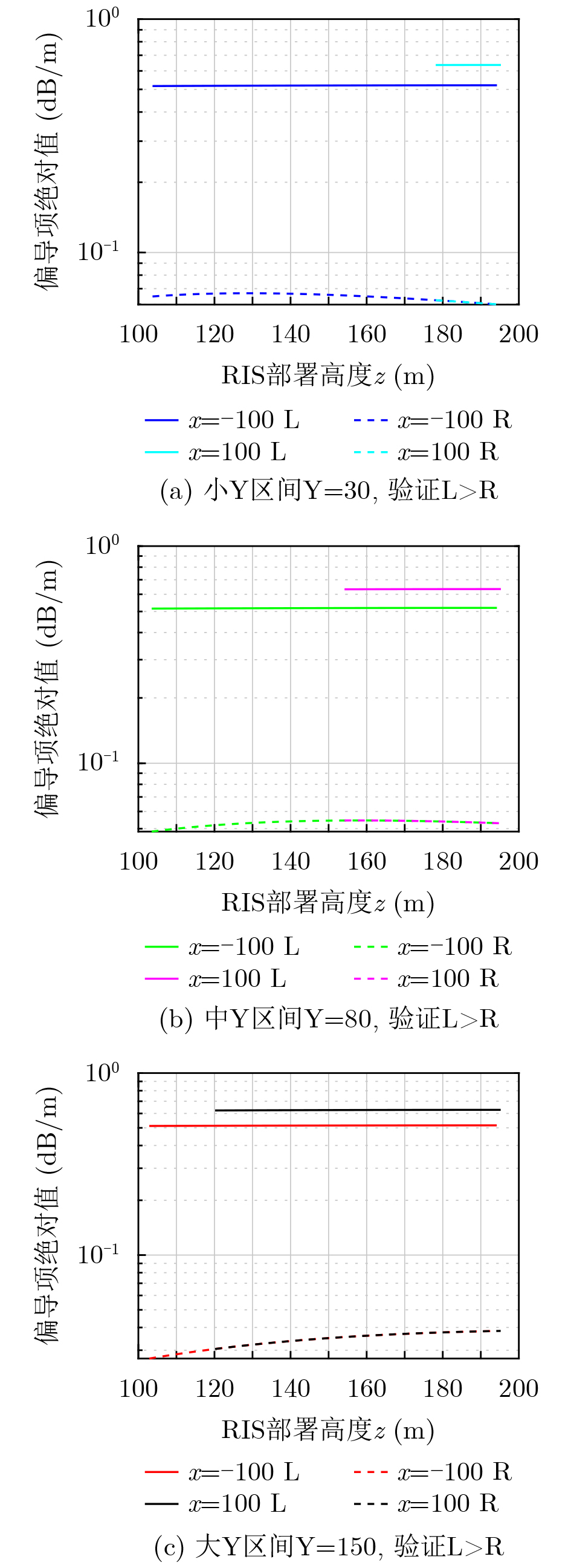
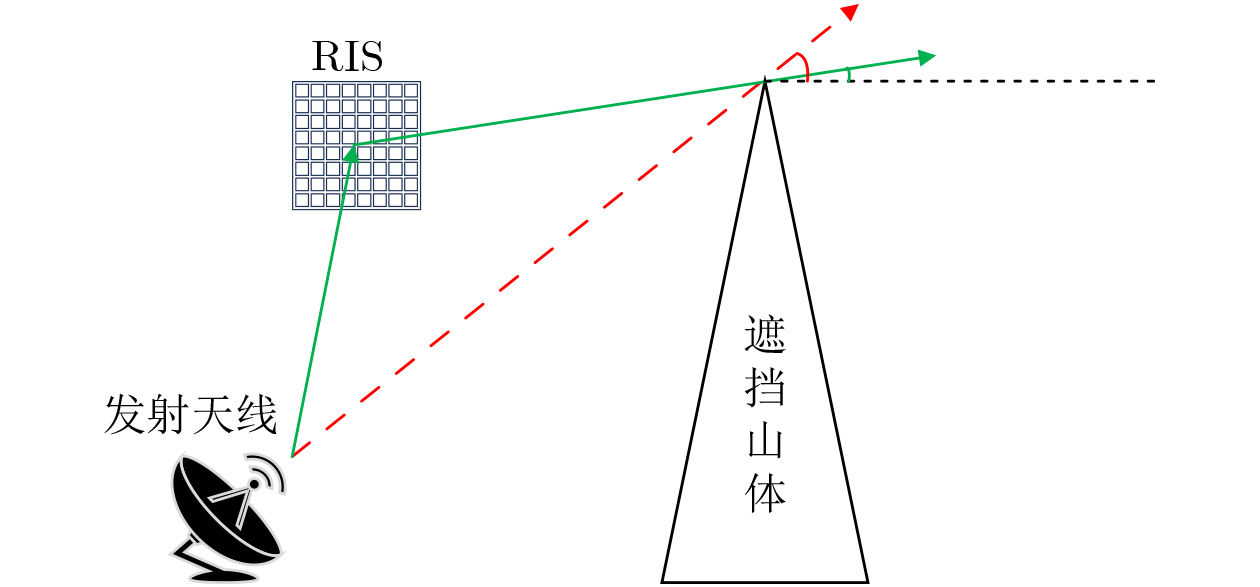
Objective Troposcatter communication serves as a valuable complement to satellite communication and thus is still quite promising in scenarios such as military long-distance communication. However, when a troposcatter communication system is deployed in mountainous environments, it is often faced with a prevalent and challenging engineering problem known as the “Line-of-Sight (LoS) obstruction”. Traditional solutions to this issue are still confronted with engineering difficulties. Increasing the antenna elevation angle to cross obstacles makes the scattering angle increase sharply and consequently lead to transmission loss surging beyond acceptable link budget limits; alternatively, building tall towers to raise antenna height preserves low-angle transmission but introduces construction difficulties and sacrifices the advantage of terrain concealment. Reconfigurable Intelligent Surface (RIS) has emerged as a disruptive technology in wireless communications, with the capability of reconstructing the wireless environment and artificially altering channel characteristics. It has been successfully applied in various civilian mobile communication systems. Obviously, it also provides an alternative to address the problem of LoS obstruction in troposcatter communications. Unfortunately, it has never been reported that RIS had been applied in such scenarios. Herein, to solve the LoS obstruction problem in troposcatter communications, RIS is involved for the first time in this field, a conceptual architecture of RIS-assisted troposcatter communication is set up, and then the problem of optimal RIS deployment is systematically investigated. Methods Based on the proposed framework of RIS-assisted troposcatter communication system, the deployment optimization of RIS is addressed step by step:Firstly, a three-dimensional model of feasible deployment region is established under four types of practical engineering constraints, i.e., the intrinsic constraint of obstacle-crossing, the optimal constraint of engineering upper bound, the antenna radiation constraint of Fresnel near-field region, and the hardware constraint of RIS effective angle.Secondly, the optimization problem of RIS deployment is formulated as minimizing the comprehensive system gain loss. The overall loss consists of three major components, namely, troposcatter transmission loss, free space path loss, and the dynamic gain attenuation of Cassegrain antennas with respect to their elevation angles. The first two parts are easily computed according to corresponding engineering knowledge of troposcatter communication and typical antenna theory, respectively. Then to calculate the dynamic gain attenuation of Cassegrain antennas, a quantitative model is developed based on cantilever beam bending theory. The model quantifies the pointing errors of a Cassegrain antenna caused by dynamic over-compensation with its elevation angle adjustment, and then the gain loss is calculated with the assistance of Taylor radiation pattern.Thirdly, through theoretical analysis and numerical verification via sectional slicing heatmaps, a dimensionality reduction property of the objective function is observed and validated. Within the feasible region, the first-order partial derivative of the objective function with respect to deployment height is always negative, implying that the global optimal deployment position necessarily lies on the upper boundary surface of the feasible region. The dimensionality reduction property is rigorously validated through slice analysis across the entire feasible domain, with more than 46,100 verification points confirming that the optimal position always resides on the upper boundary surface. This finding reduces the intractable three-dimensional constrained optimization problem to a much simpler two-dimensional manifold optimization, which significantly reduces the computational complexity of the optimization.Finally, based on this dimensionality reduction property, an improved gradient descent algorithm with momentum and adaptive backtracking line search (IGD-M&ABLS) is put forward. The algorithm introduces momentum gradient updates to suppress zigzag oscillations and accelerate convergence; it also incorporates an adaptive backtracking line search strategy to dynamically adjust step sizes, balancing iterative stability with computational efficiency. Results and Discussions A series of simulation experiments are conducted under typical engineering parameters, i.e., a 3-meter aperture Cassegrain antenna; 5 GHz signal frequency; mountain heights of 150 m, 200 m and 250 m, representing medium-high hills, the dividing line between hills and mountains, and relatively mountainous terrain, respectively. The proposed IGD-M&ABLS algorithm is benchmarked against Grid Search (GS, a classic deterministic exhaustive-search method) and Particle Swarm Optimization (PSO, a typical efficient heuristic algorithm). The results demonstrate that IGD-M&ABLS consistently converges to the global optimal solution with less gain losses than both benchmarks. Specifically, for the typical case with a 200 m mountain height, in 50 independent runs, IGD-M&ABLS always achieves the best objective function value of 11.6094 dB, much more steadily than PSO does, and it also outperforms GS's11.6127 dB. As far as time consumption is concerned, IGD-M&ABLS exhibits remarkable advantages of computational efficiency. Its average runtime is approximately 0.005 seconds, compared with 0.07 seconds of PSO and more than one hour of GS. This order-of-magnitude improvement in computational speed is consistent with the theoretical complexity analysis. IGD-M&ABLS optimizes two independent variables on a 2D manifold, whereas PSO and GS handle three independent variables in the 3D feasible domain. Robustness tests under varying terrain conditions (H = 150 m and H = 250 m) confirm that IGD-M&ABLS reliably obtains the best results across different scenarios. In all simulation tests, IGD-M&ABLS demonstrates excellent stability and reproducibility, producing consistent results across multiple independent runs, while PSO exhibits randomness-induced variations and GS remains limited by its discretization step size.Conclusions This paper pioneers the application of RIS technology in troposcatter communication, providing a new technical solution to address the LoS obstruction problem in mountainous environments. A conceptual framework of RIS-assisted troposcatter communication system is established, incorporating a three-dimensional feasible RIS deployment region model with four practical engineering constraints. Then the optimization problem of RIS deployment is formulated as minimizing the overall system gain loss including troposcatter transmission loss, free space path loss, and the dynamic gain attenuation of Cassegrain antennas with respect to their elevation angles, and the computation method of its third term is also developed for the first time based on cantilever beam bending theory. More interestingly, the objective function is found and verified with dimensionality reduction property, i.e., its minimum value always resides on the upper boundary manifold surface. That property effectively transforms the complex 3D optimization into an equivalent 2D manifold problem. Finally, a new algorithm IGD-M&ABLS is proposed by introducing momentum and adaptive backtracking line search into the traditional gradient descent framework. Simulation results show that compared with benchmarks, IGD-M&ABLS algorithm achieves the best deployment positions with order-of-magnitude faster computation, while maintaining excellent stability and reproducibility. -
1 IGD-M&ABLS算法
预设参数:初始步长α,动量系数β,衰减系数η,最大回溯次数
Nbt,收敛阈值,最大迭代次数输入:上界流形曲面$ {\Omega }^{\prime} $ 输出:最小目标函数值及对应的部署点位 1. 在$ {\Omega }^{\prime} $内计算10个初始点; 2. for 初始点(xi, yi)(i=1,2,···,10): 3. 初始化迭代步数k = 0,动量向量$ {\boldsymbol{v}}_{k}\mathbf{=}0 $; 4. while 未满足收敛条件 do: 5. 计算当前点梯度$ \nabla {L}_{\text{new}} $; 6. 动量梯度更新 $ {\boldsymbol{v}}_{k+1}=\beta {\boldsymbol{v}}_{k}+\left(1-\beta \right)\nabla {L}_{\text{new}} $; 7. 基于Armijo准则的自适应回溯线搜索: 8. 回溯次数t=0; 9. while 试探点不满足充分下降条件且t<Nbt do: 10. $ \alpha =\eta \cdot \alpha $, t = t+1; 11. end while 12. 更新坐标${x}_{k+1}={x}_{k}-\alpha \cdot {v}_{k+1,x} $,
$ {y}_{k+1}={y}_{k}-\alpha \cdot {v}_{k+1,y} $;13. 边界校验与修正,若出现异常坐标则投影至可行域内; 14. 收敛判据:梯度范数或函数值变化量达到收敛阈值 | 达
到最大迭代次数;15. k = k+1; 16. end while 17. 将(xk+1, yk+1)代入$ {\Omega }^{\prime} $,得到候选部署点位pi=(xk+1, yk+1,
zi),并按式(6)、(7)和(11)计算对应的目标函数值Lnew(pi)18. end for 19. 输出最小Lnew(pm)及其对应的pm=(xm, ym, zm)  下载: 导出CSV
表 2 实验参数设置
方法 参数 取值 IGD-M&ABLS 最大迭代次数 5000 初始迭代步长α 10 m 动量保留系数β 0.9 回溯线搜索次数 30 衰减系数η 0.7 梯度范数收敛阈值 10–5 目标函数变化量收敛阈值 10–7 PSO 独立运行次数 50 最大迭代次数 5000 种群规模 500 GS 搜索步长 0.5 m
下载: 导出CSV
表 3 最优运行结果对比(H=200 m)
方法 部署坐标(m) Ltotal
(dB)是否位于
上界曲面IGD-M&ABLS (–159.85, 0.00, 193.93) 11.6094 是 PSO (–159.88, 0.05, 193.93) 11.6094 是 GS (–144.00, 65.94, 194.00) 11.6127 是
下载: 导出CSV
表 4 统计测试结果对比(H=200 m)
方法 最差Ltotal(dB) 平均Ltotal(dB) Ltotal最大差值(dB) 标准差
(dB)IGD-M&ABLS 11.6094 11.6094 0 0 PSO 11.6378 11.6097 0.0284 0.0019
下载: 导出CSV
表 6 鲁棒性实验(H=150 m)
方法 部署坐标(m) Ltotal(dB) 是否位于
上界曲面IGD-M&ABLS (–118.82, 0.00, 144.14) 14.1372 是 PSO (–118.83, 0.044, 144.14) 14.1372 是 GS (–44.50, 110.68, 144.50) 14.1590 是
下载: 导出CSV
表 7 鲁棒性实验(H=250 m)
方法 部署坐标(m) Ltotal(dB) 是否位于
上界曲面IGD-M&ABLS (–174.75, 0.00, 243.85) 10.4862 是 PSO (–174.75, 0.037, 243.85) 10.4862 是 GS (–141.00, 102.56, 244.00) 10.4958 是
下载: 导出CSV
表 8 参量定义
符号 物理意义 单位 D 支撑杆圆管外径 m d 支撑杆圆管内径 m Isingle 单根支撑杆的截面惯性矩 m4 I 总截面惯性矩 m4 A 单根支撑杆的横截面积 m2 ρ 材料密度 kg/m3 g 标准重力加速度 m/s2 αinstall 支撑杆安装角 ° qsingle 单根支撑杆的等效线载荷 N/m q 总等效线载荷 N/m m 副面质量 kg F 端部集中力 N mrod 支撑杆质量 kg L 支撑杆等效长度(主面中心到副面的轴向距离) m E 弹性模量 Pa α1 集中受力引起的端部转角 rad α2 杆自重引起的端部转角 rad αmax 水平状态下的副面总偏转量 ° θ 天线电轴仰角 ° α(θ) 仰角为θ时的副面偏转量 ° M 卡塞格伦天线角放大率 $ \Phi \left(\theta \right) $ 等效指向误差 °
下载: 导出CSV
表 9 IGD-M&ABLS算法与标准GD算法对比
方法 求解坐标(m) Ltotal(dB) 平均迭代次数 IGD-M&ABLS (–159.85, 0.00, 193.93) 11.6094 291 标准GD
(1m步长)(–159.86, 0.00, 193.93) 11.6094 2794 标准GD
(10m步长)(–15.01, 0.00, 194.69) 20.4249 3540
下载: 导出CSV
-
[1] 张明高. 对流层散射传播[M]. 北京: 电子工业出版社, 2004: 8–21.ZHANG Minggao. Tropospheric Scatter Propagation[M]. Beijing: Publishing House of Electronics Industry, 2004: 8–21. (查阅网上资料, 未找到对应的英文翻译, 请确认). [2] 李志勇, 秦建存, 梁进波. 对流层散射通信工程[M]. 北京: 电子工业出版社, 2017: 1–4, 33–34.LI Zhiyong, QIN Jiancun, and LIANG Jinbo. Tropospheric Scatter Communication Engineering[M]. Beijing: Publishing House of Electronics Industry, 2017: 1–4, 33–34. [3] ZHANG Shuang, CHEN Xihong, LIU Qiang, et al. A new model for estimating troposcatter loss and delays based on ray-tracing and beam splitting with ERA5[J]. IEEE Transactions on Antennas and Propagation, 2022, 70(7): 5770–5783. doi: 10.1109/TAP.2022.3161458. [4] 赵玉超, 钱佳静, 芮义斌, 等. 基于CNN-GRU的对流层散射通信短期传输损耗预测[J]. 电讯技术, 2024, 64(8): 1175–1180. doi: 10.20079/j.issn.1001-893x.240415003.ZHAO Yuchao, QIAN Jiajing, RUI Yibin, et al. Short-term transmission loss prediction of troposcatter communication based on CNN-GRU[J]. Telecommunication Engineering, 2024, 64(8): 1175–1180. doi: 10.20079/j.issn.1001-893x.240415003. [5] 徐松毅, 陈常嘉, 李文铎. 高仰角对流层散射电波传播损耗的一种预计方法[J]. 电波科学学报, 2011, 26(3): 528–532. doi: 10.13443/j.cjors.2011.03.002.XU Songyi, CHEN Changjia, and LI Wenduo. A prediction method of the troposcatter transmission loss with high elevation[J]. Chinese Journal of Radio Science, 2011, 26(3): 528–532. doi: 10.13443/j.cjors.2011.03.002. [6] 赵玉超, 秦建存, 刘丽哲. 对流层散射通信传输损耗预计方法分析[J]. 无线电工程, 2013, 43(3): 62–64. doi: 10.3969/j.issn.1003-3106.2013.03.018.ZHAO Yuchao, QIN Jiancun, and LIU Lizhe. Analysis of troposcatter communication transmission loss prediction methods[J]. Radio Engineering, 2013, 43(3): 62–64. doi: 10.3969/j.issn.1003-3106.2013.03.018. [7] LI Chenglong, CHEN Xihong, and LIU Xiaopeng. Cognitive tropospheric scatter communication[J]. IEEE Transactions on Vehicular Technology, 2018, 67(2): 1482–1491. doi: 10.1109/TVT.2017.2761440. [8] 张涛, 刘莹, 孙柏昶, 等. 对流层散射通信及其应用[M]. 北京: 电子工业出版社, 2020: 259–263, 270–272.ZHANG Tao, LIU Ying, SUN Baichang, et al. Troposcatter Communication and Application[M]. Beijing: Publishing House of Electronics Industry, 2020: 259–263, 270–272. [9] 李纪, 于洋, 杜翔, 等. 基于实测AIS数据的对流层散射传播分析[J/OL]. 电波科学学报, 1–9. https://link.cnki.net/urlid/41.1185.TN.20260328.1518.001, 2026.LI Ji, YU Yang, DU Xiang, et al. Analysis of troposcatter propagation based on AIS data[J/OL]. Chinese Journal of Radio Science, 1–9. https://link.cnki.net/urlid/41.1185.TN.20260328.1518.001, 2026. [10] WU Qingqing and ZHANG Rui. Intelligent reflecting surface enhanced wireless network via joint active and passive beamforming[J]. IEEE Transactions on Wireless Communications, 2019, 18(11): 5394–5409. doi: 10.1109/TWC.2019.2936025. [11] LIU Yuanwei, LIU Xiao, MU Xidong, et al. Reconfigurable intelligent surfaces: Principles and opportunities[J]. IEEE Communications Surveys & Tutorials, 2021, 23(3): 1546–1577. doi: 10.1109/COMST.2021.3077737. [12] WU Qingqing, ZHANG Shuowen, ZHENG Beixiong, et al. Intelligent reflecting surface-aided wireless communications: A tutorial[J]. IEEE Transactions on Communications, 2021, 69(5): 3313–3351. doi: 10.1109/TCOMM.2021.3051897. [13] VIDAL ALEGRÍA J, THUNBERG J, and EDFORS O. Channel orthogonalization with reconfigurable surfaces: General models, theoretical limits, and effective configuration[J]. IEEE Transactions on Wireless Communications, 2025, 24(6): 5179–5195. doi: 10.1109/TWC.2025.3546429. [14] CHEN Weicong, WEN Chaokai, TANG Wankai, et al. Joint spatial division and multiplexing with customized orthogonal group channels in multi-RIS-assisted systems[J]. IEEE Transactions on Wireless Communications, 2025, 24(12): 10675–10690. doi: 10.1109/TWC.2025.3590467. [15] CHEN Yuxuan, WU Qingqing, CHEN Guangji, et al. Spatial multiplexing oriented channel reconfiguration in multi-IRS aided MIMO systems[J]. IEEE Transactions on Vehicular Technology, 2025, 74(6): 9840–9845. doi: 10.1109/TVT.2025.3540067. [16] CHEN Weicong, WEN Chaokai, LI Xiao, et al. Channel customization for joint Tx-RISs-Rx design in hybrid mmWave systems[J]. IEEE Transactions on Wireless Communications, 2023, 22(11): 8304–8319. doi: 10.1109/TWC.2023.3262272. [17] 袁一铭, 徐勇军, 周继华. 可重构智能反射面辅助太赫兹通信系统鲁棒波束赋形算法[J]. 电子与信息学报, 2024, 46(3): 808–816. doi: 10.11999/JEIT230160.YUAN Yiming, XU Yongjun, and ZHOU Jihua. Robust beamforming algorithm for terahertz communication systems aided by reconfigurable intelligent surfaces[J]. Journal of Electronics & Information Technology, 2024, 46(3): 808–816. doi: 10.11999/JEIT230160. [18] 徐勇军, 徐娟, 田秦语, 等. 基于统计信道状态信息的智能反射面辅助反向散射通信系统鲁棒资源分配算法[J]. 电子与信息学报, 2024, 46(5): 1986–1995. doi: 10.11999/JEIT231169.XU Yongjun, XU Juan, TIAN Qinyu, et al. Robust resource allocation algorithm for reconfigurable intelligent surface-assisted backscatter communication systems based on statistical channel state information[J]. Journal of Electronics & Information Technology, 2024, 46(5): 1986–1995. doi: 10.11999/JEIT231169. [19] 陈鸣锴, 孙振德, 万雅芳. RIS辅助下的跨模态通信资源分配[J]. 电子与信息学报, 2025, 47(2): 363–374. doi: 10.11999/JEIT240619.CHEN Mingkai, SUN Zhende, and WAN Yafang. Resource allocation for RIS-aided cross-modal communications[J]. Journal of Electronics & Information Technology, 2025, 47(2): 363–374. doi: 10.11999/JEIT240619. [20] GHOSE S, MISHRA D, MAITY S P, et al. Jointly optimal RIS placement and power allocation for underlay D2D communications: An outage probability minimization approach[J]. IEEE Transactions on Cognitive Communications and Networking, 2024, 10(2): 622–633. doi: 10.1109/TCCN.2023.3333351. [21] BAKHSHI M, BAYAT S, and AMIRI R. Optimal RIS placement in near-field localization using gray wolf optimizer[J]. IEEE Transactions on Vehicular Technology, 2025, 74(4): 6795–6800. doi: 10.1109/TVT.2024.3520232. [22] WANG Jiaping, HAN Yu, ZHANG Jun, et al. Deployment optimization of extremely large-scale RIS-aided communication system[J]. IEEE Transactions on Communications, 2025, 73(12): 15570–15582. doi: 10.1109/TCOMM.2025.3606639. [23] KUANG Yi, LIU Lingya, and XU Jing. Optimal 3-D deployment range of RIS in mmWave communications with random blockages[J]. IEEE Communications Letters, 2026, 30: 767–771. doi: 10.1109/LCOMM.2025.3649705. [24] LIANG Jingcheng, CHENG Qiang, GAO Yuan, et al. An angle-insensitive 3-bit reconfigurable intelligent surface[J]. IEEE Transactions on Antennas and Propagation, 2022, 70(10): 8798–8808. doi: 10.1109/TAP.2021.3130108. [25] VUYYURU S K R, HAO Le, RUPP M, et al. Modeling RIS from electromagnetic principles to communication systems—part I: Synthesis and characterization of a scalable anomalous reflector[J]. IEEE Transactions on Antennas and Propagation, 2025, 73(3): 1743–1755. doi: 10.1109/TAP.2024.3520416. [26] CHEN Weicong, BAI Lin, TANG Wankai, et al. Angle-dependent phase shifter model for reconfigurable intelligent surfaces: Does the angle-reciprocity hold?[J]. IEEE Communications Letters, 2020, 24(9): 2060–2064. doi: 10.1109/LCOMM.2020.2993961. [27] 董榕恩, 谢中毅, 马海波, 等. 离散相移IRS辅助放大转发中继网络的性能分析[J]. 电子与信息学报, 2025, 47(1): 138–146. doi: 10.11999/JEIT240236.DONG Rongen, XIE Zhongyi, MA Haibo, et al. Performance analysis of discrete-phase-shifter IRS-aided amplify-and-forward relay network[J]. Journal of Electronics & Information Technology, 2025, 47(1): 138–146. doi: 10.11999/JEIT240236. [28] ITU. Rec. ITU-R P. 617-2 Propagation prediction techniques and data required for the design of trans-horizon radio-relay systems[S]. ITU, 2012. (查阅网上资料, 未找到出版地信息, 请补充). [29] 中国人民解放军总参谋部通信部. 对流层散射远距离通信[M]. 北京: 中国人民解放军战士出版社, 1982: 89–93. (查阅网上资料, 未找到本条文献信息, 请确认).PLA General Staff Communication Department. Tropospheric Scatter Long-Distance Communication[M]. Beijing: PLA Soldier Publishing House, 1982: 89–93. [30] 中华人民共和国住房和城乡建设部. GB 50922-2013 天线工程技术规范[S]. 北京: 中国计划出版社, 2014.Ministry of Housing and Urban-Rural Development of the People's Republic of China. GB 50922-2013 Code for technical antenna engineering[S]. Beijing: China Planning Press, 2014. [31] 王伟. 机械结构因素对反射面天线电性能的影响机理及其应用[D]. 西安: 西安电子科技大学, 2011.WANG Wei. Influence mechanism of mechanical factors on electrical performance of reflector antenna and its applications[D]. Xi’an: Xidian University, 2011. [32] 严粤飞, 王宗清, 王文娟, 等. 主反射面形面不确定性对天线电性能的影响机理[J]. 电子机械工程, 2025, 41(1): 1–6,20. doi: 10.19659/j.issn.1008-5300.20241021001.YAN Yuefei, WANG Zongqing, WANG Wenjuan, et al. Influence mechanism of main reflecting surface shape uncertainty on electrical performance of antennas[J]. Electro-Mechanical Engineering, 2025, 41(1): 1–6,20. doi: 10.19659/j.issn.1008-5300.20241021001. [33] 王伟, 段宝岩, 马伯渊. 重力作用下天线反射面变形及其调整角度的确定[J]. 电波科学学报, 2008, 23(4): 645–650,698. doi: 10.3969/j.issn.1005-0388.2008.04.010.WANG Wei, DUAN Baoyan, and MA Boyuan. Gravity deformation and best rigging angle for surface adjustment of large reflector antennas[J]. Chinese Journal of Radio Science, 2008, 23(4): 645–650,698. doi: 10.3969/j.issn.1005-0388.2008.04.010. [34] 连培园, 王伟, 张树新. 等. 基于远场的反射面天线馈源位姿调整方法[J]. 系统工程与电子技术, 2014, 36(1): 9–15. doi: 10.3969/j.issn.1001-506X.2014.01.02.LIAN Peiyuan, WANG Wei, ZHANG Shuxin, et al. Adjustment method of position and orientation of reflector antenna feed based on far field[J]. Systems Engineering and Electronics, 2014, 36(1): 9–15. doi: 10.3969/j.issn.1001-506X.2014.01.02. [35] 项斌斌, 王从思, 王伟, 等. 基于机电耦合的反射面天线副面位置调整方法[J]. 系统工程与电子技术, 2018, 40(3): 489–497. doi: 10.3969/j.issn.1001-506X.2018.03.01.XIANG Binbin, WANG Congsi, WANG Wei, et al. Adjustment method of subreflector position of reflector antennas based on electromechanical couple theory[J]. Systems Engineering and Electronics, 2018, 40(3): 489–497. doi: 10.3969/j.issn.1001-506X.2018.03.01. [36] TAYLOR T. Design of circular apertures for narrow beamwidth and low sidelobes[J]. IRE Transactions on Antennas and Propagation, 1960, 8(1): 17–22. doi: 10.1109/TAP.1960.1144807. [37] 程维明, 周成虎, 柴慧霞, 等. 中国陆地地貌基本形态类型定量提取与分析[J]. 地球信息科学学报, 2009, 11(6): 725–736. doi: 10.3969/j.issn.1560-8999.2009.06.007.CHENG Weiming, ZHOU Chenghu, CAI Huixia, et al. Quantitative extraction and analysis of basic morphological types of land geomorphology in China[J]. Journal of Geo-Information Science, 2009, 11(6): 725–736. doi: 10.3969/j.issn.1560-8999.2009.06.007. [38] 钟祥浩, 刘淑珍. 中国山地分类研究[J]. 山地学报, 2014, 32(2): 129–140. doi: 10.3969/j.issn.1008-2786.2014.02.001.ZHONG Xianghao and LIU Shuzhen. Research on the mountain classification in China[J]. Mountain Research, 2014, 32(2): 129–140. doi: 10.3969/j.issn.1008-2786.2014.02.001. [39] 李庆扬. 数值分析[M]. 6版. 北京: 清华大学出版社, 2025: 212–214.LI Qingyang. Numerical Analysis[M]. 6th ed. Beijing: Tsinghua University Press, 2025: 212–214. (查阅网上资料, 未找到对应的英文翻译, 请确认). [40] 王文鼐, 耿心怡, 余锦涵, 等. 智能反射面室内部署的位置规划方法[J]. 电子与信息学报, 2024, 46(4): 1314–1320. doi: 10.11999/JEIT230414.WANG Wennai, GENG Xinyi, YU Jinhan, et al. A placement planning scheme of intelligent-reflecting-surface for in-door deployment[J]. Journal of Electronics & Information Technology, 2024, 46(4): 1314–1320. doi: 10.11999/JEIT230414. [41] 国家市场监督管理总局, 国家标准化管理委员会. GB/T 6728-2025 结构用冷弯型钢[S]. 北京: 中国标准出版社, 2025. (查阅网上资料, 未能确认年份信息, 请确认).State Administration for Market Regulation and Standardization Administration of the People’s Republic of China. GB/T 6728-2025 Cold forming sectional steel for general structure[S]. Beijing: Standards Press of China, 2025. [42] 中华人民共和国国家质量监督检验检疫总局, 中国国家质量监督检验检疫总局. GB/T 700-2006 碳素结构钢[S]. 中国标准出版社, 2007.General Administration of Quality Supervision, Inspection and Quarantine of the People's Republic of China and General Administration of Quality Supervision, Inspection and Quarantine of the People's Republic of China. GB/T 700-2006 Carbon structural steels[S]. Beijing: Standards Press of China, 2007. -

 下载:
下载:

图(5) / 表(10)
计量
- 文章访问数: 20
- HTML全文浏览量: 5
- PDF下载量: 0
- 被引次数: 0
