




Three-Dimensional Joint Parameter Estimation Algorithm Based on Wi-Fi Beamforming Feedback Information
-
摘要: 针对高精度感知中信道状态信息(CSI)提取严重依赖特定底层硬件,且真实商用Wi-Fi设备波束成形反馈信息(BFI)受反馈量化和室内多径相干影响而易出现测角精度下降的问题,该文提出了一种基于BFI的三维联合参数估计方法。与依赖专用网卡、驱动或固件获取CSI的方法不同,BFI可通过第三方嗅探器监听商用Wi-Fi设备获得,便于实际部署。首先,采集得到收发链路中包含视距路径与反射路径的BFI数据,并将其重构为关于天线、子载波和数据包的三维矩阵;其次,将重构的三维BFI矩阵进行初始相位矫正,并对矫正后的矩阵做平滑去相干处理;随后,计算平滑协方差矩阵,再利用特征值分解将信号子空间与噪声子空间进行分离;最后,通过谱峰搜索实现对各径信号的离开角(AoD)、相对飞行时间(ToF)与相对多普勒频移(DFS)的联合估计。仿真结果表明,所提三维联合估计方法能够有效提升多径参数分辨能力,在5 dB噪声下,AoD估计的均方根误差(RMSE)低于2°,并能够有效区分不同相对ToF和相对DFS的多径信号。实测数据结果验证,在室内和室外场景下,80%的AoD估计误差分别低于8°和5°。上述结果表明,所提方法能够在商用Wi-Fi BFI条件下有效提取视距主径的角度信息,并为基于BFI的Wi-Fi定位与感知参数估计提供理论基础和实验支撑。Abstract:
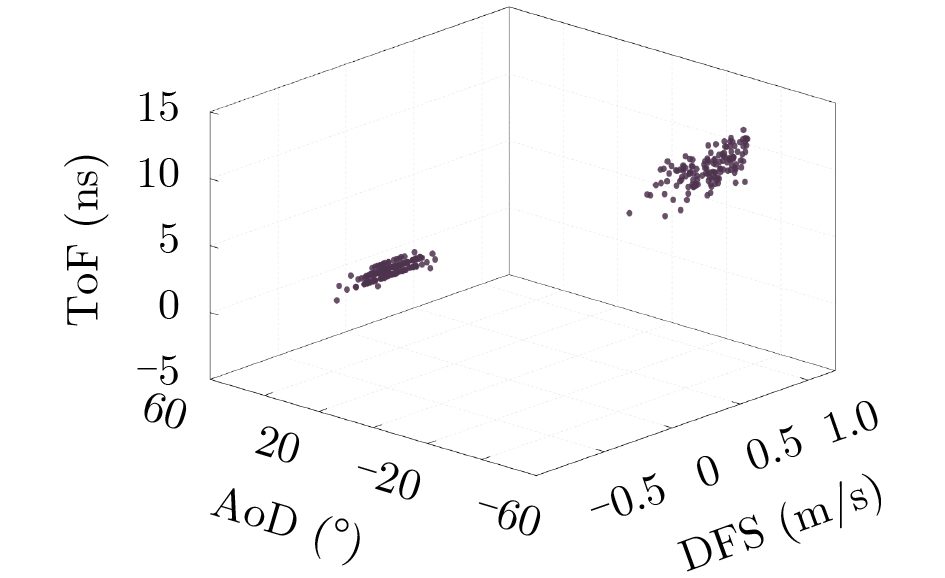
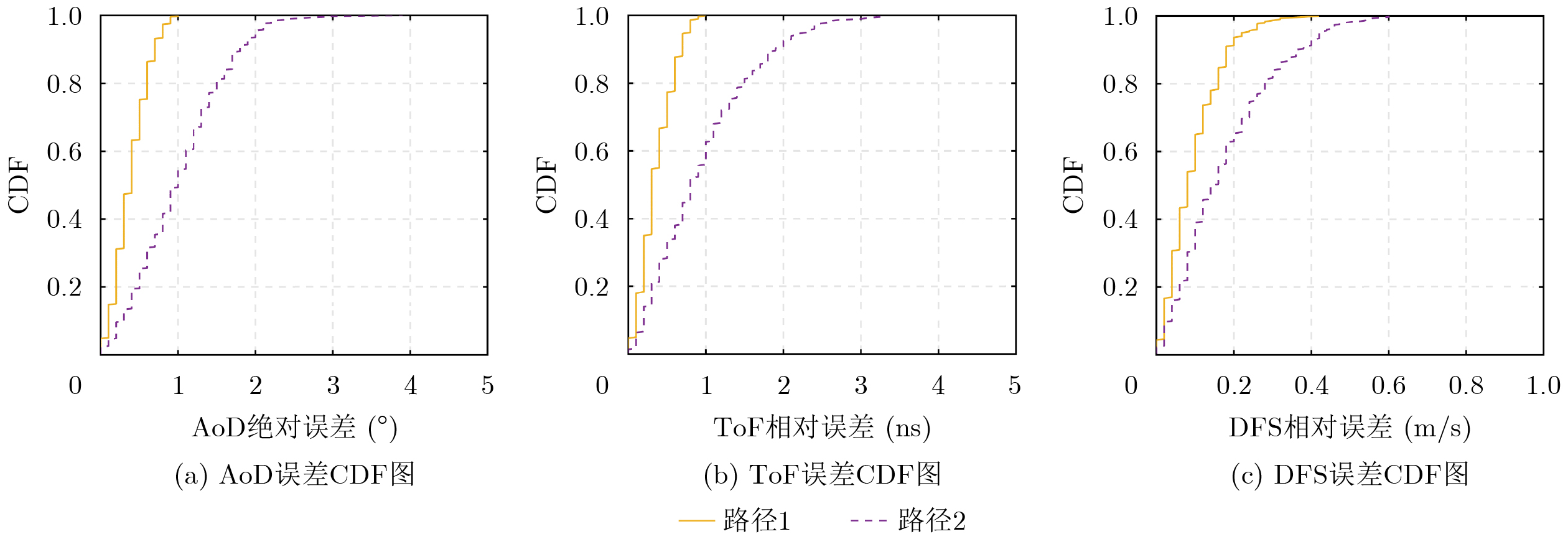
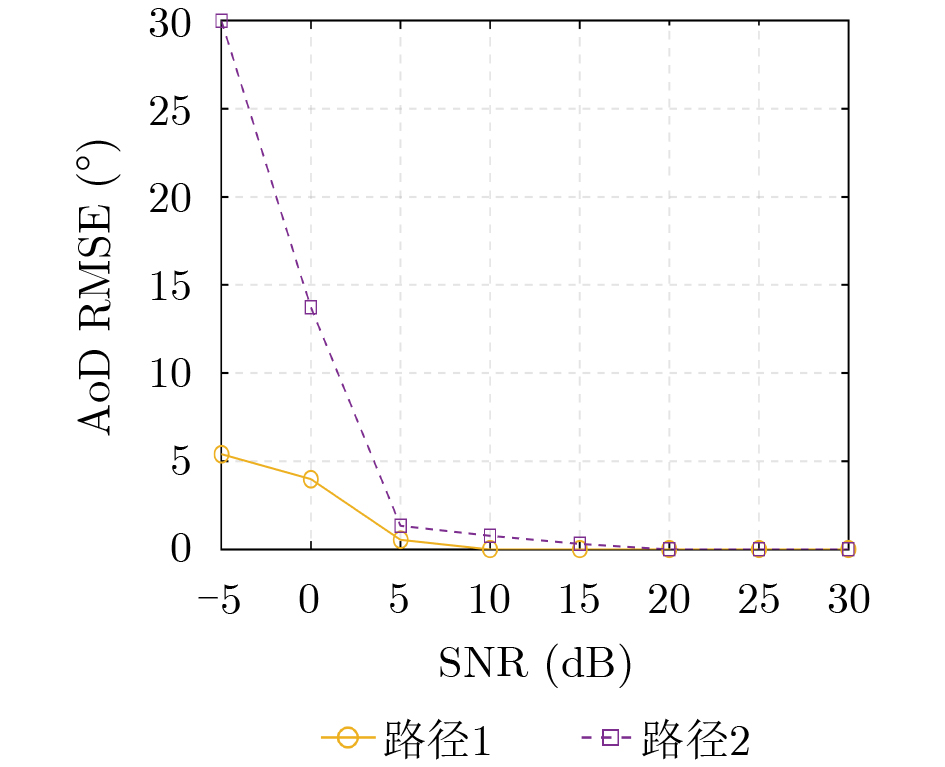
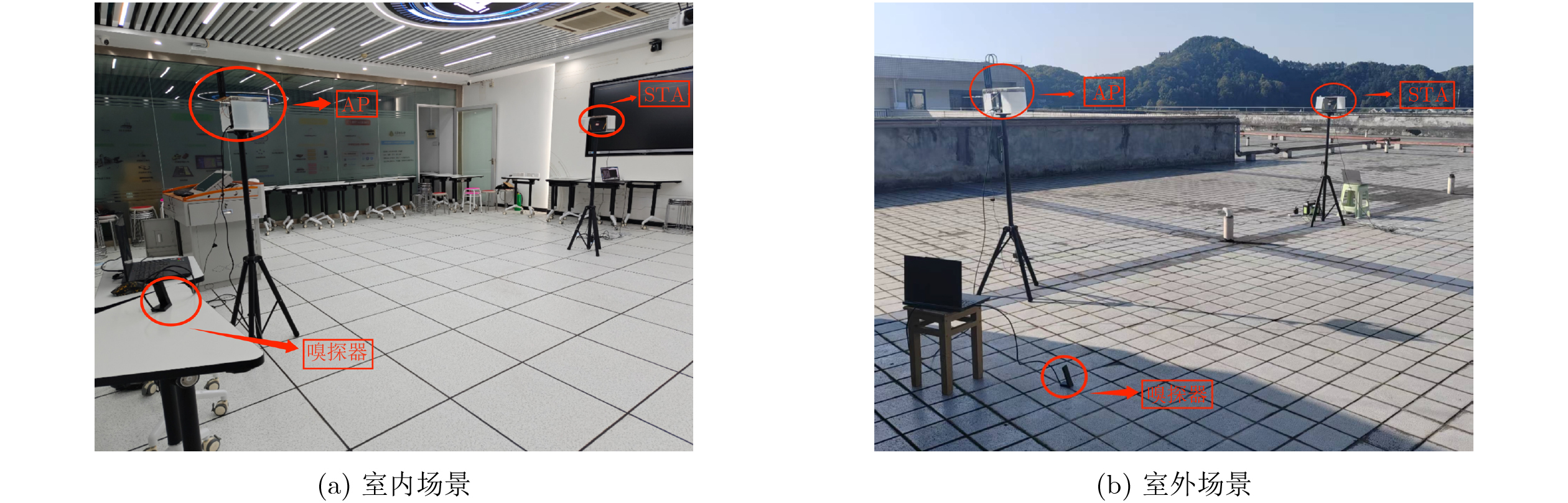
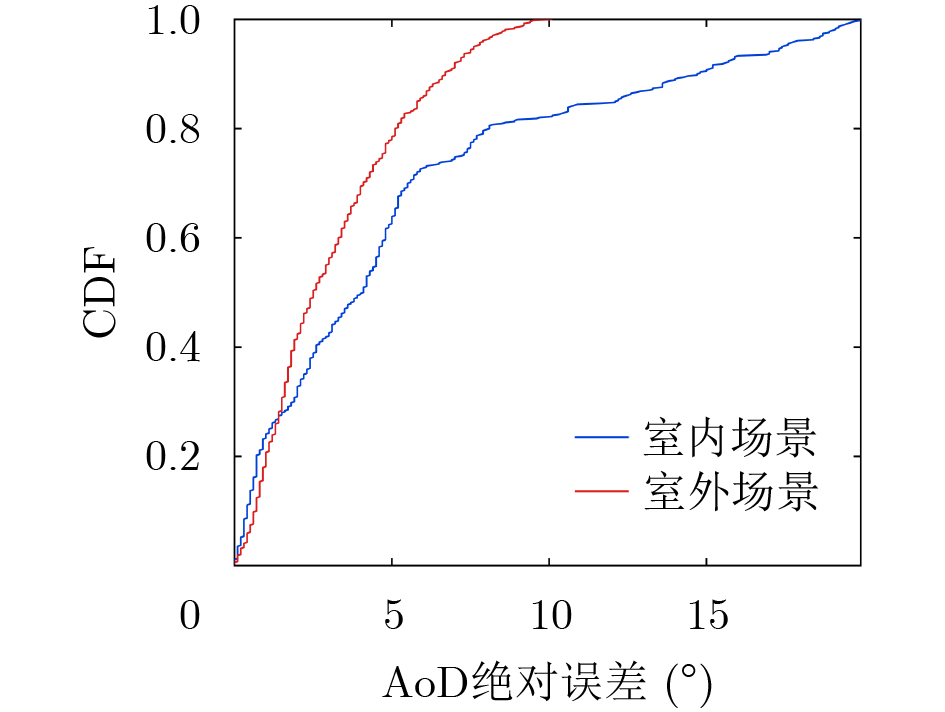
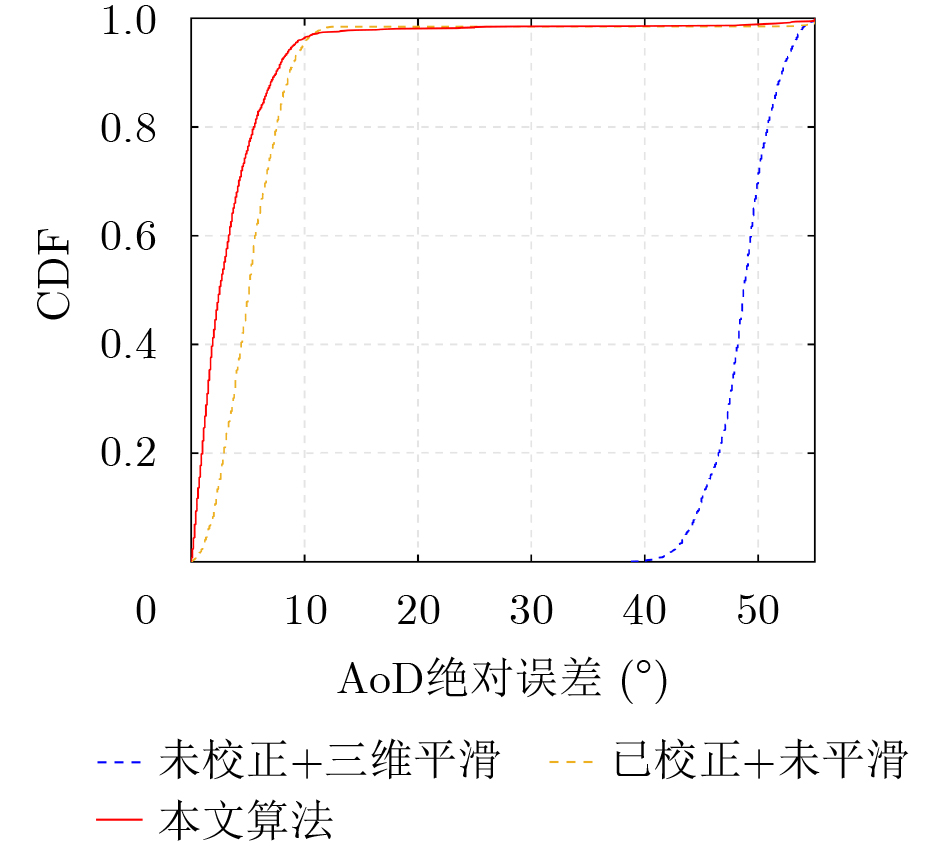
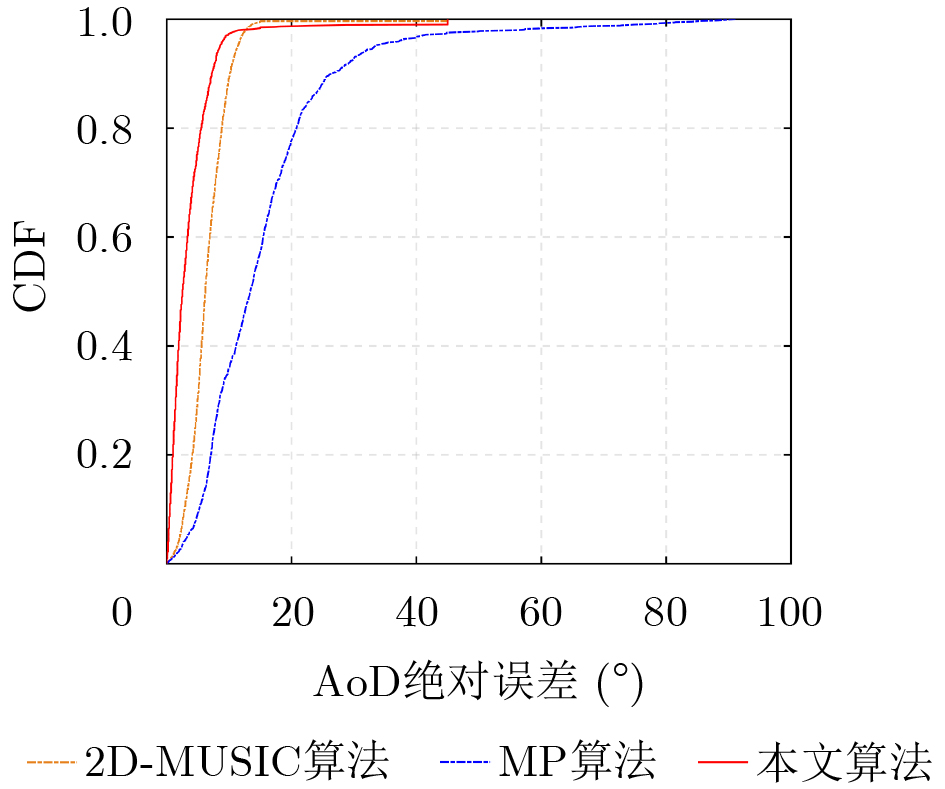
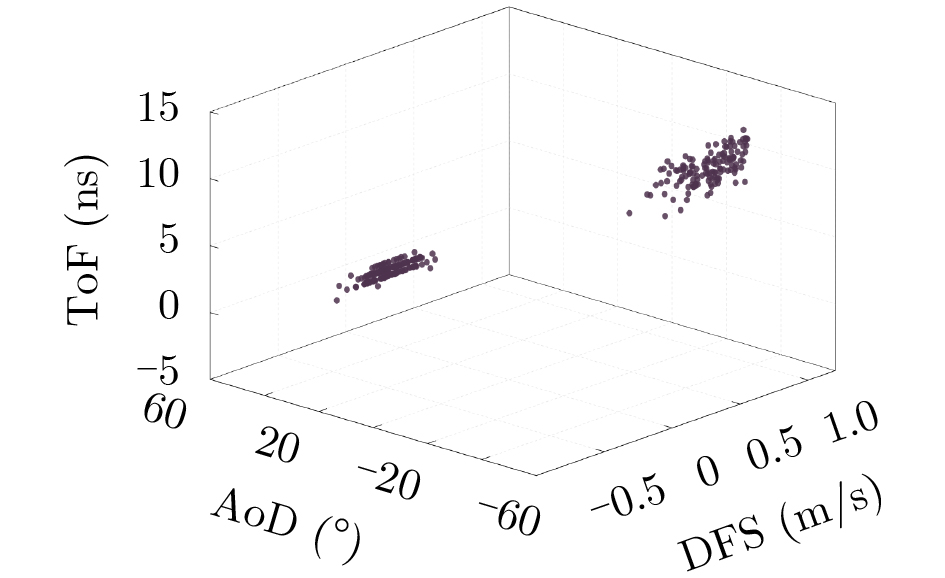
Objective With the development of the Internet of Things (IoT), smart homes, and passive sensing applications, Wi-Fi localization and sensing are used in target tracking, human activity recognition, and vital sign monitoring. Accurate propagation parameters are needed to distinguish signals from different paths in multipath environments. Channel State Information (CSI) provides fine-grained channel descriptions, but its acquisition often depends on specific hardware, drivers, or firmware. Beamforming Feedback Information (BFI) can be obtained by a third-party sniffer from the feedback frames exchanged between commercial Wi-Fi devices. However, actual BFI is affected by feedback compression, quantization, and coherent multipath propagation, which can reduce angle estimation accuracy. In addition, BFI calculated from measured CSI does not fully represent the characteristics of actual feedback data. To address these problems, a three-dimensional (3D) joint parameter estimation method based on MUltiple SIgnal Classification (MUSIC) is proposed. Antenna, subcarrier, and packet information is used to estimate the Angle of Departure (AoD), relative Time of Flight (ToF), and relative Doppler Frequency Shift (DFS) of the principal propagation paths. Methods A Wi-Fi link with a uniform linear transmit array and a single receive antenna is considered. The BFI signal model is derived from the right singular vector of the channel and the reference-phase adjustment performed during feedback generation. A dominant Line-of-Sight (LoS) path is assumed in the derivation of the BFI signal model. Under this condition, the spatial phase retains the absolute AoD of each path, while the frequency and temporal phase terms contain the ToF and DFS differences relative to the LoS path. The velocity parameter corresponding to DFS is used in the estimation, and its relationship with DFS is determined by the carrier wavelength. Feedback frames are captured by a sniffer without modifying the hardware, drivers, or firmware of the communicating devices. The feedback information is parsed and reconstructed into a 3D BFI matrix along the antenna, subcarrier, and packet dimensions. Uncorrected channel phase offsets distort the spatial steering relationship and therefore need to be compensated before AoD estimation. Initial phase calibration is performed using reference data collected in a dominant-LoS environment with a known departure direction. The phase offsets among antenna channels are estimated across subcarriers and compensated in subsequent measurements. Multidimensional smoothing is then applied to reduce multipath coherence. Coherent paths can make the covariance matrix rank deficient, affecting the separation of the signal and noise subspaces. Smoothing is used to address this problem before the joint spectrum is constructed. Overlapping data blocks are formed along the three dimensions and combined into a smoothing matrix ( Algorithm 1 ). The sample covariance matrix is calculated and processed by forward/backward averaging. Eigenvalue decomposition is used to separate the signal and noise subspaces. A joint steering vector is constructed from the spatial, frequency, and temporal responses. The MUSIC spectrum is formed using its orthogonality to the noise subspace, and the parameters are jointly estimated through a 3D spectrum peak search. The antenna dimension provides spatial phase information for AoD estimation, while the subcarrier and packet dimensions provide the phase variations associated with relative delay and Doppler. These dimensions are processed together to improve the separation of coherent propagation paths.Results and Discussions Simulations verify the joint estimation of AoD, relative ToF, and relative DFS for a stronger LoS path and an attenuated reflected path. The estimates form two clusters near the expected parameter values. The AoD estimates correspond to the absolute path directions, while the delay and velocity estimates correspond to differences relative to the LoS path, consistent with the BFI model ( Fig. 1 ). The parameter-error distributions show that higher accuracy is obtained for the stronger LoS path (Fig. 2 ). The reflected path is more sensitive to noise, indicating that joint estimation accuracy is affected by path strength. As the Signal-to-Noise Ratio (SNR) increases, the AoD Root Mean Square Errors (RMSEs) decrease. At 5 dB, the AoD RMSEs of both paths are below 2° (Fig. 3 ). These results show that the method can distinguish the direct and reflected components by jointly processing their spatial, frequency, and temporal characteristics. Measurements are conducted in indoor and outdoor environments using commercial Wi-Fi devices (Fig. 4 ). At the 80th percentile of the Cumulative Distribution Function (CDF), the AoD errors are below 8° indoors and 5° outdoors. The smaller outdoor error is attributed to weaker multipath interference in the open environment. The outdoor AoD error is approximately 3° smaller at this percentile (Fig. 5 ). Ablation experiments are conducted using the same measured data to examine phase calibration and smoothing. Without phase calibration, the 80th-percentile AoD error is approximately 50°, showing that channel phase offsets substantially affect the estimation. After calibration, smoothing further reduces this error by approximately 2° compared with processing without smoothing. Thus, phase calibration compensates for hardware-related phase offsets, while smoothing reduces the effect of coherent multipath (Fig. 6 ). Comparisons with 2D MUSIC and Matrix Pencil (MP) are conducted using the same BFI data and calibration data. The proposed method yields smaller AoD estimation errors, with an 80th-percentile error within 5.5°, compared with approximately 21° for MP (Fig. 7 ). The measured evaluation focuses on AoD. Relative ToF estimation is limited by the available frequency coverage, while DFS estimation is affected by the feedback-packet interval and observation duration. In particular, large and irregular packet intervals restrict the sampling of temporal phase changes. Therefore, the joint estimation of all three parameters is evaluated through simulation, while the measured results establish the AoD performance under the available acquisition conditions.Conclusions A BFI-based 3D joint parameter estimation method is proposed for commercial Wi-Fi devices. Under the dominant-LoS approximation, absolute AoD and relative ToF and DFS can be estimated from the reconstructed BFI matrix. Simulation results verify the joint estimation of these parameters for the LoS and reflected paths. Measurements show that initial phase calibration and multidimensional smoothing improve AoD estimation, with 80th-percentile errors below 8° indoors and 5° outdoors. Compared with 2D MUSIC and MP, improved AoD accuracy is obtained at a higher computational cost. Further measured evaluation of relative ToF and DFS requires a wider channel bandwidth and shorter, more regular feedback-packet intervals. Future work will focus on reducing the computational complexity of the 3D search. -
1 三维空间平滑处理
输入:初始相位矫正后的三维BFI矩阵$ \tilde{\boldsymbol{V}}\in {\mathbb{C}}^{M\times N\times P} $;平滑窗口大小J,K,R 输出:经三维平滑重构后的二维矩阵$ {\tilde{\boldsymbol{V}}}_{\mathrm{e}} $ 1:计算各维度的滑动窗口总数:$ {M}_{\mathrm{s}}=M-J+1 $,$ {N}_{\mathrm{s}}=N-K+1 $,$ {P}_{\mathrm{s}}=P-R+1 $ 2:for p = 1,2,···,P do 3: for m = 1,2,···,M do 4: 沿子载波维度滑动窗口K,重构向量得到子载波平滑矩阵$ {\tilde{\boldsymbol{V}}}_{m,p}\in {\mathbb{C}}^{K\times {{N}_{\mathrm{s}}}} $ 5: end for 6: 沿天线维度滑动窗口J,将对应的$ {\tilde{\boldsymbol{V}}}_{m,p} $按分块矩阵规则纵横拼接,构造二维平滑矩阵$ {\tilde{\boldsymbol{V}}}_{p}\in {\mathbb{C}}^{(JK)\times ({{M}_{\mathrm{s}}}{{N}_{\mathrm{s}}})} $ 7:end for 8:for t = 1,2, ···, $ {P}_{\mathrm{s}} $ do 9: 沿数据包维度滑动窗口R,纵向堆叠二维矩阵$ {\tilde{\boldsymbol{V}}}_{t} $,···, $ {\tilde{\boldsymbol{V}}}_{t+R-1} $形成重构分块子矩阵$ \tilde{\boldsymbol{V}}_{\mathrm{block}}^{(t)} $ 10:end for 11:将所有子矩阵$ \tilde{\boldsymbol{V}}_{\mathrm{block}}^{(1)} $至$ \tilde{\boldsymbol{V}}_{\mathrm{block}}^{({P}_{\mathrm{s}})} $按水平方向拼接,返回最终的平滑矩阵$ {\tilde{\boldsymbol{V}}}_{\mathrm{e}} $  下载: 导出CSV
表 1 仿真参数设置
参数名称 符号 数值 参数名称 符号 数值 发射天线数量 M 4 天线平滑窗口 J 3 子载波数量 N 234 子载波平滑窗口 K 12 数据包个数 P 4 数据包平滑窗口 R 2
下载: 导出CSV
表 2 算法复杂度对比
算法 主要步骤 复杂度表达式 MP算法 奇异值分解 $ \mathrm{O}\left\{{(KJ)}^{2}{L}_{2\mathrm{D}}+{(KJ)}^{3}\right\} $ 二维MUSIC
算法特征值分解
2D网格搜索$\begin{aligned} \;&\mathrm{O}\left\{{(KJ)}^{2}{L}_{2\mathrm{D}}+{(KJ)}^{3}\right.\\\;& \left.+{(KJ)}^{2}\times {N}_{\theta }\times {N}_{\tau }\right\}\end{aligned}$ 本文方法 特征值分解
3D网格搜索$ \begin{aligned} \;&\mathrm{O}\left\{{(KJR)}^{2}L+{(KJR)}^{3}+{(KJR)}^{2}\right.\\\;& \left.\times {N}_{\theta }\times {N}_{\tau }\times {N}_{v}\right\} \end{aligned}$
下载: 导出CSV
-
[1] JIANG Yihang, GONG Yi, ZENG Yuan, et al. On the design and performance of QRD-based beamforming feedback for Wi-Fi sensing[J]. IEEE Transactions on Wireless Communications, 2024, 23(5): 5261–5271. doi: 10.1109/TWC.2023.3325345. [2] WU Kaishun, XIAO Jiang, YI Youwen, et al. CSI-based indoor localization[J]. IEEE Transactions on Parallel and Distributed Systems, 2013, 24(7): 1300–1309. doi: 10.1109/TPDS.2012.214. [3] 赵万龙, 田新元, 陈超, 等. 联合Spline插值的Wi-Fi指纹匹配定位算法[J]. 电子与信息学报, 2024, 46(9): 3563–3570. doi: 10.11999/JEIT230116.ZHAO Wanlong, TIAN Xinyuan, CHEN Chao, et al. Wi-Fi fingerprint localization uniting Spline interpolation[J]. Journal of Electronics & Information Technology, 2024, 46(9): 3563–3570. doi: 10.11999/JEIT230116. [4] 杨小龙, 张冰睿, 周牧, 等. 面向通感一体化的三维矩阵束联合参数估计算法[J]. 电子与信息学报, 2025, 47(1): 84–92. doi: 10.11999/JEIT240003.YANG Xiaolong, ZHANG Bingrui, ZHOU Mu, et al. A joint parameter estimation method based on 3D matrix pencil for integration of sensing and communication[J]. Journal of Electronics & Information Technology, 2025, 47(1): 84–92. doi: 10.11999/JEIT240003. [5] YANG Runming, YANG Xiaolong, WANG Jiacheng, et al. Decimeter level indoor localization using WiFi channel state information[J]. IEEE Sensors Journal, 2022, 22(6): 4940–4950. doi: 10.1109/JSEN.2021.3067144. [6] GABER A and OMAR A. A study of wireless indoor positioning based on joint TDOA and DOA estimation using 2-D matrix pencil algorithms and IEEE 802.11ac[J]. IEEE Transactions on Wireless Communications, 2015, 14(5): 2440–2454. doi: 10.1109/TWC.2014.2386869. [7] LONG Ken, YANG Jincheng, and XIA Guoxu. FELoc: A feature equalization method based on channel state information for Wi-Fi indoor localization[J]. Digital Communications and Networks, 2026, 12(5): 813–824. doi: 10.1016/j.dcan.2026.02.002. [8] YANG Xiaolong, LIU Dingming, ZHOU Mu, et al. Geometric passive localization based on Wi-Fi beamforming feedback information[J]. IEEE Internet of Things Journal, 2026, 13(22): 55160–55176. doi: 10.1109/JIOT.2026.3732577. [9] 杨小龙, 佘媛, 周牧, 等. 基于CSI的三维联合参数估计算法[J]. 电子与信息学报, 2022, 44(2): 627–636. doi: 10.11999/JEIT200698.YANG Xiaolong, SHE Yuan, ZHOU Mu, et al. 3D parameter estimation method based on CSI[J]. Journal of Electronics & Information Technology, 2022, 44(2): 627–636. doi: 10.11999/JEIT200698. [10] SHE Yuan, YANG Xiaolong, ZHOU Mu, et al. Three-dimensional joint parameter estimation algorithm based on service antenna[C]. 2020 International Conference on Wireless Communications and Signal Processing (WCSP), Nanjing, China, 2020: 442–447. doi: 10.1109/WCSP49889.2020.9299753. [11] WEN Fangqing, SHI Junpeng, GUI Guan, et al. Joint DOD and DOA estimation for NLOS target using IRS-aided bistatic MIMO radar[J]. IEEE Transactions on Vehicular Technology, 2024, 73(10): 15798–15802. doi: 10.1109/TVT.2024.3408813. [12] CHEN Feng, YANG Desen, and MO Shiqi. A DOA estimation algorithm based on eigenvalues ranking problem[J]. IEEE Transactions on Instrumentation and Measurement, 2023, 72: 9501315. doi: 10.1109/TIM.2022.3232095. [13] 蒋伟, 支博昕, 杨俊杰, 等. 复数子空间神经网络驱动的均匀圆阵三维定位方法[J]. 电子与信息学报, 2025, 47(12): 5116–5125. doi: 10.11999/JEIT250395.JIANG Wei, ZHI Boxin, YANG Junjie, et al. 3D localization method with uniform circular array driven by complex subspace neural network[J]. Journal of Electronics & Information Technology, 2025, 47(12): 5116–5125. doi: 10.11999/JEIT250395. [14] 刘晓东, 宁依婷, 董帆, 等. 大规模多输入多输出可见光通感一体化系统的信道状态信息还原和定位[J]. 电子与信息学报, 2024, 46(6): 2391–2400. doi: 10.11999/JEIT231389.LIU Xiaodong, NING Yiting, DONG Fan, et al. Channel state information restoration and positioning of massive multiple input multiple output integrated visible light communication and sensing system[J]. Journal of Electronics & Information Technology, 2024, 46(6): 2391–2400. doi: 10.11999/JEIT231389. [15] HAQUE K F, MENEGHELLO F, and RESTUCCIA F. BFA-sense: Learning beamforming feedback angles for Wi-Fi sensing[C]. 2024 IEEE International Conference on Pervasive Computing and Communications Workshops and other Affiliated Events (PerCom Workshops), Biarritz, France, 2024: 575–580. doi: 10.1109/PerComWorkshops59983.2024.10503460. [16] HAQUE K F, ZHANG Milin, MENEGHELLO F, et al. BeamSense: Rethinking wireless sensing with MU-MIMO Wi-Fi beamforming feedback[J]. Computer Networks, 2025, 258: 111020. doi: 10.1016/j.comnet.2024.111020. [17] ZHANG Ruobei, TANG Shengeng, YAN Huan, et al. Wi-CBR: Salient-aware adaptive WiFi sensing for cross-domain behavior recognition[C]. Proceedings of the 40th AAAI Conference on Artificial Intelligence, Singapore, Singapore, 2026: 1552–1560. doi: 10.1609/aaai.v40i2.37131. [18] KANDA T, SATO T, AWANO H, et al. Respiratory rate estimation based on WiFi frame capture[C]. 2022 IEEE 19th Annual Consumer Communications & Networking Conference (CCNC), Las Vegas, USA, 2022: 881–884. doi: 10.1109/CCNC49033.2022.9700721. [19] HAQUE K F, MENEGHELLO F, and RESTUCCIA F. Wi-BFI: Extracting the IEEE 802.11 beamforming feedback information from commercial Wi-Fi devices[C]. Proceedings of the 17th ACM Workshop on Wireless Network Testbeds, Experimental Evaluation & Characterization, Madrid, Spain, 2023: 104–111. doi: 10.1145/3615453.3616514. [20] YI Enze, WU Dan, XIONG Jie, et al. BFMSense: WiFi sensing using beamforming feedback matrix[C]. 21st USENIX Symposium on Networked Systems Design and Implementation, Santa Clara, USA, 2024: 93. [21] XIE Xuecheng, ZHANG Dongheng, LI Yadong, et al. Non-cooperative localization via WiFi traffic sniffing[J]. IEEE Transactions on Mobile Computing, 2026, 25(9): 14180–14192. doi: 10.1109/TMC.2026.3676436. [22] CHEN Siyu, JIANG Hongbo, XIONG Jie, et al. BeamCount: Indoor crowd counting using Wi-Fi beamforming feedback information[C]. Proceedings of the Twenty-Fifth International Symposium on Theory, Algorithmic Foundations, and Protocol Design for Mobile Networks and Mobile Computing, Athens, Greece, 2024: 1–10. doi: 10.1145/3641512.3686361. [23] LI Zhizhen, LUO Xuanhao, CHEN Mingzhe, et al. BFMLoc: Transformer-based indoor positioning leveraging beamforming feedback matrices[C]. IEEE International Conference on Communications, Montreal, Canada, 2025: 6699–6704. doi: 10.1109/ICC52391.2025.11162122. [24] PU Qiaolin, ZHANG Jielong, ZHOU Mu, et al. Robust respiratory and heartbeat rate estimation based on Wi-Fi beamforming feedback information[J]. IEEE Transactions on Mobile Computing, 2026, 25(4): 4566–4584. doi: 10.1109/TMC.2025.3623288. [25] LI Xin, HU Jingzhi, and LUO Jun. Efficient beamforming feedback information-based Wi-Fi sensing by feature selection[J]. IEEE Wireless Communications Letters, 2024, 13(9): 2347–2351. doi: 10.1109/LWC.2024.3410383. [26] ITAHARA S, KONDO S, YAMASHITA K, et al. Beamforming feedback-based model-driven angle of departure estimation toward legacy support in WiFi sensing: An experimental study[J]. IEEE Access, 2022, 10: 59737–59747. doi: 10.1109/ACCESS.2022.3180178. [27] WANG Yan and SI Weijian. Real-valued root-MUSIC algorithm with forward/backward averaging[C]. 2017 Progress in Electromagnetics Research Symposium - Fall (PIERS - FALL), Singapore, Singapore, 2017: 621–624. doi: 10.1109/PIERS-FALL.2017.8293211. -

 下载:

图(7) / 表(3)
计量
- 文章访问数: 10
- HTML全文浏览量: 2
- PDF下载量: 2
- 被引次数: 0
