




Unified Near-Field Channel Modeling and Channel Parameter Estimation for ELAA
-
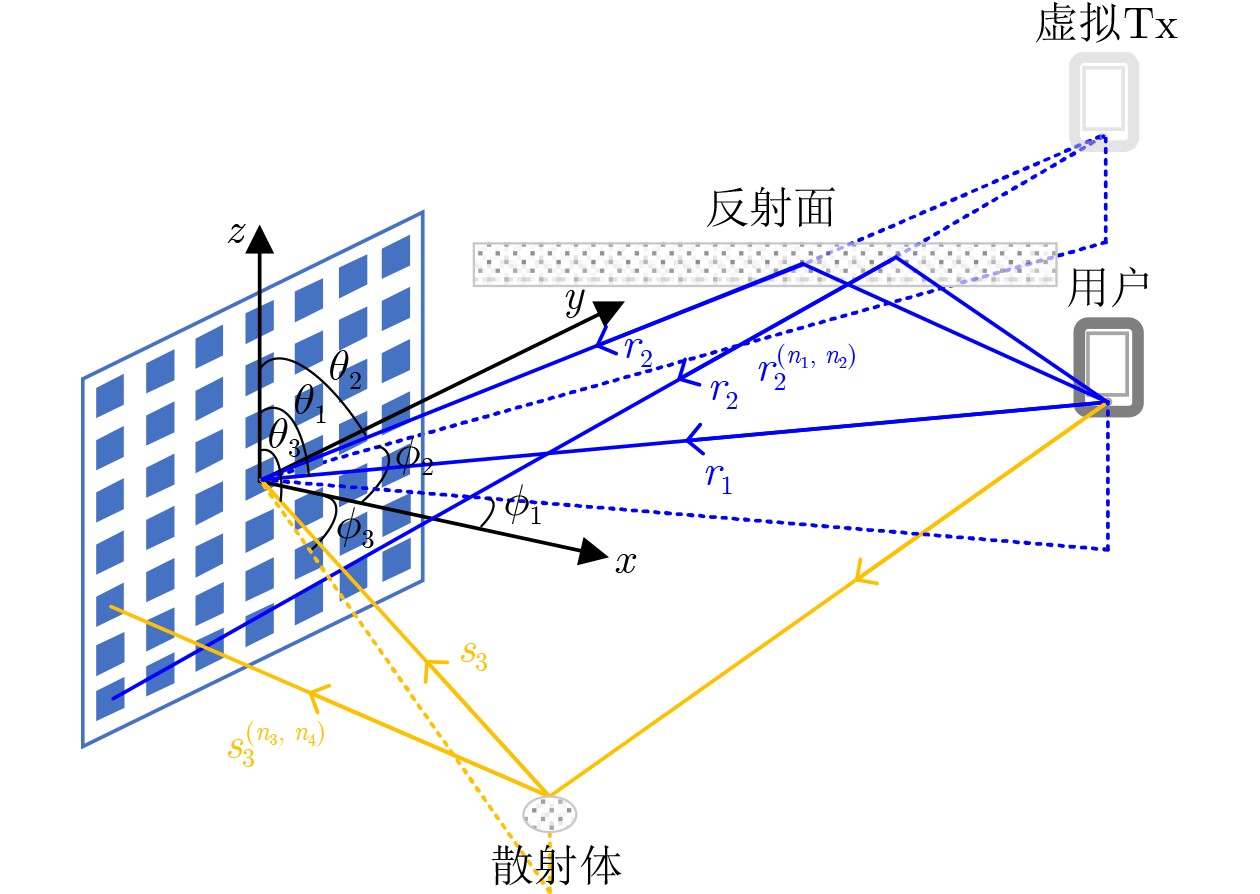
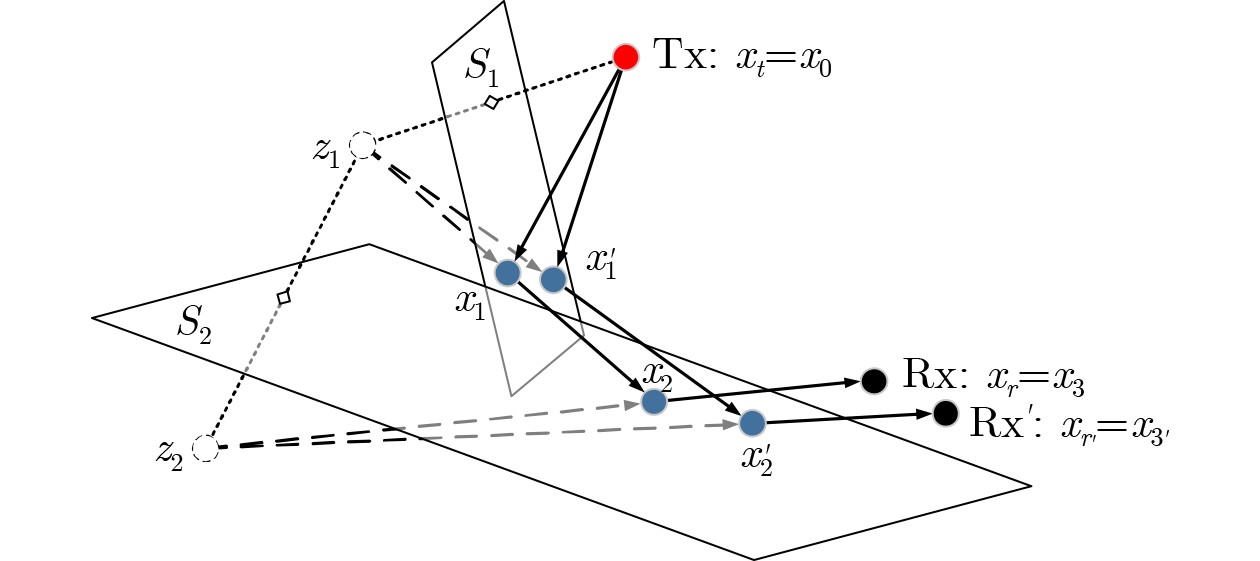
摘要: 面向第六代移动通信系统中超大孔径阵列所带来的近场传播特性,针对传统信道模型所采用的远场平面波传播模型失效以及近场信道估计精度受限等挑战,本文提出了一种面向点散射与镜面反射共存的联合近场信道建模框架及相应的参数估计算法。以往近场信道多仅考虑基于第一跳/最后一跳的点散射球面波传播,或者基于几何光学镜像原理将非视距路径等效为虚拟点到阵列的视距路径的端到端球面波传播,本文对两者共存的复杂传播环境进行联合表达,提升了近场信道建模的物理一致性。此外,将针对均匀平面阵列(Uniform Planar Array, UPA)的极域同步迭代无网格加权信道参数估计算法应用于所构建的联合信道模型,并通过球面波半径与传播路径的差异对路径类型进行分类。仿真结果表明,所提方法提升了混合传播环境下的参数估计精度与鲁棒性,在不同传播距离和信噪比条件下,均优于已有算法。Abstract:
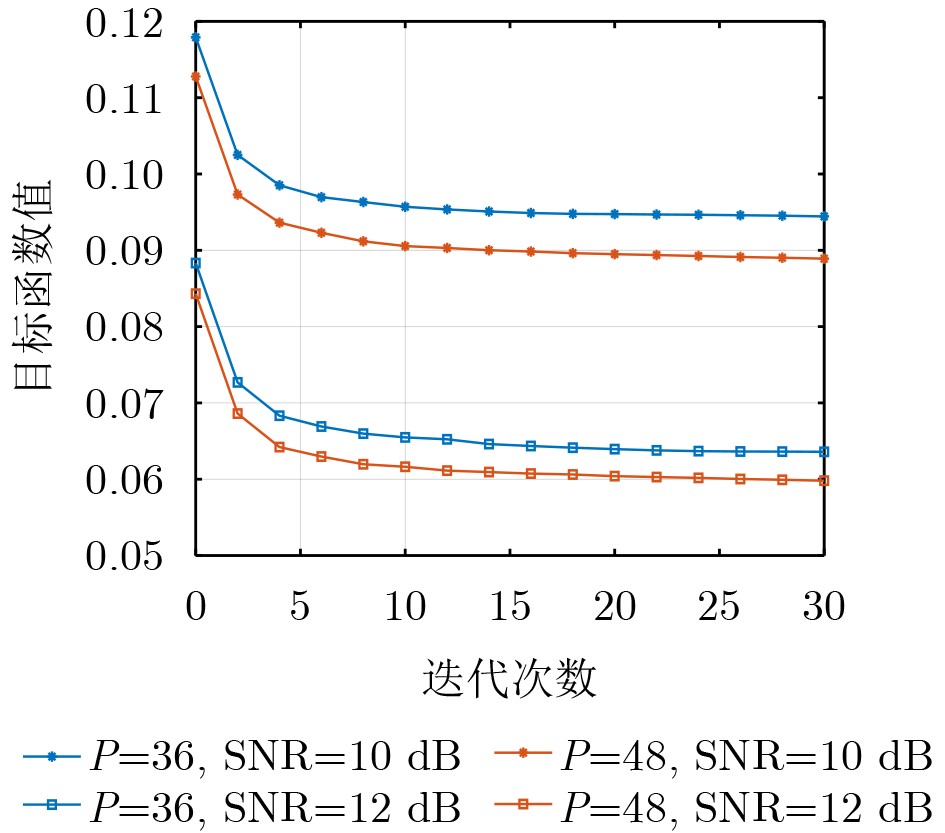
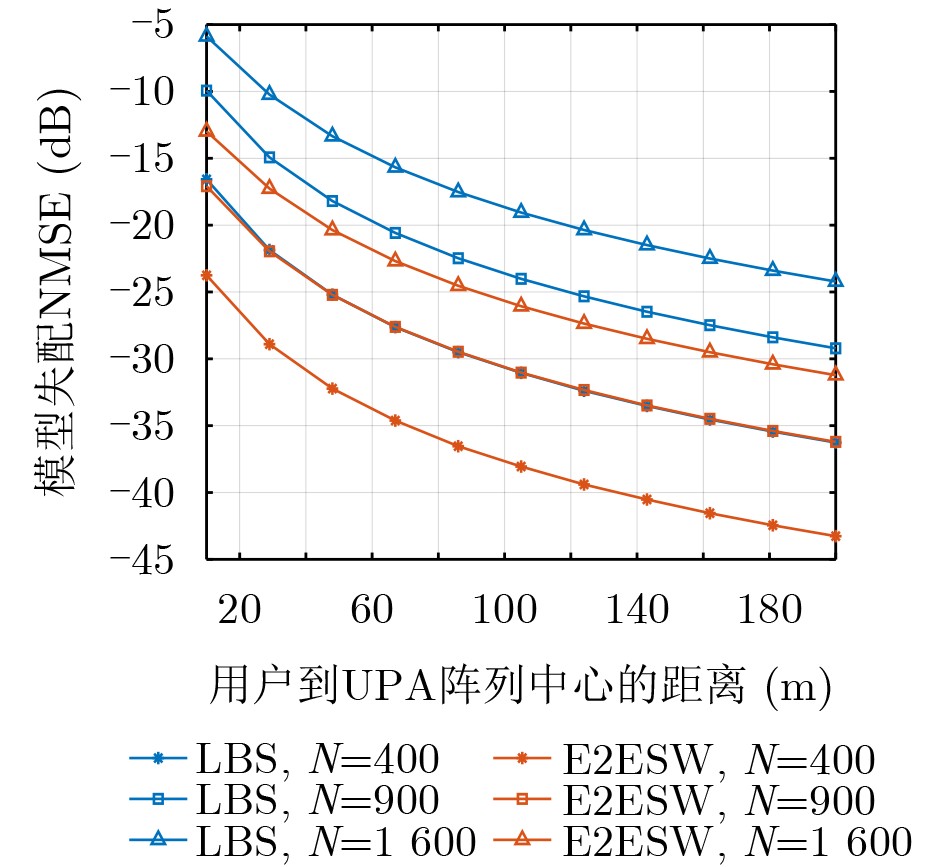
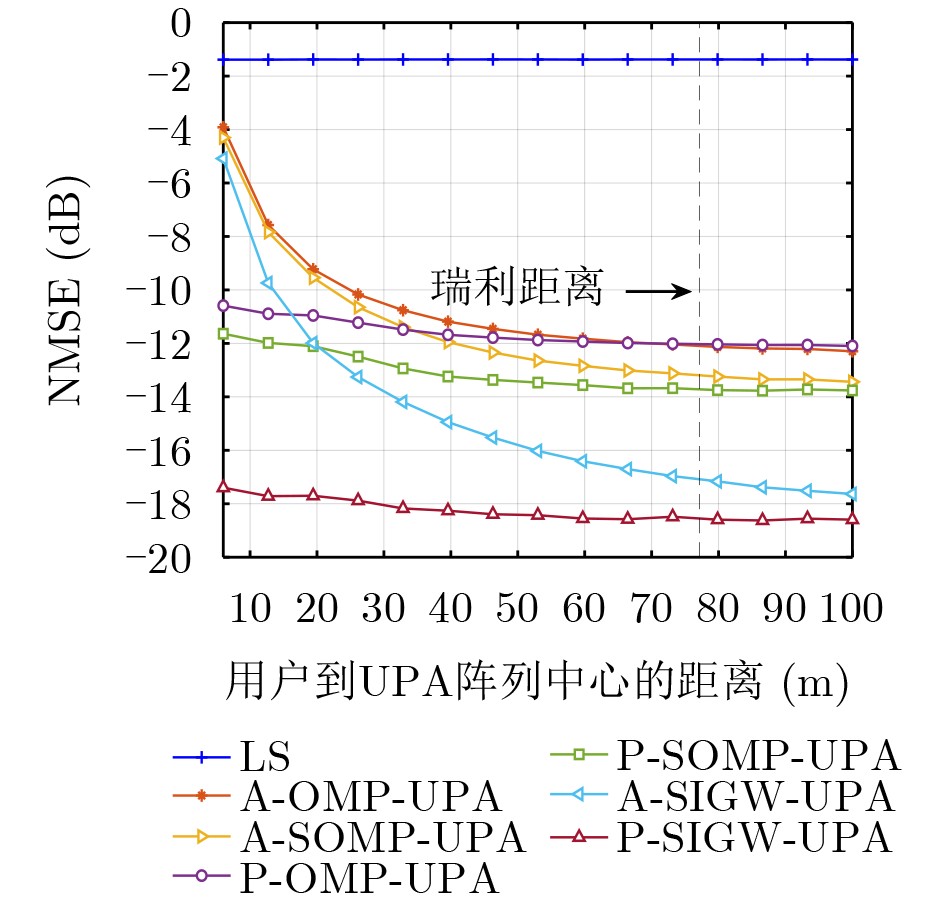
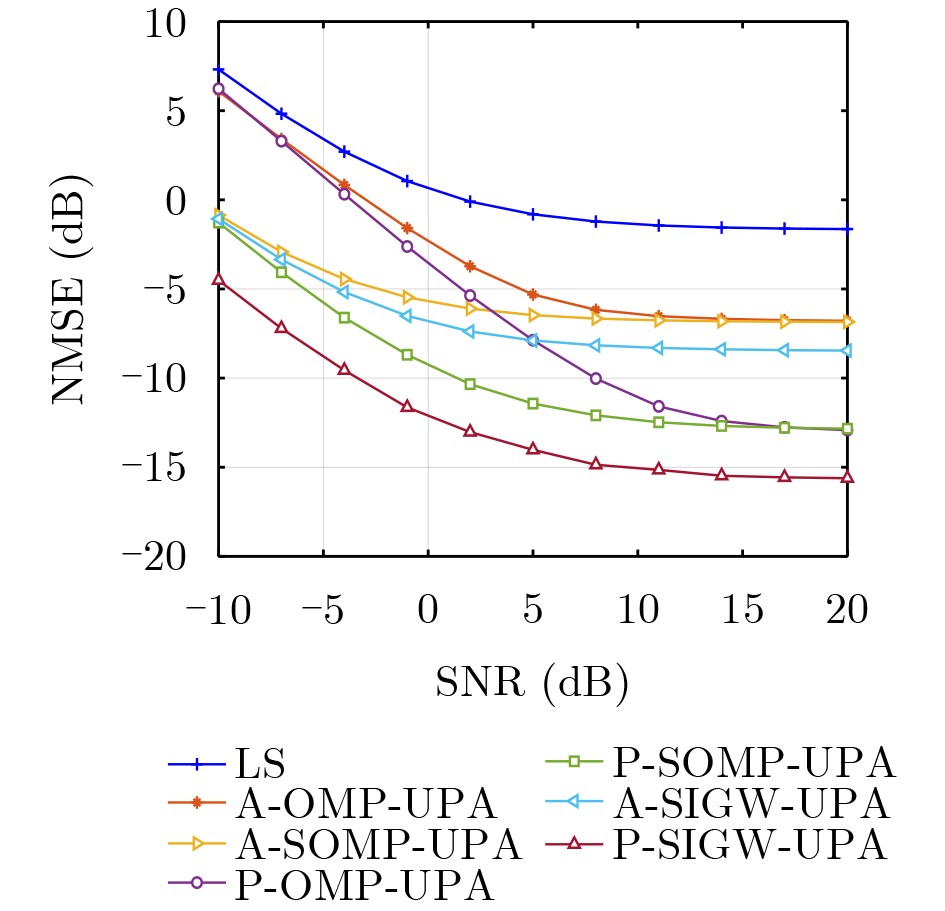
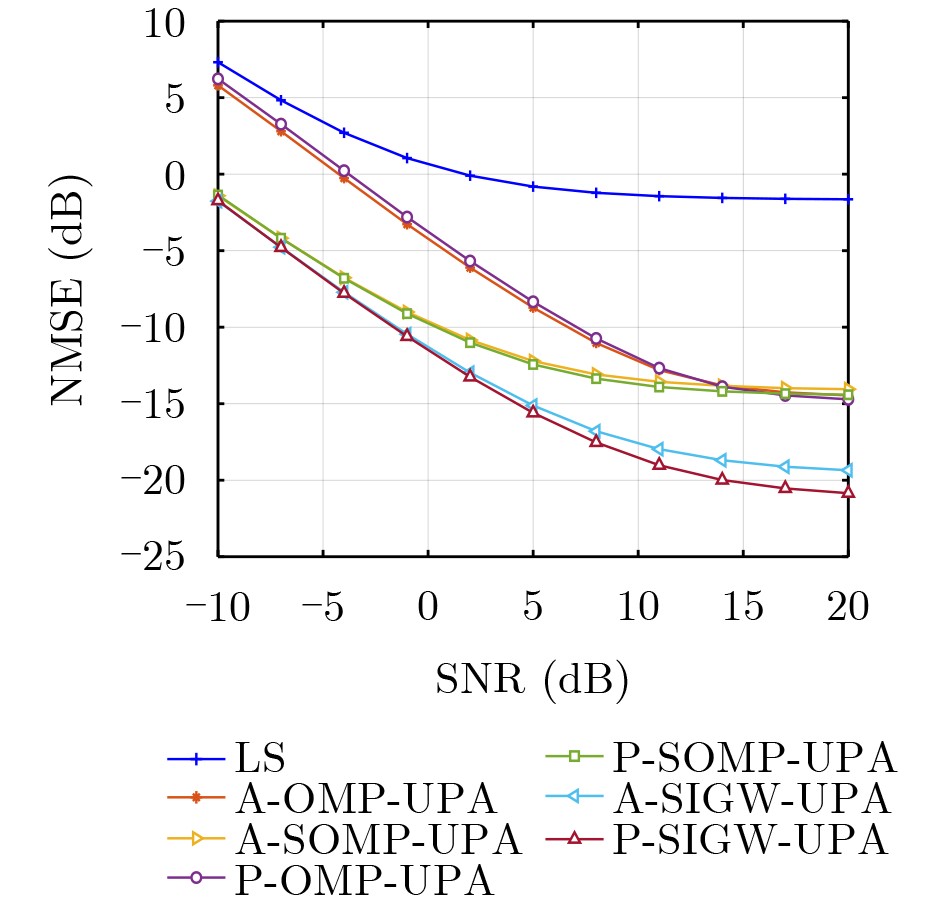
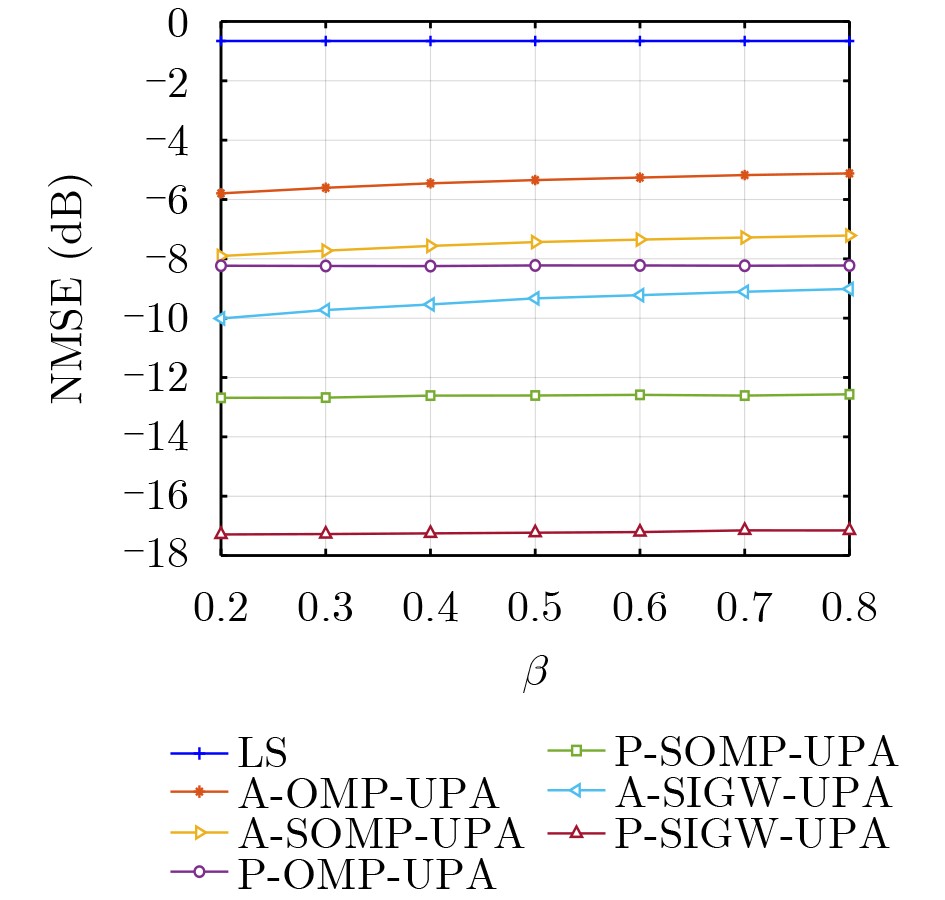
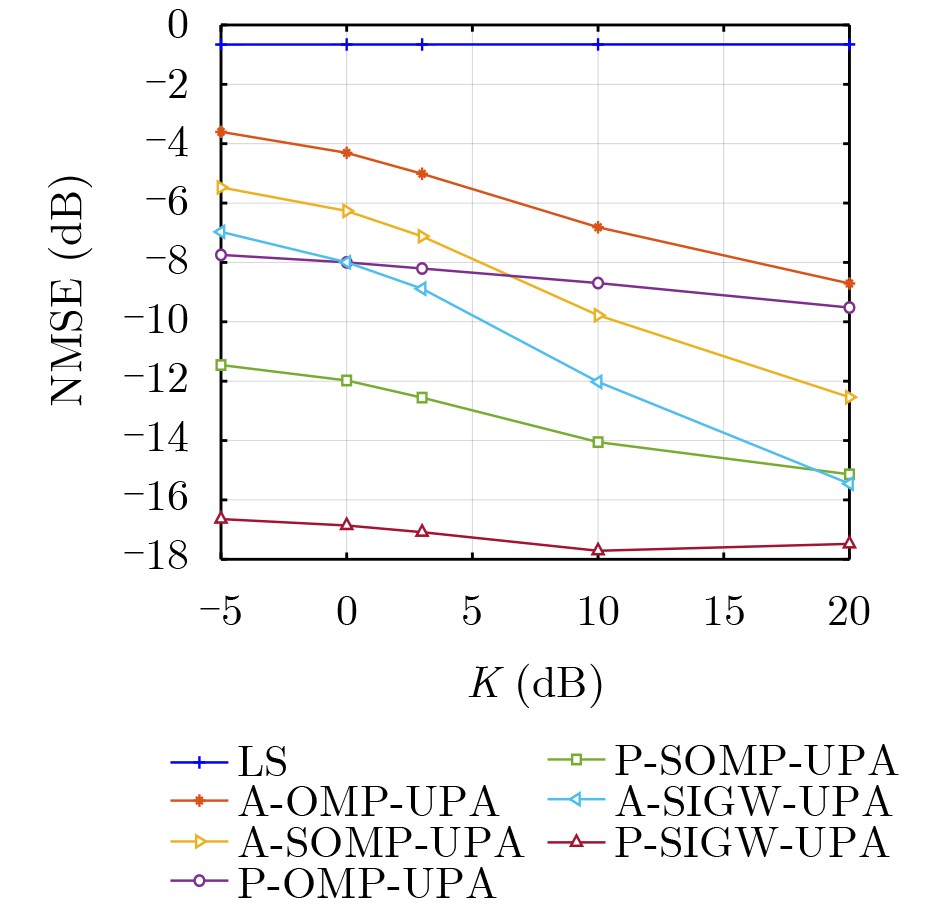
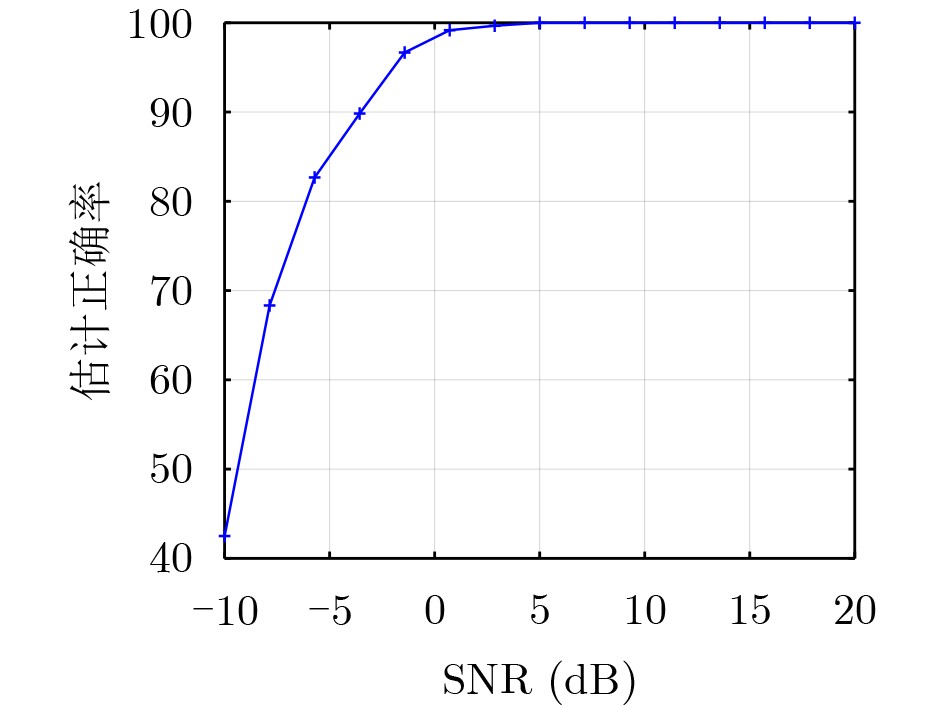
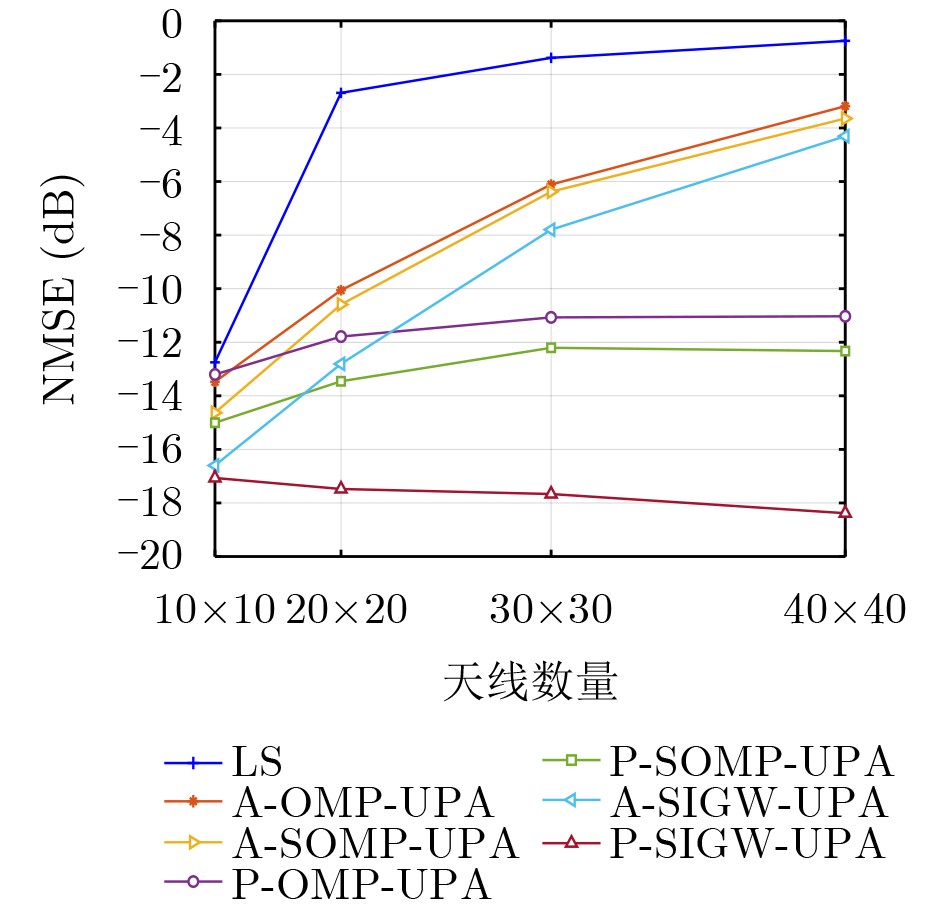
Objective As sixth-generation (6G) mobile communication systems evolve toward extremely large aperture array (ELAA) systems, conventional far-field channel models based on the plane-wave assumption become inadequate for characterizing near-field propagation. In near-field regions, electromagnetic waves exhibit spherical-wave behavior, and a strong coupling between angular and distance parameters significantly degrades the performance of existing far-field channel modeling and estimation methods. Moreover, existing near-field models are typically limited to point-scattering spherical-wave propagation based on first- and last-bouncing mechanisms, or to end-to-end spherical-wave (E2ESW) models derived from geometric optics, in which non-line-of-sight (NLoS) paths are approximated as line-of-sight (LoS) links between virtual sources and the array. However, unified channel models and high-precision parameter estimation methods for such complex propagation environments remain insufficiently developed. Methods The study considers near-field multipath propagation environments under ELAA conditions and provides a unified representation of complex propagation scenarios involving both point scattering and planar reflection, thereby improving the physical consistency of near-field channel modeling. Furthermore, to address the three-dimensional angle–distance coupling problem in uniform planar arrays (UPAs), a polar-domain sparse representation of the channel is adopted. A polar-domain simultaneous iterative gridless weighted algorithm for UPAs (P-SIGW-UPA) is used to estimate channel parameters. In addition, path types are classified by differences in spherical-wave radius and propagation distance. Results and Discussions The simulation results verify the effectiveness of the proposed unified channel model and P-SIGW-UPA algorithm. The model-mismatch analysis shows that forcing all NLoS paths to follow either the last-bouncing scatterer (LBS) or E2ESW representation introduces noticeable structural errors in mixed point-scattering and specular-reflection environments. Such mismatch increases with array aperture and decreases with propagation distance, demonstrating the necessity of unified modeling for large-aperture ELAAs ( Fig. 6 ). The normalized mean square error (NMSE) comparisons versus propagation distance and signal-to-noise ratio (SNR) show that angular-domain methods degrade in the near field because distance-dependent wavefront curvature is neglected. In contrast, P-SIGW-UPA jointly refines angular and distance parameters in the continuous domain and achieves the best overall NMSE performance. As the channel approaches the far-field regime, the performance gap between angular- and polar-domain methods narrows, while P-SIGW-UPA remains stable (Figs. 7 –9 ). P-SIGW-UPA also exhibits good robustness to different propagation-power configurations. Increasing the point-scattering power factor $ \beta $ slightly degrades angular-domain methods, whereas polar-domain methods remain comparatively stable. P-SIGW-UPA maintains the best NMSE over $ K=-5 $ to $ 20 $ dB, indicating robustness to different LoS/NLoS power ratios (Figs. 10 and11 ). The proposed path classification method effectively distinguishes point-scattering and specular-reflection paths. The classification accuracy increases from about 43% at $ -10 $ dB SNR to about 99% at 0 dB and approaches 100% above $ 5 $ dB (Figs. 12 and13 ). With increasing antenna number, P-SIGW-UPA benefits from richer spatial observations and continuous angle–distance refinement, while angular-domain methods increasingly suffer from near-field model mismatch (Fig. 14 ).Conclusions The main contributions of this study are summarized as follows: (1) A unified near-field spherical-wave channel model is developed for environments with coexisting point scattering and specular reflection. By integrating point-scattering and E2ESW models, the physical consistency and representation capability of near-field multipath channels are improved. (2) The P-SIGW-UPA algorithm is applied to the developed unified channel model to verify its applicability in scenarios involving both point scattering and specular reflections. Furthermore, the impact of different propagation mechanisms on parameter estimation performance is systematically investigated. (3) A joint path classification method based on distance deviation is proposed to improve the identification accuracy of different propagation mechanisms, supporting further environment sensing and channel modeling. -
表 3 仿真参数
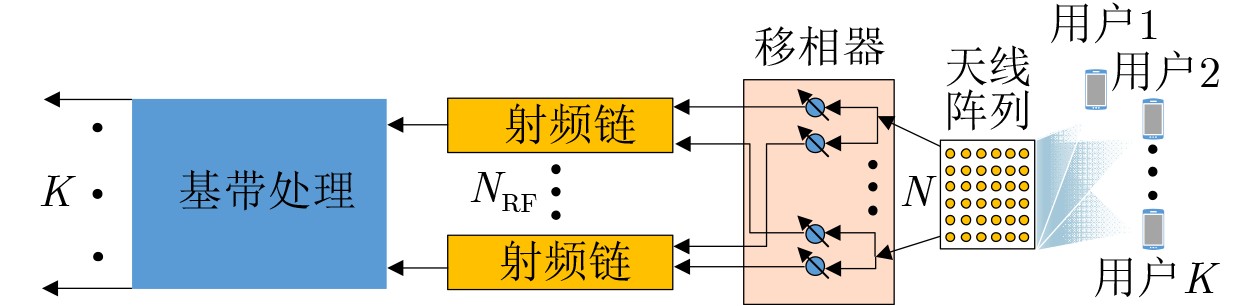
参数 符号 取值或取值范围 UPA阵列天线数量 $ {N}_{1}\times {N}_{2} $ $ 30\times 30 $ 射频链数量 $ {N}_{\text{RF}} $ $ 8 $ 载波频率 $ {f}_{\text{c}} $ $ 3.5\text{GHz} $ 系统带宽 $ B $ $ 100\text{MHz} $ 导频子载波数量 $ M $ $ 256 $ 传播路径数量 $ L $ $ 8 $ 点散射路径数量 $ {L}_{2} $ $ {L}_{2}\in \left\{1{,}2,3\right\} $ 散射体与UE间距离 $ {R}_{\text{P}} $ $ \mathcal{U}\left(0.3R,0.7R\right) $ 距离门限 $ \Delta {r}_{\text{th}} $ $ 0.2R $ Rician因子 K 3 dB 天顶角 $ \theta $ $\sin \left(\dfrac{\pi }{2}-\theta \right)\sim \mathcal{U}\left(-\dfrac{\sqrt{3}}{2},\dfrac{\sqrt{3}}{2}\right)$ 方位角 $ \phi $ $ \sin \phi \sim \mathcal{U}\left(-\frac{\sqrt{3}}{2},\frac{\sqrt{3}}{2}\right) $ 导频长度 $ P $ $ 36 $ 算法迭代次数 $ {N}_{\text{iter}} $ $ 20 $ 实验重复次数 $ {N}_{\text{MC}} $ 100  下载: 导出CSV
表 1 不同距离下的最大相位截断误差
传播距离$ {s}_{l} $ 最大相位截断误差$ \Delta {\phi }_{\max } $ 6 m 0.2776 rad10 m 0.0982 rad30 m 0.0107 rad77 m(瑞利距离附近) 0.0016 rad
下载: 导出CSV
1 P-SIGW-UPA算法
输入:接收信号矩阵$ \boldsymbol{Y} $;合并矩阵$ \boldsymbol{A} $;实际路径数$ L $;最大迭代次数$ {N}_{\text{iter}} $。 初始化:利用P-SOMP算法获得参数的初始估计,包括天顶角向量$ {\hat{\boldsymbol{\theta }}}^{(0)}=\left[\hat{\theta }_{1}^{(0)},\cdots ,\hat{\theta }_{\hat{L}}^{(0)}\right] $,方位角向量$ {\hat{\boldsymbol{\phi }}}^{(0)}=[\hat{\phi }_{1}^{(0)},\cdots ,\hat{\phi }_{\hat{L}}^{(0)}] $以及距离向
量$ {\hat{\boldsymbol{r}}}^{(0)}=\left[\hat{r}_{1}^{(0)},\cdots ,\hat{r}_{\hat{L}}^{(0)}\right] $。初始优化:对于$ n=1{,}2,\cdots ,{N}_{\text{iter}} $,执行以下步骤: 1:采用Armijo回溯线搜索方法确定步长参数$ {l}_{1} $、$ {l}_{2} $和$ {l}_{3} $。 2:根据式(21)更新天顶角和方位角参数。 3:根据式(22)更新路径距离参数。 4:根据式(24)更新路径增益矩阵。 路径剪枝:若估计路径数满足$ \hat{L}> L $,则执行路径剪枝操作: 1:根据式(25)计算每条路径的能量。 2:根据式(26)确定被保留路径的索引集合$ \mathcal{I} $。 3:对参数进行剪枝更新:天顶角$ {\hat{\boldsymbol{\theta }}}^{(n)}\leftarrow{\hat{\boldsymbol{\theta }}}^{(n)}(\mathcal{I}) $,方位角$ {\hat{\boldsymbol{\phi }}}^{(n)}\leftarrow{\hat{\boldsymbol{\phi }}}^{(n)}(\mathcal{I}) $,距离$ {\hat{\boldsymbol{r}}}^{(n)}\leftarrow{\hat{\boldsymbol{r}}}^{(n)}(\mathcal{I}) $,路径增益$ {\hat{\boldsymbol{G}}}^{(n)}\leftarrow{\hat{\boldsymbol{G}}}^{(n)}(\mathcal{I},\colon ) $。 路径分类: 1:根据式(27)-(29)计算距离偏差。 2:根据式(30)进行路径分类,并根据式(28)对点散射路径的距离进行修正。 输出:根据式(31)构建最终的信道估计矩阵。
下载: 导出CSV
表 2 计算复杂度比较
算法 计算复杂度 A-SOMP-UPA $ \mathcal{O}(\hat{L}P{N}_{\text{RF}}NM) $ P-SOMP-UPA $ \mathcal{O}(\hat{L}P{N}_{\text{RF}}NMS) $ A-SIGW-UPA ${\mathcal{O}}(\hat{L}P{N}_{\text{RF}}NM)+\mathcal{O}({N}_{\text{iter}}({P}^{2}N_{\text{RF}}^{2}M+P{N}_{\text{RF}}{M}^{2}))$ P-SIGW-UPA $ \mathcal{O}(\hat{L}P{N}_{\text{RF}}NMS)+\mathcal{O}({N}_{\text{iter}}({P}^{2}N_{\text{RF}}^{2}M+P{N}_{\text{RF}}{M}^{2})) $
下载: 导出CSV
-
[1] AKYILDIZ I F, HAN Chong, HU Zhifeng, et al. Terahertz band communication: An old problem revisited and research directions for the next decade[J]. IEEE Transactions on Communications, 2022, 70(6): 4250–4285. doi: 10.1109/TCOMM.2022.3171800. [2] ZHANG Di, CUI Yuanhao, CAO Xiaowen, et al. Integrated sensing and communications over the years: An evolution perspective[J]. IEEE Communications Surveys & Tutorials, 2026, 28: 5014–5048. doi: 10.1109/COMST.2026.3655674. [3] BJÖRNSON E, SANGUINETTI L, WYMEERSCH H, et al. Massive MIMO is a reality—What is next?: Five promising research directions for antenna arrays[J]. Digital Signal Processing, 2019, 94: 3–20. doi: 10.1016/j.dsp.2019.06.007. [4] WANG Chengxiang, YOU Xiaohu, GAO Xiqi, et al. On the road to 6G: Visions, requirements, key technologies, and testbeds[J]. IEEE Communications Surveys & Tutorials, 2023, 25(2): 905–974. doi: 10.1109/COMST.2023.3249835. [5] YUAN Zhiqiang, ZHANG Jianhua, JI Yilin, et al. Spatial non-stationary near-field channel modeling and validation for massive MIMO systems[J]. IEEE Transactions on Antennas and Propagation, 2023, 71(1): 921–933. doi: 10.1109/TAP.2022.3218759. [6] 张广驰, 谢志立, 崔苗, 等. 近场感知通信一体化系统的感知与通信性能帕累托优化[J]. 电子与信息学报, 2025, 47(10): 3528–3537. doi: 10.11999/JEIT250231.ZHANG Guangchi, XIE Zhili, CUI Miao, et al. Pareto optimization of sensing and communication performance of near-field integrated sensing and communication system[J]. Journal of Electronics & Information Technology, 2025, 47(10): 3528–3537. doi: 10.11999/JEIT250231. [7] 杨青青, 蒲雪莱, 彭艺, 等. HRIS辅助的分层稀疏重构混合远近场源定位算法[J]. 电子与信息学报, 2025, 47(11): 4220–4230. doi: 10.11999/JEIT250429.YANG Qingqing, PU Xuelai, PENG Yi, et al. HRIS-aided layered sparse reconstruction hybrid near- and far-field source localization algorithm[J]. Journal of Electronics & Information Technology, 2025, 47(11): 4220–4230. doi: 10.11999/JEIT250429. [8] 徐勇军, 李晶, 骆东鑫, 等. 近场通信物理层安全技术综述[J]. 电子与信息学报, 2025, 47(11): 4129–4143. doi: 10.11999/JEIT250336.XU Yongjun, LI Jing, LUO Dongxin, et al. A survey on physical layer security in near-field communication[J]. Journal of Electronics & Information Technology, 2025, 47(11): 4129–4143. doi: 10.11999/JEIT250336. [9] CHEN Kangjian, QI Chenhao, HUANG Jingjia, et al. Near-field communications for extremely large-scale MIMO: A beamspace perspective[J]. IEEE Communications Magazine, 2025, 63(5): 166–172. doi: 10.1109/MCOM.001.2400182. [10] XU Huixin, ZHANG Jianhua, TANG Pan, et al. Near-field propagation and spatial non-stationarity channel model for 6–24 GHz (FR3) extremely large-scale MIMO: Adopted by 3GPP for 6G[J]. IEEE Journal on Selected Areas in Communications, 2026, 44: 3201–3218. doi: 10.1109/JSAC.2026.3650888. [11] WANG Chengxiang, LV Zhen, GAO Xiqi, et al. Pervasive wireless channel modeling theory and applications to 6G GBSMs for all frequency bands and all scenarios[J]. IEEE Transactions on Vehicular Technology, 2022, 71(9): 9159–9173. doi: 10.1109/TVT.2022.3179695. [12] WANG Chengxiang, LV Zhen, HUANG Chen, et al. An enhanced 6G pervasive channel model towards standardization[J]. Science China Information Sciences, 2025, 68(6): 162301. doi: 10.1007/s11432-025-4419-9. [13] YIN Xuefeng, WANG S, ZHANG Nan, et al. Scatterer localization using large-scale antenna arrays based on a spherical wave-front parametric model[J]. IEEE Transactions on Wireless Communications, 2017, 16(10): 6543–6556. doi: 10.1109/TWC.2017.2725260. [14] 3GPP. Study on channel model for frequencies from 0.5 to 100 GHz[R]. 3GPP TR 38.901 V18.0. 0, 2024. [15] HU Yaqi, YIN Mingsheng, RANGAN S, et al. Parametrization and estimation of high-rank line-of-sight MIMO channels with reflected paths[J]. IEEE Transactions on Wireless Communications, 2024, 23(4): 3808–3822. doi: 10.1109/TWC.2023.3311735. [16] CHEN Chongbin, SUN Jian, JIANG Xiaoxu, et al. Near-field channel estimation for uniform planar arrays based on an end-to-end spherical wavefront channel model[J]. IEEE Transactions on Wireless Communications, 2026, 25: 7065–7082. doi: 10.1109/TWC.2025.3628847. [17] 邵凯, 花凡玉, 王光宇. 超大规模可重构智能表面混合远-近场信道估计[J]. 电子与信息学报, 2025, 47(11): 4231–4241. doi: 10.11999/JEIT250306.SHAO Kai, HUA Fanyu, and WANG Guangyu. Hybrid far-near field channel estimation for XL-RIS assisted communication systems[J]. Journal of Electronics & Information Technology, 2025, 47(11): 4231–4241. doi: 10.11999/JEIT250306. [18] 罗欣, 杜建和, 张耀, 等. 可重构智能表面辅助近场通信感知一体化系统基于嵌套张量的同时定位与通信方法[J]. 电子与信息学报, 2025, 47(4): 979–990. doi: 10.11999/JEIT240566.LUO Xin, DU Jianhe, ZHANG Yao, et al. Nested tensor-based simultaneous localization and communication method for RIS-assisted near-field integrated sensing and communication systems[J]. Journal of Electronics & Information Technology, 2025, 47(4): 979–990. doi: 10.11999/JEIT240566. [19] CUI Mingyao and DAI Linglong. Channel estimation for extremely large-scale MIMO: Far-field or near-field?[J]. IEEE Transactions on Communications, 2022, 70(4): 2663–2677. doi: 10.1109/TCOMM.2022.3146400. [20] ZHOU Zihao, WANG Chengxiang, ZHANG Li, et al. A novel SAGE algorithm for estimating parameters of wideband spatial nonstationary wireless channels with antenna polarization[J]. IEEE Transactions on Antennas and Propagation, 2023, 71(9): 7457–7472. doi: 10.1109/TAP.2023.3292508. [21] 王莹, 于永海, 郑毅, 等. 基于稀疏贝叶斯学习的GFDM系统联合迭代信道估计与符号检测[J]. 电子学报, 2024, 52(5): 1496–1505. doi: 10.12263/DZXB.20220480.WANG Ying, YU Yonghai, ZHENG Yi, et al. Iterative channel estimation and symbol detection for GFDM systems based on sparse Bayesian learning[J]. Acta Electronica Sinica, 2024, 52(5): 1496–1505. doi: 10.12263/DZXB.20220480. [22] FLEURY B H, TSCHUDIN M, HEDDERGOTT R, et al. Channel parameter estimation in mobile radio environments using the SAGE algorithm[J]. IEEE Journal on Selected Areas in Communications, 1999, 17(3): 434–450. doi: 10.1109/49.753729. [23] 吕璐, 梁啟辉, 冯云鹏, 等. EL-RIS赋能的混合多播-单播隐蔽通信[J]. 电子学报, 2025, 53(11): 3932–3942. doi: 10.12263/DZXB.20250532.LÜ Lu, LIANG Qihui, FENG Yunpeng, et al. EL-RIS empowered multicast-unicast covert communication[J]. Acta Electronica Sinica, 2025, 53(11): 3932–3942. doi: 10.12263/DZXB.20250532. [24] TAN Jingbo and DAI Linglong. Wideband channel estimation for THz massive MIMO[J]. China Communications, 2021, 18(5): 66–80. doi: 10.23919/JCC.2021.05.005. [25] SELVAN K T and JANASWAMY R. Fraunhofer and Fresnel distances: Unified derivation for aperture antennas[J]. IEEE Antennas and Propagation Magazine, 2017, 59(4): 12–15. doi: 10.1109/MAP.2017.2706648. [26] Fraunhofer Heinrich Hertz Institute. QuaDRiGa—Quasi deterministic radio channel generator user manual and documentation, v2.6. 1[EB/OL]. https://www.scribd.com/document/632836302/quadriga-documentation-v2-6-1-0, 2021. [27] SALEHIAN K, GHORBANI A, ABDIPOUR A, et al. Dynamic radar cross section analysis: Effects of pulsed signals and target motion on cylindrical objects[J]. IEEE Access, 2025, 13: 144445–144455. doi: 10.1109/ACCESS.2025.3599092. [28] WU Zidong and DAI Linglong. Multiple access for near-field communications: SDMA or LDMA?[J]. IEEE Journal on Selected Areas in Communications, 2023, 41(6): 1918–1935. doi: 10.1109/JSAC.2023.3275616. -

 下载:

图(14) / 表(4)
计量
- 文章访问数: 12
- HTML全文浏览量: 2
- PDF下载量: 1
- 被引次数: 0
