




Physical-layer Network Coding Aided Polar Slotted Random Access Algorithm
-
摘要: 针对大规模机器类通信高负载随机接入场景中基于逐次干扰消除(SIC)的方案易因无碰撞时隙不足而出现译码停滞的问题。本文提出一种物理层网络编码辅助的极化时隙随机接入译码算法,该算法将多用户时隙碰撞等效建模为有限域上的网络编码(NC)方程组。接收端利用包级极化译码提取可靠叠加包构建稀疏线性方程组,引入广义矩阵求逆(GMI)判据解耦可恢复用户数据,并将已恢复数据反馈至SIC环节,形成“极化译码—NC求解—SIC消除”的闭环迭代,逐步降低剩余碰撞空间的维数。仿真结果表明,所提算法缓解了高并发下的译码停滞,系统峰值吞吐量达0.87包/时隙,较极化时隙ALOHA方案提升约15%,有效负载上限由0.75拓展至0.90。Abstract:
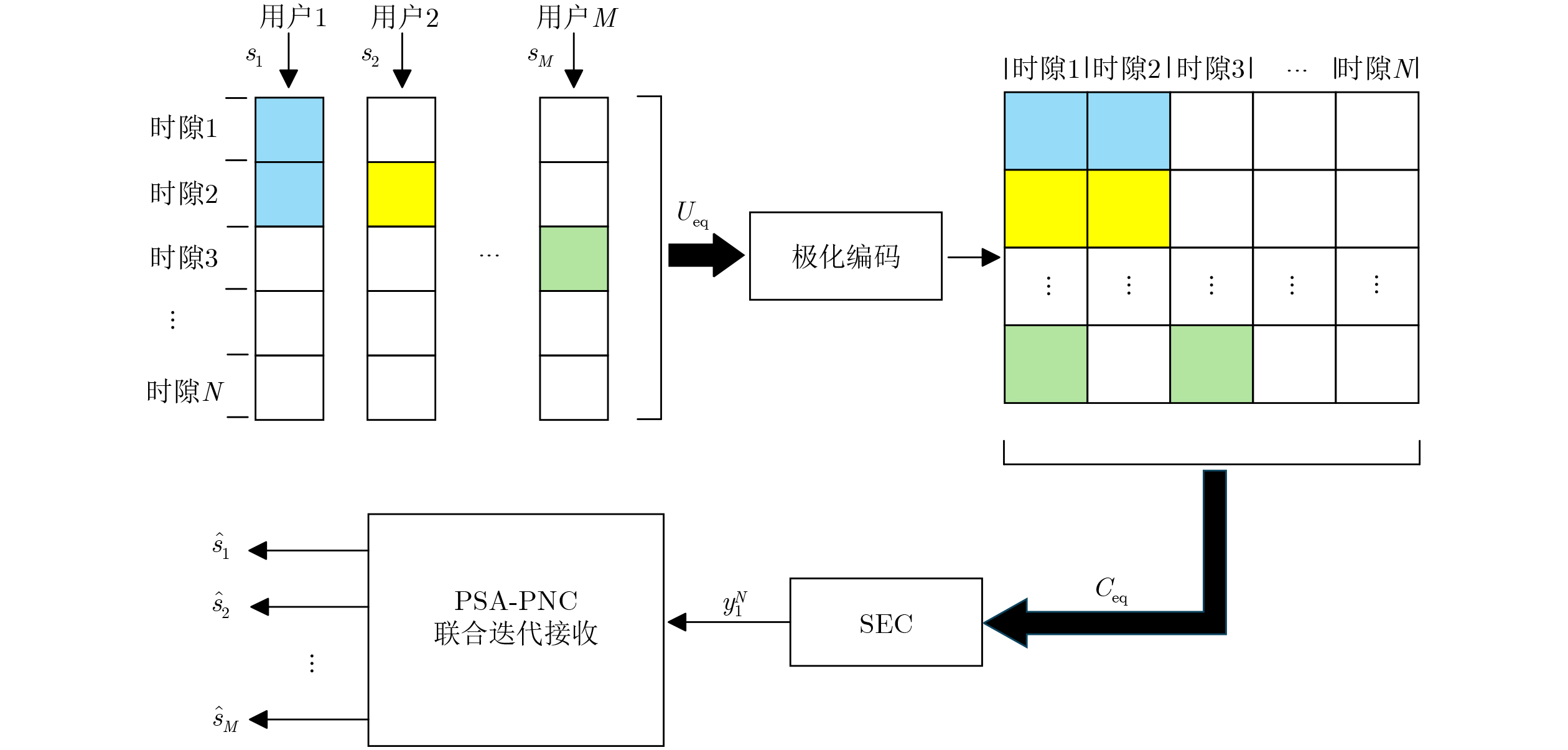
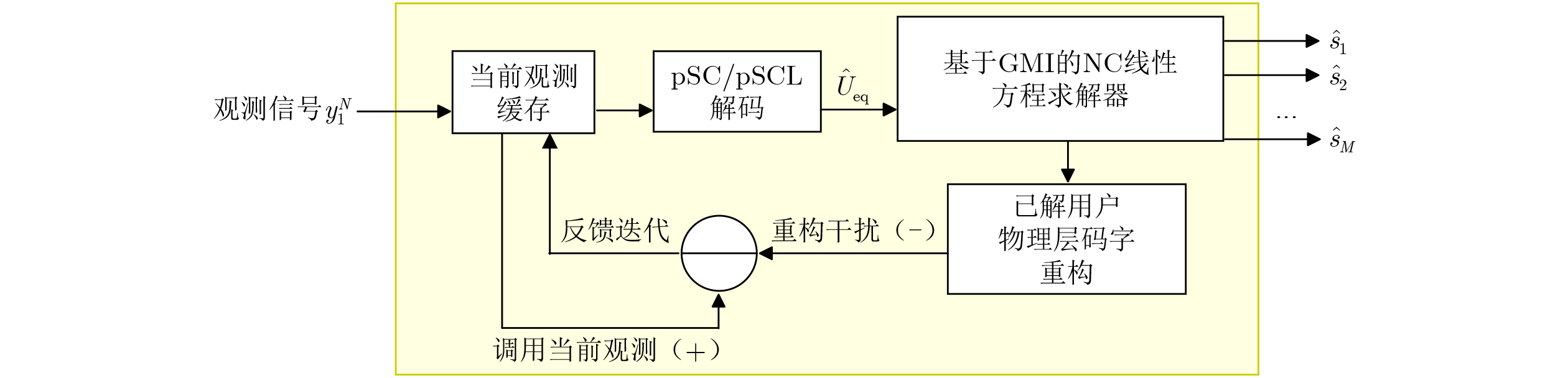
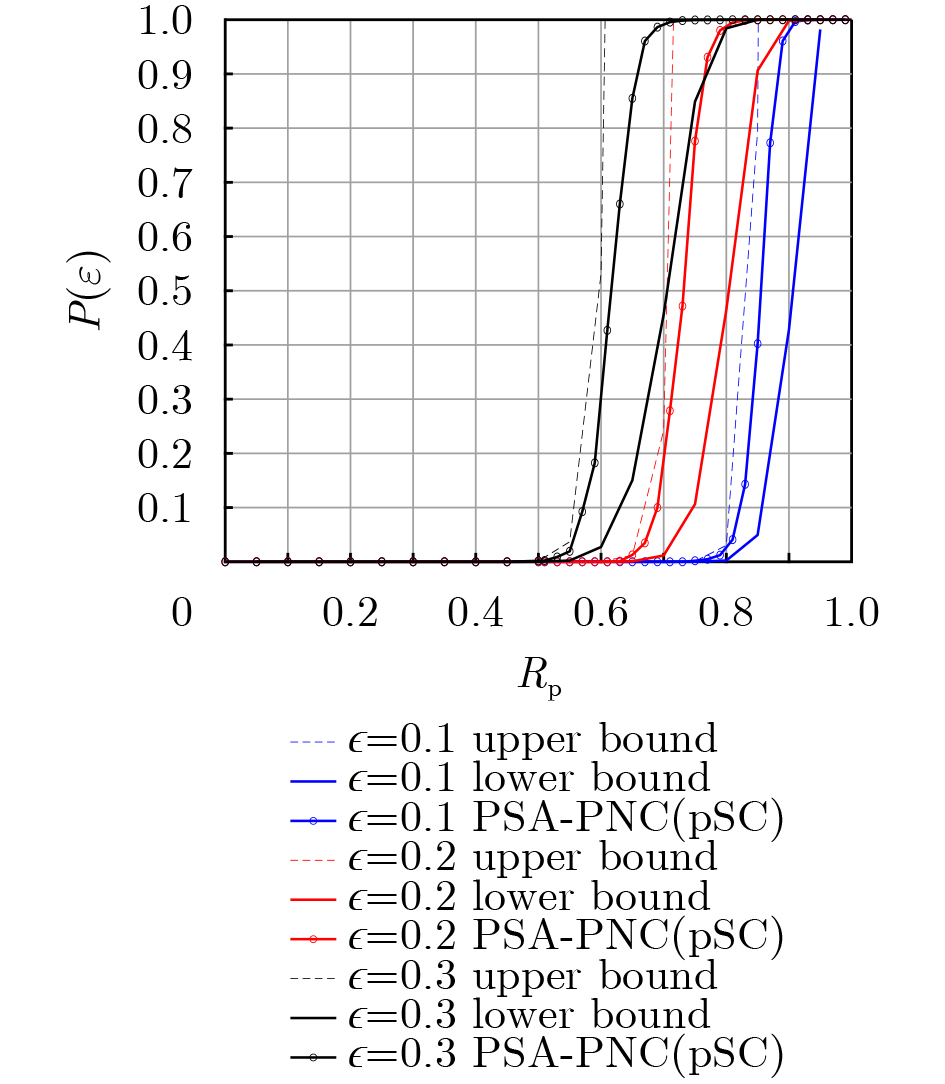
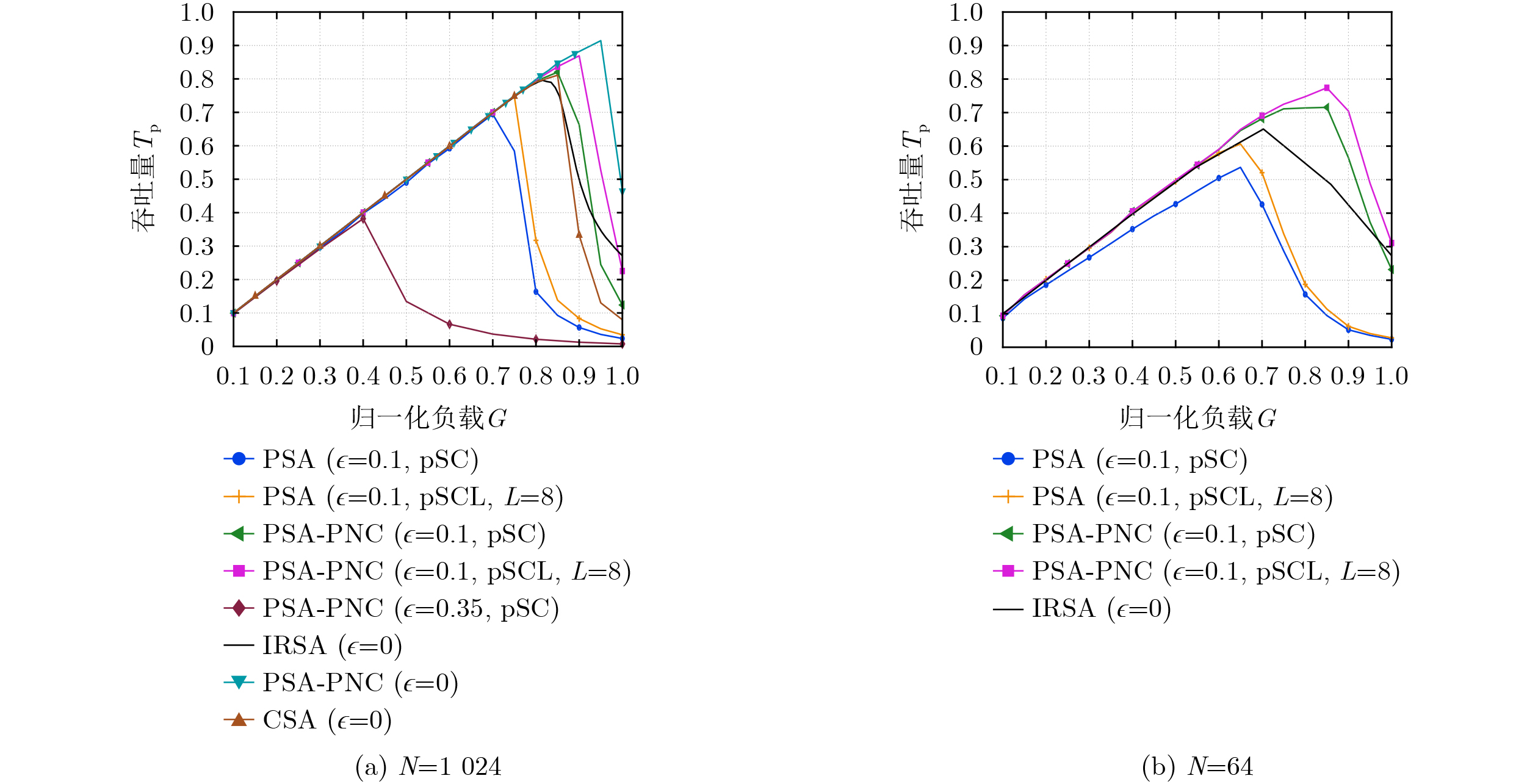
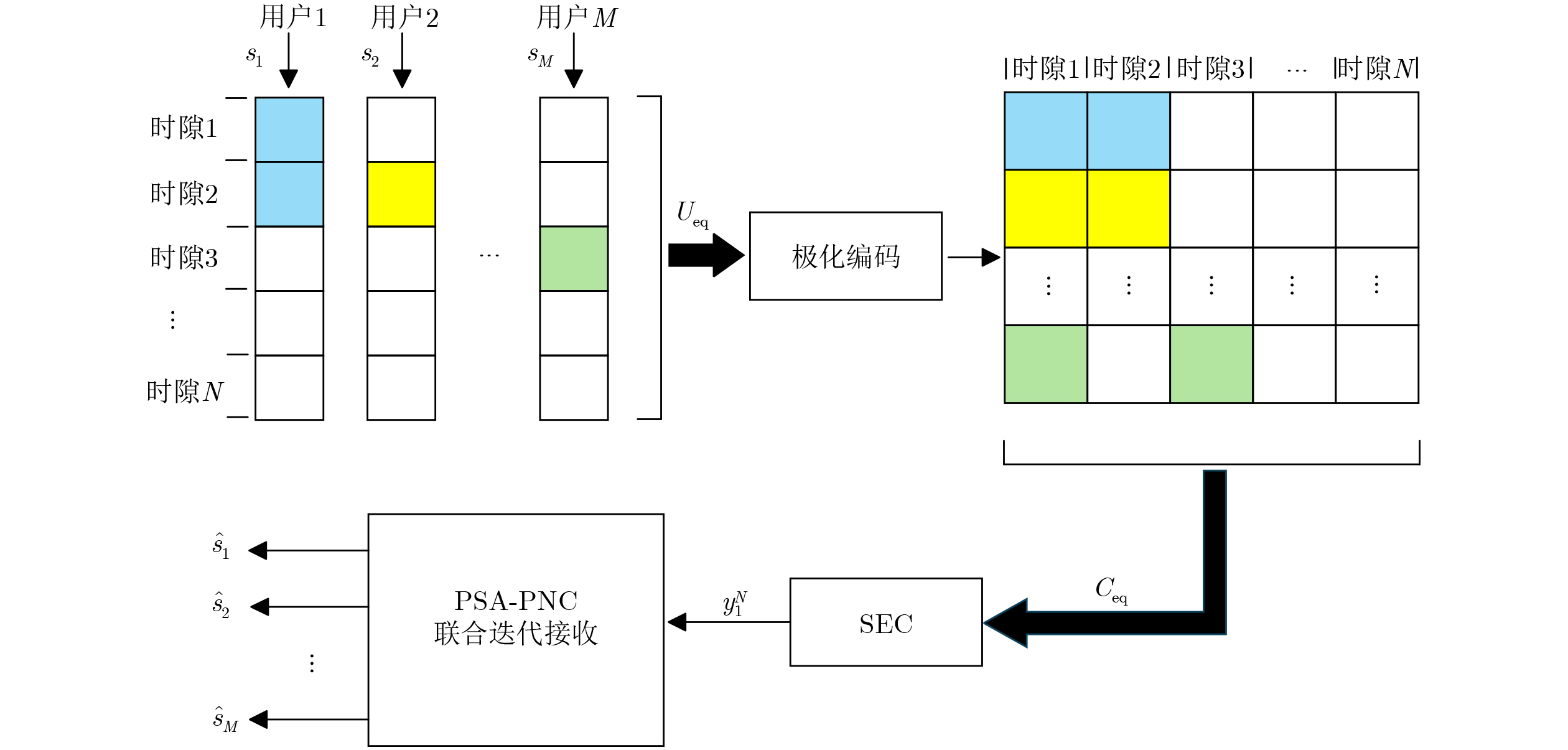
Objective Massive Machine-Type Communications (mMTC) constitutes a fundamental pillar of 5G and emerging 6G wireless networks, dedicated to supporting massive connectivity for the Internet of Things (IoT). In grant-free random access scenarios, sporadic and uncoordinated transmissions by massive terminals inevitably induce severe packet collisions under heavy traffic loads. Traditional scheduled access protocols become inefficient due to prohibitive signaling overhead. Consequently, grant-free slotted ALOHA protocols based on Successive Interference Cancellation (SIC)—such as Contention Resolution Diversity Slotted ALOHA (CRDSA), Irregular Repetition Slotted ALOHA (IRSA), and Coded Slotted ALOHA (CSA)—have garnered widespread attention. However, these classical schemes fundamentally rely on the presence of collision-free (degree-1) slots to trigger and sustain the iterative graph-peeling decoding process. Under practical constraints of finite frame lengths and heavy traffic, collision-free slots are drastically depleted, causing severe decoding stalling and throughput degradation. Furthermore, pure SIC mechanisms are intrinsically vulnerable to error propagation. Although Polar Slotted ALOHA (PSA) introduces polarization transforms across time slots to enhance packet recovery, its collision resolution remains constrained by the initial SIC condition. To resolve these challenges, a joint decoding algorithm combining Polar Slotted ALOHA with Physical-Layer Network Coding (PSA-PNC) is proposed over the Slot Erasure Channel (SEC). The objective is to transform destructive multi-user packet collisions into algebraically solvable linear network coding equations, thereby eliminating the strict reliance on collision-free slots and significantly elevating concurrent multi-user detection capability and throughput performance under heavy traffic loads. Methods A joint physical-layer and MAC-layer random access framework is established over the Slot Erasure Channel ( Fig. 1 ). At the transmitter side, active users independently select transmission time slots based on an irregular degree distribution polynomial without inter-user coordination or channel collision feedback. The sender remains blind to multi-user collision patterns in the channel. At the base station receiver, the superimposed signals across slots are equivalently modeled as a sparse global input matrix over a binary finite field, followed by packet-level polar encoding. To resolve dense collisions without relying on clean slots, a closed-loop iterative receiver architecture is developed (Fig. 2 ). In each iteration, channel observation sequences are initially processed by a packet-level Successive Cancellation (pSC) or packet-level Successive Cancellation List (pSCL) decoder to extract reliable equivalent combined packets from information slots. Instead of being discarded, the collided slots corresponding to these reliable packets are utilized to construct a local sparse linear Network Coding (NC) equation system. A Generalized Matrix Inversion (GMI) criterion is subsequently executed to analyze the column-rank characteristics of the access pattern matrix and achieve global algebraic multi-user decoupling. Solvable user packets are directly recovered without requiring full-rank matrix conditions or degree-1 slots. The algebraically decoupled user packets are then utilized as prior information to reconstruct physical-layer codewords and subtracted from the observation buffer via iterative SIC, continuously reducing the dimensionality of the unresolved collision space. High-reliability packets output by the pSCL decoding paths are leveraged in the iterative loop to effectively suppress error propagation and guarantee the linear independence of residual equations. Furthermore, the polarization evolution process of equivalent multi-user packets over the SEC is theoretically proved to be equivalent to that over a scalar Binary Erasure Channel (BEC), enabling rigorous calculation of frame error rate bounds via Bhattacharyya parameters (Fig. 3 ).Results and Discussions Extensive theoretical analyses and Monte Carlo simulations are conducted to evaluate the performance of the proposed PSA-PNC scheme over the Slot Erasure Channel. The theoretical polarization bounds of packet-level polar decoding are verified under various slot erasure probabilities ($ \epsilon \in \left\{0.1,0.2,0.3\right\} $), exhibiting precise consistency with simulation curves and validating the polarization threshold effect ( Fig. 3 ). In terms of system throughput, simulation results demonstrate that for a frame length of $ N=1024 $, the proposed PSA-PNC scheme with pSCL ($ L=8 $) achieves a peak normalized throughput of approximately 0.87 packets/slot at a normalized load of $ G\approx 0.90 $, yielding an approximate 15% throughput improvement over baseline PSA and outperforming Coded Slotted ALOHA under identical finite-length configurations (Fig. 4(a) ). In the low-load region, all evaluated schemes exhibit near-identical linear throughput growth due to the abundance of collision-free slots (Fig. 4(a) ). When the slot erasure rate increases to $ \epsilon =0.35 $, the number of recoverable reliable equivalent packets decreases, leading to insufficient NC equations and observable throughput degradation in high-load regions, which confirms the operational boundary of the algorithm (Fig. 4(a) ). For a short frame length of $ N=64 $, a consistent throughput gain ranging from 0.12 to 0.18 is maintained by PSA-PNC, demonstrating strong robustness against finite-length decoding stalling in short-packet scenarios (Fig. 4(b) ). In terms of transmission reliability, under a target Packet Loss Rate (PLR) of $ {10}^{-2} $ at $ N=1024 $, the supportable normalized load upper bound is extended from $ G\approx 0.75 $ in baseline PSA to $ G\approx 0.84 $ in PSA-PNC (Fig. 5(a) ). Furthermore, steeper waterfall regions and significantly lower error floors are consistently maintained across various frame lengths from $ N=64 $ to $ N=1024 $ (Fig. 5(b) ).Conclusions A joint decoding scheme combining Polar Slotted ALOHA with Physical-Layer Network Coding (PSA-PNC) is established to resolve the severe decoding stalling problem in grant-free random access. By constructing a closed-loop iterative receiver integrating packet-level polar decoding, GMI-based algebraic equation solving, and iterative SIC cancellation, destructive multi-user collisions are converted into solvable linear equations. The dependence on collision-free slots is effectively eliminated, and the supportable load threshold, peak normalized throughput, and packet recovery reliability are substantially enhanced under heavy traffic loads. Future research will be directed toward non-ideal multipath fading channels, such as Rayleigh fading, and the design of low-complexity sparse receiver architectures for practical massive access implementations. -
Key words:
- Random Access(RA) /
- Polar code /
- Collision resolution /
- Multi-user detection /
- Network Coding(NC)
-
[1] NGUYEN D C, DING Ming, PATHIRANA P N, et al. 6G internet of things: A comprehensive survey[J]. IEEE Internet of Things Journal, 2022, 9(1): 359–383. doi: 10.1109/JIOT.2021.3103320. [2] 逄小玮, 蒋旭, 卢华兵, 等. 面向6G多维扩展的新型多址接入技术综述[J]. 电子与信息学报, 2024, 46(6): 2323–2334. doi: 10.11999/JEIT231265.PANG Xiaowei, JIANG Xu, LU Huabing, et al. An overview of novel multi-access techniques for multi-dimensional expanded 6G[J]. Journal of Electronics & Information Technology, 2024, 46(6): 2323–2334. doi: 10.11999/JEIT231265. [3] GU Yiyang, XU Yunlai, ZHANG Bo, et al. Toward the random multiaccess in SIoT: A generalized-deduplication-based CRDSA mechanism[J]. IEEE Internet of Things Journal, 2024, 11(11): 20207–20222. doi: 10.1109/JIOT.2024.3370742. [4] CHEN Zhengchuan, FENG Yifan, TIAN Zhong, et al. Energy efficiency optimization for irregular repetition slotted ALOHA-based massive access[J]. IEEE Wireless Communications Letters, 2022, 11(5): 982–986. doi: 10.1109/LWC.2022.3151931. [5] PAOLINI E, LIVA G, and CHIANI M. Coded slotted ALOHA: A graph-based method for uncoordinated multiple access[J]. IEEE Transactions on Information Theory, 2015, 61(12): 6815–6832. doi: 10.1109/TIT.2015.2492579. [6] CHEN Zhengchuan, FENG Chundie, FENG Yifan, et al. Coded slotted ALOHA scheme with multi-packet reception under erasure channels[J]. IEEE Transactions on Vehicular Technology, 2023, 72(12): 15804–15818. doi: 10.1109/TVT.2023.3290978. [7] CHEN Zhengchuan, FENG Yifan, FENG Chundie, et al. Analytic distribution design for irregular repetition slotted ALOHA with multi-packet reception[J]. IEEE Transactions on Vehicular Technology, 2023, 72(1): 1360–1365. doi: 10.1109/TVT.2022.3207048. [8] 王义文, 王千帆, 马啸. 强干扰环境下无速率随机码编译码方案及其性能分析[J]. 电子与信息学报, 2024, 46(10): 4017–4023. doi: 10.11999/JEIT230879.WANG Yiwen, WANG Qianfan, and MA Xiao. Rateless random coding scheme and performance analysis in strong interference environments[J]. Journal of Electronics & Information Technology, 2024, 46(10): 4017–4023. doi: 10.11999/JEIT230879. [9] SHIRVANIMOGHADDAM M, MOHAMMADI M S, ABBAS R, et al. Short block-length codes for ultra-reliable low latency communications[J]. IEEE Communications Magazine, 2019, 57(2): 130–137. doi: 10.1109/MCOM.2018.1800181. [10] WANG Yiwen, WANG Qianfan, LIANG Jifan, et al. Representative OSD with local constraints of CA-polar codes[J]. Chinese Journal of Electronics, 2025, 34(4): 1111–1119. doi: 10.23919/cje.2024.00.220. [11] 王千帆, 郭延庚, 宋林琦, 等. 基于跳过机制的低复杂度顺序统计译码算法[J]. 电子与信息学报, 2025, 47(11): 4275–4284. doi: 10.11999/JEIT250447.WANG Qianfan, GUO Yangeng, SONG Linqi, et al. Low-complexity ordered statistic decoding algorithm based on skipping mechanisms[J]. Journal of Electronics & Information Technology, 2025, 47(11): 4275–4284. doi: 10.11999/JEIT250447. [12] 王骥, 李子龙, 肖健, 等. 基于低复杂度加法网络的非正交多址接入短报文多用户检测算法研究[J]. 电子与信息学报, 2024, 46(6): 2409–2417. doi: 10.11999/JEIT231186.WANG Ji, LI Zilong, XIAO Jian, et al. Research on multi-user detection algorithm for non-orthogonal multiple access short message based on low complexity adder network[J]. Journal of Electronics & Information Technology, 2024, 46(6): 2409–2417. doi: 10.11999/JEIT231186. [13] WANG Qianfan, GUO Kongjing, and MA Xiao. Block Markov superposition transmission of LDPC codes[J]. Journal of Information and Intelligence, 2023, 1(2): 115–133. doi: 10.1016/j.jiixd.2023.05.001. [14] WANG Qianfan, CHEN Li, and MA Xiao. A new HARQ scheme for 5G systems via interleaved superposition retransmission[J]. China Communications, 2023, 20(4): 1–11. doi: 10.23919/JCC.fa.2022-0670.202304. [15] ZHANG Zhijun, NIU Kai, DAI Jincheng, et al. Polar-slotted ALOHA over slot erasure channel[J]. IEEE Transactions on Vehicular Technology, 2023, 72(1): 760–771. doi: 10.1109/TVT.2022.3204321. [16] ZENG Hanxin, XIE Zhaopeng, CHEN Pingping, et al. Expectation propagation detection with physical network coding for massive MIMO systems[J]. IEEE Signal Processing Letters, 2024, 31: 41–45. doi: 10.1109/LSP.2023.3341342. [17] LIEW S C, LU Lu, and ZHANG Shengli. A Primer on Physical-Layer Network Coding[M]. Cham: Springer, 2015: 1–202. doi: 10.1007/978-3-031-79269-4. [18] CHEN Pingping, XIE Zhaopeng, FANG Yi, et al. Physical-layer network coding: An efficient technique for wireless communications[J]. IEEE Network, 2020, 34(2): 270–276. doi: 10.1109/MNET.001.1900289. [19] YU Xu, CHEN Cui, and QING Guo. Prioritized random access based on compute-and-forward[J]. China Communications, 2025, 22(4): 254–267. doi: 10.23919/JCC.fa.2024-0412.202504. [20] BAO Jianrong, ZHANG Wei, LIU Chao, et al. Selective soft-message-forward cooperation with threshold decision detection in two-way physical-layer network-coded MIMO IoT systems[J]. IEEE Internet of Things Journal, 2025, 12(7): 8587–8598. doi: 10.1109/JIOT.2024.3501354. [21] MANSOUR L and HICHAM M. Comparative analysis of physical layer network coding-based random access techniques in WSN communications[C]. The 14th International Conference on Intelligent Systems: Theories and Applications (SITA), Casablanca, Morocco, 2023: 1–6. doi: 10.1109/SITA60746.2023.10373740. [22] YANG Tao, REN Wencheng, and YU Fangtao. Design of coded slotted ALOHA operated with q-ary physical-layer network coding[C]. 2023-IEEE International Conference on Communications (ICC), Rome, Italy, 2023: 5328–5333. doi: 10.1109/ICC45041.2023.10278882. [23] QIU Yuping, XIE Zhaopeng, KANG Peng, et al. Polar-coded gaussian multiple-access channels with physical-layer network coding[J]. IEEE Transactions on Vehicular Technology, 2024, 73(6): 9083–9087. doi: 10.1109/TVT.2024.3352980. [24] ALAAELDIN M, ALSUSA E, AL-JARRAH M, et al. Generalized BER performance analysis for SIC-based uplink NOMA[J]. IEEE Open Journal of the Communications Society, 2025, 6: 1246–1265. doi: 10.1109/OJCOMS.2025.3539185. [25] YANG Tao, YU Fangtao, LIU Rongke, et al. Lattice-code multiple access: Architecture and efficient algorithms[J]. IEEE Transactions on Vehicular Technology, 2025, 74(8): 12465–12479. doi: 10.1109/TVT.2025.3553918. -

 下载:
下载:


图(5)
计量
- 文章访问数: 22
- HTML全文浏览量: 6
- PDF下载量: 0
- 被引次数: 0
