




Cross-Frequency Collaborative Low-Light Face Enhancement Guided by Structural Priors
-
摘要: 针对低光人脸图像增强中结构信息与细节信息难以协同恢复,关键区域易出现结构退化和细节失真的问题,提出一种结构先验引导的跨频协同低光人脸增强方法。首先,构建结构先验引导的跨频关联机制,利用低频人脸结构响应为空间对应的高频细节恢复提供引导,增强跨频结构与细节的协同建模能力。其次,结合局部卷积与二维选择性扫描建模高频细节和长程依赖,并通过人脸结构一致性调制,在跨频交互和跨尺度融合过程中选择性调节结构相关特征,提高关键区域结构传递的稳定性。最后,构建由基础增强约束、身份一致性约束、关键区域结构约束和跨频特征一致性正则项组成的联合优化目标,以兼顾整体增强质量、局部结构保持和身份表征稳定性。实验结果表明,所提方法在CelebA测试集的5项指标上均优于对比方法;在LaPa数据集上表现出较好的姿态变化适应能力;在Dark Face真实低光数据上具有一定的场景适应性。Abstract:
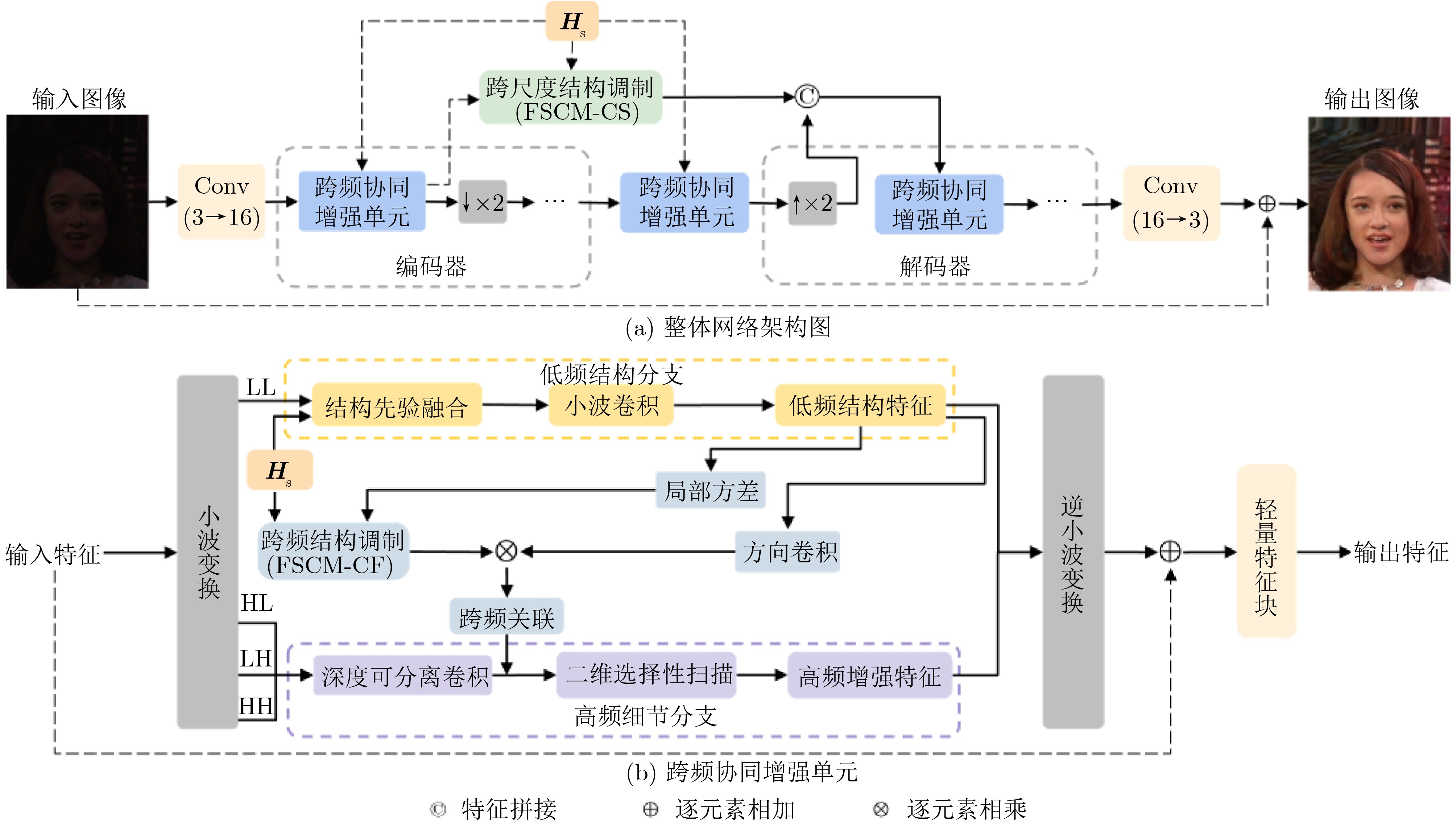
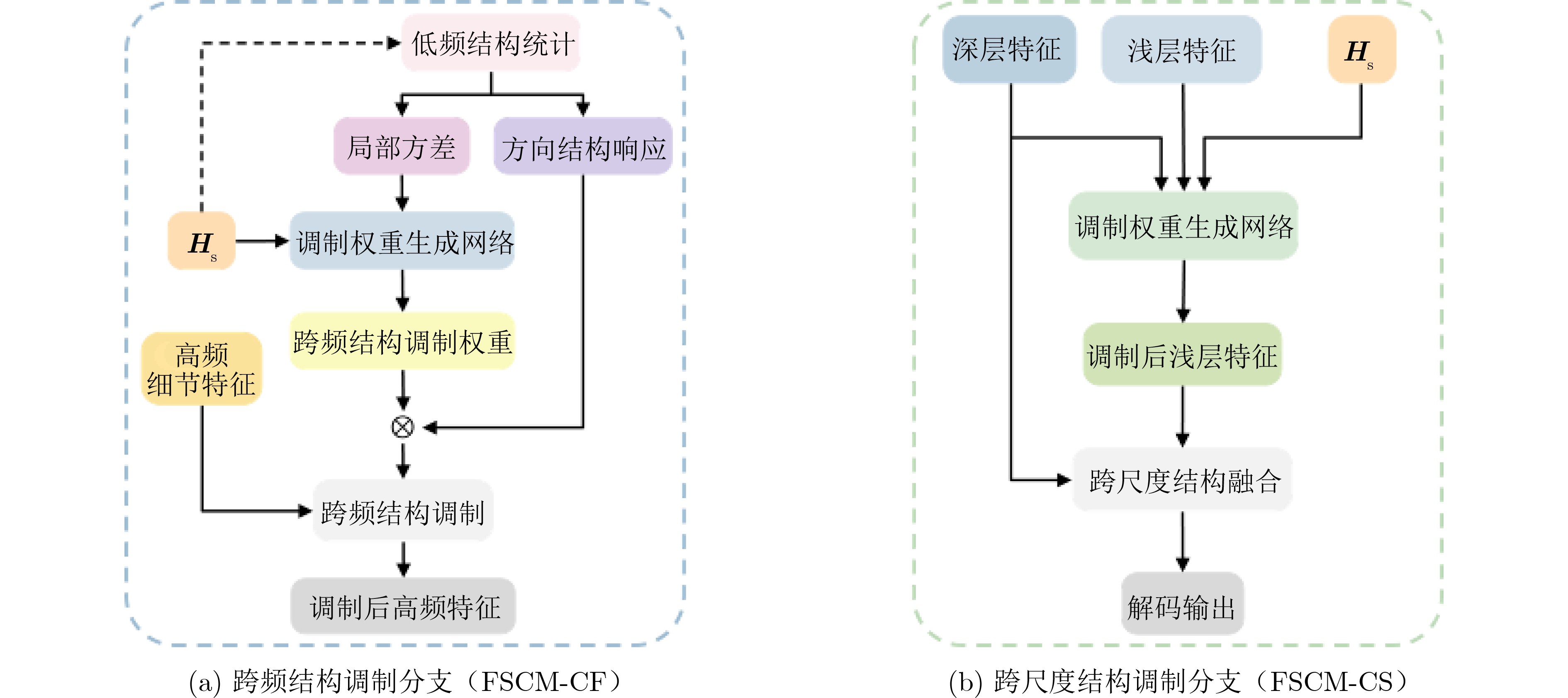
Objective Low-light face images commonly suffer from insufficient illumination, reduced contrast, amplified noise, and loss of local details. These degradations reduce visual quality and destabilize identity recognition, fatigue analysis, and face behavior understanding. Structural and discriminative information around the eyes and mouth is especially vulnerable to edge blurring, texture loss, and local structural shifts. Existing low-light image enhancement methods mainly focus on illumination recovery or general image reconstruction, while preservation of key face structures and identity-related representations remains limited. From a frequency-domain perspective, low-light degradation weakens low-frequency structural responses while disturbing high-frequency edges and textures, and directly enhancing high-frequency components without structural guidance may amplify noise or introduce false textures. Therefore, low-frequency face structures should guide spatially corresponding high-frequency detail restoration while maintaining structural stability during cross-frequency interaction and multi-scale reconstruction. To address these problems, a structural-prior-guided cross-frequency collaborative method is proposed for low-light face image enhancement. Methods An encoder-decoder enhancement network is constructed with structural-prior-guided cross-frequency association (CFA), high-frequency modeling (HFM), and face structural consistency modulation (FSCM) ( Fig. 1 ). In CFA, input features are decomposed into low-frequency and directional high-frequency subbands using a discrete wavelet transform. Key-region heatmaps generated from facial landmarks are combined with directional structural responses and local statistical information to construct a spatial structural prior, which guides the restoration of spatially corresponding high-frequency details according to key-region locations, structural directions, and local significance, thereby reducing excessive enhancement of weak-structure or noise-dominated regions. HFM combines depthwise separable convolution with two-dimensional selective scanning. Local convolution is used to extract edge and texture details, whereas multi-directional selective scanning models long-range spatial dependencies. FSCM further regulates structurally relevant features during cross-frequency interaction and cross-scale feature fusion (Fig. 2 ). Its cross-frequency branch selectively modulates high-frequency responses using low-frequency structural statistics and key-region priors, while its cross-scale branch controls the transfer of shallow structural features through encoder-decoder skip connections. The network is jointly optimized using basic enhancement, identity consistency, key-region structure, and cross-frequency feature consistency constraints. CelebA is used for main training, and LaPa is used for pose adaptation and evaluation. Identity-level partitioning is adopted to avoid identity leakage, with 90%, 5%, and 5% of identities used for training, validation, and testing, respectively. Synthetic low-light images are generated by brightness attenuation, Gamma mapping, illumination-related noise, chromatic noise, color shifts, and black-level offsets. Dark Face is used only for real low-light evaluation.Results and Discussions The proposed model contains 1.47 M parameters and requires 11.74 G floating-point operations for a 256 × 256 input, with an average inference time of 70.48 ms and a speed of approximately 14.19 FPS. On CelebA-Test, the proposed method achieves 25.36 dB PSNR, 0.88 SSIM, 0.8934 ArcFace similarity,0.0566 Eye-LPIPS, and0.0753 Mouth-LPIPS, obtaining the best results among the compared methods on all five metrics (Table 1 ). On LaPa-Test, ΔEAR, Eye-LPIPS, ΔMAR, and Mouth-LPIPS reach0.0065 ,0.0512 ,0.1219 , and0.0714 , respectively, achieving the best results for all four key-region metrics (Table 2 ). The ArcFace similarity is0.9398 , lower than those of Low-FaceNet and SCI. Sample-wise analysis shows that this gap is weakly related to pose magnitude and remains in many samples with improved local metrics, indicating partial decoupling between key-region structural fidelity and whole-face identity embedding fidelity. Visual comparisons show improved illumination and better preservation of eye contours, mouth boundaries, and facial textures without obvious local over-enhancement (Fig. 3 ). On Dark Face, the proposed method obtains a NIQE of 10.92±1.12 and improves face-region visibility in representative samples, while challenging cases reveal limitations under nonuniform illumination, occlusion, and extremely low signal-to-noise ratios (Table 3 ,Fig. 4 ). Ablation experiments confirm the complementary effects of the three additional constraints and the joint contribution of CFA, HFM, and FSCM, with the complete model achieving the best overall results (Table 4 ). Landmark perturbation experiments further show that the continuous Gaussian heatmaps and structural modulation remain stable under spatial deviations of up to ±6 pixels (Table 5 ).Conclusions A structural-prior-guided cross-frequency collaborative method is proposed for low-light face image enhancement. Low-frequency face structures guide high-frequency detail restoration, while local convolution and two-dimensional selective scanning model fine details and long-range dependencies. FSCM further regulates structural feature transfer across frequencies and scales. Experiments on CelebA and LaPa demonstrate advantages in reconstruction quality, key-region structure preservation, and local perceptual consistency. LaPa results also show that local structural improvements do not always yield equivalent gains in whole-face identity embeddings, indicating room for further optimization of global identity consistency. Real low-light and landmark perturbation experiments indicate a certain degree of scene adaptability and robustness to small spatial deviations. However, performance remains limited under severe occlusion, small-scale faces, extreme low-light conditions, and mixed real degradations. Future work will investigate real low-light face data, denser and confidence-aware regional priors, adaptive constraints for different face regions, joint optimization of local structures and global identity representations, and collaborative optimization with downstream facial analysis tasks. -
表 1 CelebA−Test数据集上的定量对比结果
Method PSNR↑(dB) SSIM↑ ArcFace↑ Eye−LPIPS↓ Mouth−LPIPS↓ Zero−DCE[9] 14.03 0.63 0.8470 0.2050 0.2435 EnlightenGAN[7] 16.44 0.69 0.8481 0.1862 0.2092 SCI[8] 18.68 0.76 0.8727 0.1789 0.2313 Retinexformer[3] 25.18 0.85 0.8202 0.2109 0.2149 CWNet[14] 19.44 0.81 0.8532 0.1648 0.1680 Low−FaceNet[20] 18.03 0.71 0.8699 0.1345 0.1720 Ours 25.36 0.88 0.8934 0.0566 0.0753  下载: 导出CSV
表 2 LaPa−Test数据集上的定量对比结果
Method ΔEAR↓ Eye−LPIPS↓ ΔMAR↓ Mouth−LPIPS↓ ArcFace↑ Zero−DCE 0.0110 0.1532 0.2126 0.1732 0.8940 EnlightenGAN 0.0081 0.0881 0.1499 0.1177 0.9282 SCI 0.0100 0.1624 0.2038 0.2112 0.9465 Retinexformer 0.0155 0.1646 0.2632 0.1816 0.8541 CWNet 0.0115 0.1576 0.2766 0.1873 0.9092 Low−FaceNet 0.0071 0.0642 0.1512 0.0922 0.9494 Ours 0.0065 0.0512 0.1219 0.0714 0.9398
下载: 导出CSV
表 3 Dark Face数据集上的NIQE结果
Metric Input Zero−DCE EnlightenGAN SCI Retinexformer CWNet Low−FaceNet Ours NIQE↓ 15.90±2.51 10.37±1.27 11.05±1.74 10.63±1.38 10.85±1.58 12.67±1.85 10.90±1.58 10.92±1.12
下载: 导出CSV
表 4 CelebA-Test数据集上的损失项与建模组成消融结果
Category Configuration ΔEAR↓ Eye−LPIPS↓ ΔMAR↓ Mouth−LPIPS↓ ArcFace↑ Loss ablation $ \mathcal{L} $rec 0.0068 0.0631 0.0762 0.0853 0.8551 $ \mathcal{L} $rec+$ \mathcal{L} $id 0.0066 0.0612 0.0751 0.0835 0.8809 $ \mathcal{L} $rec+$ \mathcal{L} $id+$ \mathcal{L} $struct 0.0063 0.0582 0.0753 0.0841 0.8872 Full 0.0061 0.0566 0.0725 0.0753 0.8934 Component ablation Baseline 0.0067 0.0592 0.0816 0.0835 0.8874 Baseline+CFA 0.0064 0.0580 0.0765 0.0812 0.8908 Baseline+CFA+HFM 0.0062 0.0574 0.0773 0.0818 0.8915 Full 0.0061 0.0566 0.0725 0.0753 0.8934
下载: 导出CSV
表 5 关键点热图扰动下的性能变化
扰动幅度/像素 PSNR变化 SSIM变化 Eye−LPIPS变化 Mouth−LPIPS变化 ArcFace变化 ±2 + 0.0014 0.0000 0.0000 0.0000 + 0.0001 ±4 − 0.0007 0.0000 0.0000 + 0.0001 − 0.0001 ±6 − 0.0020 0.0000 + 0.0004 + 0.0001 − 0.0001
下载: 导出CSV
-
[1] 彭大鑫, 甄彤, 李智慧. 低光照图像增强研究方法综述[J]. 计算机工程与应用, 2023, 59(18): 14–27. doi: 10.3778/j.issn.1002-8331.2210-0143.PENG Daxin, ZHEN Tong, and LI Zhihui. Survey of research methods for low light image enhancement[J]. Computer Engineering and Applications, 2023, 59(18): 14–27. doi: 10.3778/j.issn.1002-8331.2210-0143. [2] ZHANG Yonghua, ZHANG Jiawan, and GUO Xiaojie. Kindling the darkness: A practical low-light image enhancer[C]. Proceedings of the 27th ACM International Conference on Multimedia, Nice, France, 2019: 1632–1640. doi: 10.1145/3343031.3350926. [3] CAI Yuanhao, BIAN Hao, LIN Jing, et al. Retinexformer: One-stage Retinex-based Transformer for low-light image enhancement[C]. Proceedings of 2023 IEEE/CVF International Conference on Computer Vision, Paris, France, 2023: 12470–12479. doi: 10.1109/ICCV51070.2023.01149. [4] 陈勇, 陈东, 刘焕淋, 等. 基于深度卷积神经网络的无参考低照度图像增强[J]. 电子与信息学报, 2022, 44(6): 2166–2174. doi: 10.11999/JEIT210386.CHEN Yong, CHEN Dong, LIU Huanlin, et al. Unreferenced low-lighting image enhancement based on deep convolutional neural network[J]. Journal of Electronics & Information Technology, 2022, 44(6): 2166–2174. doi: 10.11999/JEIT210386. [5] 孙帮勇, 赵兴运, 吴思远, 等. 基于移位窗口多头自注意力U型网络的低照度图像增强方法[J]. 电子与信息学报, 2022, 44(10): 3399–3408. doi: 10.11999/JEIT211131.SUN Bangyong, ZHAO Xingyun, WU Siyuan, et al. Low-light image enhancement method based on shifted window multi-head self-attention U-shaped network[J]. Journal of Electronics & Information Technology, 2022, 44(10): 3399–3408. doi: 10.11999/JEIT211131. [6] 刘波, 田广粮, 肖斌, 等. 利用自适应光照初始化的弱光图像增强方法[J]. 电子与信息学报, 2024, 46(2): 643–651. doi: 10.11999/JEIT230056.LIU Bo, TIAN Guangliang, XIAO Bin, et al. Low light image enhancement with adaptive light initialization[J]. Journal of Electronics & Information Technology, 2024, 46(2): 643–651. doi: 10.11999/JEIT230056. [7] JIANG Yifan, GONG Xinyu, LIU Ding, et al. EnlightenGAN: Deep light enhancement without paired supervision[J]. IEEE Transactions on Image Processing, 2021, 30: 2340–2349. doi: 10.1109/TIP.2021.3051462. [8] MA Long, MA Tengyu, LIU Risheng, et al. Toward fast, flexible, and robust low-light image enhancement[C]. Proceedings of 2022 IEEE/CVF Conference on Computer Vision and Pattern Recognition, New Orleans, USA, 2022: 5627–5636. doi: 10.1109/CVPR52688.2022.00555. [9] GUO Chunle, LI Chongyi, GUO Jichang, et al. Zero-reference deep curve estimation for low-light image enhancement[C]. Proceedings of 2020 IEEE/CVF Conference on Computer Vision and Pattern Recognition, Seattle, USA, 2020: 1777–1786. doi: 10.1109/CVPR42600.2020.00185. [10] 向森, 王应锋, 邓慧萍, 等. 基于双重迭代的零样本低照度图像增强[J]. 电子与信息学报, 2022, 44(10): 3379–3388. doi: 10.11999/JEIT211593.XIANG Sen, WANG Yingfeng, DENG Huiping, et al. Zero-shot learning for low-light image enhancement based on dual iteration[J]. Journal of Electronics & Information Technology, 2022, 44(10): 3379–3388. doi: 10.11999/JEIT211593. [11] 乔成平, 金佳堃, 张俊超, 等. 图像增强与特征自适应联合学习的低光图像目标检测方法[J]. 电子与信息学报, 2025, 47(10): 3929–3940. doi: 10.11999/JEIT250302.QIAO Chengping, JIN Jiakun, ZHANG Junchao, et al. Low-light object detection via joint image enhancement and feature adaptation[J]. Journal of Electronics & Information Technology, 2025, 47(10): 3929–3940. doi: 10.11999/JEIT250302. [12] XIANG Yangjun, HU Gengsheng, CHEN Mei, et al. WMANet: Wavelet-based multi-scale attention network for low-light image enhancement[J]. IEEE Access, 2024, 12: 105674–105685. doi: 10.1109/ACCESS.2024.3434531. [13] ZHANG Jianming, JIANG Jia, FENG Zhijian, et al. Learning spatial-channel feature refiners via wavelet-based linear mixed basis for low-light image enhancement[J]. Knowledge-Based Systems, 2025, 330: 114567. doi: 10.1016/j.knosys.2025.114567. [14] ZHANG Tongshun, LIU Pingping, LU Yubing, et al. CWNet: Causal wavelet network for low-light image enhancement[C]. Proceedings of 2025 IEEE/CVF International Conference on Computer Vision, Honolulu, USA, 2025: 8789–8799. doi: 10.1109/ICCV51701.2025.00822. [15] PEI Xiao, HUANG Yongdong, SU Weijian, et al. FFTFormer: A spatial-frequency noise aware CNN-Transformer for low light image enhancement[J]. Knowledge-Based Systems, 2025, 314: 113055. doi: 10.1016/j.knosys.2025.113055. [16] SHANG Xiaoke, LI Gehui, JIANG Zhiying, et al. Holistic dynamic frequency transformer for image fusion and exposure correction[J]. Information Fusion, 2024, 102: 102073. doi: 10.1016/j.inffus.2023.102073. [17] 李秀梅, 丁林琳, 孙军梅, 等. SR-FDN: 面向图像细节恢复的频域扩散超分辨率重建网络[J]. 电子与信息学报, 2025, 47(10): 3941–3950. doi: 10.11999/JEIT250224.LI Xiumei, DING Linlin, SUN Junmei, et al. SR-FDN: A frequency-domain diffusion network for image detail restoration in super-resolution[J]. Journal of Electronics & Information Technology, 2025, 47(10): 3941–3950. doi: 10.11999/JEIT250224. [18] GUO Hang, GUO Yong, ZHA Yaohua, et al. MambaIRv2: Attentive state space restoration[C]. Proceedings of 2025 IEEE/CVF Conference on Computer Vision and Pattern Recognition, Nashville, USA, 2025: 28124–28133. doi: 10.1109/CVPR52734.2025.02619. [19] LUAN Xin, FAN Huijie, WANG Qiang, et al. FMambaIR: A hybrid state-space model and frequency domain for image restoration[J]. IEEE Transactions on Geoscience and Remote Sensing, 2025, 63: 4201614. doi: 10.1109/TGRS.2025.3526927. [20] FAN Yihua, WANG Yongzhen, LIANG Dong, et al. Low-FaceNet: Face recognition-driven low-light image enhancement[J]. IEEE Transactions on Instrumentation and Measurement, 2024, 73: 5019413. doi: 10.1109/TIM.2024.3372230. [21] ZHOU Shangchen, CHAN K C K, LI Chongyi, et al. Towards robust blind face restoration with codebook lookup transformer[C]. Proceedings of the 36th Conference on Neural Information Processing Systems, New Orleans, USA, 2022: 2218. [22] WANG Zhouxia, ZHANG Jiawei, CHEN Runjian, et al. RestoreFormer: High-quality blind face restoration from undegraded key-value pairs[C]. Proceedings of 2022 IEEE/CVF Conference on Computer Vision and Pattern Recognition, New Orleans, USA, 2022: 17491–17500. doi: 10.1109/CVPR52688.2022.01699. [23] LIU Ziwei, LUO Ping, WANG Xiaogang, et al. Deep learning face attributes in the wild[C]. Proceedings of 2015 IEEE International Conference on Computer Vision, Santiago, Chile, 2015: 3730–3738. doi: 10.1109/ICCV.2015.425. [24] LIU Yinglu, SHI Hailin, SHEN Hao, et al. A new dataset and boundary-attention semantic segmentation for face parsing[C]. Proceedings of the 34th AAAI Conference on Artificial Intelligence, New York, USA, 2020: 11637–11644. doi: 10.1609/aaai.v34i07.6832. [25] YANG Wenhan, YUAN Ye, REN Wenqi, et al. Advancing image understanding in poor visibility environments: A collective benchmark study[J]. IEEE Transactions on Image Processing, 2020, 29: 5737–5752. doi: 10.1109/TIP.2020.2981922. -

 下载:
下载:


图(4) / 表(5)
计量
- 文章访问数: 16
- HTML全文浏览量: 2
- PDF下载量: 0
- 被引次数: 0
