




Transmitter-Side Decoding-Decision Driven Adaptive LDPC-Coded Transmission
-
摘要: 本文提出了一种发送端译码判别驱动的低密度奇偶校验码(LDPC)自适应编码传输方案。不同于现有方法在得到压缩序列后直接进行后续传输,所提方案在发送端先对有偏信源数据进行压缩,并执行一次本地解压缩译码;随后根据译码结果选择传输方案。具体地,若解压缩译码成功则对压缩后数据进行信道编码保护并发送,若译码失败则直接对原始数据采用信道编码传输。针对所提传输方案,本文给出了相应的并行译码和阈值译码算法,其中,并行译码分别在压缩后信道编码和未压缩信道编码两种假设下执行置信传播译码,其需要执行两次LDPC信道译码;而阈值译码则根据接收软信息判别发送端采用的传输方案,从而仅需执行一次LDPC译码。为了分析所提方案的性能,本文提出了一种权重组合界,其本质是根据发送端解压缩译码成功概率,对压缩后信道编码方案和未压缩信道编码方案的误帧率(FER)进行加权组合。仿真结果表明,所提传输方案的FER低于未压缩信道编码方案,所得FER与权重组合界基本吻合,并接近精灵辅助界。Abstract:
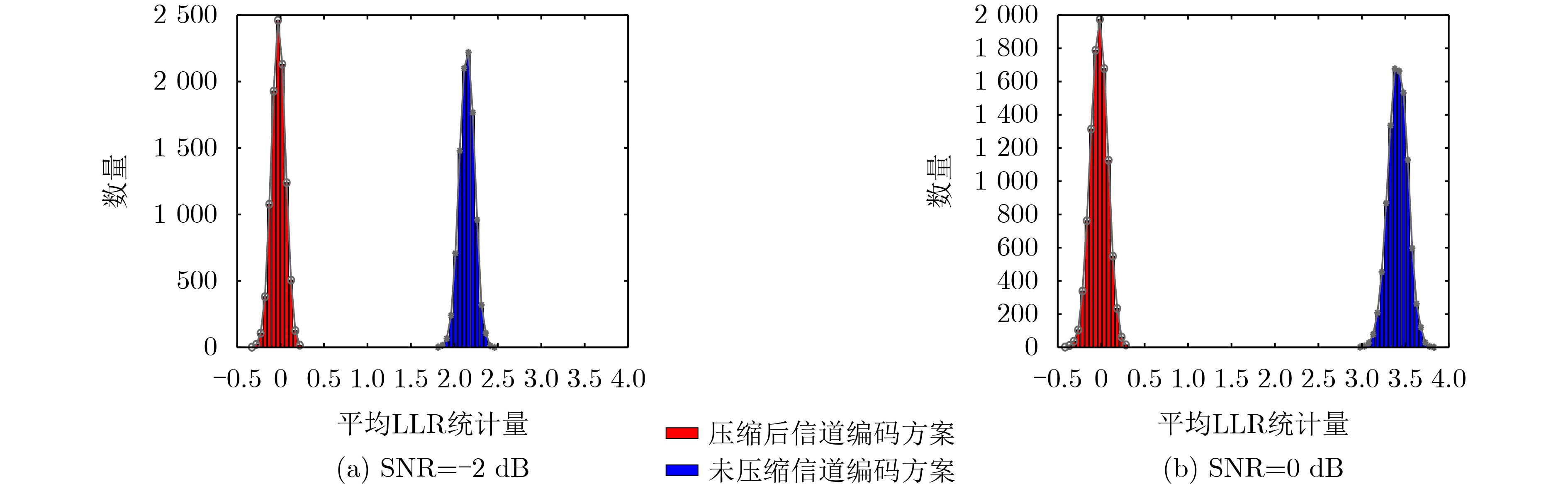
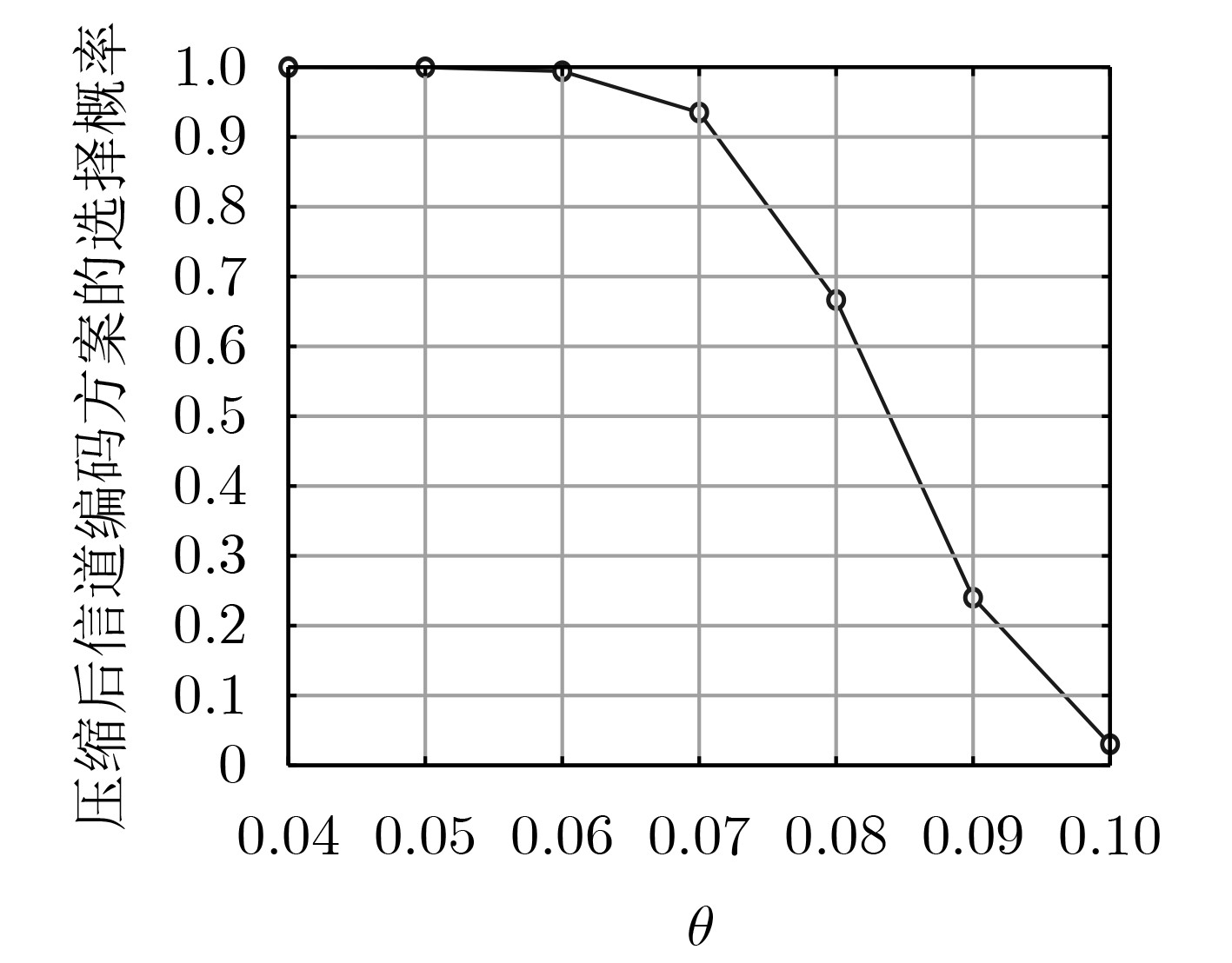
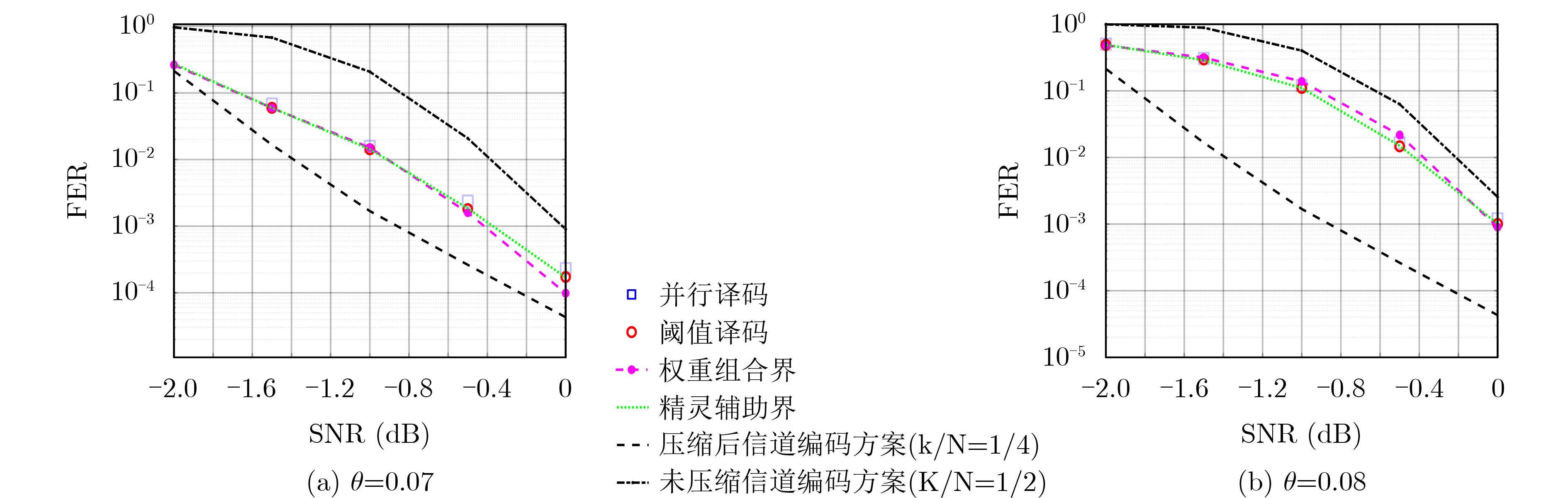
Objective Biased source data can be compressed before channel transmission to reduce the equivalent information rate. At finite block-lengths, however, BP decompression may fail for some source frames. In conventional compression-assisted transmission, a compressed sequence is typically passed directly to channel coding and transmission without verifying whether the current source frame can be correctly recovered by the adopted BP decompression decoder. To address this issue, this paper proposes an adaptive low-density parity-check (LDPC)-coded transmission scheme driven by transmitter-side decoding decisions. Methods The proposed scheme employs LDPC codes for source compression and channel protection. After source compression, the transmitter performs local belief propagation (BP) decompression decoding using the compressed sequence and source prior information. If local decompression succeeds, the compressed sequence is channel-coded and transmitted; otherwise, the original source sequence is channel-coded and transmitted. These two alternatives are referred to as the compressed and uncompressed transmission schemes, respectively. The transmission scheme is selected on a frame-by-frame basis according to the transmitter-side local decompression result. At the receiver, two decoding algorithms are developed. Parallel decoding performs BP decoding under both transmission-scheme hypotheses, whereas threshold decoding determines the transmission scheme from the received soft information and then performs only one LDPC channel decoding operation. A weighted combination bound is proposed to estimate the frame error rate (FER), and a genie-aided bound is introduced for comparison. Results and Discussions Under the simulated conditions, the proposed scheme with either parallel decoding or threshold decoding achieves a lower FER than the uncompressed transmission scheme. The resulting FERs agree well with the weighted combination bound and approach the genie-aided bound. The results further show that the probability of selecting the compressed transmission scheme decreases markedly as θ increases. The corresponding probabilities are approximately 0.935, 0.666, and 0.030 for $ \theta=0.07 $, 0.08, and $ 0.1 $, respectively. At $ \theta=0.07 $ and ${\text{SNR}}=-1\text{dB}$, the FER of the uncompressed transmission scheme is approximately 0.208, while those of the proposed scheme with parallel decoding and threshold decoding are approximately 0.0157 and0.0143 , respectively.Conclusions The proposed scheme performs transmitter-side local BP decompression to adaptively select between the compressed and uncompressed transmission schemes on a frame-by-frame basis. Its performance advantage is more pronounced for strongly biased sources and when the transmitter-side local BP decompression success probability is high. Its implementation requires one additional local BP decompression operation at the transmitter, while the decision threshold used in threshold decoding needs to be determined for the given source statistics, channel SNR, and coding parameters. -
1 发送端传输方案
输入:信源序列$ \boldsymbol{u} $,信源先验信息 输出:实际二进制发送序列$ {\boldsymbol{c}}_{\text{t}} $ 1. 调用$ {\mathcal{C}}_{S}\left[K,K-k\right] $编码器,得到压缩序列$ \boldsymbol{s} $; 2. 将压缩序列$ \boldsymbol{s} $和信源先验信息作为输入,执行BP解压缩译码,得到序列$ {\hat{\boldsymbol{u}}}_{\text{T}} $; 3. 若$ {\hat{\boldsymbol{u}}}_{\text{T}}=\boldsymbol{u} $:在序列$ \boldsymbol{s} $末尾补$ K-k $个0构造$ K $长序列$ \left(\boldsymbol{s},0\right) $,对序列$ \left(\boldsymbol{s},0\right) $进行$ \mathcal{C}\left[N,K\right] $编码,得到码字$ \boldsymbol{c} $; 将码字$ \boldsymbol{c} $中与补零序列对应的位置替换为翻转重复序列$ \boldsymbol{r} $,得到$ {\boldsymbol{c}}_{\text{t}} $; 4. 若$ {\hat{\boldsymbol{u}}}_{\text{T}}\ne\boldsymbol{u} $:对序列$ \boldsymbol{u} $进行$ \mathcal{C}\left[N,K\right] $编码,得到码字$ \boldsymbol{c} $,并令$ {\boldsymbol{c}}_{\text{t}}=\boldsymbol{c} $。  下载: 导出CSV
-
[1] ITU-R. M. 2160: Framework and overall objectives of the future development of IMT for 2030 and beyond[R/OL]. https://www.itu.int/rec/R-REC-M.2160-0-202311-I/en, 2023. [2] 张平, 牛凯, 田辉, 等. 6G移动通信技术展望[J]. 通信学报, 2019, 40(1): 141–148. doi: 10.11959/j.issn.1000-436x.2019022.ZHANG Ping, NIU Kai, TIAN Hui, et al. Technology prospect of 6G mobile communications[J]. Journal on Communications, 2019, 40(1): 141–148. doi: 10.11959/j.issn.1000-436x.2019022. [3] ROWSHAN M, QIU Min, XIE Yixuan, et al. Channel coding toward 6G: Technical overview and outlook[J]. IEEE Open Journal of the Communications Society, 2024, 5: 2585–2685. doi: 10.1109/OJCOMS.2024.3390000. [4] TATARIA H, SHAFI M, MOLISCH A F, et al. 6G wireless systems: Vision, requirements, challenges, insights, and opportunities[J]. Proceedings of the IEEE, 2021, 109(7): 1166–1199. doi: 10.1109/JPROC.2021.3061701. [5] 王千帆, 郭延庚, 毕胜, 等. 面向高可靠低时延通信的顺序统计译码(OSD)关键技术综述[J]. 电子学报, 2026, 54(1): 466–478. doi: 10.12263/DZXB.20251062.WANG Qianfan, GUO Yangeng, BI Sheng, et al. A survey of key techniques in ordered statistics decoding (OSD) for ultra-reliable low-latency communications[J]. Acta Electronica Sinica, 2026, 54(1): 466–478. doi: 10.12263/DZXB.20251062. [6] DURISI G, KOCH T, and POPOVSKI P. Toward massive, ultrareliable, and low-latency wireless communication with short packets[J]. Proceedings of the IEEE, 2016, 104(9): 1711–1726. doi: 10.1109/JPROC.2016.2537298. [7] BOCKELMANN C, PRATAS N, NIKOPOUR H, et al. Massive machine-type communications in 5G: Physical and MAC-layer solutions[J]. IEEE Communications Magazine, 2016, 54(9): 59–65. doi: 10.1109/MCOM.2016.7565189. [8] SHANNON C E. A mathematical theory of communication[J]. The Bell System Technical Journal, 1948, 27(3): 379–423. doi: 10.1002/j.1538-7305.1948.tb01338.x. [9] WENG Jianjia, ALAJAJI F, and LINDER T. Two-way source-channel coding[J]. IEEE Transactions on Information Theory, 2021, 67(10): 6507–6524. doi: 10.1109/TIT.2021.3100781. [10] BOCHAROVA I E, GUILLÉN I FÀBREGAS A, KUDRYASHOV B D, et al. Multi-class source-channel coding[J]. IEEE Transactions on Information Theory, 2016, 62(9): 5093–5104. doi: 10.1109/TIT.2016.2588496. [11] PETTIJOHN B D, HOFFMAN M W, and SAYOOD K. Joint source/channel coding using arithmetic codes[J]. IEEE Transactions on Communications, 2001, 49(5): 826–836. doi: 10.1109/26.923806. [12] GRANGETTO M, MAGLI E, and OLMO G. Distributed joint source-channel arithmetic coding[C]. 2010 IEEE International Conference on Image Processing, Hong Kong, China, 2010: 3717–3720. doi: 10.1109/ICIP.2010.5652684. [13] WANG Qianfan, CHEN Yanzhi, LIANG Jifan, et al. A new joint source-channel coding for short-packet communications[J]. IEEE Transactions on Communications, 2024, 72(1): 28–37. doi: 10.1109/TCOMM.2023.3320699. [14] ZHENG Xiangping, WANG Qianfan, WEI Baodian, et al. Quasi-OSD of binary image of RS codes with applications to JSCC[C]. 2024 IEEE International Symposium on Information Theory (ISIT), Athens, Greece, 2024: 3576–3581. doi: 10.1109/ISIT57864.2024.10619269. [15] CHEN Yanzhi, LIANG Jifan, WANG Qianfan, et al. A new joint source-channel coding scheme with overlay spread spectrum transmission[C]. 2023 International Conference on Wireless Communications and Signal Processing, Hangzhou, China, 2023: 239–244. doi: 10.1109/WCSP58612.2023.10404761. [16] WANG Qianfan, CHEN Yanzhi, LIANG Jifan, et al. A new joint source-channel coding in the short blocklength regime[C]. 2023 IEEE Globecom Workshops, Kuala Lumpur, Malaysia, 2023: 1566–1571. doi: 10.1109/GCWkshps58843.2023.10464813. [17] FOSSORIER M P C and LIN Shu. Soft-decision decoding of linear block codes based on ordered statistics[J]. IEEE Transactions on Information Theory, 1995, 41(5): 1379–1396. doi: 10.1109/18.412683. [18] 王千帆, 郭延庚, 宋林琦, 等. 基于跳过机制的低复杂度顺序统计译码算法[J]. 电子与信息学报, 2025, 47(11): 4275–4284. doi: 10.11999/JEIT250447.WANG Qianfan, GUO Yangeng, SONG Linqi, et al. Low-complexity ordered statistic decoding algorithm based on skipping mechanisms[J]. Journal of Electronics & Information Technology, 2025, 47(11): 4275–4284. doi: 10.11999/JEIT250447. [19] WANG Qianfan, LIANG Jifan, YUAN Peihong, et al. Guessing decoding of short blocklength codes[J/OL]. IEEE BITS the Information Theory Magazine, https://ieeexplore.ieee.org/abstract/document/11644918, 2026. doi: 10.1109/MBITS.2026.3722157. [20] WANG Yiwen, WANG Qianfan, LIANG Jifan, et al. Representative ordered statistics decoding of polar codes[C]. 2024 IEEE 99th Vehicular Technology Conference, Singapore, Singapore, 2024: 1–5. doi: 10.1109/VTC2024-Spring62846.2024.10683273. [21] WANG Qianfan, WANG Yiwen, ZHENG Xiangping, et al. Ordered reliability bits guessing codeword decoding of short codes[J]. IEEE Wireless Communications Letters, 2025, 14(9): 2823–2827. doi: 10.1109/LWC.2025.3580156. [22] DONG Yanfei, NIU Kai, DAI Jincheng, et al. Joint source and channel coding using double polar codes[J]. IEEE Communications Letters, 2021, 25(9): 2810–2814. doi: 10.1109/LCOMM.2021.3088941. [23] DONG Yanfei, NIU Kai, and DAI Jincheng. Distributed joint source-channel polar coding[C]. 2022 IEEE International Symposium on Information Theory, Espoo, Finland, 2022: 2362–2367. doi: 10.1109/ISIT50566.2022.9834726. [24] DONG Yanfei, NIU Kai, DAI Jincheng, et al. Joint successive cancellation list decoding for the double polar codes[J]. IEEE Communications Letters, 2022, 26(8): 1715–1719. doi: 10.1109/LCOMM.2022.3179644. [25] GAO Jian, SONG Xin, ZHANG Xiaojun, et al. Learning to decode double polar codes for joint source-channel coding[J]. IEEE Transactions on Vehicular Technology, 2026, 75(4): 6013–6025. doi: 10.1109/TVT.2025.3619411. [26] CHEN Chen, WANG Lin, and LIU Sanya. The design of protograph LDPC codes as source codes in a JSCC system[J]. IEEE Communications Letters, 2018, 22(4): 672–675. doi: 10.1109/LCOMM.2018.2804382. [27] CHEN Chen, WANG Lin, and LAU F C M. Joint optimization of protograph LDPC code pair for joint source and channel coding[J]. IEEE Transactions on Communications, 2018, 66(8): 3255–3267. doi: 10.1109/TCOMM.2018.2814603. [28] XU Zhiping, WANG Lin, HONG Shaohua, et al. Joint shuffled scheduling decoding algorithm for DP-LDPC codes-based JSCC systems[J]. IEEE Wireless Communications Letters, 2019, 8(6): 1696–1699. doi: 10.1109/LWC.2019.2937766. [29] LIU Sanya, WANG Lin, CHEN Jun, et al. Joint component design for the JSCC system based on DP-LDPC codes[J]. IEEE Transactions on Communications, 2020, 68(9): 5808–5818. doi: 10.1109/TCOMM.2020.3001647. [30] LIN Weiwei, XU Zhiping, HONG Shaohua, et al. Multi-round joint belief propagation decoding with perturbation for JSCC system based on DP-LDPC codes[C]. 2021 International Conference on Computer, Information and Telecommunication Systems, Istanbul, Turkey, 2021: 1–5. doi: 10.1109/CITS52676.2021.9618613. [31] SONG Dan, WANG Lin, XU Zhiping, et al. Joint code rate compatible design of DP-LDPC code pairs for joint source channel coding over implant-to-external channel[J]. IEEE Transactions on Wireless Communications, 2022, 21(7): 5526–5540. doi: 10.1109/TWC.2022.3141729. [32] JIMENEZ FELSTROM A and ZIGANGIROV K S. Time-varying periodic convolutional codes with low-density parity-check matrix[J]. IEEE Transactions on Information Theory, 1999, 45(6): 2181–2191. doi: 10.1109/18.782171. [33] WANG Qianfan, CAI Suihua, LIN Wenchao, et al. Spatially coupled LDPC codes via partial superposition[C]. 2019 IEEE International Symposium on Information Theory, Paris, France, 2019: 2614–2618. doi: 10.1109/ISIT.2019.8849384. [34] 王千帆, 杨佳仪, 王寅楚, 等. 面向流式通信的耦合LDPC码研究综述[J]. 电子学报, 2024, 52(8): 2913–2932. doi: 10.12263/DZXB.20240167.WANG Qianfan, YANG Jiayi, WANG Yinchu, et al. A review of coupled LDPC codes for streaming communications[J]. Acta Electronica Sinica, 2024, 52(8): 2913–2932. doi: 10.12263/DZXB.20240167. [35] WANG Qianfan, CAI Suihua, CHEN Li, et al. Semi-LDPC convolutional codes: Construction and low-latency windowed list decoding[J]. Journal of Communications and Information Networks, 2021, 6(4): 411–419. doi: 10.23919/JCIN.2021.9663105. [36] LI Yupeng, ZHOU Lin, CHEN Qiwang, et al. Quasi-cyclic concatenated spatially coupled LDPC codes based joint source-channel coding[C]. 2023 2nd International Joint Conference on Information and Communication Engineering, Chengdu, China, 2023: 66–70. doi: 10.1109/JCICE59059.2023.00023. [37] GOLMOHAMMADI A and MITCHELL D G M. Concatenated spatially coupled LDPC codes with sliding window decoding for joint source-channel coding[J]. IEEE Transactions on Communications, 2022, 70(2): 851–864. doi: 10.1109/TCOMM.2021.3126750. [38] GRIFFIN J, YUAN Peihong, POPOVSKI P, et al. Code at the receiver, decode at the sender: GRAND with feedback[C]. 2023 IEEE Information Theory Workshop, Saint-Malo, France, 2023: 341–346. doi: 10.1109/ITW55543.2023.10161690. [39] GRIFFIN J C, YUAN Peihong, THESMAR R, et al. Code at the receiver, decode at the sender: Feedback communication with GRAND-CE[J]. IEEE Transactions on Communications, 2025, 73(12): 13017–13032. doi: 10.1109/TCOMM.2025.3604322. [40] GALLAGER R. Low-density parity-check codes[J]. IRE Transactions on Information Theory, 1962, 8(1): 21–28. doi: 10.1109/TIT.1962.1057683. [41] 吕毅博, 胡伟, 王琳. Beyond-BP译码算法综述: 原理与应用[J]. 电子与信息学报, 2017, 39(6): 1503–1514. doi: 10.11999/JEIT161288.LÜ Yibo, HU Wei, and WANG Lin. Survey of Beyond-BP decoding algorithms: Theory and applications[J]. Journal of Electronics & Information Technology, 2017, 39(6): 1503–1514. doi: 10.11999/JEIT161288. [42] CAI Suihua, ZHAO Shancheng, and MA Xiao. Free ride on LDPC coded transmission[J]. IEEE Transactions on Information Theory, 2022, 68(1): 80–92. doi: 10.1109/TIT.2021.3122342. [43] WANG Qianfan, CAI Suihua, WANG Yinchu, et al. Free-ride feedback and superposition retransmission over LDPC coded links[J]. IEEE Transactions on Communications, 2023, 71(1): 13–25. doi: 10.1109/TCOMM.2022.3224018. [44] MA Xiao, WANG Qianfan, CAI Suihua, et al. Implicit partial product-LDPC codes using free-ride coding[C]. ICC 2022 - IEEE International Conference on Communications, Seoul, Korea, 2022: 2471–2476. doi: 10.1109/ICC45855.2022.9839082. [45] WANG Qianfan, WANG Yiwen, LIANG Jifan, et al. Free-ride BCH codes for fine-grained rate adaptation: Construction, decoding, and analysis[J]. IEEE Transactions on Communications, 2026, 74: 13579–13590. doi: 10.1109/TCOMM.2026.3726769. -


 下载:


图(4) / 表(1)
计量
- 文章访问数: 18
- HTML全文浏览量: 6
- PDF下载量: 0
- 被引次数: 0
