




Interference Analysis and Iterative Signal Detection for ODDM Systems with Non-Ideal Pulse Shaping
-
摘要: 正交时延多普勒分集复用(ODDM)是一种按照时延–多普勒(DD)平面分辨率进行正交传输的多载波调制技术,其正交性实现通常要求成型脉冲满足理想奈奎斯特条件。然而受工程可实现性限制,有限长成型脉冲难以严格满足此条件。在载波频率偏移作用下,该非理想成型脉冲会产生理想假设下不存在的残余干扰。基于此,本文分析了非理想成型脉冲与载波频率偏移共同作用下的DD域等效干扰特性,并在此基础上设计了一种线性残余干扰抵消检测算法,以补偿上述残余干扰所导致的性能损失。仿真结果表明,本文采用的干扰模型结果与仿真结果更为接近,所提检测算法能够有效补偿因忽略残余干扰导致的性能损失,并在复杂度低于完整最小均方误差(MMSE)检测的前提下获得接近其性能的检测结果。
-
关键词:
- 正交时延多普勒分集复用 /
- 干扰分析 /
- 信号检测
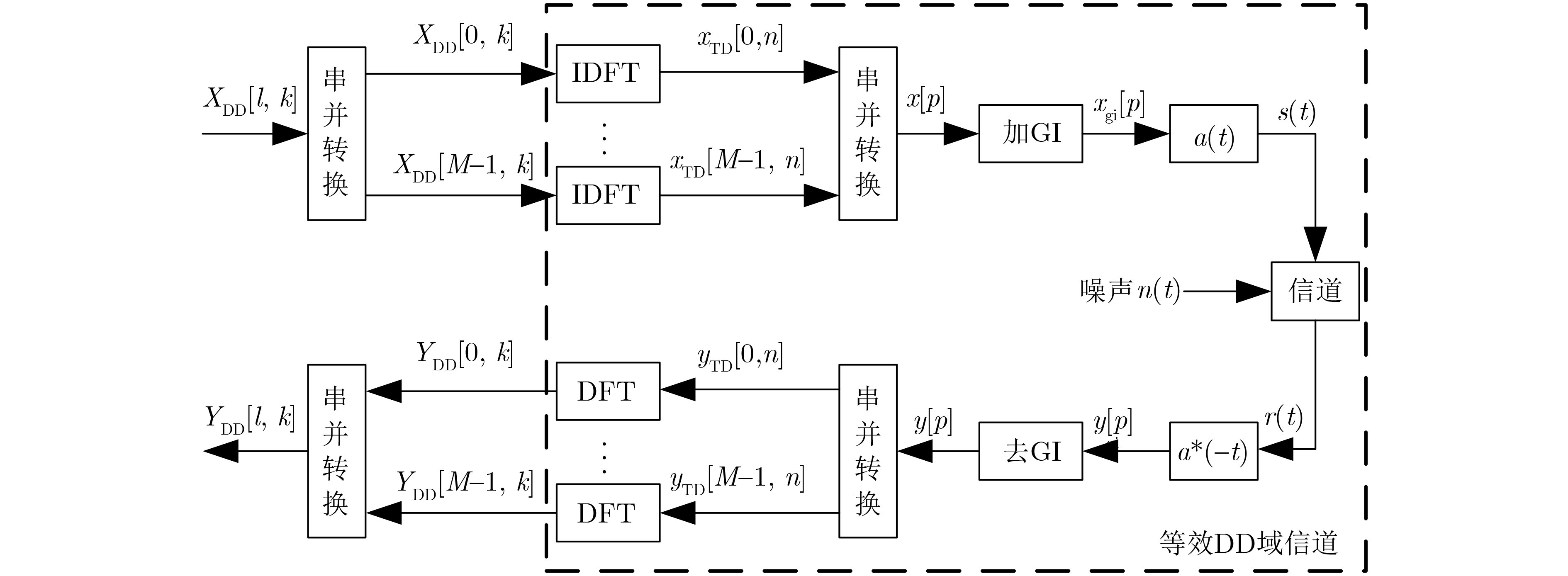
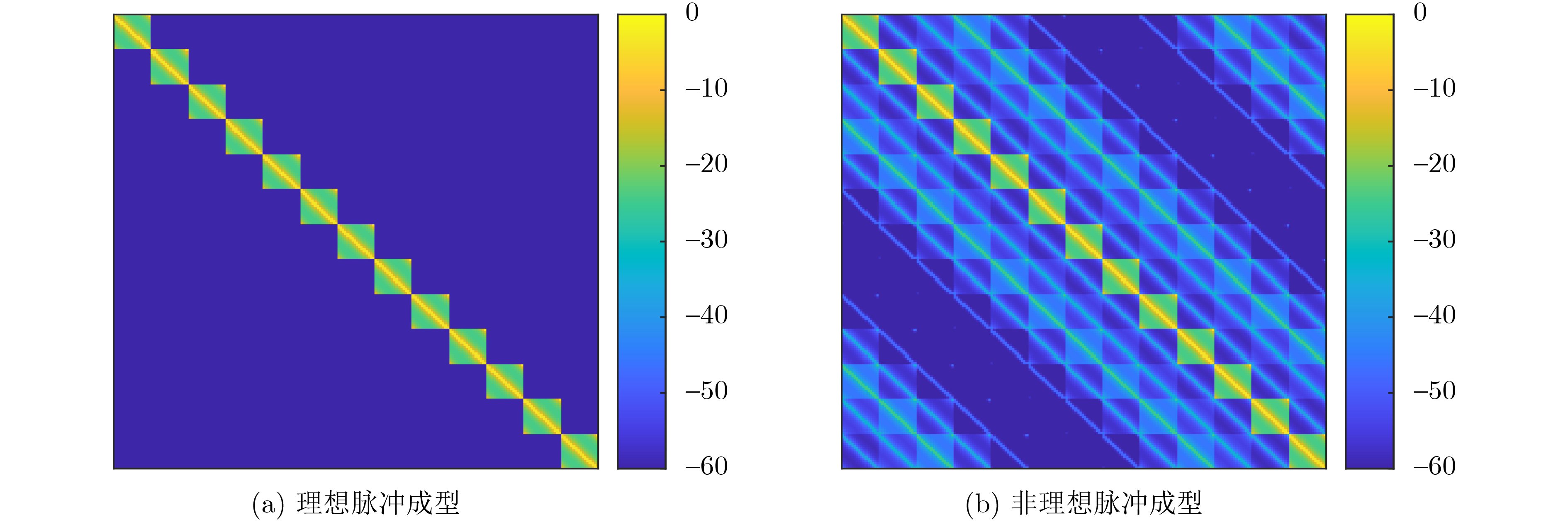
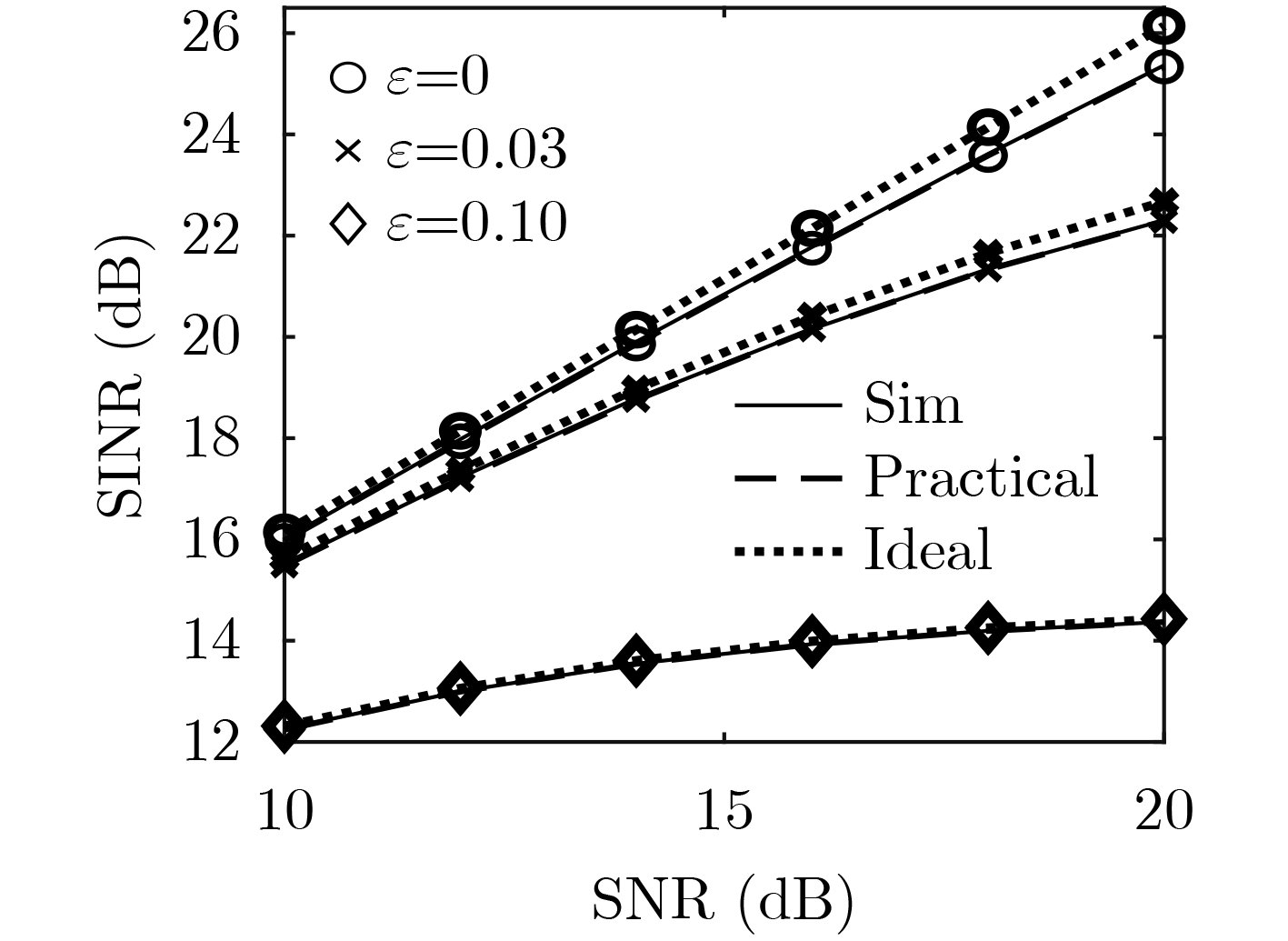
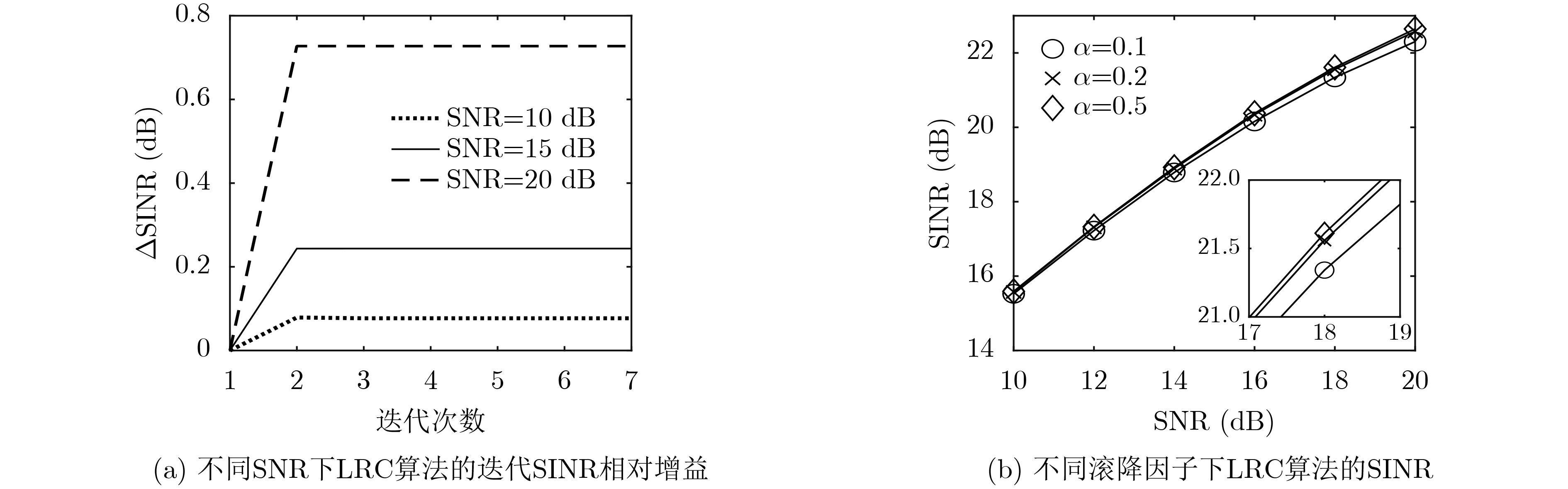
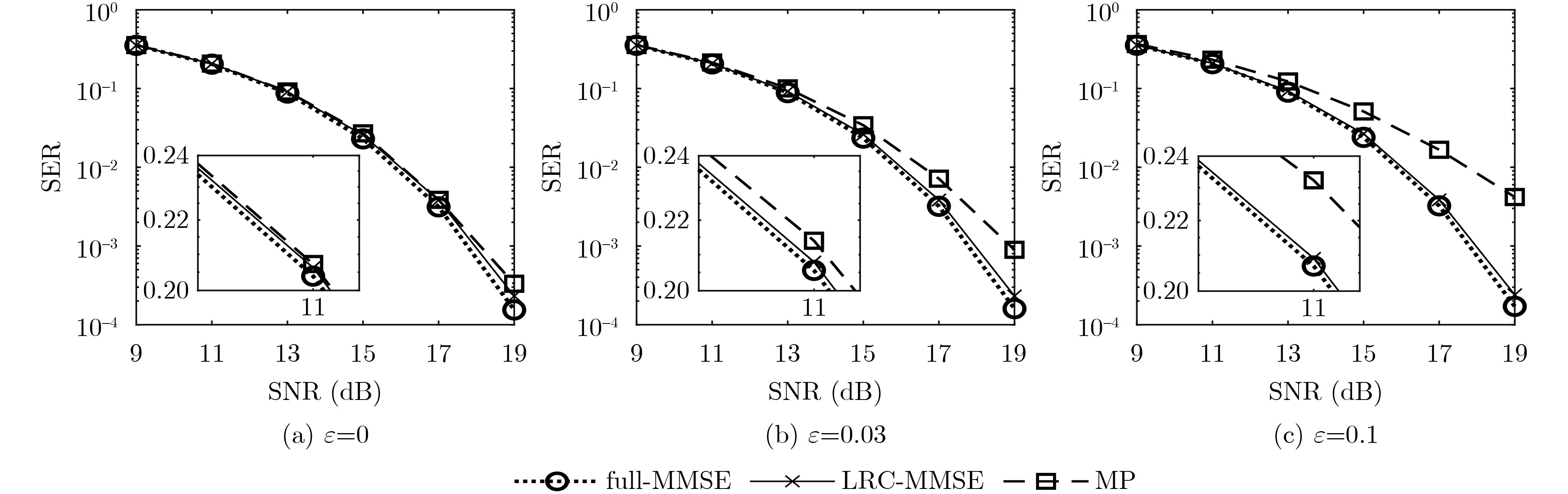
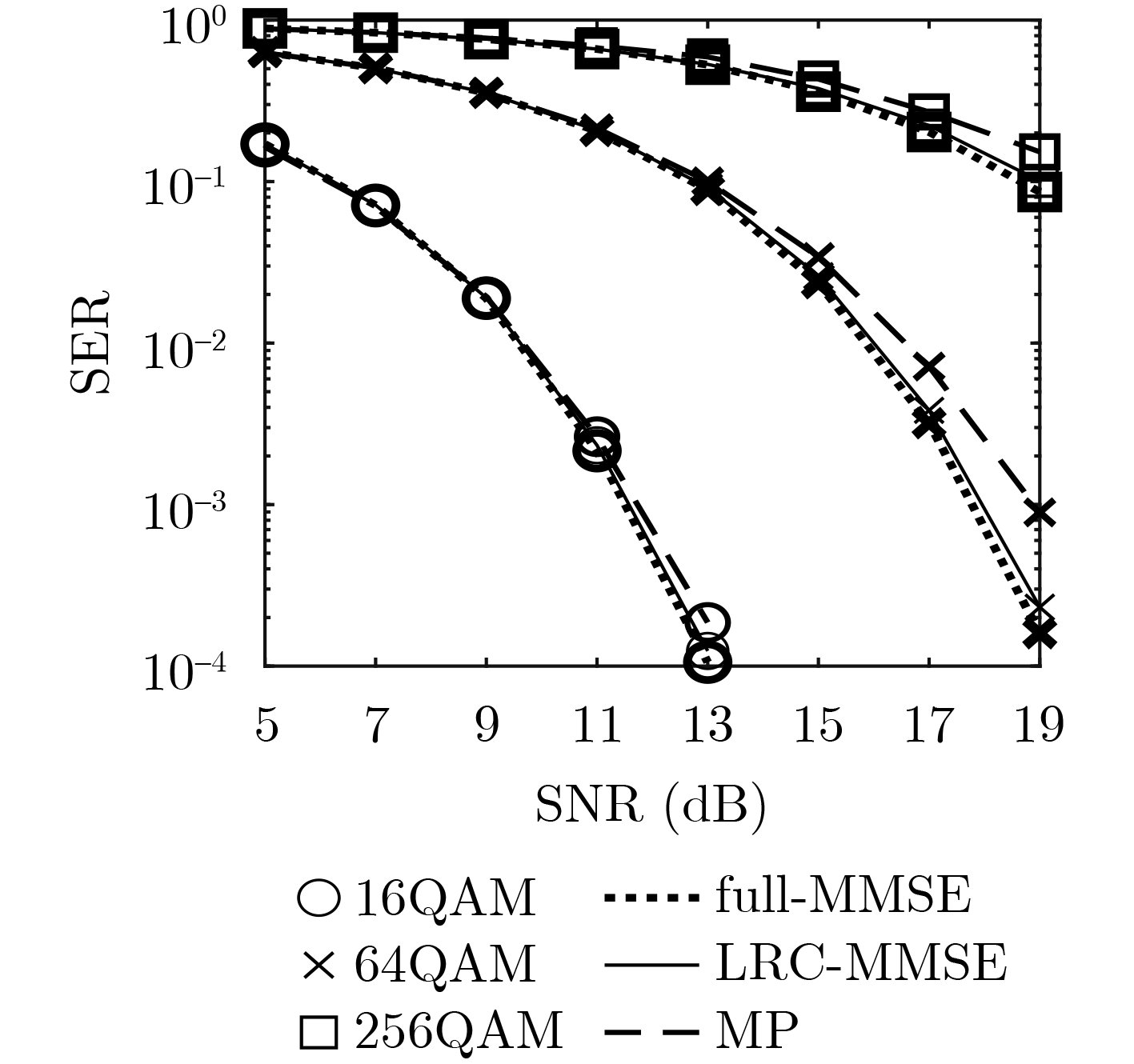
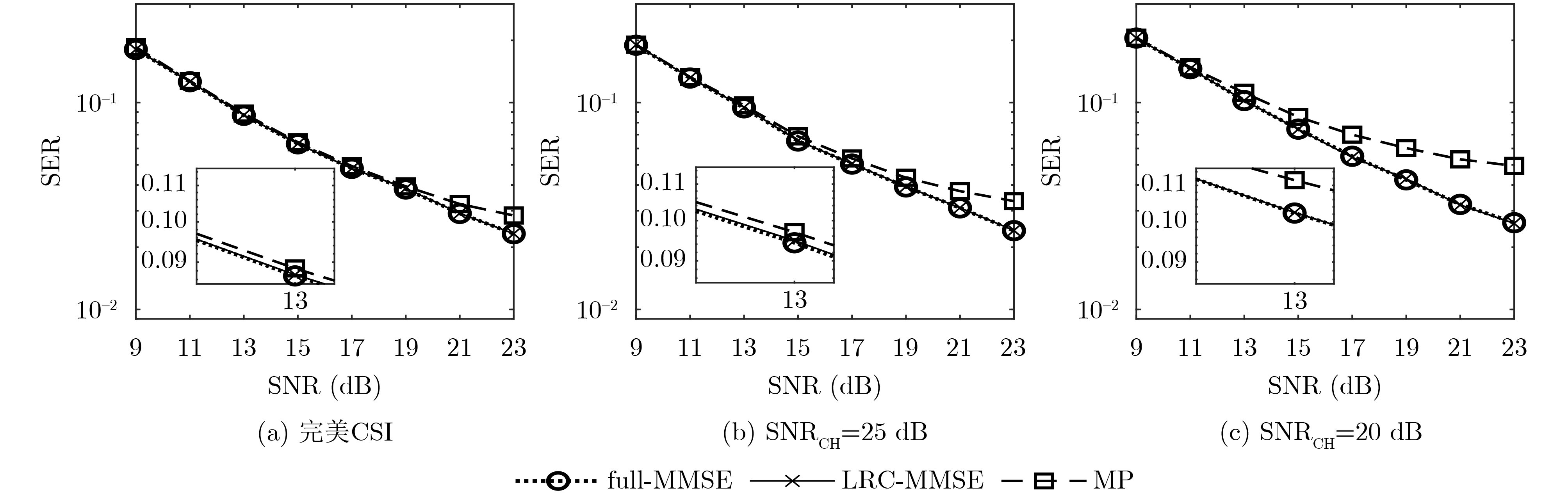
Abstract:Objective Orthogonal Delay-Doppler Division Multiplexing (ODDM) is a delay-Doppler (DD) domain multicarrier modulation scheme that transmits information symbols according to the resolution of the DD plane. By exploiting orthogonal pulses in the DD domain, ODDM achieves a structured input-output relationship and a sparse equivalent channel representation in high-mobility wireless communication scenarios. However, the orthogonality of ODDM typically relies on the ideal Nyquist property of the pulse shaping filter. In practical systems, finite-length pulses cannot strictly satisfy this condition, and their non-ideal Nyquist characteristics introduce additional energy leakage. In the presence of carrier frequency offset (CFO), this energy leakage further couples with inter-carrier interference to form residual interference. If such residual interference is neglected in receiver design, the detector operates based on a mismatched equivalent channel model, resulting in degraded symbol detection performance. To address this issue, this paper investigates the interference characteristics of ODDM systems with non-ideal pulse shaping under CFO, and proposes an iterative detection algorithm to compensate for the performance loss caused by neglecting residual interference under the ideal Nyquist assumption. Methods First, a DD-domain equivalent interference model is established for ODDM systems with non-ideal pulse shaping under CFO, characterizing the residual interference that is neglected under the ideal Nyquist pulse assumption. Second, based on the structure of the derived DD-domain interference matrix, the equivalent interference is decomposed into a nominal interference component captured by the ideal pulse model and a residual interference component introduced by non-ideal pulse shaping. Building on this decomposition, a linear residual interference cancellation (LRC) detection algorithm is designed to suppress residual interference through a small number of iterations, thereby compensating for the performance loss incurred by neglecting such interference. Finally, the accuracy of the adopted interference model based on practical pulses and the effectiveness of the proposed detection algorithm are validated through Signal-to-Interference-plus-Noise Ratio (SINR) and Symbol Error Rate (SER) simulations. Results and Discussions A comprehensive evaluation of the non-ideal pulse interference modeling framework and the proposed LRC detection algorithm is conducted in this paper. Simulation results demonstrate that the SINR computed by the non-ideal pulse interference model maintains consistently closer agreement with Monte Carlo simulations, with a deviation of no more than 0.05 dB, whereas the ideal Nyquist pulse model overestimates SINR by up to 0.7 dB across the simulated SNR range ( Fig. 3 ). This discrepancy is particularly pronounced at low residual CFO and high SNR. In terms of detection performance, the Message Passing (MP) detector commonly used under the ideal pulse assumption exhibits an increasing performance gap from the MMSE detector based on the full interference model as the normalized CFO increases. At an SNR of 19 dB, the SER ratio between MP and the full-model MMSE detector rises from approximately 2.2 at zero CFO to approximately 24.5 when the normalized CFO is 0.1, whereas the proposed LRC detector remains close to the full-model MMSE detector, with its SER staying within about 1.5 times that of the full-model MMSE detector under the same conditions (Fig. 5 ). This confirms that model mismatch incurs non-negligible performance degradation. The proposed LRC detection algorithm effectively compensates for this performance loss and closely approaches the detection performance of the full-model MMSE detector with as few as 2 iterations across all tested CFO values. Consistent conclusions are further corroborated by results obtained under 16QAM, 64QAM, and 256QAM modulations (Fig. 6 ): as the modulation order increases, the performance gap between the MP detector and the full-model MMSE detector widens, whereas LRC maintains close approximation to the full-model MMSE across different modulation orders. Furthermore, under doubly selective channels, LRC still achieves SER performance close to that of the full-model MMSE detector and outperforms MP detection (Fig. 7 ). When imperfect channel state information (CSI) is further considered, the SERs of all three detection methods increase as the channel estimation SNR decreases. Among them, the performance degradation of LRC and the full-model MMSE is relatively limited, and their detection results remain close to each other, whereas MP is more significantly affected by channel estimation errors. These results further demonstrate that the proposed method exhibits good robustness and broad applicability in interference-limited systems with non-ideal pulse shaping.Conclusions This paper investigates the interference analysis and signal detection problem in ODDM systems with non-ideal pulse shaping under CFO. Based on the characterization of the equivalent interference structure in the delay-Doppler domain under the joint effect of non-ideal pulse shaping and CFO, a linear residual interference cancellation detection algorithm is proposed. The algorithm compensates for the residual interference neglected under the ideal Nyquist pulse assumption, thereby recovering the associated performance loss. Simulation results demonstrate that the adopted non-ideal pulse interference model more accurately characterizes the system interference behavior. Based on this model, the proposed LRC detection algorithm effectively compensates for the performance loss caused by model mismatch, achieving close approximation to the detection performance of the full-model MMSE detector while maintaining lower computational complexity. -
1 基于LRC的迭代检测算法
输入:$ {\boldsymbol{y}}_{\text{DD}} $, $ {\boldsymbol{H}}_{\text{main}} $, $ {\boldsymbol{H}}_{\text{other}} $, $ \sigma _{\text{n}}^{2} $, $ {I}_{\max } $ 输出:$ {\boldsymbol{x}}_{\text{LRC}}={{\hat{\boldsymbol{x}}}}^{({{I}_{\max }})} $ (1) 初始化:$ i=1 $,令$ {\boldsymbol{y}}^{(1)}={\boldsymbol{y}}_{\text{DD}} $ (2) 根据式(22)和(23)预计算各时延分组MMSE检测矩阵$ {\boldsymbol{W}}_{l} $ (3) while $ i\leq {I}_{\max } $ (4) for $ l=0,1,\cdots ,M-1 $ (5) $ {\tilde{\boldsymbol{x}}}_{l}^{(i)}={\boldsymbol{W}}_{l}\boldsymbol{y}_{l}^{(i)} $对各时延分组进行分块检测 (6) end (7) 对所有软输出结果进行硬判决$ {{\hat{\boldsymbol{x}}}}^{(i)}=Q\left({{\tilde{\boldsymbol{x}}}}^{(i)}\right) $ (8) 重构并抵消残余干扰$ {\boldsymbol{y}}^{(i+1)}={\boldsymbol{y}}_{\text{DD}}-{\boldsymbol{H}}_{\text{other}}{{\hat{\boldsymbol{x}}}}^{(i)} $ (9) $ i=i+1 $ (10) end  下载: 导出CSV
表 1 仿真参数
仿真参数 参数值 发送符号数$ M $ 33 子载波个数$ N $ 64 调制方式 64QAM 脉冲滚降因子$ \alpha $ 0.1 过采样因子$ K $ 4 截断符号数$ 2Q $ 16 归一化载波频率偏移 0, 0.03, 0.1
下载: 导出CSV
-
[1] AKBAR M S, HUSSAIN Z, IKRAM M, et al. On challenges of sixth-generation (6G) wireless networks: A comprehensive survey of requirements, applications, and security issues[J]. Journal of Network and Computer Applications, 2025, 233: 104040. doi: 10.1016/j.jnca.2024.104040. [2] 束锋, 张钧豪, 张旗, 等. 混合智能反射面辅助感通算一体化车联网的联合功率时间分配方法[J]. 电子与信息学报, 2025, 47(4): 1026–1042. doi: 10.11999/JEIT240719.SHU Feng, ZHANG Junhao, ZHANG Qi, et al. Hybrid reconfigurable intelligent surface assisted sensing communication and computation for joint power and time allocation in vehicle ad-hoc network[J]. Journal of Electronics & Information Technology, 2025, 47(4): 1026–1042. doi: 10.11999/JEIT240719. [3] DING Zhiguo, SCHOBER R, FAN Pingzhi, et al. Next generation multiple access for IMT towards 2030 and beyond[J]. Science China Information Sciences, 2024, 67(6): 166301. doi: 10.1007/s11432-024-4014-x. [4] ADOUM B A, ZOUKALNE K, IDRISS M S, et al. A comprehensive survey of candidate waveforms for 5G, beyond 5G and 6G wireless communication systems[J]. Open Journal of Applied Sciences, 2023, 13(1): 136–161. doi: 10.4236/ojapps.2023.131012. [5] LORCA HERNANDO J and ARMADA A G. Frequency-modulated OFDM: A new waveform for high-mobility wireless communications[J]. IEEE Transactions on Communications, 2023, 71(1): 540–552. doi: 10.1109/TCOMM.2022.3224212. [6] 曾嵘, 邵智敏. 零前缀OFDM中智能反射表面环境下干扰抑制算法研究[J]. 电子与信息学报, 2022, 44(7): 2358–2365. doi: 10.11999/JEIT211389.ZENG Rong and SHAO Zhimin. Research on interference suppression algorithm in reconfigurable intelligent surface environment in ZP-OFDM[J]. Journal of Electronics & Information Technology, 2022, 44(7): 2358–2365. doi: 10.11999/JEIT211389. [7] 华惊宇, 杨乐, 闻建刚, 等. 通用滤波多载波系统原型滤波器的连续凸近似优化设计方法[J]. 电子与信息学报, 2025, 47(10): 3793–3803. doi: 10.11999/JEIT250278.HUA Jingyu, YANG Le, WEN Jian’gang, et al. A successive convex approximation optimization based prototype filter design method for universal filtered multi-carrier systems[J]. Journal of Electronics & Information Technology, 2025, 47(10): 3793–3803. doi: 10.11999/JEIT250278. [8] 陈浩, 闻建刚, 邹园萍, 等. 滤波正交频分复用系统中的降复杂度主动干扰抵消算法[J]. 电子与信息学报, 2026, 48(4): 1495–1504. doi: 10.11999/JEIT251172.CHEN Hao, WEN Jian’gang, ZOU Yuanping, et al. A complexity-reduced active interference cancellation algorithm in f-OFDM[J]. Journal of Electronics & Information Technology, 2026, 48(4): 1495–1504. doi: 10.11999/JEIT251172. [9] SHEIKH-HOSSEINI M, RAHDARI F, GHASEMNEZHAD H, et al. A comparative performance evaluation of OFDM, GFDM, and OTFS in impulsive noise channels[J]. IEEE Open Journal of the Communications Society, 2025, 6: 2693–2705. doi: 10.1109/OJCOMS.2024.3506723. [10] SCHAICH F and WILD T. Waveform contenders for 5G — OFDM vs. FBMC vs. UFMC[C]. 2014 6th International Symposium on Communications, Control and Signal Processing (ISCCSP), Athens, Greece, 2014: 457–460. doi: 10.1109/ISCCSP.2014.6877912. [11] WEI Zhiqiang, YUAN Weijie, LI Shuangyang, et al. Orthogonal time-frequency space modulation: A promising next-generation waveform[J]. IEEE Wireless Communications, 2021, 28(4): 136–144. doi: 10.1109/MWC.001.2000408. [12] TONG Jun, SHAFIE A, and YUAN Jinghong. Delay-Doppler domain multicarrier modulation (DDMC) for future communications and sensing[J]. IEEE Communications Standards Magazine, 2026, 10(2): 150–159. doi: 10.1109/MCOMSTD.2026.3654780. [13] MOHAMMED S K, HADANI R, CHOCKALINGAM A, et al. OTFS—a mathematical foundation for communication and radar sensing in the delay-Doppler domain[J]. IEEE BITS the Information Theory Magazine, 2022, 2(2): 36–55. doi: 10.1109/MBITS.2022.3216536. [14] LIN Hai, YUAN Jinghong, YU Wei, et al. Multi-carrier modulation: An evolution from time-frequency domain to delay-Doppler domain[J]. IEEE Transactions on Communications, 2026, 74: 7962–7992. doi: 10.1109/TCOMM.2026.3686722. [15] LIN Hai and YUAN Jinghong. Multicarrier modulation on delay-Doppler plane: Achieving orthogonality with fine resolutions[C]. ICC 2022 - IEEE International Conference on Communications, Seoul, Korea, 2022: 2417–2422. doi: 10.1109/ICC45855.2022.9838684. [16] LIN Hai and YUAN Jinghong. On delay-Doppler plane orthogonal pulse[C]. GLOBECOM 2022 - 2022 IEEE Global Communications Conference, Rio de Janeiro, Brazil, 2022: 5589–5594. doi: 10.1109/GLOBECOM48099.2022.10001406. [17] LIN Hai and YUAN Jinghong. Orthogonal delay-Doppler division multiplexing modulation[J]. IEEE Transactions on Wireless Communications, 2022, 21(12): 11024–11037. doi: 10.1109/TWC.2022.3188776. [18] TONG Jun, YUAN Jinghong, LIN Hai, et al. Orthogonal delay-Doppler division multiplexing (ODDM) over general physical channels[J]. IEEE Transactions on Communications, 2024, 72(12): 7938–7953. doi: 10.1109/TCOMM.2024.3416892. [19] TONG Jun, SHAFIE A, YUAN Jinghong, et al. Equivalent sampled delay-Doppler (ESDD) channel models for ODDM over highly-spread channels[J]. IEEE Transactions on Wireless Communications, 2026, 25: 3944–3959. doi: 10.1109/TWC.2025.3607314. [20] HUANG Kehan, QIU Min, TONG Jun, et al. Performance of ODDM with imperfect channel estimation[C]. 2023 IEEE 24th International Workshop on Signal Processing Advances in Wireless Communications (SPAWC), Shanghai, China, 2023: 561–565. doi: 10.1109/SPAWC53906.2023.10304518. [21] WANG Dezhi, HUANG Chongwen, LIU Lei, et al. Exploring channel estimation and signal detection for ODDM-based ISAC systems[J]. IEEE Wireless Communications Letters, 2024, 13(8): 2270–2274. doi: 10.1109/LWC.2024.3411637. -

 下载:

图(7) / 表(2)
计量
- 文章访问数: 9
- HTML全文浏览量: 1
- PDF下载量: 0
- 被引次数: 0
