




Cross-Scale Functional Safety Verification: Expert-Guided Graph Learning for SoCs
-
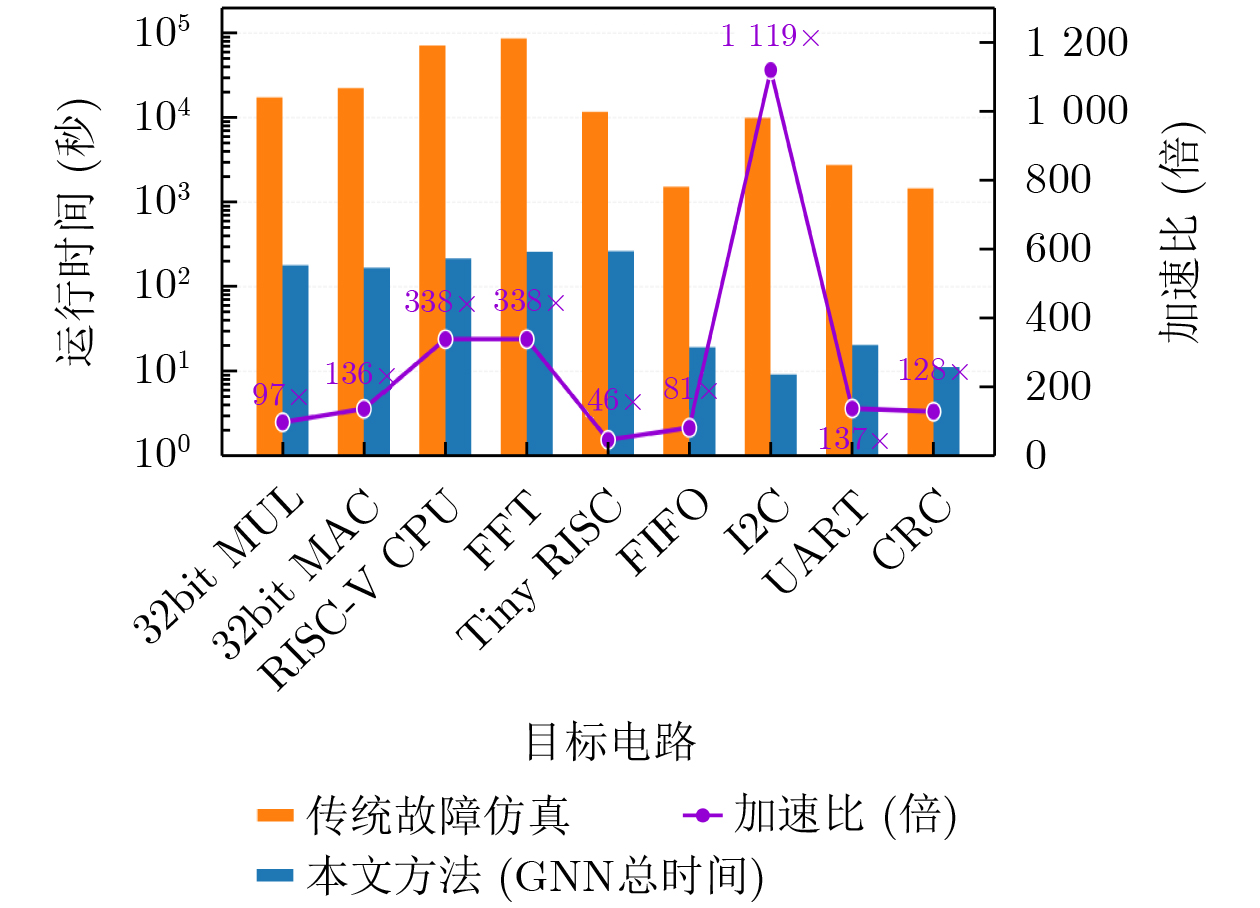
摘要: 针对汽车系统级芯片功能安全验证中传统故障注入成本过高、现有学习方法跨尺度迁移能力不足的问题,提出一种原语级故障数据集与专家引导图学习框架。该框架基于40个标准库原语构建统一图表示数据集,融入结构、时序等多维特征与节点级关键性标签。模型采用图注意力网络,并结合传播导向、安全上下文、置信度校正与电路自适应四层专家规则校准预测结果,实现跨尺度故障关键性预测;同时构建“预测-解释-加固”闭环,支持低开销选择性加固。在9个基准电路上的实验表明,方法最高预测准确率达99.4%,较传统故障仿真最高加速
1119 倍;与全局三重模块冗余相比,面积开销降低8.35%~14.95%,8个电路达到ISO26262 ASIL-D对应目标值。-
关键词:
- 电路功能安全性 /
- 汽车系统级芯片(SoC) /
- 故障注入 /
- 图神经网络 /
- 选择性加固
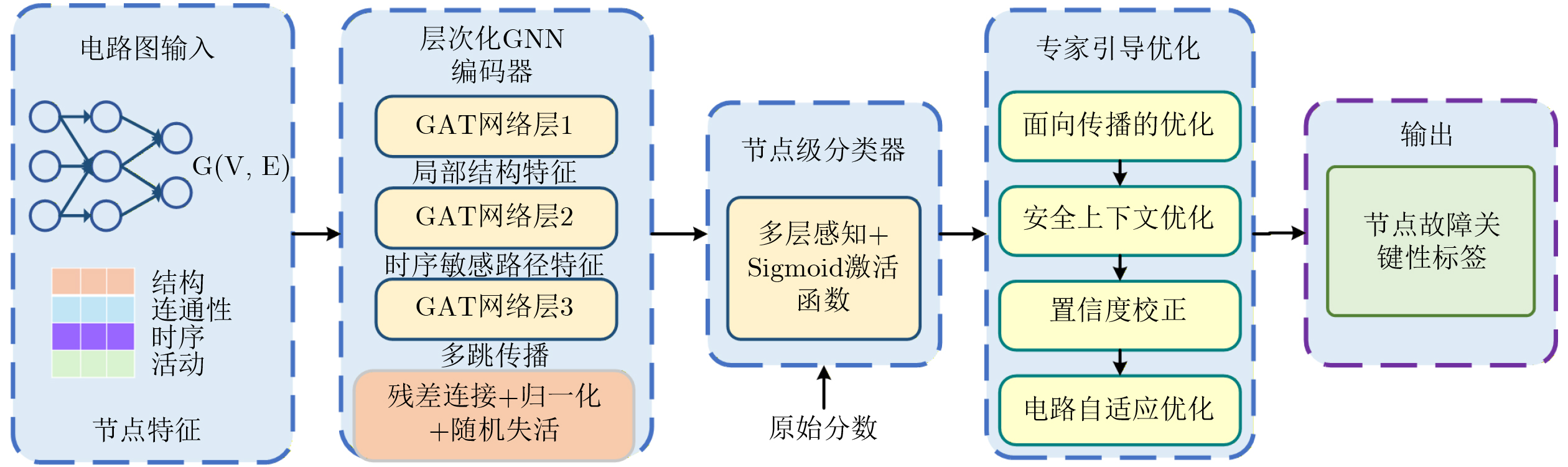
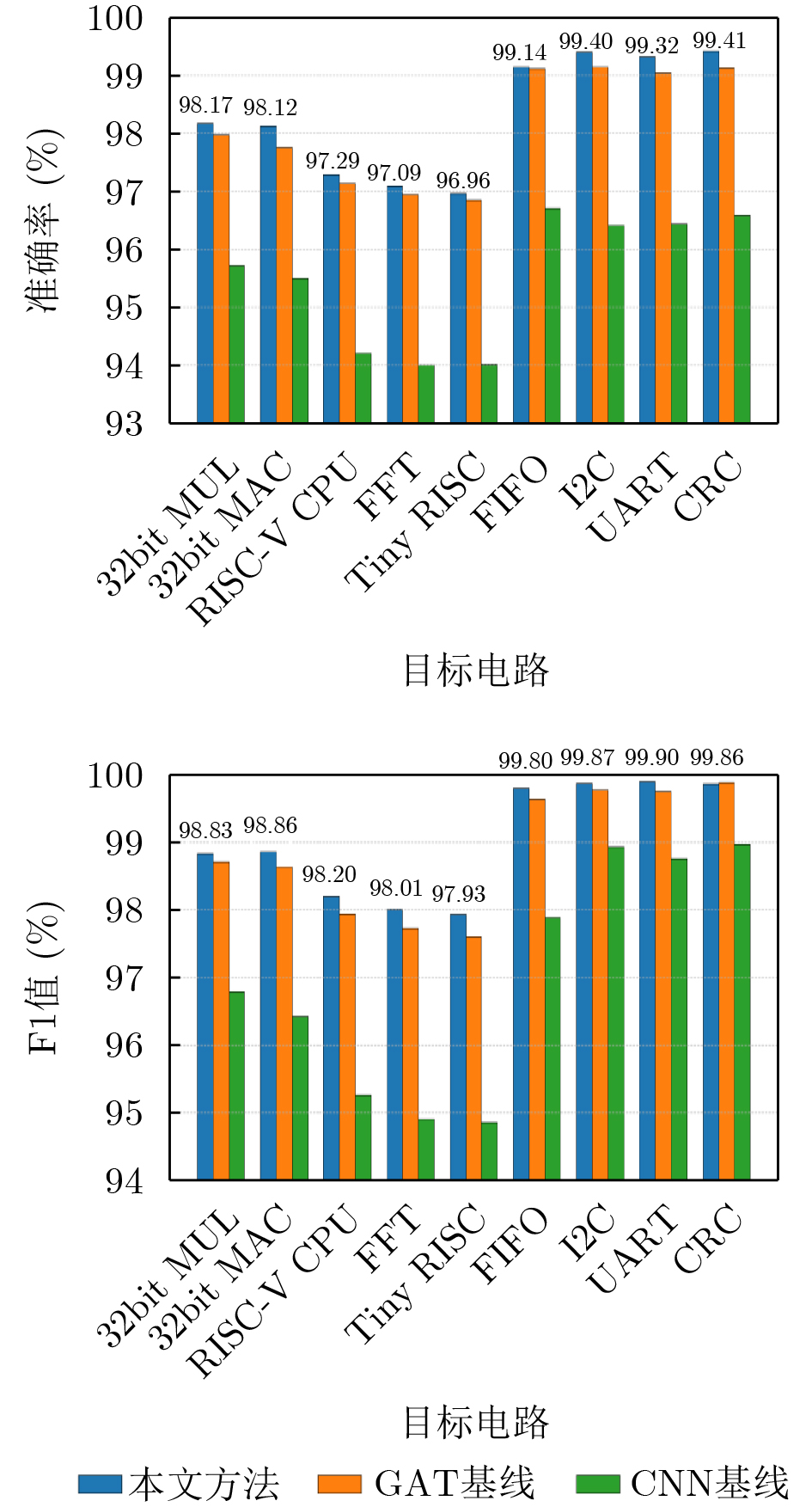
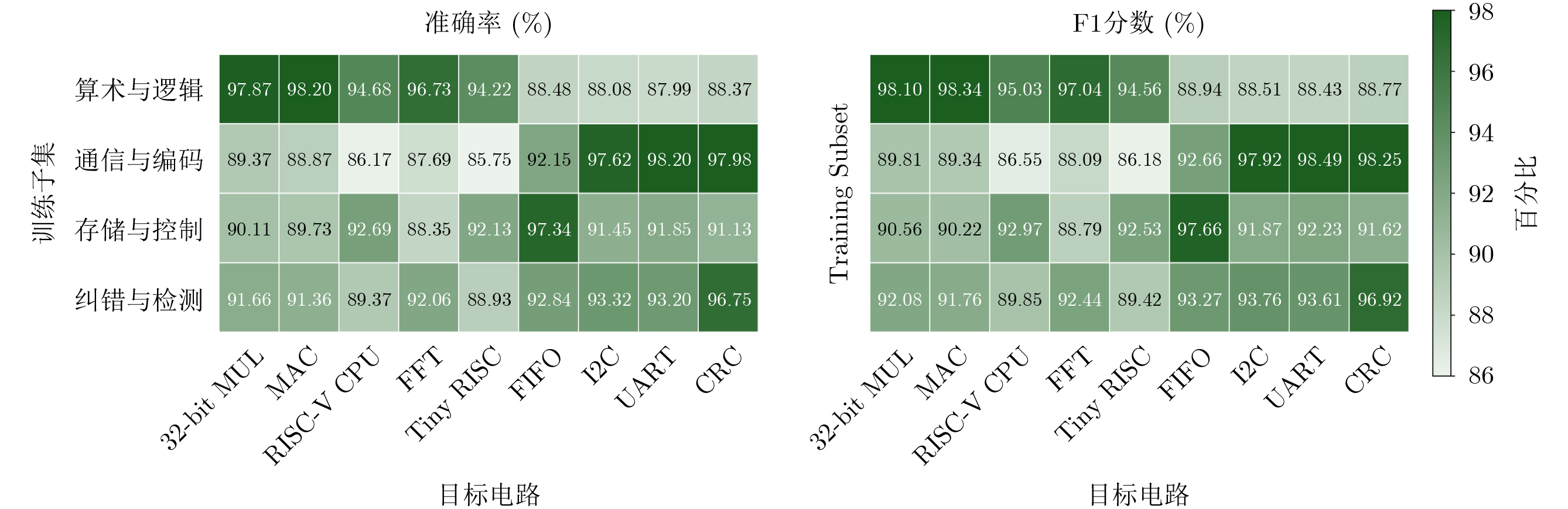
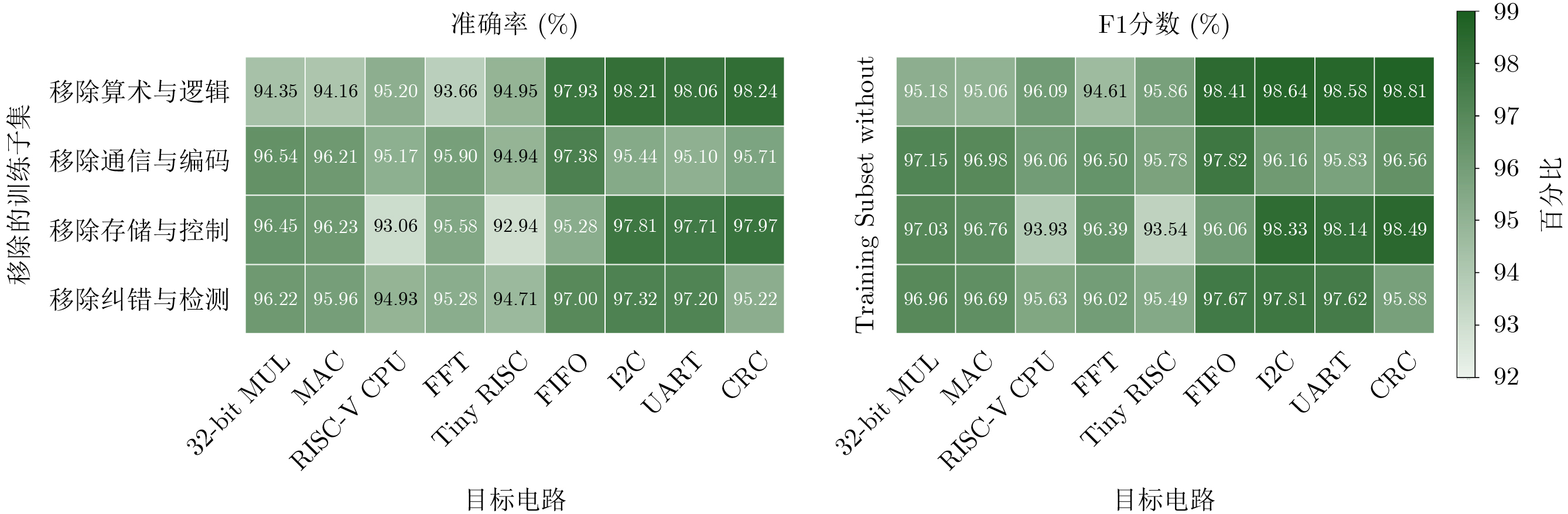
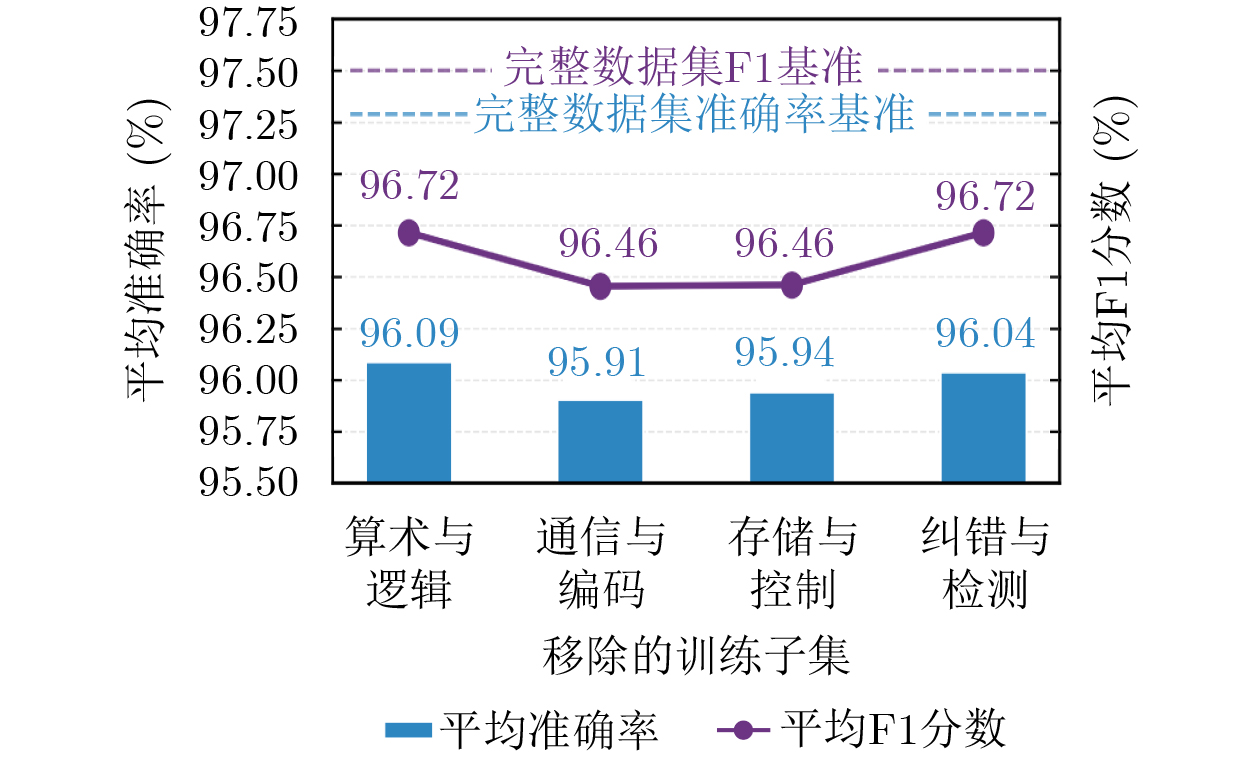
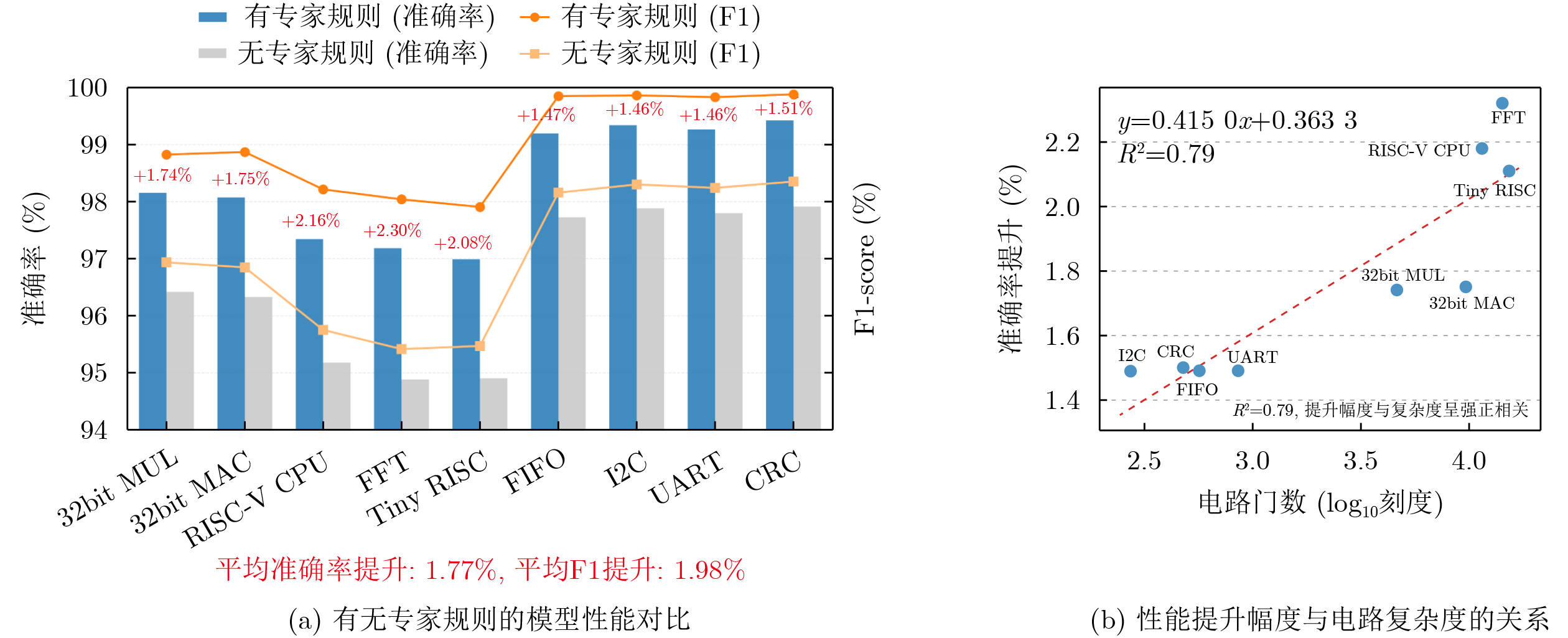
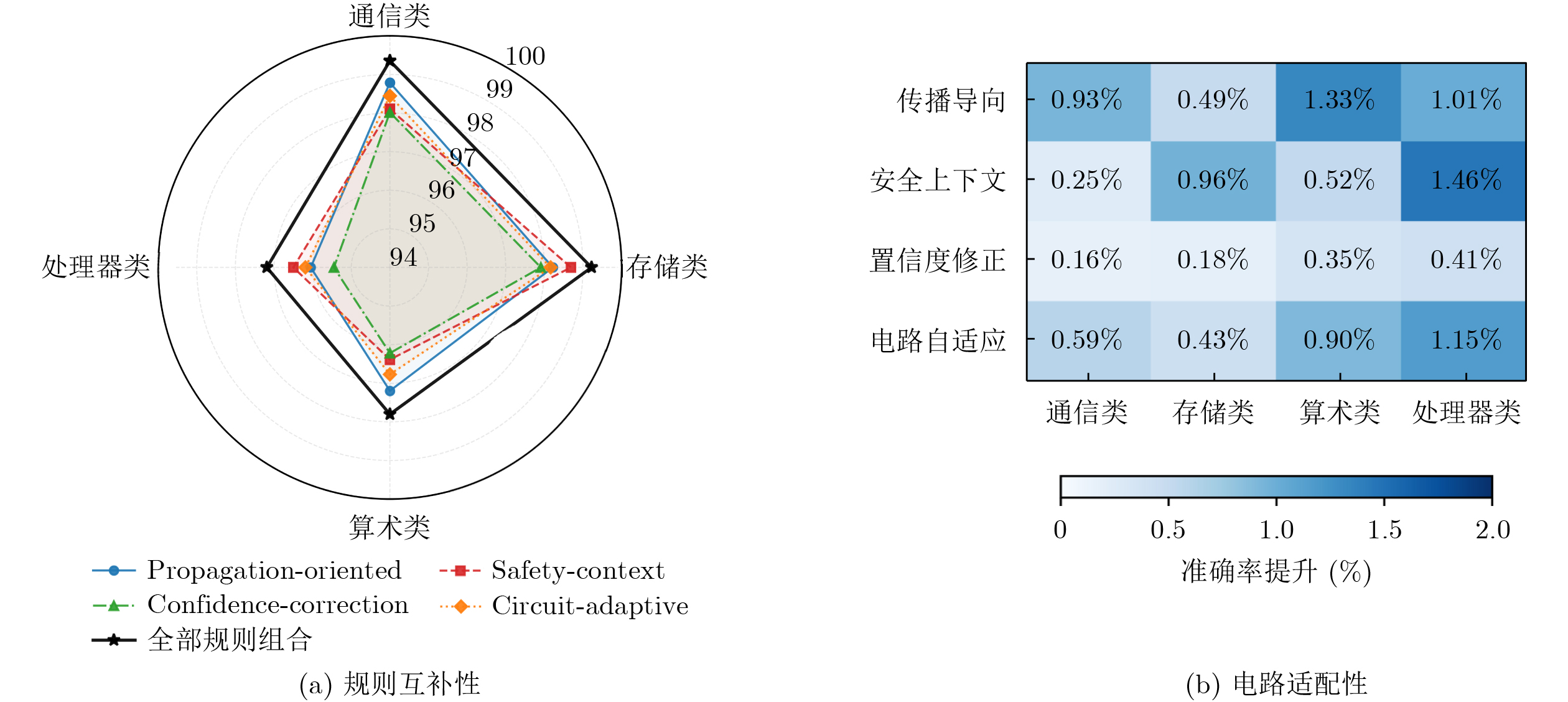
Abstract:Objective Functional safety has become a critical requirement in automotive System-on-Chip (SoC) design under ISO 26262 standards. Conventional exhaustive fault injection faces prohibitive computational costs for large-scale circuits, often resulting in missed high-risk regions or overly conservative global protection. Existing learning-based methods lack cross-scale transferability, circuit-aware inductive bias, and support for downstream hardening decisions. This work aims to provide an accurate, efficient, and transferable framework for node-level fault-criticality prediction and low-overhead selective hardening to support automotive SoC functional safety verification.Methods A standardized primitive-level fault dataset is constructed from 40 DesignWare library circuits covering four functional families: arithmetic and logic, communication and encoding, storage and control, and error correction and detection. Each circuit is converted into a unified directed graph with structural, connectivity, timing, and activity node features, and node-level criticality labels are generated via controlled stuck-at fault injection with ASIL-aware threshold calibration. An expert-guided graph learning model is proposed, which uses graph attention networks with residual connections to learn transferable fault-sensitive representations, followed by a four-layer expert rule calibration module: propagation-oriented rules emphasize high fan-out and critical-path nodes, safety-context rules highlight clock-domain crossings and reset logic, confidence-correction rules suppress false positives, and circuit-adaptive rules dynamically adjust rule intensity by functional family. An explanation-based node ranking mechanism combining structural and feature attribution analysis further forms a closed "prediction–explanation–hardening" flow for targeted protection ( Fig. 1 ,Fig. 2 ).Results and Discussions Evaluated on nine benchmark circuits (gate counts 273–15,290), the method achieves up to 99.4% accuracy and outperforms GAT, CNN, and three state-of-the-art methods across all test circuits ( Fig. 3 ,Table 4 ). Expert rules yield 1.77 pp accuracy improvement and 1.98 pp F1 improvement, with stronger gains in complex circuits (Fig. 7 ,Fig. 8 ). Ablation studies confirm that the four functional families provide complementary fault knowledge essential for cross-scale generalization (Fig. 4 ,Fig. 5 ). The framework achieves geometric mean 166.4× speedup over traditional fault simulation, up to 1,119× on I2C, with explainability module adding only approximately 20% overhead (Fig. 9 ). Selective hardening reduces area overhead by 8.35%~14.95% versus global TMR while maintaining SPFM above 99.3% and LFM above 89%. All nine circuits meet the SPFM target value associated with ASIL-D, eight circuits meet both the SPFM and LFM target values associated with ASIL-D, while the remaining circuit meets the corresponding ASIL-C target values (Fig. 10 ,Fig. 11 ).Conclusions The proposed framework enables effective cross-scale fault-criticality prediction by learning transferable patterns from primitive circuits without retraining on target designs. It achieves high accuracy, significant speedup, and low hardware overhead with ISO 26262 compliance. Future work will expand the primitive dataset coverage, adopt causal inference to reduce dependence on manually designed expert rules, and explore extension toward heterogeneous Chiplet architectures. -
表 1 40个DW标准库原语电路信息
序号 功能家族 等效门数 核心功能说明 序号 功能家族 等效门数 核心功能说明 1 算术与逻辑 78 8位加法器 21 通信与编码 62 带使能的译码器 2 82 8位减法器 22 286 8b/10b编码器 3 112 8位加减法器 23 312 8b/10b解码器 4 95 8位数值比较器 24 184 串行CRC校验生成器 5 136 桶形移位器 25 372 并行CRC校验生成器 6 64 可配置多路选择器 26 45 4位边界扫描单元 7 328 16位并行乘法器 27 88 8位边界扫描单元 8 412 16位乘加(MAC)单元 28 256 用户定制JTAG TAP控制器 9 158 多输入累加求和单元 29 224 标准JTAG TAP控制器 10 482 单精度浮点加减法器 30 58 奇偶校验位生成器 11 396 16位整数除法器 31 存储与控制 386 同步FIFO控制器 12 72 绝对值计算单元 32 358 位宽异步FIFO控制器 13 纠错与检测 468 ECC纠错编解码器 33 128 轮询仲裁器 14 128 影子校验寄存器组 34 164 双优先级仲裁器 15 392 逆平方根运算单元 35 88 加减计数器 16 356 整数平方根运算单元 36 142 线性反馈移位计数器 17 324 带饱和处理的除法器 37 96 单时钟域数据同步器 18 288 单精度浮点比较器 38 72 异步复位同步器 19 426 低功耗流水线ECC单元 39 112 流水线寄存器组 20 72 可观测性数据生成器 40 156 堆栈控制器  下载: 导出CSV
表 2 四层电路领域专家规则说明
规则图层 物理意义与作用 计算方式 传播导向$ {\varGamma }_{v}^{\text{prop}} $ 强调故障传播能力强的区域 (1)关键路径强度>0.4时×1.15,0.2~0.4时×1.08;
(2)扇出数>4时×1.12,2~4时×1.05;
(3)I/O接口×1.06;安全上下文$ {\varGamma }_{v}^{safe} $ 突出安全敏感的操作条件 (4)时序裕量<0.2时×1.10;
(5)复位关联度>0.5时×1.09;
(6)跨时钟域节点×1.08;
(7)多电源域节点×1.07;置信度校正$ {\varGamma }_{v}^{corr} $ 抑制不稳定预测与假阳性结果 (8)冗余等价节点×0.9;
(9)扇入数>3时×1.05;
(10)原始预测概率<0.1时×0.85;电路自适应$ {\varGamma }_{v}^{adapt} $ 根据目标电路所属功能家族调整规则强度 存储与控制×1.04;算术与逻辑×1.03;
通信与编码×1.02;纠错与检测×1.0;
下载: 导出CSV
表 3 电路级故障关键性验证目标电路
电路名称 核心功能 门计数 与原语平均规模比 32位乘法器 整数乘法 4629 22.1× 32位MAC 乘法-累加单元 9621 46.0× FFT 快速傅里叶变换模块 14221 68.0× RISC-V CPU 嵌入式处理器核心 11445 54.8× 微型RISC 紧凑型处理器核心 15290 73.1× I2C 串行通信控制器 273 1.3× UART 异步串行通信 859 4.1× FIFO 数据缓冲和有序传输 567 2.7× CRC CRC生成与验证 476 2.3×
下载: 导出CSV
表 4 本文方法与领域 SOTA 方法的性能对比
电路 方法 准确率 (%) F1 值 (%) UART 本文方法 99.20 99.79 ICCAD 2025 97.55 98.62 TCAS-I 2024 97.87 98.93 DAC 2024 96.21 97.35 32 bit MUL 本文方法 98.14 98.80 ICCAD 2025 95.85 97.12 TCAS-I 2024 96.14 97.82 DAC 2024 90.37 92.46 Tiny RISC 本文方法 97.01 97.90 ICCAD 2025 92.55 94.22 TCAS-I 2024 90.71 94.52 DAC 2024 93.79 90.15
下载: 导出CSV
表 5 专家规则性能提升的统计显著性与参数鲁棒性分析
(a)统计显著性检验 指标 提升量/百分点 95%置信区间 Wilcoxon p值 Accuracy +1.77 [1.55, 1.98] 0.0039 F1 +1.98 [1.74, 2.20] 0.0039 (b)参数敏感性分析 扰动水平 平均
Accuracy/%平均
F1/%平均
SPFM/%平均
LFM/%达到ASIL-D指标
目标值的电路数标称系数 98.10 98.72 99.38 90.45 8/9 ±5%扰动 98.08 98.70 99.37 90.42 8/9 ±10%扰动 98.04 98.66 99.36 90.33 8/9
下载: 导出CSV
-
[1] WEI Dongsheng, XIE Guoqi, WANG Zhongjia, et al. WTP: Weighted time protocol in fault-tolerant automotive embedded systems[J]. IEEE Transactions on Computer-Aided Design of Integrated Circuits and Systems. doi: 10.1109/TCAD.2026.3678169. [2] WANG Mingjun, WANG Hui, MU Jianan, et al. Efficient functional safety method for gate-level fine-grained digital circuits with ISO-26262[C]. 2024 IEEE International Test Conference in Asia, Changsha, China, 2024: 1–6. doi: 10.1109/ITC-Asia62534.2024.10661312. [3] AZAM S, ORA N D, FRACCAROLI E, et al. Analog defect injection and fault simulation techniques: A systematic literature review[J]. IEEE Transactions on Computer-Aided Design of Integrated Circuits and Systems, 2024, 43(1): 16–29. doi: 10.1109/TCAD.2023.3298698. [4] FIBICH C, HORAUER M, and OBERMAISSER R. Automated Bitstream-level cost-reliability design-space exploration for SRAM-based FPGAs[J]. IEEE Transactions on Computer-Aided Design of Integrated Circuits and Systems, 2026, 45(1): 218–231. doi: 10.1109/TCAD.2025.3573225. [5] XUE Xinghua, LIU Cheng, MIN Feng, et al. Adaptive soft error protection for neural network processing[J]. IEEE Transactions on Computer-Aided Design of Integrated Circuits and Systems. doi: 10.1109/TCAD.2026.3667089. [6] KELLER A M and WIRTHLIN M J. Partial TMR for improving the soft error reliability of SRAM-based FPGA designs[J]. IEEE Transactions on Nuclear Science, 2021, 68(5): 1023–1031. doi: 10.1109/TNS.2021.3070856. [7] 蔡烁, 何辉煌, 余飞, 等. 基于相关性分离的逻辑电路敏感门定位算法[J]. 电子与信息学报, 2024, 46(1): 362–372. doi: 10.11999/JEIT230012.CAI Shuo, HE Huihuang, YU Fei, et al. Critical gates localization of logic circuits based on correlation separation[J]. Journal of Electronics & Information Technology, 2024, 46(1): 362–372. doi: 10.11999/JEIT230012. [8] YAN Aibin, FAN Zhengzheng, DING Liang, et al. Cost-effective and highly reliable circuit-components design for safety-critical applications[J]. IEEE Transactions on Aerospace and Electronic Systems, 2022, 58(1): 517–529. doi: 10.1109/TAES.2021.3103586. [9] LI Fuping, YUAN Ding, WANG Yujie, et al. Chipletizer 2.0: Toward cost-effective chiplet design via reuse-aware decomposition[J]. IEEE Transactions on Computer-Aided Design of Integrated Circuits and Systems, 2026, 45(4): 1584–1597. doi: 10.1109/TCAD.2025.3602743. [10] BALAKRISHNAN A, ALEXANDRESCU D, JENIHHIN M, et al. Gate-level graph representation learning: A step towards the improved stuck-at faults analysis[C]. 2021 22nd International Symposium on Quality Electronic Design, Santa Clara, CA, USA, 2021: 24–30. doi: 10.1109/ISQED51717.2021.9424256. [11] AFTABJAHANI S and PRADEEP W. Security verification and secure testing solutions[C]. 2025 IEEE 43rd VLSI Test Symposium, Tempe, AZ, USA, 2025: 1. doi: 10.1109/VTS65138.2025.11022775. [12] HAKHAMANESHI K, NASSAR M, PHIELIPP M, et al. Pretraining graph neural networks for few-shot analog circuit modeling and design[J]. IEEE Transactions on Computer-Aided Design of Integrated Circuits and Systems, 2023, 42(7): 2163–2173. doi: 10.1109/TCAD.2022.3217421. [13] LU Li, CHEN Junchao, ULBRICHT M, et al. Toward critical flip-flop identification for soft-error tolerance with graph neural networks[J]. IEEE Transactions on Computer-Aided Design of Integrated Circuits and Systems, 2024, 43(4): 1135–1148. doi: 10.1109/TCAD.2023.3331968. [14] LU Li, CHEN Junchao, ULBRICHT M, et al. Machine learning methodologies to predict the results of simulation-based fault injection[J]. IEEE Transactions on Circuits and Systems I: Regular Papers, 2024, 71(5): 1978–1991. doi: 10.1109/TCSI.2024.3349928. [15] LU Li, CHEN Junchao, BALAKRISHNAN A, et al. Accelerate SEU simulation-based fault injection with spatio-temporal graph convolutional networks[J]. IEEE Transactions on Computer-Aided Design of Integrated Circuits and Systems, 2025, 44(7): 2599–2612. doi: 10.1109/TCAD.2025.3526748. [16] ALRAHIS L, KNECHTEL J, KLEMME F, et al. GNN4REL: Graph neural networks for predicting circuit reliability degradation[J]. IEEE Transactions on Computer-Aided Design of Integrated Circuits and Systems, 2022, 41(11): 3826–3837. doi: 10.1109/TCAD.2022.3197521. [17] KLEMME F and AMROUCH H. Scalable machine learning to estimate the impact of aging on circuits under workload dependency[J]. IEEE Transactions on Circuits and Systems I: Regular Papers, 2022, 69(5): 2142–2155. doi: 10.1109/TCSI.2022.3147587. [18] AMROUCH H, VAN SANTEN V M, DIAZ-FORTUNY J, et al. Machine learning unleashes aging and self-heating effects: From transistors to full processor (Invited Paper)[C]. 2024 IEEE International Reliability Physics Symposium, Grapevine, TX, USA, 2024: 1–8. doi: 10.1109/IRPS48228.2024.10529386. [19] 倪林, 李霖, 张帅, 等. IP软核硬件木马图谱特征分析检测方法[J]. 电子与信息学报, 2024, 46(11): 4151–4160. doi: 10.11999/JEIT240219.NI Lin, LI Lin, ZHANG Shuai, et al. Graph features analysis and detection method of IP soft core hardware Trojan[J]. Journal of Electronics & Information Technology, 2024, 46(11): 4151–4160. doi: 10.11999/JEIT240219. [20] HU Wenya, WU Jia, and QIAN Quan. CiRLExplainer: Causality-inspired explainer for graph neural networks via reinforcement learning[J]. IEEE Transactions on Neural Networks and Learning Systems, 2025, 36(6): 9970–9984. doi: 10.1109/TNNLS.2025.3543070. [21] SU Hao, HU Wei, ZHANG Xuelin, et al. Toward precise and explainable hardware Trojan localization at LUT level[J]. IEEE Transactions on Computer-Aided Design of Integrated Circuits and Systems, 2025, 44(7): 2817–2821. doi: 10.1109/TCAD.2025.3527377. [22] DAS S, KUNDU S, MADHUSOODHANAN P, et al. Graph learning-based fault criticality analysis for enhancing functional safety of E/E systems[C]. 2024 61st ACM/IEEE Design Automation Conference, San Francisco, CA, USA, 2024: 1–6. [23] SUN Yutao, HUANG Jiehua, LIAO Xiangping, et al. ISO 26262-aligned functional safety verification framework with explainable graph neural network[C]. 2025 IEEE/ACM International Conference on Computer Aided Design, Munich, Germany, 2025: 1–9. doi: 10.1109/ICCAD66269.2025.11240753. [24] MASHNOOR N, AKYASH M, KAMALI H, et al. LLM-IFT: LLM-powered information flow tracking for secure hardware[C]. 2025 IEEE 43rd VLSI Test Symposium, Tempe, AZ, USA, 2025: 1–5. doi: 10.1109/VTS65138.2025.11022949. [25] PURDY R, NIGH C, LI Wei, et al. CHEF: CHaracterizing elusive logic circuit failures[C]. 2025 IEEE 43rd VLSI Test Symposium, Tempe, AZ, USA, 2025: 1–7. doi: 10.1109/VTS65138.2025.11022916. [26] ISO. ISO 26262-5: 2018. Road vehicles — Functional safety — Part 5: Product development at the hardware level[S]. Geneva: ISO, 2018. [27] 李炎, 胡岳鸣, 曾晓洋. 面向商业航天卫星成本效益的三模冗余软错误防护技术: 近似计算的实践[J]. 电子与信息学报, 2024, 46(5): 1604–1612. doi: 10.11999/JEIT231288.LI Yan, HU Yueming, and ZENG Xiaoyang. Cost-effective TMR soft error tolerance technique for commercial aerospace: Utilization of approximate computing[J]. Journal of Electronics & Information Technology, 2024, 46(5): 1604–1612. doi: 10.11999/JEIT231288. [28] 闫爱斌, 李坤, 黄正峰, 等. 两种面向宇航应用的高可靠性抗辐射加固技术静态随机存储器单元[J]. 电子与信息学报, 2024, 46(10): 4072–4080. doi: 10.11999/JEIT240082.YAN Aibin, LI Kun, HUANG Zhengfeng, et al. Two highly reliable radiation hardened by design static random access memory cells for aerospace applications[J]. Journal of Electronics & Information Technology, 2024, 46(10): 4072–4080. doi: 10.11999/JEIT240082. -


 下载:
下载:


图(11) / 表(5)
计量
- 文章访问数: 11
- HTML全文浏览量: 1
- PDF下载量: 1
- 被引次数: 0
