




A Review of Energy-Efficient Superconducting Computing Architectures
-
摘要: 随着摩尔定律和登纳德定律的演进日趋放缓,速度与功耗日益成为制约算力持续提升的根本瓶颈。除了延续半导体工艺演进与体系结构优化来实现能效的持续提升之外,发展与当前半导体技术形成互补的新型电路技术尤为迫切。作为一种新型低温计算技术,超导计算技术正成为一种极具吸引力的半导体互补方案,有望满足未来计算系统对算力及能效的要求。凭借其在速度与能效方面的显著优势,超导计算技术正日益受到关注,相关研究投入不断增加,为实现大规模超导计算以及推动其实际应用奠定了基础。本文对超导计算领域在体系结构方面的进展进行了梳理。根据其内部运行原理,本文将超导计算架构大致分为三大类:传统计算架构、超导神经形态计算和超导量子计算,分别讨论了各类架构的优势与局限性,并进一步探讨了超导计算架构领域面临的主要挑战及未来发展方向。Abstract:
Significance The slowing of Moore’s law and the end of Dennard scaling have made power consumption a fundamental constraint on the continued growth of computing capability. Although improvements in semiconductor fabrication and conventional architectures remain important, complementary technologies are increasingly needed to meet the performance and energy requirements of future computing systems. Superconducting computing offers a promising approach through Josephson junction devices, extremely short switching times, and low switching energies. Single flux quantum (SFQ) circuits are a class of superconducting circuits that encode information in discrete voltage pulses. Among superconducting logic families, rapid single-flux-quantum (RSFQ) logic can achieve orders-of-magnitude higher operating frequencies than conventional complementary metal-oxide-semiconductor (CMOS) technology, whereas adiabatic quantum-flux-parametron (AQFP) logic enables ultralow power dissipation approaching the thermodynamic limit through adiabatic switching. Translating these device advantages into practical systems, however, requires architectures that accommodate pulse encoding, clock synchronization, restricted fanout, and limited memory density. This review examines architectural developments in superconducting computing and organizes them into conventional computing architectures, superconducting neuromorphic computing, and superconducting quantum computing. It distinguishes their physical mechanisms and evaluation criteria while identifying connections through common devices, fabrication capabilities, design constraints, and the demand for efficient cryogenic control electronics. Progress The review first introduces representative superconducting logic families and their circuit characteristics, emphasizing the effects of clocking, path balancing, and fanout constraints on architectural design. Typical superconducting digital circuits require deep pipelines, additional storage elements to synchronize converging paths, and splitter networks to distribute signals. These requirements influence circuit area, operating frequency, and achievable throughput, making the direct adoption of CMOS architectures inadequate. Within conventional computing, the review traces the development of microprocessors, arithmetic logic units, multipliers, register files, and branch predictors. Bit-serial, bit-parallel, and bit-slice architectures provide different tradeoffs between hardware complexity and performance. Early processors primarily established functional feasibility, whereas recent designs address pipeline inefficiency, storage density, and synchronization. Alternating logic elements, compact storage cells, and improved clocking schemes illustrate the shift toward architectural optimization. Representative examples include the CORE processor family and the AQFP-based MANA processor, while SuperCore and SuperSFQ illustrate attempts to exploit wider parallel execution at high frequencies. For neural computation, JBNN, SuperNPU, SMART, and JBSA demonstrate how precision reduction, storage organization, and execution style can be adapted to superconducting logic. Their comparisons emphasize that peak device speed alone cannot determine application performance. Specialized accelerators are examined through neural network inference and cryptographic computation. Binary neural networks reduce precision requirements and hardware complexity, making them attractive under current fabrication constraints. AQFP implementations combine low-energy logic with in-memory computation, while stochastic computing exploits device behavior to simplify arithmetic. For deeper neural networks, superconducting accelerators benefit from regular dataflow and high operating frequencies, but sequential access in shift register memories can substantially limit utilization. Heterogeneous scratchpad memories and bit-serial execution alleviate access and bandwidth constraints through coordinated changes to storage organization, processing elements, and scheduling. Representative graph convolutional network accelerators further demonstrate the potential of algorithm and hardware co-design. Cryptographic designs cover SHA-256 hashing, Advanced Encryption Standard encryption, and number-theoretic transforms (NTTs) for post-quantum cryptography (PQC). These studies show opportunities for high-throughput and low-energy consumption, but also expose the area costs of fully unrolled pipelines, the limitations imposed by feedback paths, and the need for dense storage. Reported energy advantages are interpreted with attention to whether refrigeration costs are included. Reconfigurable computing is reviewed through superconducting field-programmable gate arrays (SFPGAs), including designs using nondestructive readout cells, magnetic Josephson junctions, and hybrid memories. Existing efforts demonstrate programmable logic and interconnection structures, but remain largely at the circuit level. The review also discusses dual clocking, multiphase clocking, and temporal logic. These approaches reduce path balancing overhead or encode information in pulse arrival times, offering alternatives to conventional Boolean architectures while introducing tradeoffs involving throughput, synchronization, and implementation complexity. For neuromorphic computing, superconducting neuron designs are classified according to current, charge, flux, and digital representations of membrane potential. Current-based neurons use Josephson junction thresholds to reproduce firing behavior, charge-based neurons exploit quantum phase-slip junctions, and flux-based neurons accumulate magnetic flux in inductive elements. Digital designs implement neuronal and synaptic functions with standard superconducting logic cells. Analog implementations reproduce neuronal dynamics through device behavior, whereas discrete and digital approaches seek improved robustness and compatibility with established superconducting cell libraries. Despite their potential, analog neurons often require application-specific customization and remain sensitive to noise and fabrication variations. The review examines neuron and synapse structures, representative spiking neural network implementations, and comparisons of performance and energy efficiency with CMOS designs. Network expansion is constrained by high fan-in and fan-out requirements, interconnection overhead, timing alignment, and sensitivity to device parameters. Mutual inductive coupling, merger-based signal collection, and splitter trees provide different implementation options, each with limitations in scalability and applicability. For quantum computing, the review introduces representative superconducting Qubits and focuses on Transmon design. It summarizes progress toward larger processors and discusses differences in coherence, control, fabrication, and scalability. The review distinguishes Qubit characteristics from controller integration requirements. Quantum controllers are examined alongside Qubits because increasing processor size intensifies wiring and thermal constraints between room-temperature equipment and cryogenic devices. Cryogenic CMOS and SFQ control provide alternative integration paths. SFQ pulse sequences support Qubit manipulation, while Josephson photomultipliers (JPMs) enable cryogenic Qubit readout and facilitate integration with SFQ digital logic, potentially reducing the complexity of conventional microwave readout chains. Nevertheless, large-scale integrated superconducting control systems remain less mature than individual circuit demonstrations. Conclusions Superconducting computing has progressed from device demonstrations toward increasingly systematic architectural exploration. Its high-frequency operation and low switching energy offer opportunities for conventional computing, neuromorphic systems, and quantum control. These advantages do not automatically produce comparable system benefits, because memory organization, pipeline structure, interconnection, fabrication, and refrigeration determine practical efficiency. Four major obstacles are identified. First, limited fabrication density, yield, and reliability hinder the realization of larger and more complex chips. Second, immature cryogenic memory technologies force processors to rely on area-intensive shift registers or hybrid interfaces that introduce additional latency and power costs. Third, electronic design automation (EDA) tools do not yet provide a sufficiently complete and scalable flow for superconducting circuits, particularly for sequential logic, feedback structures, and physical design. Fourth, quantum system integration faces increasing wiring density, heat dissipation, and crosstalk as Qubit counts grow. Progress therefore requires coordinated optimization across devices, circuits, architectures, and cryogenic systems, together with careful distinctions between simulated performance, fabricated demonstrations, and system performance. Prospects Future research should prioritize five directions. First, superconducting design automation should support sequential synthesis, verification, feedback handling, and scalable physical implementation through consistent data models and interfaces. Second, high-density memories based on flux storage, nanowires, or other emerging mechanisms should be explored alongside hybrid integration of Josephson-junction and CMOS technologies. Such efforts should address both processor memory bottlenecks and the integration of quantum control electronics. Third, superconducting reconfigurable architectures require standardized benchmarks and evaluation methods that quantify area, speed, and power, enabling comparisons beyond isolated circuit demonstrations and encouraging alternatives to conventional island-style organizations. Fourth, scalable superconducting spiking neural networks should combine efficient neuron and synapse designs with network topology optimization, practical routing, time-division multiplexing, and pruning. Fifth, quantum computing requires coordinated design of Qubit chips, cryogenic controllers, room-temperature instrumentation, and refrigeration systems to balance fidelity, connectivity, coherence, and system power. Addressing these directions will help establish the conditions under which superconducting technologies can deliver practical advantages and support their development from laboratory prototypes into useful computing systems. -
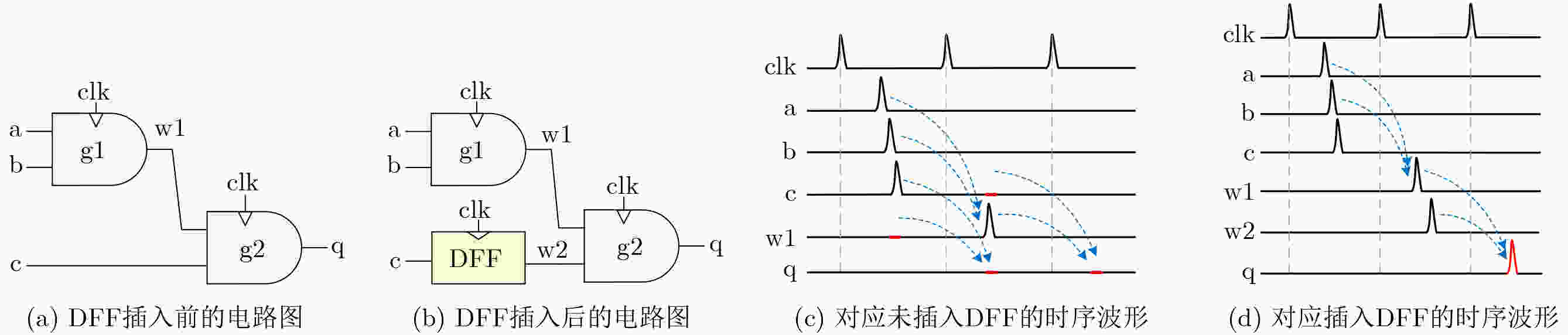
图 3 实现逻辑函数“$ \mathrm{q}=\mathrm{a}\wedge \mathrm{b}\wedge \mathrm{c} $”的RSFQ门级电路图和时序波形
表 1 RSFQ逻辑、AQFP逻辑与CMOS电路对比
电路特性 RSFQ AQFP CMOS 有源器件 约瑟夫森结 约瑟夫森结 晶体管 无源器件 电感 电感 电容 信息载体 SFQ电压脉冲 电流脉冲 电平信号 时钟机制 流时钟 多相时钟 零偏差时钟 扇出能力 1($ \gt 1 $时需使用
分流器)1($ \gt 1 $时需使用
分流器)$ \gt $1 供电方式 DC AC DC 互连线 微带线 微带线 金属线 开关功耗 $ \times {10}^{-19} $ J $ \times {10}^{-21} $ J $ \times {10}^{-15} $ J 典型频率 $ 50 $ GHz $ 5 $ GHz $ 4 $ GHz  下载: 导出CSV
表 2 不同超导微处理器、ALU、乘法器、寄存器文件及分支预测器设计
方案 年份 SFQ逻辑 局部频率 (GHz) 字长/规格 JJ数量 功耗 (mW) 架构类型 微处理器 FLUX-1[24] 2002 RSFQ 20 8 65759 14~15 比特并行 CORE1α6[26] 2005 RSFQ 18 8 6319 2.10 比特串行 SCRAM2[29] 2007 RSFQ 20 8 8197 2.61 比特串行 CORE1γ[28] 2008 RSFQ 25 8 22302 6.56 比特串行 CORE e4[30] 2016 RSFQ 80 8 7194 2.03 比特串行 CORE e2h[31] 2017 RSFQ 50 8 N/A N/A 比特串行 SFQ-GLP1[32] 2020 RSFQ 32 4 23713 6.50 比特并行 [33] 2020 RSFQ 16.70 8 7702 N/A 比特并行 MANA[34] 2021 AQFP 5 4 21460 N/A 比特并行 SuperCore[35] 2024 ERSFQ 40 32 778086 2.60 比特并行 SuperSFQ[36] 2025 ERSFQ 34 32 1045000 N/A 比特并行 ALU [37] 2015 RSFQ 80 8 1555 N/A 比特串行 [38] 2016 RSFQ 50 4 3481 N/A 比特切片 [39] 2018 RSFQ N/A 16 5784 N/A 比特切片 [40] 2019 ERSFQ 10 8 6840 N/A 比特并行 [41] 2021 xSFQ 22.22 8 2800 N/A 比特并行 乘法器 [42] 2013 RSFQ 20 8×8 5948 1.70 比特并行 [43] 2015 RSFQ 50 24×24 N/A N/A 比特串行 [44] 2017 RSFQ 50 32×32 56885 N/A 比特切片 寄存器文件 [45] 2022 RSFQ 18.87 32×32 16133 3.91 比特并行 分支预测器 [46] 2023 RSFQ N/A 128×32 225874 48.34 比特并行
下载: 导出CSV
表 3 超导神经网络加速器代表性工作对比
加速器类型 架构 逻辑类型 主频(GHz) 功耗
(mW)性能优势 能效优势 二值神经网络
推理加速器JBNN[2] CMOS@300K 1.20 17.19 对比77K CMOS:
$ \uparrow $71×对比77K CMOS:
$ \uparrow $929×(不含制冷)CMOS@77K 2.24 12.03 RSFQ/ERSFQ 50 9.78 (ERSFQ) IBM ReRAM[63] CMOS@300K 0.10 12.50 ×1 (参考基准) ×1 SupeRBNN[54] AQFP 5 6.20×10⁻³
~7.60×10⁻³对比ReRAM:
$ \uparrow $36.50×对比ReRAM:
$ \uparrow $(7.80×10⁴)×(不含制冷)深度神经网络
推理加速器Google TPU[65] CMOS@300K 0.70 4×104 ×1 ×1 SuperNPU[55] RSFQ/ERSFQ 52.60 1.90×10³ (ERSFQ) 对比TPU:
$ \uparrow $23×对比TPU:
$ \uparrow $490×(不含制冷)Smart[56] RSFQ/ERSFQ 52.60 N/A 对比SuperNPU:
$ \uparrow $2.20×~3.9×对比SuperNPU:
能耗$ \downarrow $71%~86%(不含制冷)JBSA[57] RSFQ/ERSFQ 23.30 N/A 对比SuperNPU:
$ \uparrow $11%对比SuperNPU:
$ \uparrow $2.30×(不含制冷)图卷积网络
加速器GCN加速器[64] AQFP 5 N/A 对比FPGA方案:
$ \uparrow $3.34×~5.22×对比FPGA:$ \uparrow $(1.07×10⁴~8.68×10⁴)×
(含制冷)
下载: 导出CSV
表 4 现有的超导神经元和突触设计方案
文献 膜电位表征
类型神经元胞体类型 突触设计 峰值性能
(SOPS)能效
(SOPS/W)对比CMOS基准
(TrueNorth[95])验证级别 [88] 电流 模拟,可偏置调节 模拟,定制不可调 N/A N/A N/A 仿真 [89] 电流 模拟,可偏置调节 数字,数字可调 $ 1.20\times {10}^{10} $ $ 8.57\times {10}^{11} $(不含制冷) 能效:$ \uparrow 2.14\times $ 流片 [90] 电荷 准数字,定制不可调 模拟,外磁场调节 N/A N/A N/A 仿真 [91] 电荷 准数字,定制不可调 模拟,外磁场调节 N/A $ 4.30\times 10{^{1}}{^{9}} $
(不含制冷)能效:$ \uparrow (1.08\times {10}^{8})\times $ 仿真 [92] 磁通 准数字,可偏置调节 数字,数字可调 $ 1.78\times {10}^{11} $
($ 32\times 32 $网络)$ 5.03\times {10}^{12} $
(不含制冷)能效:$ \uparrow 12.58\times $ 仿真 [93] 磁通 准数字,数字可调 N/A N/A N/A N/A 仿真 [94] 数字 数字,数字可调 数字,数字可调 $ 1.36\times {10}^{12} $
($ 16\times 16 $网络)$ 3.24\times {10}^{13} $
(不含制冷)能效:$ \uparrow 81\times $ 流片
下载: 导出CSV
表 5 国内外通用门式超导Transmon量子芯片或原型机核心指标对比
研究机构 代表芯片或原型机 物理比特数 双比特门保真度 相干时间 ($ \text{μs} $) Google Willow (2024)[107] 105 $ \gt 99\% $(平均) T1=68, T2=89(平均) IBM Heron r3 (2025)[111] 156 $ \gt 99\% $(中位数) T2=350(平均) 中国科学技术大学 “祖冲之三号” (2025)[108] 105 $ 99.62\% $(平均) T1=72, T2=58(平均) 浙江大学 “天目2号” (2025)[112] 125 $ 99.50\% $(中位数) N/A Rigetti Cepheus-1-108Q (2026)[113] 107 $ 98.82\% $(中位数) T1=29, T2=11(中位数) 本源量子 “本源悟空-180” (2026)[110] 180 $ 99.00\% $(平均) T1=40, T2=20(平均)
下载: 导出CSV
-
[1] TOP500. TOP500 list - November 2025[EB/OL]. https://www.top500.org/lists/top500/list/2025/11/, 2025. [2] FU Rongliang, HUANG Junying, WU Haibin, et al. JBNN: A hardware design for Binarized neural networks using single-flux-quantum circuits[J]. IEEE Transactions on Computers, 2022, 71(12): 3203–3214. doi: 10.1109/TC.2022.3215085. [3] CHEN W, RYLYAKOV A V, PATEL V, et al. Rapid single flux quantum T-flip flop operating up to 770 GHz[J]. IEEE Transactions on Applied Superconductivity, 1999, 9(2): 3212–3215. doi: 10.1109/77.783712. [4] CEZE L, HILL M D, and WENISCH T F. Arch2030: A vision of computer architecture research over the next 15 years[EB/OL]. https://arxiv.org/abs/1612.03182, 2016. [5] HUANG Yang, XU Gaowei, LI Kun, et al. Fabrication of superconducting through-silicon-vias by using wet etching method[J]. Superconductor Science and Technology, 2025, 38(6): 065002. doi: 10.1088/1361-6668/add842. [6] ERSOZ T T, MOHAMED A E M A, and ATTALLAH M M. Additive manufacturing of superconductors: Opportunities and challenges[J]. Materials Research Bulletin, 2025, 189: 113448. doi: 10.1016/j.materresbull.2025.113448. [7] FU Rongliang, WILLE R, YOSHIKAWA N, et al. Efficient Cartesian genetic programming-based automatic synthesis framework for reversible quantum-flux-parametron logic circuits[J]. IEEE Transactions on Computer-Aided Design of Integrated Circuits and Systems, 2025, 44(9): 3369–3380. doi: 10.1109/TCAD.2025.3546884. [8] FU Rongliang, WANG Mengmeng, KAN Yirong, et al. Buffer and splitter insertion for adiabatic quantum-flux-parametron circuits[J]. IEEE Transactions on Computer-Aided Design of Integrated Circuits and Systems, 2025, 44(3): 975–988. doi: 10.1109/TCAD.2024.3461573. [9] JOSEPHSON B D. The discovery of tunnelling supercurrents[J]. Reviews of Modern Physics, 1974, 46(2): 251–254. doi: 10.1103/RevModPhys.46.251. [10] FUJIMAKI N, KOTANI S, IMAMURA T, et al. Josephson modified variable threshold logic gates for use in ultra-high-speed LSI[J]. IEEE Transactions on Electron Devices, 1989, 36(2): 433–446. doi: 10.1109/16.19947. [11] PEROLD W J, JEFFERY M, WANG Zuoqin, et al. Complementary output switching logic-a new superconducting voltage-state logic family[J]. IEEE Transactions on Applied Superconductivity, 1996, 6(3): 125–131. doi: 10.1109/77.544779. [12] KRYLOV G, JABBARI T, and FRIEDMAN E G. Single Flux Quantum Integrated Circuit Design[M]. 2nd ed. Cham: Springer, 2024: 53–63. doi: 10.1007/978-3-031-47475-0. [13] TAFURI F. Fundamentals and Frontiers of the Josephson Effect[M]. Cham: Springer, 2019: 611–701. doi: 10.1007/978-3-030-20726-7. [14] HIDAKA M, NAGASAWA S, SATOH T, et al. Current status and future prospect of the Nb-based fabrication process for single flux quantum circuits[J]. Superconductor Science and Technology, 2006, 19(3): S138–S142. doi: 10.1088/0953-2048/19/3/020. [15] TAKEUCHI N, NAGASAWA S, CHINA F, et al. Adiabatic quantum-flux-parametron cell library designed using a 10 kA cm-2 niobium fabrication process[J]. Superconductor Science and Technology, 2017, 30(3): 035002. doi: 10.1088/1361-6668/aa52f3. [16] YAMAE T, HIRONAKA Y, NAGASAWA S, et al. Rapid single-flux-quantum and adiabatic quantum-flux-parametron cell libraries using a 1 kA/cm2 niobium fabrication process[J]. Scientific Reports, 2025, 15(1): 41429. doi: 10.1038/s41598-025-20666-7. [17] TOLPYGO S K, MALLEK J L, BOLKHOVSKY V, et al. Progress toward superconductor electronics fabrication process with planarized NbN and NbN/Nb layers[J]. IEEE Transactions on Applied Superconductivity, 2023, 33(5): 1101512. doi: 10.1109/TASC.2023.3246430. [18] YING Liliang, ZHANG Xue, NIU Minghui, et al. Development of multi-layer fabrication process for SFQ large scale integrated digital circuits[J]. IEEE Transactions on Applied Superconductivity, 2021, 31(5): 1301504. doi: 10.1109/TASC.2021.3065277. [19] SEMENOV V K, POLYAKOV Y A, and TOLPYGO S K. AC-biased shift registers as fabrication process benchmark circuits and flux trapping diagnostic tool[J]. IEEE Transactions on Applied Superconductivity, 2017, 27(4): 1301409. doi: 10.1109/TASC.2017.2669585. [20] TAKEUCHI N, YAMAE T, AYALA C L, et al. An adiabatic superconductor 8-bit adder with 24kBT energy dissipation per junction[J]. Applied Physics Letters, 2019, 114(4): 042602. doi: 10.1063/1.5080753. [21] GAJ K, FRIEDMAN E G, and FELDMAN M J. Timing of multi-gigahertz rapid single flux quantum digital circuits[J]. The Journal of VLSI Signal Processing-Systems for Signal, Image, and Video Technology, 1997, 16(2/3): 247–276. doi: 10.1023/A:1007903527533. [22] SHEN Hongxiang, HAN Zeyu, LI Zongyuan, et al. Design and fabrication of integrator using adiabatic quantum-flux-parametron circuit[J]. Superconductor Science and Technology, 2025, 38(2): 025017. doi: 10.1088/1361-6668/adabcb. [23] AVILES R S and BEEREL P A. A joint optimization of buffer and splitter insertion for phase-skipping adiabatic quantum-flux-parametron circuits[C]. 2024 IEEE 42nd International Conference on Computer Design, Milan, Italy, 2024: 534–541. doi: 10.1109/ICCD63220.2024.00088. [24] DOROJEVETS M. A 20-GHz FLUX-1 superconductor RSFQ microprocessor[C]. Proceedings of the 5th European Workshop on Low Temperature Electronics, Grenoble, France, 2002: 157–160. doi: 10.1109/WOLTE.2002.1022472. [25] TANAKA M, MATSUZAKI F, KONDO T, et al. A single-flux-quantum logic prototype microprocessor[C]. 2004 IEEE International Solid-State Circuits Conference (IEEE Cat. No. 04CH37519), San Francisco, USA, 2004: 298–299. doi: 10.1109/ISSCC.2004.1332714. [26] TANAKA M, KONDO T, NAKAJIMA N, et al. Demonstration of a single-flux-quantum microprocessor using passive transmission lines[J]. IEEE Transactions on Applied Superconductivity, 2005, 15(2): 400–404. doi: 10.1109/TASC.2005.849860. [27] YAMANASHI Y, TANAKA M, AKIMOTO A, et al. Design and implementation of a pipelined bit-serial SFQ microprocessor, CORE1β[J]. IEEE Transactions on Applied Superconductivity, 2007, 17(2): 474–477. doi: 10.1109/TASC.2007.898606. [28] FUJIMAKI A, TANAKA M, YAMADA T, et al. Bit-serial single flux quantum microprocessor CORE[J]. IEICE Transactions on Electronics, 2008, E91. C(3): 342–349. doi: 10.1093/ietele/e91-c.3.342. [29] NOBUMORI Y, NISHIGAI T, NAKAMIYA K, et al. Design and implementation of a fully asynchronous SFQ microprocessor: SCRAM2[J]. IEEE Transactions on Applied Superconductivity, 2007, 17(2): 478–481. doi: 10.1109/TASC.2007.898658. [30] ANDO Y, SATO R, TANAKA M, et al. Design and demonstration of an 8-bit bit-serial RSFQ microprocessor: CORE e4[J]. IEEE Transactions on Applied Superconductivity, 2016, 26(5): 1301205. doi: 10.1109/TASC.2016.2565609. [31] SATO R, HATANAKA Y, ANDO Y, et al. High-speed operation of random-access-memory-embedded microprocessor with minimal instruction set architecture based on rapid single-flux-quantum logic[J]. IEEE Transactions on Applied Superconductivity, 2017, 27(4): 1300505. doi: 10.1109/TASC.2016.2642049. [32] ISHIDA K, TANAKA M, NAGAOKA I, et al. 32 GHz 6.5 mW gate-level-pipelined 4-bit processor using superconductor single-flux-quantum logic[C]. 2020 IEEE Symposium on VLSI Circuits, Honolulu, USA, 2020: 1–2. doi: 10.1109/VLSICircuits18222.2020.9162826. [33] QU Peiyao, TANG Guangming, YANG Jiahong, et al. Design of an 8-bit bit-parallel RSFQ microprocessor[J]. IEEE Transactions on Applied Superconductivity, 2020, 30(7): 1302706. doi: 10.1109/TASC.2020.3017527. [34] AYALA C L, TANAKA T, SAITO R, et al. MANA: A monolithic adiabatic integration architecture microprocessor using 1.4-zJ/op unshunted superconductor Josephson junction devices[J]. IEEE Journal of Solid-State Circuits, 2021, 56(4): 1152–1165. doi: 10.1109/JSSC.2020.3041338. [35] CHOI J, BYUN I, HONG J, et al. SuperCore: An ultra-fast superconducting processor for cryogenic applications[C]. 2024 57th IEEE/ACM International Symposium on Microarchitecture, Austin, USA, 2024: 1532–1547. doi: 10.1109/MICRO61859.2024.00112. [36] CHOI J, HONG J, KIM J, et al. SuperSFQ: A hardware design to realize high-frequency superconducting processors[C]. Proceedings of the 58th IEEE/ACM International Symposium on Microarchitecture, Seoul, Korea, 2025: 995–1010. doi: 10.1145/3725843.3756024. [37] ANDO Y, SATO R, TANAKA M, et al. 80-GHz operation of an 8-bit RSFQ arithmetic logic unit[C]. 2015 15th International Superconductive Electronics Conference, Nagoya, Japan, 2015: 1–3. doi: 10.1109/ISEC.2015.7383427. [38] TANG Guangming, TAKATA K, TANAKA M, et al. 4-bit bit-slice arithmetic logic unit for 32-bit RSFQ microprocessors[J]. IEEE Transactions on Applied Superconductivity, 2016, 26(1): 1300106. doi: 10.1109/TASC.2015.2507125. [39] TANG Guangming, QU Peiyao, YE Xiaochun, et al. Logic design of a 16-bit bit-slice arithmetic logic unit for 32-/64-bit RSFQ microprocessors[J]. IEEE Transactions on Applied Superconductivity, 2018, 28(4): 1300305. doi: 10.1109/TASC.2018.2799994. [40] KIRICHENKO A F, VERNIK I V, KAMKAR M Y, et al. ERSFQ 8-bit parallel arithmetic logic unit[J]. IEEE Transactions on Applied Superconductivity, 2019, 29(5): 1302407. doi: 10.1109/TASC.2019.2904484. [41] TZIMPRAGOS G, VOLK J, WYNN A, et al. Superconducting computing with alternating logic elements[C]. 2021 ACM/IEEE 48th Annual International Symposium on Computer Architecture, Valencia, Spain, 2021: 651–664. doi: 10.1109/ISCA52012.2021.00057. [42] DOROJEVETS M, KASPEREK A K, YOSHIKAWA N, et al. 20-GHz 8×8-bit parallel carry-save pipelined RSFQ multiplier[J]. IEEE Transactions on Applied Superconductivity, 2013, 23(3): 1300104. doi: 10.1109/TASC.2012.2227648. [43] PENG Xizhu, XU Qiuyun, KATO T, et al. High-speed demonstration of bit-serial floating-point adders and multipliers using single-flux-quantum circuits[J]. IEEE Transactions on Applied Superconductivity, 2015, 25(3): 1301106. doi: 10.1109/TASC.2014.2382973. [44] TANG Guangming, TAKAGI K, and TAKAGI N. 32×32-bit 4-bit bit-slice integer multiplier for RSFQ microprocessors[J]. IEEE Transactions on Applied Superconductivity, 2017, 27(3): 1301005. doi: 10.1109/TASC.2017.2662700. [45] ZHA Haipeng, KATAM N K, PEDRAM M, et al. HiPerRF: A dual-bit dense storage SFQ register file[C]. 2022 IEEE International Symposium on High-Performance Computer Architecture, Seoul, Korea, 2022: 415–428. doi: 10.1109/HPCA53966.2022.00038. [46] ZHA Haipeng, TANNU S, and ANNAVARAM M. SuperBP: Design space exploration of perceptron-based branch predictors for superconducting CPUs[C]. Proceedings of the 56th Annual IEEE/ACM International Symposium on Microarchitecture, Toronto, Canada, 2023: 599–613. doi: 10.1145/3613424.3614267. [47] ABDULLAH M A, ELAMIEN M B, and DEEN M J. A comprehensive review of time-to-digital converters: Architectures, applications, and trends[J]. IEEE Transactions on Instrumentation and Measurement, 2026, 75: 2003036. doi: 10.1109/TIM.2026.3693440. [48] WAKAMATSU T, YAMANASHI Y, and YOSHIKAWA N. High-speed superconductive decimation filter for sigma-delta analog to digital converter[J]. Journal of Physics: Conference Series, 2017, 871: 012068. doi: 10.1088/1742-6596/871/1/012068. [49] NARENDRAN S. Design of Josephson junction based reconfigurable N–point bit slicing FFT processor using mixed radix algorithm[C]. 2024 12th International Conference on Internet of Everything, Microwave, Embedded, Communication and Networks, Jaipur, India, 2024: 1–6. doi: 10.1109/IEMECON62401.2024.10846703. [50] 卢迪, 王振发. 脉动阵列协同层融合的卷积神经网络加速器设计[J]. 电子与信息学报, 2026, 48(3): 1280–1291. doi: 10.11999/JEIT250867.LU Di and WANG Zhenfa. Design of a CNN accelerator based on systolic array collaboration with inter-layer fusion[J]. Journal of Electronics & Information Technology, 2026, 48(3): 1280–1291. doi: 10.11999/JEIT250867. [51] SILVANO C, IELMINI D, FERRANDI F, et al. A survey on deep learning hardware accelerators for heterogeneous HPC platforms[J]. ACM Computing Surveys, 2025, 57(11): 286. doi: 10.1145/3729215. [52] YAMAUCHI T, SAN Hao, YOSHIKAWA N, et al. Design and implementation of energy-efficient binary neural networks using adiabatic quantum-flux-parametron logic[J]. IEEE Transactions on Applied Superconductivity, 2023, 33(5): 1400105. doi: 10.1109/TASC.2023.3243180. [53] CHEN O, LI Zhengang, YAMAUCHI T, et al. Performance assessment of an extremely energy-efficient binary neural network using adiabatic superconductor devices[C]. 2023 IEEE 5th International Conference on Artificial Intelligence Circuits and Systems, Hangzhou, China, 2023: 1–5. doi: 10.1109/AICAS57966.2023.10168607. [54] LI Zhengang, YUAN Geng, YAMAUCHI T, et al. SupeRBNN: Randomized binary neural network using adiabatic superconductor Josephson devices[C]. Proceedings of the 2023 56th IEEE/ACM International Symposium on Microarchitecture, Toronto, Canada, 2023: 584–598. [55] ISHIDA K, BYUN I, NAGAOKA I, et al. SuperNPU: An extremely fast neural processing unit using superconducting logic devices[C]. 2020 53rd Annual IEEE/ACM International Symposium on Microarchitecture, Athens, Greece, 2020: 58–72. doi: 10.1109/MICRO50266.2020.00018. [56] ZOKAEE F and JIANG Lei. SMART: A heterogeneous scratchpad memory architecture for superconductor SFQ-based systolic CNN accelerators[C]. MICRO-54: 54th Annual IEEE/ACM International Symposium on Microarchitecture, 2021: 912–924. doi: 10.1145/3466752.3480041. (查阅网上资料,未找到本条文献出版地信息,请确认). [57] SU Yang, LI Sheng, JIANG Huilong, et al. JBSA: A bit-serial accelerator for deep neural networks using superconducting SFQ logic[C]. Proceedings of the 39th ACM International Conference on Supercomputing, Salt Lake City, USA, 2025: 1092–1105. doi: 10.1145/3721145.3729517. [58] 陈璐, 王强源, 钟坤材, 等. 随机计算应用与挑战概述[J]. 电子与信息学报, 2025, 47(9): 3010–3019. doi: 10.11999/JEIT250413.CHEN Lu, WANG Qiangyuan, ZHONG Kuncai, et al. Overview of stochastic computing applications and challenges[J]. Journal of Electronics & Information Technology, 2025, 47(9): 3010–3019. doi: 10.11999/JEIT250413. [59] LIU Yidong, LIU Siting, WANG Yanzhi, et al. A survey of stochastic computing neural networks for machine learning applications[J]. IEEE Transactions on Neural Networks and Learning Systems, 2021, 32(7): 2809–2824. doi: 10.1109/TNNLS.2020.3009047. [60] LEE Y Y and ABDUL HALIM Z. Stochastic computing in convolutional neural network implementation: A review[J]. PeerJ Computer Science, 2020, 6: e309. doi: 10.7717/peerj-cs.309. [61] ALAGHI A and HAYES J P. Survey of stochastic computing[J]. ACM Transactions on Embedded Computing Systems, 2013, 12(2s): 92. doi: 10.1145/2465787.2465794. [62] CAI Ruizhe, REN Ao, CHEN O, et al. A stochastic-computing based deep learning framework using adiabatic quantum-flux-parametron superconducting technology[C]. Proceedings of the 2019 ACM/IEEE 46th Annual International Symposium on Computer Architecture, Phoenix, USA, 2019: 567–578. [63] KIM H, KIM Y, and KIM J J. In-memory batch-normalization for resistive memory based binary neural network hardware[C]. Proceedings of the 24th Asia and South Pacific Design Automation Conference, Tokyo, Japan, 2019: 645–650. doi: 10.1145/3287624.3287718. [64] LI Zhengang, PENG Hongwu, SHEN Xuan, et al. Graph convolutional network acceleration using adiabatic superconductor Josephson devices[C]. Proceedings of the 39th ACM International Conference on Supercomputing, Salt Lake City, USA, 2025: 189–204. doi: 10.1145/3721145.3730434. [65] JOUPPI N P, YOUNG C, PATIL N, et al. In-datacenter performance analysis of a tensor processing unit[C]. Proceedings of the 2017 ACM/IEEE 44th Annual International Symposium on Computer Architecture, Toronto, Canada, 2017: 1–12. doi: 10.1145/3079856.3080246. [66] TANNU S S, DAS P, LEWIS M L, et al. A case for superconducting accelerators[C]. Proceedings of the 16th ACM International Conference on Computing Frontiers, Alghero, Italy, 2019: 67–75. doi: 10.1145/3310273.3321561. [67] WEYERMÜLLER J, DELPORT J A, JACKMAN K, et al. Energy analysis of an AQFP logic SHA-256 hash[J]. IEEE Transactions on Applied Superconductivity, 2026, 36(8): 1102009. doi: 10.1109/TASC.2026.3693839. [68] ZHOU Yan, TANG Guangming, YANG Jiahong, et al. Logic design and simulation of a 128-b AES encryption accelerator based on rapid single-flux-quantum circuits[J]. IEEE Transactions on Applied Superconductivity, 2021, 31(6): 1302911. doi: 10.1109/TASC.2021.3075604. [69] PHETLA S H. Towards superconducting cryptographic accelerators[D]. [Master dissertation], Stellenbosch University, 2025. [70] XU Yilun, HUANG Gang, BALEWSKI J, et al. QubiC: An open-source FPGA-based control and measurement system for superconducting quantum information processors[J]. IEEE Transactions on Quantum Engineering, 2021, 2: 6003811. doi: 10.1109/TQE.2021.3116540. [71] YANG Yuchen, SHEN Zhongtao, ZHU Xing, et al. An FPGA-based low latency AWG for superconducting quantum computers[C]. 2021 IEEE International Instrumentation and Measurement Technology Conference, Glasgow, UK, 2021: 1–6. doi: 10.1109/I2MTC50364.2021.9460084. [72] FOURIE C J and VAN HEERDEN H. An RSFQ superconductive programmable gate array[J]. IEEE Transactions on Applied Superconductivity, 2007, 17(2): 538–541. doi: 10.1109/TASC.2007.897387. [73] REOHR W R and VOIGT R J. Superconducting cell array logic circuit system[P]. US, 9595970B1, 2017. [74] KATAM N K, MUKHANOV O A, and PEDRAM M. Superconducting magnetic field programmable gate array[J]. IEEE Transactions on Applied Superconductivity, 2018, 28(2): 1300212. doi: 10.1109/TASC.2018.2797262. [75] MAREE C C and FOURIE C J. Development of an all-SFQ superconducting field-programmable gate array[J]. IEEE Transactions on Applied Superconductivity, 2019, 29(4): 1300212. doi: 10.1109/TASC.2018.2886208. [76] MAREE C C. Development of superconducting field-programmable gate array and supporting EDA software[EB/OL]. https://scholar.sun.ac.za/items/24053c3b-9f8f-428e-8cb3-13adae38167f/full, 2025. [77] ZHOU Minglei, FU Rongliang, ZHANG Ran, et al. An optimal DFF-oriented technology legalization algorithm for rapid single-flux-quantum circuits[C]. Proceedings of the Great Lakes Symposium on VLSI 2025, New Orleans, USA, 2025: 105–111. doi: 10.1145/3716368.3735163. [78] BAIRAMKULOV R and DE MICHELI G. Superconductive electronics: A 25-year review [feature][J]. IEEE Circuits and Systems Magazine, 2024, 24(2): 16–33. doi: 10.1109/MCAS.2024.3376492. [79] PASANDI G. Designing efficient algorithms and developing suitable software tools to support logic synthesis of superconducting single flux quantum circuits[D]. [Ph. D. dissertation], University of Southern California, 2020. [80] LI Xi, PAN Min, LIU Tong, et al. Multi-phase clocking for multi-threaded gate-level-pipelined superconductive logic[C]. 2022 IEEE Computer Society Annual Symposium on VLSI, Nicosia, Cyprus, 2022: 62–67. doi: 10.1109/ISVLSI54635.2022.00024. [81] AVILES R S, LI Xi, LU Lei, et al. An efficient and scalable clocking assignment algorithm for multi-threaded multi-phase single flux quantum circuits[C]. 2024 IEEE Computer Society Annual Symposium on VLSI, Knoxville, USA, 2024: 266–271. doi: 10.1109/ISVLSI61997.2024.00056. [82] FU Rongliang, ZHOU Minglei, JIANG Huilong, et al. J2Place: A multiphase clocking-oriented length-matching placement for rapid single-flux-quantum circuits[C]. 2025 IEEE/ACM International Conference On Computer Aided Design, Munich, Germany, 2025: 1–8. doi: 10.1109/ICCAD66269.2025.11240637. [83] TZIMPRAGOS G, VASUDEVAN D, TSISKARIDZE N, et al. A computational temporal logic for superconducting accelerators[C]. Proceedings of the Twenty-Fifth International Conference on Architectural Support for Programming Languages and Operating Systems, Lausanne, Switzerland, 2020: 435–448. doi: 10.1145/3373376.3378517. [84] GONZALEZ-GUERRERO P, BAUTISTA M G, LYLES D, et al. Temporal and SFQ pulse-streams encoding for area-efficient superconducting accelerators[C]. Proceedings of the 27th ACM International Conference on Architectural Support for Programming Languages and Operating Systems, Lausanne, Switzerland, 2022: 963–976. doi: 10.5281/zenodo.5746945. [85] MEAD C. Neuromorphic electronic systems[J]. Proceedings of the IEEE, 1990, 78(10): 1629–1636. doi: 10.1109/5.58356. [86] MAASS W. Networks of spiking neurons: The third generation of neural network models[J]. Neural Networks, 1997, 10(9): 1659–1671. doi: 10.1016/S0893-6080(97)00011-7. [87] 王子华, 叶莹, 刘洪运, 等. 基于脉冲序列标识的深度脉冲神经网络时空反向传播算法[J]. 电子与信息学报, 2024, 46(6): 2596–2604. doi: 10.11999/JEIT230705.WANG Zihua, YE Ying, LIU Hongyun, et al. Spiking sequence label-based spatio-temporal back-propagation algorithm for training deep spiking neural networks[J]. Journal of Electronics & Information Technology, 2024, 46(6): 2596–2604. doi: 10.11999/JEIT230705. [88] CROTTY P, SCHULT D, and SEGALL K. Josephson junction simulation of neurons[J]. Physical Review E, 2010, 82(1): 011914. doi: 10.1103/PhysRevE.82.011914. [89] BOZBEY A, KARAMUFTUOGLU M A, RAZMKHAH S, et al. Single flux quantum based ultrahigh speed spiking neuromorphic processor architecture[EB/OL]. https://arxiv.org/abs/1812.10354v3, 2018. [90] CHENG Ran, GOTETI U S, and HAMILTON M C. Superconducting neuromorphic computing using quantum phase-slip junctions[J]. IEEE Transactions on Applied Superconductivity, 2019, 29(5): 1300505. doi: 10.1109/TASC.2019.2892111. [91] ZHANG Huilin, GANG Chen, XU Chen, et al. Brain-inspired spiking neural network using superconducting devices[J]. IEEE Transactions on Emerging Topics in Computational Intelligence, 2023, 7(1): 271–277. doi: 10.1109/TETCI.2021.3089328. [92] JIANG Huilong, WANG Zhongqi, HUANG Junying, et al. JSNPE: A digital superconducting spiking neural processing element[J]. IEEE Transactions on Applied Superconductivity, 2025, 35(4): 1100812. doi: 10.1109/TASC.2025.3561667. [93] UCPINAR B Z, KARAMUFTUOGLU M A, RAZMKHAH S, et al. An on-chip trainable neuron circuit for SFQ-based spiking neural networks[J]. IEEE Transactions on Applied Superconductivity, 2024, 34(3): 1300506. doi: 10.1109/TASC.2024.3359164. [94] LIU Zeshi, CHEN Shuo, QU Peiyao, et al. SUSHI: Ultra-high-speed and ultra-low-power neuromorphic chip using superconducting single-flux-quantum circuits[C]. Proceedings of the 56th Annual IEEE/ACM International Symposium on Microarchitecture, Toronto, Canada, 2023: 614–627. doi: 10.1145/3613424.3623787. [95] AKOPYAN F, SAWADA J, CASSIDY A, et al. TrueNorth: Design and tool flow of a 65 mW 1 million neuron programmable neurosynaptic chip[J]. IEEE Transactions on Computer-Aided Design of Integrated Circuits and Systems, 2015, 34(10): 1537–1557. doi: 10.1109/TCAD.2015.2474396. [96] SONG Changxu, CALISKAN A, UCPINAR B Z, et al. SuperSNN: A hardware-aware framework for physically realizable, high-performance superconducting spiking neural network chips[EB/OL]. https://arxiv.org/abs/2509.05532, 2025. [97] SCHNEIDER M, TOOMEY E, ROWLANDS G, et al. SuperMind: A survey of the potential of superconducting electronics for neuromorphic computing[J]. Superconductor Science and Technology, 2022, 35(5): 053001. doi: 10.1088/1361-6668/ac4cd2. [98] ABUGHANEM M. IBM quantum computers: Evolution, performance, and future directions[J]. The Journal of Supercomputing, 2025, 81(5): 687. doi: 10.1007/s11227-025-07047-7. [99] HU Ruizi, LI Zongyuan, YAO Zhancheng, et al. Millikelvin digital-to-analog converter for superconducting quantum processors[EB/OL]. https://arxiv.org/abs/2604.25303, 2026. [100] JORDAN C, BERNHARDT J, RAHAMIM J, et al. A quantum computer controlled by superconducting digital electronics at millikelvin temperature[J]. Nature Electronics, 2026, 9(3): 287–294. doi: 10.1038/s41928-026-01576-6. [101] TAKEUCHI N, YAMAE T, YAMASHITA T, et al. Microwave-multiplexed qubit controller using adiabatic superconductor logic[J]. npj Quantum Information, 2024, 10(1): 53. doi: 10.1038/s41534-024-00849-2. [102] JOKAR M R, RINES R, PASANDI G, et al. DigiQ: A scalable digital controller for quantum computers using SFQ logic[C]. 2022 IEEE International Symposium on High-Performance Computer Architecture, Seoul, Korea, 2022: 400–414. doi: 10.1109/HPCA53966.2022.00037. [103] MIN D, KIM J, CHOI J, et al. QIsim: Architecting 10+K qubit QC interfaces toward quantum supremacy[C]. Proceedings of the 50th Annual International Symposium on Computer Architecture, Orlando, USA, 2023: 1. doi: 10.1145/3579371.3589036. [104] OPREMCAK A, LIU C H, WILEN C, et al. High-fidelity measurement of a superconducting qubit using an on-chip microwave photon counter[J]. Physical Review X, 2021, 11(1): 011027. doi: 10.1103/PhysRevX.11.011027. [105] LADD T D, JELEZKO F, LAFLAMME R, et al. Quantum computers[J]. Nature, 2010, 464(7285): 45–53. doi: 10.1038/nature08812. [106] KOCH J, YU T M, GAMBETTA J, et al. Charge-insensitive qubit design derived from the Cooper pair box[J]. Physical Review A, 2007, 76(4): 042319. doi: 10.1103/PhysRevA.76.042319. [107] Google Quantum AI and Collaborators. Quantum error correction below the surface code threshold[J]. Nature, 2025, 638(8052): 920–926. doi: 10.1038/s41586-024-08449-y. [108] GAO Dongxin, FAN Daojin, ZHA Chen, et al. Establishing a new benchmark in quantum computational advantage with 105-qubit Zuchongzhi 3.0 processor[J]. Physical Review Letters, 2025, 134(9): 090601. doi: 10.1103/PhysRevLett.134.090601. [109] NGUYEN L B, LIN Y H, SOMOROFF A, et al. High-coherence fluxonium qubit[J]. Physical Review X, 2019, 9(4): 041041. doi: 10.1103/PhysRevX.9.041041. [110] Origin Quantum. Origin Wukong 180 - China's 4th gen superconducting quantum computer[EB/OL]. https://originqc.com/quantum-machines/quantum-computer. (查阅网上资料,未找到本条文献年份信息,请确认). [111] IBM. Processor types[EB/OL]. https://quantum.cloud.ibm.com/docs/en/guides/processor-types, 2025. [112] JIN Feitong, JIANG Si, ZHU Xuhao, et al. Topological prethermal strong zero modes on superconducting processors[J]. Nature, 2025, 645(8081): 626–632. doi: 10.1038/s41586-025-09476-z. [113] Rigetti Computing. Quantum computing | Rigetti computing[EB/OL]. https://www.rigetti.com, 2026. (查阅网上资料,未找到本条文献题目和年份信息,请确认).Rigetti Computing. Quantum computing | Rigetti computing[EB/OL]. https://www.rigetti.com, 2026. (查阅网上资料,未找到本条文献题目和年份信息,请确认). [114] VAN DIJK J P G, PATRA B, SUBRAMANIAN S, et al. A scalable cryo-CMOS controller for the wideband frequency-multiplexed control of spin qubits and transmons[J]. IEEE Journal of Solid-State Circuits, 2020, 55(11): 2930–2946. doi: 10.1109/JSSC.2020.3024678. -

 下载:

图(6) / 表(5)
计量
- 文章访问数: 8
- HTML全文浏览量: 0
- PDF下载量: 1
- 被引次数: 0
