




Topology Optimization Method for UAV Swarm SAR Using Illuminators of Opportunity from LEO Communication Satellites
-
摘要: 低轨通信卫星(LEO-COS)凭借全球覆盖与高频次重访特性,为合成孔径雷达(SAR)成像提供了丰富的可持续照射机会,在广域动态遥感领域具有巨大的应用潜力。然而,将LEO-COS的通信信号作为SAR成像的机会照射源,存在成像信噪比低和有效带宽受限等问题。因此,该文提出将LEO-COS与无人机集群深度融合的“星座-机群”SAR协同成像新体制,并针对该体制下的无人机集群SAR构型优化,提出了一种基于关联结构体编码的非支配排序遗传算法(AS-NSGA-II)。首先,针对“星座-机群”体制下无人机集群SAR波数谱几何分布受机群空间构型约束的特性,分析了成像性能与空间构型之间的内在联系,并将空间构型设计问题建模为多目标优化问题。其次,设计了一种结合Cubic混沌映射初始化种群与关联结构体编码的自适应动态调整机制,该机制在提高初始种群多样性的同时,有效保持了变量间的协同约束关系,并显著提升了无人机集群SAR构型的全局优化性能。仿真实验验证了该文所提算法的有效性。Abstract:
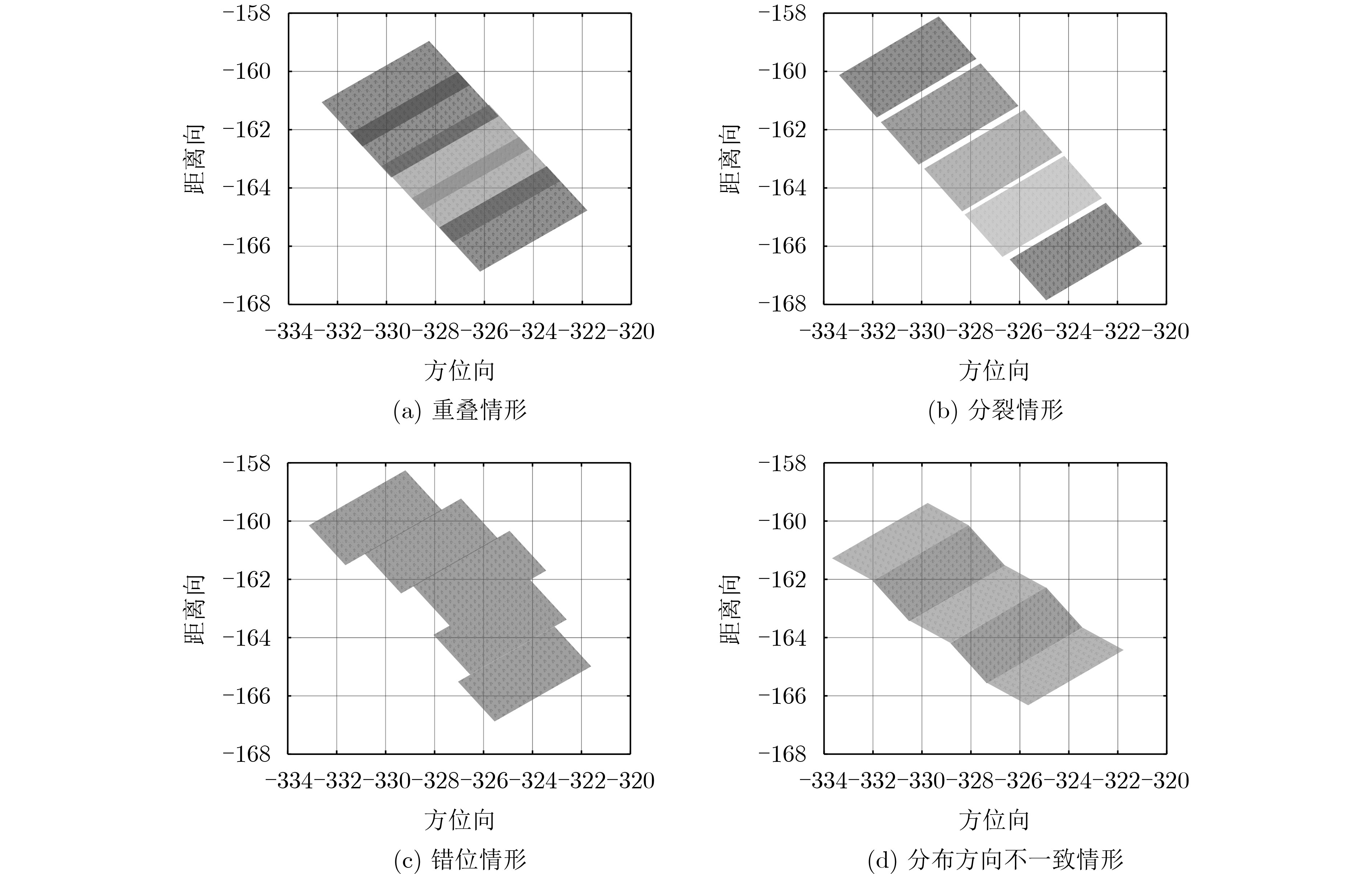
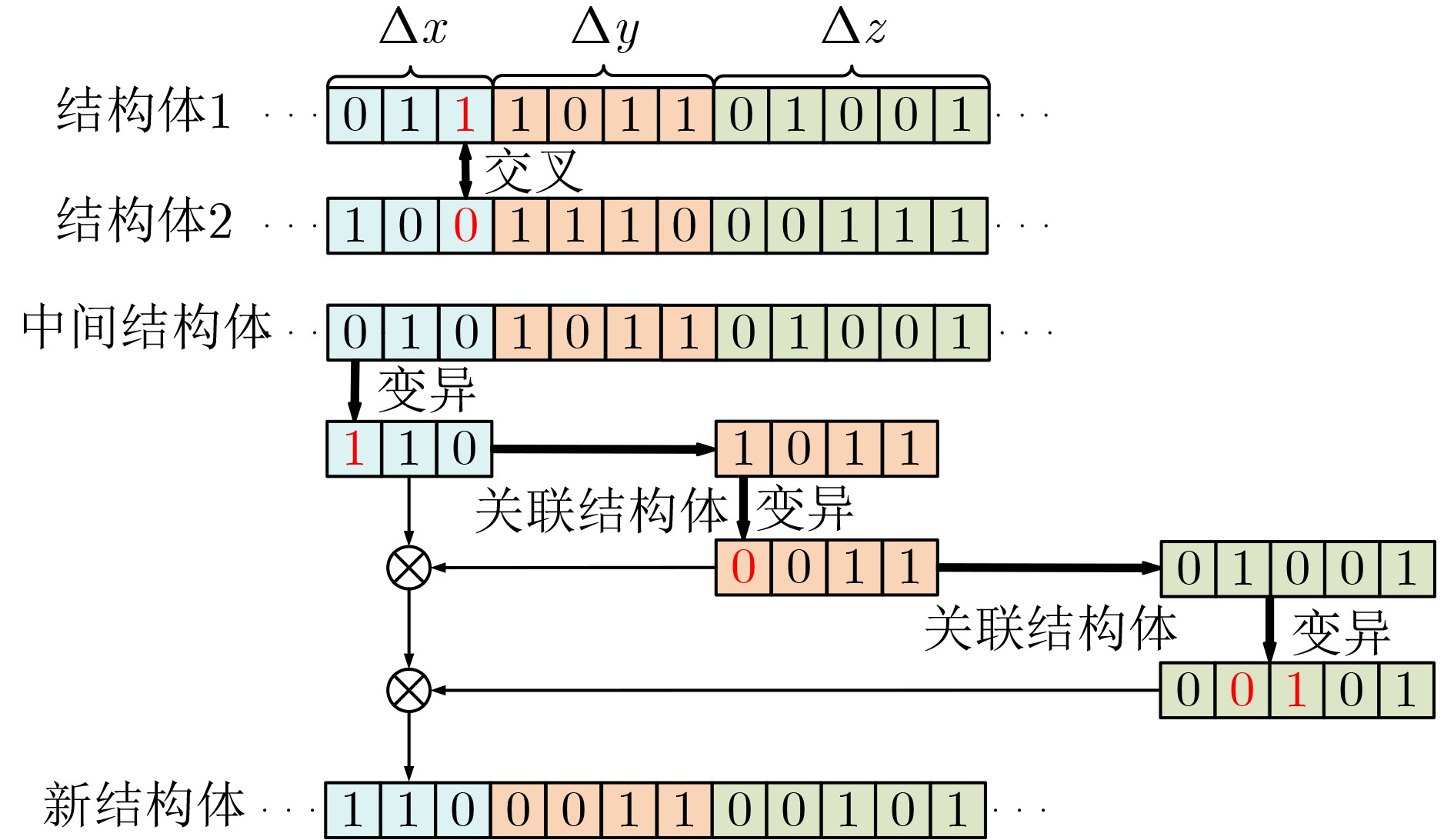
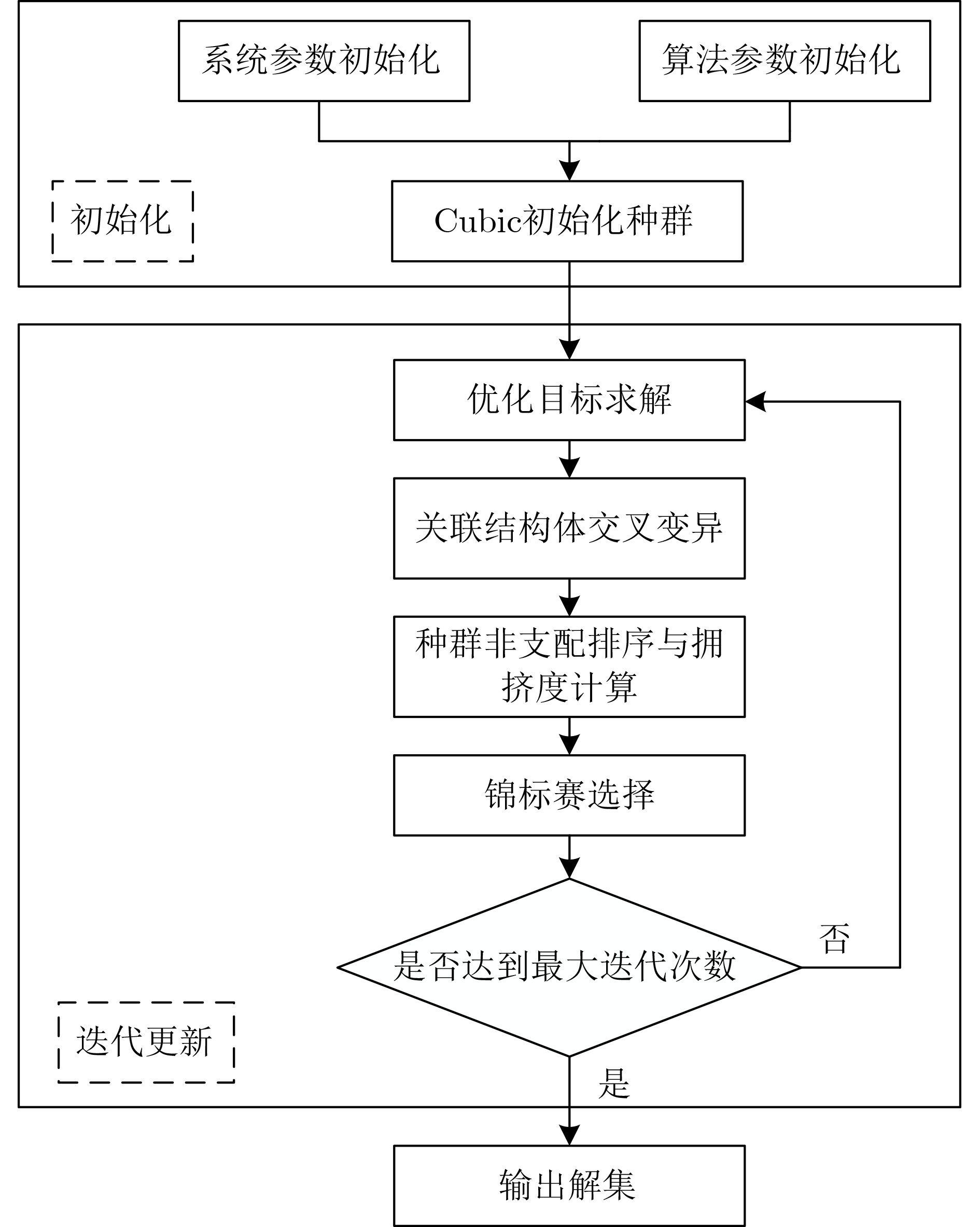
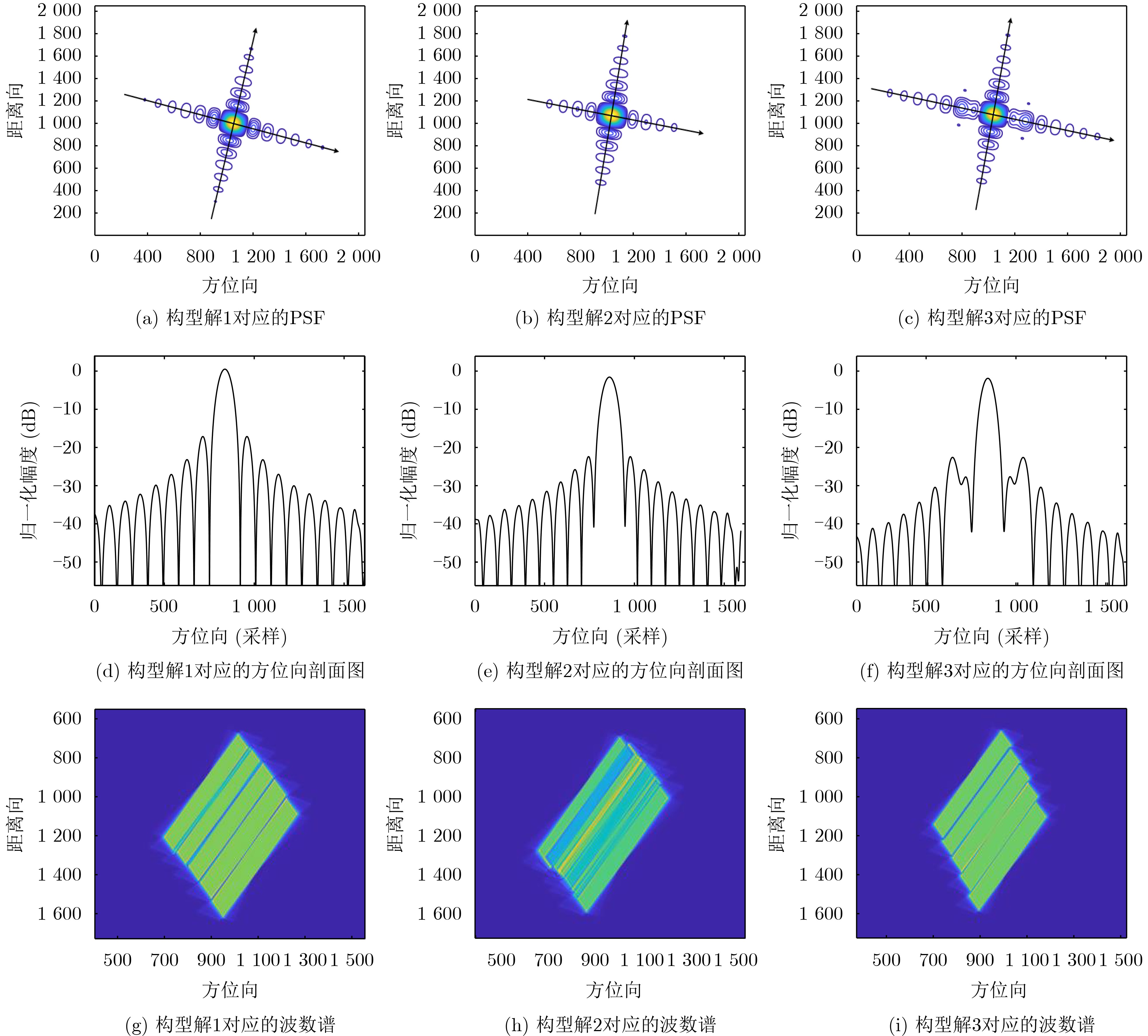
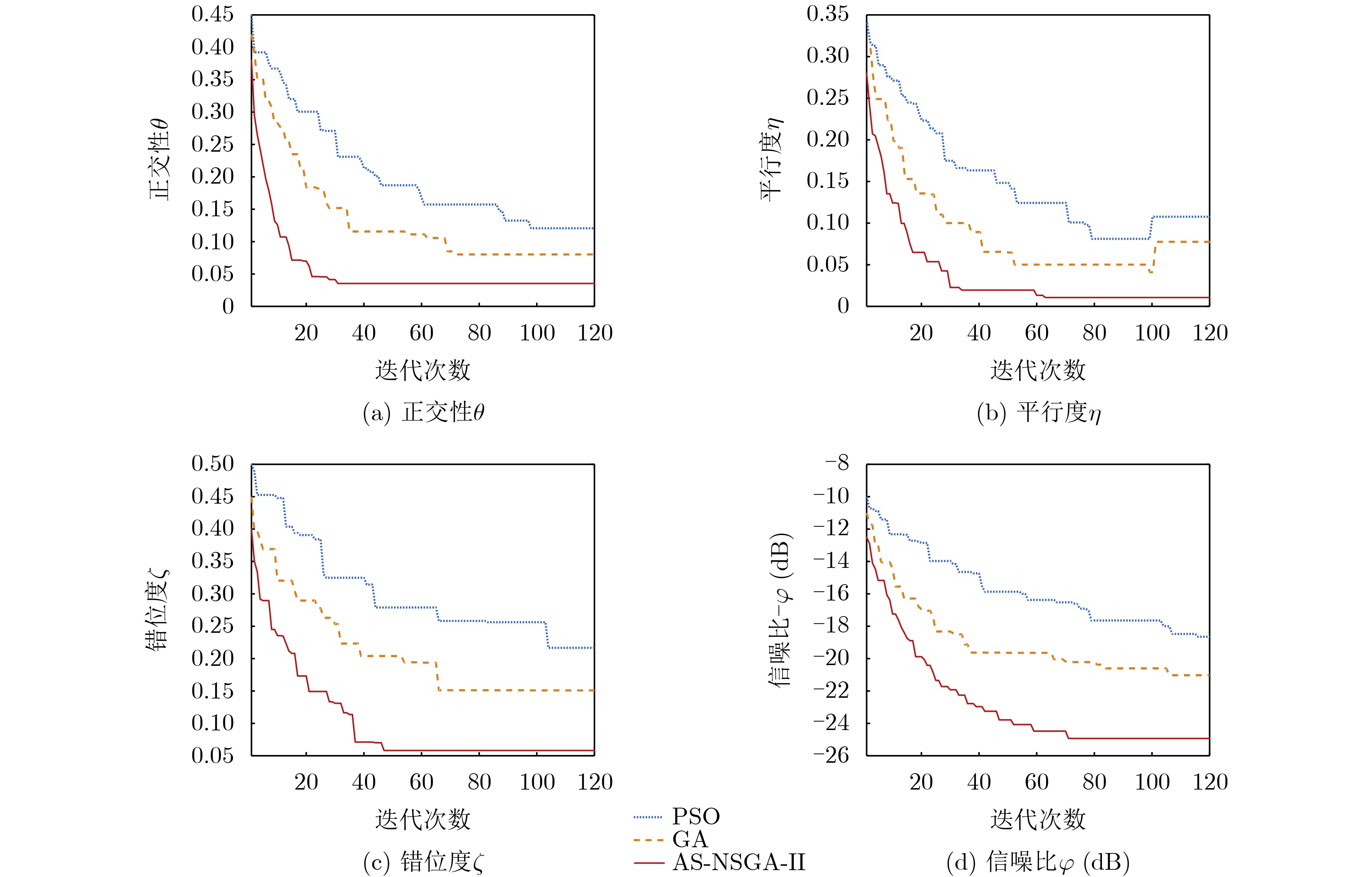
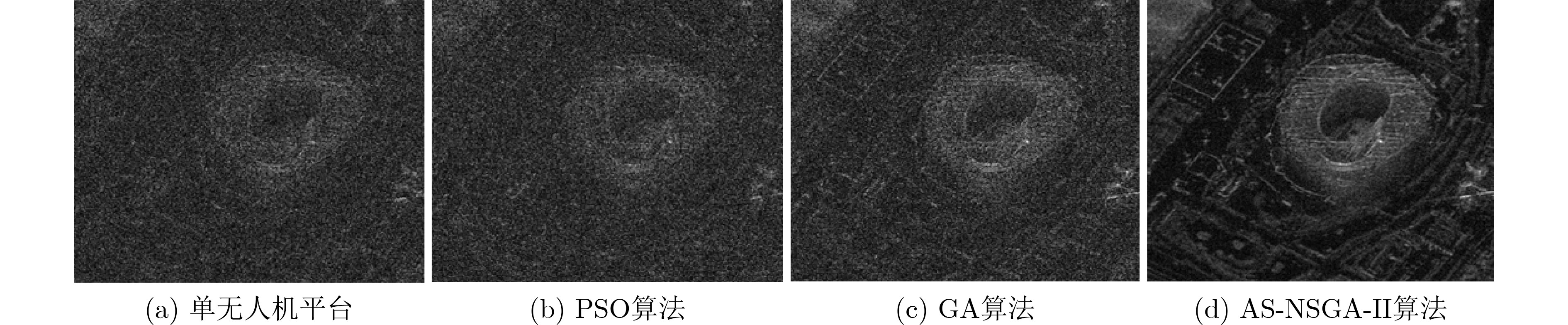
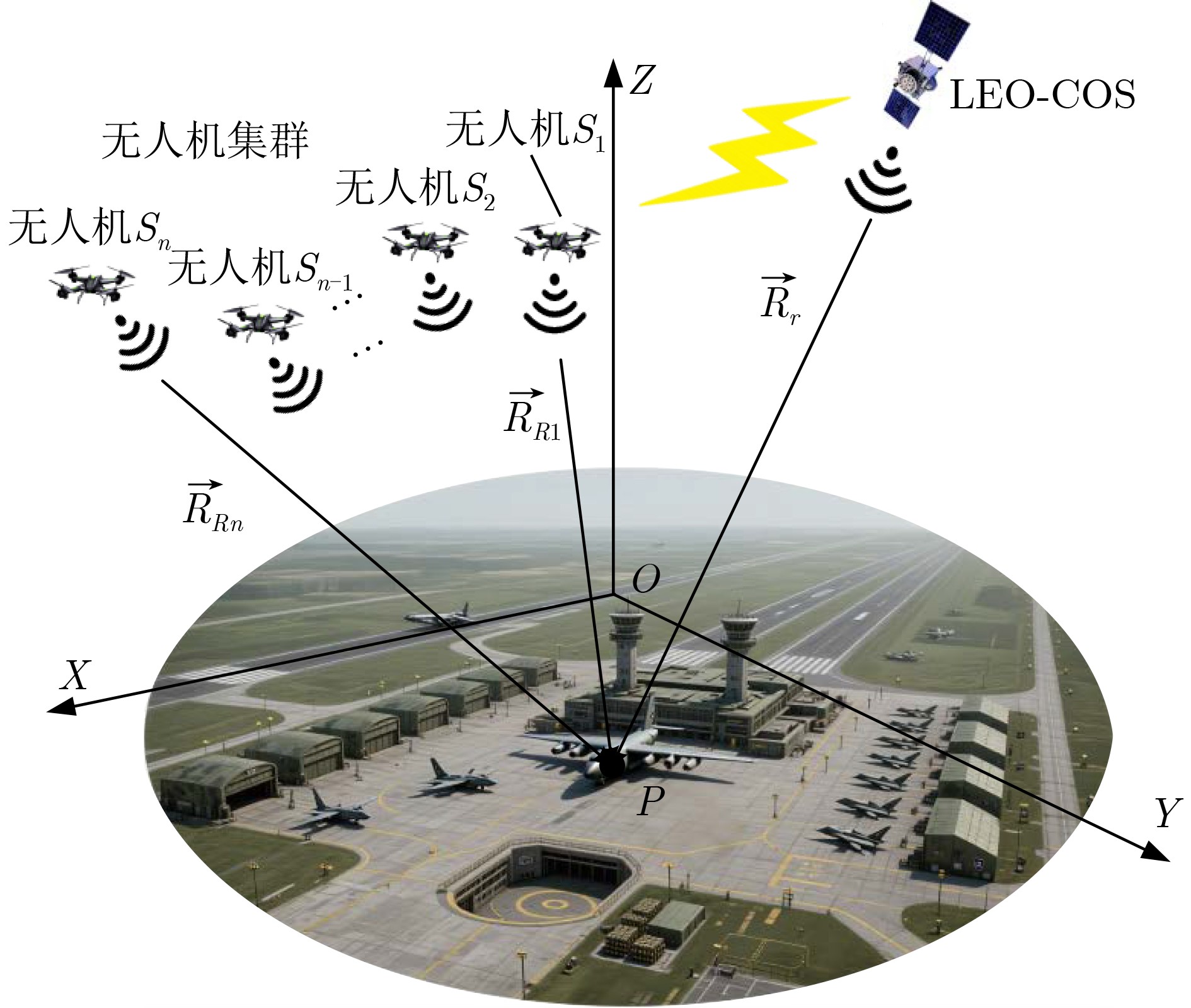
Objective Low Earth Orbit Communication Satellite Constellations (LEO-COS) provide globally distributed, continuously available communication signals, which offer a promising opportunity for passive Synthetic Aperture Radar (SAR) imaging. However, when LEO-COS signals are used as opportunistic illuminators, the limited effective bandwidth and relatively low Signal-to-Noise Ratio (SNR) restrict the imaging capability of conventional single-receiver SAR systems. To overcome these limitations, this paper proposes a novel “constellation–swarm” cooperative SAR imaging mode that integrates LEO-COS illuminators with an Unmanned Aerial Vehicle (UAV) swarm. In this mode, multiple UAV receivers cooperatively collect echo signals, enabling spectrum extension and coherent energy accumulation. Since the spatial configuration of the UAV swarm directly determines the wavenumber spectrum distribution and ultimately affects SAR imaging quality, it is necessary to optimize the UAV swarm configuration under dynamic and heterogeneous bistatic observation geometries. This study aims to establish a configuration optimization method for UAV swarm SAR using LEO-COS opportunistic illumination, thereby improving spectrum utilization, imaging resolution, and robustness in complex observation scenarios. Methods The relationship between UAV swarm spatial configuration and SAR imaging performance is first analyzed from the perspective of wavenumber spectrum geometry. Based on the echo model of the “constellation–swarm” SAR system, the influence of UAV positions and motion parameters on spectrum distribution is derived. The configuration design problem is then formulated as a multi-objective optimization problem by considering spectrum orthogonality, spectrum parallelism, spectrum misalignment suppression, and minimum imaging SNR. To solve this high-dimensional and strongly coupled optimization problem, an Associated-Structure-Encoding Nondominated Sorting Genetic Algorithm II (AS-NSGA-II) is proposed. In the proposed algorithm, the associated structure encoding mechanism is used to preserve the geometric coupling relationship among configuration variables during crossover and mutation. Layered Cubic chaotic mapping is introduced to initialize the population, which improves the uniformity and diversity of candidate solutions in the search space. In addition, an adaptive mutation strategy is designed to dynamically adjust the mutation probability during evolution, so that the algorithm can balance global exploration and local exploitation while maintaining configuration feasibility. Results and Discussions Simulation results show that the optimized UAV swarm configurations can effectively rearrange the wavenumber spectrum support areas of different receiving nodes, reduce spectrum overlap and misalignment, and improve spectrum stitching quality( Fig. 5 ). In comparison with conventional Genetic Algorithm (GA) and Particle Swarm Optimization (PSO) methods, the proposed AS-NSGA-II algorithm shows faster and more stable convergence. The convergence curves of the four objective functions demonstrate that AS-NSGA-II reaches a stable optimization state after approximately 60 generations, while GA and PSO exhibit slower convergence and larger fluctuations(Fig. 6 ). Area target imaging results further show that the proposed method suppresses false grating lobes more effectively and preserves the target edge and structural features more clearly(Fig. 7 ). Under low-SNR conditions, the optimized configuration maintains reliable imaging quality through multi-aperture coherent integration, demonstrating better robustness than the comparison methods.Conclusions This paper investigates the UAV swarm configuration optimization problem for “constellation–swarm” cooperative SAR imaging using LEO-COS signals as opportunistic illuminators. By analyzing the coupling relationship between spatial configuration and wavenumber spectrum distribution, a multi-objective optimization model is established to jointly consider geometric spectrum constraints and imaging SNR. The proposed AS-NSGA-II algorithm improves the optimization process by incorporating associated structure encoding, Layered Cubic chaotic initialization, and adaptive mutation. Simulation results demonstrate that the proposed method outperforms conventional GA and PSO methods in convergence speed, optimization stability, spectrum stitching performance, and imaging quality. The optimized UAV swarm configuration can effectively compensate for the bandwidth and SNR limitations of LEO-COS opportunistic illumination and enhance the resolution and robustness of cooperative SAR imaging. This work provides a feasible technical approach for future wide-area, high-resolution, and robust SAR imaging based on integrated satellite–UAV swarm systems. -
表 1 典型“星座-机群”SAR系统参数表
系统参数 算法参数 载频 9.6 GHz 迭代次数 200 带宽 250 MHz 种群大小 30 脉冲重复率 7000 Hz交叉率 0.8 卫星高度 330 km 变异率 0.2 卫星速度 ( 3000 , 0, 0) m/s留存率 0.1 接收端参考斜距 600 m 波数谱间隙因子 1.129 无人机高度 300 m 优化目标约束 无人机速度 (10, 0, 0) m/s $ (\Delta x,\Delta y,\Delta z) $ [–300, 300] m 场景大小 150 m×150 m $ (\Delta {\theta }_{\boldsymbol{v}R2},\Delta {\theta }_{\boldsymbol{v}T}) $ [–10, 10]° 距离向采样点数 4096 $ \Delta {\theta }_{TR1} $ [–90, 90]°  下载: 导出CSV
表 2 构型优化结果
序号 $ (\Delta x,\Delta y,\Delta z) $(m) $ (\Delta {\theta }_{\boldsymbol{v}R2},\Delta {\theta }_{\boldsymbol{v}T},\Delta {\theta }_{TR1}) $(°) $ [\theta (\boldsymbol{g}),\eta (\boldsymbol{g}),\zeta (\boldsymbol{g})] $ 1 (–61.1, –3.4, –2.3) (–3.45, 6.47, –17.40) (0.311, 0.024, 0.207) 2 (–56.4, –2.7, –3.4) (–2.41, 6.39, –17.84) (0.313, 0.018, 0.137) 3 (–55.6, –2.2, –4.7) (–3.28, 5.98, –17.32) (0.314, 0.020, 0.130)
下载: 导出CSV
表 3 副瓣延伸方向PSLR、ISLR以及主瓣-3 dB宽度
序号 方向 PSLR (dB) ISLR (dB) 主瓣–3 dB宽度(m) 1 $ {\vartheta }_{1} $ –11.04 –8.75 1.49 $ {\vartheta }_{2} $ –13.42 –10.71 0.91 2 $ {\vartheta }_{1} $ –12.30 –9.80 1.44 $ {\vartheta }_{2} $ –13.33 –10.71 0.93 3 $ {\vartheta }_{1} $ –13.35 –10.84 1.76 $ {\vartheta }_{2} $ –13.32 –10.82 1.18
下载: 导出CSV
-
[1] 傅鸿伟, 张章, 罗宇, 等. 基于低轨通信卫星信号的外辐射源雷达技术: 综述与展望[J]. 雷达学报, 2025, 14(4): 1092–1114. doi: 10.12000/JR24219.FU Hongwei, ZHANG Zhang, LUO Yu, et al. Passive radar using LEO communication satellite signals: An overview and prospect[J]. Journal of Radars, 2025, 14(4): 1092–1114. doi: 10.12000/JR24219. [2] 李亚超, 王家东, 张廷豪, 等. 弹载雷达成像技术发展现状与趋势[J]. 雷达学报, 2022, 11(6): 943–973. doi: 10.12000/JR22119.LI Yachao, WANG Jiadong, ZHANG Tinghao, et al. Present situation and prospect of missile-borne radar imaging technology[J]. Journal of Radars, 2022, 11(6): 943–973. doi: 10.12000/JR22119. [3] 邢孟道, 马鹏辉, 楼屹杉, 等. 合成孔径雷达快速后向投影算法综述[J]. 雷达学报, 2024, 13(1): 1–22. doi: 10.12000/JR23183.XING Mengdao, MA Penghui, LOU Yishan, et al. Review of fast back projection algorithms in synthetic aperture radar[J]. Journal of Radars, 2024, 13(1): 1–22. doi: 10.12000/JR23183. [4] XU Yichao, CHEN Xiaoming, YING Ming, et al. Integrated communication and remote sensing in LEO satellite systems: Protocol, architecture, and prototype[J]. IEEE Transactions on Wireless Communications, 2026, 25: 1609–1623. doi: 10.1109/TWC.2025.3591886. [5] GOMEZ-DEL-HOYO P and SAMCZYNSKI P. Starlink-based passive radar for Earth’s surface imaging: First experimental results[J]. IEEE Journal of Selected Topics in Applied Earth Observations and Remote Sensing, 2024, 17: 13949–13965. doi: 10.1109/JSTARS.2024.3437179. [6] WANG Zao, ZHOU Song, WANG Yuhao, et al. A coherence-oriented fast time-domain algorithm for UAV swarm SAR imaging with trajectory difference correction and data-driven MOCO[J]. IEEE Transactions on Geoscience and Remote Sensing, 2025, 63: 5213518. doi: 10.1109/TGRS.2025.3575198. [7] REN Hang, SUN Zhichao, YANG Jianyu, et al. A hybrid resolution enhancement framework for swarm UAV SAR based on cost-effective formation strategy[J]. IEEE Transactions on Geoscience and Remote Sensing, 2024, 62: 5200216. doi: 10.1109/TGRS.2023.3338247. [8] 陆音, 刘金志, 张珉. 一种模型辅助的联邦强化学习多无人机路径规划方法[J]. 电子与信息学报, 2025, 47(5): 1368–1380. doi: 10.11999/JEIT241055.LU Yin, LIU Jinzhi, and ZHANG Min. A model-assisted federated reinforcement learning method for multi-UAV path planning[J]. Journal of Electronics & Information Technology, 2025, 47(5): 1368–1380. doi: 10.11999/JEIT241055. [9] 公茂果, 罗天实, 李豪, 等. 面向演化计算的群智协同研究综述[J]. 电子与信息学报, 2024, 46(5): 1716–1741. doi: 10.11999/JEIT231195.GONG Maoguo, LUO Tianshi, LI Hao, et al. A survey of collaborative swarm intelligence for evolutionary computation[J]. Journal of Electronics & Information Technology, 2024, 46(5): 1716–1741. doi: 10.11999/JEIT231195. [10] 胡昊南, 韩铭, 李文鹏, 等. 面向无线传感器网络信息年龄的多无人机轨迹优化算法[J]. 电子与信息学报, 2024, 46(4): 1222–1230. doi: 10.11999/JEIT230458.HU Haonan, HAN Ming, LI Wenpeng, et al. Multi-unmanned aerial vehicles trajectory optimization for age of information minimization in wireless sensor networks[J]. Journal of Electronics & Information Technology, 2024, 46(4): 1222–1230. doi: 10.11999/JEIT230458. [11] 李一兵, 孙柳晴, 戚昌龙. 基于改进秘书鸟算法的协同干扰资源分配方法[J]. 电子与信息学报, 2025, 47(5): 1494–1504. doi: 10.11999/JEIT240709.LI Yibing, SUN Liuqing, and QI Changlong. Collaborative interference resource allocation method based on improved secretary bird algorithm[J]. Journal of Electronics & Information Technology, 2025, 47(5): 1494–1504. doi: 10.11999/JEIT240709. [12] JIA Zhenyue, YU Jianqiao, AI Xiaolin, et al. Cooperative multiple task assignment problem with stochastic velocities and time windows for heterogeneous unmanned aerial vehicles using a genetic algorithm[J]. Aerospace Science and Technology, 2018, 76: 112–125. doi: 10.1016/j.ast.2018.01.025. [13] XIONG Tongmin, LIAO Yi, HAN Songjun, et al. Integrated sensing and communication with MIMO-OTFS: Energy-conscious channel reconstruction via efficient target parameter estimation[J]. IEEE Transactions on Green Communications and Networking, 2026, 10: 1552–1564. doi: 10.1109/TGCN.2025.3641228. [14] YANG Lang, BIAN Xin, and LI Mingqi. A novel Tabu search detector for OTFS[J]. IEEE Wireless Communications Letters, 2024, 13(12): 3653–3657. doi: 10.1109/LWC.2024.3485068. [15] LI Zhongyu, SANTI F, PASTINA D, et al. Multi-frame fractional Fourier transform technique for moving target detection with space-based passive radar[J]. IET Radar, Sonar & Navigation, 2017, 11(5): 822–828. doi: 10.1049/iet-rsn.2016.0432. [16] 邢孟道, 孙光才, 王彤. 雷达成像技术[M]. 北京: 电子工业出版社, 2024: 160–162.XING Mengdao, SUN Guangcai, and WANG Tong. Radar Imaging Techniques[M]. Beijing: Publishing House of Electronics Industry, 2024: 160–162. [17] WANG Shaogang, PATEL V M, and PETROPULU A. Multidimensional sparse Fourier transform based on the Fourier projection-slice theorem[J]. IEEE Transactions on Signal Processing, 2019, 67(1): 54–69. doi: 10.1109/TSP.2018.2878546. [18] 武俊杰, 杨建宇, 李中余, 等. 双基地SAR成像处理方法综述[J]. 雷达学报, 2025, 14(5): 1115–1141. doi: 10.12000/JR25067.WU Junjie, YANG Jianyu, LI Zhongyu, et al. Review of bistatic synthetic aperture radar imaging methods[J]. Journal of Radars, 2025, 14(5): 1115–1141. doi: 10.12000/JR25067. [19] LI Yachao, XU Gaotian, ZHOU Song, et al. A novel CFFBP algorithm with noninterpolation image merging for bistatic forward-looking SAR focusing[J]. IEEE Transactions on Geoscience and Remote Sensing, 2022, 60: 5225916. doi: 10.1109/TGRS.2022.3162230. [20] 陈伯孝. 现代雷达系统分析与设计[M]. 西安: 西安电子科技大学出版社, 2012: 110–111.CHEN Boxiao. Mordern Radar System Analysis and Design[M]. Xi’an: Xidian University Press, 2012: 110–111. -

 下载:
下载:

图(7) / 表(3)
计量
- 文章访问数: 9
- HTML全文浏览量: 1
- PDF下载量: 0
- 被引次数: 0
