




Efficient Hyperdimensional Computing Accelerator Design for Chinese Text Classification
-
摘要: 随着物联网与智能穿戴设备的普及,在本地进行低延迟、高隐私的中文文本分析已成为刚需。然而,基于神经网络的语言模型计算量大、参数量大,难以在资源受限的边缘设备上运行。超维计算(HDC)作为一种新兴的类脑计算范式,通过2 k~10 k维度的超向量表征文本,以轻量级的“编码-查询”机制替代了复杂的多层网络结构,提供了硬件友好型的技术路径。然而,现有HDC研究主要面向由少量字母构成的拼音文字系统如英文。对于拥有庞大字符集的中文,现有方法会因基超向量数量的剧增而导致存储开销显著上升,这直接破坏了其在边缘侧部署的轻量化优势。为突破中文文本在边缘侧的高效表征瓶颈,该文基于汉字独特的书写与结构特征,提出一种高效的汉字超维编码方法,并构建了专为边缘侧中文文本分类设计的超维计算框架HDChinese。此外,为进一步适配边缘硬件环境,该文还设计了与HDChinese适配的加速器架构。实验结果表明,在维持分类准确率相当的前提下,HDChinese及其硬件加速器能够将模型复杂度大幅缩减99%以上,同时实现4.91%~77.36%的训练时间缩短以及6.67%~47.25%的推理延迟降低。该研究有效兼顾了准确性与极低开销,为边缘设备上的中文文本分析任务提供了理想的硬件解决方案。Abstract:
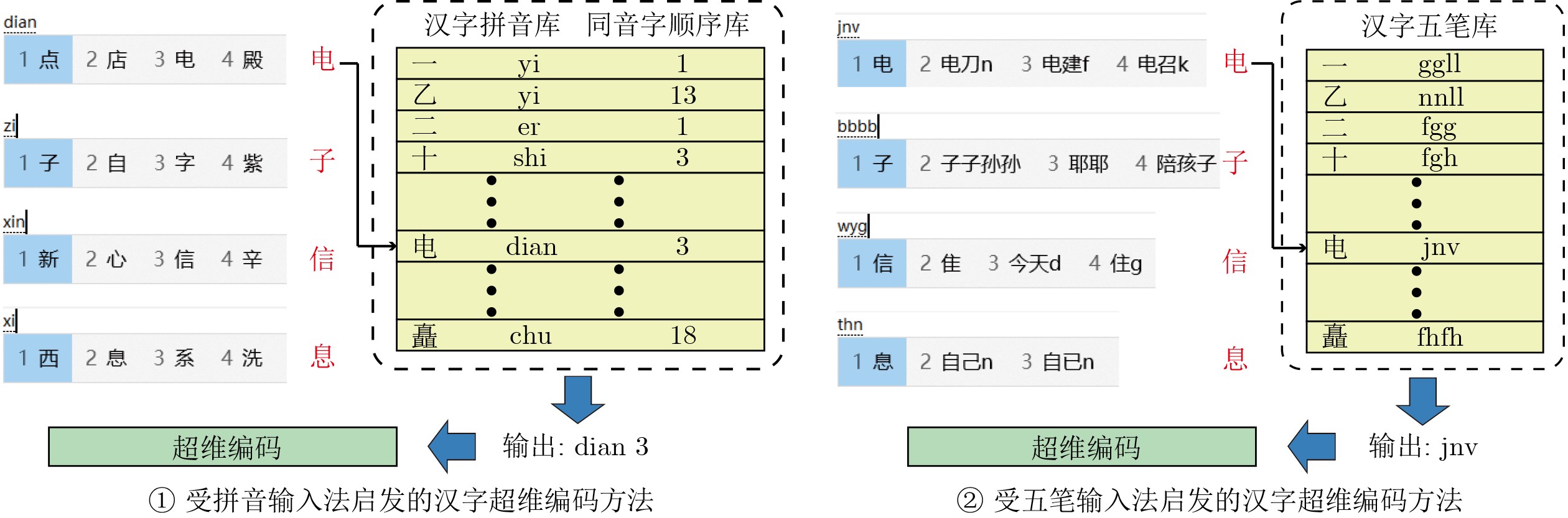
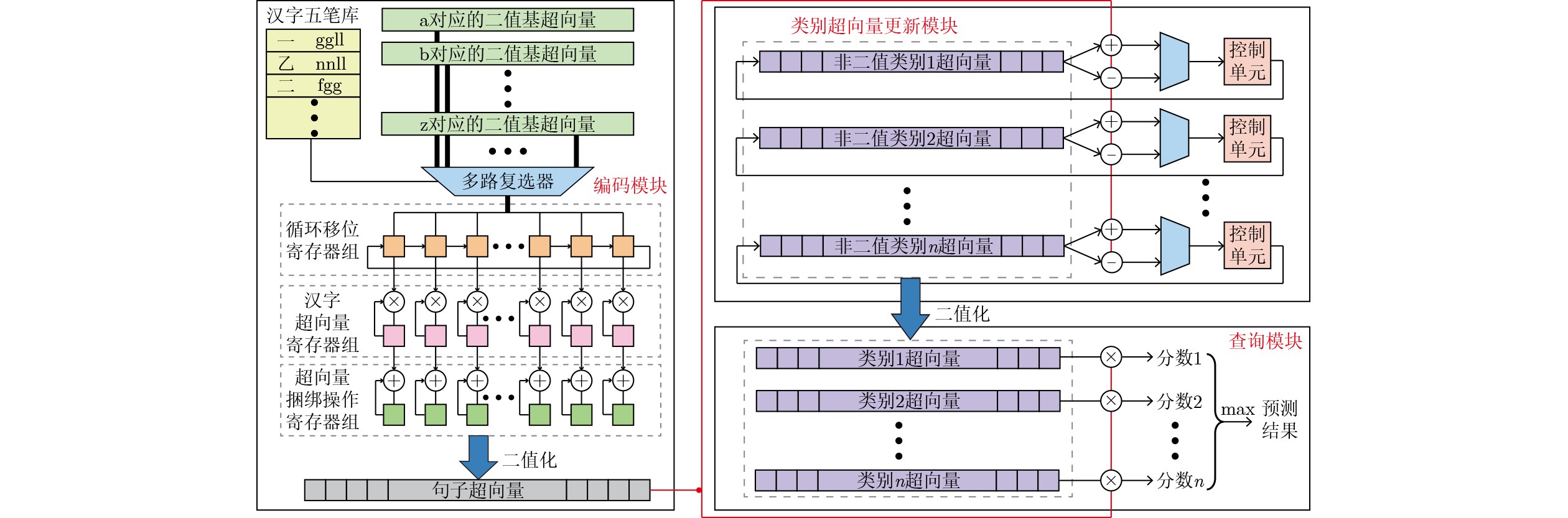
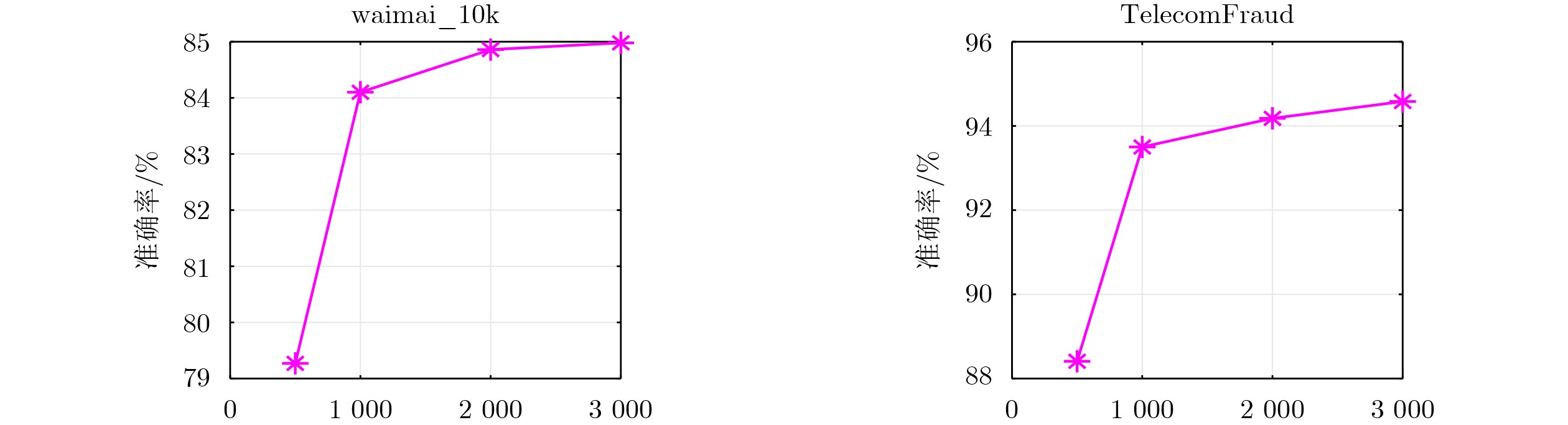
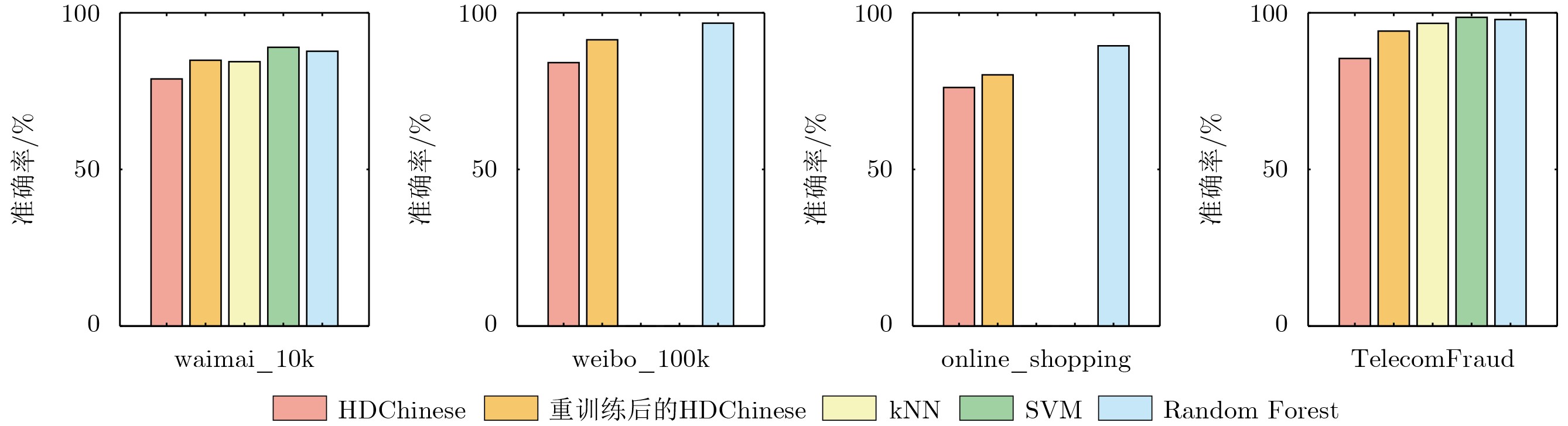
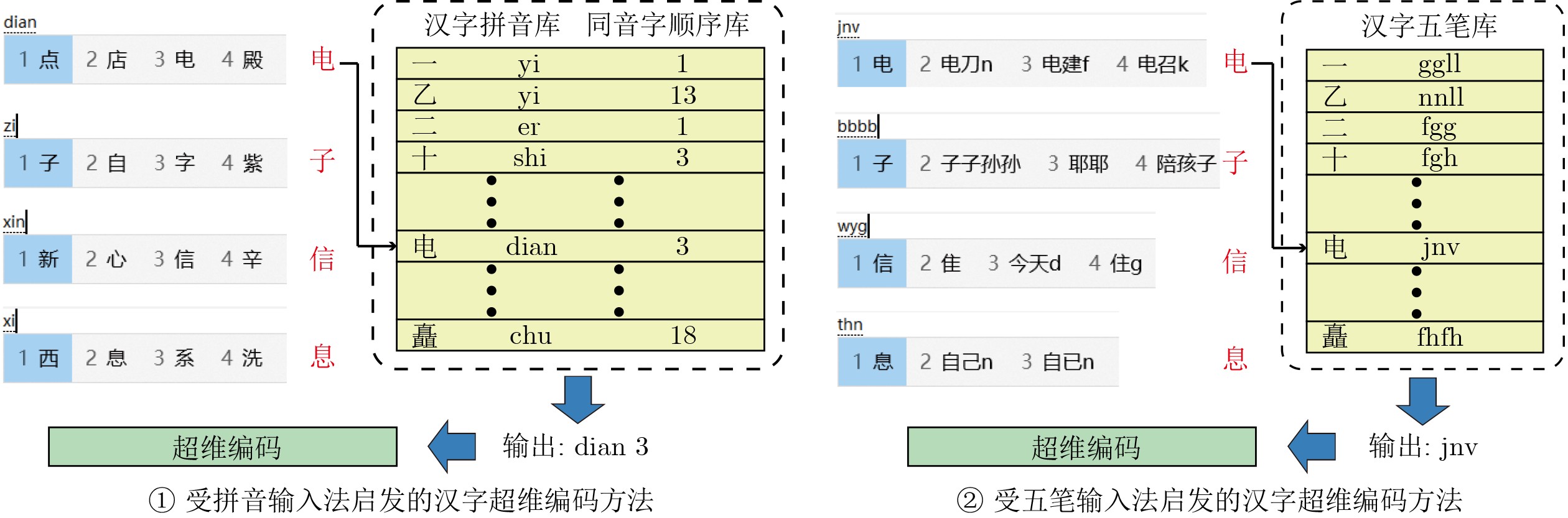
Objective With the proliferation of edge computing in the Internet of Things (IoT), smart wearables, and offline terminals, low-latency and privacy-preserving Chinese text analysis on local devices has become a core requirement. Although neural network-based and Transformer-based language models achieve high accuracy, their large parameter sizes and computational demands make them difficult to deploy on power- and storage-constrained edge devices. HyperDimensional Computing (HDC), an emerging brain-inspired computing paradigm, represents text using 2 k~10 k-dimensional hypervectors and employs lightweight encoding and querying mechanisms instead of complex multilayer networks, providing a hardware-friendly approach for edge-side text processing. However, existing HDC studies have mainly focused on alphabetic writing systems such as English, in which a limited set of letters is sufficient for N-gram encoding. For Chinese, which contains thousands of commonly used characters, directly applying these methods would require a large number of base hypervectors, resulting in substantial storage overhead and weakening the lightweight advantage of HDC. This paper aims to address this limitation by proposing an efficient character encoding method and a dedicated HDC framework with hardware acceleration for Chinese text classification. Methods Based on the glyph structure of Chinese characters, a hyperdimensional encoding method based on character glyph structure is proposed. Specifically, the encoding process of the Wubi input method is reverse-engineered to decompose each Chinese character into an equivalent Wubi letter sequence for efficient hyperdimensional encoding. A retrieval library covering 3 500 commonly used Chinese characters, as defined in the General Standard Chinese Characters Table issued by the Ministry of Education of the People’s Republic of China, is constructed. For each character, the Wubi library is queried to obtain a letter sequence of length 3 or 4, with each letter mapped to a base hypervector. Cyclic shift and binding operations are then applied to the base hypervectors of consecutive letters. This produces a character-level hypervector that captures both letter identity and positional order information, thereby avoiding confusion caused by different letter permutations. Compared with directly assigning an independent hypervector to each Chinese character, the proposed method reduces the storage requirement for base hypervectors by more than 95% (Table 1). Building on this character encoding method, the HDChinese framework is developed to support inference, training, and retraining. During inference, the sentence-level hypervector obtained by bundling all character hypervectors queries the class hypervectors using cosine similarity. Because the hypervectors are binary, the inner-product operation is efficiently implemented using XNOR logic. During training, class hypervectors are generated by bundling sentence hypervectors belonging to the same class and applying sign-based binarization. During retraining, the nonbinary class hypervectors are iteratively updated using misclassified samples with a learning rate of 0.25, thereby reducing the effect of outlier hypervectors on the cluster center. Furthermore, a dedicated hardware accelerator architecture is designed for HDChinese. The architecture comprises three main modules: an encoding module, a querying module, and a class hypervector update module. These modules can be selectively activated to support inference, training, and retraining modes, respectively ( Fig. 2 ). The accelerator is prototyped on an Ultra96v2 FPGA development board equipped with a Xilinx ZYNQ System on Chip (SoC).Results and Discussions Four open-source Chinese text classification datasets covering binary and multiclass tasks are used for evaluation ( Table 2 ). The Wubi-based encoding method achieves higher accuracy than the Pinyin-based method on all four datasets and reduces the storage requirement by 31.46% (Table 4 ). Ignoring uncommon Chinese characters, which occur at an average frequency of less than 0.5%, has a negligible effect on accuracy (Table 4 ). A hypervector dimension of 2 k is selected because increasing the dimension beyond 2 k provides no significant accuracy improvement (Fig. 3 ). FPGA measurements show that HDChinese achieves a model size of approximately 16 kB, representing a reduction of more than 99% compared with k-Nearest Neighbor (kNN), Support Vector Machine (SVM), and random forest models (Table 7 ). Compared with SVM and random forest, the proposed accelerator reduces inference time by 6.67%~47.25% and total training time by 4.91%~77.36%. After retraining, the classification accuracy reaches levels comparable to those of the comparison methods (Fig. 4 ,Table 7 ). The kB-scale model also enables operation without external memory chips, whereas the comparison methods require more than 400 MB of runtime memory. At 100 MHz, the FPGA implementation consumes 0.278 W, providing the most favorable trade-off between throughput and power consumption (Table 6 ).Conclusions A hyperdimensional encoding method based on Chinese character glyph structure is proposed to address the incompatibility between existing HDC methods and Chinese text. The HDChinese framework and its dedicated hardware accelerator reduce model complexity by more than 99% while maintaining competitive classification accuracy. Training time is reduced by 4.91%~77.36%, and inference time is reduced by 6.67%~47.25%. The proposed approach achieves a favorable balance between accuracy and computational and storage overhead, providing a hardware solution for Chinese text analysis on edge devices. -
表 1 汉字超维编码方法对比
编码方法 检索库空间占用(拼音+顺序;五笔) 基超向量空间占用 总空间占用 超向量直接表征的方法 0 3500 ×2000 bit=7 Mbit7 Mbit 基于拼音的方法 3500 ×(6×5 bit)+3500 ×6 bit=126 kbit26× 2000 bit=52 kbit178 kbit 基于五笔的方法 3500 ×(4×5 bit)=70 kbit26× 2000 bit=52 kbit122 kbit  下载: 导出CSV
表 2 评估所用数据集
数据集名称 类别数 内容简介 waimai_10k* 2 某外卖平台收集的用户评价,正向 4000 条,负向8000 条weibo_100k* 2 带情感标注新浪微博评论文本,正负向评论约各50 000条 online_shopping* 2 共60 000余条电商评论数据,正、负向评论各约30 000条 TelecomFraud[22] 5 包含4种电信诈骗类型的文本,各约 1000 条,以及1类非诈骗的文本约8000 条*开源地址: https://github.com/SophonPlus/ChineseNlpCorpus
下载: 导出CSV
表 3 硬件参数
硬件描述 主频 LUT FlipFlop BRAM DSP 功耗(W) CPU 4核Cortex-A53 CPU 1.2 GHz - - - - 1.710 FPGA Ultrascale+ FPGA 100 MHz 25060 27877 56.5 0 0.278
下载: 导出CSV
表 4 不同超维编码方法准确率对比(%)
waimai_10k weibo_100k online_shopping TelecomFraud 基于拼音的方法 83.82 90.27 80.10 93.50 基于五笔的方法 84.86 91.40 80.20 94.18 基于五笔的方法* 84.73
(0.38)90.76
(1.12)79.92
(0.21)94.14
(0.20)*保留对生僻字( 3500 个常用汉字以外的字)的超维表征,括号中是生僻字在数据集中出现的频率。
下载: 导出CSV
表 5 跨域泛化准确率对比(%)
waimai_10k weibo_100k online_shopping 在waimai_10k上训练 84.86 64.91 71.67 在weibo_100k上训练 65.01 91.40 58.63 在online_shopping
上训练71.35 59.58 80.20
下载: 导出CSV
表 6 加速器在不同主频下的实测性能
主频
(MHz)waimai_10k weibo_100k online_shopping TelecomFraud 训练
吞吐率*推理
吞吐率*功率(W) 训练
吞吐率*推理
吞吐率*功率(W) 训练
吞吐率*推理
吞吐率*功率 训练
吞吐率*推理
吞吐率*功率(W) 50 2350.24 2321.39 0.191 1370.3 1374.63 0.210 1221.13 1196.27 0.219 639.87 627.74 0.219 100 2523.42 2497.62 0.250 1991.08 1975.14 0.278 1835.72 1827.66 0.289 1212.1 1201.53 0.294 150 2497.14 2462.01 0.350 1993.73 1972.71 0.381 1897.14 1832.58 0.385 1389.09 1394.07 0.393 *吞吐率指标SPS:Samples Per Second,每秒处理样本数量。
下载: 导出CSV
表 7 性能对比
waimai_10k weibo_100k online_shopping TelecomFraud 训练
时间(s)推理
时间(s)模型
大小训练
时间(s)推理
时间(s)模型
大小训练
时间(s)推理
时间(s)模型
大小训练
时间(s)推理
时间(s)模型
大小kNN 1.52 24.00 43.97 MB 内存溢出 内存溢出 3.93 24.27 43.18 MB SVM 184.71 69.05 19.40 MB 运行时间超过1 h 运行时间超过1 h 75.55 34.56 9.5 MB Random Forest 68.29 1.82 28.96 MB 1284.28 19.96 102.30 MB 583.52 10.94 118.20 MB 59.44 2.10 11.96 MB HDChinese 3.80 0.96 15.38 kB 48.21 12.15 15.38 kB 27.35 6.87 15.38 kB 7.77 1.96 16.11 kB HDChinese* 22.80 0.96 15.38 kB 290.71 12.15 15.38 kB 164.10 6.87 15.38 kB 46.52 1.96 16.11 kB *在训练完成后加入了5轮的重训练,因此总训练时间(包括1轮训练和5轮重训练)更长,但不影响其他性能。
下载: 导出CSV
-
[1] ZHAO Jinghua, SHU Xi, ZHAO Xiaohua, et al. Online opinion trend prediction for public health events based on time series transformer[J]. IEEE Transactions on Computational Social Systems, 2026, 13(1): 1159–1168. doi: 10.1109/TCSS.2025.3617491. [2] 朱振方, 李嘉欣, 徐富永, 等. 一种融合情感和策略信息的共情对话生成方法[J]. 电子与信息学报, 2024, 46(8): 3382–3389. doi: 10.11999/JEIT231417.ZHU Zhenfang, LI Jiaxin, XU Fuyong, et al. Empathetic dialogue generation via sentiment and support strategy[J]. Journal of Electronics & Information Technology, 2024, 46(8): 3382–3389. doi: 10.11999/JEIT231417. [3] LIU Fengyu. Research on user dynamic preference modeling and recommendation system based on text sentiment transfer[C]. 2025 2nd International Conference on Intelligent Computing and Robotics (ICICR), Dalian, China, 2025: 1088–1092. doi: 10.1109/ICICR65456.2025.00192. [4] LIU Pengfei, QIU Xipeng, and HUANG Xuanjing. Recurrent neural network for text classification with multi-task learning[C]. The Twenty-Fifth International Joint Conference on Artificial Intelligence, New York, USA, 2016: 2873–2879. [5] ZHENG Yafeng, GAO Zhanghao, SHEN Jun, et al. Optimizing automatic text classification approach in adaptive online collaborative discussion-a perspective of attention mechanism-based bi-LSTM[J]. IEEE Transactions on Learning Technologies, 2023, 16(5): 591–602. doi: 10.1109/tlt.2022.3192116. [6] JIANG Ting, WANG Deqing, SUN Leilei, et al. LightXML: Transformer with dynamic negative sampling for high-performance extreme multi-label text classification[C]. The 35th AAAI Conference on Artificial Intelligence, 2021: 7987–7994. doi: 10.1609/aaai.v35i9.16974. [7] 王泽昊, 朱振华, 谢童欣, 等. 混合专家大语言模型的系统与架构优化技术综述[J]. 电子与信息学报, 2025, 47(11): 4055–4078. doi: 10.11999/JEIT250407.WANG Zehao, ZHU Zhenhua, XIE Tongxin, et al. A survey on system and architecture optimization techniques for mixture-of-experts large language models[J]. Journal of Electronics & Information Technology, 2025, 47(11): 4055–4078. doi: 10.11999/JEIT250407. [8] 刘文波, 姚翼荣, 张弓, 等. 超维计算概念、应用及研究进展[J]. 系统工程与电子技术, 2023, 45(7): 1938–1956. doi: 10.12305/j.issn.1001-506X.2023.07.04.LIU Wenbo, YAO Yirong, ZHANG Gong, et al. Concept, application, and research progress of hyperdimensional computing[J]. Systems Engineering and Electronics, 2023, 45(7): 1938–1956. doi: 10.12305/j.issn.1001-506X.2023.07.04. [9] 余天洋, 吴比, 陈珂, 等. 超维计算硬件设计: 进展、趋势和展望[J]. 集成电路与嵌入式系统, 2025, 25(8): 1–9. doi: 10.20193/j.ices2097-4191.2025.0047.YU Tianyang, WU Bi, CHEN Ke, et al. Hyperdimensional computing hardware: Progress, trends and prospects[J]. Integrated Circuits and Embedded Systems, 2025, 25(8): 1–9. doi: 10.20193/j.ices2097-4191.2025.0047. [10] RAHIMI A, KANERVA P, and RABAEY J M. A robust and energy-efficient classifier using brain-inspired hyperdimensional computing[C]. The 2016 International Symposium on Low Power Electronics and Design, San Francisco Airport, USA, 2016: 64–69. doi: 10.1145/2934583.2934624. [11] THAPA R, LAMICHHANE B, MA Dongning, et al. SpamHD: Memory-efficient text spam detection using brain-inspired hyperdimensional computing[C]. 2021 IEEE Computer Society Annual Symposium on VLSI (ISVLSI), Tampa, USA, 2021: 84–89. doi: 10.1109/isvlsi51109.2021.00026. [12] ALONSO P, SHRIDHAR K, KLEYKO D, et al. HyperEmbed: Tradeoffs between resources and performance in NLP tasks with hyperdimensional computing enabled embedding of n-gram statistics[C]. 2021 International Joint Conference on Neural Networks (IJCNN), Shenzhen, China, 2021: 1–9. doi: 10.1109/IJCNN52387.2021.9534359. [13] PARK S, KIM K, SEO J, et al. Unsupervised extractive dialogue summarization in hyperdimensional space[C]. ICASSP 2024-2024 IEEE International Conference on Acoustics, Speech and Signal Processing (ICASSP), Seoul, Korea, 2024: 12411–12415. doi: 10.1109/ICASSP48485.2024.10446698. [14] MIKOLOV T, CHEN Kai, CORRADO G, et al. Efficient estimation of word representations in vector space[C]. 1st International Conference on Learning Representations, Scottsdale, USA, 2013. [15] PENNINGTON J, SOCHER R, and MANNING C D. GloVe: Global vectors for word representation[C]. The 2014 Conference on Empirical Methods in Natural Language Processing (EMNLP), Doha, Qatar, 2014: 1532–1543. doi: 10.3115/v1/D14-1162. [16] DEVLIN J, CHANG Mingwei, LEE K, et al. BERT: Pre-training of deep bidirectional transformers for language understanding[C]. The 2019 Conference of the North American Chapter of the Association for Computational Linguistics: Human Language Technologies, Volume 1 (long and short papers), Minneapolis, USA, 2019: 4171–4186. doi: 10.18653/v1/N19-1423. [17] LIU Caizhi, SEHNG Yanxiu, WEI Zhiqiang, et al. Research of text classification based on improved TF-IDF algorithm[C]. IEEE International Conference of Intelligent Robotic and Control Engineering (IRCE), Lanzhou, China, 2018: 218–222. doi: 10.1109/IRCE.2018.8492945. [18] YU Tianyang, WU Bi, CHEN Ke, et al. Fully learnable hyperdimensional computing framework with ultratiny accelerator for edge-side applications[J]. IEEE Transactions on Computers, 2024, 73(2): 574–585. doi: 10.1109/tc.2023.3337316. [19] GE Lulu and PARHI K K. Classification using hyperdimensional computing: A review[J]. IEEE Circuits and Systems Magazine, 2020, 20(2): 30–47. doi: 10.1109/mcas.2020.2988388. [20] GORBAN A N and TYUKIN I Y. Blessing of dimensionality: Mathematical foundations of the statistical physics of data[J]. Philosophical Transactions of the Royal Society A: Mathematical, Physical and Engineering Sciences, 2018, 376(2118): 20170237. doi: 10.1098/rsta.2017.0237. [21] SHIN S H, YOO Y, MOON Y, et al. STAR-PIM: Self-test and repair structure for processing-in-memory with adder tree-based MAC[J]. IEEE Transactions on Circuits and Systems I: Regular Papers, 2026, 73(3): 1990–2003. doi: 10.1109/tcsi.2025.3615631. [22] LI Jun, ZHANG Cheng, and JIANG Lanlan. Innovative telecom fraud detection: A new dataset and an advanced model with RoBERTa and dual loss functions[J]. Applied Sciences, 2024, 14(24): 11628. doi: 10.3390/app142411628. [23] 王杰, 王鹃. 面向RISC-V平台的安全高效固件可信平台模块设计与实现[J]. 电子与信息学报, 2025, 47(7): 2385–2395. doi: 10.11999/JEIT241112.WANG Jie and WANG Juan. The design and implementation of a secure and efficient firmware trusted platform module for RISC-V platforms[J]. Journal of Electronics & Information Technology, 2025, 47(7): 2385–2395. doi: 10.11999/JEIT241112. -

 下载:
下载:

图(4) / 表(7)
计量
- 文章访问数: 476
- HTML全文浏览量: 228
- PDF下载量: 38
- 被引次数: 0
