




Cooperative Search and Tracking of Moving Ships Using Constellation Multifunctional Payloads Based on Dynamic Information Gain
-
摘要: 针对广域海面非合作机动舰船位置不确定性随未观测时间持续扩散,以及星群多功能载荷在搜索-跟踪模式、姿态机动和能量消耗方面存在强耦合约束的问题,该文提出一种基于动态信息增益的协同搜索与跟踪方法。首先,依据目标上一确认状态、航速/航向扰动和未观测时长生成参数化概率网格,以离散信息熵表征目标位置不确定性,并结合连续命中状态构建状态驱动的双模收益模型:稳健跟踪态采用窄视场模式,以任务视场内的先验捕获概率评价观测收益;丢失搜索态采用宽视场模式,以Kullback-Leibler(KL)散度的信息论定义为基础,利用2元Hit/Miss事件熵近似评价候选区域的搜索信息价值。其次,建立同时考虑目标动态优先级、跟踪收益、搜索收益和能量消耗的滚动多目标规划模型,并将单星时域互斥、姿态切换稳定时间及能量预算作为物理硬约束。在此基础上,提出基于非支配排序遗传算法(NSGA-II)的多目标协同演化规划算法(CEP-MO),通过全局整数索引编码、约束感知启发式初始化、卫星分组交叉、自适应修复和理想点决策,提高强约束大规模任务空间中的可行解生成与协同规划效率。仿真实验表明,在200艘机动目标的大规模场景下,相较于标准NSGA-II,所提CEP-MO算法保障了规划方案在星群能源与姿态等物理硬约束下的可行性,降低了目标位置不确定性对系统调度效能的影响,将平均重访间隔缩短了62.8%,提高不确定性目标的再捕获与持续监视能力。Abstract:
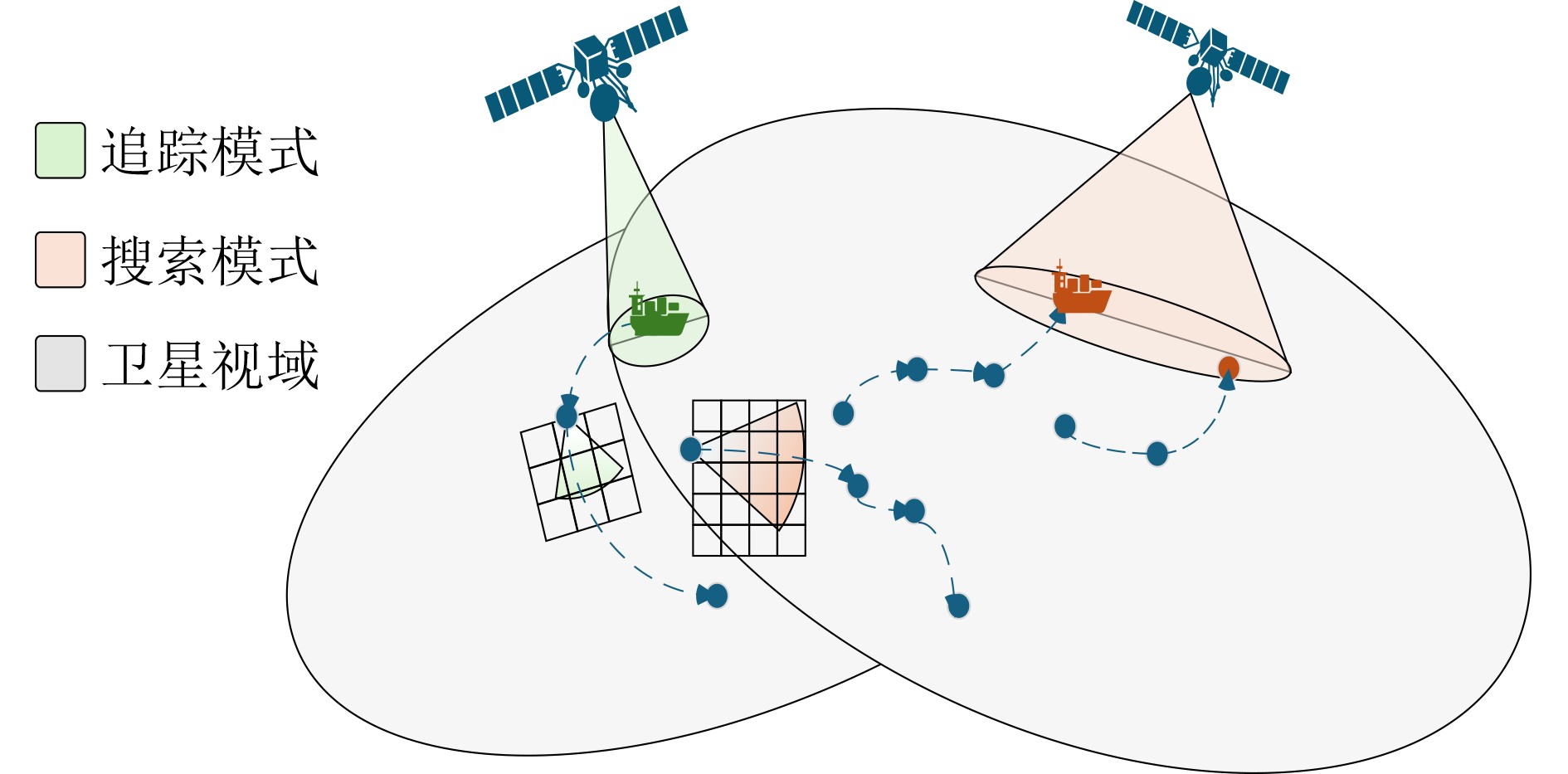
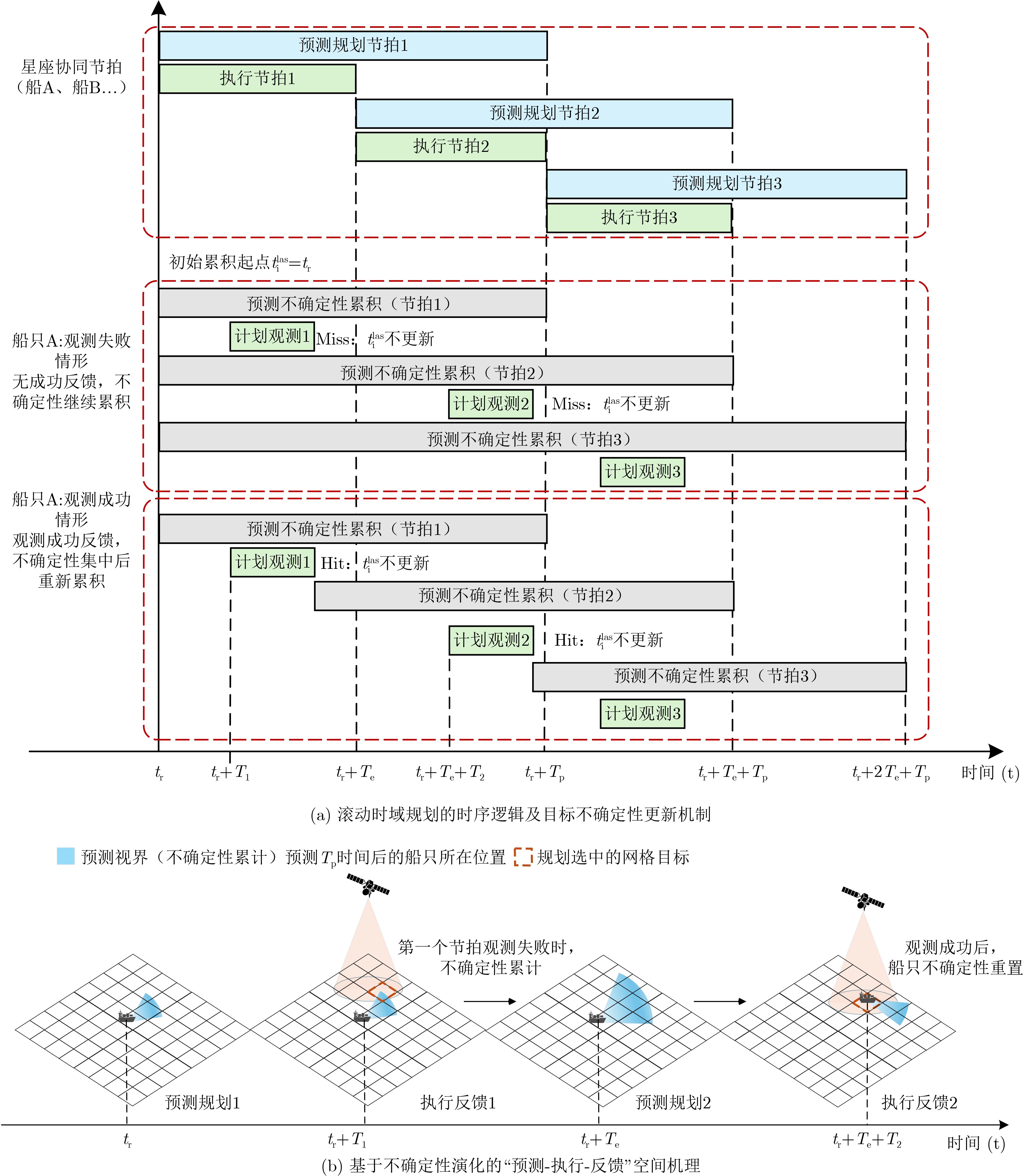
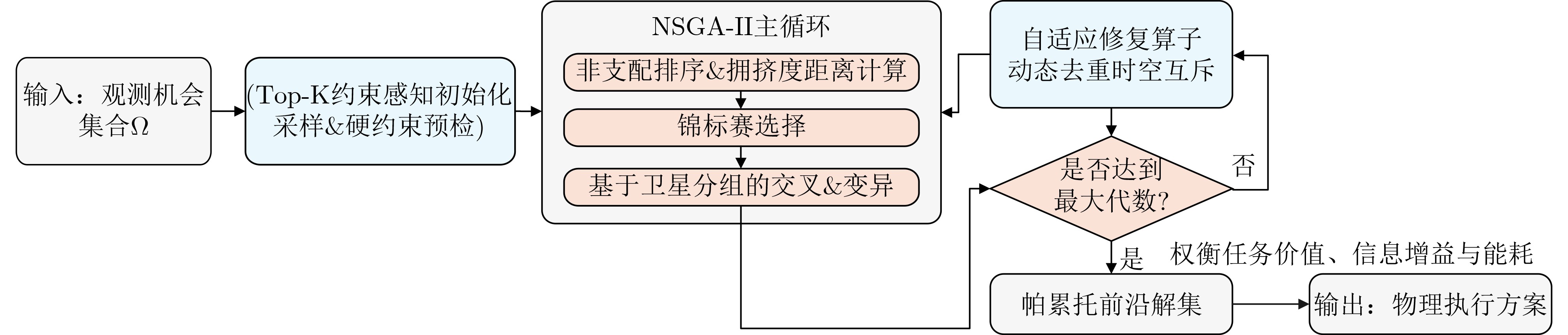
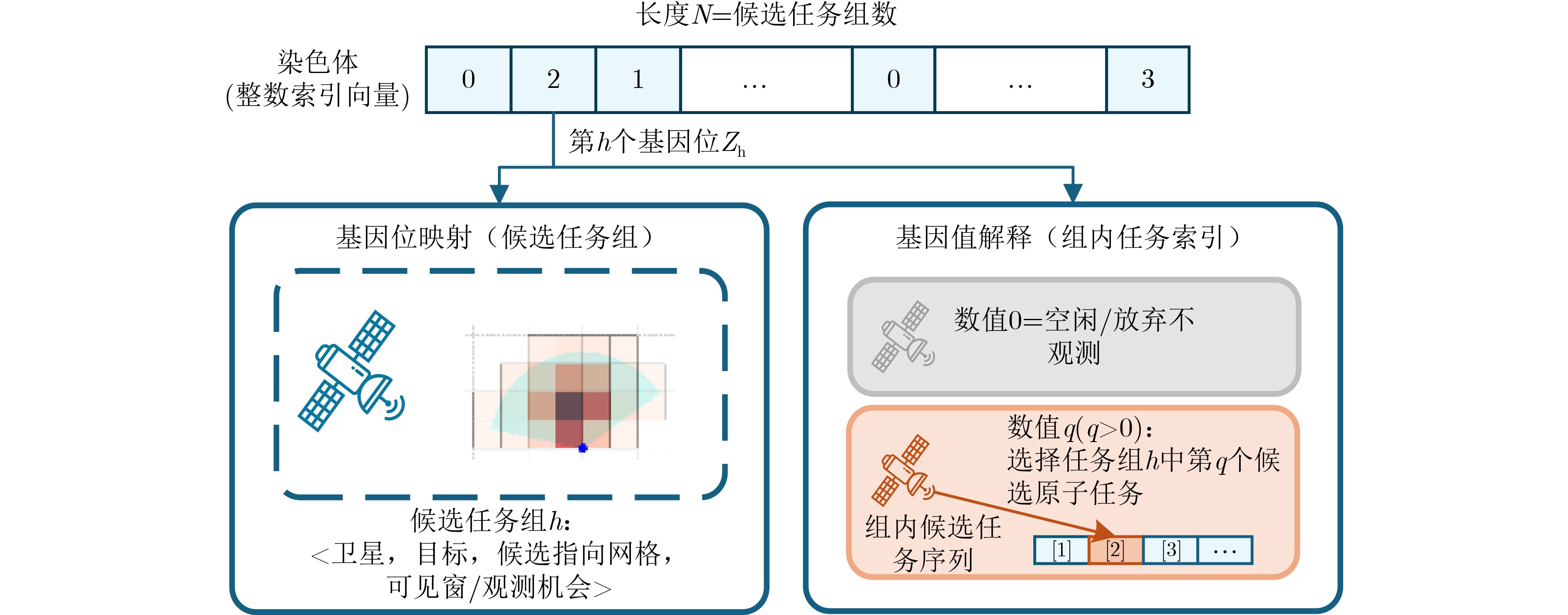
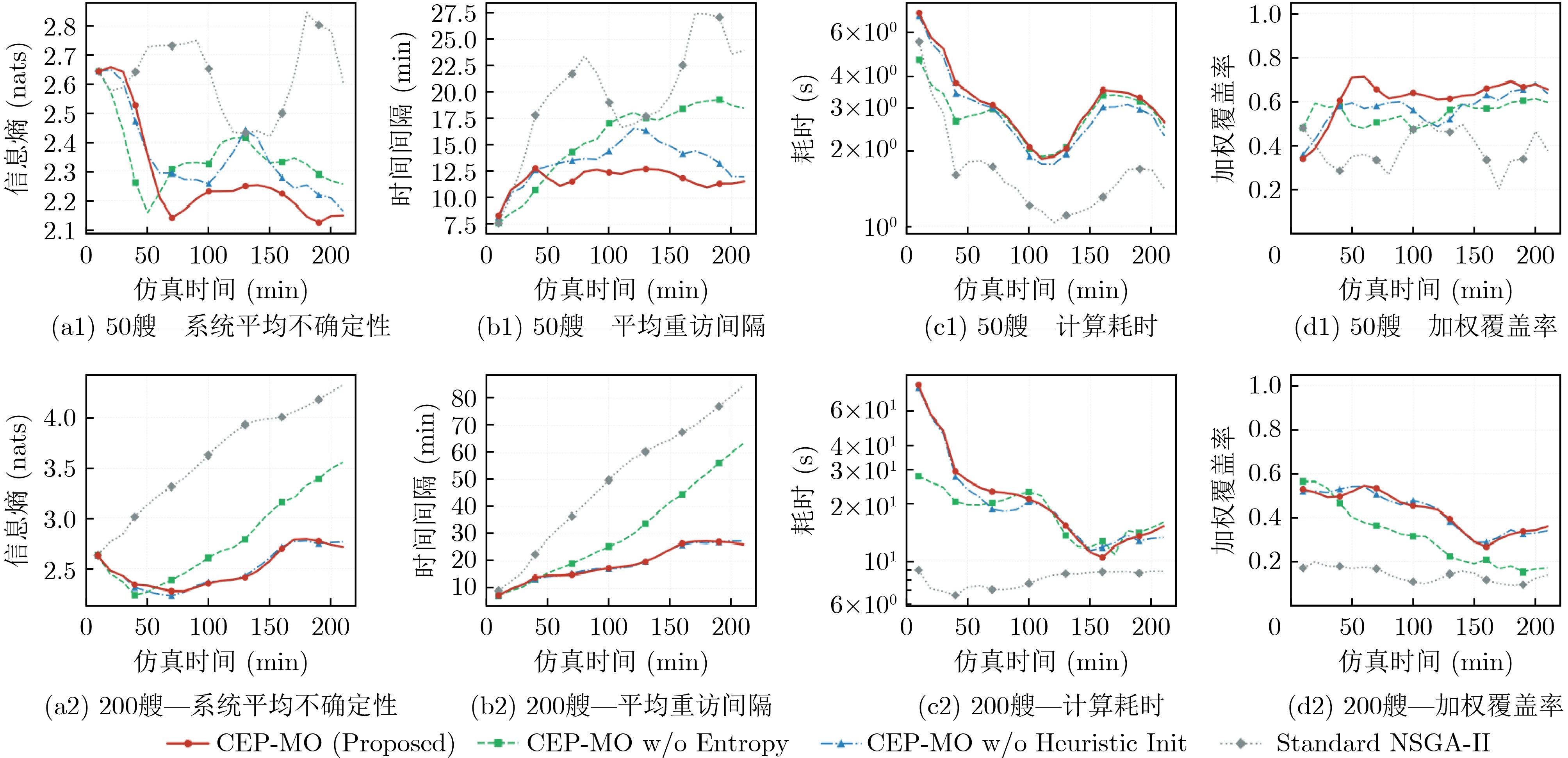
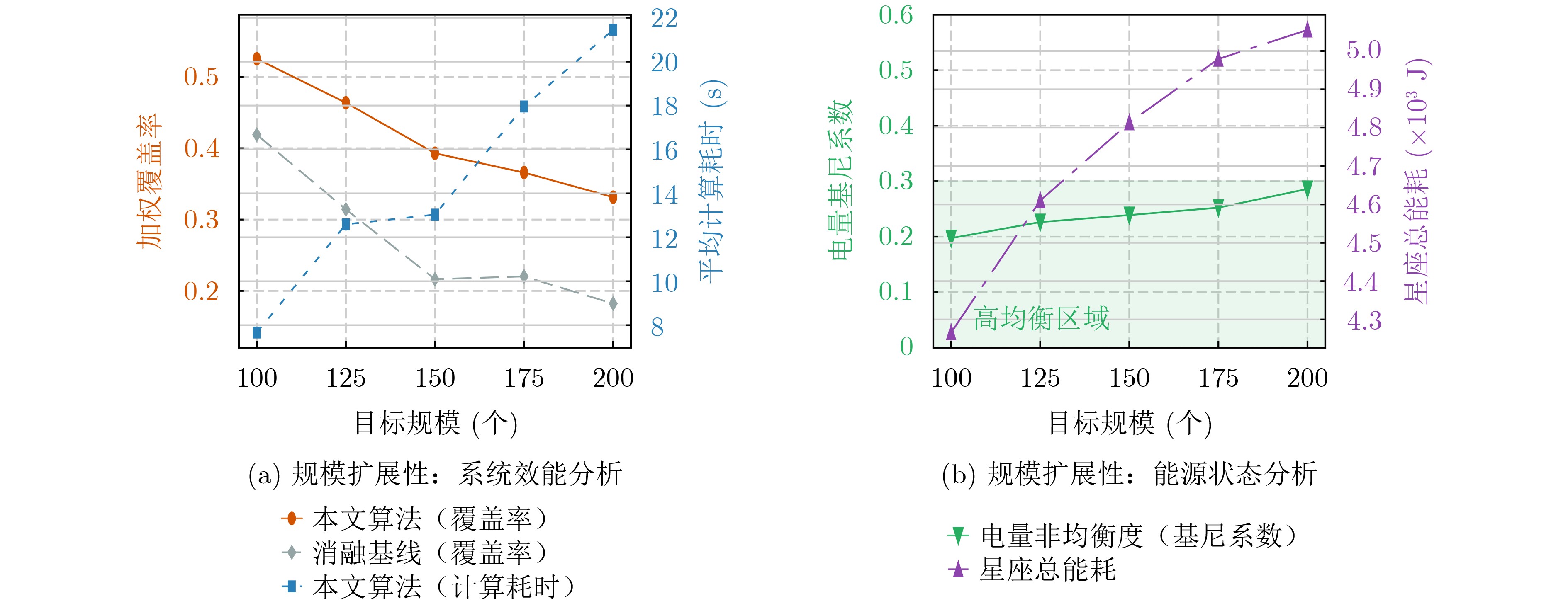
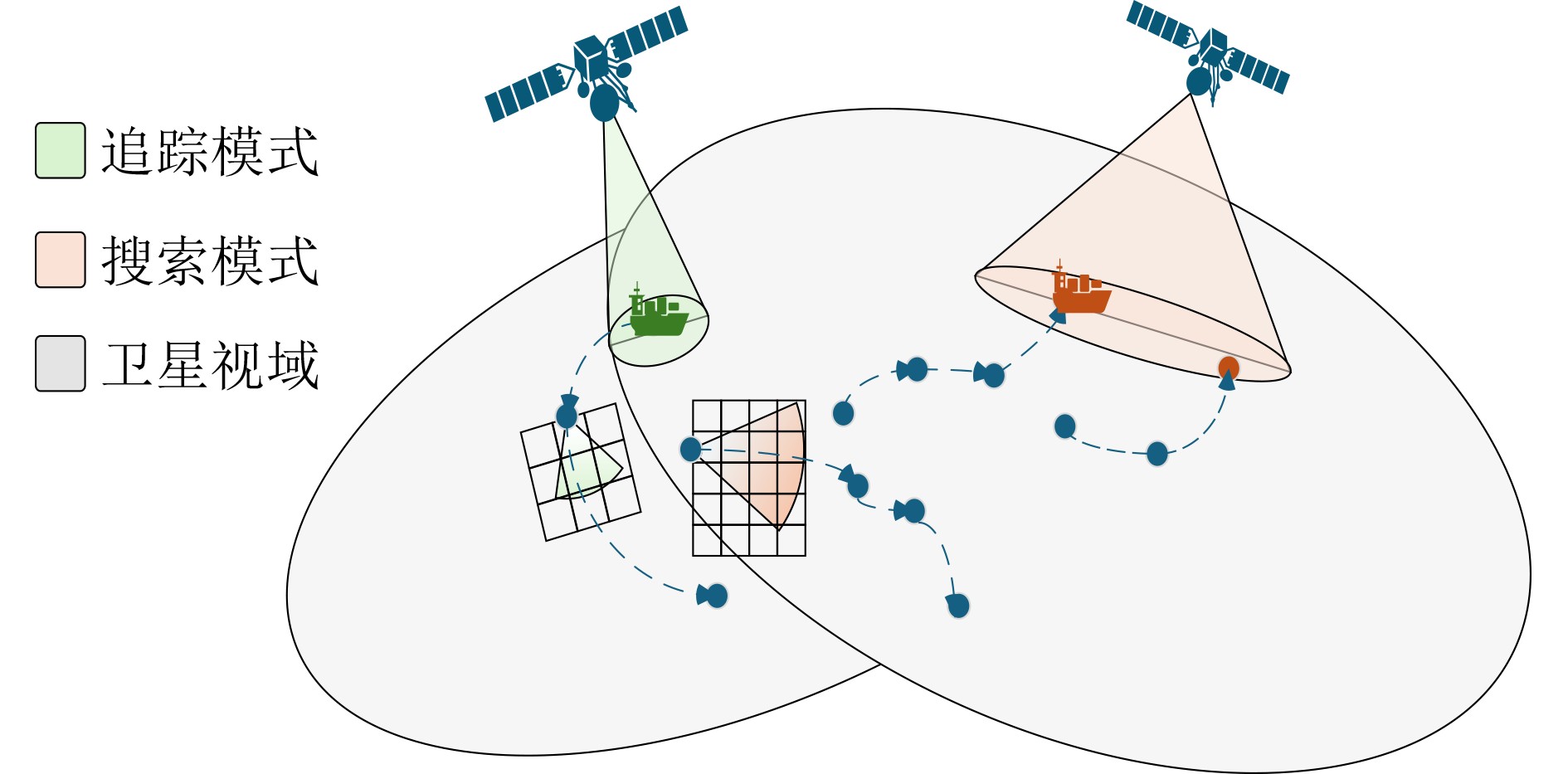
Objective Wide-area maritime surveillance requires satellite constellations to search for and revisit noncooperative maneuvering ships whose positional uncertainty increases during periods without successful observation. Meanwhile, multifunctional payloads are subject to strongly coupled constraints on observation timing, attitude maneuvering, payload mode, and energy consumption. To address dynamic target uncertainty while ensuring executable constellation scheduling, a cooperative search-and-tracking method based on dynamic information gain is proposed. Methods A closed-loop rolling-horizon framework inspired by model predictive control is constructed for prediction, optimization, execution, and feedback. At each rolling decision epoch, candidate atomic observation tasks are generated within the planning horizon, whereas only tasks within the current execution window are committed. Each task specifies the executing satellite, target, candidate pointing grid, start and end times, and payload mode. Target uncertainty is represented by a parameterized probability grid generated from the last confirmed state, speed and heading perturbations, and elapsed time since the last successful observation. Hit/Miss feedback updates the uncertainty baseline for the next rolling decision epoch, at which the probability grid, candidate tasks, and observation plan are regenerated. A state-driven dual-mode benefit model is established based on target information entropy and the number of consecutive Hits. In the robust tracking state, tasks in the narrow-field-of-view mode are evaluated using the prior capture probability, defined as the probability mass covered by the task footprint. In the lost-search state, tasks in the wide-field-of-view mode are evaluated using binary Hit/Miss event entropy as an approximation of the search information value. This approximation is based on the information-theoretic definition of Kullback-Leibler divergence and avoids explicit posterior reconstruction for each candidate task. A dynamic priority coefficient is introduced to increase the scheduling urgency of targets that have remained unobserved for longer periods and to moderately reduce the priority of repeatedly confirmed targets. The resulting multi-objective model maximizes weighted task benefit and information gain while minimizing energy consumption. Hard constraints are imposed on single-satellite temporal exclusivity, attitude-switching stabilization time, and energy budget. Based on Non-dominated Sorting Genetic Algorithm II (NSGA-II), the Cooperative Evolutionary Planning-Multi-Objective (CEP-MO) algorithm employs global integer-index encoding, constraint-aware Top-K heuristic initialization, satellite-group crossover, and an adaptive repair operator to improve feasible-solution generation and cooperative planning efficiency. The objective values of feasible Pareto solutions are normalized, and the solution closest to the ideal point (1, 1, 0) is selected for execution. Results and Discussions Simulations using a 48-satellite Walker Delta constellation demonstrate the effectiveness of the proposed method. In the 200-target scenario, Standard NSGA-II yields an average revisit interval of 53.5 min and a weighted coverage rate of 13.9%, whereas CEP-MO achieves 19.9 min and 41.7%, respectively. The average revisit interval is therefore reduced by 62.8% ( Fig. 7 ). Removing the binary Hit/Miss event entropy benefit increases the system average uncertainty and average revisit interval. Replacing constraint-aware initialization with random initialization also degrades early-stage planning performance and the weighted coverage rate. As the number of targets increases from 100 to 200, CEP-MO maintains acceptable scalability (Fig. 8 ). At 200 targets, its weighted coverage rate is 16.6 percentage points higher than that of CEP-MO w/o Entropy. The computation time per rolling decision is approximately 22 s, which is shorter than the 10 min rolling period. In addition, the Gini coefficient of remaining satellite energy remains below 0.3, indicating that energy consumption is not excessively concentrated on a small subset of satellites.Conclusions The proposed framework integrates parameterized probability-grid uncertainty representation, state-driven dual-mode benefit evaluation for search and tracking, closed-loop rolling-horizon feedback, and constraint-aware multi-objective evolutionary planning. CEP-MO reduces the average revisit interval and improves the weighted coverage rate while satisfying single-satellite temporal exclusivity, attitude-switching stabilization, and energy-budget constraints. The method provides an effective approach for large-scale resource-constrained maritime surveillance and establishes a basis for future extensions that consider identification errors, communication delays, and constrained inter-satellite links. -
表 1 符号说明
符号 释义 $ {w} $ 候选原子观测任务,$ {w}=\left\langle {k},{I},{g},{{t}}_{\mathrm{s}},{{t}}_{\mathrm{e}},{m}\right\rangle $,具体含义见3.4节 $ {{M}}_{{i}} $ 当前决策节拍内目标$ {i} $的双模指示函数:1代表稳健跟踪态,0代表丢失搜索态 $ {C}_{m}(w) $ 任务$ w $在载荷模式$ m $下视场投影覆盖的概率网格集合 $ {{P}}_{{i}}\left({w}\right) $ 任务$ w $对目标$ i $的先验捕获概率 $ {{G}}_{{i}} $ 当前决策节拍内目标$ i $的预测概率网格集合 $ g $ 候选概率网格/候选指向网格 $ {{p}}_{{i},{g}} $ 当前决策节拍内目标$ i $位于网格$ g $的先验概率质量 $ {{H}}_{{i}} $ 当前决策节拍内目标$ i $的离散概率分布信息熵 $ {\alpha }_{i} $ 目标$ i $在当前滚动决策时刻的动态优先级系数,完整形式可记为$ {\alpha }_{i}({t}_{r}) $ $ {{V}}_{\text{track}}\left({w}\right) $ 稳健跟踪模态下,执行任务$ {w} $带来的观测收益 $ {{V}}_{\text{search}}\left({w}\right) $ 丢失搜索模态下,执行任务$ {w} $带来的期望信息增益 $ {{C}}_{\text{task}}\left({w}\right) $ 卫星执行任务$ {w} $所需消耗的能量代价  下载: 导出CSV
1 约束感知启发式初始化策略
输入:规划视界$ {{T}}_{\mathrm{p}}$内全体可见任务集合$\varOmega $,种群大小${{N}}_{\text{pop}} $,卫星初始电量${{E}}_{{k}}\left({{t}}_{{r}}\right) $ 输出:初始种群$ {{P}}_{0} $ 1: 计算所有任务的初始化评分:$ {{J}}_{\text{init}}({w})\leftarrow {\alpha }_{{i}}\left[{{M}}_{{i}}{{V}}_{\text{track}}({w})+(1-{{M}}_{{i}}){{V}}_{\text{search}}({w})\right] $ 2: $ {{P}}_{0}\leftarrow \mathrm{\varnothing } $ 3: for $ {p}=1 $ to $ {{N}}_{\text{pop}} $ do 4: 初始化空染色体$ x $,并复制当前各卫星的资源状态 5: 动态构建候选任务池 $ {{Q}}_{\text{pool}}\leftarrow \varOmega $ 6: while$ {{Q}}_{\text{pool}}\neq \mathrm{\varnothing } $ do 7: 从$ {{Q}}_{\text{pool}} $中Top-K任务中按$ {J}_{\text{init}}\left(w\right) $归一化概率抽取任务$ w $ 8: $ {{Q}}_{\text{pool}}\leftarrow {{Q}}_{\text{pool}}\smallsetminus \left\{{w}\right\} $ 9: if激活$ \mathrm{\mathit{w}} $满足物理排他约束式(13)、姿态机动约束式(14)及能量约束式(15) then 10: 激活对应基因位并更新卫星时间与能源状态 11: end if 12: end while; $ {{P}}_{0}\leftarrow {{P}}_{0}\cup \left\{{x}\right\} $ 13:end for 14:return $ {{P}}_{0} $
下载: 导出CSV
2 自适应修复算子
输入:交叉或变异后产生的子代染色体$ x $,目标当前状态序列
$ {M}_{i}\left(t\right) $输出:修复后的染色体$ x $ 1: 提取$ x $中的已选任务集合$ S(x) $ 2: for 每个处于稳健跟踪模态的目标$ i $($ {M}_{i}\left(t\right)==1 $) do 3: 识别距离小于$ {D}_{\text{th}} $的局部冗余任务组 4: 保留$ {J}_{\text{init}} $最高的任务并取消其余任务 5: end for 6: 计算当前染色体的约束违背度$ {\mathrm{CV}}(x) $ 7: while $ {\mathrm{CV}}(x)> 0 $ do 8: 定位产生时域、姿态或能量违背的冲突任务集合 9: 取消其中$ {J}_{\text{init}} $最低的任务;更新资源状态与$ {\mathrm{CV}}(x) $ 10: end while 11: return $ x $
下载: 导出CSV
-
[1] 杜永浩, 张本奎, 吴健, 等. 大规模遥感卫星智能任务调度方法研究进展[J]. 电子与信息学报, 2025, 47(12): 5033–5047. doi: 10.11999/JEIT251038.DU Yonghao, ZHANG Benkui, WU Jian, et al. Survey on intelligent methods for large-scale remote sensing satellite scheduling[J]. Journal of Electronics & Information Technology, 2025, 47(12): 5033–5047. doi: 10.11999/JEIT251038. [2] LI Weiming, DU Zhiqiang, WANG Li, et al. Evaluation of the monitoring capabilities of remote sensing satellites for maritime moving targets[J]. ISPRS International Journal of Geo-Information, 2024, 13(9): 325. doi: 10.3390/ijgi13090325. [3] LI Xiang, HAN Xiaofeng, MA Ping, et al. Mission planning of continuous tracking moving targets by earth observation satellite in unknown scenarios[C]. 2025 IEEE 19th International Conference on Control & Automation, Tallinn, Estonia, 2025: 244–249. doi: 10.1109/ICCA65672.2025.11129799. [4] REN Xupu, CHENG Yao, and LI Yuqing. A method for continuous observation of sea surface moving targets based on multi point trajectory prediction[J]. Journal of Physics: Conference Series, 2024, 2762(1): 012059. doi: 10.1088/1742-6596/2762/1/012059. [5] GAO Gui, YAO Libo, LI Wenfeng, et al. Onboard information fusion for multisatellite collaborative observation: Summary, challenges, and perspectives[J]. IEEE Geoscience and Remote Sensing Magazine, 2023, 11(2): 40–59. doi: 10.1109/MGRS.2023.3274301. [6] LI Tianzuo and WANG Guangyuan. A scheduling method for real-time multi-fold regional coverage based on MEO constellations[J]. Advances in Space Research, 2026, 77(4): 4271–4292. doi: 10.1016/j.asr.2025.11.116. [7] CHEN Hao, PENG Shuang, DU Chun, et al. Earth Observation Satellites: Task Planning and Scheduling[M]. Singapore: Springer, 2023. doi: 10.1007/978-981-99-3565-9. [8] CHENG Zhuo, DENBY B, MCCLEARY K, et al. EagleEye: Nanosatellite constellation design for high-coverage, high-resolution sensing[C]. The 29th ACM International Conference on Architectural Support for Programming Languages and Operating Systems, La Jolla, USA, 2024: 117–132. doi: 10.1145/3617232.3624851. [9] HE Peng, LEI Hailong, WU Dapeng, et al. Nonterrestrial network technologies: Applications and future prospects[J]. IEEE Internet of Things Journal, 2025, 12(6): 6275–6299. doi: 10.1109/JIOT.2024.3522912. [10] SHI Zhong, ZHAO Fanyu, WANG Xin, et al. Model predictive control-based mission planning method for moving target tracking by multiple observing satellites[C]. 2022 IEEE 6th Information Technology and Mechatronics Engineering Conference, Chongqing, China, 2022: 1158–1162. doi: 10.1109/ITOEC53115.2022.9734412. [11] CAO Xibin, LI Ning, QIU Shi, et al. Research on the method of searching and tracking of the time-sensitive target through the mega-constellation[J]. Aerospace Science and Technology, 2023, 137: 108299. doi: 10.1016/j.ast.2023.108299. [12] ZHENG Xiao, PENG Xiaodong, GUO Zhiyuan, et al. A position probability prediction method of marine moving targets for optimization search by satellite[C]. 2024 IEEE International Conference on Control Science and Systems Engineering, Beijing, China, 2024: 55–62. doi: 10.1109/ICCSSE63803.2024.10823961. [13] YU Tianyue, ZHANG Yasheng, and YANG Jie. Study on the fast search planning problem of lost targets for maritime emergency response based on an improved adaptive immunogenetic algorithm[J]. Sensors, 2024, 24(12): 3904. doi: 10.3390/s24123904. [14] ZHANG Chao, CHEN Jinyong, LI Yanbin, et al. Satellite group autonomous operation mechanism and planning algorithm for marine target surveillance[J]. Chinese Journal of Aeronautics, 2019, 32(4): 991–998. doi: 10.1016/j.cja.2019.02.005. [15] 李恒伟, 罗启章, 顾轶, 等. 基于滚动时域策略的中继卫星多目标动态调度优化方法[J]. 航空学报, 2024, 45(16): 329706. doi: 10.7527/S1000-6893.2023.29706.LI Hengwei, LUO Qizhang, GU Yi, et al. Multi-objective dynamic scheduling optimization method for relay satellites based on rolling horizon strategy[J]. Acta Aeronautica et Astronautica Sinica, 2024, 45(16): 329706. doi: 10.7527/S1000-6893.2023.29706. [16] LIU Dacheng, CHANG Sheng, DENG Yunkai, et al. A novel spaceborne SAR constellation scheduling algorithm for sea surface moving target search tasks[J]. IEEE Journal of Selected Topics in Applied Earth Observations and Remote Sensing, 2024, 17: 3715–3726. doi: 10.1109/JSTARS.2024.3355974. [17] XU Shilong, SONG Bingyu, CHEN Yingguo, et al. A heat grid-driven method for generation of satellite observation tasks[J]. Advances in Space Research, 2024, 74(8): 3983–3996. doi: 10.1016/j.asr.2024.06.067. [18] 何奇恩, 李峰, 钟兴. 多目标算法在卫星区域覆盖调度及数传规划上的应用综述[J]. 遥感技术与应用, 2023, 38(4): 783–793. doi: 10.11873/j.issn.1004-0323.2023.4.0783.HE Qi'en, LI Feng, and ZHONG Xing. A review of the application of multi-objective algorithms in satellite regional coverage scheduling and data transmission planning[J]. Remote Sensing Technology and Application, 2023, 38(4): 783–793. doi: 10.11873/j.issn.1004-0323.2023.4.0783. [19] SHAO Xiaowei, ZHANG Zehao, WANG Jihe, et al. NSGA-II-based multi-objective mission planning method for satellite formation system[J]. Journal of Aerospace Technology and Management, 2016, 8(4): 451–458. doi: 10.5028/jatm.v8i4.700. [20] CHU Xiaochen, HAN Xiaofeng, and LI Shuang. Tracking moving targets by earth observation satellites: A multi-objective scheduling approach[C]. 2024 International Conference on New Trends in Computational Intelligence, Qingdao, China, 2024: 37–41. doi: 10.1109/NTCI64025.2024.10776156. [21] LU Wenlong, GAO Weihua, LIU Bingyan, et al. Parallel dual adaptive genetic algorithm: A method for satellite constellation task assignment in time-sensitive target tracking[J]. Advances in Space Research, 2024, 74(10): 5192–5213. doi: 10.1016/j.asr.2024.07.044. [22] XIANG Shang, WANG Ling, XING Lining, et al. Knowledge-based memetic algorithm for joint task planning of multi-platform earth observation system[J]. Computers & Industrial Engineering, 2021, 160: 107559. doi: 10.1016/j.cie.2021.107559. [23] QI Maochen, GUO Wenting, LIU Zhengyang, et al. Agile satellite mission planning for moving targets observation based on modified genetic algorithm[C]. 2025 44th Chinese Control Conference, Chongqing, China, 2025: 2001–2006. doi: 10.23919/CCC64809.2025.11178330. [24] WEN Xin, LIU Mingmin, and HU Qinglei. Satellite mission planning for moving targets observation via data driven approach[C]. 2019 Chinese Control Conference, Guangzhou, China, 2019: 2130–2135. doi: 10.23919/ChiCC.2019.8865487. [25] DEB K, PRATAP A, AGARWAL S, et al. A fast and elitist multiobjective genetic algorithm: NSGA-II[J]. IEEE Transactions on Evolutionary Computation, 2002, 6(2): 182–197. doi: 10.1109/4235.996017. [26] LIU Da, ZONG Qun, ZHANG Xiuyun, et al. Enhancing space-based situational awareness: Real-time observation of dynamic targets with meta-cooperative-scheduling net[J]. IEEE Transactions on Aerospace and Electronic Systems, 2024, 60(6): 8198–8211. doi: 10.1109/TAES.2024.3425389. [27] CHAO Tao, HAN Xiaofeng, LI Xiang, et al. Multi-objective optimization of continuous monitoring scheduling for moving targets by earth observation satellites[J]. Engineering Applications of Artificial Intelligence, 2025, 144: 110056. doi: 10.1016/j.engappai.2025.110056. [28] LIU Yilong, ZHANG Cong, ZHANG Sihang, et al. Multi-satellite mission planning method for dynamic targets based on reinforcement learning[C]. 2023 China Automation Congress, Chongqing, China, 2023: 3865–3870. doi: 10.1109/CAC59555.2023.10450405. [29] 陈盈果, 王斐然, 胡云鹏, 等. 融合大语言模型与强化学习的敏捷卫星任务分配算法设计[J]. 电子与信息学报, 2025, 47(12): 4959–4972. doi: 10.11999/JEIT250991.CHEN Yingguo, WANG Feiran, HU Yunpeng, et al. Automating algorithm design for agile satellite task assignment with large language models and reinforcement learning[J]. Journal of Electronics & Information Technology, 2025, 47(12): 4959–4972. doi: 10.11999/JEIT250991. [30] 夏维, 魏宏图, 程颖, 等. 面向卫星任务规划的专家链构建与优化方法[J]. 电子与信息学报, 2025, 47(12): 4986–4994. doi: 10.11999/JEIT251018.XIA Wei, WEI Hongtu, CHENG Ying, et al. An expert chain construction and optimization method for satellite mission planning[J]. Journal of Electronics & Information Technology, 2025, 47(12): 4986–4994. doi: 10.11999/JEIT251018. [31] WU Qianyu, PAN Jun, and WANG Mi. Dynamic task planning method for multi-source remote sensing satellite cooperative observation in complex scenarios[J]. Remote Sensing, 2024, 16(4): 657. doi: 10.3390/rs16040657. [32] KULLBACK S and LEIBLER R A. On information and sufficiency[J]. The Annals of Mathematical Statistics, 1951, 22(1): 79–86. doi: 10.1214/aoms/1177729694. [33] ZHAO Yulong, ZHANG Yuan, XU Can, et al. Research on quantitative expression of priority for imaging satellite requirements[J]. Journal of Physics: Conference Series, 2024, 2755(1): 012004. doi: 10.1088/1742-6596/2755/1/012004. [34] 杨文沅. 面向移动目标跟踪的多星协同规划与自主调度研究[D]. [博士论文], 国防科技大学, 2021. doi: 10.27052/d.cnki.gzjgu.2021.000480.YANG Wenyuan. Research on multi-satellite collaborative planning and autonomous scheduling for moving targets tracking[D]. [Ph. D. dissertation], National University of Defense Technology, 2021. doi: 10.27052/d.cnki.gzjgu.2021.000480. -

 下载:
下载:



图(8) / 表(3)
计量
- 文章访问数: 179
- HTML全文浏览量: 44
- PDF下载量: 12
- 被引次数: 0
