




Design and Performance Evaluation of Ultrasonic Nebulization Glow Discharge Detector for High-sensitivity and Rapid Detection of Metal Elements in Liquids
-
摘要: 水体中的金属元素主要来源于人为活动与自然过程,其组成与含量直接影响着生态环境与生物健康。针对水体中Cu、Na、K等金属元素的现场实时快速检测问题,本研究设计并开发了一种基于超声雾化辉光放电(UNGD)的高灵敏快速探测器。该探测器的超声雾化单元设计带有空间约束转接口的雾化导流腔室与可快速拆卸的雾化片固定结构,采用路径较短的气路,以达到液体样品的快速雾化和高效输送;同时,为了实现激发能量的集中,等离子体激发单元的钨针电极对采用180°对向共轴放置方式,构成点对点式的放电结构,对样品进行激发。本研究系统评估并确定了UNGD探测器的最优参数条件:放电电流38 mA、氩气流速0.5 L/min、电极间距1 mm、采样距离22 mm。在最优参数条件下,Cu I 324.7 nm、Na I 589.0 nm和K I 766.5 nm的检出限分别为141.29 μg/L、9.54 μg/L和12.05 μg/L,相对标准偏差分别为6.8%、6.1%和5.5%。此外,UNGD探测器对样品中共存的高浓度Ca、Mg、Zn、Fe、Co、Ni等离子具有良好的抗干扰能力。上述结果表明,本研究提出的高敏快速微型探测器可在无需额外样品预处理和驱动泵设备的前提下,实现快速进样与定量分析,为水体中Cu、Na、K等金属元素的现场实时快速监测提供了一种可靠且具有应用前景的技术支持,并有望进一步拓展至其他金属元素的检测。Abstract:
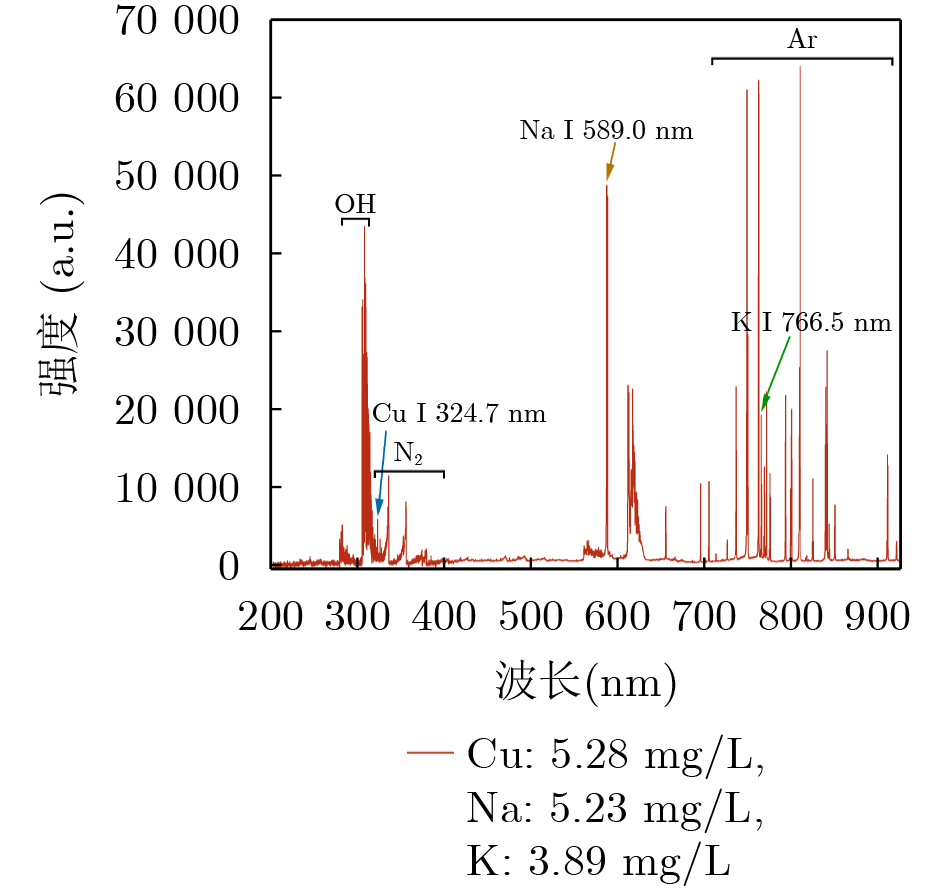
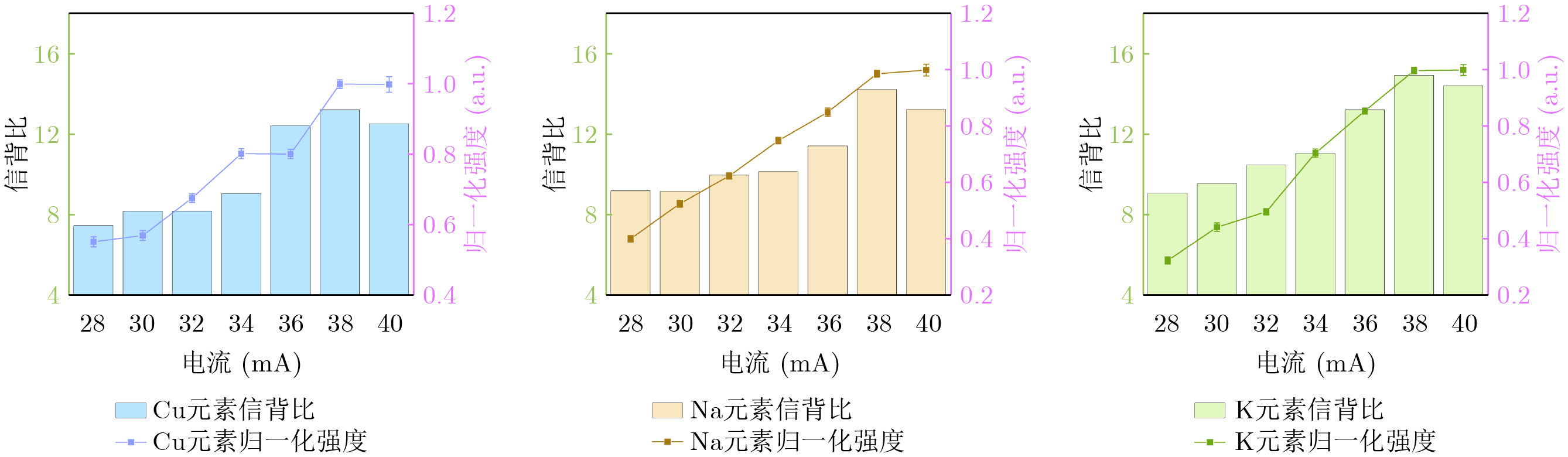
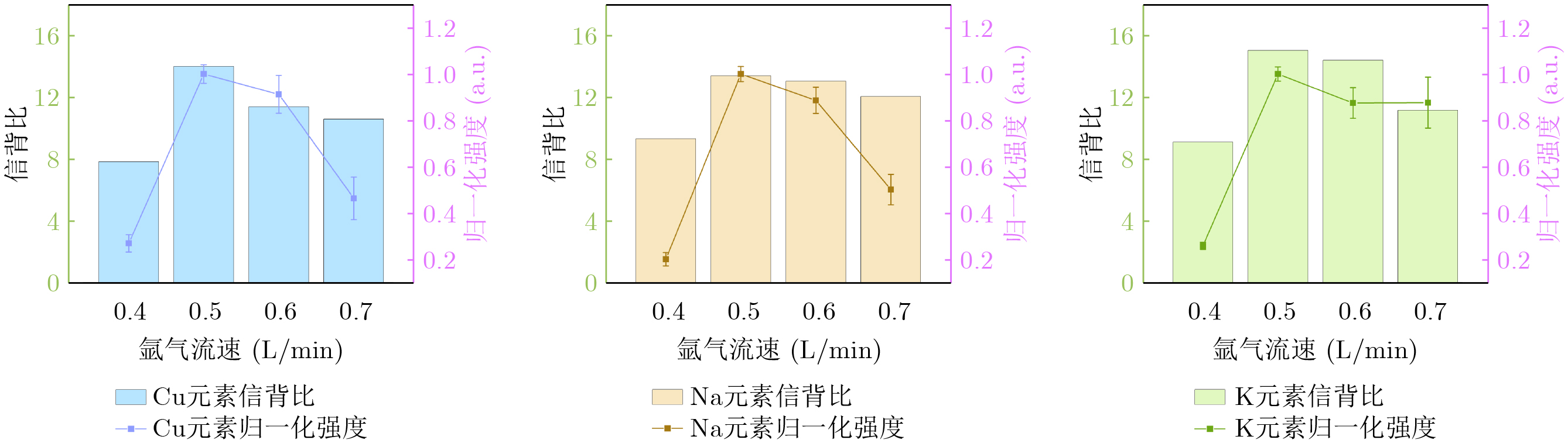
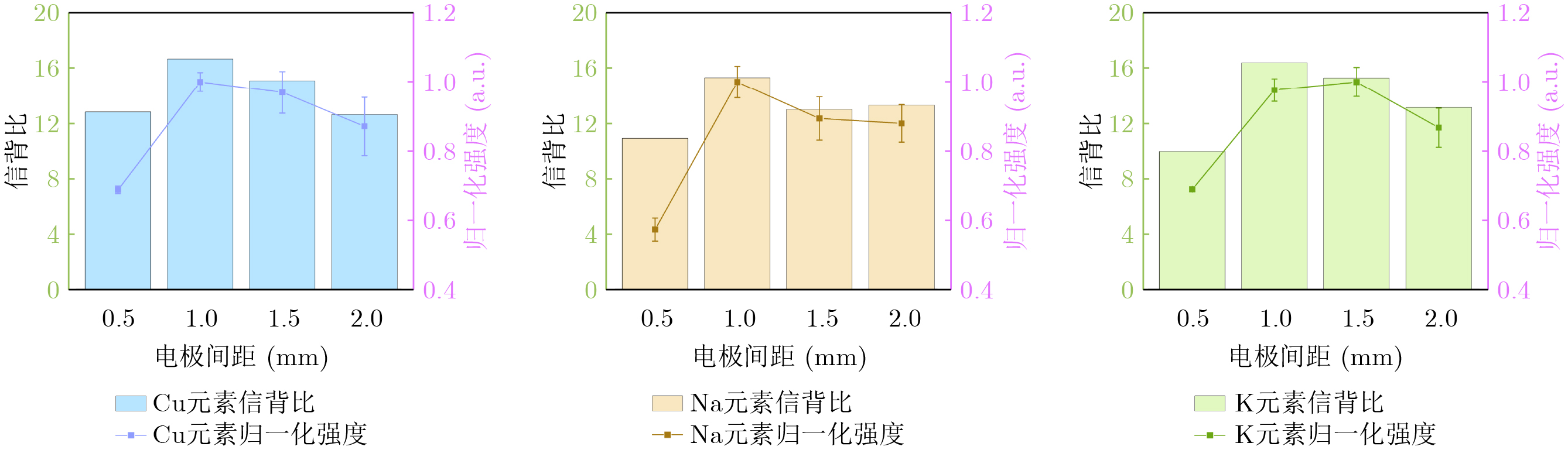
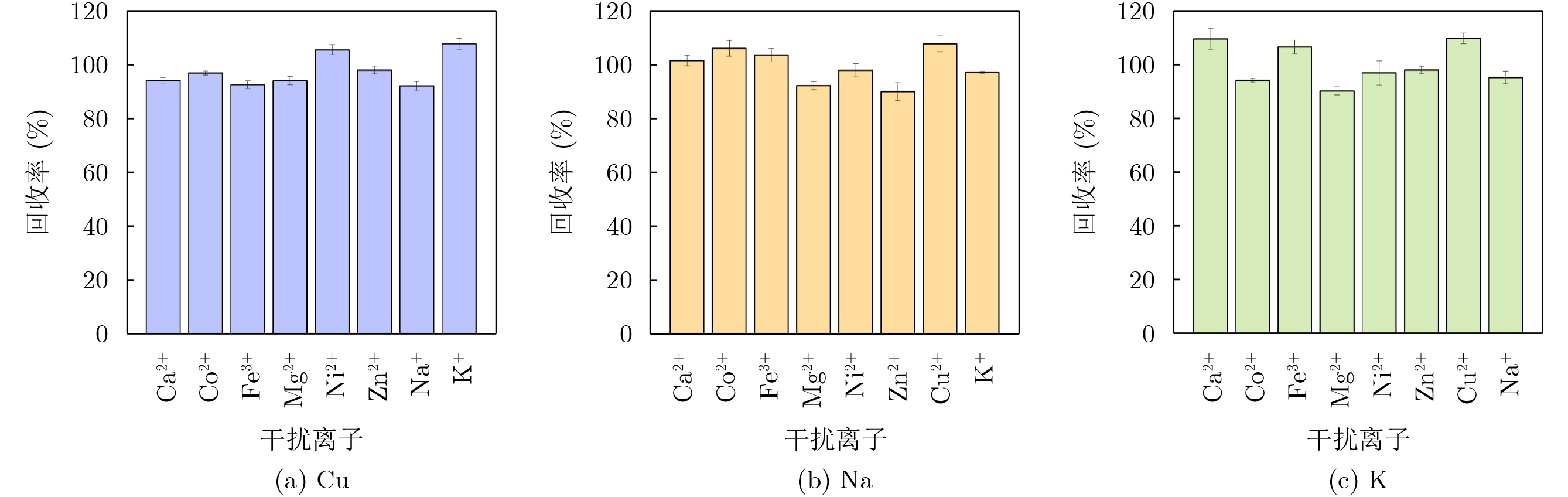
Objective Water is essential for all organisms and ecological systems, and the composition and content of dissolved metal elements, especially copper (Cu), sodium (Na), and potassium (K), are crucial for maintaining ecological balance and biological health. Cu is an essential human trace element that forms enzymes with functional proteins, participating in antioxidant, energy supply, and immune processes. However, excessive Cu in water—from industrial wastewater, feed additives, pipeline corrosion, and electronic waste leakage—harms human health, causing vomiting, hypotension, jaundice, and hemolytic anemia. Aquatic organisms and plants, lacking effective detoxification systems, are more vulnerable to Cu pollution, which damages roots, induces oxidative stress, and inhibits growth. Na and K are vital for nerve conduction, muscle movement, and fluid balance, but excessive intake endangers those with hypertension or renal/cardiac insufficiency, and their imbalance in irrigation water causes soil salinization. Conventional detection methods (ICP-MS/AES, AAS, AFS) have excellent sensitivity but are limited by large size, complex pretreatment, high cost, and professional operation. Atmospheric pressure glow discharge (APGD) shows potential for miniaturization, but existing APGD-based technologies (PN-APGD, SCGD) require expensive equipment or complex pretreatment. Thus, a highly sensitive, rapid detector for on-site real-time detection of Cu, Na, K without additional pretreatment or driving equipment is urgently needed. Methods A Ultrasonic Nebulization Glow Discharge (UNGD) detector was designed, consisting of an ultrasonic nebulization unit, a plasma excitation unit, and a spectral signal collection unit. The ultrasonic nebulization unit adopted a self-designed centrifuge tube-based diversion chamber with a detachable microporous atomizing sheet, argon inlet/outlet, and a space-constrained transfer tube to form a short gas path, reducing aerosol loss. The plasma excitation unit used 180° coaxial tungsten needle electrodes (cathode/anode) with a double-layer fixing sleeve, clamped on a 3D platform for precise spacing adjustment, powered by a high-voltage DC power supply with a 20 kΩ ballast resistor. The spectral unit included an optical fiber probe and a three-channel AvaSpec spectrometer for high-resolution signal collection. Performance was evaluated using Cu/Na/K mixed solutions: single-factor experiments optimized parameters; characteristic spectra for qualitative analysis; recovery rates for anti-interference assessment; standard curves, LOD, RSD, and CRM detection for quantitative verification; and comparison with similar technologies. Results and Discussions Qualitative analysis of a water sample (Cu: 5.28 mg/L, Na: 5.23 mg/L, K: 3.89 mg/L) showed OH (281.1~309.0 nm) and N2 (315.0~406.0 nm) molecular bands, with obvious Cu (324.7 nm), Na (589.0 nm), and K (766.5 nm) characteristic peaks ( Fig. 2 ); 324.7 nm was selected as Cu’s analytical line. Parameter optimization determined optimal conditions: discharge current 38 mA (Fig. 3 ), argon flow rate 0.5 L/min (Fig. 4 ), electrode spacing 1 mm (Fig. 5 ), sampling distance 22 mm (Fig. 6 ). Under these conditions, Cu, Na, K showed good linearity (R2:0.9942 ,0.9968 ,0.9973 ), with LODs of 141.29 μg/L, 9.54 μg/L, 12.05 μg/L, and RSDs of 6.8%, 6.1%, 5.5% (n=11) (Table 1 ). Anti-interference tests showed 90%~110% recovery rates with 500 mg/L interfering cations (Fig. 7 ). CRM detection showed 89%~110% recovery rates, consistent with standard values (Table 2 ).Conclusions The UNGD detector achieves accurate quantitative analysis of Cu, Na, K in liquids without additional pretreatment or driving equipment. Its detachable atomizing sheet and short gas path improve sampling efficiency, while coaxial electrodes concentrate excitation energy. With excellent sensitivity, precision, and anti-interference ability, it provides reliable technical support for on-site real-time monitoring of water metal elements and has potential for extending to other metal detections, contributing to water ecological protection and biological health. -
表 1 UNGD探测器测定样品中Cu、Na、K的测定结果
元素 线性范围 (mg/L) 回归方程 检出限 (3σ,n=11, μg/L) 精密度 (n=11,%) Cu 0.53~95.11 y=606.62x+ 1979.42 141.29 6.8 Na 0.03~6.54 y=9370.04x+ 1646.95 9.54 6.1 K 0.02~9.72 y=4658.26x+500.93 12.05 5.5  下载: 导出CSV
表 2 UNGD探测器对水质标样的测定结果
元素 CRMs 标准值 (mg/L) 测量值 (mg/L) 回收率(%) Cu GBW(E)080397 10.00±0.2 8.93±0.93 89.3 GBW(E)085689 100.00±1 97.49±1.87 97.5 Na GSB07- 3185 -20141.09±0.04 1.01±0.11 92.7 BWB2506-2016 2.00±0.2 1.89±0.17 94.5 K GSB07- 3185 -20140.74±0.03 0.86±0.07 109.2 BWB2506-2016 2.00±0.2 2.13±0.31 106.5
下载: 导出CSV
-
[1] MUKHERJEE S, BHATTACHARYYA S, GHOSH K, et al. Sensory development for heavy metal detection: A review on translation from conventional analysis to field-portable sensor[J]. Trends in Food Science & Technology, 2021, 109: 674–689. doi: 10.1016/j.tifs.2021.01.062. [2] FU Zhiyou, WU Fengchang, CHEN Lulu, et al. Copper and zinc, but not other priority toxic metals, pose risks to native aquatic species in a large urban lake in Eastern China[J]. Environmental Pollution, 2016, 219: 1069–1076. doi: 10.1016/j.envpol.2016.09.007. [3] BROWN A L, FLUITT M B, and ECELBARGER C M. Mechanistic target of rapamycin: Integrating growth factor and nutrient signaling in the collecting duct[J]. American Journal of Physiology-Renal Physiology, 2018, 315(3): F413–F416. doi: 10.1152/ajprenal.00170.2018. [4] 翟杰, 杨树青, 刘月, 等. 微生物菌肥施用下微咸水灌溉对盐碱土理化性质与细菌群落的影响[J]. 中国环境科学, 2025, 45(12): 6749–6761. doi: 10.19674/j.cnki.issn1000-6923.20251013.003.ZHAI Jie, YANG Shuqing, LIU Yue, et al. Effects of irrigation with brackish-water on the physicochemical properties and bacterial community of saline-alkali soils under microbial fertilizer application[J]. China Environmental Science, 2025, 45(12): 6749–6761. doi: 10.19674/j.cnki.issn1000-6923.20251013.003. [5] ZHANG Yuehong, LI Xianyue, ŠIMŮNEK J, et al. Quantifying water and salt movement in a soil-plant system of a corn field using HYDRUS (2D/3D) and the stable isotope method[J]. Agricultural Water Management, 2023, 288: 108492. doi: 10.1016/j.agwat.2023.108492. [6] PEDRERO SALCEDO F, PÉREZ CUTILLAS P, AZIZ F, et al. Soil salinity prediction using remotely piloted aircraft systems under semi-arid environments irrigated with salty non-conventional water resources[J]. Agronomy, 2022, 12(9): 2022. doi: 10.3390/agronomy12092022. [7] 邹亮, 任柯龙, 吴浩, 等. 融合G-DPN与近红外光谱的铝矾土品质参数协同检测方法研究[J]. 电子与信息学报, 2025, 47(10): 3904–3916. doi: 10.11999/JEIT250240. ZOU Liang, REN Kelong, WU Hao, et al. A collaborative detection method for bauxite quality parameters based on the fusion of G-DPN and near-infrared spectroscopy[J]. Journal of Electronics & Information Technology, 2025, 47(10): 3904–3916. doi: 10.11999/JEIT250240. [8] 赵英飞, 王小龙, 李凯, 等. 关于电感耦合等离子体质谱(ICP-MS)法在科学、技术、产品、应用方面的思考[J]. 中国无机分析化学, 2025, 15(3): 382–388. doi: 10.20236/j.CJIAC.2025.03.009.ZHAO Yingfei, WANG Xiaolong, LI Kai, et al. Reflections on ICP-MS in science, technology, engineering and applications[J]. Chinese Journal of Inorganic Analytical Chemistry, 2025, 15(3): 382–388. doi: 10.20236/j.CJIAC.2025.03.009. [9] KUKUSAMUDE C, KONGSRI S, TAMKLANG R, et al. Feasibility of matrix-matched material for determining elements in rice flour by SN-ICP-MS and LA-ICP-MS[J]. Foods, 2024, 13(11): 1604. doi: 10.3390/foods13111604. [10] VOLCHEK V V, SHEVEN D G, and ABRAMOV P A. HPLC with parallel ESI-MS and ICP-AES detection as a tool for the speciation studies of phosphovanadotungstates[J]. Microchemical Journal, 2024, 207: 111985. doi: 10.1016/j.microc.2024.111985. [11] 韩亚, 郭伟, 汪洪. 电感耦合等离子体质谱(ICP-MS)法与氢化物发生-原子吸收光谱(HG-AAS)法测定土壤中硒含量的对比研究[J]. 中国无机分析化学, 2020, 10(3): 28–32. doi: 10.3969/j.issn.2095-1035.2020.03.006.HAN Ya, GUO Wei, and WANG Hong. Method comparison for determination of selenium in soil by ICP-MS and HG-AAS[J]. Chinese Journal of Inorganic Analytical Chemistry, 2020, 10(3): 28–32. doi: 10.3969/j.issn.2095-1035.2020.03.006. [12] FERREIRA S L C, BEZERRA M A, SANTOS A S, et al. Atomic absorption spectrometry - A multi element technique[J]. TrAC Trends in Analytical Chemistry, 2018, 100: 1–6. doi: 10.1016/j.trac.2017.12.012. [13] 李鸿, 蒋越华, 秦玉燕, 等. 原子荧光光谱(AFS)和石墨炉原子吸收光谱(GFAAS)法测定富硒粮食中硒含量[J]. 中国无机分析化学, 2021, 11(3): 89–93. doi: 10.3969/j.issn.2095-1035.2021.03.018.LI Hong, JIANG Yuehua, QIN Yuyan, et al. Determination of selenium in selenium-rich grain by AFS and GFAAS[J]. Chinese Journal of Inorganic Analytical Chemistry, 2021, 11(3): 89–93. doi: 10.3969/j.issn.2095-1035.2021.03.018. [14] ZOU Zhirong, DENG Yujia, HU Jing, et al. Recent trends in atomic fluorescence spectrometry towards miniaturized instrumentation-A review[J]. Analytica Chimica Acta, 2018, 1019: 25–37. doi: 10.1016/j.aca.2018.01.061. [15] 李欣芯, 王义程, 赵王昱斐, 等. 液体样本重金属离子检测微流控传感器与系统[J]. 仪器仪表学报, 2023, 44(6): 86–98. doi: 10.19650/j.cnki.cjsi.J2311295.LI Xinxin, WANG Yicheng, ZHAO Wangyufei, et al. Microfluidic sensors and systems for detecting heavy metal ions in liquid samples[J]. Chinese Journal of Scientific Instrument, 2023, 44(6): 86–98. doi: 10.19650/j.cnki.cjsi.J2311295. [16] 黄雯静, 汪正. 大气压辉光放电原子发射光谱技术及其在环境检测中的应用[J]. 环境化学, 2025, 44(10): 3748–3760. doi: 10.7524/j.issn.0254-6108.2025071504.HUANG Wenjing and WANG Zheng. Atmospheric pressure glow discharge atomic emission spectroscopy and its applications in environmental monitoring[J]. Environmental Chemistry, 2025, 44(10): 3748–3760. doi: 10.7524/j.issn.0254-6108.2025071504. [17] MARCUS R K, MANARD B T, and QUARLES C D JR. Liquid sampling-atmospheric pressure glow discharge (LS-APGD) microplasmas for diverse spectrochemical analysis applications[J]. Journal of Analytical Atomic Spectrometry, 2017, 32(4): 704–716. doi: 10.1039/c7ja00008a. [18] XU Jianan, DING Yu, TAN Qiang, et al. Development of open-flow atmospheric pressure glow discharge optical emission spectrometry coupled with pneumatic nebulization for direct determination of Cu and Zn[J]. Atomic Spectroscopy, 2025, 46(3): 305–313. doi: 10.46770/as.2025.090. [19] 张东阳, 陆子轩, 刘军民, 等. 深度模型的持续学习综述: 理论、方法和应用[J]. 电子与信息学报, 2024, 46(10): 3849–3878. doi: 10.11999/JEIT240095. ZHANG Dongyang, LU Zixuan, LIU Junmin, et al. A survey of continual learning with deep networks: Theory, method and application[J]. Journal of Electronics & Information Technology, 2024, 46(10): 3849–3878. doi: 10.11999/JEIT240095. [20] 刘壮, 宋祥瑞, 赵斯桓, 等. 进化网络模型: 无先验知识的自适应自监督持续学习[J]. 电子与信息学报, 2024, 46(8): 3256–3266. doi: 10.11999/JEIT240142. LIU Zhuang, SONG Xiangrui, ZHAO Sihuan, et al. EvolveNet: Adaptive self-supervised continual learning without prior knowledge[J]. Journal of Electronics & Information Technology, 2024, 46(8): 3256–3266. doi: 10.11999/JEIT240142. [21] 刘双, 于永亮, 王建华. 基于微等离子体激发源的小型化原子发射光谱系统研究进展[J]. 分析化学, 2024, 52(10): 1424–1434. doi: 10.19756/j.issn.0253-3820.241141.LIU Shuang, YU Yongliang, and WANG Jianhua. Advances in miniaturized optical emission spectrometry system with microplasma as excitation source[J]. Chinese Journal of Analytical Chemistry, 2024, 52(10): 1424–1434. doi: 10.19756/j.issn.0253-3820.241141. [22] SWIDERSKI K, WELNA M, GREDA K, et al. Hanging drop cathode-atmospheric pressure glow discharge as a new method of sample introduction for inductively coupled plasma-optical emission spectrometry[J]. Analytical and Bioanalytical Chemistry, 2020, 412(18): 4211–4219. doi: 10.1007/s00216-020-02685-7. [23] DONG Junhang, YANG Chun, HE Dong, et al. Performance evaluation of atmospheric pressure glow discharge-optical emission spectrometry for the determination of sodium, lithium, calcium and magnesium using membrane desolvation[J]. Atomic Spectroscopy, 2020, 41(2): 57–63. doi: 10.46770/as.2020.02.002. [24] ZHENG Peichao, XIANG Junhao, WANG Jinmei, et al. Baseline correction for solution cathode glow discharge (SCGD) atomic emission spectroscopy (AES) using an iterative shift difference algorithm based on fitting-accuracy[J]. Spectrochimica Acta Part B: Atomic Spectroscopy, 2025, 233: 107291. doi: 10.1016/j.sab.2025.107291. [25] ZHANG Yinchenxi, OREJAS J, PISONERO J, et al. Concomitant ion matrix effects in SCGD-OES enhanced with formic acid[J]. Journal of Analytical Atomic Spectrometry, 2024, 39(3): 808–819. doi: 10.1039/d3ja00372h. [26] ZHANG Yinchenxi, OREJAS J, FANDIÑO J, et al. Critical evaluation of SCGD-OES analytical performance in the presence of NaCl[J]. Journal of Analytical Atomic Spectrometry, 2022, 37(5): 1150–1160. doi: 10.1039/d1ja00439e. [27] MOß K K, REINSBERG K G, and BROEKAERT J A C. Study of a direct current atmospheric pressure glow discharge in helium with wet aerosol sample introduction systems[J]. Journal of Analytical Atomic Spectrometry, 2014, 29(4): 674–680. doi: 10.1039/c3ja50190f. [28] YU Jie, ZHANG Xiaomin, LU Quanfang, et al. Liquid cathode glow discharge as an excitation source for the analysis of complex water samples with atomic emission spectrometry[J]. ACS Omega, 2020, 5(31): 19541–19547. doi: 10.1021/acsomega.0c01906. [29] YU Jie, YANG Shuxiu, LU Quanfang, et al. Evaluation of liquid cathode glow discharge-atomic emission spectrometry for determination of copper and lead in ores samples[J]. Talanta, 2017, 164: 216–221. doi: 10.1016/j.talanta.2016.11.015. [30] YU Jie, WANG Kai, FENG Yan, et al. Sensitive determination of alkali metals by liquid anode glow discharge-atomic emission spectrometry (LAGD-AES)[J]. Analytical Letters, 2025, 58(9): 1549–1563. doi: 10.1080/00032719.2024.2380426. -


 下载:
下载:



图(7) / 表(3)
计量
- 文章访问数: 11
- HTML全文浏览量: 2
- PDF下载量: 0
- 被引次数: 0
