




THz Ultra-Massive MIMO Channel Estimation via a Noise-Conditioned Fixed-Point Network
-
摘要: 针对太赫兹超大规模MIMO系统在混合场传播与AoSA架构下,现有压缩感知与深度展开方法在低信噪比(SNR)及噪声统计失配条件下易出现性能饱和与泛化性较差问题。为此,该文提出一种噪声条件化不动点展开网络(FPN-NCAS)。该方法在保持不动点理论框架的同时,将由重复导频差分获得的粗噪声功率估计值作为条件控制量耦合至非线性恢复过程,从而实现随噪声水平自适应调节的估计策略。在此基础上,设计噪声条件化的块稀疏近端恢复模块Block Shrink,通过噪声感知阈值与平滑切换机制增强混合场稀疏结构恢复能力;构造Token-Gate模块对子阵级特征进行轻量可靠性校准,并构建门控混合多尺度细化(G-HMTD)模块对主恢复后的残余误差进行全局-局部协同细化。仿真结果表明,所提方法在不同SNR条件下均取得更优的归一化均方误差(NMSE)性能;此外,在多种非理想信道与噪声条件下,所提方法仍表现出良好的鲁棒性。Abstract:
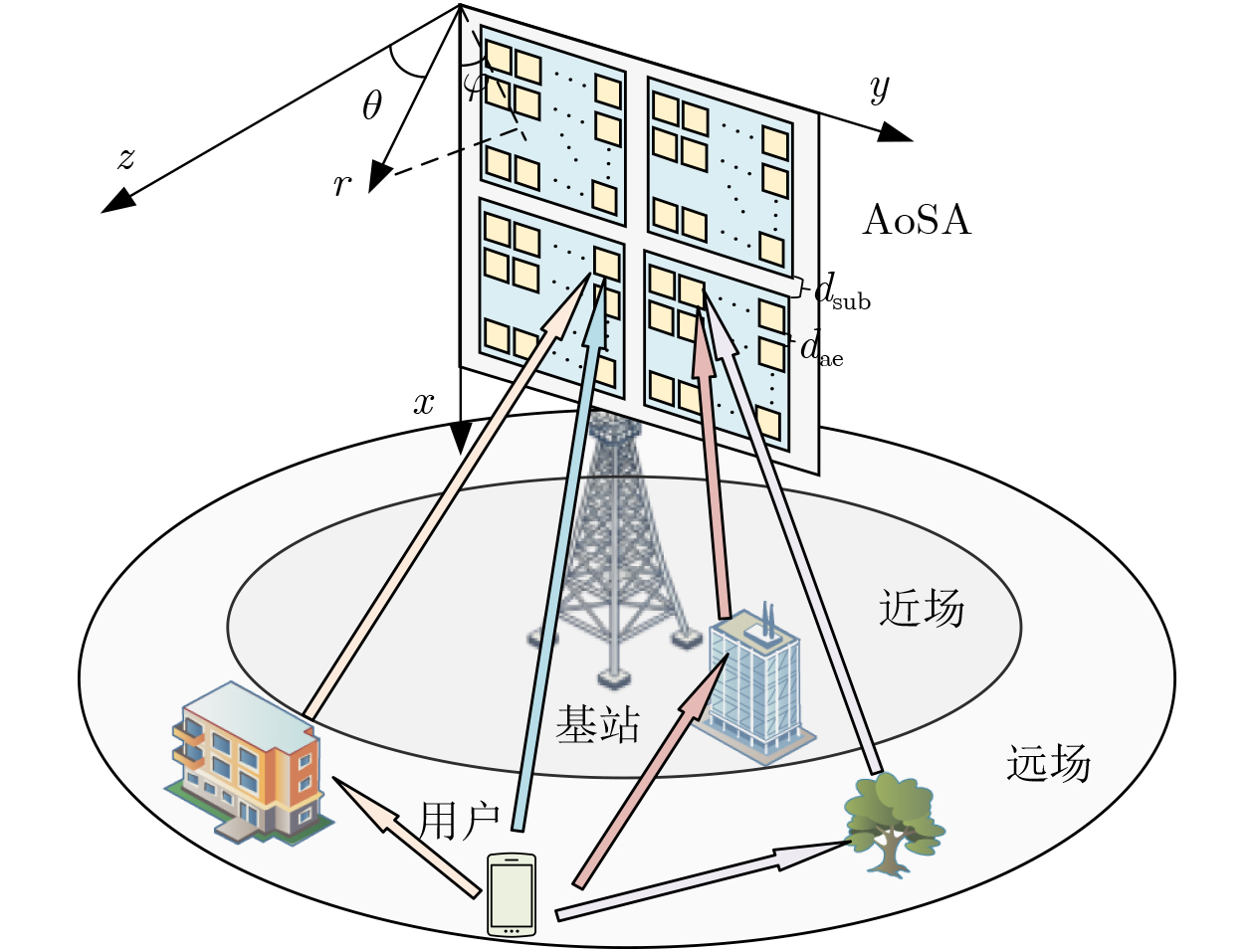
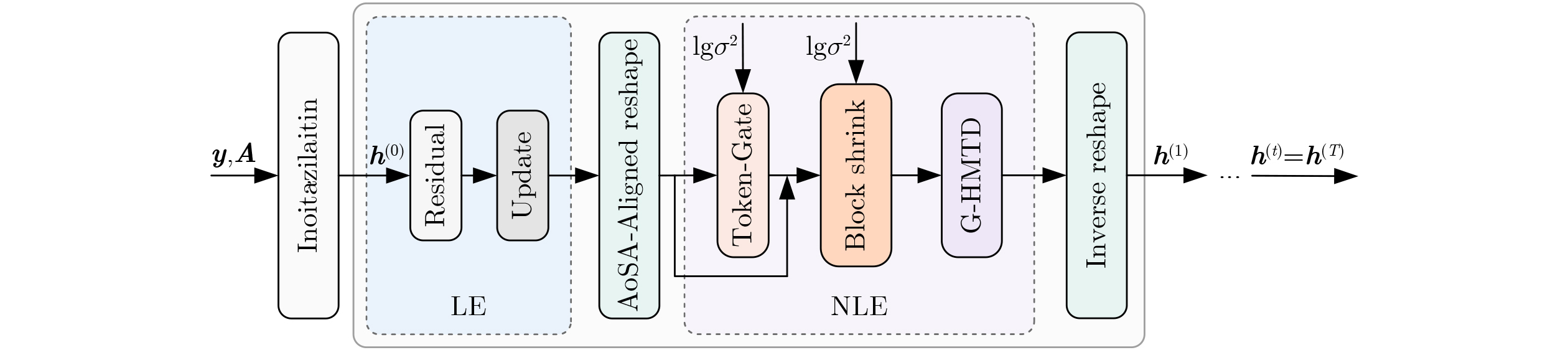
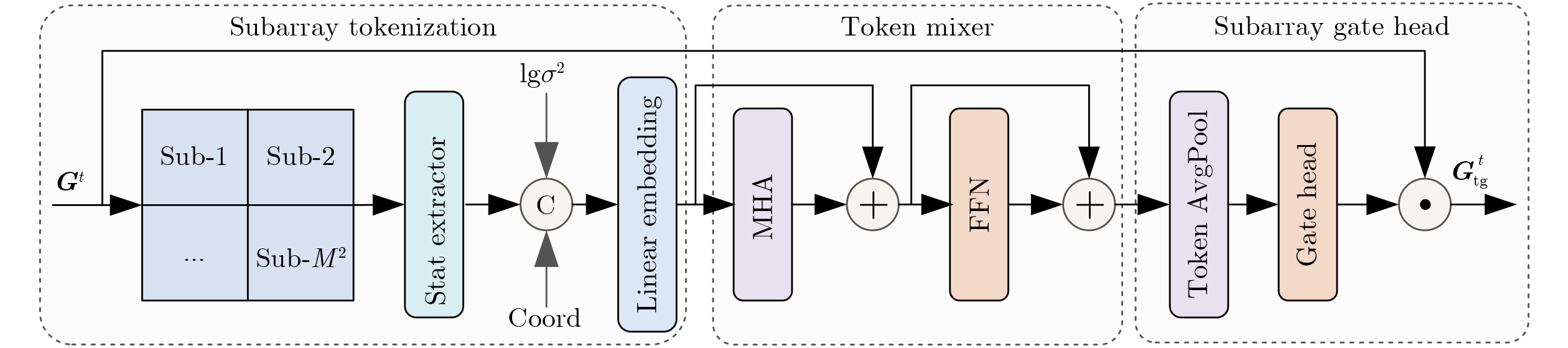
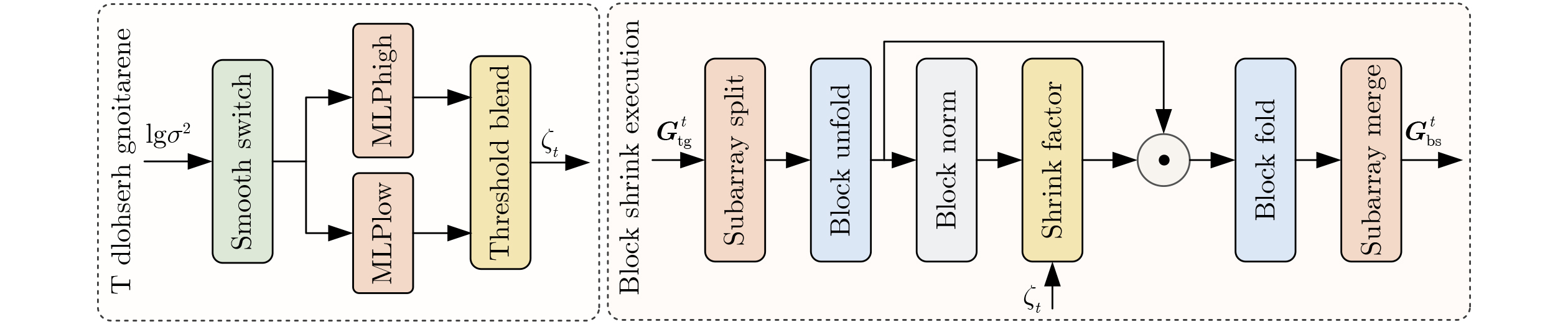
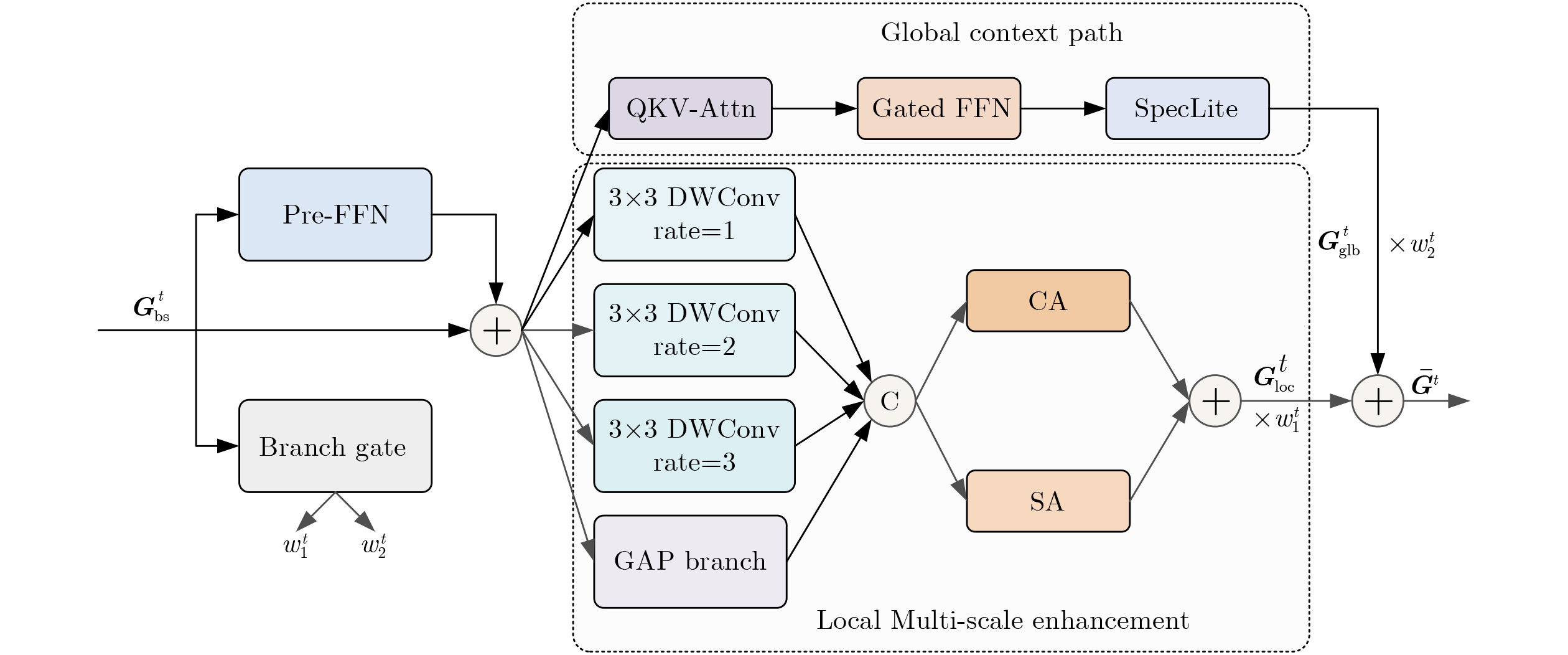
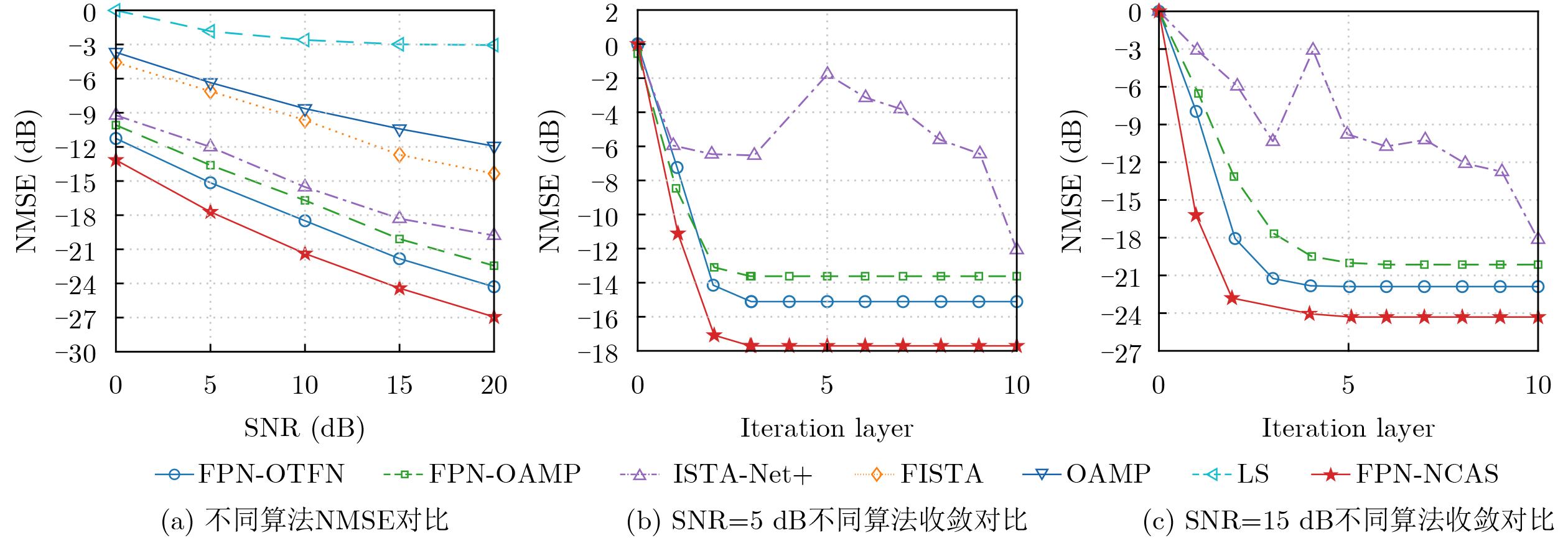
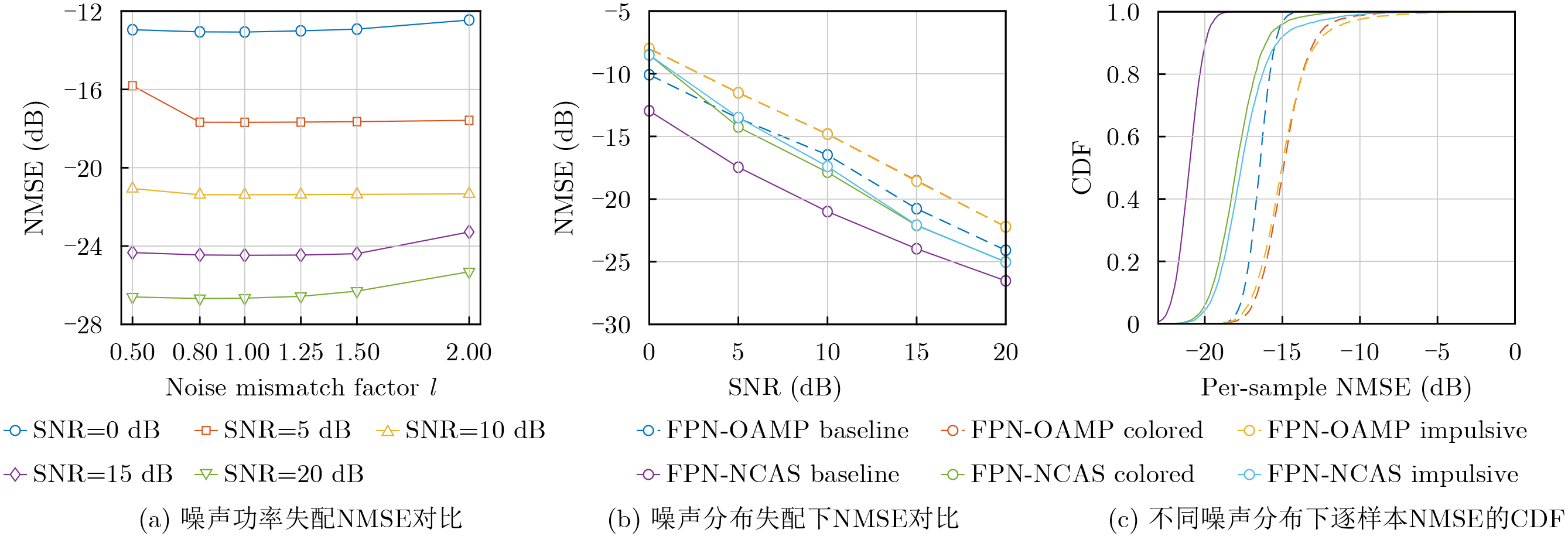
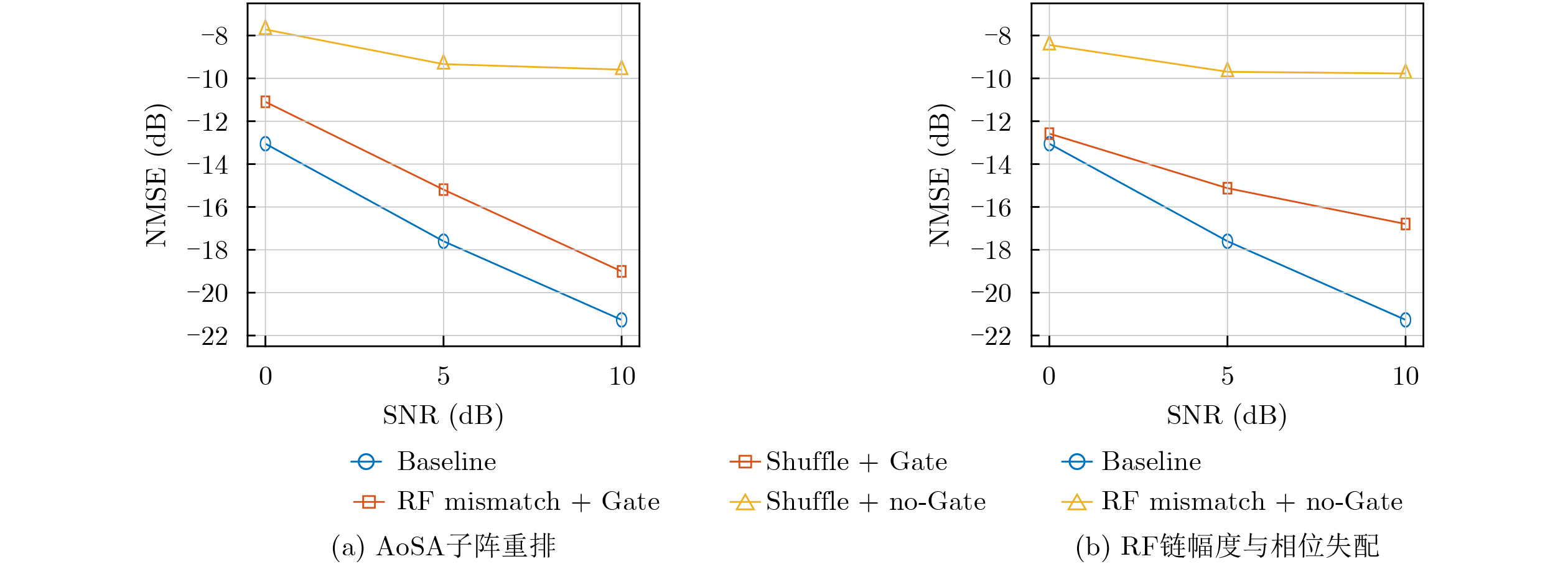
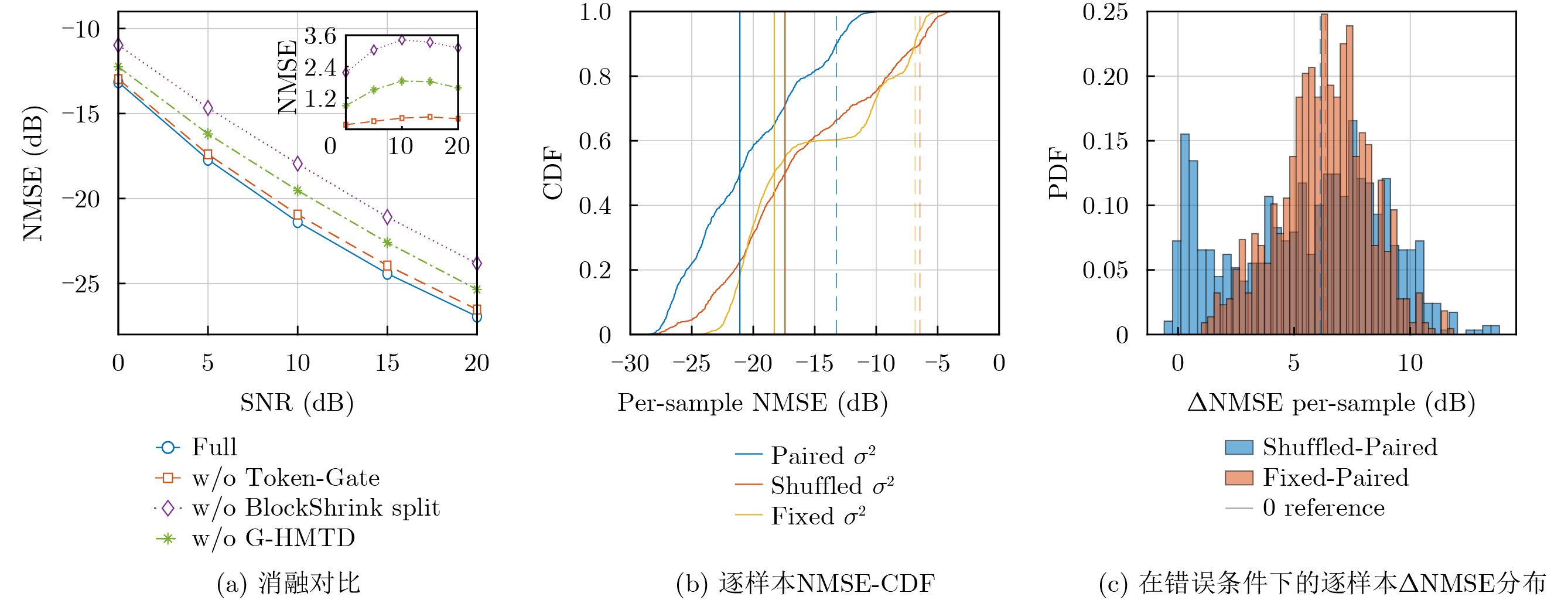
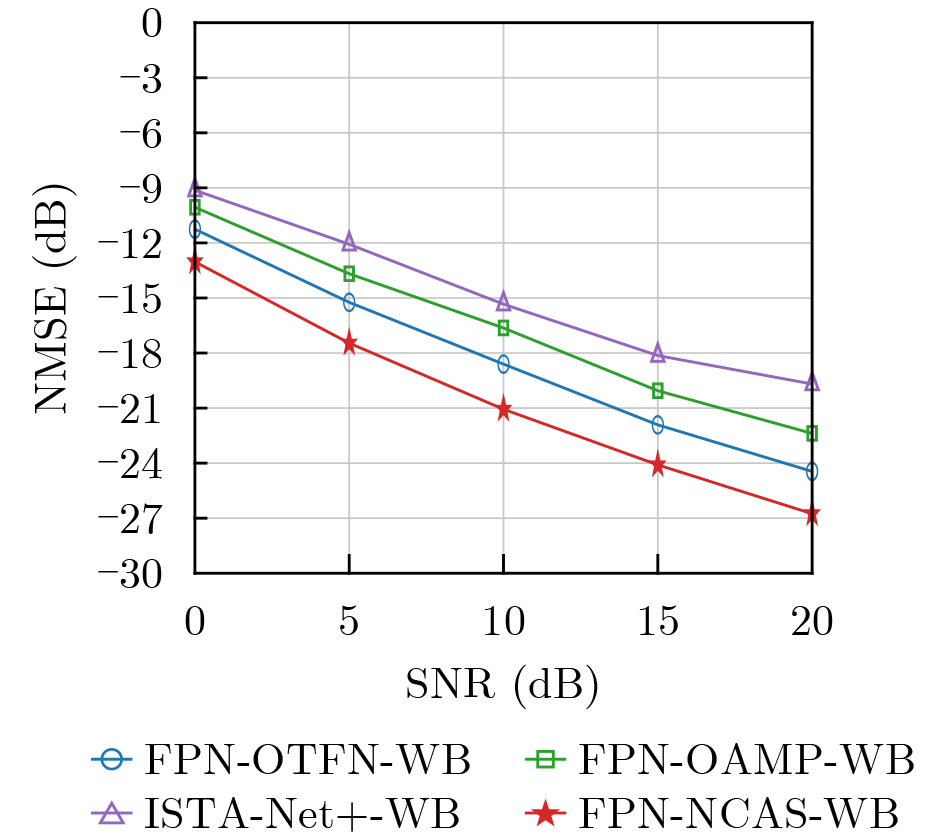
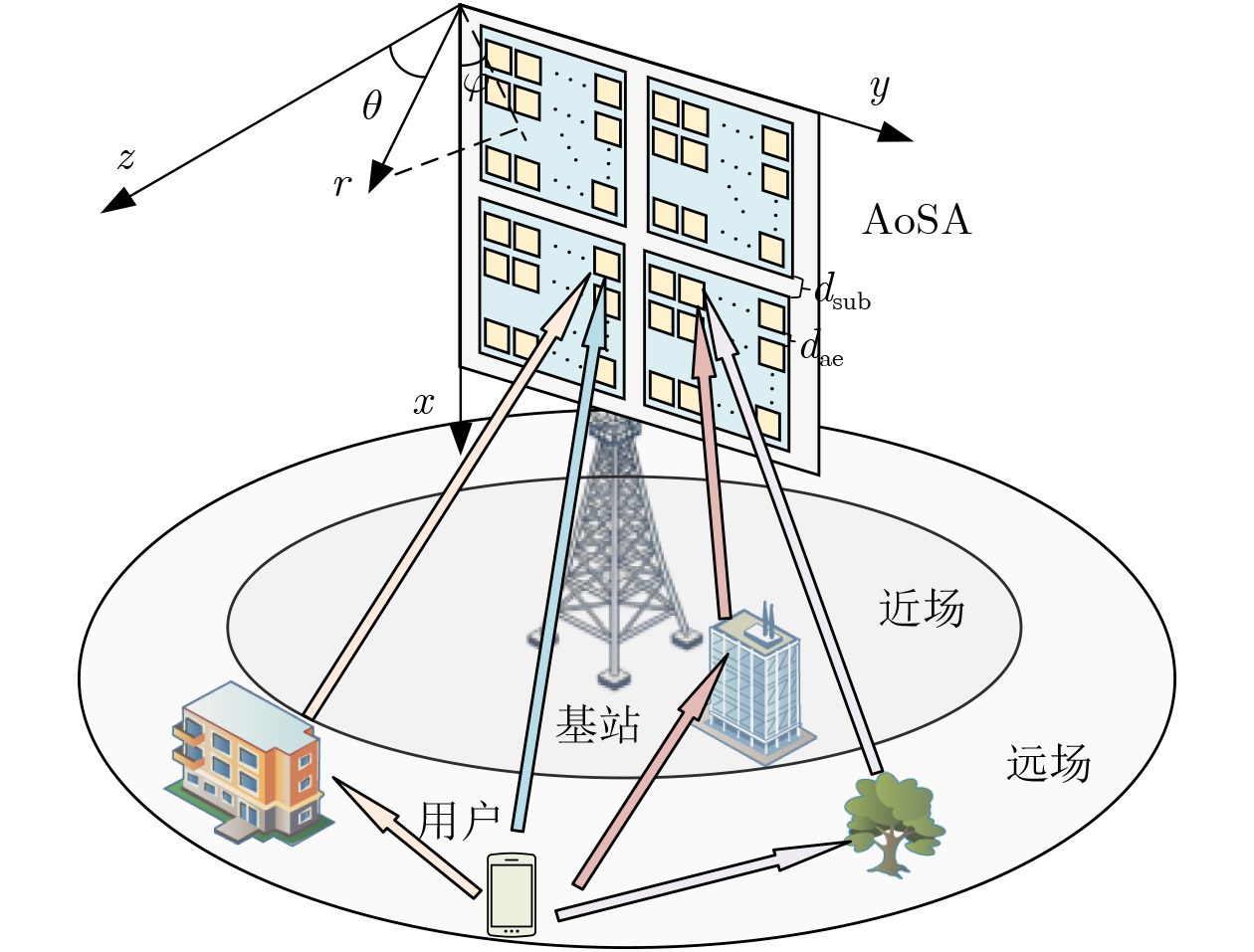
Objective Terahertz (THz) Ultra-Massive Multiple-Input Multiple-Output (UM-MIMO) systems are expected to support future high-capacity wireless communications. However, accurate channel estimation remains challenging under hybrid near-/far-field propagation and Array-of-SubArrays (AoSA) architectures, where limited Radio-Frequency (RF) chains, low Signal-to-Noise Ratio (SNR), noise uncertainty, and structural perturbations degrade compressed observations. Existing compressed sensing, Bayesian inference, and deep unfolding methods generally rely on fixed statistical assumptions, which limit their cross-SNR generalization under varying noise conditions and statistical mismatches. To address these limitations, this paper proposes a Noise-Conditioned Fixed-Point Network (FPN-NCAS) for robust THz UM-MIMO channel estimation. The proposed method aims to improve estimation accuracy, cross-SNR generalization, robustness, and iterative stability by incorporating noise-aware nonlinear recovery. Methods FPN-NCAS is developed within an Orthogonal Approximate Message Passing (OAMP)-based fixed-point unfolding framework. A coarse noise power estimate is obtained from repeated pilot differences and injected into the nonlinear recovery module as an explicit conditioning variable. After each linear update, the vector-domain estimate is reshaped into an AoSA-aligned tensor to exploit subarray-level structural priors. The nonlinear recovery chain consists of three components. Token-Gate performs lightweight subarray-level reliability pre-calibration to suppress unreliable responses under low-SNR and structurally inconsistent conditions. Block Shrink serves as the core noise-conditioned block-sparse proximal operator, in which a smooth dual-threshold mechanism balances strong denoising at low SNR with structural preservation at medium-to-high SNR. G-HMTD(Gated Hybrid Multi-scale Transformer Denoiser) further refines residual errors by combining Local Multi-scale Enhancement and Global Context Modeling. Bridge relaxation and nonlinear residual scaling are also incorporated to improve inter-stage stability. Results and Discussions Simulation results demonstrate that FPN-NCAS consistently outperforms LS, OAMP, ISTA-Net+, FPN-OAMP, and FPN-OTFN over the 0~20 dB SNR range ( Fig. 6 ). At SNR = 0 dB, FPN-NCAS achieves Normalized Mean Square Error (NMSE) gains of approximately 3.0 dB and 1.9 dB over FPN-OAMP and FPN-OTFN, respectively. At SNR = 20 dB, the gains increase to approximately 4.5 dB and 2.6 dB (Fig. 6(a) ). The convergence curves show that FPN-NCAS reaches a stable plateau after approximately three layers at SNR = 5 dB and five layers at SNR = 15 dB, demonstrating stable fixed-point iterative behavior (Fig. 6(b) andFig. 6(c) ). Analysis of repeated pilots shows that four repeated pilot pairs introduce only 3.13% additional pilot overhead while reducing the relative standard deviation of the coarse noise power estimate to 25.00%. Under moderate noise power mismatch, NMSE degradation remains within 0.3 dB. The proposed method also maintains strong robustness under colored Gaussian noise, impulsive noise, near-/far-field distribution shifts, variation in the number of propagation paths, AoSA subarray shuffling, and RF amplitude/phase mismatch (Fig. 7 andFig. 8 ). Ablation studies indicate that Block Shrink provides the largest performance gain, whereas Token-Gate and G-HMTD further improve performance through structural calibration and residual refinement (Fig. 9 ).Conclusions This paper proposes FPN-NCAS for noise-conditioned fixed-point channel estimation in THz UM-MIMO systems. By integrating repeated-pilot-based noise conditioning, AoSA-aware feature reshaping, Token-Gate calibration, Block Shrink recovery, and G-HMTD refinement, the proposed method improves NMSE performance, robustness, and iterative stability under different SNR conditions and non-ideal scenarios. The improved performance is achieved at the cost of higher inference complexity. Future work will focus on lightweight implementations and extensions to wideband, multi-user, and hardware-impaired THz communication systems. -
表 1 部分信道仿真参数
参数 载波频率$ f $(GHz) 子阵数量$ {M}^{2} $ 天线单元数量$ {N}^{2} $ 天线间距$ {d}_{\mathrm{ae}} $(m) 子阵间距$ {d}_{\mathrm{sub}} $(m) 导频长度$ Q $ 总路径数$ L $ 取值 300 4 256 5×10⁻⁴ 0.056 128 5  下载: 导出CSV
表 2 不同重复导频对下的噪声估计敏感性
Q1 导频开销(%) 相对标准差(%) 0 dB 5 dB 10 dB 15 dB 20 dB 1 0.78 50.00 –12.94 –17.57 –21.32 –24.42 –26.58 2 1.56 35.36 –13.02 –17.64 –21.36 –24.45 –26.63 4 3.13 25.00 –13.07 –17.68 –21.38 –24.47 –26.66 8 6.25 17.68 –13.09 –17.69 –21.39 –24.48 –26.67 16 12.50 12.50 –13.10 –17.70 –21.40 –24.48 –26.67
下载: 导出CSV
表 3 不同分布与主路径数条件下的NMSE对比
测试项 分布/条件变化 NMSE(dB) 相对变化(dB) 区域分布外推 混合场→近场 –20.57 +0.15 区域分布外推 混合场→远场 –20.64 +0.08 主路径数偏移 L=3~4 平均 –21.84 –1.22 主路径数基线 L=5 平均 –20.62 0 主路径数偏移 L=6~7 平均 –19.22 +1.40
下载: 导出CSV
表 4 RF链幅度相位随机扰动下的Token-Gate统计验证
项目 统计对象/方法 均值 标准差 0 dB 5 dB 10 dB 幅度扰动 $ {\alpha }_{i} $ 1.005 0.101 - - - 相位扰动 $ {\phi }_{i} $ 0 rad 0.20 rad - - - NMSE RF失配+无Gate - - –7.665 ± 0.523 –8.931 ± 0.765 –8.856 ± 0.883 NMSE RF失配+Gate - - –10.794 ±1.083 –13.001 ±1.892 –13.510 ± 2.501 改善量 无Gate–Gate - - 3.130 ± 0.563 4.071 ± 1.145 4.654 ± 1.657
下载: 导出CSV
表 5 不同模型的复杂度对比
模型 固定迭代层数 可训练参数量(M) 计算量(G) 平均推理时间(ms) OAMP - - 0.065 7.71 ISTA-Net+ 15 0.454 0.181 31.76 FPN-OAMP 15 0.362 0.888 64.89 FPN-OTFN 15 0.179 0.701 150.47 FPN-NCAS 15 0.523 1.764 251.33
下载: 导出CSV
-
[1] HE Yuanzhi, MA Chensheng, ZHU Zhongbo, et al. Terahertz communication payload architecture for space information networks: Challenges, key technologies, and trends[J]. IEEE Network, 2026, 40(1): 107–114. [2] JIANG Wei, ZHOU Qiuheng, HE Jiguang, et al. Terahertz communications and sensing for 6G and beyond: A comprehensive review[J]. IEEE Communications Surveys & Tutorials, 2024, 26(4): 2326-2381. doi: 10.1109/COMST.2024.3385908. [3] HAN Chong, CHEN Yuhang, YAN Longfei, et al. Cross far- and near-field wireless communications in terahertz ultra-large antenna array systems[J]. IEEE Wireless Communications, 2024, 31(3): 148–154. [4] LIN Cen and LI G Y L. Terahertz communications: An array-of-subarrays solution[J]. IEEE Communications Magazine, 2016, 54(12): 124–131. [5] SHA Ziyuan and WANG Zhaocheng. Channel estimation and equalization for terahertz receiver with RF impairments[J]. IEEE Journal on Selected Areas in Communications, 2021, 39(6): 1621–1635. [6] TARBOUSH S, ALI A, and AL-NAFFOURI T Y, et al. Cross-field channel estimation for ultra massive-MIMO THz systems[J]. IEEE Transactions on Wireless Communications, 2024, 23(8): 8619–8635. [7] YANG Songjie, PENG Yizhou, LYU Wanting, et al. Near-field channel estimation for extremely large-scale terahertz communications[J]. Science China Information Sciences, 2024, 67(9): 192302. [8] 袁正道, 郭亚博, 高大伟, 等. 参数化全息MIMO信道建模及其贝叶斯估计[J]. 电子与信息学报, 2025, 47(11): 4176-4187. doi: 10.11999/JEIT250436.YUAN Zhengdao, GUO Yabo, GAO Dawei, et al. Parametric holographic MIMO channel modeling and its Bayesian estimation[J]. Journal of Electronics & Information Technology, 2025, 47(11): 4176-4187. doi: 10.11999/JEIT250436. [9] LI Yuanjian and MADHUKUMAR A S. Hybrid near- and far-field THz UM-MIMO channel estimation: A sparsifying matrix learning-aided bayesian approach[J]. IEEE Transactions on Wireless Communications, 2025, 24(3): 1881–1897. [10] 蒲旭敏, 刘雁翔, 宋米雪, 等. 基于模型驱动深度学习的OTFS信道估计[J]. 电子与信息学报, 2024, 46(2): 680-687. doi: 10.11999/JEIT230072.PU Xumin, LIU Yanxiang, SONG Mixue, et al. Orthogonal time frequency space channel estimation based on model-driven deep learning[J]. Journal of Electronics & Information Technology, 2024, 46(2): 680-687. doi: 10.11999/JEIT230072. [11] GAO Jiabao, CHEN Xiaoming, and LI G Y. Deep unfolding based channel estimation for wideband terahertz near-field massive MIMO systems[J]. Frontiers of Information Technology & Electronic Engineering, 2024, 25(8): 1162–1172. [12] WANG Kuiyu, GAO Zhen, CHEN Sheng, et al. Knowledge and data dual-driven channel estimation and feedback for ultra-massive MIMO systems under hybrid field beam squint effect[J]. IEEE Transactions on Wireless Communications, 2024, 23(9): 11240–11259. [13] 刘婷, 王媛, 辛元雪. 可重构智能超表面辅助的大规模机器类通信深度学习大规模MIMO信道估计[J]. 电子与信息学报, 2024, 46(10): 4002-4008. doi: 10.11999/JEIT240584.LIU Ting, WANG Yuan, XIN Yuanxue. Deep learning-enhanced massive channel estimation for reconfigurable intelligent surface-aided massive machine-type communication[J]. Journal of Electronics & Information Technology, 2024, 46(10): 4002-4008. doi: 10.11999/JEIT240584. [14] YU Wentao, SHEN Yifei, HE Hengtao, et al. An adaptive and robust deep learning framework for THz ultra-massive MIMO channel estimation[J]. IEEE Journal of Selected Topics in Signal Processing, 2023, 17(4): 761–776. [15] HU Zhengdong, HAN Chong, GERSTACKER W, et al. DiffPace: Diffusion-based plug-and-play augmented channel estimation in mmWave and terahertz ultra-massive MIMO systems[J]. IEEE Journal on Selected Areas in Communications, 2026, 44: 2559–2573. [16] DOVELOS K, MATTHAIOU M, NGO H Q, et al. Channel estimation and hybrid combining for wideband terahertz massive MIMO systems[J]. IEEE Journal on Selected Areas in Communications, 2021, 39(6): 1604–1620. [17] ZAMIR S W, ARORA A, KHAN S, et al. Restormer: Efficient transformer for high-resolution image restoration[C]. The 2022 IEEE/CVF Conference on Computer Vision and Pattern Recognition, New Orleans, USA, 2022: 5718–5729. [18] MA Junjie and LI Ping. Orthogonal AMP[J]. IEEE Access, 2017, 5: 2020–2033. [19] ZHANG Jian and GHANEM B. ISTA-Net: Interpretable optimization-inspired deep network for image compressive sensing[C]. The 2018 IEEE/CVF Conference on Computer Vision and Pattern Recognition, Salt Lake City, USA, 2018: 1828–1837. [20] 于舒娟, 赵阳, 魏玉尧, 等. 超大规模太赫兹系统深度学习信道估计算法[J]. 通信学报, 2025, 46(1): 144–156.YU Shujuan, ZHAO Yang, WEI Yuyao, et al. Deep learning channel estimation algorithm for ultra-massive terahertz systems[J]. Journal on Communications, 2025, 46(1): 144–156. -

 下载:
下载:

图(10) / 表(5)
计量
- 文章访问数: 361
- HTML全文浏览量: 154
- PDF下载量: 11
- 被引次数: 0
