




An Intelligent Computing Resource Deployment Method for Mega Satellite Constellations
-
摘要: 随着大规模卫星网络的广泛部署,卫星部署算力以提供自主服务各类应用成为新兴研究之一。考虑到算力资源受限于卫星硬件能力,如何权衡卫星部署算力的开销和算力服务覆盖的增益是亟待解决的重点难题之一。本文针对高动态卫星网络算力资源部署问题,设计了算力结构图以表征算力资源的分布与关联性,并通过卫星拓扑变化、算力部署限制等对卫星访问算力资源的传输时延、算力信息更新和算力部署开销等进行建模,旨在最小化部署算力资源的同时减少管控时延和部署能耗。由于在算力结构图嵌入动态网络拓扑中依赖卫星节点和星间链路的资源状态信息,本文提出了一种图神经网络-近端策略优化(Graph Neural Network-Proximal Policy Optimization, GNN-PPO)驱动的算力结构图嵌入方法,通过图神经网络编码卫星拓扑及节点、链路资源状态,由智能体确定当前网络状态下的算力节点部署数量,并结合节点度、剩余算力和中心性筛选具体部署位置。仿真结果表明,在相同规模下与粒子群优化算法及DQN算法相比,在保障平均管控时延为约2跳下,所提算法生成的算力节点数量可减少29%,且部署能耗减少35.8%,验证了所提算法在算力资源部署决策上的有效性。Abstract:
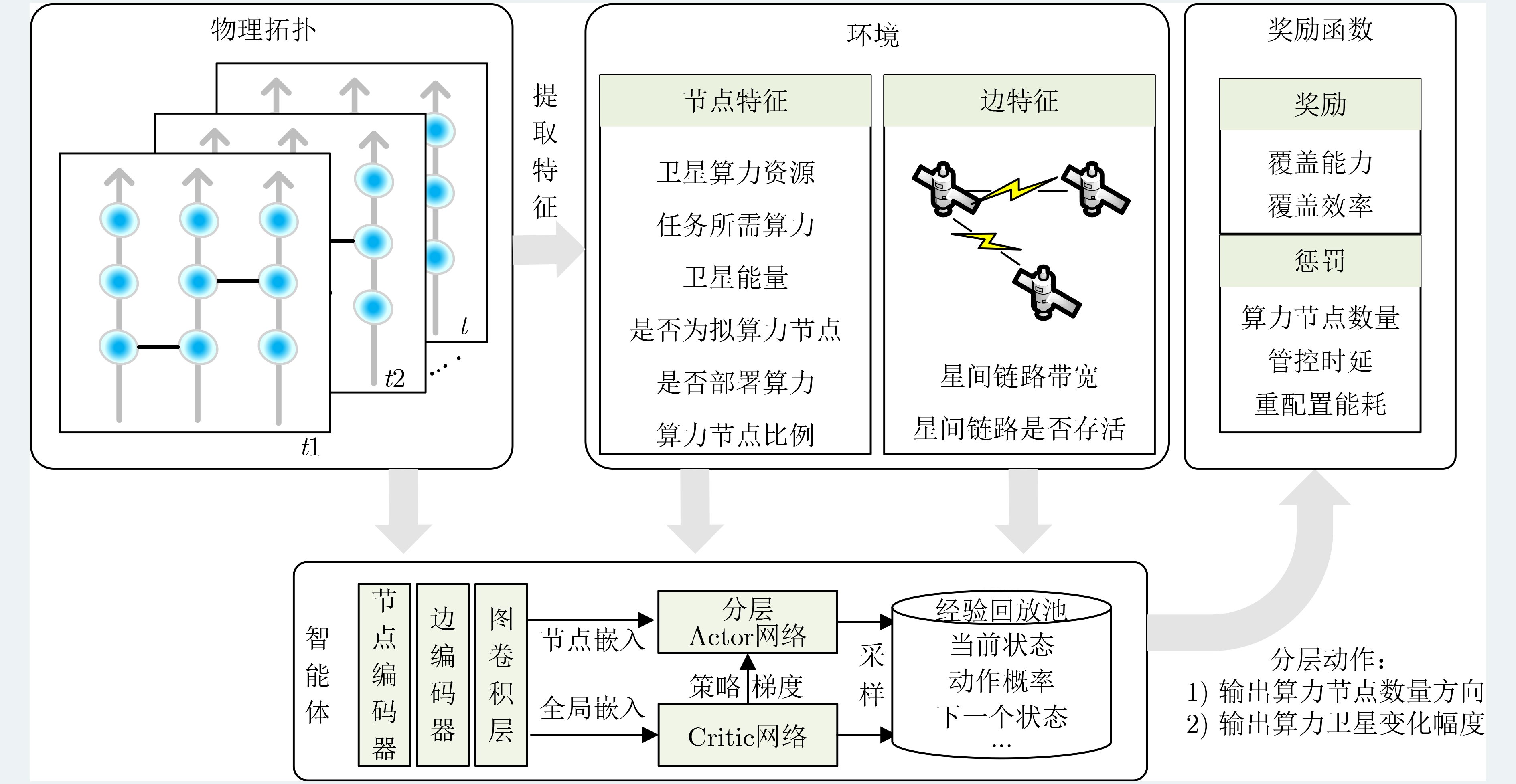
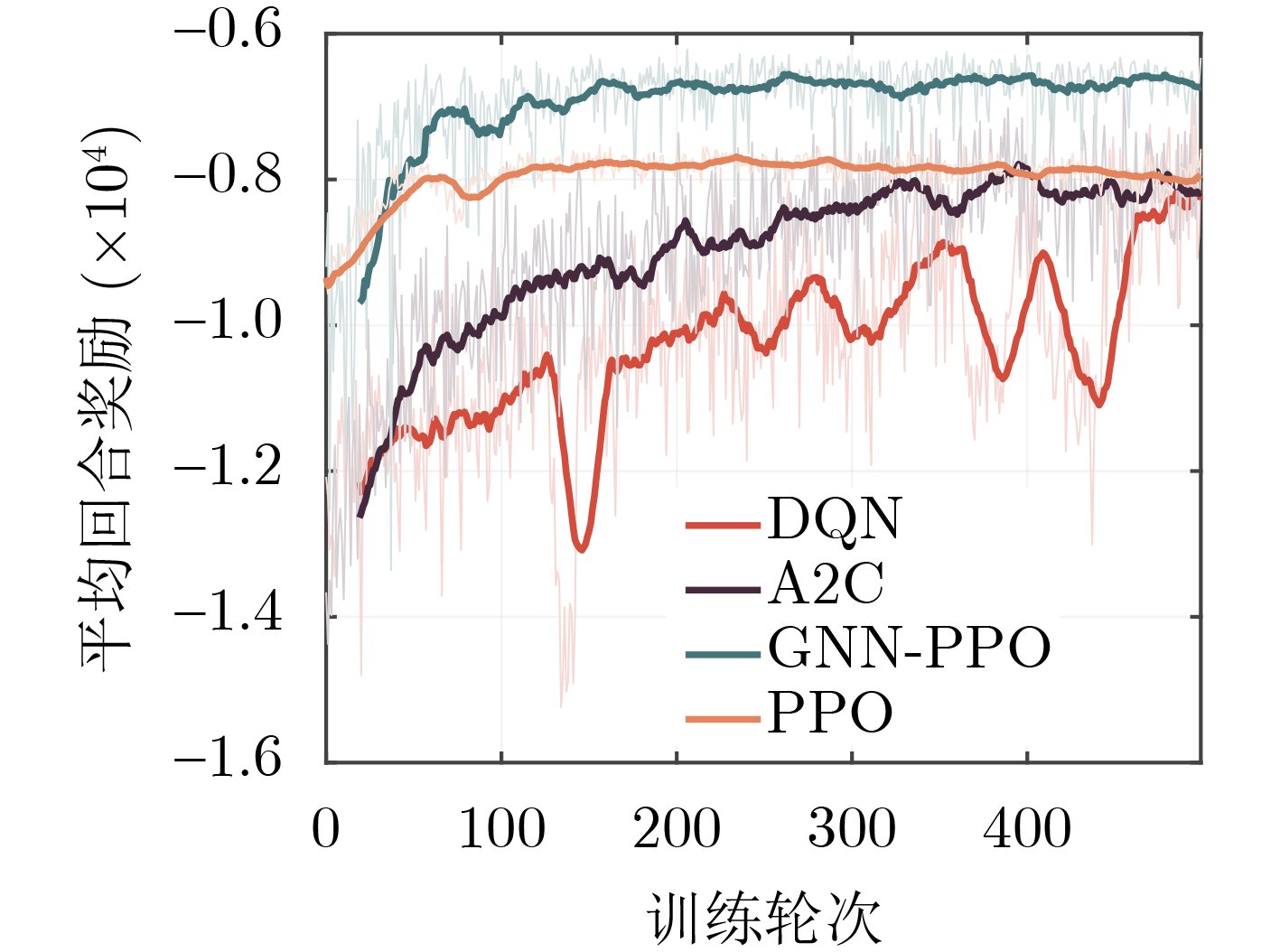
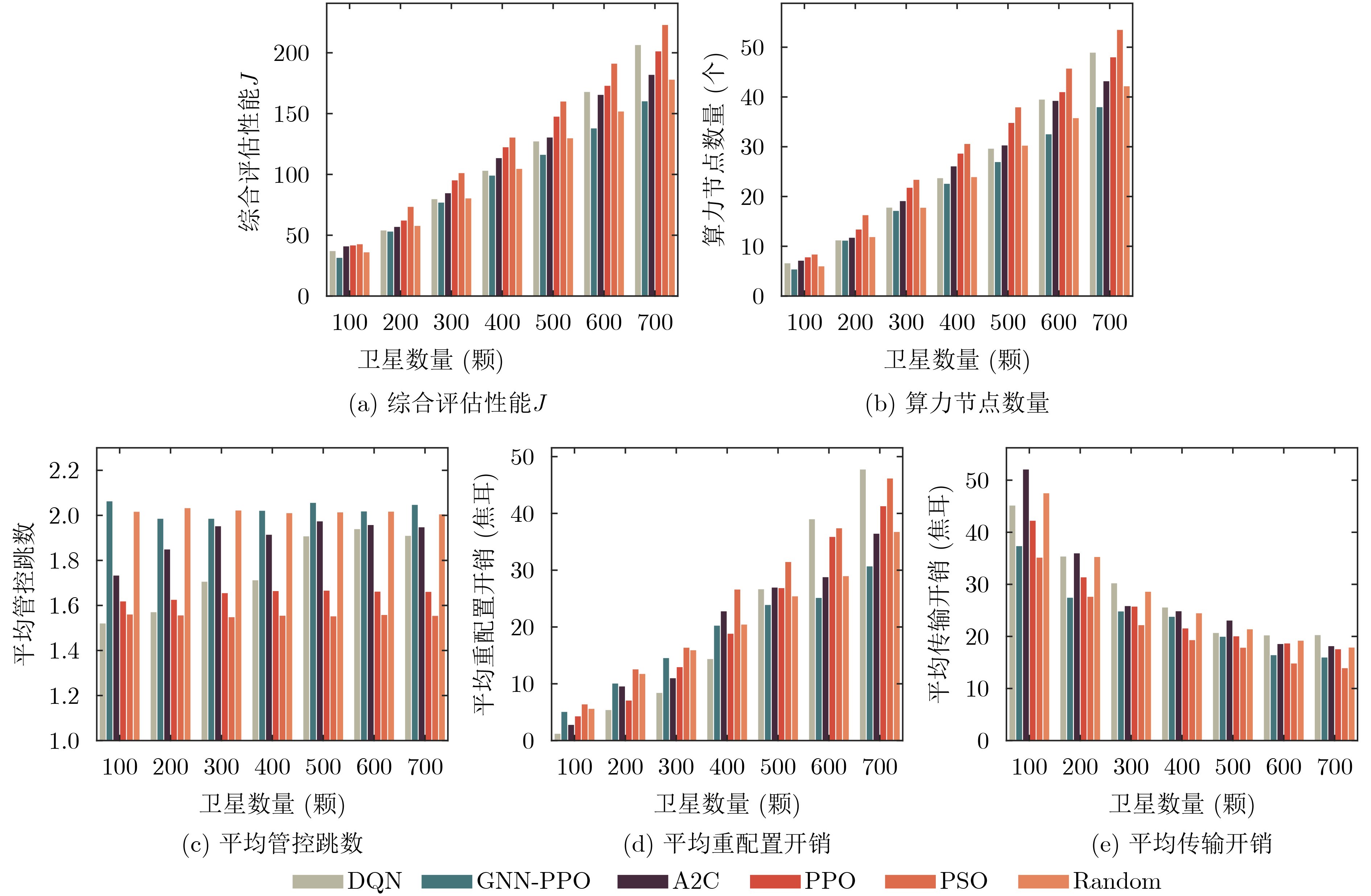
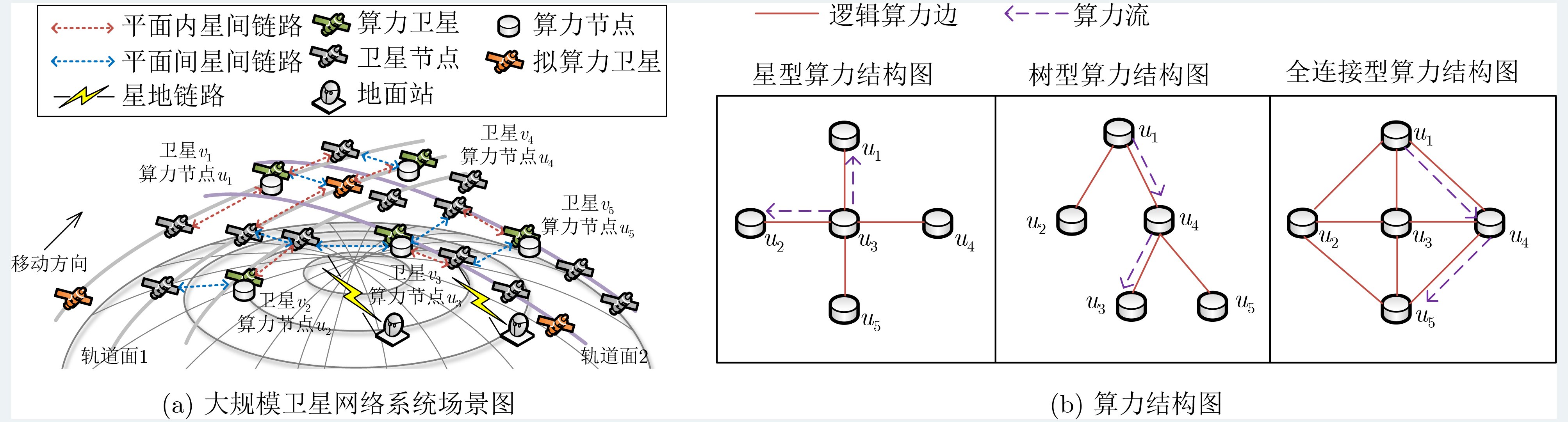
Objective With the proliferation of satellites and the continuous emergence of services, the concept of “satellite computing” is expected to enable a significant leap in the service capability of large-scale networks. However, the limited onboard computing resources impose the deployment complexity. To pursue the efficient deployment strategy in the highly dynamic network, the intertwined impacts of deployed number and costs on changed topology features should be captured by constructing graph models. To this end, the Graph Neural Network-Proximal Policy Optimization (GNN-PPO) has been proposed, which can enable the agent to encode neighbor information of nodes through the GNN model, thereby perceiving the connectivity relationships among satellite nodes and the spatial distribution of computational resources in highly dynamic satellite networks. Consequently, it obtains the optimal required number of computational resources and their deployment locations within such high-dynamic networks, which provides theoretical support for computing deployment in the future satellite constellations. Methods The guidance logic of the GNN-PPO algorithm dynamically captures the features of satellites and inter-satellite links by the GNN model. The GNN model includes the topological states of the satellite network, the computing resources, the node energy, the required computing resources and node load, which can be encoded to form a compressed network feature. Through the message passing mechanism, the GNN model extracts the key information such as the global resource distribution, the core hub locations, transmission link quality and the current service coverage region of computing nodes, which builds a fixed-length dense vector so that the PPO agent can make decisions efficiently. Moreover, the action is designed as the hierarchical actions, wherein the upper action decides the trend of computing node number, i.e., increasing/reducing/maintaining, then the lower action determines the extent of the changed number of computing nodes and the location of them by the heuristic algorithm. The reward function can calculate the delay cost, energy cost, the number of computing nodes, computing service coverage and service coverage efficiency, thus the PPO agent selects computing satellites with abundant computing resources and proper locations to deploy computing nodes. Results and Discussions The GNN-PPO algorithm acquires the deployment strategy based on the GNN model, where the GNN model encodes the neighbor information of each satellite, which renders the PPO agent percepts the connections among satellites and the distribution of computing resources in the network, and further the PPO agent can require the optimal computing nodes with their locations. Simulation results demonstrate that the proposed GNN-PPO algorithm can obtain the better convergence effect in Fig. 3 , while DQN and A2C algorithms are worse. Meanwhile,Fig 5 illustrates that compared with the PSO and DQN algorithms, the computing node number is reduced by 29%, and the reconfiguration energy consumption is reduced by 35.8%, respectively. Especially, theTab 4 shows that the average management hop fluctuates within the range of 2.5 hops to 3.3 hops under each computing structure graph (CSG), and the average reconfiguration energy consumption varies from 0.9 J to 1.2 J, while the average transmission energy consumption of the tree CSG is approximately 15 times that of the star CSG and the full-connected CSG, which indicates that in a large-scale satellite network, the star CSG and fully-connected CSG can be selected to deploy the computing resources.Conclusions This paper addresses the computing resource deployment scheme in a highly dynamic satellite networks by integrating the computing structure graph and the GNN-PPO algorithm. The proposed algorithm exploits the GNN model to extract the node features of satellites and the edge features of ISLs, and using these as the network state input for the PPO agent, the agent is guided to execute hierarchical actions for the selection of deployment quantities and locations, and learn the deployment strategy with the optimal long-term benefits. However, this study assumes that the reconfiguration energy consumption is only related to the changed nodes and their task volume, and future work should evaluate the migration cost, as well as investigate scalability in mega satellite constellations with heterogeneous demands. -
表 1 符号参数表
符号 含义 $ {G}^{t}(V,{E}^{t}) $, $ \mathcal{G}_{\text{c}}^{s}(\mathcal{V}_{\text{c}}^{t},\mathcal{E}_{\text{c}}^{s}) $ 卫星物理拓扑图,算力结构图 $ {\mathcal{C}}^{t} $,$ {\mathcal{R}}^{t} $ 拟算力卫星集合,算力服务的普通卫星集合 $ L_{k}^{t} $,$ M_{u}^{t} $,$ \delta _{i}^{t} $ 第k条算力流在时隙t内的任务数据量,第t个时隙逻辑算力节点u的算力需求,
第t个时隙拟算力卫星的可用算力资源量$ l_{k}^{t}(i,j) $,$ C_{i,j}^{t} $, $ \phi _{i,u}^{t} $,$ \rho _{r,i}^{t} $ 第t个时隙第k条算力流到物理链路(i,j)的二进制映射变量,星间/星地链路(i,j)在时隙t的传输容量,第t个时隙逻辑算力节点u部署在卫星节点i的二进制映射变量,第t个时隙普通卫星r是否有算力卫星i服务的二进制变量 $ h_{k}^{\text{flow}} $,$ {h}_{\mathrm{cov}} $ 第k条算力流的最大路径跳数,普通卫星到距离其最近算力卫星的跳数 $ n_{\text{com}}^{t} $,$ P_{r,i}^{t} $, $ \theta _{i}^{t} $ 第t个时隙部署的算力卫星数量,第t个时隙普通卫星r到算力卫星i的物理路径,拟算力卫星i在第t个时隙承载逻辑算力节点的二进制映射变量 $ D_{\text{hop}}^{t} $,$ E_{\textit{tran}}^{\mathrm{t}} $,$ E_{\text{recon}}^{t} $,$ {P}_{\text{tr}} $ 平均管控跳数,算力流传输能耗,算力节点重配置能耗,链路发射功率 $ {S}_{t} $,$ {a}_{t} $,$ {P}_{\text{delay}} $,$ {P}_{\text{cn}} $,$ Co{v}_{t} $,$ S{r}_{t} $ 状态空间,动作空间,跳数惩罚,能耗惩罚,算力覆盖,服务覆盖效率  下载: 导出CSV
表 3 权重系数敏感性分析
权重因子 对应目标项 取值范围 平均综合奖励 综合奖励
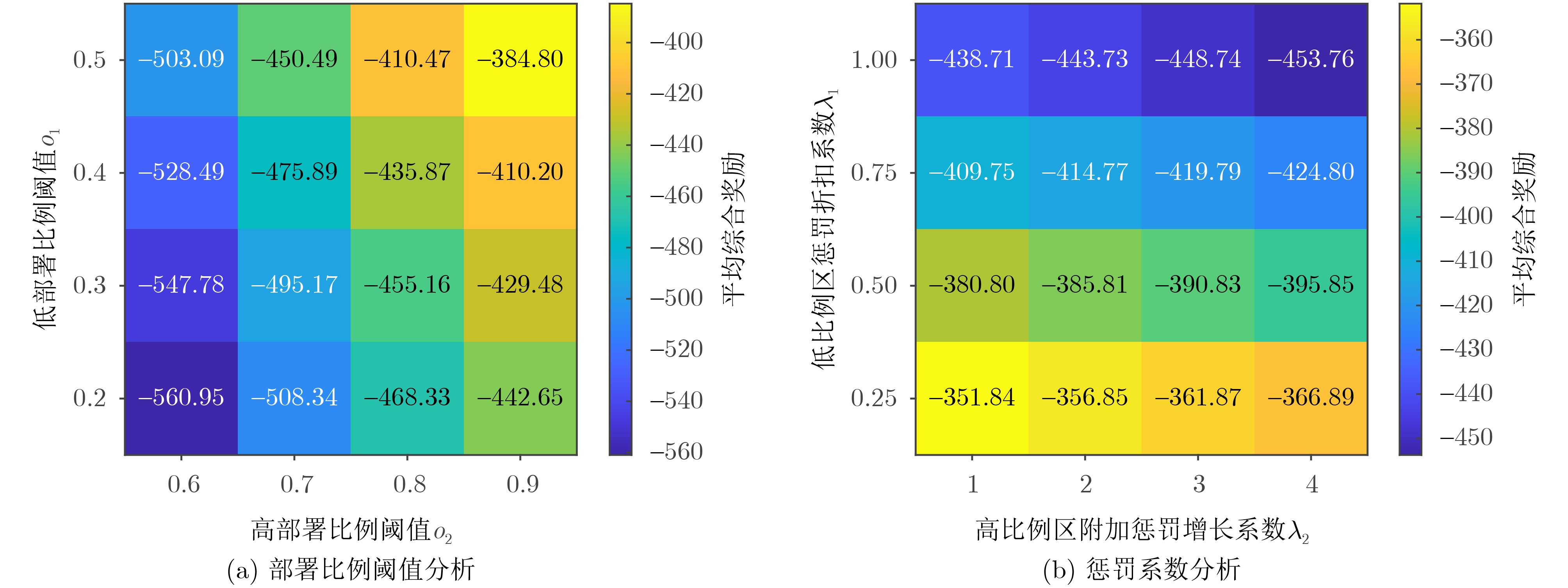
变化幅度敏感性分析 w1 平均管控跳数 0.5,1,2,4 [–380.04, –380.01] 0.024 影响最小,属于边界跳数保护,防止管控路径异常变长 w2 算力节点数量 2,4,8 [–815.4, –226.22] 589.18 影响最大,说明部署节点数量惩罚是主导因素 w3 重配置能耗 0.05,0.1,0.2,0.4 [–378.8, –375.14] 3.65 影响较小,重配置惩罚在当前量级下变化有限 w4 传输能耗 0.05, 0.1, 0.2, 0.4 [–364.51, –333.14] 31.36 影响次之,传输能耗对综合奖励有一定影响
下载: 导出CSV
表 4 不同算力结构图下的算法性能对比
拟算力卫星跳数策略 算力结构图类型 算力节点数量(个) 平均管控时延(跳) 平均重配置开销(焦耳) 平均传输能耗(焦耳)
h=1星型 37 2.605 0.912 17.648 树型 36 2.576 1.142 270.9199 全连接型 34 3.264 0.935 18.063 h=2 星型 38 2.711 1.111 21.745 树型 36 2.842 0.946 309.535 全连接型 36 2.901 0.976 16.511
h=3星型 38 2.6 0.873 17.028 树型 37 2.678 0.847 258.649 全连接型 37 2.681 1.168 17.536
下载: 导出CSV
-
[1] SpaceX. Starlink progress 2025[EB/OL]. https://starlink.com/public-files/starlinkProgressReport_2025.pdf?srsltid=AU7gw4W7p-Sbp2G93YG1Go2gY3MYF1y7MbDp8rYvOl0k2j25WDb1ta-R, 2025.(查阅网上资料,未能确认本条文献修改是否正确,请确认). [2] 戴翠琴, 王泓运, 廖荣鹏, 等. 星地融合网络中平衡QoS的服务放置与任务卸载联合优化[J]. 电子与信息学报, 2026, 48(5): 2132–2143. doi: 10.11999/JEIT251294.DAI Cuiqin, WANG Hongyun, LIAO Rongpeng, et al. Joint optimization of service placement and task offloading for QoS balancing in satellite-terrestrial integrated networks[J]. Journal of Electronics & Information Technology, 2026, 48(5): 2132–2143. doi: 10.11999/JEIT251294. [3] 武燕燕, 吴松, 邓伟. 6G天地一体通感算智能协同网络资源管理技术综述[J]. 电子与信息学报, 2025, 47(8): 2448–2472. doi: 10.11999/JEIT250140.WU Yanyan, WU Song, and DENG Wei. An overview of resource management technology of 6G integrated communication, sensing, and computation enabled satellite-terrestrial intelligent network[J]. Journal of Electronics & Information Technology, 2025, 47(8): 2448–2472. doi: 10.11999/JEIT250140. [4] WANG Chao, ZHANG Yiran, LI Qing, et al. Satellite computing: A case study of cloud-native satellites[C]. 2023 IEEE International Conference on Edge Computing and Communications, Chicago, USA, 2023: 262–270. doi: 10.1109/EDGE60047.2023.00048. [5] JAKUBSKI K. China's military opportunities for the three-body computing constellation (3BCC) concept[J]. Cybersecurity & Cybercrime, 2025, 1(7): 149–170. doi: 10.5604/01.3001.0055.2402. [6] PENG Pei, XU Tianheng, CHEN Xianfu, et al. Blocked-job-offloading-based computing resources sharing in LEO satellite networks[J]. IEEE Internet of Things Journal, 2025, 12(2): 2287–2290. doi: 10.1109/JIOT.2024.3491839. [7] JIA Min, WU Jian, ZHANG Liang, et al. DDPG-based intelligent computation offloading and resource allocation for LEO satellite edge computing network[J]. China Communications, 2025, 22(3): 1–15. doi: 10.23919/JCC.fa.2023-0337.202503. [8] FAN Wenhao, MENG Qingcheng, WANG Guan, et al. Satellite edge intelligence: DRL-based resource management for task inference in LEO-based satellite-ground collaborative networks[J]. IEEE Transactions on Mobile Computing, 2025, 24(10): 10710–10728. doi: 10.1109/TMC.2025.3570799. [9] JI Zhe, WU Sheng, and JIANG Chunxiao. Cooperative multi-agent deep reinforcement learning for computation offloading in digital twin satellite edge networks[J]. IEEE Journal on Selected Areas in Communications, 2023, 41(11): 3414–3429. doi: 10.1109/JSAC.2023.3313595. [10] LAI Junyu, WU Di, CHEN Yuhang, et al. Optimizing resource utilization and performance in LEO satellite edge computing: A joint service deployment and task offloading approach[J]. IEEE Internet of Things Journal, 2026, 13(10): 21676–21689. doi: 10.1109/JIOT.2026.3668808. [11] WANG Lina, LI Juan, DAI Minghui, et al. Energy efficient multi-task offloading in satellite- assisted vehicular edge computing networks: An improved soft-actor-critic approach[J]. IEEE Transactions on Vehicular Technology, 2025, 74(4): 6473–6587. doi: 10.1109/TVT.2024.3513259. [12] 冯伊凡, 吴畏虹, 孙罡, 等. 天地一体化边缘计算网络服务迁移算法研究[J]. 电子与信息学报, 2026, 48(2): 499–511. doi: 10.11999/JEIT250835.FENG Yifan, WU Weihong, SUN Gang, et al. Service migration algorithm for satellite-terrestrial edge computing networks[J]. Journal of Electronics & Information Technology, 2026, 48(2): 499–511. doi: 10.11999/JEIT250835. [13] 何善琪, 罗志勇, 贺智敏. 星算网络中算力均衡的智能调度方法[J]. 移动通信, 2025, 49(10): 74–84. doi: 10.3969/j.issn.1006-1010.20250822-0002.HE Shanqi, LUO Zhiyong, and HE Zhimin. An intelligent scheduling method for balanced computing power in computing-satellite networks[J]. Mobile Communications, 2025, 49(10): 74–84. doi: 10.3969/j.issn.1006-1010.20250822-0002. [14] JI Sijing, ZHOU Di, SHENG Min, et al. Mega satellite constellation system optimization: From a network control structure perspective[J]. IEEE Transactions on Wireless Communications, 2022, 21(2): 913–927. doi: 10.1109/TWC.2021.3100247. [15] JIA Xiao, ZHOU Di, SHENG Min, et al. Satellite computing network construction: Optimal computing node deployment in multi-layer LEO mega-constellations[J]. IEEE Transactions on Communications, 2026, 74: 1747–1761. doi: 10.1109/TCOMM.2025.3638621. [16] 彪晓卫, 魏新龙, 夏嘉俊, 等. 国外轻小型空间激光通信终端技术发展分析[J]. 航天器工程, 2025, 34(4): 108–119. doi: 10.3969/j.issn.1673-8748.2025.04.015.BIAO Xiaowei, WEI Xinlong, XIA Jiajun, et al. Analysis of development of lightweight and compact space laser communication terminal technology abroad[J]. Spacecraft Engineering, 2025, 34(4): 108–119. doi: 10.3969/j.issn.1673-8748.2025.04.015. [17] GUIMARÃES C, NETTI A, SAUER M, et al. A survey on satellite computing: Connecting the dots between networks and applications[J]. IEEE Communications Surveys & Tutorials, 2026, 28: 567–592. doi: 10.1109/COMST.2025.3579525. [18] HAO Qi, ZHOU Di, SHENG Min, et al. Tiered clustering-based management architecture in mega-satellite networks[J]. Science China Information Sciences, 2024, 67(5): 152301. doi: 10.1007/s11432-023-3937-y. [19] LIU Yu, WANG Luhan, LU Zhaoming, et al. A stateless design of satellite–terrestrial integrated core network and its deployment strategy[J]. IEEE Transactions on Network and Service Management, 2024, 21(1): 953–966. doi: 10.1109/TNSM.2023.3318569. [20] HAO Qi, ZHOU Di, SHENG Min, et al. Hierarchically dynamic planning of inter-layer connections in multi-layer satellite mega constellations[J]. IEEE Transactions on Wireless Communications, 2025, 24(12): 10551–10565. doi: 10.1109/TWC.2025.3580400. [21] GAO Yufang, YAN Zhibo, ZHAO Kanglian, et al. Joint optimization of server and service selection in satellite-terrestrial integrated edge computing networks[J]. IEEE Transactions on Vehicular Technology, 2024, 73(2): 2740–2754. doi: 10.1109/TVT.2023.3320187. -


 下载:

图(5) / 表(4)
计量
- 文章访问数: 7
- HTML全文浏览量: 0
- PDF下载量: 0
- 被引次数: 0
