




RepCAN: A Lightweight Intrusion Detection Method for In-Vehicle Networks Integrating Temporal Graph Re-parameterization
-
摘要: 随着智能网联汽车(ICV)的快速普及,原本封闭的车载网(IVN)与外部环境的交互日益频繁,面临消息注入、语义操纵等诸多外部恶意攻击风险。该文提出了一种融合时序图重参数化的车载网轻量级入侵检测技术(RepCAN) ,通过 “ 幽灵节点 ” 机制与架构无损变换,实现了高泛化检测能力与低资源占用的均衡。具体而言,该技术首先在图构建阶段将攻击引发的突发流量或时序偏差统一映射至幽灵节点,并结合实时流量统计特征生成动态连接权重,使得模型在保留静态通信拓扑先验的同时对节点间的动态关联过程进行建模,从而提升对复杂通信模式变化的表达能力;其次,利用结构重参数化技术构建了 “ 训练态多分支、推理态单路径 ” 的模型架构,大幅降低了边缘端的访存成本与推理延迟。在 Car-Hacking Dataset 上的实验结果表明, RepCAN在攻击下的整体区分能力 AUC (判别阈值无关)高达
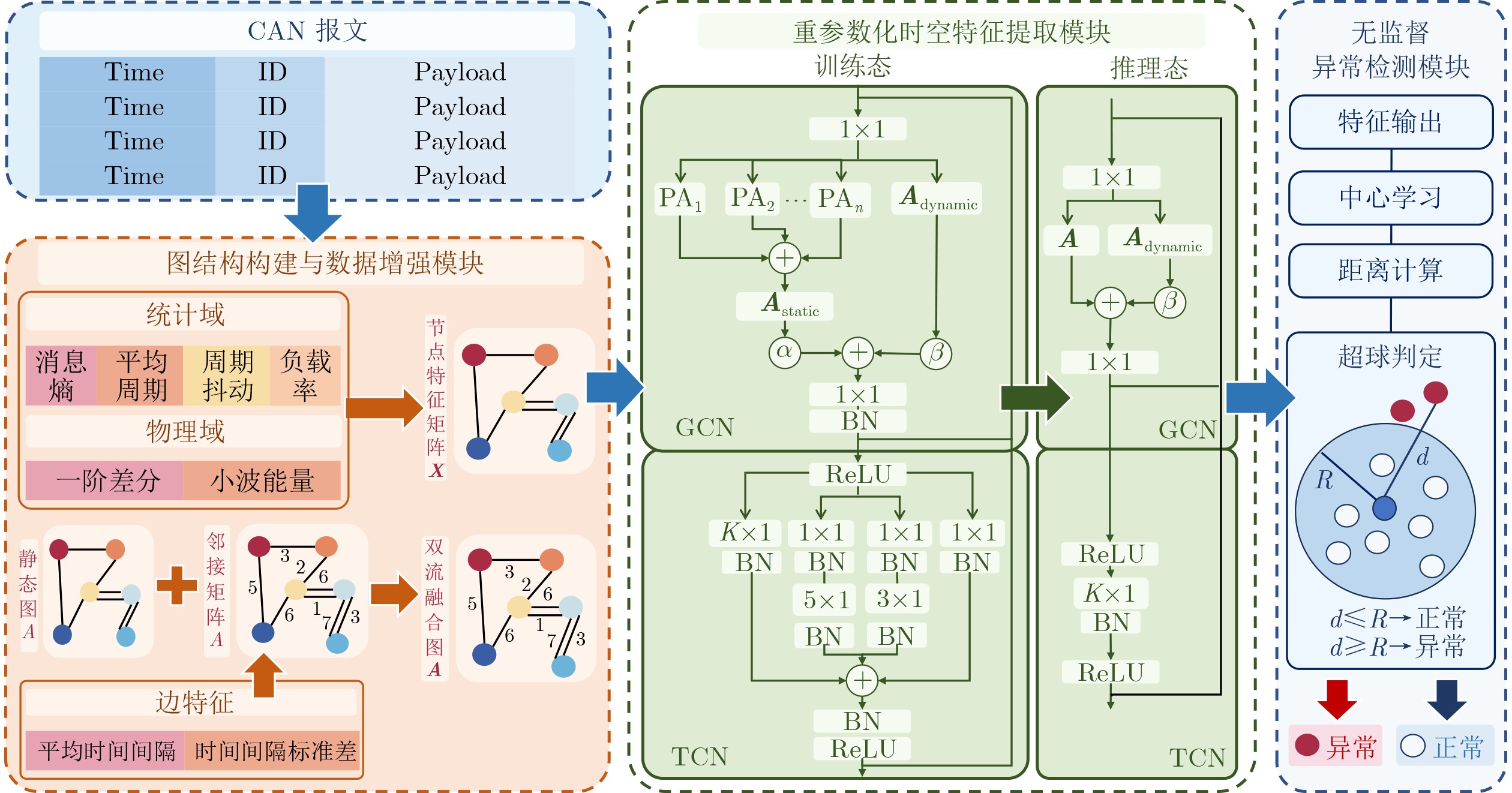
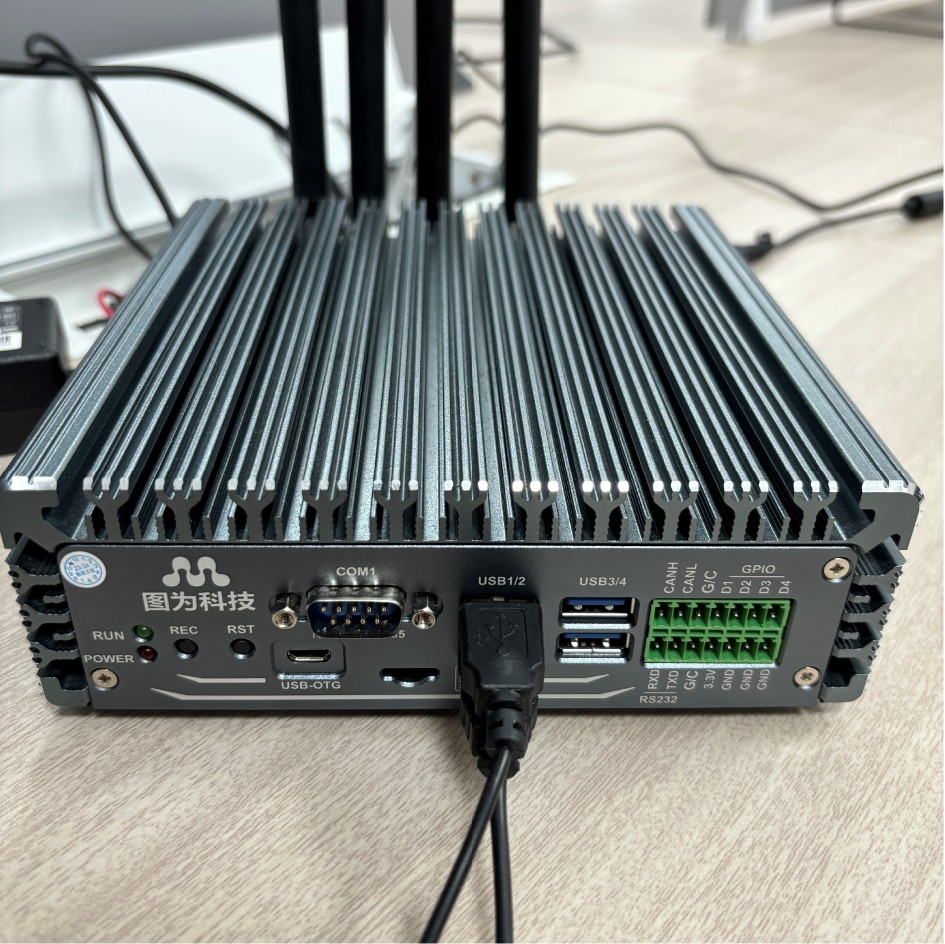
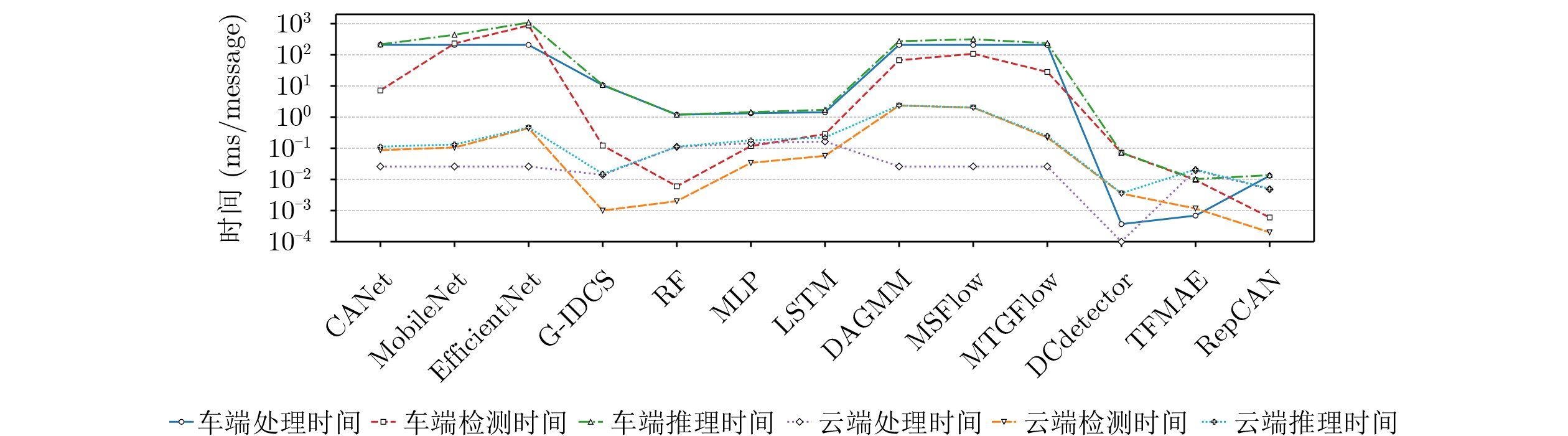
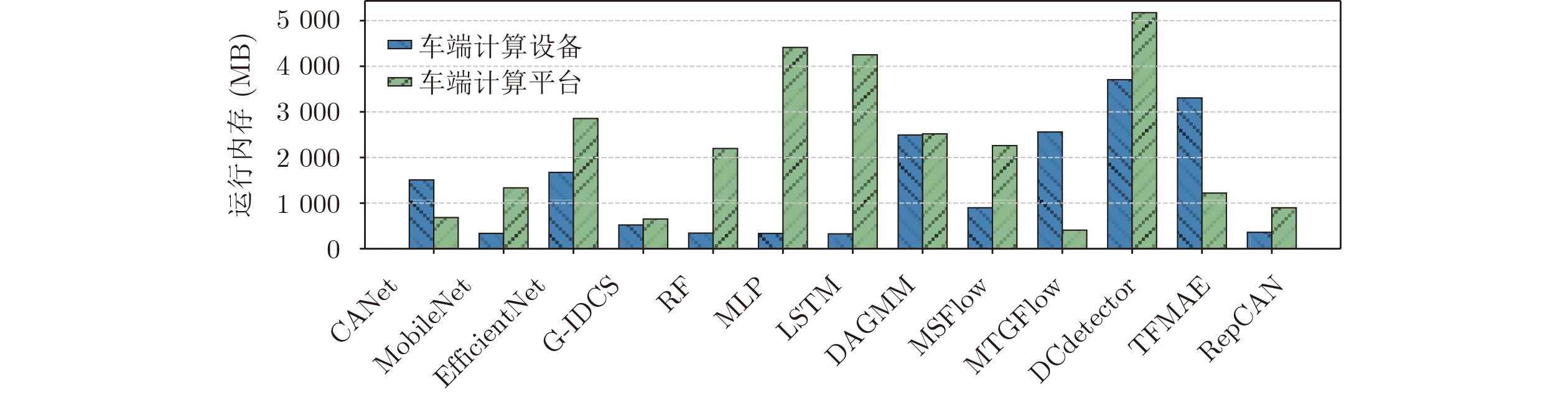
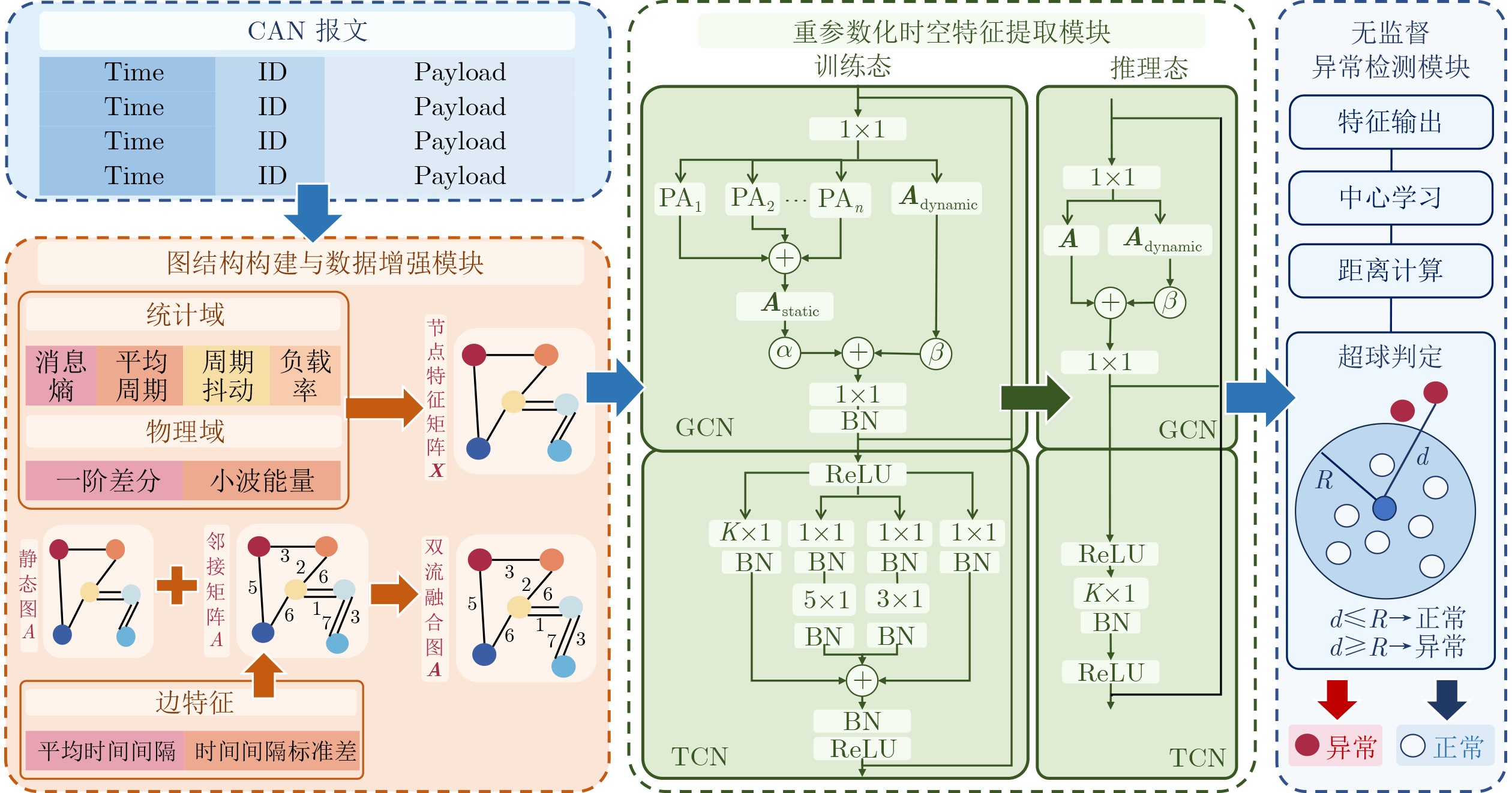
0.9942 ,且单条报文推理延迟低至0.004827 ms。以1 Mbps满载车载网通信环境为基准,该延迟远低于单条报文的最短物理传输时间极限(约为0.1–0.15 ms),有效避免了与核心驾驶任务的算力争夺,具备良好的实车部署潜力。Abstract:Objective With the rapid popularization of Intelligent Connected Vehicles (ICVs), the interaction between the inherently closed In-Vehicle Network (IVN) and external environments occurs increasingly frequently. Consequently, vehicles are exposed to open network environments, facing severe threats from external cyberattacks such as message injection and semantic manipulation. Once a vehicle is remotely compromised, devastating consequences, including core control system hijacking, sensitive data leakage, and fatal accidents, can occur. As a critical security measure, Intrusion Detection Systems (IDS) are widely recognized by both academia and industry due to their protocol-independent and non-intrusive deployment characteristics. Furthermore, the R155 regulation issued by the UN/WP.29 explicitly requires that vehicles on the market must possess IVN intrusion detection capabilities. While deep learning-based models possess powerful feature extraction capabilities and have become the mainstream direction for IVN intrusion detection, traditional deep Graph Neural Networks (GNNs) and large-parameter Transformers face severe computational and memory constraints when deployed on vehicle edge devices. To address these challenges, RepCAN, a novel lightweight intrusion detection technology for IVNs integrating temporal graph re-parameterization, is proposed in this paper. The primary objective is to balance high-generalization detection capabilities and low resource consumption through a unique "ghost node" mechanism and lossless architecture transformations, specifically targeting the Controller Area Network (CAN) protocol under a vehicle-cloud collaborative architecture. Methods The proposed RepCAN framework is constructed as an efficient lightweight intrusion detection model suitable for real-world automotive environments, comprising three core modules. First, a graph structure construction and data augmentation module is developed. To transform the unstructured raw CAN message stream into semantic tensors processable by GNNs, a hierarchical sliding window strategy is employed. Within each window, dual features encompassing statistical patterns and deep payload semantics are extracted. Statistical features include message entropy, average periodicity, and periodicity jitter to capture fuzzing noise and temporal conflicts. For payload semantics, first-order differences of the payload are calculated to capture non-continuous jumps, and discrete wavelet transforms are utilized to extract the energy spectrum of detail coefficients. This approach successfully identifies disguised attacks without relying on explicit semantic decoding. In terms of graph topology, a lightweight dual-stream graph and a "ghost node" mechanism are designed. A learnable global static adjacency matrix is constructed to learn physical topology control priors, while a dynamic adjacency matrix is generated based on communication frequencies. The ghost node mechanism redirects sudden out-of-distribution messages to a virtual node, transforming traffic bursts into structural feature evolutions. Second, a re-parameterized spatiotemporal feature extraction module is designed. In the training phase, a multi-branch Re-parameterized Graph Convolutional Network (RepGCN) and a Re-parameterized Temporal Convolutional Network (RepTCN) are utilized to capture complex spatiotemporal dependencies. RepGCN handles the spatial stream using a multi-head aggregation structure, allowing the model to capture dependencies among Electronic Control Units (ECUs) from different subspaces. RepTCN employs multi-branch temporal convolutions with varying kernel sizes to capture multi-scale long- and short-term temporal patterns. During the inference phase, structural re-parameterization techniques mathematically collapse these multi-branch architectures into highly efficient single-path structures. Third, an unsupervised anomaly detection module is implemented. Deep Support Vector Data Description (Deep SVDD) is adopted to map the extracted deep spatiotemporal features into a minimum enclosing hypersphere. Anomalies are systematically detected in a completely unsupervised manner by calculating the Euclidean distance between the test sample and the hypersphere center. Results and Discussions Extensive experiments are conducted on the widely recognized Car-Hacking dataset, which includes normal traffic and four attack types: DoS, Fuzzy, Gear, and RPM ( Table 1 ). Comparative evaluations against mainstream supervised and unsupervised baseline methods demonstrate the superiority of the proposed RepCAN model. Under an unsupervised setting, RepCAN achieves an Accuracy of0.9840 , an F1-score of0.9798 , and an Area Under the Curve (AUC) of0.9942 , outperforming all unsupervised baselines and rivaling classic supervised models (Table 2 ). Notably, RepCAN maintains a False Positive Rate (FPR) of0.0117 while achieving a Recall of0.9774 , indicating a strong ability to balance missed detection and false alarm risks in highly imbalanced vehicular network scenarios. Comprehensive ablation studies are performed to validate the contribution of specific components. The integration of statistical and payload semantic features significantly enhances defense robustness, increasing the F1-score to0.9798 compared to relying on a single feature domain (Table 3 ). Furthermore, topological ablation experiments confirm that removing the ghost node mechanism drops the F1-score to0.8902 , highlighting its necessity for the adaptive perception of unknown threats. The removal of the dual-stream structure or the multi-branch re-parameterization module similarly degrades overall performance (Table 4 ). To verify practical deployment feasibility, the framework is evaluated in a vehicle-cloud collaborative environment utilizing an NVIDIA Jetson Orin Nano edge computing device (Fig. 2 ). Through structural re-parameterization, the model's parameters are reduced by 64.15% and Floating-Point Operations (FLOPs) are decreased by 59.32% during inference (Table 5 ). Experimental results indicate that RepCAN achieves an overall inference latency of0.004827 ms/message on the vehicle-end device (Fig. 3 ). This latency is significantly lower than the shortest physical transmission time limit of a CAN message (approximately 0.1 to 0.15 ms), effectively avoiding competition for computing power with core driving tasks. Additionally, the operational memory overhead of RepCAN is restricted to approximately 360 MB, substantially lower than many baseline models, proving its exceptional lightweight characteristics and adaptability to strictly constrained storage resources (Fig. 4 ). Further verification on the full Car-Hacking test set (Table 6 ) validates the lossless re-parameterization mechanism, with deep feature errors at the 10-4 level and ΔAUC below0.0007 across all attack scenarios. Additional evaluation on ROAD dataset masquerade attacks (Table 7 ) reveals notable performance degradation, as pure semantic attacks without timing disturbances remain a limitation of this lightweight framework.Conclusions A lightweight intrusion detection technology for CAN buses, RepCAN, integrating temporal graph re-parameterization, is proposed in this study. The innovatively designed ghost node mechanism maps out-of-distribution anomalous traffic to a virtual node, enhancing structural representation and model generalization without expanding the graph scale. Moreover, structural re-parameterization resolves the conflict between high-capacity multi-scale training requirements and low-latency inference constraints. Evaluations on the benchmark dataset and hardware platform confirm that RepCAN achieves a compelling balance between state-of-the-art detection performance and minimal resource consumption. Future investigations will target stealthy camouflage attacks, such as the Masquerade Attack, by incorporating fine-grained semantic analysis mechanisms to eliminate feature perception blind spots. -
1 幽灵节点构建与动态路由
输入:正常训练集CAN ID集合$ {\boldsymbol{I}}_{\text{known}} $;时间片$ {\boldsymbol{S}}_{t}=\left\{\left({c}_{i},{\tau }_{i},{p}_{i}\right)\right\}_{i=1}^{W} $ 输出:节点特征矩阵$ {\boldsymbol{X}}^{t} $和动态邻接矩阵$ \boldsymbol{A}_{\text{dynamic}}^{t} $ 1: 保留节点$ {v}_{0} $作为幽灵节点,为合法ID $ c\in {\boldsymbol{I}}_{\text{known}} $分配编号$ r\left(c\right)\in \{1{,}2,\cdots ,N\} $; 2: 初始化消息桶$ \boldsymbol{B}_{v}^{t}=\varnothing $与转移集合$ D_{uv}^{t}=\varnothing $, $ \forall u,v $; 3: for $ i=1 $ to $ W $ do 4: $ {v}_{i}\leftarrow \left({c}_{i}\in {\boldsymbol{I}}_{\text{known}}\right)?r\left({c}_{i}\right)\colon 0; $ //ID $ {v}_{0} $ 5: 将报文$ \left({c}_{i},{\tau }_{i},{p}_{i}\right) $加入$ \boldsymbol{B}_{{v}_{i}}^{t} $; 6: if $ i> 1 $ then 将 $ {\tau }_{i}-{\tau }_{i-1} $ 加入$ D_{{v}_{i-1},{v}_{i}}^{t} $; 7: end 8: for $ v=0 $ to $ N $ do $ \boldsymbol{x}_{v}^{t}=\left[H_{v}^{t},\mu _{\Delta\tau ,v}^{t},\sigma _{\Delta \tau ,v}^{t},\rho _{v}^{t},d_{v}^{t},w_{v}^{t}\right] $; 9: for 每个节点对$ (u,v) $ do $ A_{uv}^{t}\leftarrow \left(D_{uv}^{t}\neq \varnothing \right)?\dfrac{|D_{uv}^{t}|}{\text{mean}\left(D_{uv}^{t}\right)+\text{std}\left(D_{uv}^{t}\right)+\epsilon }\colon 0 $; 10: return $ {\boldsymbol{X}}^{t}=\left[\boldsymbol{x}_{0}^{t},\ldots ,\boldsymbol{x}_{N}^{t}\right] $ 和 $ \boldsymbol{A}_{\text{dynamic}}^{t} $;  下载: 导出CSV
表 1 Car-Hacking数据集的分布
类型 正常样本数 攻击样本数 攻击占比 样本总数 Normal 988987 0 0 988987 DoS 3078250 587521 0.16 3665771 Fuzzy 3347013 491847 0.13 3838860 Gear 3845890 597252 0.13 4443142 RPM 3966805 654897 0.14 4621702
下载: 导出CSV
表 2 RepCAN与各方法的对比结果
类型 方法 Accuracy Precision AUC F1 Recall FPR 监督 G-IDCS 0.9269 0.8759 0.9259 0.8735 0.8711 0.1450 RF 0.9733 0.9807 0.9463 0.9303 0.8208 0.0033 MLP 0.9314 0.9222 0.8317 0.7782 0.6731 0.0094 LSTM 0.9415 0.7521 0.9512 0.8055 0.8672 0.0000 EfficientNet 0.0688 0.2526 0.9626 0.1018 0.8015 0.1868 MobileNet 0.2815 0.2474 0.9851 0.2474 0.8485 0.1865 CANet 0.9050 0.6447 0.9942 0.7347 0.9725 0.0727 无监督 DAGMM 0.9417 0.0000 0.5000 0.0000 0.0000 0.0000 MSFlow 0.9364 0.5092 0.5910 0.5344 0.5621 0.0000 MTGFlow 0.6848 0.5239 0.6398 0.5191 0.5144 0.0075 DCdetector 0.7855 0.3463 0.6142 0.3609 0.5498 0.1362 TFMAE 0.7606 0.3104 0.7587 0.3987 0.5572 0.2056 RepCAN(Ours) 0.9840 0.9823 0.9942 0.9798 0.9774 0.0117
下载: 导出CSV
表 3 带有特征消融变体的详细性能比较
特征变体 Accuracy Precision AUC F1 Recall FPR RepCAN(Ours) 0.9840 0.9823 0.9942 0.9798 0.9774 0.0117 STAT-only 0.9624 0.9657 0.9855 0.9521 0.9389 0.0221 Phys-only 0.9539 0.9780 0.9423 0.9399 0.9046 0.0135
下载: 导出CSV
表 4 RepCAN 架构组件的消融研究
模块 架构变体 攻击类型 Accuracy Precision AUC F1 Recall FPR 完整模型 RepCAN(Ours) - 0.9840 0.9823 0.9942 0.9798 0.9774 0.0117 节点表示 w/o Ghost Node DoS 0.9834 0.9829 0.9937 0.9734 0.9640 0.0077 Fuzzy 0.8924 0.9293 0.8507 0.8317 0.7527 0.0313 Gear 0.9842 0.9947 0.9904 0.9819 0.9693 0.0040 RPM 0.8759 0.9091 0.9331 0.8582 0.8127 0.0698 Overall 0.9181 0.9565 0.9376 0.8902 0.8324 0.0251 图结构 w/o Dual-Stream - 0.7752 0.7528 0.7941 0.6972 0.6493 0.1413 重参数化 Conv (K=3) - 0.8845 0.8923 0.9423 0.8478 0.8075 0.0646 Conv (K=5) - 0.8382 0.8763 0.8376 0.7732 0.6198 0.0647
下载: 导出CSV
表 5 模型推理效率与资源消耗对比
评估指标 多路训练 单路推理 降幅(%) 参数量(M) 0.4294 0.1540 ↓64.15 FLOPs(M) 2.7824 1.1318 ↓59.32 存储占用(MB) 1.7004 0.6013 ↓64.64 内存占用(MB) 2.0540 0.8982 ↓56.27
下载: 导出CSV
表 6 重参数化前后输出一致性与误差评估
攻击类型 样本数 深层特征平均绝对误差 异常得分 训练态AUC 推理态AUC $ \Delta \text{AUC} $ DoS 146621 5.33×10⁻⁴ 4.15×10⁻³ 0.97646 0.97658 1.23×10⁻⁴ Fuzzy 153545 7.52×10⁻⁴ 4.15×10⁻³ 0.96377 0.96384 7.43×10⁻⁵ Gear 177716 7.00×10⁻⁴ 3.70×10⁻³ 0.93155 0.93089 6.59×10⁻⁴ RPM 184859 9.02×10⁻⁴ 4.09×10⁻³ 0.99090 0.99093 2.48×10⁻⁵ Overall 662741 7.31×10⁻⁴ 4.01×10⁻³ - - -
下载: 导出CSV
表 7 RepCAN在ROAD数据集Masquerade Attack下的定量评估结果
评估子项 攻击场景 Accuracy AUC F1 correlated_signal_attack 多相关信号协同篡改 0.3648 0.7991 0.0000 max_engine_coolant_temp_attack 动力系统传感信号超限篡改 0.2393 0.6403 0.0000 max_speedometer_attack 车载仪表感知信号篡改 0.2966 0.9447 0.0068 reverse_light_off_attack 执行器信号强制关闭 0.7563 0.6363 0.0000 reverse_light_on_attack 执行器虚假触发 0.4860 0.7578 0.0011 Overall - 0.5237 0.7680 0.0015
下载: 导出CSV
-
[1] 韩乔妮, 马建国, 李鹏, 等. 混合网络攻击下车辆队列的无模型自适应弹性控制[J]. 电子与信息学报, 2026, 48(5): 2066–2076. doi: 10.11999/JEIT251135.HAN Qiaoni, MA Jianguo, LI Peng, et al. Model-free adaptive resilient control of vehicle platoons against hybrid cyberattacks[J]. Journal of Electronics & Information Technology, 2026, 48(5): 2066–2076. doi: 10.11999/JEIT251135. [2] WANG Kai, ZHANG Aiheng, SUN Haoran, et al. Analysis of recent deep-learning-based intrusion detection methods for in-vehicle network[J]. IEEE Transactions on Intelligent Transportation Systems, 2023, 24(2): 1843–1854. doi: 10.1109/TITS.2022.3222486. [3] YING Xuhang, SAGONG S U, CLARK A, et al. Shape of the cloak: Formal analysis of clock skew-based intrusion detection system in controller area networks[J]. IEEE Transactions on Information Forensics and Security, 2019, 14(9): 2300–2314. doi: 10.1109/TIFS.2019.2895957. [4] MÜTER M and ASAJ N. Entropy-based anomaly detection for in-vehicle networks[C]. 2011 IEEE Intelligent Vehicles Symposium (IV), Baden-Baden, Germany, 2011: 1110–1115. doi: 10.1109/IVS.2011.5940552. [5] CHO K T and SHIN K G. Fingerprinting electronic control units for vehicle intrusion detection[C]. Proceedings of the 25th USENIX Conference on Security Symposium, Austin, USA, 2016: 911–927. [6] GROZA B and MURVAY P S. Efficient intrusion detection with bloom filtering in controller area networks[J]. IEEE Transactions on Information Forensics and Security, 2019, 14(4): 1037–1051. doi: 10.1109/TIFS.2018.2869351. [7] 张瑞丰, 杨荣妮. 拒绝服务攻击下信息物理系统的数据驱动安全控制: 一种在线模态依赖的切换-Q-学习策略[J]. 电子与信息学报, 2026, 48(4): 1424–1433. doi: 10.11999/JEIT250746.ZHANG Ruifeng and YANG Rongni. Data-driven secure control for cyber-physical systems under denial-of-service attacks: An online mode-dependent switching-Q-learning algorithm[J]. Journal of Electronics & Information Technology, 2026, 48(4): 1424–1433. doi: 10.11999/JEIT250746. [8] XIE Guoqi, YANG L T, YANG Yuanda, et al. Threat analysis for automotive CAN networks: A GAN model-based intrusion detection technique[J]. IEEE Transactions on Intelligent Transportation Systems, 2021, 22(7): 4467–4477. doi: 10.1109/TITS.2021.3055351. [9] MCHERGUI A, MOULAHI T, and ZEADALLY S. Survey on artificial intelligence (AI) techniques for vehicular ad-hoc networks (VANETs)[J]. Vehicular Communications, 2022, 34: 100403. doi: 10.1016/j.vehcom.2021.100403. [10] RAJAPAKSHA S, KALUTARAGE H, AL-KADRI M O, et al. AI-based intrusion detection systems for in-vehicle networks: A survey[J]. ACM Computing Surveys, 2023, 55(11): 237. doi: 10.1145/3570954. [11] LAMPE B and MENG Weizhi. A survey of deep learning-based intrusion detection in automotive applications[J]. Expert Systems with Applications, 2023, 221: 119771. doi: 10.1016/j.eswa.2023.119771. [12] AL-AQL N and AL-SHAMMARI A. Hybrid RNN-LSTM networks for enhanced intrusion detection in vehicle CAN systems[J]. Journal of Electrical Systems, 2024, 20(6s): 3019–3031. doi: 10.52783/jes.3318. [13] XU He, WU Di, LU Yufeng, et al. Models on the move: Towards feasible embedded AI for intrusion detection on vehicular CAN bus[C]. Proceedings of the 2024 USENIX Conference on Usenix Annual Technical Conference, Santa Clara, USA, 2024: 64. [14] HOSSAIN M D, INOUE H, OCHIAI H, et al. An effective in-vehicle CAN bus intrusion detection system using CNN deep learning approach[C]. GLOBECOM 2020-2020 IEEE Global Communications Conference, Taipei, China, 2020: 1–6. doi: 10.1109/GLOBECOM42002.2020.9322395. [15] JAVED A R, UR REHMAN S, KHAN M U, et al. CANintelliIDS: Detecting in-vehicle intrusion attacks on a controller area network using CNN and attention-based GRU[J]. IEEE Transactions on Network Science and Engineering, 2021, 8(2): 1456–1466. doi: 10.1109/TNSE.2021.3059881. [16] ZHANG Hengrun, ZENG Kai, and LIN Shuai. Federated graph neural network for fast anomaly detection in controller area networks[J]. IEEE Transactions on Information Forensics and Security, 2023, 18: 1566–1579. doi: 10.1109/TIFS.2023.3240291. [17] HE Yaru, GAO Jiaqi, FAN Mingrui, et al. A&D graph-based graph neural network intrusion detection for in-vehicle controller area network[C]. 2024 IEEE/CIC International Conference on Communications in China (ICCC), Hangzhou, China, 2024: 1281–1286. doi: 10.1109/ICCC62479.2024.10681772. [18] ALKHATIB N, MUSHTAQ M, GHAUCH H, et al. CAN-BERT do it? Controller area network intrusion detection system based on BERT language model[C]. 2022 IEEE/ACS 19th International Conference on Computer Systems and Applications (AICCSA), Abu Dhabi, United Arab Emirates, 2022: 1–8. doi: 10.1109/AICCSA56895.2022.10017800. [19] WU Zhongqiang and LI Mengting. ResNet-Swin Transformer based intrusion detection system for in-vehicle network[J]. Expert Systems with Applications, 2025, 279: 127547. doi: 10.1016/j.eswa.2025.127547. [20] 谈名名, 张恒, 王鑫, 等. 一种融合时序与深度特征的二阶段CAN总线攻击识别方法[J]. 电子与信息学报, 2026, 48(4): 1444–1453. doi: 10.11999/JEIT250651.TAN Mingming, ZHANG Heng, WANG Xin, et al. A two-stage framework for CAN bus attack detection by fusing temporal and deep features[J]. Journal of Electronics & Information Technology, 2026, 48(4): 1444–1453. doi: 10.11999/JEIT250651. [21] WANG Yingqing, QIN Guihe, ZOU Mi, et al. A lightweight intrusion detection system for internet of vehicles based on transfer learning and MobileNetV2 with hyper-parameter optimization[J]. Multimedia Tools and Applications, 2024, 83(8): 22347–22369. doi: 10.1007/s11042-023-15771-6. [22] WANG Shaoqiang, WANG Yizhe, ZHENG Baosen, et al. Intrusion detection system for vehicular networks based on MobileNetV3[J]. IEEE Access, 2024, 12: 106285–106302. doi: 10.1109/ACCESS.2024.3437416. [23] JEONG S, LEE S, LEE H, et al. X-CANIDS: Signal-aware explainable intrusion detection system for controller area network-based in-vehicle network[J]. IEEE Transactions on Vehicular Technology, 2024, 73(3): 3230–3246. doi: 10.1109/TVT.2023.3327275. [24] WANG Kai, JIANG Qiguang, WANG Bailing, et al. StatGraph: Effective in-vehicle intrusion detection via multi-view statistical graph learning[J]. IEEE Transactions on Mobile Computing, 2026, 25(5): 6335–6351. doi: 10.1109/TMC.2025.3636517. [25] ZHANG Aiheng, SUN Zhen, JIANG Qiguang, et al. LiPar: A lightweight parallel learning model for practical in-vehicle network intrusion detection[J]. IEEE Transactions on Intelligent Transportation Systems, 2025, 26(12): 23358–23373. doi: 10.1109/TITS.2025.3605465. [26] JIANG Qiguang, WANG Kai, WEI Yuliang, et al. XIPHOS: Adaptive in-vehicle intrusion detection via unsupervised graph contrastive learning[J]. IEEE Transactions on Information Forensics and Security, 2025, 20: 10419–10433. doi: 10.1109/TIFS.2025.3616624. [27] LI Sifan, CAO Yue, ZHANG Yu’ang, et al. A cloud collaborative-based intrusion detection and prevention system for IVN[J]. IEEE Transactions on Cognitive Communications and Networking, 2025, 11(4): 2768–2785. doi: 10.1109/TCCN.2024.3516052. [28] ALTHUNAYYAN M, JAVED A, and RANA O. A robust multi-stage intrusion detection system for in-vehicle network security using hierarchical federated learning[J]. Vehicular Communications, 2024, 49: 100837. doi: 10.1016/j.vehcom.2024.100837. [29] CAO Jinhui, DI Xiaoqiang, LIU Xu, et al. Anomaly detection for in-vehicle network using self-supervised learning with vehicle-cloud collaboration update[J]. IEEE Transactions on Intelligent Transportation Systems, 2024, 25(7): 7454–7466. doi: 10.1109/TITS.2024.3351438. [30] DING Xiaohan, ZHANG Xiangyu, MA Ningning, et al. RepVGG: Making VGG-style ConvNets great again[C]. Proceedings of the 2021 IEEE/CVF Conference on Computer Vision and Pattern Recognition (CVPR), Nashville, USA, 2021: 13728–13737. doi: 10.1109/CVPR46437.2021.01352. [31] WANG Junyi, LI Zi’ao, LIU Bangli, et al. High-performance inference graph convolutional networks for skeleton-based action recognition[J]. Neurocomputing, 2025, 653: 131078. doi: 10.1016/j.neucom.2025.131078. [32] RUFF L, VANDERMEULEN R A, GÖRNITZ N, et al. Deep one-class classification[C]. Proceedings of the 35th International Conference on Machine Learning, Stockholm, Sweden, 2018: 4393–4402. [33] DENG Zhouyan, XUN Yijie, LIU Jiajia, et al. A novel intrusion detection system for next generation in-vehicle networks[C]. GLOBECOM 2022-2022 IEEE Global Communications Conference, Rio de Janeiro, Brazil, 2022: 2098–2103. doi: 10.1109/GLOBECOM48099.2022.10000766. [34] SONG H M, WOO J, and KIM H K. In-vehicle network intrusion detection using deep convolutional neural network[J]. Vehicular Communications, 2020, 21: 100198. doi: 10.1016/j.vehcom.2019.100198. [35] SONG Jiaru, QIN Guihe, LIANG Yanhua, et al. DGIDS: Dynamic graph-based intrusion detection system for CAN[J]. Computers & Security, 2024, 147: 104076. doi: 10.1016/j.cose.2024.104076. [36] KALKAN S C and SAHINGOZ O K. In-vehicle intrusion detection system on controller area network with machine learning models[C]. 2020 11th International Conference on Computing, Communication and Networking Technologies (ICCCNT), Kharagpur, India, 2020: 1–6. doi: 10.1109/ICCCNT49239.2020.9225442. [37] GOLOVKO V and VAITSEKHOVICH L. Neural network approaches for intrusion detection and recognition[J]. International Journal of Computing, 2014, 5(3): 118–125. doi: 10.47839/ijc.5.3.416. [38] BERGER I, RIEKE R, KOLOMEETS M, et al. Comparative study of machine learning methods for in-vehicle intrusion detection[C]. ESORICS 2018 International Workshops Computer Security, Barcelona, Spain, 2018: 85–101. doi: 10.1007/978-3-030-12786-2_6. [39] TAN Mingxing and LE Q. EfficientNet: Rethinking model scaling for convolutional neural networks[C]. Proceedings of the 36th International Conference on Machine Learning, Long Beach, USA, 2019: 6105–6114. [40] HOWARD A, SANDLER M, CHEN Bo, et al. Searching for MobileNetV3[C]. Proceedings of the 2019 IEEE/CVF International Conference on Computer Vision (ICCV), Seoul, Korea (South), 2019: 1314–1324. doi: 10.1109/ICCV.2019.00140. [41] HANSELMANN M, STRAUSS T, DORMANN K, et al. CANet: An unsupervised intrusion detection system for high dimensional CAN bus data[J]. IEEE Access, 2020, 8: 58194–58205. doi: 10.1109/ACCESS.2020.2982544. [42] ZONG Bo, SONG Qi, MIN M R, et al. Deep autoencoding gaussian mixture model for unsupervised anomaly detection[C]. 6th International Conference on Learning Representations, Vancouver, Canada, 2018. [43] ZHOU Yixuan, XU Xing, SONG Jingkuan, et al. MSFlow: Multiscale flow-based framework for unsupervised anomaly detection[J]. IEEE Transactions on Neural Networks and Learning Systems, 2025, 36(2): 2437–2450. doi: 10.1109/TNNLS.2023.3344118. [44] ZHOU Qihang, HE Shibo, LIU Haoyu, et al. Label-free multivariate time series anomaly detection[J]. IEEE Transactions on Knowledge and Data Engineering, 2024, 36(7): 3166–3179. doi: 10.1109/TKDE.2024.3349613. [45] YANG Yiyuan, ZHANG Chaoli, ZHOU Tian, et al. DCdetector: Dual attention contrastive representation learning for time series anomaly detection[C]. Proceedings of the 29th ACM SIGKDD Conference on Knowledge Discovery and Data Mining, Long Beach, USA, 2023: 3033–3045. [46] FANG Yuchen, XIE Jiandong, ZHAO Yan, et al. Temporal-frequency masked autoencoders for time series anomaly detection[C]. 2024 IEEE 40th International Conference on Data Engineering (ICDE), Utrecht, Netherlands, 2024: 1228–1241. doi: 10.1109/ICDE60146.2024.00099. [47] 苗金钊, 刘金良, 孙乐, 等. 基于虚假数据检测的信息物理系统安全学习控制方法[J]. 电子与信息学报, 2026, 48(4): 1434–1443. doi: 10.11999/JEIT250537.MIAO Jinzhao, LIU Jinliang, SUN Le, et al. A learning-based security control method for cyber-physical systems based on false data detection[J]. Journal of Electronics & Information Technology, 2026, 48(4): 1434–1443. doi: 10.11999/JEIT250537. -

 下载:
下载:

图(4) / 表(8)
计量
- 文章访问数: 11
- HTML全文浏览量: 1
- PDF下载量: 0
- 被引次数: 0
