




Research on LEO Constellation Interference Prediction and Detection Algorithm Driven by Collaborative Spatial Feature Mapping and Temporal Transformer
-
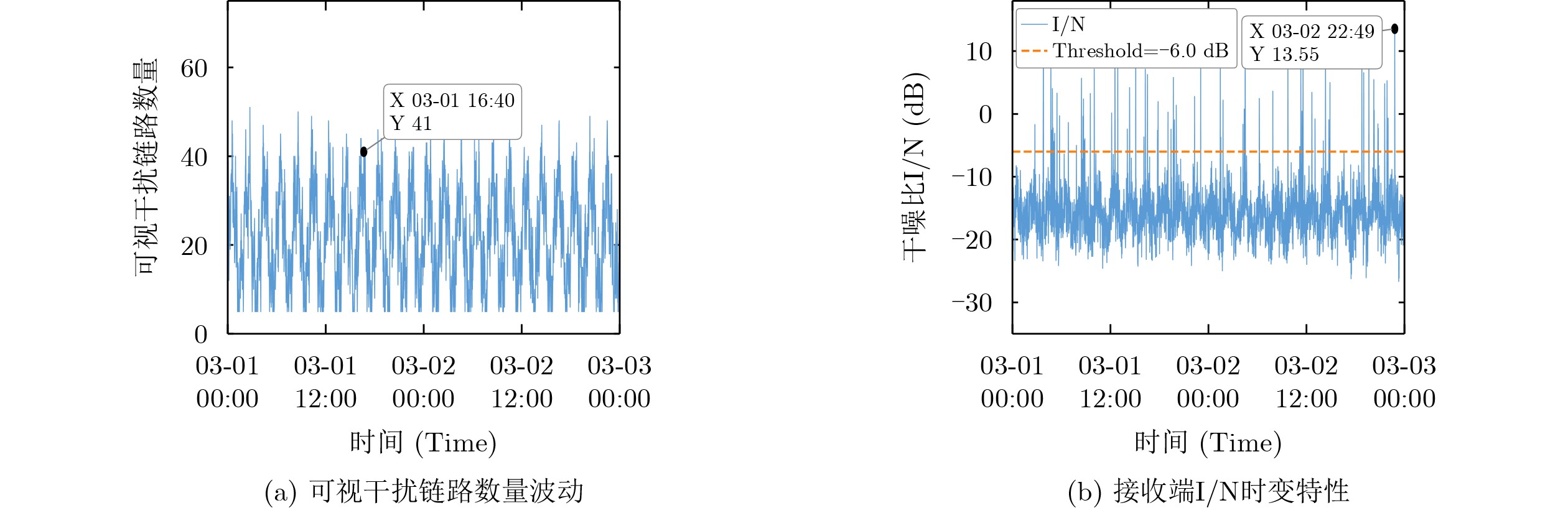
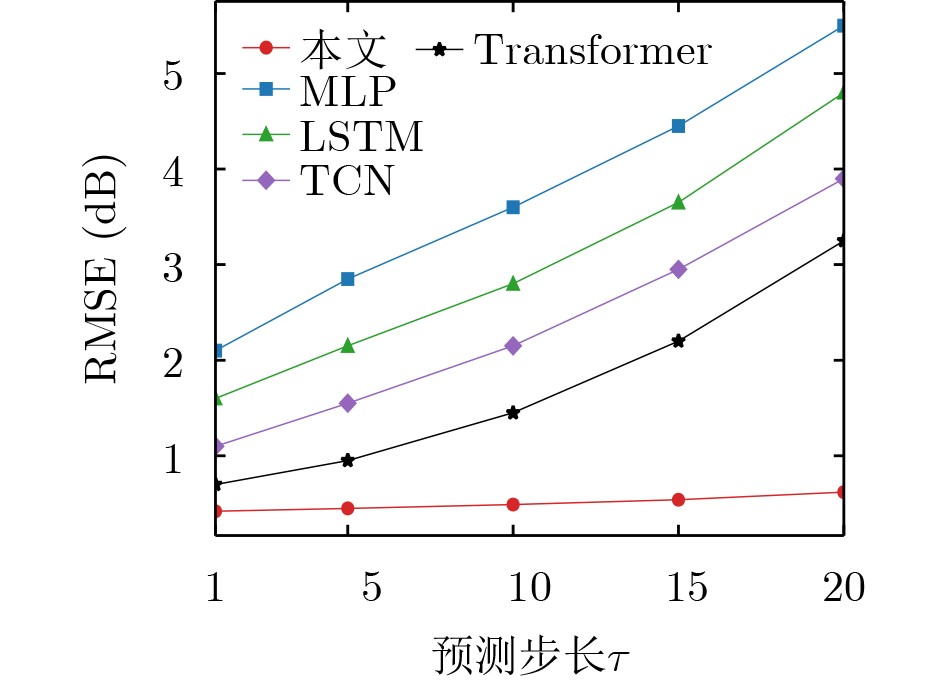
摘要: 针对低轨(LEO)卫星星座高动态拓扑导致的计算开销暴增问题,现有方法主要基于国际电信联盟(ITU)标准的全量物理迭代方法。然而,在轨LEO卫星数量的急剧增加导致干扰预测与检测的计算复杂度阶跃式上升。全量物理迭代仿真下,单个地面站完成单周期干扰评估需超过30个小时。为此,该文提出一种空间特征映射与时序Transformer协同驱动的低轨星座干扰预测与检测算法。首先,建立多星座共存场景下的干扰物理模型,解析出干扰函数的置换不变性、空间稀疏性和时间连续性。调整构建结合可变注意力机制的空间特征映射模块,通过自适应聚焦和对称聚合实现无序变长结构的高效降维压缩。最后,依托时序Transformer精准捕获干扰轨迹的全局演化规律,通过预测未来干扰噪声比(I/N)的时序轨迹,实现干扰事件的敏捷检测。模拟LEO卫星星座场景并以ITU标准为基准进行仿真验证。结果表明:在干扰预测方面,该文算法在20 s长程预测下的均方根误差为0.45 dB;在干扰检测方面,模型能精准刻画物理边界并维持较高的干扰召回率。单次推理耗时稳定在14.2 ms,仅为物理迭代的4.1%。与基线相比,该文算法在多尺度预测步长和动态开销下具有更强自适应性。
-
关键词:
- 低轨卫星星座 /
- 干扰预测与检测 /
- 空间特征映射 /
- 时序Transformer /
- 干扰噪声比
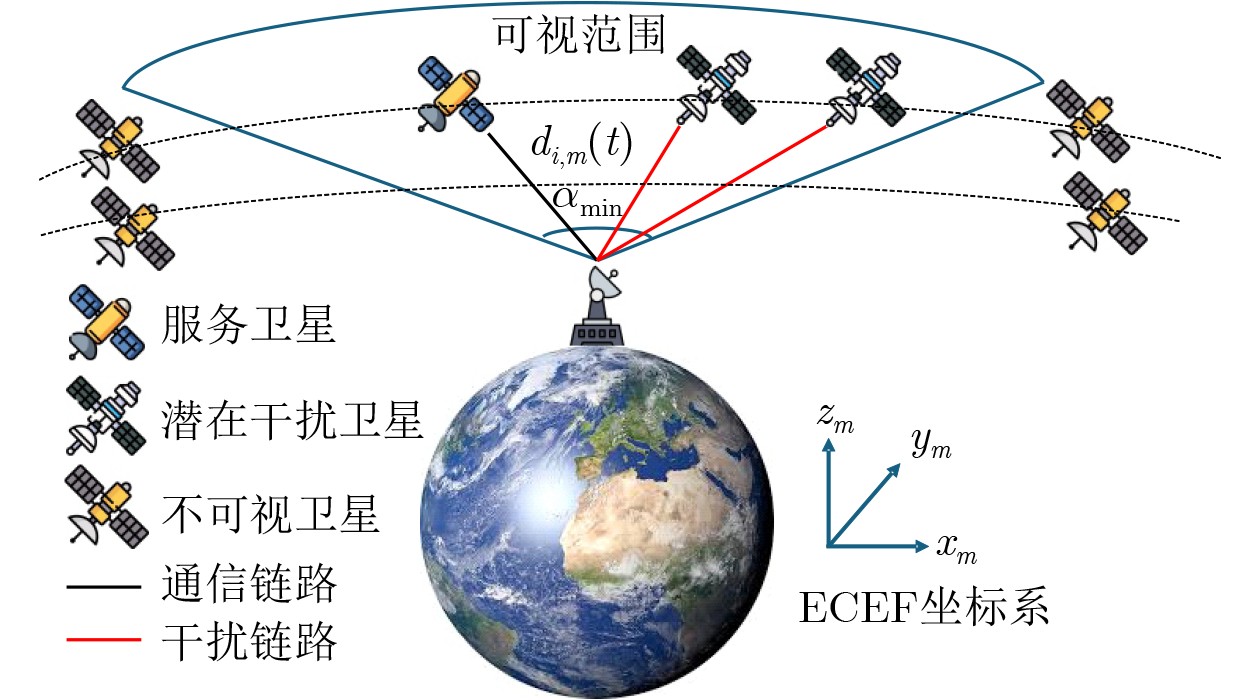
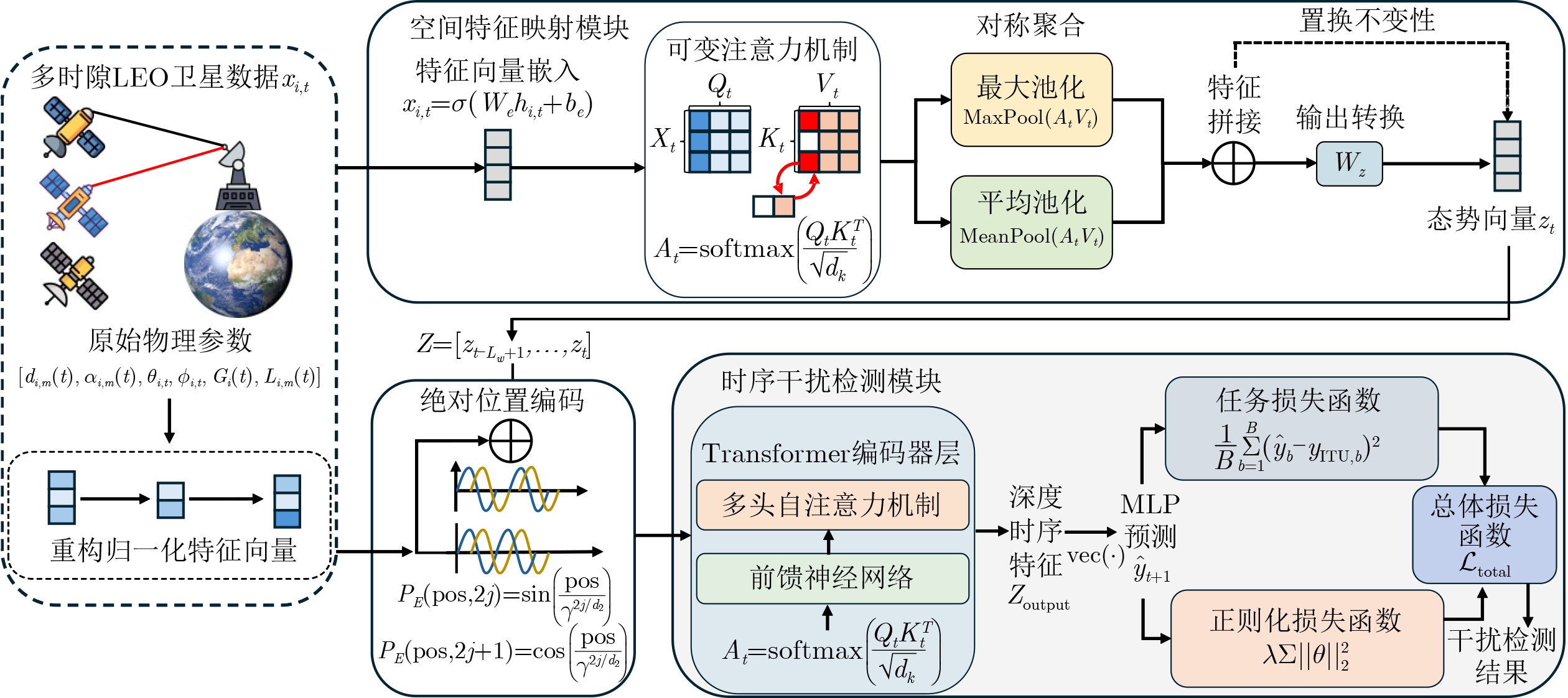
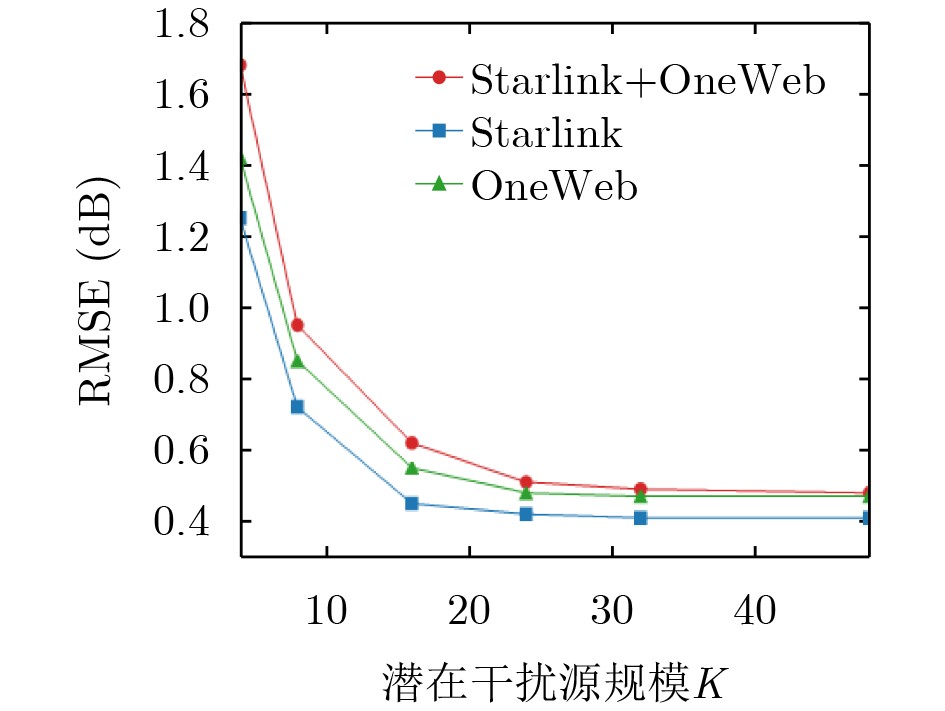
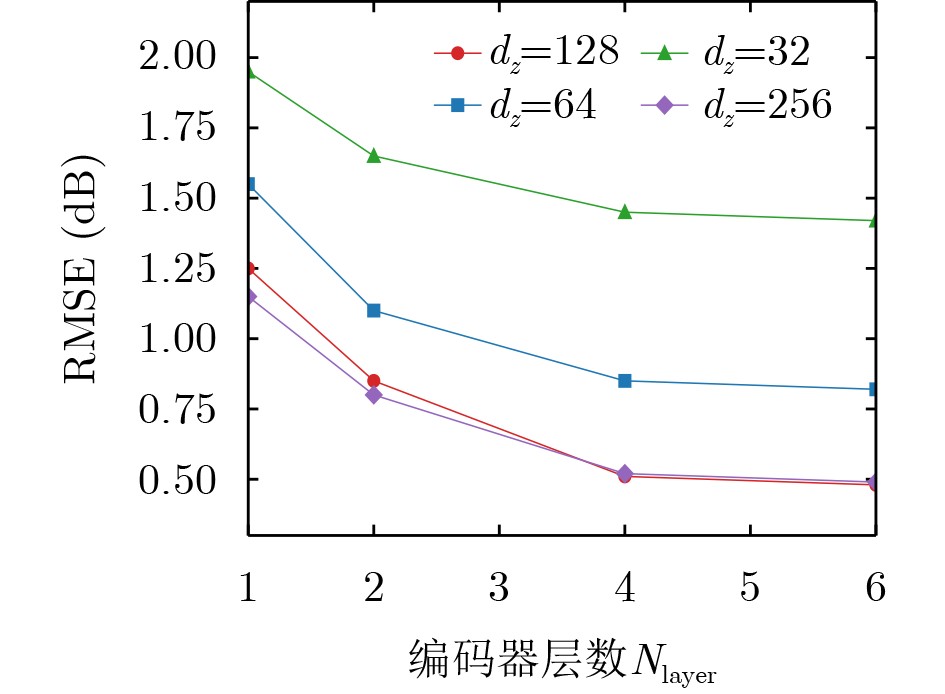
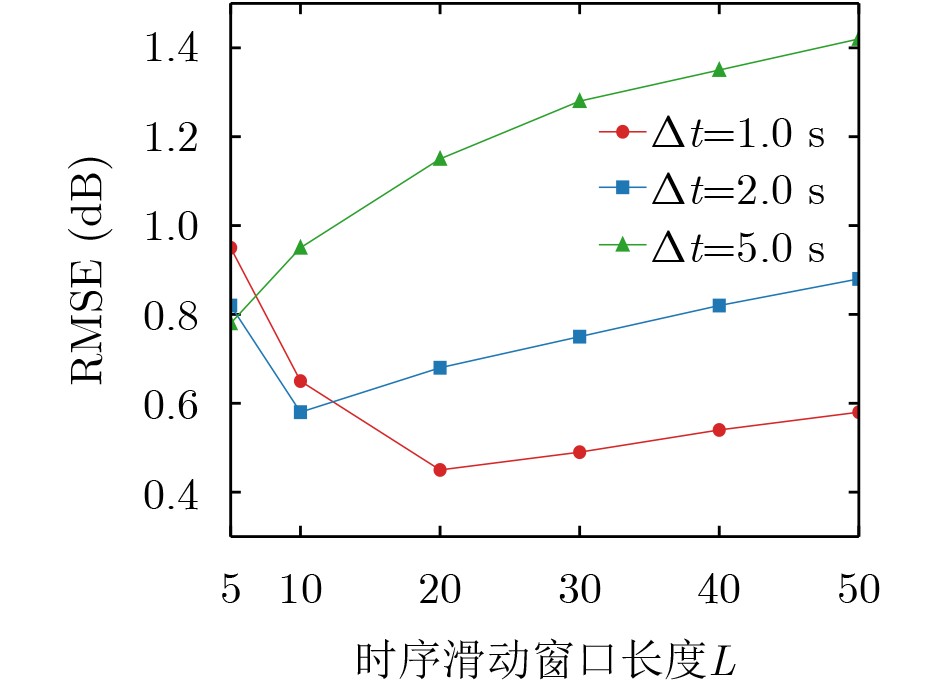
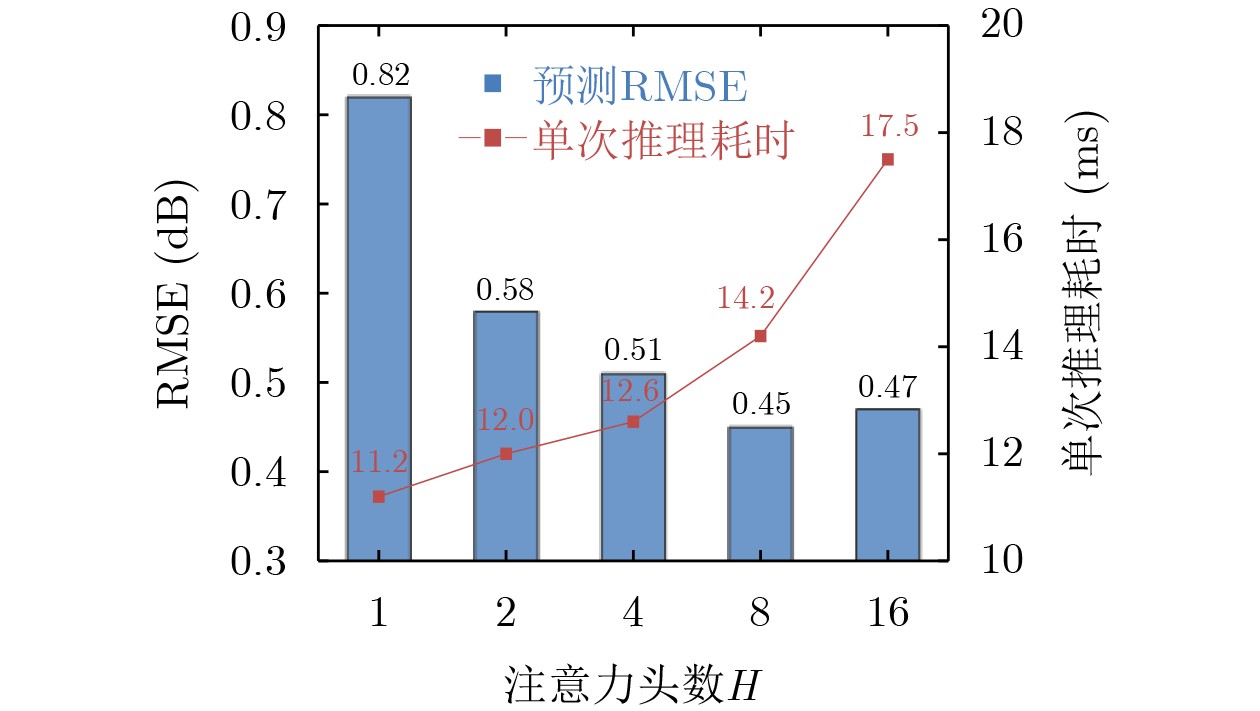
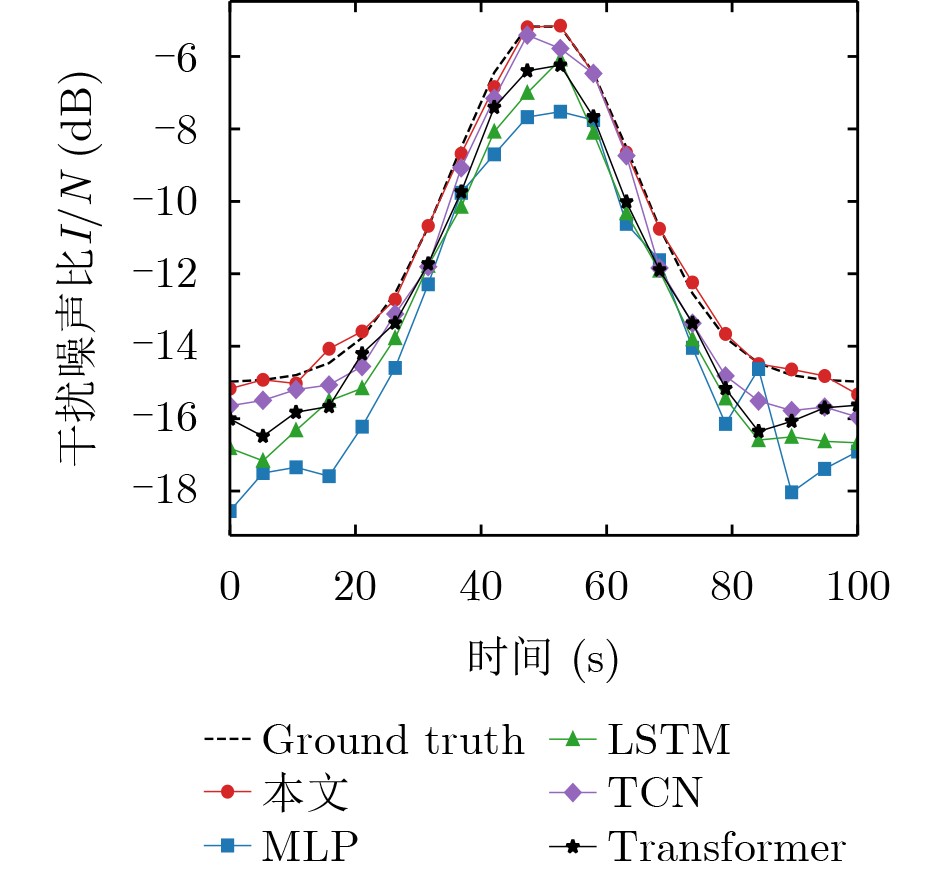
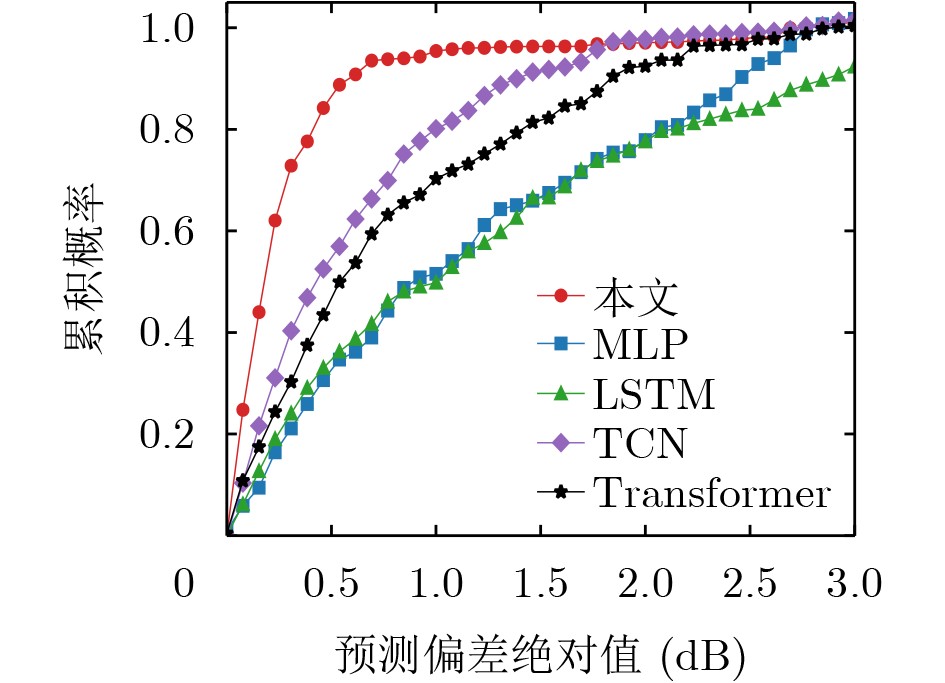
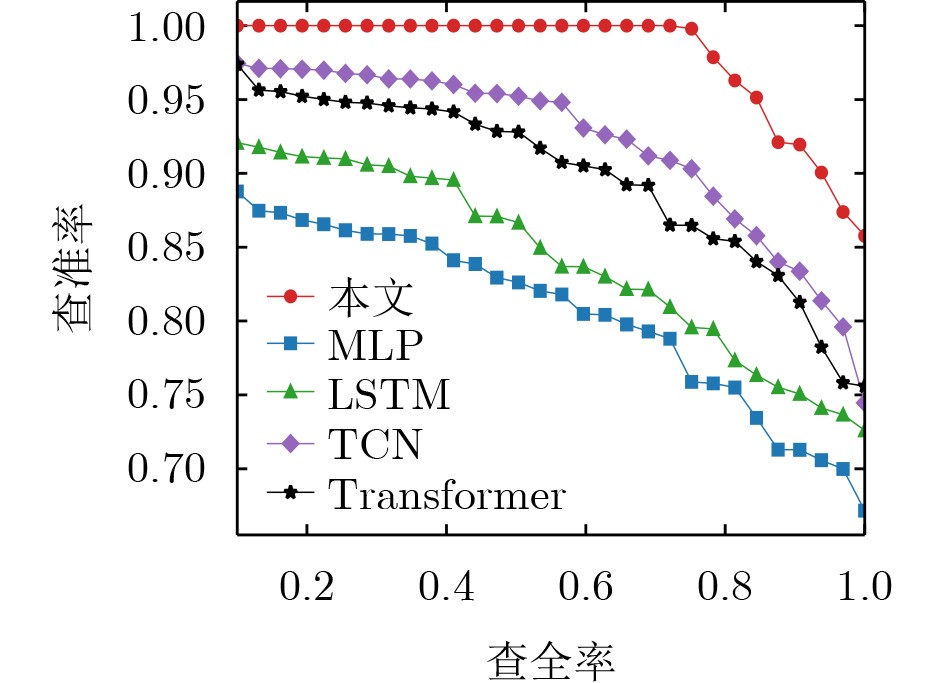
Abstract:Objective The rapid deployment of large-scale Low Earth Orbit (LEO) satellite constellations has intensified competition for orbital and spectrum resources. To improve spectrum utilization, different LEO satellite constellations commonly employ co-frequency reuse, which increases the risk of inter-system co-frequency interference. The high-speed motion of LEO satellites and their highly dynamic, heterogeneous topology further cause rapid variations in interference power, resulting in severe co-frequency interference. Existing interference assessment methods mainly rely on the regulations of the International Telecommunication Union (ITU), with the Interference-to-Noise Ratio (I/Noise) as a key evaluation metric. However, conventional ITU-based physical-iteration methods require repeated calculations of satellite positions, link attenuation and interference contributions for all visible satellites, causing computational cost to increase rapidly with constellation size. A complete interference assessment for a single ground station in a constellation of approximately 10 000 satellites can require more than 30 h. Recent deep-learning-based methods still commonly use all visible satellites as inputs and therefore do not adequately exploit the spatial sparsity of interference features. To address these limitations, an LEO constellation interference prediction and detection method driven by collaborative spatial feature mapping and temporal Transformer is proposed to reduce computational cost while maintaining accurate interference prediction and detection. Methods A spatiotemporal framework is developed to model dynamic co-frequency interference in large-scale heterogeneous multi-constellation LEO networks. Based on the ITU physical interference model, three key properties of the interference function are identified: permutation invariance, spatial sparsity and temporal continuity. The conventional physical-iteration process is therefore reformulated as a spatiotemporally decoupled feature-mapping problem. A spatial feature mapping module with adaptive attention and symmetric pooling is constructed to compress unordered and variable-length satellite interference-source features into fixed-dimensional, permutation-invariant spatial features. The attention mechanism adaptively focuses on dominant interference sources, whereas symmetric pooling using maximum and mean pooling captures extreme and global statistical characteristics while suppressing redundant satellite nodes. A temporal Transformer is then employed to model the long-range evolution of interference trajectories. The future I/Noise trajectory is predicted to support rapid interference detection under dynamic constellation configurations. Results and Discussions A large-scale heterogeneous LEO constellation scenario consisting of 6 800 Starlink satellites and 650 OneWeb satellites is simulated according to ITU regulations. Real Two-Line Element (TLE) data are used to propagate satellite orbits, and 100,000 time-series samples are generated at 0.5 s intervals. Parameter analysis shows that appropriate feature dimensions and encoder depths provide a favorable balance between feature extraction accuracy and computational cost ( Figs. 4 and5 ). The sampling interval and sliding-window length are further optimized to balance prediction accuracy and real-time inference performance (Figs. 6 and7 ). Compared with the baseline methods, the proposed method produces interference trajectories that closely follow the physical-iteration ground truth (Fig. 8 ). At a cumulative probability of 90%, the absolute prediction error is maintained within 0.5 dB (Fig. 9 ). The method also maintains a high interference recall under a low false-alarm-rate constraint (Fig. 10 ). For a 20.0 s prediction horizon, the Root Mean Square Error (RMSE) remains at 0.45 dB, substantially lower than those of the baseline models. At a 20 s prediction step, the RMSE values of the Multi-Layer Perceptron (MLP) and Long Short-Term Memory (LSTM) network increase to 5.53 dB and 4.82 dB, respectively (Fig. 11 ). In terms of computational efficiency, the proposed method requires 14.2 ms for a single inference, which is only 4.1% of the computational time required by the ITU-based physical-iteration method (Table 3 ). The computational cost is therefore effectively decoupled from constellation size.Conclusions To address the high computational cost caused by the highly dynamic topology of LEO satellite networks, a collaborative spatial feature mapping and temporal Transformer-based interference prediction and detection method is proposed. The spatial feature mapping module compresses variable-length interference-source features into fixed-dimensional representations, whereas the temporal Transformer captures the long-range evolution of interference trajectories. Simulation results show that the proposed method provides accurate long-term trajectory tracking while remaining consistent with ITU-based interference assessment. Parameter-sensitivity experiments demonstrate that the proposed method can balance feature extraction accuracy and computational cost under different configurations. With its long-range dependency modeling capability, the temporal Transformer maintains an RMSE of 0.45 dB over a 20 s prediction horizon. By filtering redundant satellite nodes and decoupling computational cost from constellation size, the method reduces single-inference time to 14.2 ms. Comprehensive evaluations of prediction error distributions, detection performance and model parameters demonstrate that the proposed method achieves high prediction accuracy and substantially reduced computational complexity, providing a flexible engineering solution for interference monitoring in large-scale LEO constellation deployments. -
表 1 基本符号及其含义
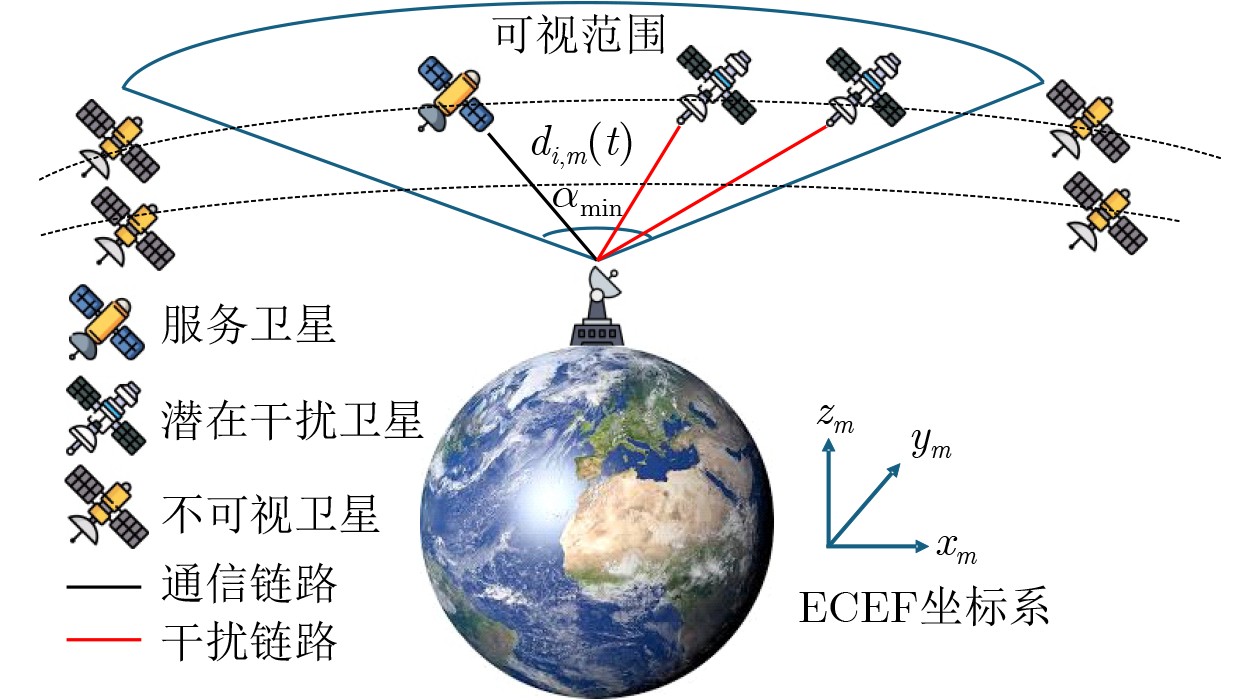
符号 定义 $ N $ LEO星座系统的在轨卫星总数量 $ {d}_{i,m}(t) $ $ t $时刻卫星$ i $与地面站$ m $间的空间直线距离 $ {\alpha }_{i,m}(t) $ $ t $时刻卫星$ i $相对于地面站$ m $的仰角 $ {\boldsymbol{V}}_{m}(t) $ $ t $时刻地面站$ m $的可视卫星集合 $ {\boldsymbol{I}}_{m}(t) $ $ t $时刻地面站$ m $的潜在干扰卫星集合 $ {L}_{\text{fs},i,m}(t) $ $ t $时刻第$ i $颗卫星与地面站间的自由空间损耗 $ {L}_{i,m}(t) $ $ t $时刻第$ i $颗卫星与地面站$ m $间的综合链路损耗 $ {I}_{i,m}(t) $ $ t $时刻地面站$ m $接收到卫星$ i $的单星干扰功率 $ {\boldsymbol{h}}_{i,t} $ $ t $时刻潜在干扰卫星集合中各元素的特征向量 $ {\boldsymbol{x}}_{i,t} $ $ t $时刻干扰卫星$ i $经归一化处理后的输入特征向量 $ {\boldsymbol{z}}_{t} $ $ t $时刻经过空间重构算子降维后的空间态势向量 $ {\boldsymbol{P}}_{\text{E}} $ 输入特征序列的位置编码  下载: 导出CSV
1 基于空间特征映射与时序Transformer的干扰预测与检测
输入:时间窗口$ L_{\mathrm{w}} $,干扰卫星集合$ {\boldsymbol{I}}_{m}(t) $及其特征$ {\boldsymbol{h}}_{i,t} $,ITU标
签$ {y}_{\text{ITU}} $输出:训练完成的网络权重参数$ \boldsymbol{\theta} $ (1)初始化网络权重参数$ \boldsymbol{\theta} $与特征维度$ {d}_{{z}} $ (2) for epoch = 1 to $ {E}_{\max } $ do (3) 抽取批次大小为$ B $的序列样本 (4) for $ t=1 $ to $ L_{\mathrm{w}} $ do (5) 提取集合$ {\boldsymbol{I}}_{m}(t) $的物理特征$ {\boldsymbol{h}}_{i,t} $并映射获取高维嵌入
特征矩阵$ {\boldsymbol{X}}_{t} $(7) 基于$ {\boldsymbol{X}}_{t} $生成$ {\boldsymbol{Q}}_{t} $, $ {\boldsymbol{K}}_{t} $, $ {\boldsymbol{V}}_{t} $,计算空间注意力得分
$ {\boldsymbol{A}}_{t} $并结合$ {\boldsymbol{V}}_{t} $经对称池化生成$ {\boldsymbol{z}}_{t} $(10) end for (11) 拼接态势向量$ {\boldsymbol{z}}_{t} $构建特征序列$ \boldsymbol{Z} $,并引入频率基数$ \gamma $注
入绝对位置编码$ {\boldsymbol{P}}_{\text{E}} $(12) 将序列投影至$ H $个子空间,利用$ {\boldsymbol{Q}}_{h} $与$ \boldsymbol{K} $计算多头注意
力$ {\text{head}}_{h} $以获取编码器输出$ {\boldsymbol{Z}}_{\text{output}} $(13) 利用向量化算子重构$ {\boldsymbol{Z}}_{\text{output}} $,并通过多层感知机预测
下一时刻指标$ {\hat{y}}_{t+1} $(14) 引入正则化系数$ \lambda $构建总体损失$ {\mathcal{L}}_{\text{total}} $,并利用反向传
播更新网络参数$ \theta $(18) end for (19)返回网络权重参数$ \boldsymbol{\theta} $
下载: 导出CSV
表 2 主要参数设置
系统参数 参数设置 卫星总数$ N $ 7450 (6800 Starlink +
650 OneWeb)载波频率$ {f}_{\text{c}} $ 12.5 GHz (Ku 频段) 参考带宽$ {B}_{\text{ref}} $ 20 MHz 最小可视仰角 $ {\alpha }_{\min } $ 10° 卫星最大等效全向辐射功率$ {E}_{\text{max}} $ 34 dBW 天线峰值增益$ {G}_{\text{max}} $ 45 dBi 系统噪声温度$ {T}_{\text{sys}} $ 150 K 玻尔兹曼常数$ k_{\mathrm{B}} $ 1.38×10⁻²³ J/K 潜在干扰源规模$ K $ 24 时序滑动窗口长度$ L_{\mathrm{w}} $ 20 空间映射特征维度$ {d}_{{z}} $ 128 编码器层数$ {N}_{\text{layer}} $ 4 频率基数参数$ \gamma $ 10000 正则化系数$ \lambda $ 10–4 训练批次大小$ {B}_{\text{batch}} $ 64 多头自注意力头数$ H $ 8 采样步长$ \Delta t $ 1 s 最大训练轮数$ {E}_{\max } $ 200 干扰判定阈值$ \eta $ –6 dB
下载: 导出CSV
表 3 不同算法的计算复杂度与推理开销
系统参数 理论计算复杂度 模型参数量 (M) 单次推理耗时 (ms) RMSE (dB) ITU $ \mathcal{O}(N_{\mathrm{v}}(t)C_{\text{phy}}) $ - 342.50 - MLP $ \mathcal{O}(N\mathrm{_v}(t)d_z^2) $ 1.01 8.54 2.30 LSTM $ \mathcal{O}(L_{\mathrm{w}}N\mathrm{_v}(t)d_z^2) $ 2.14 45.27 1.80 TCN $ \mathcal{O}(L_{\mathrm{w}}N\mathrm{_v}(t)d_z^2) $ 1.76 38.63 1.15 Transformer $ \mathcal{O}(N\mathrm{_v}(t)^2d_z+L_{\mathrm{w}}^2d_z+L\mathrm{_w}d_z^2) $ 2.32 85.46 0.95 本文 $ \mathcal{O}(Kd_z^2+K^2d_z+L_{\mathrm{w}}^2d_z+L_{\mathrm{w}}d_z^2) $ 2.18 14.20 0.45
下载: 导出CSV
-
[1] LIU Jiajia, SHI Yongpeng, FADLULLAH Z M, et al. Space-air-ground integrated network: A survey[J]. IEEE Communications Surveys & Tutorials, 2018, 20(4): 2714–2741. doi: 10.1109/COMST.2018.2841996. [2] YUE Pingyue, AN Jianping, ZHANG Jiankang, et al. Low earth orbit satellite security and reliability: Issues, solutions, and the road ahead[J]. IEEE Communications Surveys & Tutorials, 2023, 25(3): 1604–1652. doi: 10.1109/COMST.2023.3296160. [3] 苏昭阳, 刘留, 艾渤, 等. 面向低轨卫星的星地信道模型综述[J]. 电子与信息学报, 2024, 46(5): 1684–1702. doi: 10.11999/JEIT230941.SU Zhaoyang, LIU Liu, AI Bo, et al. Survey of satellite-ground channel models for low earth orbit satellites[J]. Journal of Electronics & Information Technology, 2024, 46(5): 1684–1702. doi: 10.11999/JEIT230941. [4] 杜星葵, 束妮娜, 刘春生, 等. 低轨卫星网络安全问题及防御技术综述[J]. 电子与信息学报, 2025, 47(6): 1609–1622. doi: 10.11999/JEIT240957.DU Xingkui, SHU Nina, LIU Chunsheng, et al. Overview of security issues and defense technologies for low earth orbit satellite network[J]. Journal of Electronics & Information Technology, 2025, 47(6): 1609–1622. doi: 10.11999/JEIT240957. [5] International Telecommunication Union (ITU). Radio Regulations, Edition of 2024[M]. Geneva: ITU, 2024. [6] International Telecommunication Union. Recommendation ITU-R S. 1432–1 Apportionment of the allowable error performance degradations to fixed-satellite service (FSS) hypothetical reference digital paths arising from time invariant interference for systems operating below 30 GHz[S]. Geneva: ITU, 2006. [7] 武燕燕, 吴松, 邓伟. 6G天地一体通感算智能协同网络资源管理技术综述[J]. 电子与信息学报, 2025, 47(8): 2448–2472. doi: 10.11999/JEIT250140.WU Yanyan, WU Song, and DENG Wei. An overview of resource management technology of 6G integrated communication, sensing, and computation enabled satellite-terrestrial intelligent network[J]. Journal of Electronics & Information Technology, 2025, 47(8): 2448–2472. doi: 10.11999/JEIT250140. [8] International Telecommunication Union. Space networks and related software[EB/OL]. https://www.itu.int/en/ITU-R/software/Pages/space-network-software.aspx, 2026. [9] 刘畅, 魏文康, 李伟. 对地静止轨道卫星网络间的频率干扰分析计算问题[J]. 天地一体化信息网络, 2021, 2(1): 52–59,68. doi: 10.11959/j.issn.2096-8930.2021007.LIU Chang, WEI Wenkang, and LI Wei. Frequency interference analysis and calculation of geostationary-orbit satellite network[J]. Space-Integrated-Ground Information Networks, 2021, 2(1): 52–59,68. doi: 10.11959/j.issn.2096-8930.2021007. [10] KIM D, PARK J, CHOI J, et al. Spectrum sharing between low earth orbit satellite and terrestrial networks: A stochastic geometry perspective analysis[J]. IEEE Transactions on Wireless Communications, 2026, 25: 8905–8921. doi: 10.1109/TWC.2025.3646185. [11] RU Juanjuan, WANG Ruibo, and ALOUINI M S. Coverage and rate analysis of follower-based LEO satellite networks: A stochastic geometry approach[J]. IEEE Transactions on Wireless Communications, 2026, 25: 12662–12675. doi: 10.1109/TWC.2026.3666549. [12] 李伟, 严康, 耿静茹, 等. NGSO通信星座系统间同频干扰场景与建模研究[J]. 天地一体化信息网络, 2021, 2(1): 20–27. doi: 10.11959/j.issn.2096-8930.2021003.LI Wei, YAN Kang, GENG Jingru, et al. Research on scenarios and modeling of co-frequency interference between NGSO communication constellation systems[J]. Space-Integrated-Ground Information Networks, 2021, 2(1): 20–27. doi: 10.11959/j.issn.2096-8930.2021003. [13] HEYDARISHAHREZA N, HAN Tao, and ANSARI N. Spectrum sharing and interference management for 6G LEO satellite-terrestrial network integration[J]. IEEE Communications Surveys & Tutorials, 2025, 27(5): 2794–2825. doi: 10.1109/COMST.2024.3507019. [14] LIM B and VU M. Interference analysis for coexistence of terrestrial networks with satellite services[J]. IEEE Transactions on Wireless Communications, 2024, 23(4): 3146–3161. doi: 10.1109/TWC.2023.3306010. [15] TORRENS S A, PETROV V, and JORNET J M. Modeling interference from millimeter wave and terahertz bands cross-links in low earth orbit satellite networks for 6G and beyond[J]. IEEE Journal on Selected Areas in Communications, 2024, 42(5): 1371–1386. doi: 10.1109/JSAC.2024.3365894. [16] LIU Xiangnan, ZHANG Haijun, SHENG Min, et al. Ultra dense satellite-enabled 6G networks: Resource optimization and interference management[J]. China Communications, 2023, 20(10): 262–275. doi: 10.23919/JCC.ea.2021-0740.202302. [17] ZHANG Bo, GAO Ronghao, GAO Pengyu, et al. Interference-suppressed joint channel and power allocation for downlinks in large-scale satellite networks: A dynamic hypergraph neural network approach[J]. IEEE Transactions on Wireless Communications, 2026, 25: 728–742. doi: 10.1109/TWC.2025.3586230. [18] SAIFALDAWLA A, ORTIZ F, LAGUNAS E, et al. Convolutional autoencoders for non-geostationary satellite interference detection[C]. 2024 IEEE International Conference on Communications Workshops (ICC Workshops), Denver, USA, 2024: 1334–1339. doi: 10.1109/ICCWorkshops59551.2024.10615457. [19] SAIFALDAWLA A, ORTIZ F, LAGUNAS E, et al. GenAI-based models for NGSO satellites interference detection[J]. IEEE Transactions on Machine Learning in Communications and Networking, 2024, 2: 904–924. doi: 10.1109/TMLCN.2024.3418933. [20] YANG Chunyu, YANG Boyu, QIU Kun, et al. DualAttWaveNet: Multiscale attention networks for satellite interference detection[C]. 2025 IEEE/CIC International Conference on Communications in China (ICCC), Shanghai, China, 2025: 1–6. doi: 10.1109/ICCC65529.2025.11148638. [21] International Telecommunication Union. Non-geostationary-satellite networks (Non-GSO): ITU regulatory procedures[EB/OL]. https://www.itu.int/en/ITU-R/space/support/nonGSO/Pages/default.aspx, 2026. [22] VALLADO D A, CRAWFORD P, HUJSAK R, et al. Revisiting spacetrack report #3[C]. AIAA/AAS Astrodynamics Specialist Conference and Exhibit, Keystone, USA, 2006: AIAA-2006–6753. doi: 10.2514/6.2006-6753. [23] International Telecommunication Union. Recommendation ITU-R S. 1503-3 Functional description to be used in developing software tools for determining conformity of non-geostationary-satellite orbit fixed-satellite service systems or networks with limits contained in article 22 of the radio regulations[S]. Geneva: ITU, 2018. [24] International Telecommunication Union. Recommendation ITU-R S. 580-6 Radiation diagrams for use as design objectives for antennas of earth stations operating with geostationary satellites[S]. Geneva: ITU, 2004. [25] LECUN Y, BENGIO Y, and HINTON G. Deep learning[J]. Nature, 2015, 521(7553): 436–444. doi: 10.1038/nature14539. [26] GREFF K, SRIVASTAVA R K, KOUTNIK J, et al. LSTM: A search space odyssey[J]. IEEE Transactions on Neural Networks and Learning Systems, 2017, 28(10): 2222–2232. doi: 10.1109/TNNLS.2016.2582924. [27] PELLETIER C, WEBB G I, and PETITJEAN F. Temporal convolutional neural network for the classification of satellite image time series[J]. Remote Sensing, 2019, 11(5): 523. doi: 10.3390/rs11050523. [28] VASWANI A, SHAZEER N, PARMAR N, et al. Attention is all you need[C]. The 31st International Conference on Neural Information Processing Systems, Long Beach, USA, 2017: 6000–6010. -

 下载:
下载:

图(11) / 表(4)
计量
- 文章访问数: 361
- HTML全文浏览量: 112
- PDF下载量: 35
- 被引次数: 0
