




A Modulation-Information-guided Dual-Branch Specific Emitter Identification Method Under Variable Modulation Scenarios
-
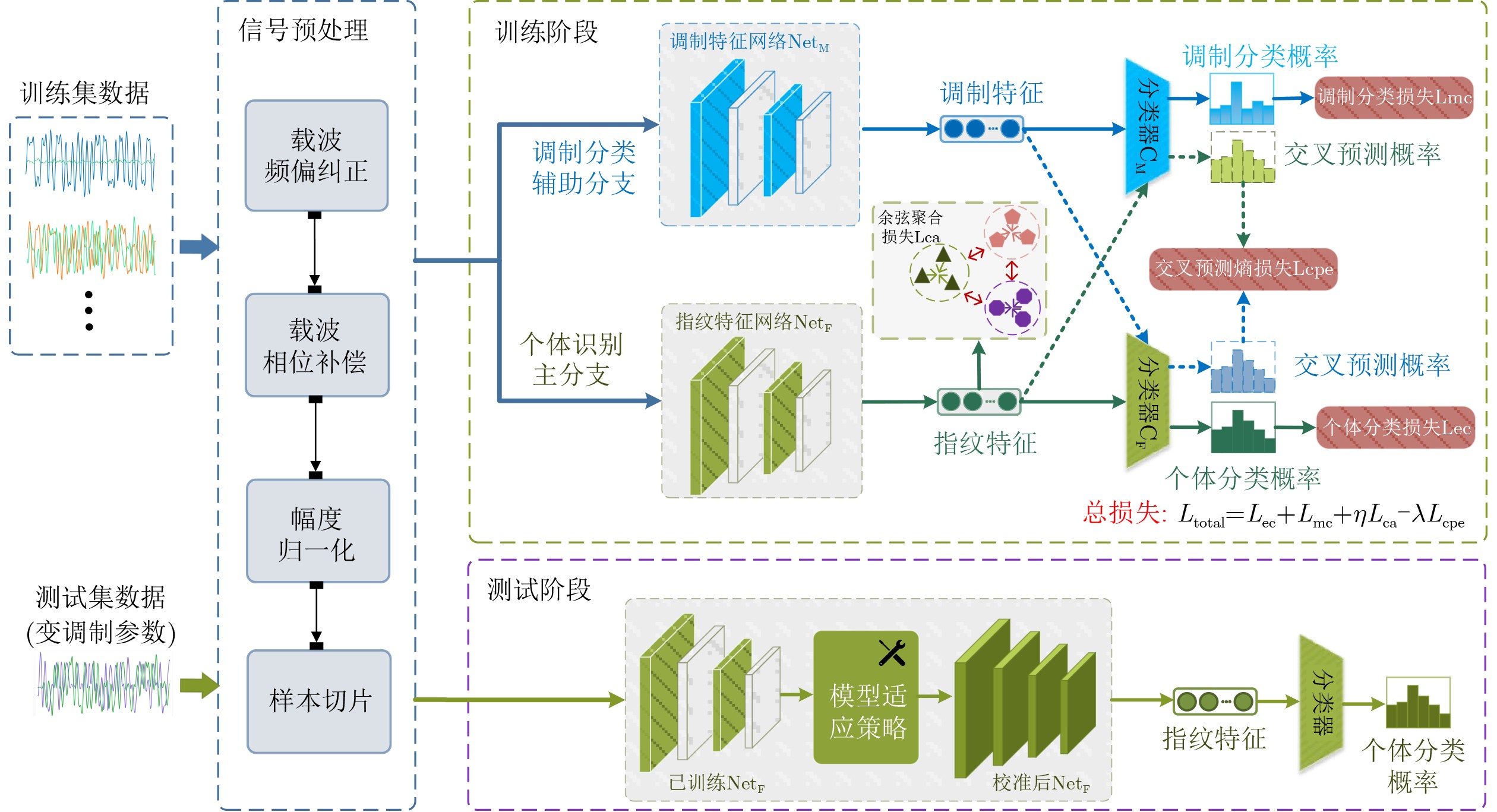
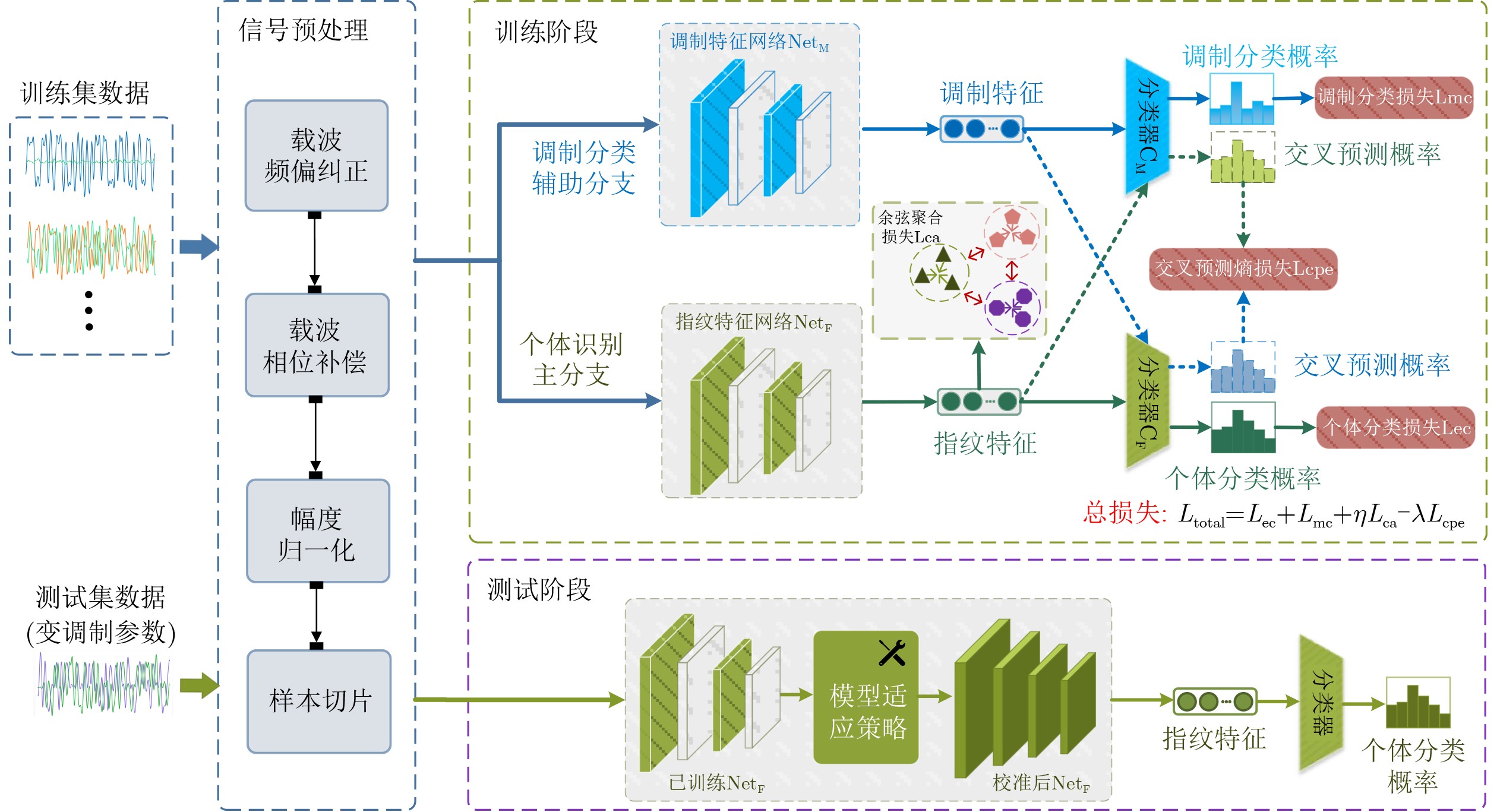
摘要: 通信辐射源调制参数的动态变化,给辐射源个体识别(SEI)性能带来严峻挑战。针对现有基于域适应的变调制SEI方法存在特征鲁棒性不足、过度依赖目标域数据重训练的问题,本文首次将域泛化方法引入该任务,提出一种调制信息引导的双分支训练框架(MIG-DTF)及测试阶段模型适应策略(TMA)。MIG-DTF采用个体识别主分支与调制分类辅助分支协同训练模式。主分支引入余弦聚合损失以强化指纹特征的区分度,辅助分支通过最大化交叉预测熵损失,引导主分支抑制指纹特征中的调制相关信息,从而实现对调制变化鲁棒的指纹特征提取。测试时采用TMA自适应策略单步微调批归一化层参数,以改善失配参数对特征造成的分布偏移,进一步提升识别准确率。基于真实数据集,在变调制样式、变载频、变符号速率三种典型场景下开展对比实验,结果表明,所提方法的识别率显著优于主流域泛化方法,较基线方法在三个场景中分别提升20.39%、12.43%和14.51%。特征可视化分析与抗噪声实验进一步验证了该方法能够有效提取对调制变化鲁棒的指纹特征,以及良好的抗噪声鲁棒性。此外,得益于TMA单步微调的极低训练开销,及无需目标域训练样本特性,本方法更具实际部署前景。Abstract:
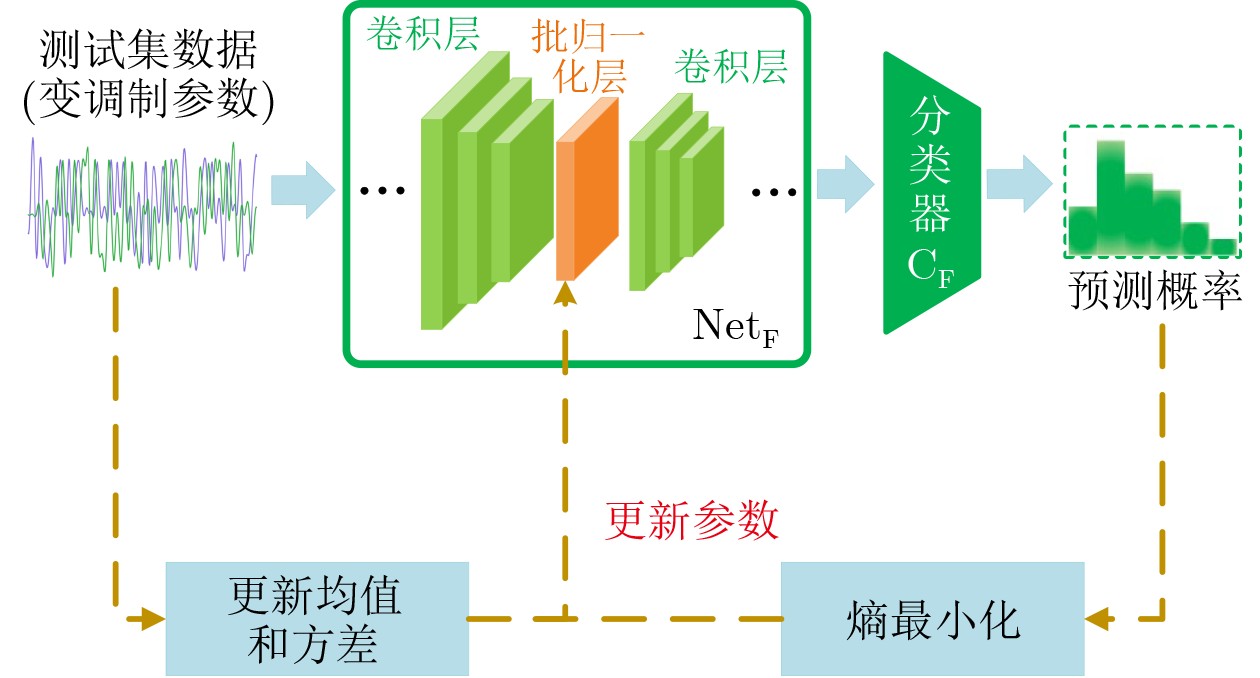
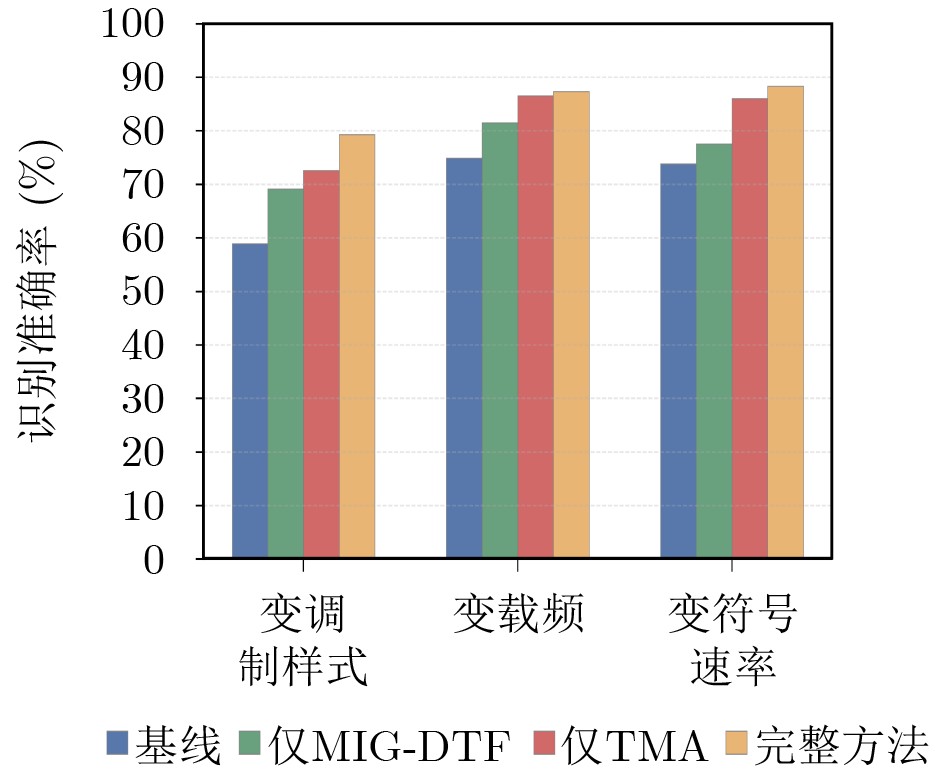
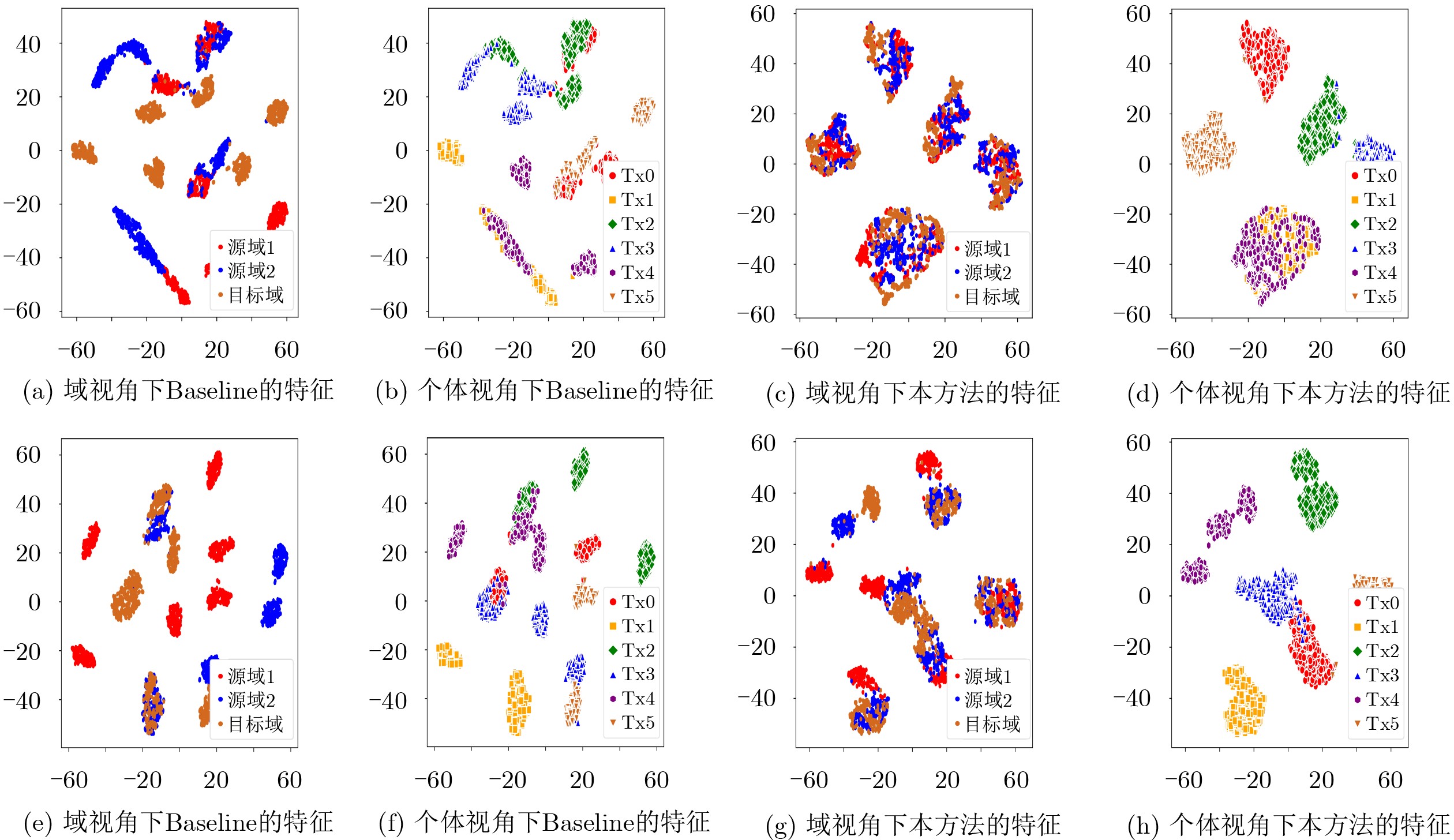
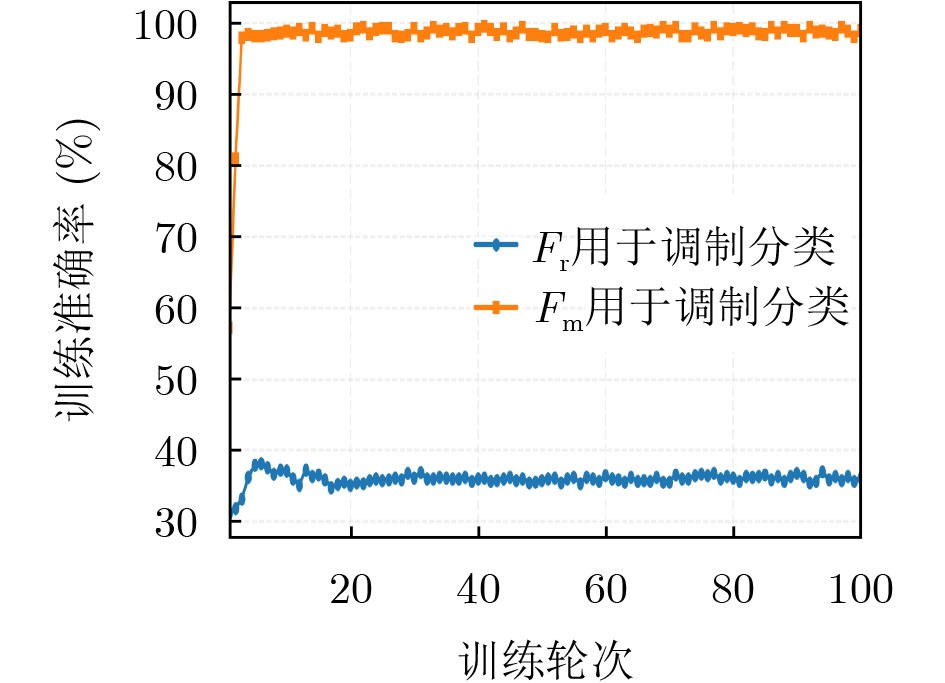
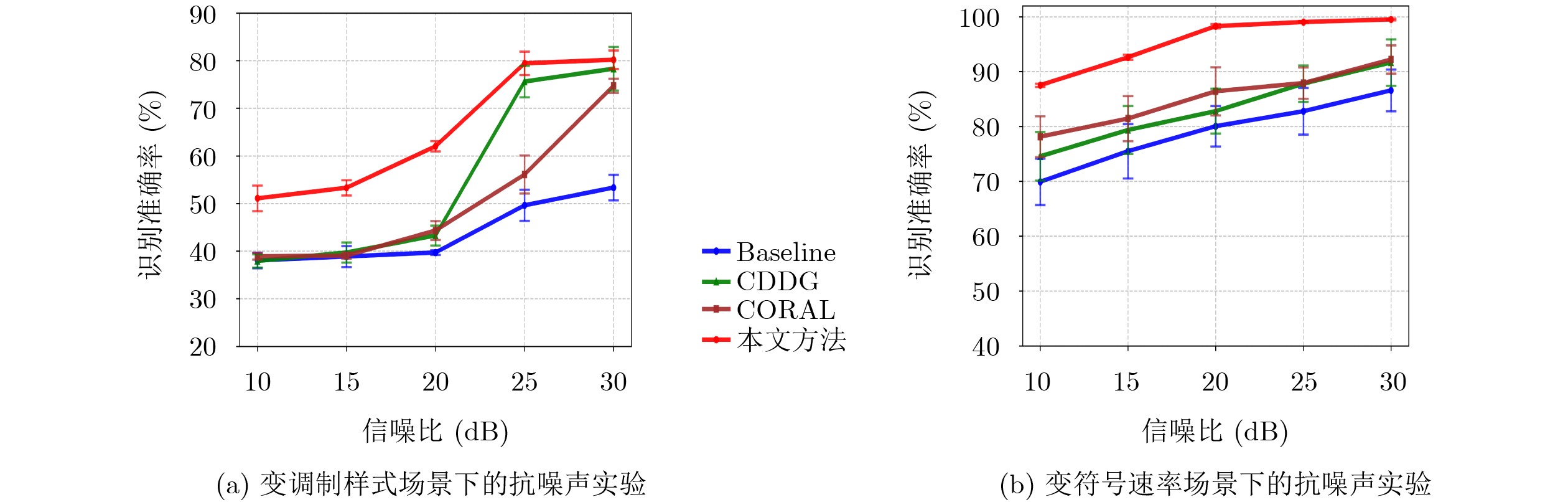
Objective Specific Emitter Identification (SEI) relies on Radio Frequency Fingerprints (RFFs) for emitter discrimination, widely used in military reconnaissance and IoT authentication. Traditional SEI only works under fixed modulation parameters, and existing Domain Adaptation (DA) methods lack robust features and rely heavily on target-domain retraining for variable-modulation SEI. To address these limitations, this paper pioneers the application of Domain Generalization (DG) to variable-modulation SEI, proposing a Modulation-Information-guided Dual-branch Training Framework (MIG-DTF) with a Test-Time Adaptation strategy (TMA). This method extracts modulation-invariant RFFs without large-scale target domain retraining, improves SEI accuracy under variations in multiple common modulation parameters. Methods The proposed method consists of training and testing stages. MIG-DTF serves as the core of the training stage, composed of an emitter identification main branch and a modulation classification auxiliary branch for collaborative training. The main branch innovatively adopts cosine aggregation loss to enhance the discriminability of RFFs, while the auxiliary branch maximizes the cross-prediction entropy to guide the main branch to filter out modulation-related information and extract modulation-invariant robust RFFs. At test time, TMA performs one-step fine-tuning on the BN layer parameters under the entropy minimization objective based on the test samples. This corrects the parameter mismatch of BN layers between training and test domains, alleviates the drift of feature distribution, and improves the identification accuracy. Results and Discussions Experiments on a real-world variable-modulation dataset validate the proposed method’s effectiveness. Comparisons against mainstream DG methods yield identification accuracies of 79.31% ( Table 1 ), 87.39% (Table 2 ) and 88.33% (Table 3 ) under variable modulation type, carrier frequency and symbol rate, respectively. Ablation studies validate the individual and combined performance gains of MIG-DTF and TMA (Fig. 4 ). Feature visualization verifies that the extracted modulation-invariant RFFs exhibit intra-class compactness and inter-class separability (Fig. 5 ), and quantitative correlation analysis with modulation labels demonstrates their superior modulation invariance over baseline (Table 5 ). Across 10–30 dB SNR anti-noise tests, the proposed method surpasses the baseline with a minimum 10% accuracy gain at 10 dB (Fig. 7 ), showing remarkable noise robustness. Overhead analysis indicates TMA reduces training costs and eliminates target-domain training data requirements, facilitating practical deployment.Conclusions This paper tackles robust SEI under variable modulation scenarios via the training-stage MIG-DTF and testing-stage TMA strategy. The proposed method improves SEI performance by extracting modulation-invariant RFFs with MIG-DTF and enabling fast model fine-tuning via TMA without extra target domain retraining. Comprehensive experiments on a real-world dataset validate the method: (1) The proposed method exhibits superior identification accuracy against mainstream DG methods; (2) Feature visualization verifies its effective extraction of discriminative modulation-invariant RFFs; (3) The method exhibits satisfactory anti-noise robustness in noise-added experiments; (4) TMA boasts minimal computational overhead and requires no target-domain training data, facilitating practical deployment. However, this study only considers modulation variations, and more complex practical scenarios, such as time-varying channel conditions, should be involved in future work. -
表 1 变调制样式场景下不同方法的识别准确率对比(%)
算法 BP, QP→8P BP, 8P→QP QP, 8P→BP QP, 8P→QAM BP, QP→QAM 均值 Baseline 70.65±4.83 85.04±4.15 62.76±4.85 34.66±0.45 41.49±7.36 58.92 CORAL 91.00±0.24 86.53±3.10 65.56±2.57 33.57±3.84 48.27±6.20 64.99 V-REx 80.29±1.77 86.56±1.86 66.00±1.36 38.13±0.27 48.33±2.00 63.86 RIEI 89.62±3.64 87.31±2.65 65.31±0.98 37.38±0.36 39.84±0.31 63.89 CDDG 90.45±4.44 89.31±0.16 66.62±0.80 32.66±2.89 49.27±8.23 65.66 本文方法 84.89±2.72 89.11±0.44 81.74±2.67 66.34±0.31 74.49±2.67 79.31  下载: 导出CSV
表 2 变载频场景下不同方法的识别准确率对比(%)
算法 F1, F2→F3 F1, F3→F2 F2, F3→F1 均值 Baseline 80.45±3.03 66.93±2.98 77.49±2.37 74.96 CORAL 86.87±2.89 63.56±2.73 75.69±2.18 75.37 V-REx 88.69±1.52 73.51±2.33 80.38±1.08 80.86 RIEI 82.64±0.93 68.98±2.04 77.73±1.46 76.45 CDDG 86.40±1.42 66.24±1.51 76.45±1.30 76.36 本文方法 89.26±0.13 88.49±0.14 84.43±0.27 87.39
下载: 导出CSV
表 3 变符号速率场景下不同方法的识别准确率对比(%)
算法 R1, R2→R3 R1, R3→R2 R2, R3→R1 均值 Baseline 55.33±0.99 94.51±4.11 71.62±4.67 73.82 CORAL 56.33±1.87 98.98±0.38 69.07±1.20 74.79 V-REx 61.29±2.76 95.53±2.08 69.82±4.42 75.55 RIEI 56.50±1.06 98.53±1.16 82.60±3.91 79.21 CDDG 57.78±0.22 99.13±0.11 79.86±6.71 78.92 本文方法 66.58±0.71 99.80±0.04 98.62±0.53 88.33
下载: 导出CSV
表 4 TMA与DA的开销对比
阶段 更新参数量 单轮耗时 MIG-DTF训练 1.12 M 5.36 s 测试 0 0.75 s TMA模型微调 1.60 K 0.79 s DA模型重训练 561.27 K 2.15 s
下载: 导出CSV
表 5 特征与调制标签、个体标签的第一典型相关系数$ \rho $值
方法 实验组 特征与调制标签 特征与个体标签 Baseline BP, 8P→QP 0.9636 0.9975 R1, R3→R2 0.9823 0.9905 本文方法 BP, 8P→QP 0.3833 0.9926 R1, R3→R2 0.4185 0.9870
下载: 导出CSV
-
[1] 刘高辉, 席宏恩. 改进变分模态分解与多特征的通信辐射源个体识别方法[J]. 电子与信息学报, 2024, 46(10): 4044–4052. doi: 10.11999/JEIT231348.LIU Gaohui and XI Hongen. Individual identification method for communication emitters based on improved variational modal decomposition and multiple features[J]. Journal of Electronics & Information Technology, 2024, 46(10): 4044–4052. doi: 10.11999/JEIT231348. [2] DANEV B, HEYDT-BENJAMIN T S, and ČAPKUN S. Physical-layer identification of RFID devices[C]. Proceedings of the 18th Conference on USENIX Security Symposium, Montreal, Canada, 2009: 199–214. [3] ZHANG Jingwen, WANG Fanggang, DOBRE O A, et al. Specific emitter identification via Hilbert-Huang transform in single-hop and relaying scenarios[J]. IEEE Transactions on Information Forensics and Security, 2016, 11(6): 1192–1205. doi: 10.1109/TIFS.2016.2520908. [4] SATIJA U, TRIVEDI N, BISWAL G, et al. Specific emitter identification based on variational mode decomposition and spectral features in single hop and relaying scenarios[J]. IEEE Transactions on Information Forensics and Security, 2019, 14(3): 581–591. doi: 10.1109/TIFS.2018.2855665. [5] FU Hua, SUN Yanfeng, PENG Linning, et al. Channel-resilient RF fingerprint identification based on nonlinear features with memory effect[J]. IEEE Communications Letters, 2024, 28(4): 798–802. doi: 10.1109/LCOMM.2024.3364494. [6] 肖易寒, 王博煜, 于祥祯, 等. 基于双路射频指纹卷积神经网络与特征融合的雷达辐射源个体识别[J]. 电子与信息学报, 2024, 46(8): 3238–3245. doi: 10.11999/JEIT231236.XIAO Yihan, WANG Boyu, YU Xiangzhen, et al. Radar emitter identification based on dual radio frequency fingerprint convolutional neural network and feature fusion[J]. Journal of Electronics & Information Technology, 2024, 46(8): 3238–3245. doi: 10.11999/JEIT231236. [7] GIUSTINIANO D, SCHALCH M, LIECHTI M, et al. Interference suppression in bandwidth hopping spread spectrum communications[C]. Proceedings of the 11th ACM Conference on Security & Privacy in Wireless and Mobile Networks, Stockholm, Sweden, 2018: 134–143. doi: 10.1145/3212480.3212484. [8] HUANG Keju, YANG Junan, LIU Hui, et al. Deep adversarial neural network for specific emitter identification under varying frequency[J]. Bulletin of the Polish Academy of Sciences-Technical Sciences, 2021, 69(2): e136737. doi: 10.24425/bpasts.2021.136737. [9] ZHANG Xinliang, LI Tianyun, GONG Pei, et al. Variable-modulation specific emitter identification with domain adaptation[J]. IEEE Transactions on Information Forensics and Security, 2023, 18: 380–395. doi: 10.1109/TIFS.2022.3223794. [10] YIN Lijun, FU Xue, SHI Shengnan, et al. Few-shot domain adaption-based specific emitter identification under varying modulation[C]. 2023 IEEE 23rd International Conference on Communication Technology (ICCT), Wuxi, China, 2023: 1439–1443. doi: 10.1109/ICCT59356.2023.10419733. [11] HE Yazhe and ZHANG Qin. Cross-modulation specific emitter identification based on source-free domain adaptation[C]. 2025 10th International Conference on Computer and Communication System (ICCCS), Chengdu, China, 2025: 458–463. doi: 10.1109/ICCCS65393.2025.11069648. [12] LI Ying, WANG Xingwei, ZENG Rongfei, et al. Federated domain generalization: A survey[J]. Proceedings of the IEEE, 2025, 113(4): 370–410. doi: 10.1109/JPROC.2025.3596173. [13] 王雪安. 基于循环谱的调制方式盲识别与频偏估计[D]. [硕士论文], 北京邮电大学, 2017.WANG Xuean. Modulation blind recognition and frequency offset estimation based on cyclic spectrum[D]. [Master dissertation], Beijing University of Posts and Telecommunications, 2017. [14] DI ROSA G and RICHTER A. Low complexity blind carrier phase recovery for probabilistically shaped QAM[J]. IEEE Photonics Technology Letters, 2020, 32(17): 1109–1112. doi: 10.1109/LPT.2020.3012970. [15] LIM D. A modified Gardner detector for symbol timing recovery of M-PSK signals[J]. IEEE Transactions on Communications, 2004, 52(10): 1643–1647. doi: 10.1109/TCOMM.2004.836450. [16] MAO Anqi, MOHRI M, and ZHONG Yutao. Cross-entropy loss functions: Theoretical analysis and applications[C]. 40th International Conference on Machine Learning, Honolulu, USA, 2023: 23803–23828. [17] MAHAJAN D, TOPLE S, and SHARMA A. Domain generalization using causal matching[C]. Proceedings of the 38th International Conference on Machine Learning, 2021: 7313–7324. (查阅网上资料, 未找到本条文献出版地信息, 请确认). [18] WU Zhize, DU Changjiang, WANG Xinqi, et al. Domain Adaptation via Feature Disentanglement for cross-domain image classification[J]. Applied Soft Computing, 2025, 172: 112868. doi: 10.1016/j.asoc.2025.112868. [19] SU Kejia, LIU Kai, WAN Bo, et al. Multisource adversarial feature disentanglement method for cross-subject gesture recognition using sEMG signals[J]. IEEE Transactions on Instrumentation and Measurement, 2025, 74: 4508912. doi: 10.1109/TIM.2025.3557823. [20] WANG Dequan, SHELHAMER E, LIU Shaoteng, et al. Tent: Fully test-time adaptation by entropy minimization[C]. 9th International Conference on Learning Representations, 2021. (查阅网上资料, 未找到本条文献出版地信息, 请确认). [21] SUN Baochen and SAENKO K. Deep CORAL: Correlation alignment for deep domain adaptation[C]. Computer Vision – ECCV 2016 Workshops, Amsterdam, The Netherlands, 2016: 443–450. [22] KRUEGER D, CABALLERO E, JACOBSEN J H, et al. Out-of-distribution generalization via risk extrapolation[C]. Proceedings of the 38th International Conference on Machine Learning, 2021: 5815–5826. (查阅网上资料, 未找到本条文献出版地信息, 请确认). [23] ZHANG Ying, LI Qiang, LIU Hongli, et al. Domain generalization for cross-receiver radio frequency fingerprint identification[J]. IEEE Internet of Things Journal, 2025, 12(5): 5207–5218. doi: 10.1109/JIOT.2024.3486068. [24] JIA Linshan, CHOW T W C, and YUAN Yixuan. Causal Disentanglement Domain Generalization for time-series signal fault diagnosis[J]. Neural Networks, 2024, 172: 106099. doi: 10.1016/j.neunet.2024.106099. [25] LU Weipeng and YAN Xuefeng. Visual high dimensional industrial process monitoring based on deep discriminant features and t-SNE[J]. Multidimensional Systems and Signal Processing, 2021, 32(2): 767–789. doi: 10.1007/s11045-020-00758-5. [26] HARDOON D R, SZEDMAK S, and SHAWE-TAYLOR J. Canonical correlation analysis: An overview with application to learning methods[J]. Neural Computation, 2004, 16(12): 2639–2664. doi: 10.1162/0899766042321814. -

 下载:
下载:

图(7) / 表(5)
计量
- 文章访问数: 19
- HTML全文浏览量: 4
- PDF下载量: 0
- 被引次数: 0
