




Robust Dynamic Searchable Symmetric Encryption with Collusion Resistant Feasible for Internet of Vehicles
-
摘要: 随着车辆规模的持续扩大,车联网的应用日益广泛。车联网用户普遍将加密数据外包至云服务器,同时动态可搜索对称加密(Dynamic searchable symmetric encryption, DSSE)为解决加密数据动态更新与搜索提供了一种有效的手段。然而,传统的DSSE方案在实际应用中仍面临若干问题。一方面,DSSE无法同时支持多用户场景与搜索结果可验证。另一方面,DSSE还应实现前向与后向隐私从而保护敏感数据。此外,在设计方案时也需要考虑恶意用户与云服务器的合谋攻击风险与方案鲁棒性。因此,该文提出了适用于车联网的抗合谋攻击的鲁棒动态可搜索对称加密(Robust dynamic searchable symmetric encryption with collusion resistant feasible for Internet of Vehicles, RDSSE-CR)方案。该方案通过双位图索引与布尔电路,构建了同时满足前后向隐私与鲁棒性的DSSE框架。同时,该文采用基于身份的密钥封装机制以适用于可能存在恶意用户与不可信云服务器合谋的多用户场景,该机制显著降低数据拥有者端的存储开销。此外,云服务器返回搜索结果的同时须根据验证标签提供工作量证明,以实现搜索结果完整性和正确性的有效验证。安全性分析证明RDSSE-CR方案实现了自适应安全性。性能分析表明,与现有同类方案相比,本方案在存储开销方面具有显著优势,在实现更多功能的同时仍保持了较高的运行效率,因而更加适用于车联网应用场景。Abstract:
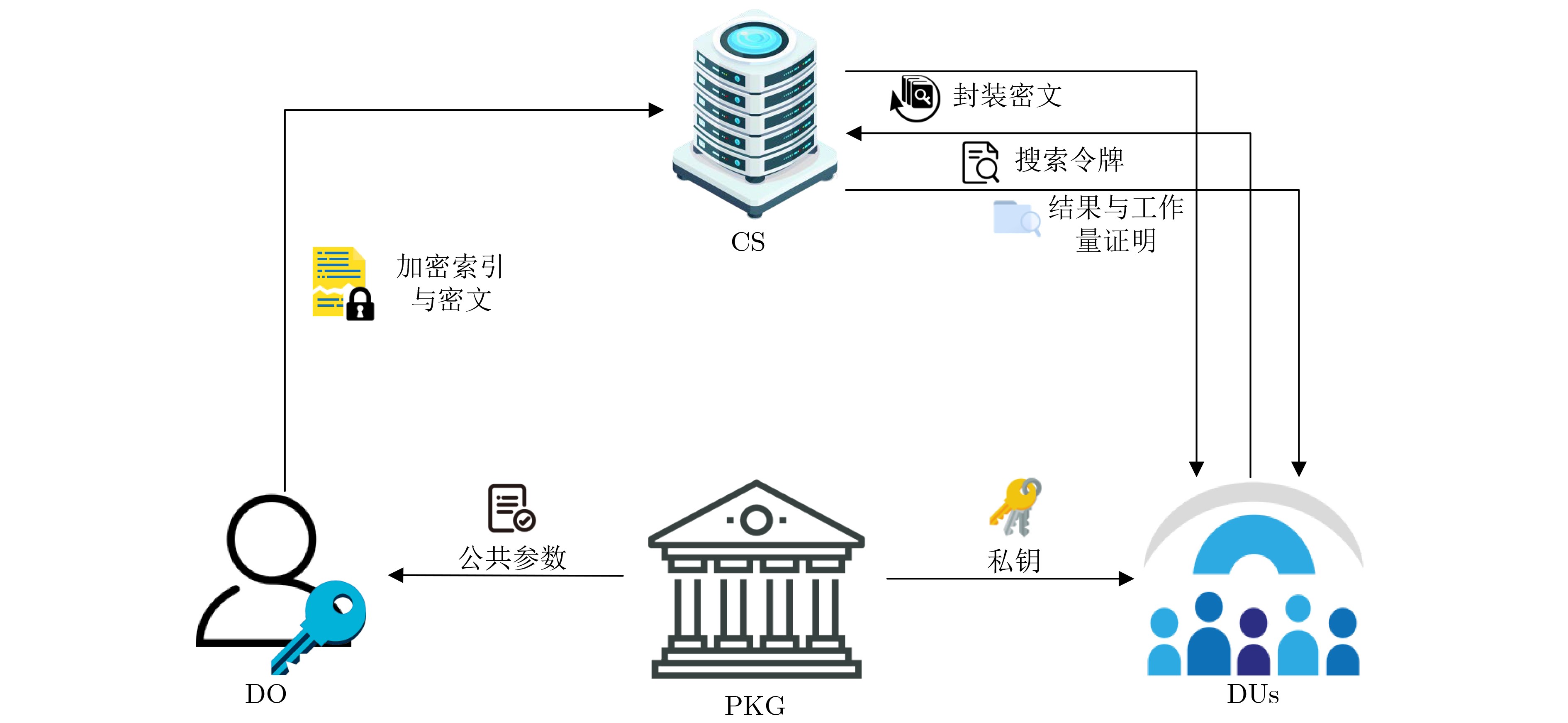
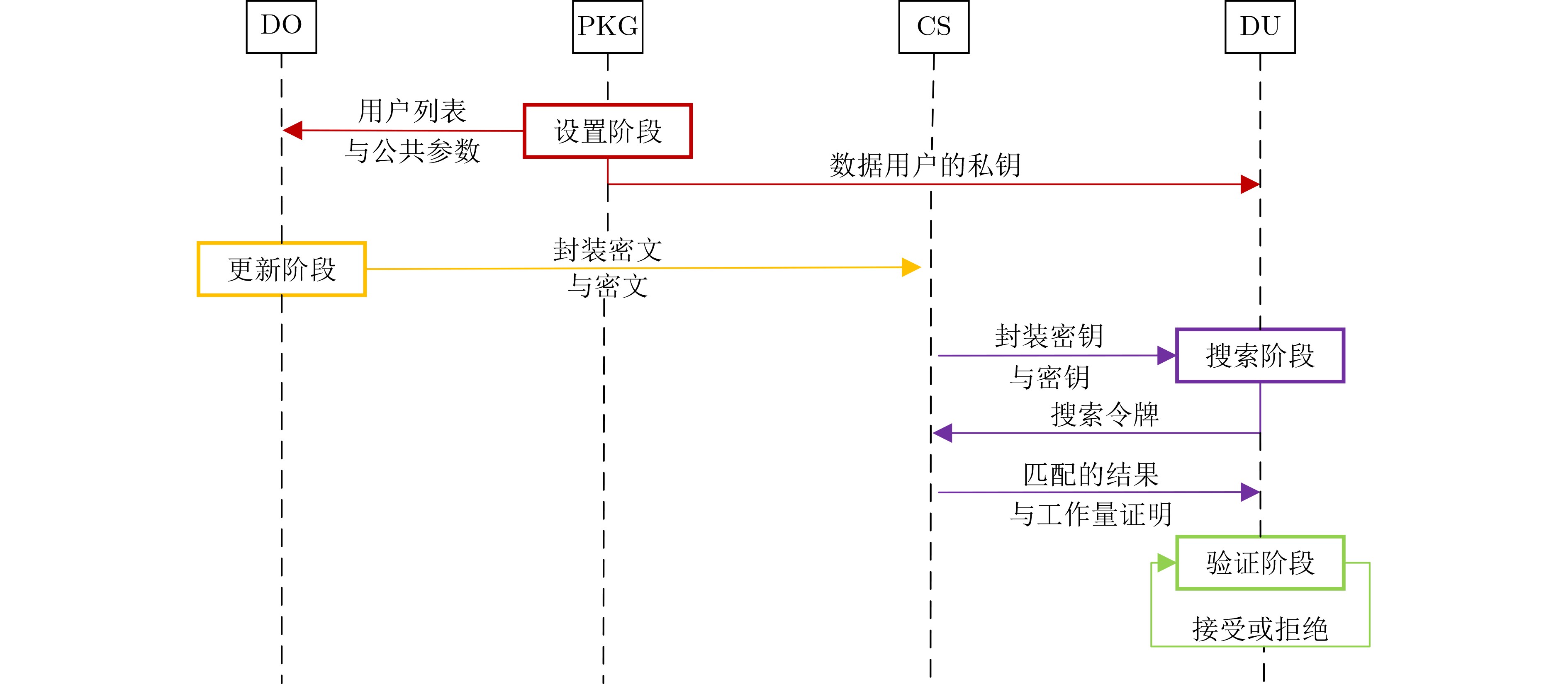
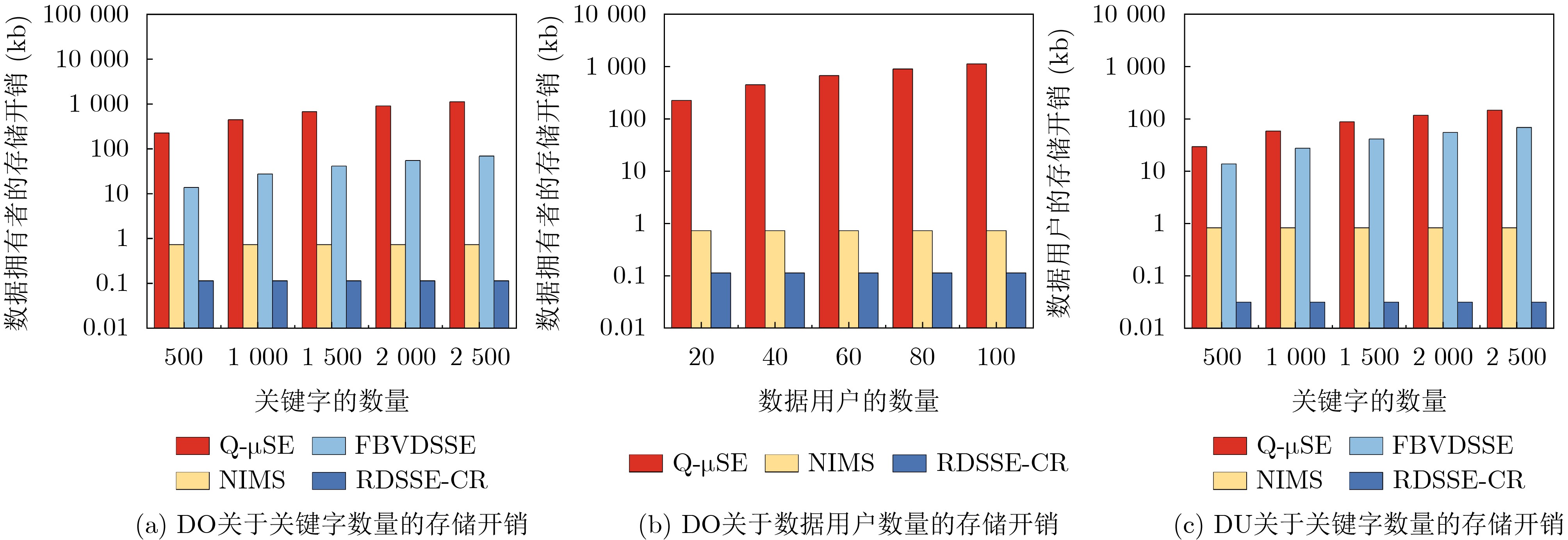
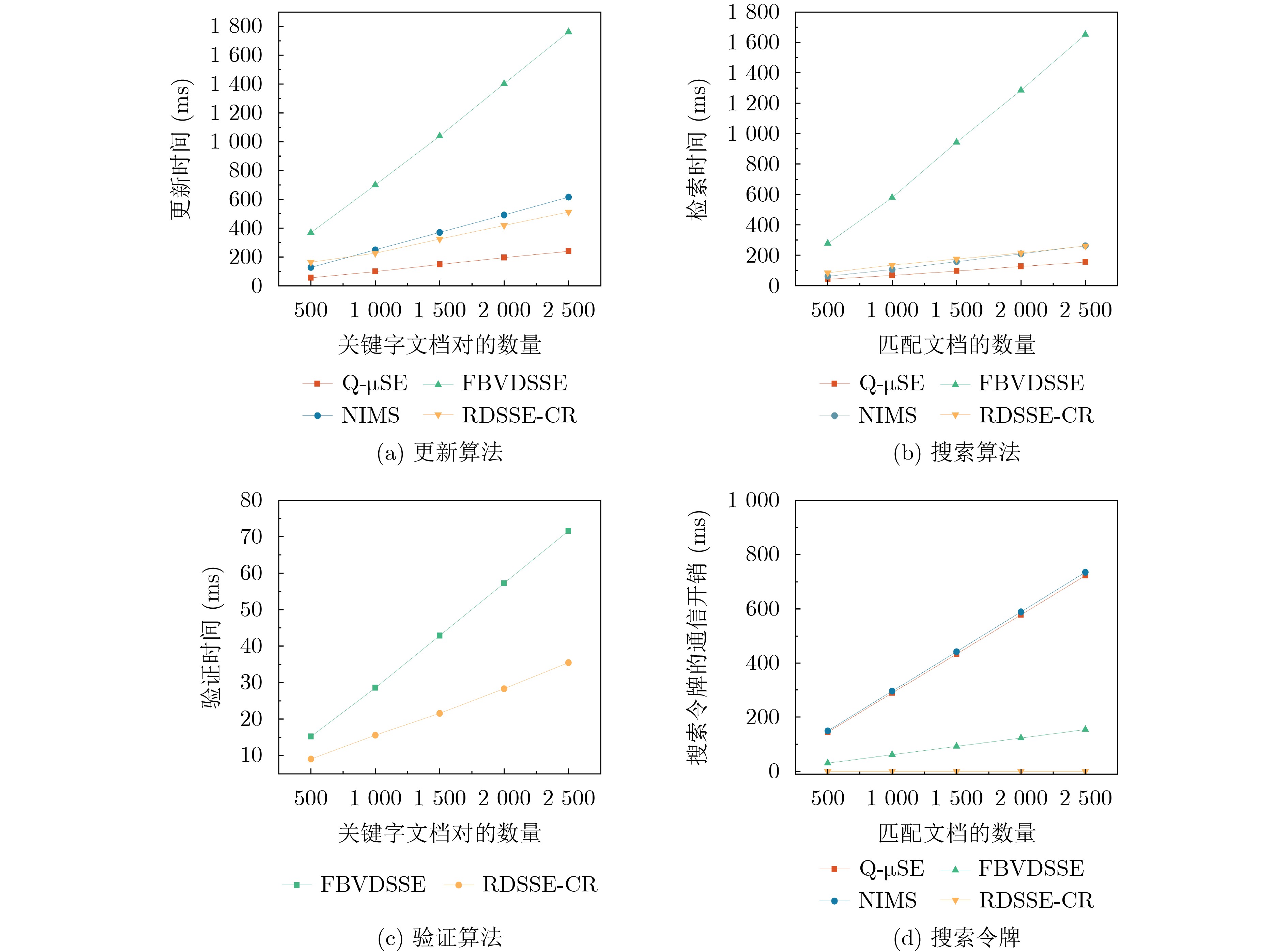
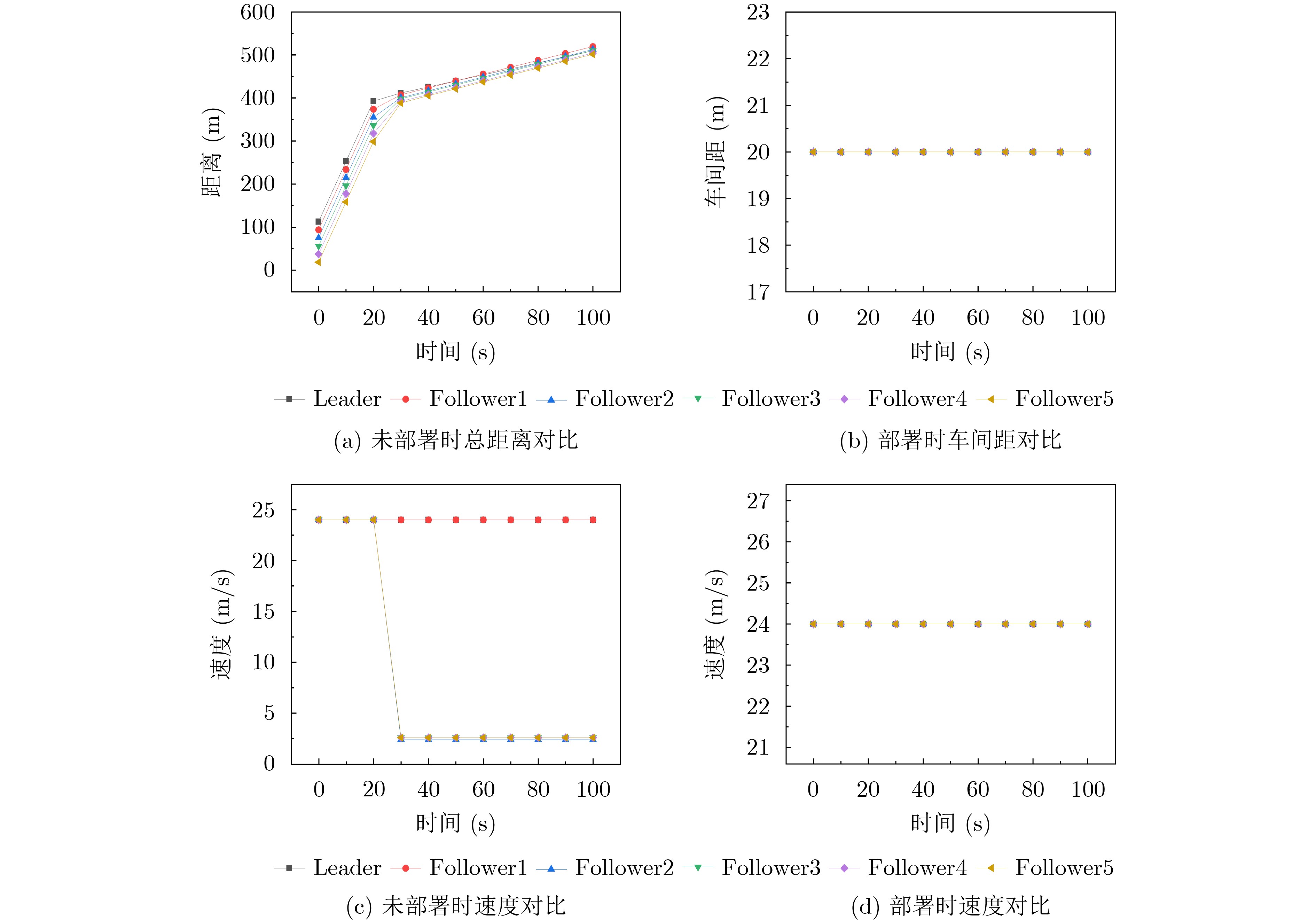
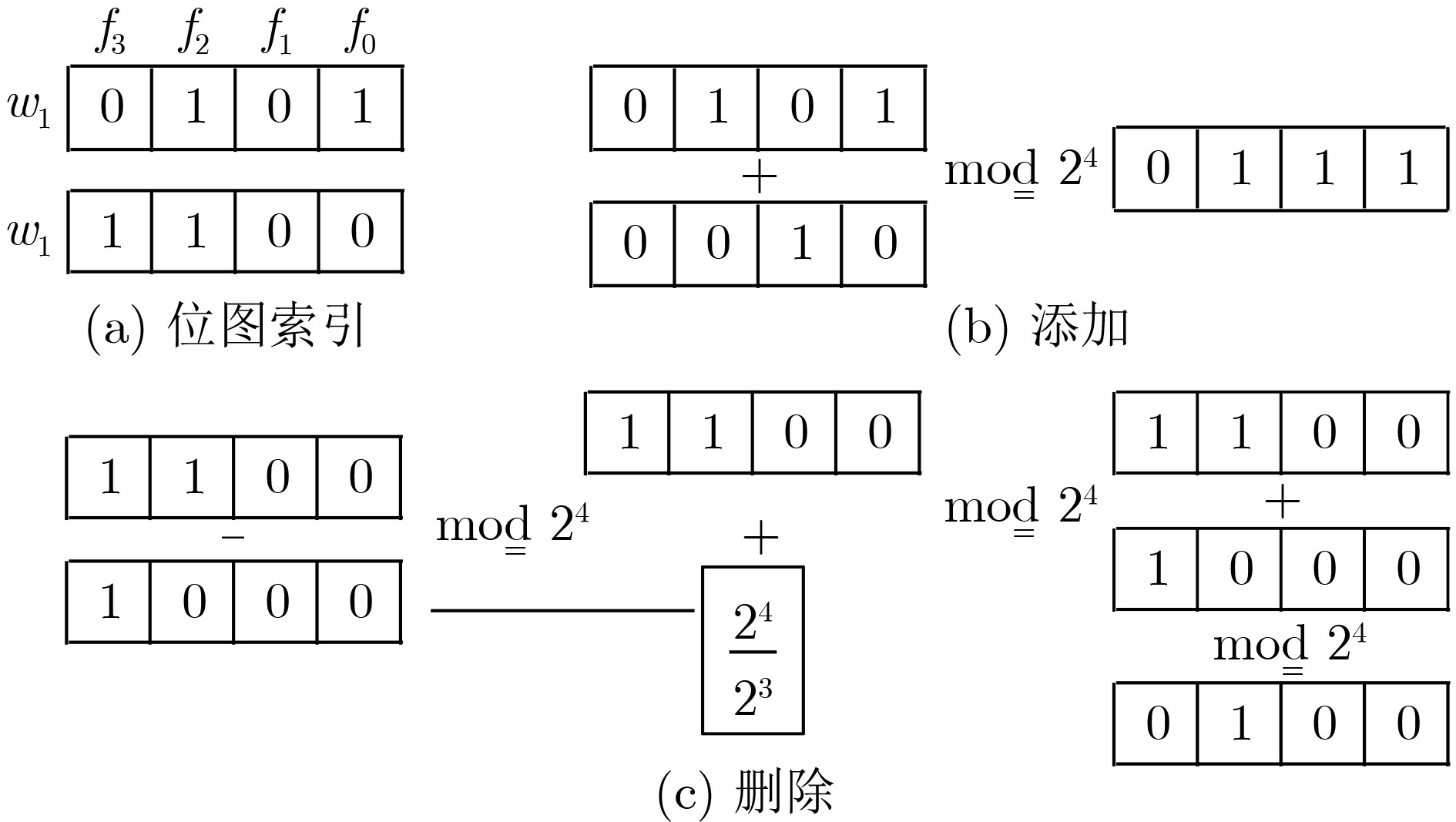
Objective With the continuous expansion of vehicle scale, the application of the Internet of Vehicles (IoV) is becoming increasingly widespread. Users commonly outsource encrypted data to cloud servers, and Dynamic Searchable Symmetric Encryption (DSSE) provides an effective solution for dynamically updating and searching encrypted data. However, traditional DSSE schemes still face several challenges in practical applications. On one hand, DSSE cannot simultaneously support multi-user scenarios and verifiable search results. Multi-user enhances the collaborative efficiency of the group and the verification of search results ensures the verifiability and reliability of the query results. On the other hand, DSSE must also achieve forward and backward privacy to protect sensitive data. Forward privacy ensures that the newly inserted vehicle data cannot be associated with historical query tokens. Backward privacy ensures that the deleted vehicle data will not be leaked in subsequent queries, and the cloud server cannot restore the removed data content using current or future query information. Furthermore, design considerations must account for the risk of collusive attacks by malicious users and cloud servers, as well as the robustness of the solution. Methods This scheme achieves forward privacy protection through a state chain mechanism generated by random numbers, ensuring that newly added data cannot be associated with historical query tokens. At the same time, the construction method based on bitmap indexing effectively guarantees backward privacy, preventing deleted data from revealing information in subsequent queries. Additionally, the scheme constructs a dual bitmap index structure consisting of keyword bitmap index and operation bitmap index, combined with Boolean circuit technology, and designs a DSSE framework that simultaneously meets the requirements of forward privacy, backward privacy, and robustness. This framework can maintain the stable operation of the system in the face of abnormal or unreasonable operation requests. On the other hand, this paper adopts the Identity-based Key Encapsulation Mechanism (ID-KEM) to be applicable to multi-user scenarios where corrupt users and untrusted cloud servers may collude. This mechanism enables data owners to avoid storing additional information for authorized users, thereby significantly reducing the storage overhead at the data owner's end. Moreover, the cloud server must provide proof of work based on the verification label when returning search results, to effectively verify the integrity and correctness of the search results. Results and Discussions This paper demonstrates the security of the RDSSE-CR scheme through a series of games between real game $ \text{REAL}_{\mathcal{A}}^{\prod }({1}^{\lambda }) $ and ideal game $ \mathrm{IDEAL}_{\mathcal{A}}^{\prod }({1}^{\lambda }) $. Firstly, by constructing games $ {G}_{0} $ to $ {G}_{7} $, the paper gradually eliminates the opponent's ability to distinguish, thereby under the assumptions of pseudo-random function security, hash function collusion resistant, and symmetric encryption security, it proves that the opponent's distinguishing advantage is negligible, and finally establishes that the scheme has $ \mathcal{L} $ - adaptive security. Secondly, since the search token is generated by a pseudo-random function bound to the user's identity, the tokens for the same keyword of different users are independent and uncorrelated, thus ensuring that even in the case of collusion attacks, it is impossible to derive the search tokens or privacy information of other authorized users. The experiment is divided into two parts: performance analysis and vehicle networking scenario simulation. The aim is to evaluate the efficiency of the scheme and its effectiveness in practical applications. In the performance test based on the Intel Core i7 environment, the RDSSE-CR scheme, compared with several existing schemes, has the lowest storage cost at the data owner's end and the user's end due to the fact that the data owner and the data user only need to maintain their own private keys ( Fig. 4 ). In terms of algorithm performance (Fig. 5 ), the RDSSE-CR scheme achieves the best verification efficiency by relying on efficient XOR operations, while maintaining a constant search token size. Although the update and search introduce a slight increase in cost due to the introduction of security mechanisms, it still has significant advantages in functionality and security. In the vehicle networking simulation based on SUMO and OMNeT++, this scheme successfully resisted attack interference, enabling the vehicle queue to maintain stable spacing and consistent speed when subjected to attacks (Fig. 6 ). This avoided the phenomenon of vehicle lag and queue collapse that occurred in the absence of the deployed scheme, fully demonstrating its practical application value in ensuring the safety and stability of vehicle networking in complex communication environments.Conclusions To meet the practical application requirements in the context of the Internet of Vehicles, this paper designs a verifiable multi-user dynamic searchable symmetric encryption that supports forward and backward privacy. In response to the security threat in a multi-user environment where untrusted cloud servers and corrupt users may collude, this scheme implements multi-user authorization based on the ID-KEM, effectively resisting collusion attacks. The proposed RDSSE-CR scheme ensures the robustness of the system when facing unreasonable operation requests by constructing a dual-bit map index structure and combining Boolean circuit design. During the search stage, the cloud server needs to generate a proof of work based on the verification label to allow users to verify the correctness and integrity of the search results. Future research will focus on the efficient revocation mechanism for violating users to further enhance the practicality and security of the scheme. -
表 1 具有鲁棒性的真值表
$ b{s}_{w}[i] $ $ (b{s}_{a}[i],b{s}_{b}[i]) $ (0,0) (0,1) (1,1) (1,0) 0 0 0 1 0 1 1 1 1 0  下载: 导出CSV
1 ID-KEM
$ \text{Setup}({1}^{\lambda }) $ 1: $ m\leftarrow Z_{p}^{\ast } $ 2: $ mpk\leftarrow {g}^{m} $ 3: $ par\leftarrow \{e,g,p,G,{G}_{1},N,h,H\} $ $ \text{KeyGen(}u,msk) $ 1: $ msk\leftarrow m $ 2: $ s{k}_{{{u}_{j}}}\leftarrow h{({{u}_{j}})}^{m} $ $ \text{Encap(}u,mpk) $ 1: $ n\leftarrow Z_{p}^{\ast } $ 2: $ {\mu }^{\prime}\leftarrow {g}^{n} $ 3: $ {\mu }_{j}\leftarrow ({\mu }^{\prime},j) $ 4: $ {r}_{j}\leftarrow H(e(h({u}_{j}),{({{g}^{m}})}^{n}),j) $ $ \text{Decap}(s{k}_{u},\mu ) $ 1: $ {r}_{j}\leftarrow H(e(h{({{u}_{j}})}^{m},{g}^{n}),j) $
下载: 导出CSV
表 2 符号说明
符号 含义 $ par $ 系统公共参数 $ mpk $ 主公钥 $ msk $ 主私钥 $ s{k}_{{{u}_{j}}} $ 授权用户$ {u}_{j} $的密钥 $ {\mu }_{j} $ 封装密文 $ {r}_{j} $ 封装密钥 $ {K}_{w} $ 关键字状态密钥 $ {{{K}^{\prime}}}_{w} $ 计数器密钥 $ S{T}_{c} $ 关键字状态 $ U{T}_{c} $ 加密索引 $ (b{s}_{a},b{s}_{b}) $ 双位图索引 $ ({e}_{a},{e}_{b}) $ 加密双位图索引 $ {\mathrm{C}}_{S{{T}_{c}}} $ 加密状态 $ {m}_{j} $ 封装的内容 $ vt $ 工作量证明 $ token $ 搜索令牌 $ \Gamma $ 3.3节中的密钥封装方案 $ b{s}_{w} $ 聚合位图索引 $ {e}_{w} $ 加密聚合
下载: 导出CSV
2 Setup
Input: $ \lambda ,{u}_{j} $ Output: $ k,\text{O,S,EDB},par,mpk,msk,s{k}_{{{u}_{j}}} $ DO: 1: $ k\leftarrow {\{0,1\}}^{\lambda } $ 2: $ \text{O,S,EDB}\leftarrow \mathrm{empty}\mathrm{map} $ 3: $ \text{Send (S,EDB) to CS} $ 4: $ \text{Store (}k,\text{O) in DO} $ PKG: 5: $ \mathrm{userList}\leftarrow \{{u}_{1},{u}_{2},\cdots,{u}_{m}\} $ 6: $ (par,msk,mpk)\leftarrow \Gamma .{\text{Setup(1}}^{\lambda }) $ 7: $ \text{for all}{u}_{j}\text{in}\mathrm{userList}\text{do} $ 8: $s{k}_{{{u}_{j}}}\leftarrow \Gamma .\mathrm{KeyGen}({u}_{j},msk) $ 9: end for 10: $\text{Send}s{k}_{{{u}_{j}}}\text{to DU}{u}_{j} $
下载: 导出CSV
3 Update
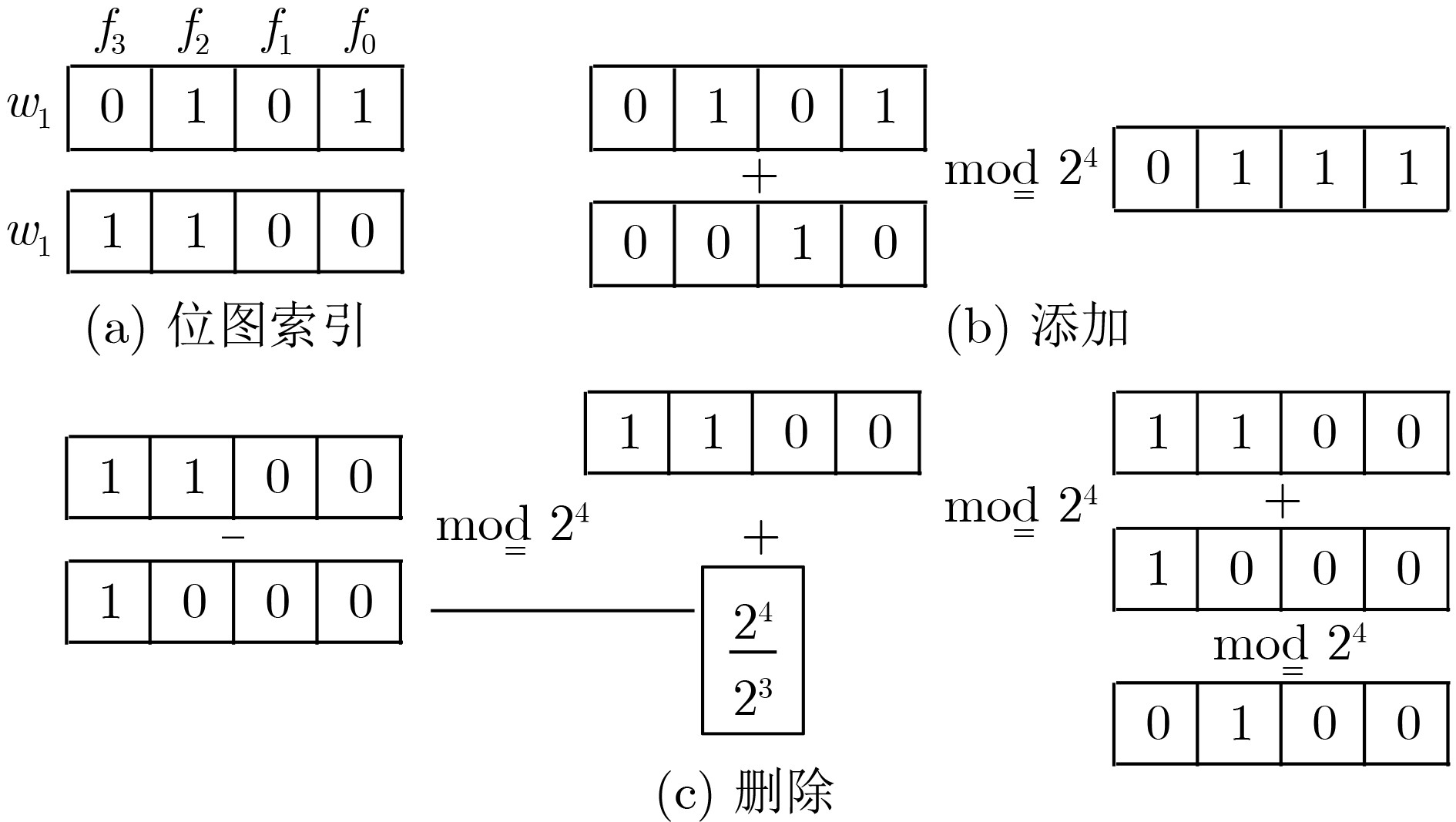
Input: $ k,mpk,\text{userList},op,(w,ind),\mathrm{O} $ Output: $ {m}_{j},{\mu }_{j},({K}_{w},{{{K}^{\prime}}}_{w}),c,S{T}_{c},U{T}_{c},{C}_{S{{T}_{c}}},vt,({e}_{a},{e}_{b}) $ DO: 1: $ \mathrm{userList}\leftarrow \{{u}_{1},\cdots,{u}_{m}\} $ 2: $ \text{AccessList,CList}\leftarrow \mathrm{empty}\mathrm{map} $ 3: $ ({\mu }_{j},{r}_{j})\leftarrow \Gamma .\mathrm{Encap}({u}_{j},mpk) $ 4: $ \text{for all}w\text{in}W({u}_{j}\text{) do} $ 5: $ {K}_{w}||{{{K}^{\prime}}}_{w}\leftarrow F(k,w||{u}_{j}) $ 6: $ (S{T}_{c},c)\leftarrow \text{O}[w] $ 7: $ \text{if O}[w]=\bot \text{then} $ 8: $c\leftarrow -1,S{T}_{c}\leftarrow {\{0,1\}}^{\lambda } $ 9: $ \text{end if} $ 10: $ S{T}_{c}\leftarrow {\{0,1\}}^{\lambda },\text{where}c=c+1 $ 11: $ \text{O}[w]\leftarrow (S{T}_{c},c) $ 12: $ U{T}_{c}\leftarrow {H}_{1}({K}_{w},S{T}_{c}) $ 13: $ {\mathrm{C}}_{S{{T}_{c}}}\leftarrow {H}_{2}({K}_{w},S{T}_{c})\oplus S{T}_{c-1} $ 14: $ { Generate the bi-bitmap (}b{s}_{a},\mathrm{b}{s}_{b}) $ based on 2.1
technology15: $ {e}_{a}\leftarrow {H}_{3}({{{K}^{\prime}}}_{w},c)\oplus b{s}_{a} $ 16: $ {e}_{b}\leftarrow {H}_{4}({{{K}^{\prime}}}_{w},c)\oplus b{s}_{b} $ 17: $ vt\leftarrow {F}_{1}(w,c-1)\oplus {F}_{1}(w,c)\oplus {F}_{1}(w,ind)$ 18: $ \text{ AccessList}[{u}_{j}]\leftarrow (w,{K}_{w},{{{K}^{\prime}}}_{w},S{T}_{c},c)$ 19: end for 20: $ {m}_{j}\leftarrow \text{SE.Enc}({r}_{j},\text{AccessList}[{u}_{j}])$ 21:$ \text{CList}[{u}_{j}]\leftarrow ({\mu }_{j},{m}_{j}) $ 22:$\mathrm{Send}(U{T}_{c},({e}_{a},{e}_{b},{\mathrm{C}}_{S{{T}_{c}}},vt))\text{and CList}[{u}_{j}]\mathrm{to}\text{CS} $ CS: 23:$ \text{EDB[}U{T}_{c}]\leftarrow ({e}_{a},{e}_{b},{\mathrm{C}}_{S{{T}_{c}}},vt) $
下载: 导出CSV
4 Search
Input: $ s{k}_{{{u}_{j}}},\text{CList}[{u}_{j}],\text{EDB,S,AccessList}[{u}_{j}] $ Output: $ \text{E},{e}_{w},\text{EDB,S,}proof,ind\text{s} $ DU: 1: $ \text{Receive}({\mu }_{j},{m}_{j})\text{from CS} $ 2: $ {r}_{j}\leftarrow \Gamma .\text{Decap}(s{k}_{{{u}_{j}}},{\mu }_{j}) $ 3: $ \text{AccessList}[{u}_{j}]\leftarrow \text{SE.Dec}({r}_{j},{m}_{j}) $ 4: $ (w,{K}_{w},{{{K}^{\prime}}}_{w},S{T}_{c},c)\leftarrow \text{AccessList}[{u}_{j}] $ 5: $ \mathrm{if}(S{T}_{c},c)=\bot \text{then} $ 6: $ \text{return}\varnothing $ 7: end if 8: $ token\leftarrow ({K}_{w},S{T}_{c},c) $ 9: $ \mathrm{Send}\;token\;\mathrm{to}\;\text{CS} $ CS: 10: $ \text{1if S}[{K}_{w}] =\mathrm{Null}\text{then} $ 11: $ {e}_{w}\leftarrow {0}^{n} $ 12: else 13: ${e}_{w}\leftarrow \text{S}[{K}_{w}] $ 14: end if 15: $ \text{E}\leftarrow \text{empty map} $ 16: $ \text{for}i=c\text{to}0\text{do}$ 17: $ U{T}_{i}\leftarrow {H}_{1}({K}_{w},S{T}_{i})$ 18: $ ({e}_{a},{e}_{b},{\mathrm{C}}_{S{{T}_{i-1}}},vt)\leftarrow \text{EDB[}U{T}_{i}] $ 19: $ \text{E}[i-{c}_{0}]\leftarrow ({e}_{a},{e}_{b}) $ 20: $ proof\leftarrow proof\oplus vt $ 21: $\text{ Remove EDB[}U{T}_{i}] $ 22: $ \mathrm{if}{\mathrm{C}}_{S{{T}_{i-1}}}=\bot \text{then} $ 23: Break 24: end if 25: $ S{T}_{i-1}\leftarrow {H}_{2}({K}_{w},S{T}_{i})\oplus {\mathrm{C}}_{S{{T}_{i-1}}}$ 26: end for 27: $ \text{EDB[}U{T}_{c}]\leftarrow ({e}_{a},{e}_{b},{\mathrm{C}}_{S{{T}_{c-1}}},vt) $ 28: $ \mathrm{Send}({e}_{w},\text{E,}proof)\mathrm{to}\text{DU}$ DU: 29: $ b{s}_{w}\leftarrow {0}^{n}\$ 30: $ \text{if}{e}_{w}\neq {0}^{n}\text{then} $ 31: $ b{s}_{w}\leftarrow {H}_{5}({{{K}^{\prime}}}_{w},c)\oplus {e}_{w} $ 32: end if 33: $ \text{for}\;i =0\;\text{to}\;c\;\text{do} $ 34: $ ({e}_{a},{e}_{b})\leftarrow \text{E}[i]$ 35: $ b{s}_{a}\leftarrow {e}_{a}\oplus {H}_{3}({{{K}^{\prime}}}_{w},i) $ 36: $ b{s}_{b}\leftarrow {e}_{b}\oplus {H}_{4}({{{K}^{\prime}}}_{w},i)$ 37: $ b{s}_{w}\leftarrow (\overline{b{s}_{a}}\wedge b{s}_{w})\oplus (b{s}_{a}\wedge b{s}_{b}) $ 38: end for 39: $ {e}_{w}\leftarrow b{s}_{w}\oplus {H}_{5}({{{K}^{\prime}}}_{w},c+1) $ 40: $ \text{Send}\;{e}_{w}\text{to CS} $ 41: $ \mathrm{Parse}\;b{s}_{w}\;\text{into file identifiers}ind\text{s} $ 42: $ \mathrm{Return}\;ind\text{s} $ CS: 43: $ \text{S}[{K}_{w}]\leftarrow {e}_{w} $
下载: 导出CSV
5 Verify
Input: $ w,ind\text{s},\text{AccessList}[{u}_{j}],proof $ Output: $ accept/reject $ DU: 1: $ (w,{K}_{w},{{{K}^{\prime}}}_{w},S{T}_{c},c)\leftarrow \text{AccessList}[{u}_{j}] $ 2: $ proof'\leftarrow {F}_{1}(w,0)\oplus {F}_{1}(w,c) $ 3: $ \text{for each}ind\text{in}inds\text{do} $ 4: $ proof'\leftarrow proof'\oplus {F}_{1}(w,ind) $ 5: end for 6: $ \text{if}\;proof =proof'\text{then} $ 7: $ \text{return}\;accept $ 8: else 9: $ \text{return}\;reject$ 10: end if
下载: 导出CSV
6 Simulator
Setup DO: 1: $ \text{O,S,EDB}\leftarrow \mathrm{empty}\mathrm{map} $ 2: $ \text{Send (S,EDB) to CS and keep others locally} $ 3: $ \mathrm{userList}\leftarrow \{{u}_{1},{u}_{2},\cdots,{u}_{m}\} $ 4: $ (par,msk,mpk)\leftarrow \Gamma .{\text{Setup(1}}^{\lambda }) $ 5: $ \text{for all}{u}_{j}\text{in}\mathrm{userList}\text{do} $ 6:$ s{k}_{{{u}_{j}}}\leftarrow \Gamma .\mathrm{KeyGen}({u}_{j},msk) $ 7:$ \text{end for} $ 8:$ \text{Send}s{k}_{{{u}_{j}}}\text{to DU}{u}_{j} $ Update DO: 1: $ ts\leftarrow ts+1 $ 2: $ S{T}_{c}\leftarrow {\{0,1\}}^{\lambda } $ 3: $ {\text{T}}_{1}[ts]\leftarrow {\{0,1\}}^{\lambda } $ 4: $ {\text{T}}_{2}[ts]\leftarrow {\{0,1\}}^{\lambda } $ 5: $ \text{Generate the bi-bitmap (}b{s}_{a},b{s}_{b}) $ 6: $ {\text{T}}_{3}[ts]\leftarrow {\{0,1\}}^{\lambda } $ Search DU: 1: $ ts\leftarrow ts+1 $ 2: $ \tilde{w}\leftarrow \min \text{sp(}w) $ 3: $ \text{Parse Ti(}w\text{) as}(t{s}_{0},\cdots,t{s}_{c}) $ 4: $ {K}_{\tilde{w}}||{{{K}^{\prime}}}_{\tilde{w}}\leftarrow {\text{T}}_{F}(\tilde{w}) $ 5: $ \text{for}i=c\text{to 0 do}$ 6: $ S{T}_{i-1}\leftarrow \{0,1\}^{\lambda }$ 7: $\text{ Program}{H}_{1}({K}_{\tilde{w}},S{T}_{i})\leftarrow {\text{T}}_{1}[t{s}_{i}]$ 8: $ \text{Program}{H}_{2}({K}_{\tilde{w}},S{T}_{i})\leftarrow {\text{T}}_{2}[ts]\oplus S{T}_{i-1} $ 9: $ \text{Program}{H}_{3}({{{K}^{\prime}}}_{\tilde{w}},i)\leftarrow {\text{T}}_{3}[ts] $ 10: $ \text{Program}{H}_{4}({{{K}^{\prime}}}_{\tilde{w}},i)\leftarrow {\text{T}}_{4}[ts] $ 11: $ proof \leftarrow proof \oplus {\text{VT}}[ts] $ 12: end for 13: $ \text{Program}{H}_{5}({{{K}^{\prime}}}_{\tilde{w}},i+1)\leftarrow {\text{T}}_{5}[ts] $ 14: $ \mathrm{Send}({K}_{\tilde{w}},S{T}_{c},c)\mathrm{to}\text{CS} $ 15: $ \text{Return rp(}w) $ Verify DU: 1: $ proo{f}^{\prime}\leftarrow {\text{T}}_{{{F}_{1}}}[0]\oplus {\text{T}}_{{{F}_{1}}}[c] $ 2: $ \text{for each}ind\text{in rp}[w]\text{do} $ 3: $ proo{f}^{\prime}\leftarrow proo{f}^{\prime}\oplus {\text{T}}_{{{F}_{1}}}[ind]$ 4: end for 5: $ \mathrm{if}\;proof=proo{f}^{\prime}\;\text{then} $ 6: $ \text{return}accept $ 7: else 8: $ \text{return}\;reject $ 9: end if
下载: 导出CSV
表 3 功能性与复杂度对比
方案 多用户 结果可验证 前向隐私 后向隐私 抗合谋 鲁棒性 更新复杂度 搜索复杂度 验证复杂度 $ \text{Q-}\mu \text{SE} $(2020)[31] Π × Π Type-II Π × $ O(|\text{DB}|)\cdot F $ $ O({R}_{w})\cdot F $ - NIMS(2023)[10] Π × Π Type-III × × $ O(|\mathrm{DB}|+|W|)\cdot F $ $ O({a}_{w}+|W|) $ - FBVDSSE(2025)[21] × Π Π Type-II × × $ O(|\mathrm{DB}|)\cdot (F+Exp) $ $ O({R}_{w})\cdot (F+Exp) $ $ O({R}_{w})\cdot Exp $ RDSSE-CR Π Π Π Type-$ {\text{I}}^{-} $ Π Π $ O(|\mathrm{DB}|)\cdot (F+Hash) $ $ O({R}_{w})\cdot (F+Hash) $ $ O({R}_{w})\cdot F $ $ F $和$ Hash $分别表示伪随机函数和哈希函数。$ {R}_{w} $表示对应关键字w的搜索结果的大小,$ {a}_{w} $和$ {R}_{w} $分别表示关键字w的更新总数和对应关键字w的搜索结果的大小。|W|和|DB|分别表示关键字的总数和关键字/文档对的数量。$ Exp $表示幂运算。
下载: 导出CSV
表 4 参数配置
参数 值 队列规模 6 速度 24 m/s 默认间距 20 m 车道数量 4 高速公路长度 18 km 模拟时间 100 s 网络协议 LTE-V2X 消息大小 256 bytes
下载: 导出CSV
-
[1] CHEN Liqing, LIU Yu, ZHANG Hao, et al. Multi-authority attribute-based searchable encryption with attribute revocation for Internet of Vehicles[J]. IEEE Transactions on Vehicular Technology, 2026, 75(5): 8522–8533. doi: 10.1109/TVT.2025.3629863. [2] SONG D X, WAGNER D, and PERRIG A. Practical techniques for searches on encrypted data[C]. Proceedings of the IEEE Symposium on Security and Privacy, Berkeley, USA, 2000: 44–55. doi: 10.1109/SECPRI.2000.848445. [3] CHEN Liqing, LI Jiayi, LI Jiguo, et al. PAESS: Public-key authentication encryption with similar data search for pay-per-query[J]. IEEE Transactions on Information Forensics and Security, 2024, 19: 9910–9923. doi: 10.1109/TIFS.2024.3484155. [4] YANG Yunbo, HU Yiwei, LI Ruofan, et al. LSE: Efficient symmetric searchable encryption based on labeled PSI[J]. IEEE Transactions on Services Computing, 2024, 17(2): 563–574. doi: 10.1109/TSC.2024.3356728. [5] CHEN Liqing, XU Shiguo, ZHANG Hao, et al. Fair-and-exculpable-attribute-based searchable encryption with revocation and verifiable outsourced decryption using smart contract[J]. IEEE Internet of Things Journal, 2025, 12(4): 4302–4317. doi: 10.1109/JIOT.2024.3484227. [6] KAMARA S, PAPAMANTHOU C, and ROEDER T. Dynamic searchable symmetric encryption[C]. Proceedings of the ACM Conference on Computer and Communications Security, Raleigh, USA, 2012: 965–976. doi: 10.1145/2382196.2382298. [7] SUN Lixue, XU Chunxiang, and ZHANG Yuan. A dynamic and non-interactive Boolean searchable symmetric encryption in multi-client setting[J]. Journal of Information Security and Applications, 2018, 40: 145–155. doi: 10.1016/j.jisa.2018.03.002. [8] KERMANSHAHI S K, LIU J K, STEINFELD R, et al. Multi-client cloud-based symmetric searchable encryption[J]. IEEE Transactions on Dependable and Secure Computing, 2021, 18(5): 2419–2437. doi: 10.1109/TDSC.2019.2950934. [9] LI Sensen, HUANG Yicai, FU Zhengxin, et al. Practical multisource–multiclient conjunctive searchable encryption with forward and backward privacy for cloud–IoT[J]. IEEE Internet of Things Journal, 2025, 12(23): 49820–49842. doi: 10.1109/JIOT.2025.3606622. [10] ZHANG Hanqi, XU Chang, LU Rongxing, et al. Non-interactive multi-client searchable symmetric encryption with small client storage[J]. IEEE Transactions on Services Computing, 2023, 16(6): 3972–3985. doi: 10.1109/TSC.2023.3301712. [11] WANG Beining, LI Yinuo, CHEN Jing, et al. Forward and backward private conjunctive dynamic searchable symmetric encryption with refined leakage function and low communication[J]. IEEE Transactions on Information Forensics and Security, 2025, 20: 8224–8236. doi: 10.1109/TIFS.2025.3592533. [12] GUO Cheng, LI Wenfeng, TANG Xinyu, et al. Forward private verifiable dynamic searchable symmetric encryption with efficient conjunctive query[J]. IEEE Transactions on Dependable and Secure Computing, 2024, 21(2): 746–763. doi: 10.1109/TDSC.2023.3262060. [13] CHEN Liqing, LI Jiguo, LU Yang, et al. Adaptively secure certificate-based broadcast encryption and its application to cloud storage service[J]. Information Sciences, 2020, 538: 273–289. doi: 10.1016/j.ins.2020.05.092. [14] CURTMOLA R, GARAY J, KAMARA S, et al. Searchable symmetric encryption: Improved definitions and efficient constructions[C]. Proceedings of the 13th ACM Conference on Computer and Communications Security, Alexandria, USA, 2006: 79–88. doi: 10.1145/1180405.1180417. [15] ZHANG Yupeng, KATZ J, and PAPAMANTHOU C. All your queries are belong to us: The power of file-injection attacks on searchable encryption[C]. Proceedings of the 25th USENIX Conference on Security Symposium, Austin, USA, 2016: 707–720. [16] BOST R. Σoϕoς – Forward secure searchable encryption[C]. Proceedings of the 23rd ACM Conference on Computer and Communications Security, Vienna, Austria, 2016: 1143–1154. doi: 10.1145/2976749.2978303. [17] BOST R, MINAUD B, and OHRIMENKO O. Forward and backward private searchable encryption from constrained cryptographic primitives[C]. Proceedings of the ACM SIGSAC Conference on Computer and Communications Security, Dallas, USA, 2017: 1465–1482. doi: 10.1145/3133956.3133980. [18] PENG Yu, LIU Qin, TIAN Yue, et al. Dynamic searchable symmetric encryption with forward and backward privacy[C]. Proceedings of the 20th International Conference on Trust, Security and Privacy in Computing and Communications (TrustCom), Shenyang, China, 2021: 420–427. doi: 10.1109/TrustCom53373.2021.00070. [19] CHEN Liqing, LI Jiayi, and LI Jiguo. Toward forward and backward private dynamic searchable symmetric encryption supporting data deduplication and conjunctive queries[J]. IEEE Internet of Things Journal, 2023, 10(19): 17408–17423. doi: 10.1109/JIOT.2023.3274390. [20] 郭宇韬, 柳枫, 王峰, 等. 优化局部性的前向安全动态对称可搜索加密方案[J]. 电子与信息学报, 2025, 47(8): 2780–2790. doi: 10.11999/JEIT250107.GUO Yutao, LIU Feng, WANG Feng, et al. Locality-optimized forward-secure dynamic searchable symmetric encryption[J]. Journal of Electronics & Information Technology, 2025, 47(8): 2780–2790. doi: 10.11999/JEIT250107. [21] ZHAO Chenbin, DU Ruiying, HE Kun, et al. Efficient verifiable dynamic searchable symmetric encryption with forward and backward security[J]. IEEE Internet of Things Journal, 2025, 12(3): 2633–2645. doi: 10.1109/JIOT.2024.3470772. [22] 张文琪, 李雄, 尹智明, 等. 鲁棒的前后向隐私联合对称可搜索加密方案[J]. 软件学报, 2025, 36(8): 3858–3882. doi: 10.13328/j.cnki.jos.007251.ZHANG Wenqi, LI Xiong, YIN Zhiming, et al. Robust scheme for conjunctive symmetric searchable encryption with forward and backward privacy[J]. Journal of Software, 2025, 36(8): 3858–3882. doi: 10.13328/j.cnki.jos.007251. [23] ZHU Jie, LI Qi, WANG Cong, et al. Enabling generic, verifiable, and secure data search in cloud services[J]. IEEE Transactions on Parallel and Distributed Systems, 2018, 29(8): 1721–1735. doi: 10.1109/TPDS.2018.2808283. [24] SHI Zhenkui, FU Xuemei, LI Xianxian, et al. ESVSSE: Enabling efficient, secure, verifiable searchable symmetric encryption[J]. IEEE Transactions on Knowledge and Data Engineering, 2022, 34(7): 3241–3254. doi: 10.1109/TKDE.2020.3025348. [25] 李宇溪, 陈晶晶, 周福才, 等. 基于区块链索引的可验证布尔搜索加密方案[J]. 计算机研究与发展, 2025, 62(11): 2855–2869. doi: 10.7544/issn1000-1239.202440501.LI Yuxi, CHEN Jingjing, ZHOU Fucai, et al. Verifiable Boolean searchable encryption scheme based on blockchain index[J]. Journal of Computer Research and Development, 2025, 62(11): 2855–2869. doi: 10.7544/issn1000-1239.202440501. [26] GE Yue, GAO Ying, NING Jianting, et al. Verifiable multilevel dynamic searchable encryption with forward and backward privacy in cloud-assisted IoT[J]. IEEE Internet of Things Journal, 2024, 11(24): 40861–40874. doi: 10.1109/JIOT.2024.3457270. [27] LI Jiguo, JI Licheng, ZHANG Yicheng, et al. Response-hiding and volume-hiding verifiable searchable encryption with conjunctive keyword search[J]. IEEE Transactions on Computers, 2025, 74(2): 455–467. doi: 10.1109/TC.2024.3485172. [28] CHEN Liqing, XU Shiguo, JIN Chunhua, et al. Partially hidden policy attribute-based multi-keyword searchable encryption with verification and revocation[J]. IEEE Transactions on Mobile Computing, 2025, 24(9): 9020–9035. doi: 10.1109/TMC.2025.3558955. [29] ZHU Xiaojie, ZHOU Jiancong, DAI Yueyue, et al. A verifiable and efficient symmetric searchable encryption scheme for dynamic dataset with forward and backward privacy[J]. IEEE Transactions on Dependable and Secure Computing, 2025, 22(3): 2741–2755. doi: 10.1109/TDSC.2024.3521423. [30] SUN Shifeng, LIU J K, SAKZAD A, et al. An efficient non-interactive multi-client searchable encryption with support for Boolean queries[C]. Proceedings of the 21st European Symposium on Research in Computer Security, Heraklion, Greece, 2016: 154–172. doi: 10.1007/978-3-319-45744-4_8. [31] LIU Xueqiao, YANG Guomin, MU Yi, et al. Multi-user verifiable searchable symmetric encryption for cloud storage[J]. IEEE Transactions on Dependable and Secure Computing, 2020, 17(6): 1322–1332. doi: 10.1109/TDSC.2018.2876831. [32] CHAMANI J G, WANG Yun, PAPADOPOULOS D, et al. Notice of removal: Multi-user dynamic searchable symmetric encryption with corrupted participants[J]. IEEE Transactions on Dependable and Secure Computing, 2023, 20(1): 114–130. doi: 10.1109/TDSC.2021.3127546. [33] WU Panyu, SHEN Jiachen, CAO Zhenfu, et al. MMKFB: Multi-client and multi-keyword searchable symmetric encryption with forward and backward privacy[J]. Frontiers of Computer Science, 2025, 19(3): 193804. doi: 10.1007/s11704-024-3390-z. [34] CHEN Liqing, CHEN Shiyu, ZHANG Hao, et al. Fair and verifiable identity-based broadcast proxy re-encryption with designated sender feasible for medical internet of things[J]. IEEE Transactions on Information Forensics and Security, 2025, 20: 6033–6045. doi: 10.1109/TIFS.2025.3578925. [35] LI Mingyue, WAN Honggang, DU Ruizhong, et al. Practical collusion-resistant conjunctive dynamic searchable encryption with result pattern hiding[J]. Journal of Information Security and Applications, 2026, 97: 104363. doi: 10.1016/j.jisa.2025.104363. [36] 黄一才, 李森森, 郁滨. 云环境下对称可搜索加密研究综述[J]. 电子与信息学报, 2023, 45(3): 1134–1146. doi: 10.11999/JEIT211572.HUANG Yicai, LI Sensen, and YU Bin. A survey of symmetric searchable encryption in cloud environment[J]. Journal of Electronics & Information Technology, 2023, 45(3): 1134–1146. doi: 10.11999/JEIT211572. [37] 牛淑芬, 戈鹏, 董润园, 等. 智能交通系统中具有隐私保护性的属性基可搜索加密方案[J]. 电子与信息学报, 2024, 46(7): 3036–3045. doi: 10.11999/JEIT231074.NIU Shufen, GE Peng, DONG Runyuan, et al. Privacy preseving attribute based searchable encryption scheme in intelligent transportation system[J]. Journal of Electronics & Information Technology, 2024, 46(7): 3036–3045. doi: 10.11999/JEIT231074. [38] KARNAUGH M. The map method for synthesis of combinational logic circuits[J]. Transactions of the American Institute of Electrical Engineers, Part I: Communication and Electronics, 1953, 72(5): 593–599. doi: 10.1109/TCE.1953.6371932. [39] DOU Haochen, DAN Zhenwu, XU Peng, et al. Dynamic searchable symmetric encryption with strong security and robustness[J]. IEEE Transactions on Information Forensics and Security, 2024, 19: 2370–2384. doi: 10.1109/TIFS.2024.3350330. [40] PARK J H, LEE K, and LEE D H. New chosen-ciphertext secure identity-based encryption with tight security reduction to the bilinear Diffie-Hellman problem[J]. Information Sciences, 2015, 325: 256–270. doi: 10.1016/j.ins.2015.07.011. [41] ZHAO Chenbin, DU Ruiying, CHEN Jing, et al. Practical multiuser dynamic searchable symmetric encryption with collusion resistance[J]. IEEE Transactions on Reliability, 2025, 74(4): 5119–5132. doi: 10.1109/TR.2025.3575034. [42] ZUO Cong, SUN Shifeng, LIU J K, et al. Dynamic searchable symmetric encryption with forward and stronger backward privacy[C]. Proceedings of the 24th European Symposium on Research in Computer Security, Luxembourg, Luxembourg, 2019: 283–303. doi: 10.1007/978-3-030-29962-0_14. [43] CHEN Liqing, ZHANG Meng, and LI Jiguo. Conditional identity-based broadcast proxy re-encryption with anonymity and revocation[J]. IEEE Transactions on Reliability, 2025, 74(3): 3573–3584. doi: 10.1109/TR.2024.3521507. -

 下载:
下载:

图(6) / 表(10)
计量
- 文章访问数: 26
- HTML全文浏览量: 3
- PDF下载量: 5
- 被引次数: 0
