




Queue Stability-Constrained Robust Secure Beamforming for Low-Altitude UAV-ISAC Systems
-
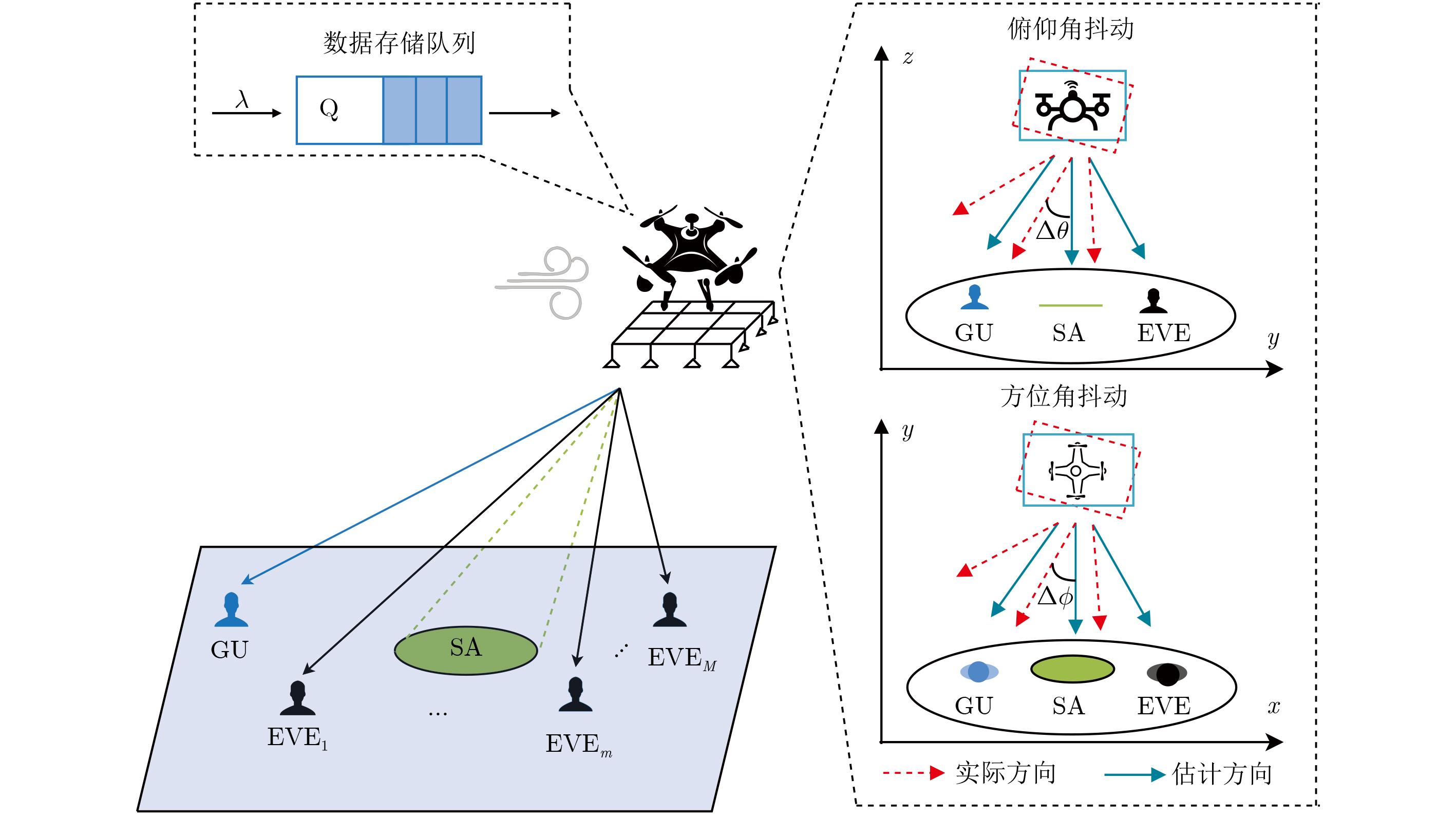
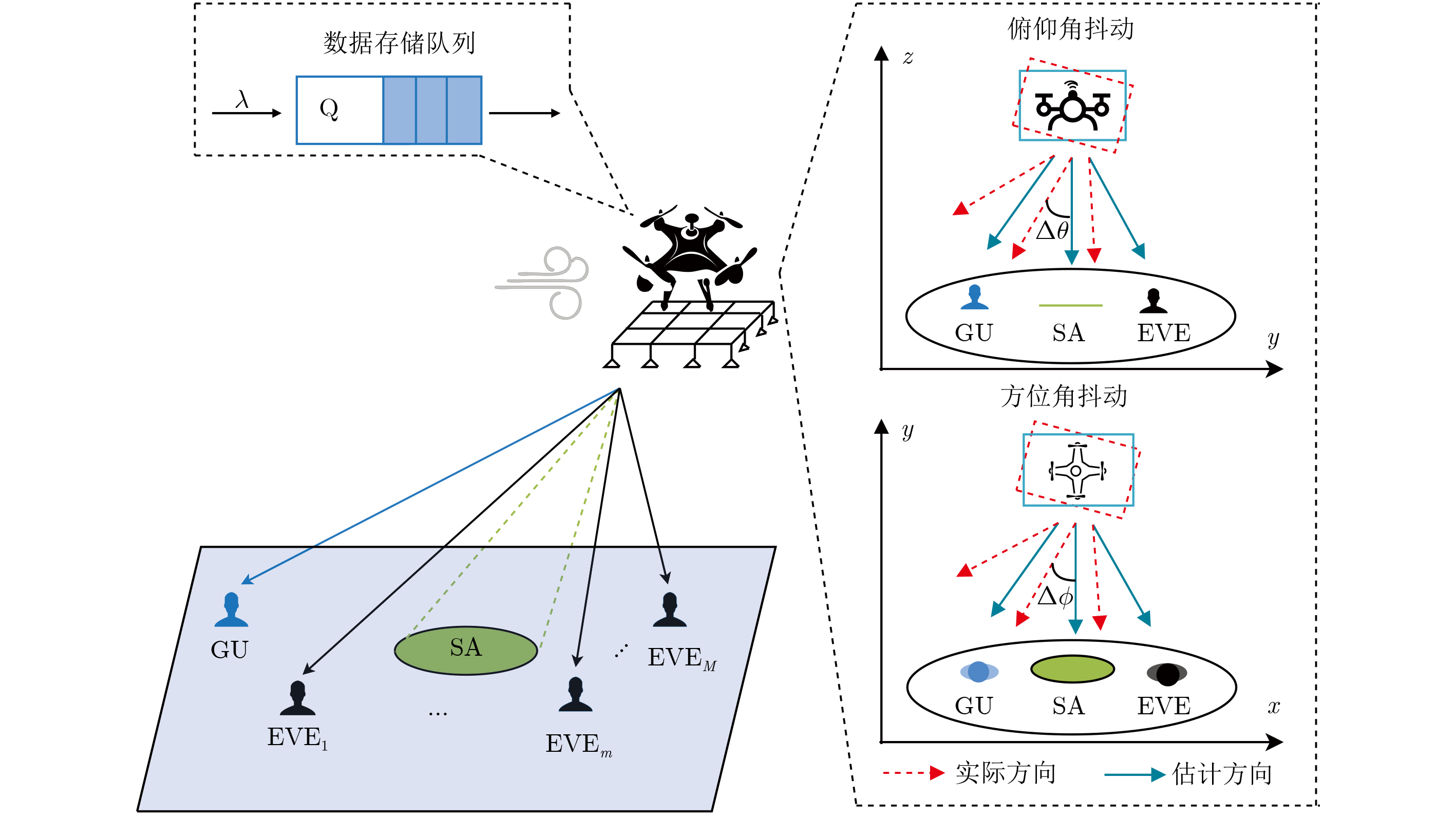
摘要: 针对低空无人机通感一体化(UAV-ISAC)系统中的数据到达量随机、机体抖动以及窃听威胁等问题,该文提出了一种基于队列稳定性约束的鲁棒安全波束成形算法。首先,构建以最小化系统长时隙平均发射功率为目标函数,以队列稳定性、安全通信速率下限、感知性能下限和发射功率上限为约束的长时隙队列稳定性优化问题。其次,由于长时隙优化问题难以直接求解,采用Lyapunov优化框架将长时隙随机性优化问题转化为前后时隙关联的短时隙优化问题;在短时隙优化中利用二阶泰勒展开对UAV机体抖动导致的通信链路角度误差进行近似处理,并提出一种基于惩罚连续凸逼近的鲁棒安全优化算法。仿真结果表明,所提算法与多种基准方案相比,可有效保障UAV-ISAC系统在抖动场景下的数据传输稳定性与安全性。
-
关键词:
- 无人机 /
- 通感一体化 /
- 队列稳定性 /
- Lyapunov优化 /
- 鲁棒安全波束成形
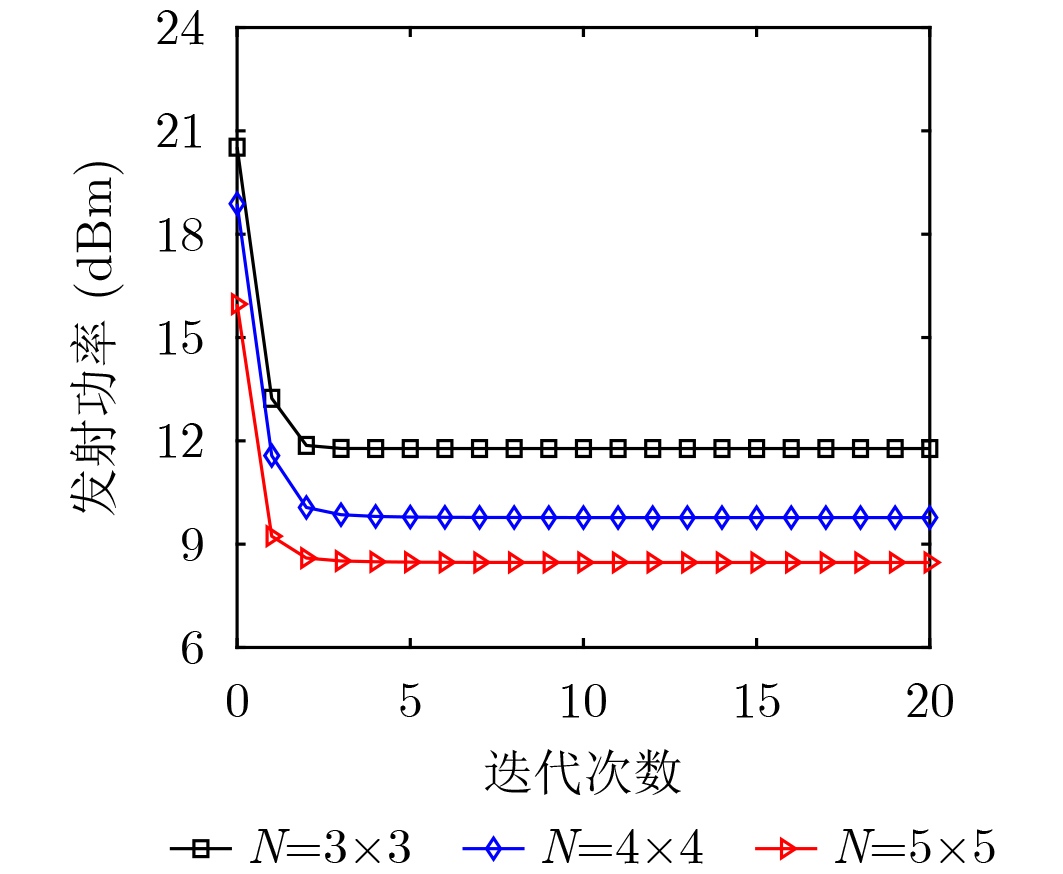
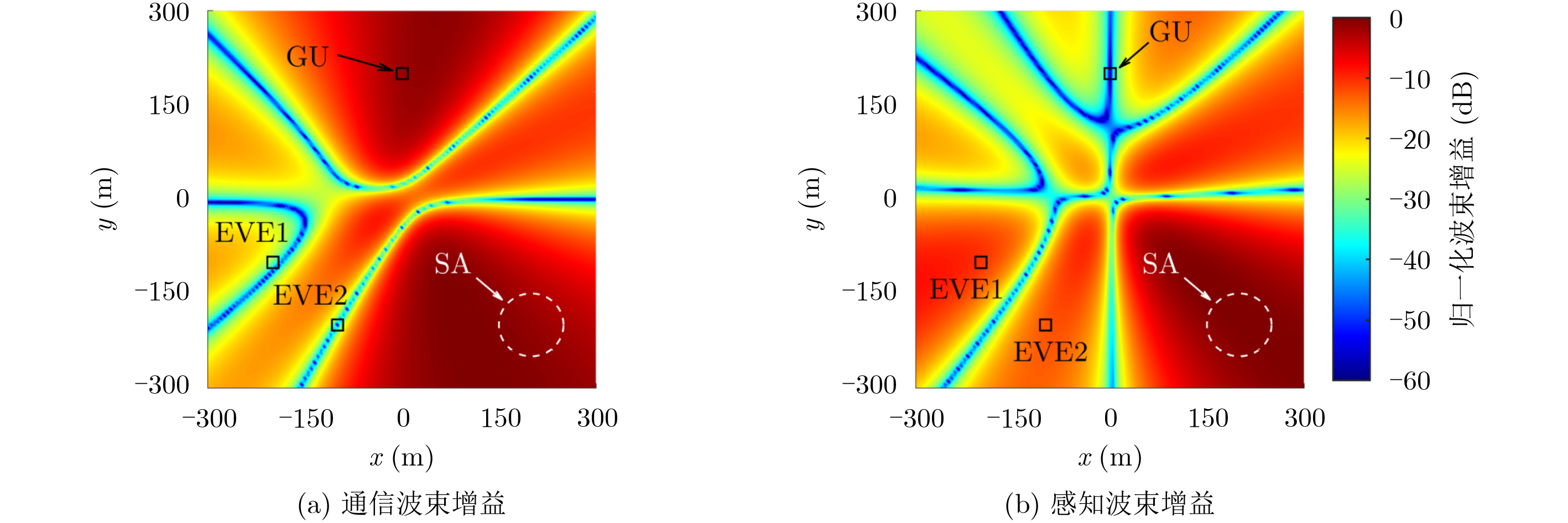
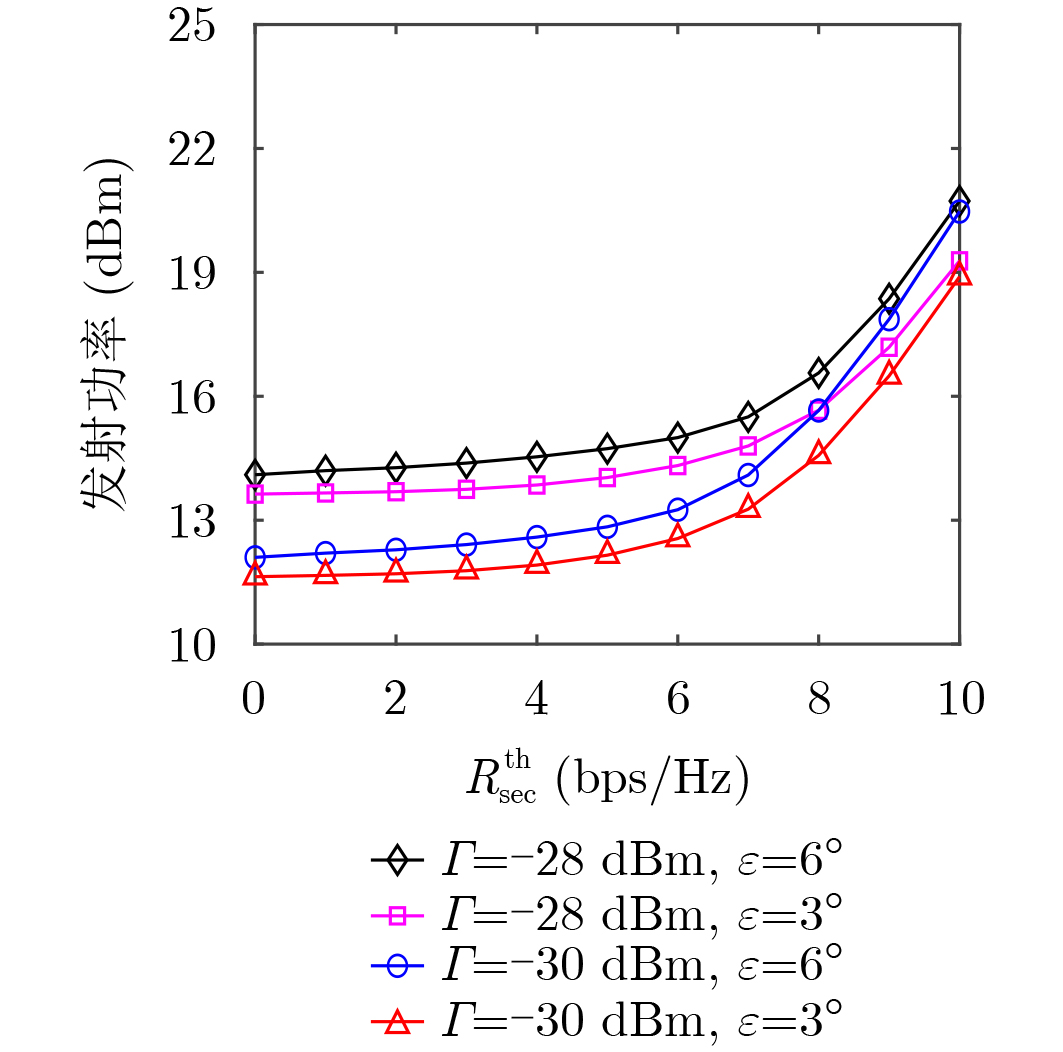
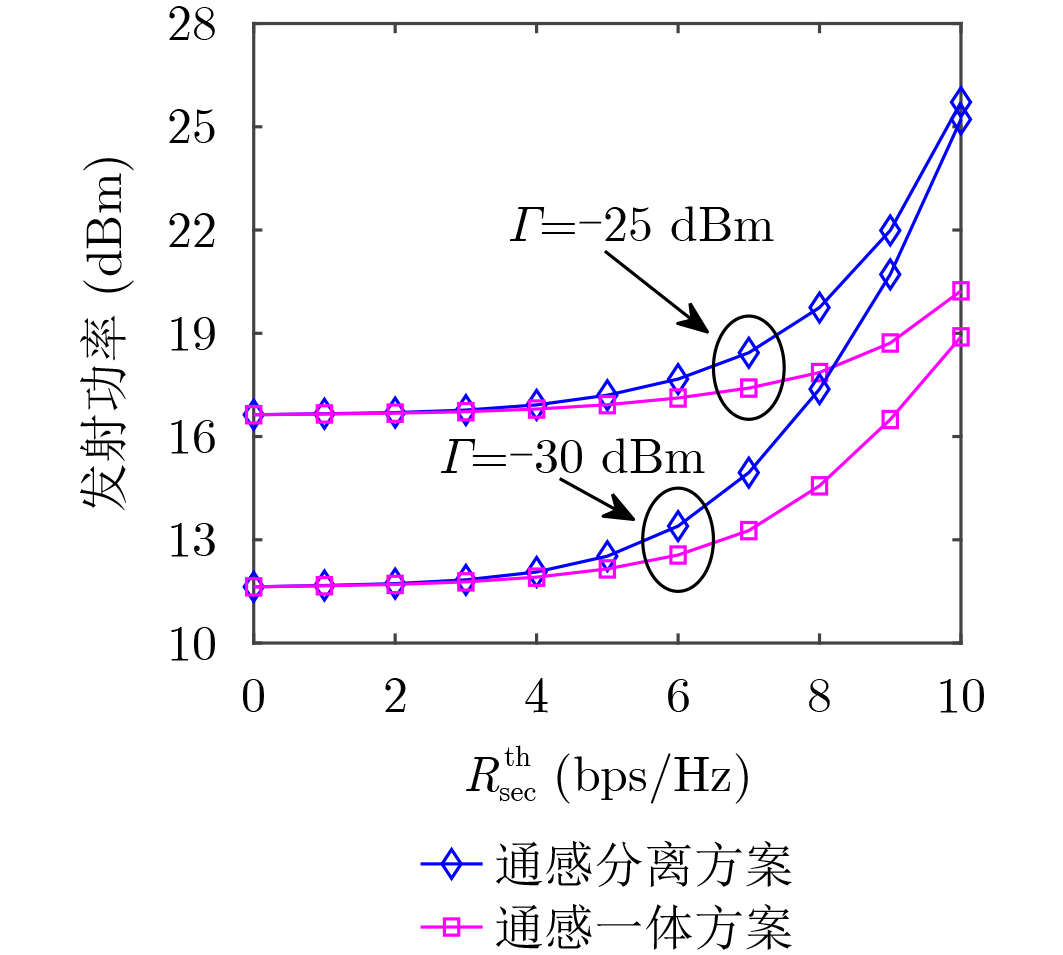
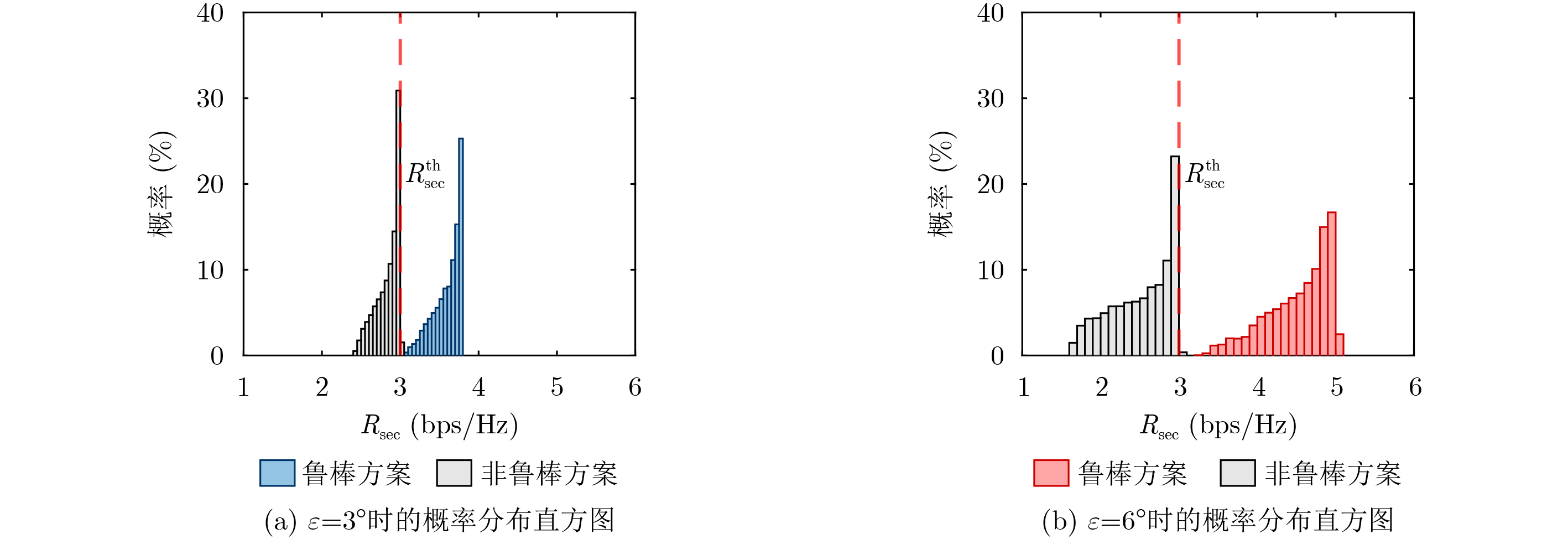
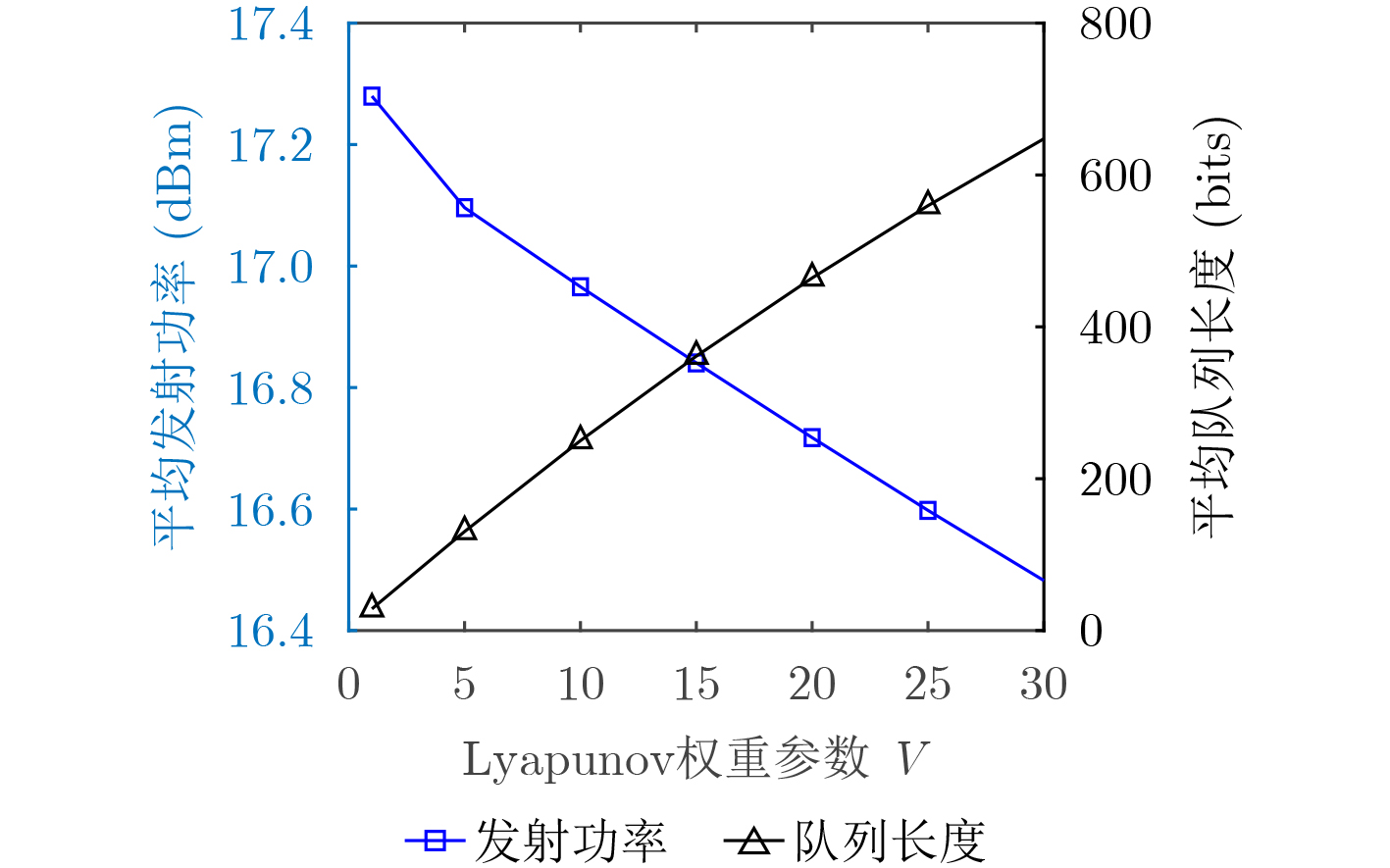
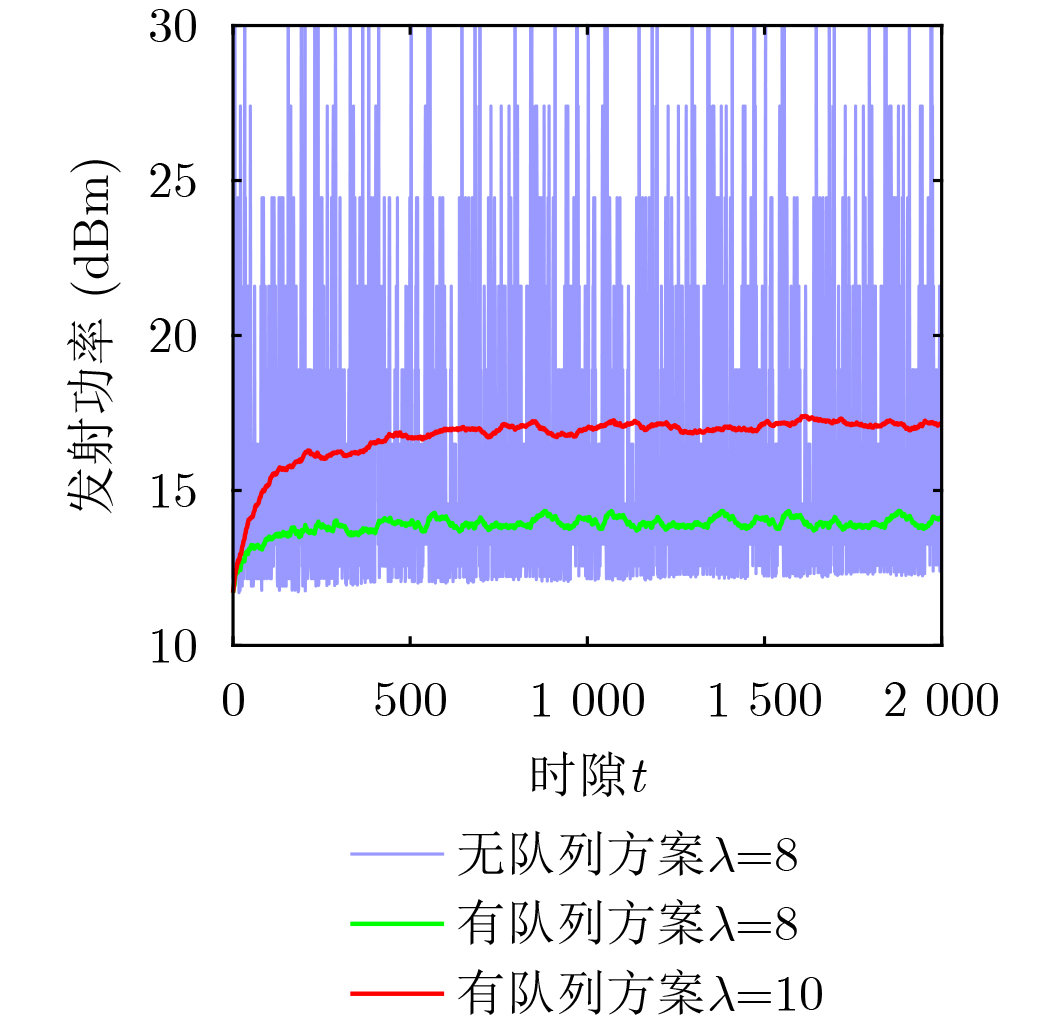
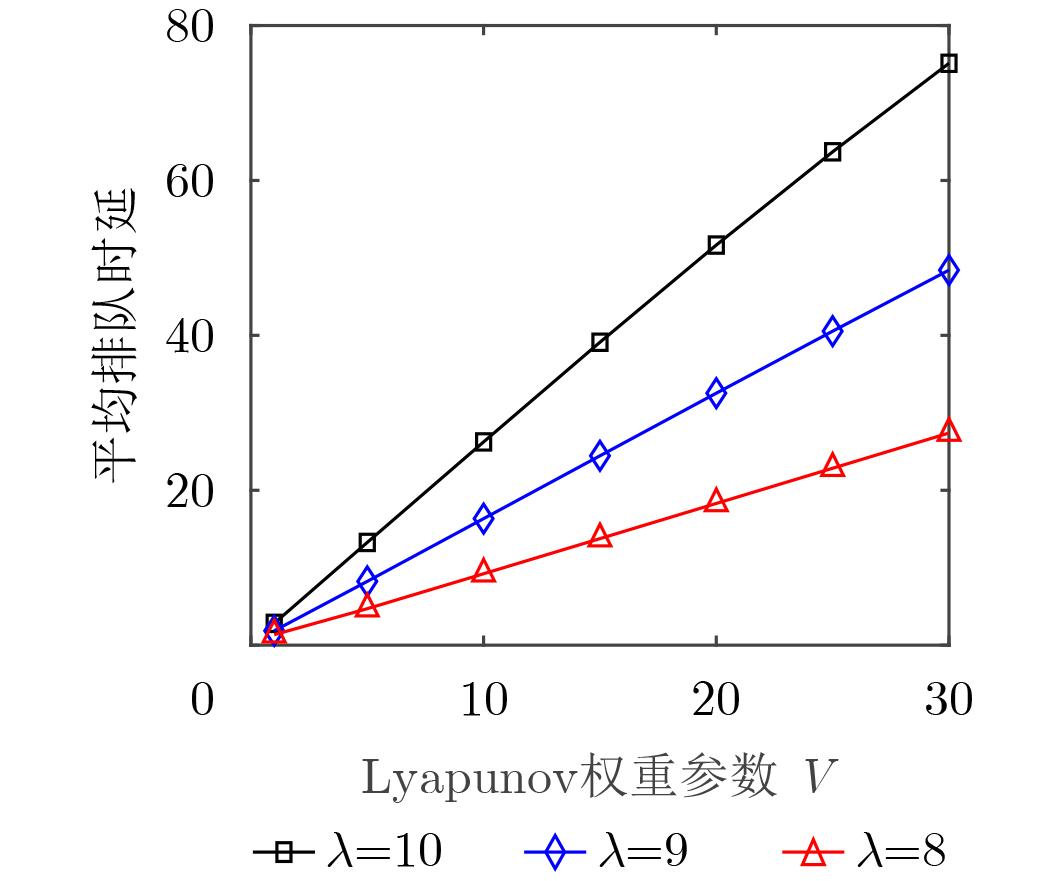
Abstract:Objective To address antenna array angle errors caused by Unmanned Aerial Vehicle (UAV) jitter, transmission instability resulting from random data arrivals, and secure transmission in multi-eavesdropper scenarios for low-altitude Integrated Sensing and Communication (ISAC) systems, a robust secure beamforming algorithm subject to queue stability constraints is proposed. The proposed algorithm minimizes the long-term average transmit power while maintaining data queue stability and enhancing beamforming robustness against UAV jitter. Methods An optimization problem is formulated to minimize the long-term average transmit power subject to constraints on data queue stability, minimum secrecy rate, sensing performance, and maximum transmit power. Because the long-term stochastic optimization problem is difficult to solve directly, the Lyapunov optimization framework is employed to transform it into a sequence of short-term optimization subproblems. To address antenna array angle errors caused by UAV jitter within each time slot, the Second-Order Taylor Series Expansion (STSE) and the S-Procedure are jointly employed to approximate the non-convex problem with a tractable convex formulation. A robust secure beamforming algorithm based on penalty-based successive convex approximation is then developed. Results and Discussions Simulation results demonstrate the effects of the number of antennas, minimum secrecy rate threshold, sensing beam gain threshold, UAV jitter error, and Lyapunov weight factor on the system transmit power. As shown in Fig. 3 , the communication beamformer provides additional sensing gain for the sensing area, whereas the sensing beamformer enhances communication security by directing interference toward potential eavesdroppers. These results verify the effectiveness of the proposed algorithm in jointly improving sensing and secure communication performance. Furthermore, by exploiting the dual-function characteristics of the communication and sensing beamformers, the proposed ISAC scheme achieves higher resource utilization efficiency than the separated sensing-and-communication scheme, as shown inFig. 5 .Figure 6 further shows that, compared with the non-robust scheme, the proposed robust scheme consistently satisfies the minimum secrecy rate requirement under various angle errors. In addition,Fig. 8 demonstrates that the proposed queue-aware scheme effectively suppresses transmit power fluctuations caused by random data arrivals, providing better transmission stability than the scheme without queue constraints.Conclusions A robust secure beamforming method for UAV-ISAC systems subject to queue stability constraints is investigated. The Lyapunov optimization framework transforms the long-term stochastic optimization problem into a sequence of short-term optimization subproblems. The STSE and the S-Procedure are jointly employed to convert the non-convex constraints caused by UAV jitter into tractable convex forms. A robust secure beamforming algorithm based on penalty-based successive convex approximation is then developed to efficiently solve the resulting deterministic short-term optimization subproblems. Simulation results demonstrate that the proposed scheme effectively addresses random data arrivals, UAV jitter, and eavesdropping threats, thereby ensuring the stability and security of downlink data transmission in low-altitude UAV-ISAC systems. -
Key words:
- UAV /
- ISAC /
- Queue stability /
- Lyapunov optimization /
- Robust secure beamforming
-
表 1 鲁棒安全波束成形算法
(1) 初始化队列积压量$ Q(0) $和可行初始点$ ({\boldsymbol{W}}_{\text{c}}(0),{\boldsymbol{W}}_{\text{s}}(0)) $。 (2) 根据$ {\boldsymbol{W}}_{\text{c}}(0) $和$ {\boldsymbol{W}}_{\text{s}}(0) $计算$ {R}_{\text{G}}(0) $,并设置$ t=1 $。 (3) While $ t\leq T $: (4) $ t=t+1 $; (5) 获取$ A(t-1) $,并依据公式(9)更新$ Q(t) $; (6) 设置时隙$ t $的初始点$(\mathbf{\overline{\boldsymbol{W}}}_{\text{c}}^{0},\mathbf{\overline{\boldsymbol{W}}}_{\text{s}}^{0})=({\boldsymbol{W}}_{\text{c}}(t-1) $,
$ {\boldsymbol{W}}_{\text{s}}(t-1)) $和$ i=0 $;(7) do: (8) $ i=i+1 $; (9) 求解优化问题(P5),获得最优解$ (\mathbf{\overline{\boldsymbol{W}}}_{\text{c}}^{i},\mathbf{\overline{\boldsymbol{W}}}_{\text{s}}^{i}) $; (10) While$ \left|\left|\mathbf{\overline{\boldsymbol{W}}}_{\text{c}}^{i}-\mathbf{\overline{\boldsymbol{W}}}_{\text{c}}^{i-1}\right|\right|+\left|\left|\mathbf{\overline{\boldsymbol{W}}}_{\text{s}}^{i}-\mathbf{\overline{\boldsymbol{W}}}_{\text{s}}^{i-1}\right|\right|\rightarrow 0 $ (11) 更新$ ({\boldsymbol{W}}_{\text{c}}(t),{\boldsymbol{W}}_{\text{s}}(t))=(\mathbf{\overline{\boldsymbol{W}}}_{\text{c}}^{i},\mathbf{\overline{\boldsymbol{W}}}_{\text{s}}^{i}) $; (12) 根据$ {\boldsymbol{W}}_{\text{c}}(t) $和$ {\boldsymbol{W}}_{\text{s}}(t) $计算$ {R}_{\text{G}}(t) $; (13) end  下载: 导出CSV
表 2 仿真参数
参数名称 符号 数值 参数名称 符号 数值 天线数量 $ N $ 3×3 平均数据到达量 $ \lambda $ 10 无人机高度 $ H $ 100 m[13] 安全速率阈值 $ R_{\text{sec}}^{\text{th}} $ 3 bps/Hz 噪声功率 $ {\sigma }^{2} $ –110 dBm[12] 感知波束增益阈值 $ {\varGamma } $ –30 dBm[12] 载波频率 $ {f}_{\text{c}} $ 20 GHz[19] 发射功率上限 $ P_{\text{T}}^{\max } $ 30 dBm 感知区域采样点数 $ K $ 9 总时隙 $ T $ 2000 抖动误差界限 $ \varepsilon $ 3°[15] Lyapunov权重参数 $ V $ 20
下载: 导出CSV
-
[1] WANG Yixian, SUN Geng, SUN Zemin, et al. Toward realization of low-altitude economy networks: Core architecture, integrated technologies, and future directions[J]. IEEE Transactions on Cognitive Communications and Networking, 2025, 11(5): 2788–2820. doi: 10.1109/TCCN.2025.3601015. [2] 钱志鸿, 王义君. 低空经济赋能者: 智能无人机技术体系综述与展望[J]. 电子与信息学报, 2026, 48(1): 1–33. doi: 10.11999/JEIT251246.QIAN Zhihong and WANG Yijun. Intelligent unmanned aerial vehicles for low-altitude economy: A review of the technology framework and future prospects[J]. Journal of Electronics & Information Technology, 2026, 48(1): 1–33. doi: 10.11999/JEIT251246. [3] JIANG Yihang, LI Xiaoyang, ZHU Guangxu, et al. Integrated sensing and communication for low altitude economy: Opportunities and challenges[J]. IEEE Communications Magazine, 2025, 63(12): 72–78. doi: 10.1109/MCOM.001.2400685. [4] 朱政宇, 温鑫平, 李兴旺, 等. 面向低空经济的通感一体化关键技术[J]. 电子与信息学报, 2026, 48(2): 471–486. doi: 10.11999/JEIT250747.ZHU Zhengyu, WEN Xinping, LI Xingwang, et al. An overview on integrated sensing and communication for low altitude economy[J]. Journal of Electronics & Information Technology, 2026, 48(2): 471–486. doi: 10.11999/JEIT250747. [5] PENG Guangqian, ZHANG Ningbo, CHEN Hao, et al. Energy-efficient-aware RSMA-enabled UAV-ISAC[J]. IEEE Wireless Communications Letters, 2026, 15: 1380–1384. doi: 10.1109/LWC.2025.3647149. [6] GOU Haosong, ZHAO Siyu, RAO Yunbo, et al. Energy-efficient trajectory design and resource allocation for multi-drone-enabled ISAC in IoT networks[J]. IEEE Transactions on Consumer Electronics, 2026, 72(1): 1672–1684. doi: 10.1109/TCE.2025.3631745. [7] ZHOU Yuyan, LIU Yang, WU Qingqing, et al. Queueing aware power minimization for wireless communication aided by double-faced active RIS[J]. IEEE Transactions on Communications, 2023, 71(10): 5799–5813. doi: 10.1109/TCOMM.2023.3293858. [8] WANG Xue, WANG Ying, ZHAO Jianguo, et al. Joint long-term user scheduling and beamforming design for burst IIoT[J]. IEEE Internet of Things Journal, 2024, 11(12): 22628–22642. doi: 10.1109/JIOT.2024.3382738. [9] SHENG Zhichao, HU Hao, NASIR A A, et al. Online Trajectory planning and resource allocation of UAV-enabled MEC networks empowered by RIS[J]. IEEE Transactions on Green Communications and Networking, 2025, 9(3): 1224–1238. doi: 10.1109/TGCN.2024.3503687. [10] QIN Peng, FU Yang, YU Zhigang, et al. URLLC-aware trajectory plan and beamforming design for NOMA-aided UAV integrated sensing, communication, and computation networks[J]. IEEE Transactions on Vehicular Technology, 2025, 74(1): 1610–1625. doi: 10.1109/TVT.2024.3460813. [11] 朱政宇, 杨晨一, 李铮, 等. 智能反射面辅助通感一体化系统安全资源分配算法[J]. 电子与信息学报, 2025, 47(1): 66–74. doi: 10.11999/JEIT240083.ZHU Zhengyu, YANG Chenyi, LI Zheng, et al. Resource allocation algorithm for intelligent reflecting surface-assisted secure integrated sensing and communications system[J]. Journal of Electronics & Information Technology, 2025, 47(1): 66–74. doi: 10.11999/JEIT240083. [12] DENG Dan, ZHOU Wen, LI Xingwang, et al. Joint beamforming and UAV trajectory optimization for covert communications in ISAC networks[J]. IEEE Transactions on Wireless Communications, 2025, 24(2): 1016–1030. doi: 10.1109/TWC.2024.3503726. [13] GAO Ruifeng, CHEN Ying, HU Yingdong, et al. Towards UAV aerial base station networking robustness: A jitter-aware antenna selection perspective[J]. IEEE Transactions on Vehicular Technology, 2024, 73(10): 15866–15871. doi: 10.1109/TVT.2024.3399309. [14] CHENG Tianhao, WANG Buhong, CAO Kunrui, et al. Aerial IRS-assisted secure SWIPT system with UAV jitter[J]. IEEE Transactions on Green Communications and Networking, 2024, 8(4): 1530–1544. doi: 10.1109/TGCN.2024.3366539. [15] OUYANG Jian, LU Yuting, LIU Chengyang, et al. Robust beamforming for uplink RSMA in UAV communication systems with jittering[J]. IEEE Communications Letters, 2025, 29(4): 769–773. doi: 10.1109/LCOMM.2025.3543284. [16] OUYANG Jian, DING Jing, WANG Runan, et al. Robust secrecy-energy efficient beamforming for jittering UAV in cognitive satellite-aerial networks[J]. IEEE Transactions on Aerospace and Electronic Systems, 2025, 61(4): 9567–9583. doi: 10.1109/TAES.2025.3552313. [17] ZHANG Yu, CHEN Jiachi, ZHONG Caijun, et al. Active IRS-assisted integrated sensing and communication in C-RAN[J]. IEEE Wireless Communications Letters, 2023, 12(3): 411–415. doi: 10.1109/LWC.2022.3228405. [18] XU Dongfang, SUN Yan, NG D W K, et al. Multiuser MISO UAV communications in uncertain environments with no-fly zones: Robust trajectory and resource allocation design[J]. IEEE Transactions on Communications, 2020, 68(5): 3153–3172. doi: 10.1109/TCOMM.2020.2970043. [19] XU Yu, ZHANG Tiankui, LIU Yuanwei, et al. UAV-enabled integrated sensing, computing, and communication: A fundamental trade-off[J]. IEEE Wireless Communications Letters, 2023, 12(5): 843–847. doi: 10.1109/LWC.2023.3245728. -

 下载:
下载:

图(9) / 表(2)
计量
- 文章访问数: 507
- HTML全文浏览量: 197
- PDF下载量: 25
- 被引次数: 0
