




Communication-Efficient Adaptive Federated Split Learning Optimization Method in Edge Intelligence Scenarios
-
摘要: 联邦分割学习(FSL)在边缘智能(EI)场景中通过划分神经网络实现端边协同训练,有效缓解终端资源约束。但其面临通信开销高、对动态网络环境适应性不足等挑战,严重制约模型的部署效率。此外,数据异构性导致全局模型泛化性能下降,现有研究缺乏个性化精度与通信效率的协同优化。针对上述问题,该文首先构建基于强化学习的联邦分割学习框架,融合预训练初始化、激活重用与量化压缩降低通信开销,并利用强化学习算法自适应决策模型分割点以应对带宽变化。其次,针对非独立同分布(Non-IID)数据场景,基于多任务学习实现客户端模型个性化优化,引入私有个性化层适配本地数据分布,并结合量化与动态层级压缩感知技术降低双向通信成本。实验结果表明,所提方法在带宽变化条件下,可在保持与基线方法相当的全局模型精度的同时,实现最高117.61倍训练加速与最高72.75倍通信开销降低;在Non-IID数据异构场景下,对于两个数据集均能实现个性化测试精度的提升,且双向通信成本最高降低11.97倍。Abstract:
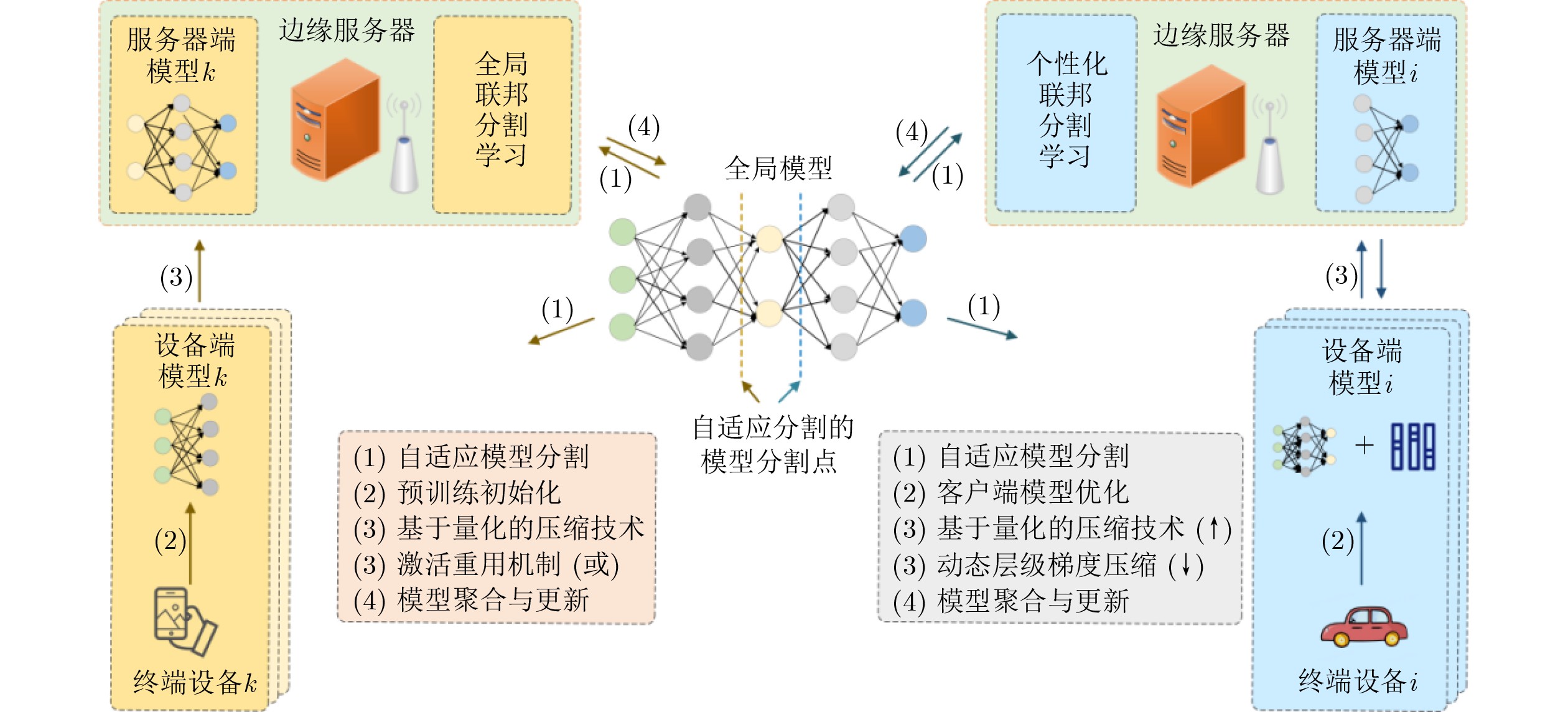
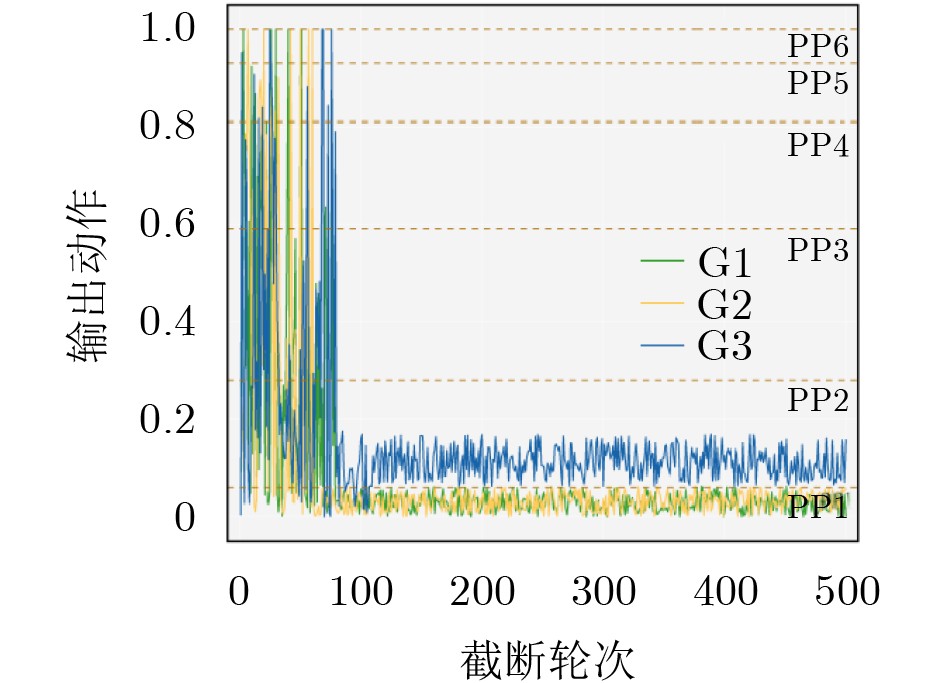
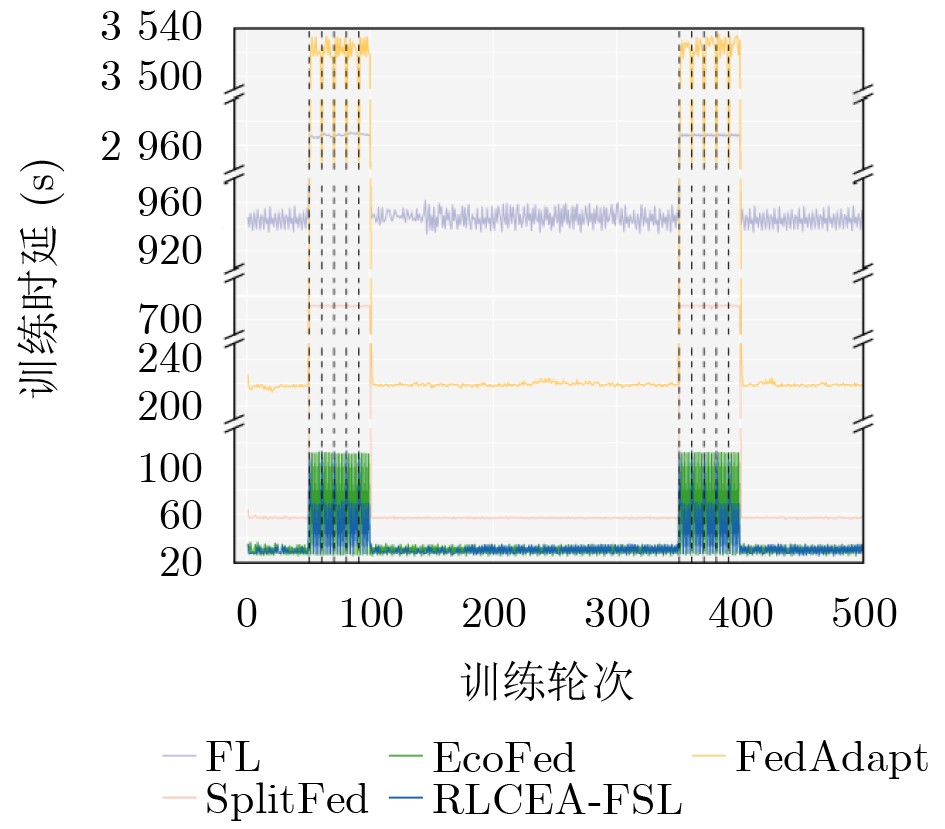
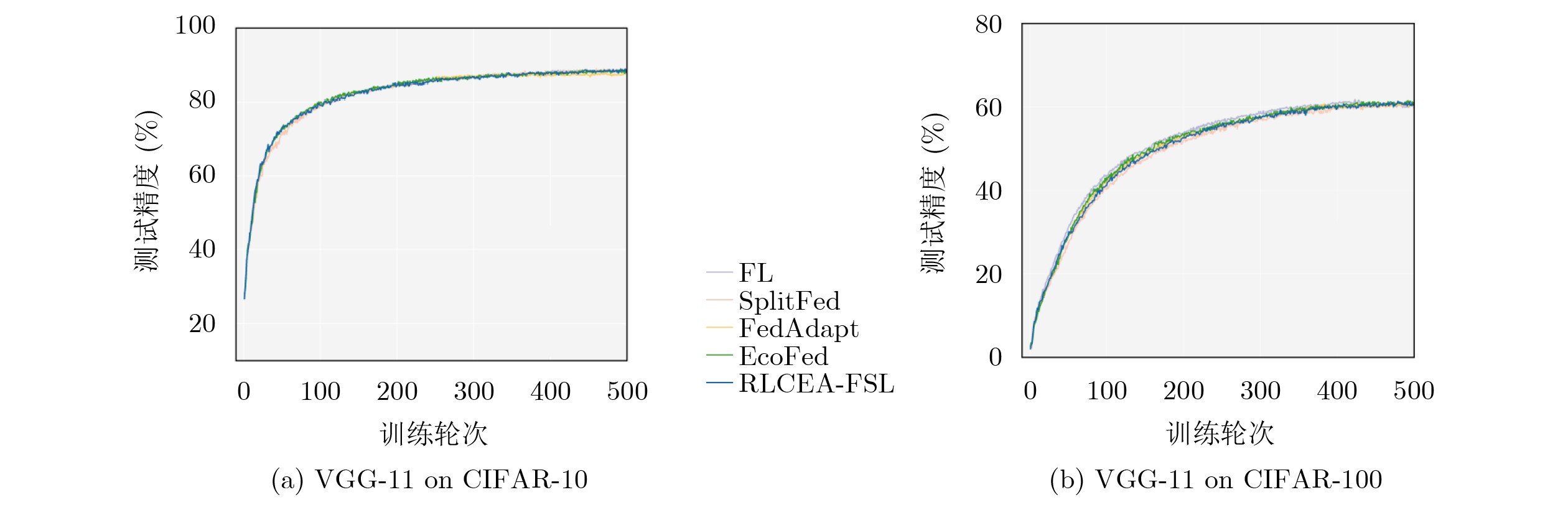
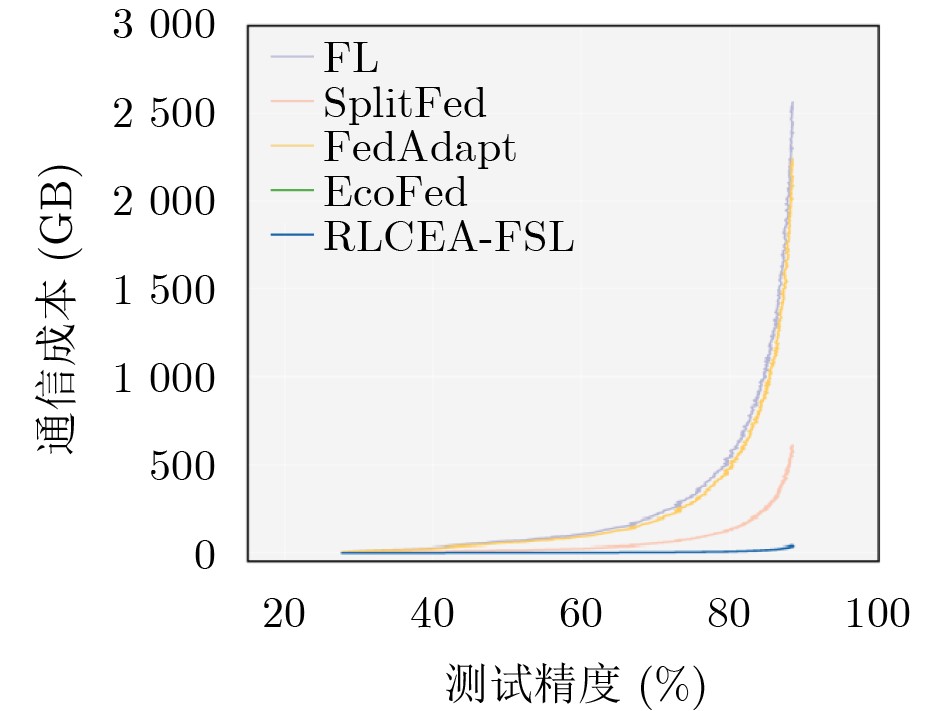
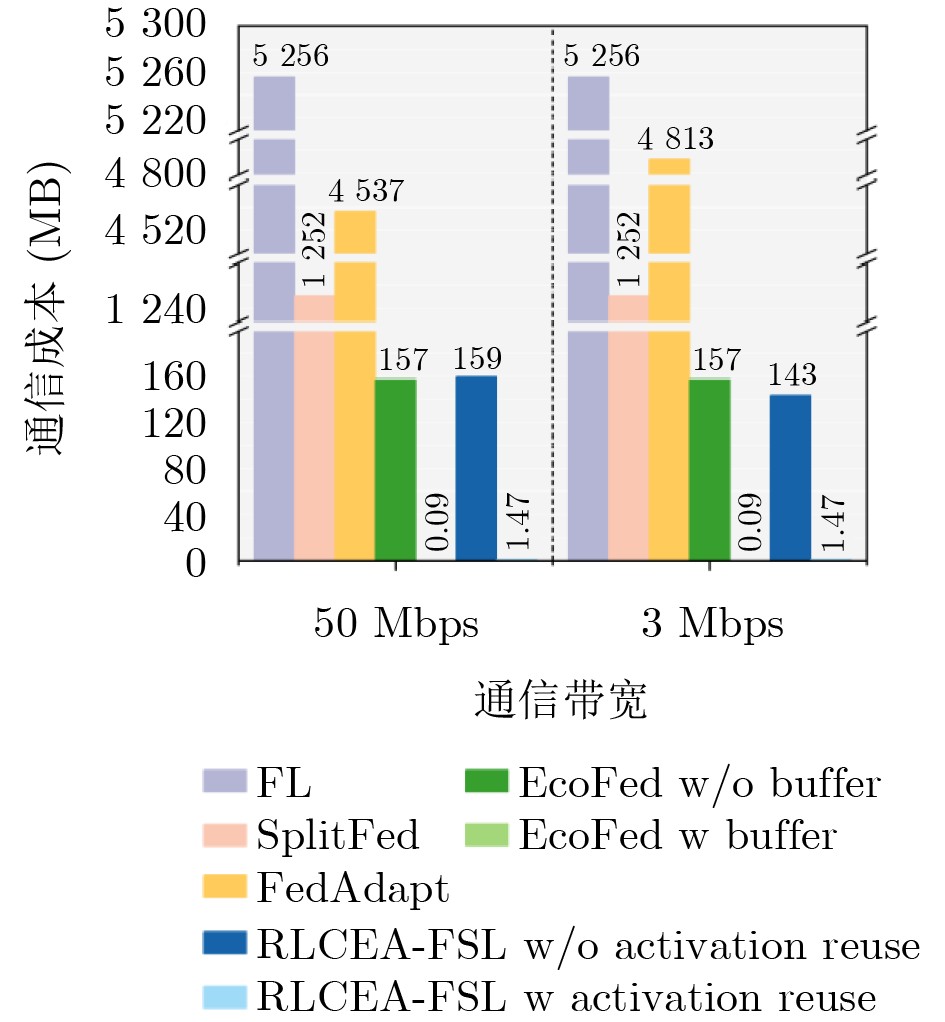
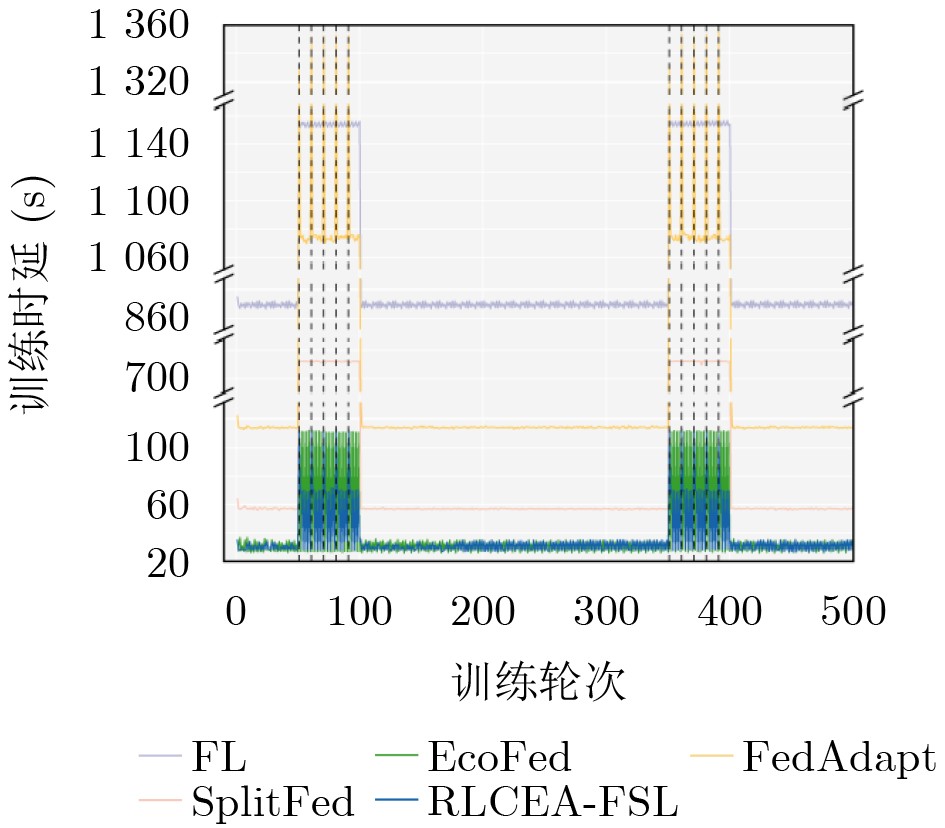
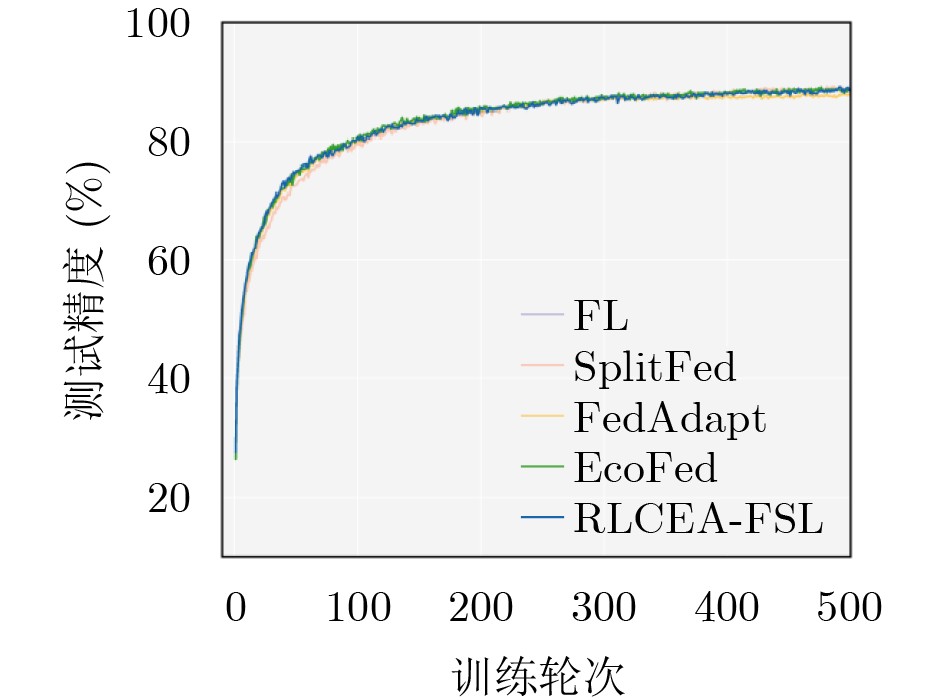
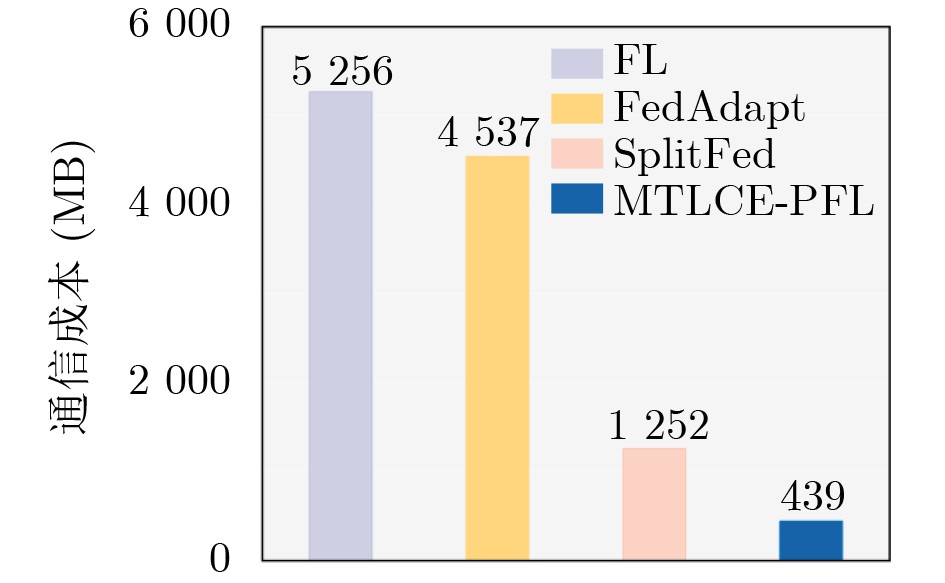
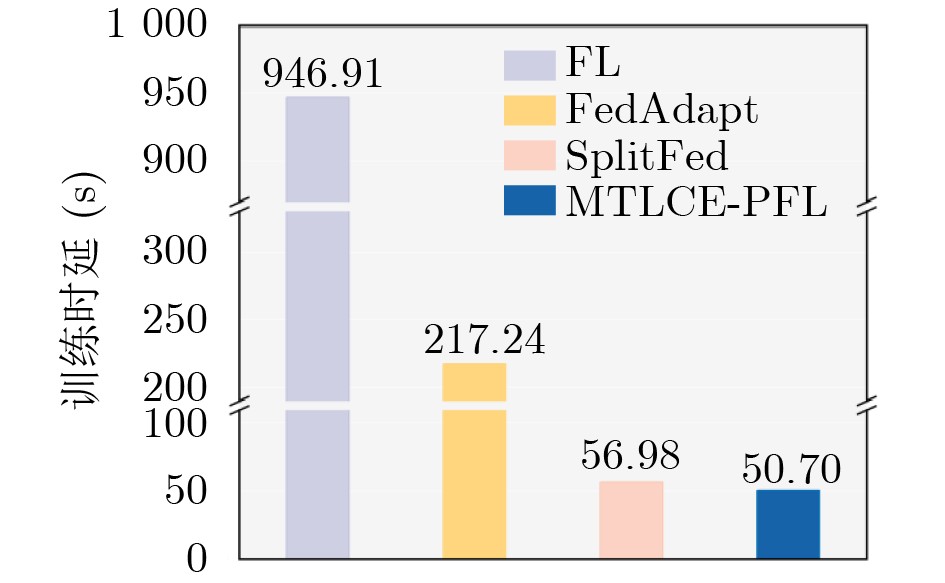
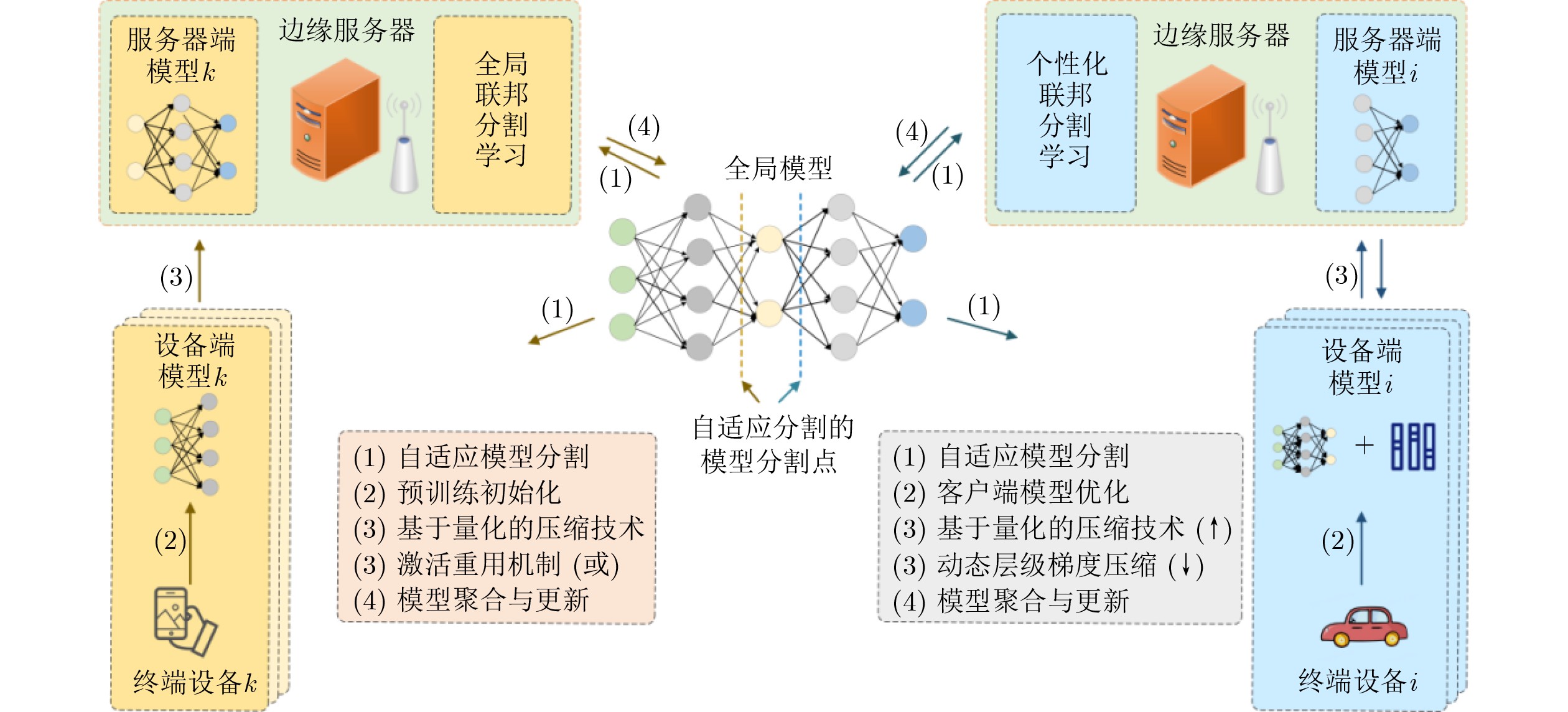
Objective Federated Split Learning (FSL) has emerged as a promising paradigm for Edge Intelligence (EI) scenarios, enabling collaborative training through neural network partitioning to alleviate resource constraints on terminal devices. However, FSL faces critical challenges including high communication overhead introduced by frequent interactions between devices and edge servers and insufficient adaptability to dynamic network environments, which severely restrict deployment efficiency. Moreover, the data heterogeneity in practical edge environments poses severe challenges to the personalized performance of models, and existing research lacks synergistic optimization between personalized accuracy and communication efficiency. This study addresses these challenges by jointly incorporating Reinforcement Learning (RL), multi-strategy communication optimization, and multi-task learning to adapt to network bandwidth variations, reduce communication overhead, and improve personalized model testing accuracy. Methods This paper designs a communication-efficient adaptive FSL framework integrating RL-based adaptive model splitting, multi-strategy communication optimization, and multi-task learning-based personalized optimization. First, this paper proposes a Reinforcement Learning-based Communication-Efficient Adaptive Federated Split Learning (RLCEA-FSL) algorithm. This responds to network bandwidth changes adaptively via RL and reduces communication overhead between end devices and edge servers by multiple communication optimization strategies. Second, a Multi-Task Learning-based Communication-Efficient Personalized Federated Learning (MTLCE-PFL) algorithm is proposed to tackle the challenge of joint optimization between personalized accuracy and communication efficiency under non-independent and identically distributed (Non-IID) data distributions. Specifically, private personalized layers are introduced using batch normalization layers to adapt to local data distributions, transforming the Non-IID problem into a multi-task learning problem. Additionally, quantization compression is applied to intermediate activates transmitted from devices to servers, and dynamic hierarchical gradient compression based on compressed sensing is implemented for gradient backhaul from servers to devices. Results and Discussions The proposed framework and algorithms are evaluated through extensive simulations on CIFAR-10 and CIFAR-100 datasets using VGG-11 and ResNet-9 models. Four baseline methods are adopted, namely classical FL, SplitFed, FedAdapt, and EcoFed (hereinafter referred to in this order). Compared with the baseline methods, RLCEA-FSL (Algorithm 1) achieves up to 101.23 ×, 24.27 ×, 117.61 × speedup and 37.91 % reduction in training latency without and with activation reuse mechanism, respectively ( Fig.3 ). The algorithm reduces overall communication overhead by 72.75 ×, 17.33 ×, 66.62 ×, and 8.1 % compared with the baseline methods, respectively, when bandwidth is constrained (Fig. 6 ). This improvement results from the adaptive model splitting strategy dynamically adjusting partition points according to bandwidth variations, combined with multi-strategy communication optimization methods. The RL agent trained on VGG-11 can be directly applied to ResNet-9 without retraining, demonstrating favorable results in terms of training latency, test accuracy, and communication cost (Fig. 7 ,Fig. 8 ). The MTLCE-PFL algorithm effectively improves personalized testing accuracy under Non-IID data distributions while reducing communication costs and training latency. Compared with other algorithms, MTLCE-PFL (Algorithm 2) achieves faster convergence and higher personalized testing accuracy on both CIFAR-10 and CIFAR-100 datasets with VGG-11 and ResNet-9 models (Fig. 9 ). This improvement results from the multi-task learning framework with private personalized layers adapting to local data distributions, transforming the Non-IID problem into independent task optimization for each client. In terms of communication efficiency, MTLCE-PFL reduces bidirectional communication overhead by 11.97 ×, 2.86 ×, and 10.33 × compared with classical FL, SplitFed, and FedAdapt, respectively, through quantization-based compression for forward activates and dynamic hierarchical compressed sensing for backward gradients (Fig. 10 ). For training latency, despite increased computational complexity from personalized layers, MTLCE-PFL reduces average per-round training time by 11.02 % compared with SplitFed, and achieves 4.28 × and 18.68 × speedup compared with FedAdapt and classical FL, respectively (Fig. 11 ). The results demonstrate the effectiveness and efficiency of the proposed methods in terms of global model accuracy, personalized testing accuracy, communication cost, and training delay.Conclusions The proposed communication-efficient adaptive federated split learning framework addresses the challenges of high communication overhead, dynamic network environments, and data heterogeneity in EI scenarios from multiple perspectives. By integrating RL-based adaptive model splitting with multi-strategy communication optimization, the RLCEA-FSL algorithm adaptively responds to bandwidth variations and significantly reduces training latency and communication costs while maintaining comparable global model accuracy. The cross-model generalization capability of the RL agent enhances practical deployment flexibility, enabling direct transfer between different neural network architectures without retraining. Furthermore, by introducing multi-task learning with private personalized layers, the MTLCE-PFL algorithm effectively improves personalized testing accuracy under Non-IID data distributions while reducing bidirectional communication overhead through quantization and dynamic hierarchical compressed sensing techniques. -
1 RLCEA-FSL算法
输入:预训练模型 $ {\omega }_{\text{p}} $,初始分割点$ \text{PP}_{0}^{k} $ 本地数据集 $ {\text{D}}_{i} $,i=1,2,···,K 总训练轮次 $ N $ 输出:全局模型 $ {\omega }^{\text{(global)}} $ (1) 以状态$ {\text{S}}_{0} $初始化RL智能体; (2) for $ t\leftarrow 1 $ to $ N $ do (3) for 每个设备$ {\text{d}}_{k},k\in ${1,2,…,K} do (4) 分割模型为设备端模型$ \omega _{k}^{\text{C}} $与服务器端模型$ \omega _{k}^{\text{S}} $; (5) 预训练初始化 ( ) (6) 使用$ {\omega }_{\text{p}} $初始化并冻结设备端模型$ \omega _{k}^{\text{C}} $; (7) 在服务器端初始化服务器端模型$ \omega _{k}^{\text{S}} $; (8) 基于权重子集通信的高效带宽评估 ( ) (9) 获取带宽测试权重$ {\omega }_{\text{test}} $; (10) 发送$ {\omega }_{\text{test}} $至服务器获取带宽$ B_{t}^{k} $; (11) if $ (t\text{mod}\tau ==0) $ or $ \text{(PP}_{t}^{k}!=\text{PP}_{t}^{k-1}) $ then //达到缓存更新周期or设备端模型/对应本地输入发生变化 (12) 前向传输$ \omega _{k}^{\text{C}} $得到 $ O_{\text{PP}_{t}^{k}}^{f} $; (13) $ O_{\text{PP}_{t}^{k}}^{{f}^{\text{'}}} \leftarrow $ 量化压缩 ($ O_{\text{PP}_{t}^{k}}^{f}) $; (14) 发送 $ O_{\text{PP}_{t}^{k}}^{{f}^{\text{'}}} $至服务器; (15) 使用 $ O_{\text{PP}_{t}^{k}}^{{f}^{\text{'}}} $更新缓存; (16) end (17) else (18) 激活重用 ( ) (19) 从缓存获取 $ O_{\text{PP}_{t}^{k}}^{{f}^{\text{'}}} $; (20) end (21) $ \hat{O}_{\text{PP}_{t}^{k}}^{f} \leftarrow $ 解量化 ($ O_{\text{PP}_{t}^{k}}^{{f}^{\text{'}}} $); (22) 使用 $ \hat{O}_{PP_{t}^{k}}^{f} $训练$ \omega _{k}^{\text{S}} $; (23) end (24) 按公式(8)聚合$ \omega _{t}^{\text{(global)}} $;//FedAvg (25) $ {\text{PP}}_{t+1}\leftarrow $自适应模型分割 (RL智能体,$ {\text{S}}_{t} $); (26) end (27) return $ {\omega }^{\text{(global)}} $  下载: 导出CSV
2 MTLCE-PFL算法
输入:本地数据集 $ {\text{D}}_{i} $,i=1,2,···,K 总训练轮次 $ N $ 初始分割点$ \text{PP}_{0}^{k} $ 最高压缩率$ {r}_{\max } $与最低压缩率$ {r}_{\min } $ 输出:全局模型 $ {\omega }^{\text{(global)}} $ (1) 初始化全局模型$ \omega _{0}^{(\text{global})} $; (2) for $ t\leftarrow 1 $ to $ N $ do (3) for 每个设备$ {\text{d}}_{k},k\in ${1,2,···,K} do (4) 分割模型为设备端模型$ \omega _{k}^{\text{C}} $与服务器端模型$ \omega _{k}^{\text{S}} $; (5) 基于多任务学习的客户端模型优化 ( ) (6) 构建/更新私有个性化层$ {p}_{{{\text{k}}_{i}}} $; (7) 构建/更新个性化模型$ {\text{P}}_{k} $与设备端模型$ \omega _{k}^{\text{C}}’ $; (8) 前向传输$ \omega _{k}^{\text{C}}’ $得到前向激活$ O_{PP_{t}^{k}}^{f} $; (9) $ O_{\text{PP}_{t}^{k}}^{{f}^{\text{'}}} \leftarrow $ 量化压缩 ($ O_{\text{PP}_{t}^{k}}^{f}) $; (10) 发送 $ O_{\text{PP}_{t}^{k}}^{{f}^{\text{'}}} $至服务器; (11) $ \hat{O}_{\text{PP}_{t}^{k}}^{f} \leftarrow $ 解量化 ($ O_{\text{PP}_{t}^{k}}^{{f}^{\text{'}}} $); (12) 使用 $ \hat{O}_{PP_{t}^{k}}^{f} $训练$ \omega _{k}^{\text{S}} $; (13) 基于CS的动态层级梯度压缩 ( ) (14) for $ l\leftarrow 1 $ to $ L $ do (15) 计算各层梯度$ {\boldsymbol{g}}^{l} $的$ {l}_{2} $-范数权重比; (16) 设置各层压缩率$ {r}^{l} $; (17) 构造确定性二进制测量矩阵$ {\boldsymbol{\phi }}^{l} $;//公式(15) (18) 对各层梯度$ {\boldsymbol{g}}^{l} $执行编码压缩;//公式(16) (19) end (20) $ \boldsymbol{g}'\leftarrow $ CS重构 ($ \boldsymbol{y},\boldsymbol{{\varPhi }} $); (21) 更新私有个性化层$ {p}_{{{\text{k}}_{i}}} $与设备端模型$ \omega _{k}^{\text{C}} $; (22) end (23) 按公式(8)聚合$ \omega _{t}^{\text{(global)}} $;//FedAvg (24) end (25) return $ {\omega }^{\text{(global)}} $
下载: 导出CSV
表 1 DNN模型
模型 架构 VGG-11 C64-MP(PP1)-C128-MP(PP2)-C256-
C256-MP(PP3)-C512-C512-MP(PP4)-
C512-C512(PP5)-FC4096-FC4096-FC10(PP6)ResNet-9 C64-MP(PP1)-C128-MP(PP2)-RB256(PP3)-
RB512(PP4)-RB512(PP5)-FC10(PP6)
下载: 导出CSV
表 2 不同网络带宽下VGG-11在联邦分割学习中的每轮训练时间
模型
分割点50 Mbps(Wi-Fi) 25 Mbps
(4G+)20 Mbps 10 Mbps
(4G)3 Mbps
(3G)PP1 0.096 0.119 0.131 0.191 0.497 PP2 0.147 0.158 0.163 0.219 0.308 PP3 0.604 0.615 0.616 0.622 0.652 PP4 0.785 0.792 0.794 0.797 0.810 PP5 1.478 1.485 1.489 1.497 1.520 PP6 3.654 3.654 3.654 3.654 3.654
下载: 导出CSV
表 3 在训练VGG-11时,不同带宽条件下五个设备的聚类示例
设备 训练
时间(s)带宽 聚类
结果聚类
中心(s)d1 0.096 50 Mbps 1 0.115 d2 0.119 25 Mbps 1 0.115 d3 0.131 20 Mbps 1 0.115 d4 0.191 10 Mbps 2 0.191 d5 0.308 3 Mbps 3 0.308
下载: 导出CSV
-
[1] CHEN Bin, HUANG Yujun, QIU Han, et al. Image compression for resource-constrained AIoT system with compressed sensing[J]. IEEE Transactions on Systems, Man, and Cybernetics: Systems, 2025, 55(8): 5464–5476. doi: 10.1109/TSMC.2025.3571480. [2] FANG Juan, QU Dezheng, CHEN Huijie, et al. Dependency-aware dynamic task offloading based on deep reinforcement learning in mobile-edge computing[J]. IEEE Transactions on Network and Service Management, 2024, 21(2): 1403–1415. doi: 10.1109/TNSM.2023.3319294. [3] 曹绍华, 陈辉, 陈舒, 等. AccFed: 物联网中基于模型分割的联邦学习加速[J]. 电子与信息学报, 2023, 45(5): 1678–1687. doi: 10.11999/JEIT220240.CAO Shaohua, CHEN Hui, CHEN Shu, et al. AccFed: Federated learning acceleration based on model partitioning in internet of things[J]. Journal of Electronics & Information Technology, 2023, 45(5): 1678–1687. doi: 10.11999/JEIT220240. [4] TENG Ziyi, FANG Juan, YANG Huijing, et al. Attention mechanism-aided deep reinforcement learning for dynamic edge caching[J]. IEEE Internet of Things Journal, 2024, 11(6): 10197–10213. doi: 10.1109/JIOT.2023.3327656. [5] YAN Guozhi, LIU Kai, LIU Chunhui, et al. Edge intelligence for internet of vehicles: A survey[J]. IEEE Transactions on Consumer Electronics, 2024, 70(2): 4858–4877. doi: 10.1109/TCE.2024.3378509. [6] 宁博, 宁一鸣, 杨超, 等. 自适应聚类中心个数选择: 一种联邦学习的隐私效用平衡方法[J]. 电子与信息学报, 2025, 47(2): 519–529. doi: 10.11999/JEIT240414.NING Bo, NING Yiming, YANG Chao, et al. Adaptive clustering center selection: A privacy utility balancing method for federated learning[J]. Journal of Electronics & Information Technology, 2025, 47(2): 519–529. doi: 10.11999/JEIT240414. [7] THAPA C, MAHAWAGA ARACHCHIGE P C, CAMTEPE S, et al. SplitFed: When federated learning meets split learning[C]. Proceedings of the 36th AAAI Conference on Artificial Intelligence, Vancouver, Canada, 2022: 8485–8493. doi: 10.1609/aaai.v36i8.20825. (查阅网上资料,未找到本条文献出版地信息,请确认). [8] NI Wanli, AO Huiqing, TIAN Hui, et al. FedSL: Federated split learning for collaborative healthcare analytics on resource-constrained wearable IoMT devices[J]. IEEE Internet of Things Journal, 2024, 11(10): 18934–18935. doi: 10.1109/JIOT.2024.3370985. [9] 唐伦, 汪智平, 蒲昊, 等. 基于自适应梯度压缩的高效联邦学习通信机制研究[J]. 电子与信息学报, 2023, 45(1): 227–234. doi: 10.11999/JEIT211262.TANG Lun, WANG Zhiping, PU Hao, et al. Research on efficient federated learning communication mechanism based on adaptive gradient compression[J]. Journal of Electronics & Information Technology, 2023, 45(1): 227–234. doi: 10.11999/JEIT211262. [10] WU Di, ULLAH R, RODGERS P, et al. EcoFed: Efficient communication for DNN partitioning-based federated learning[J]. IEEE Transactions on Parallel and Distributed Systems, 2024, 35(3): 377–390. doi: 10.1109/TPDS.2024.3349617. [11] YAN Maoxuan, LUO Qingcai, ZHANG Bo, et al. Solving client dropout in federated learning via client similarity discovery and gradient supplementation mechanism[C]. 23rd International Conference Algorithms and Architectures for Parallel Processing, Tianjin, China, 2023: 446–457. doi: 10.1007/978-981-97-0808-6_26. [12] WU Di, ULLAH R, HARVEY P, et al. FedAdapt: Adaptive offloading for IoT devices in federated learning[J]. IEEE Internet of Things Journal, 2022, 9(21): 20889–20901. doi: 10.1109/JIOT.2022.3176469. [13] CHOUGULE S B, CHAUDHARI B S, GHORPADE S N, et al. Exploring computing paradigms for electric vehicles: From cloud to edge intelligence, challenges and future directions[J]. World Electric Vehicle Journal, 2024, 15(2): 39. doi: 10.3390/wevj15020039. [14] 何帆, 王勇, 杨静, 等. 面向边缘计算场景的个性化联邦学习综述[J]. 通信学报, 2025, 46(7): 206–225. doi: 10.11959/j.issn.1000-436x.2025131.HE Fan, WANG Yong, YANG Jing, et al. Survey of personalized federated learning for edge computing scenarios[J]. Journal on Communications, 2025, 46(7): 206–225. doi: 10.11959/j.issn.1000-436x.2025131. [15] 汪永好, 肖峰, 万弘友. 个性化联邦学习算法综述[J]. 计算机技术与发展, 2026, 36(2): 1–9. doi: 10.20165/j.cnki.ISSN1673-629X.2025.0245.WANG Yonghao, XIAO Feng, and WAN Hongyou. Review of personalized federated learning algorithms[J]. Computer Technology and Development, 2026, 36(2): 1–9. doi: 10.20165/j.cnki.ISSN1673-629X.2025.0245. [16] MILLS J, HU Jia, and MIN Geyong. Multi-task federated learning for personalised deep neural networks in edge computing[J]. IEEE Transactions on Parallel and Distributed Systems, 2022, 33(3): 630–641. doi: 10.1109/TPDS.2021.3098467. [17] ALOTAIBI B K, KHAN F A, QAWQZEH Y, et al. Performance and communication cost of deep neural networks in federated learning environments: An empirical study[J]. International Journal of Interactive Multimedia and Artificial Intelligence, 2025, 9(4): 6–17. doi: 10.9781/ijimai.2024.12.001. [18] YUAN Xin, SAVKIN A V, NI Wei, et al. Optimal online control strategy for differentially private federated learning[J]. IEEE Transactions on Dependable and Secure Computing, 2026, 23(2): 4164–4176. doi: 10.1109/TDSC.2025.3643906. [19] 李敏, 肖迪, 陈律君. 兼顾通信效率与效用的自适应高斯差分隐私个性化联邦学习[J]. 计算机学报, 2024, 47(4): 924–946. doi: 10.11897/SP.J.1016.2024.00924.LI Min, XIAO Di, and CHEN Lüjun. Communication-efficient and utility-aware adaptive Gaussian differential privacy for personalized federated learning[J]. Chinese Journal of Computers, 2024, 47(4): 924–946. doi: 10.11897/SP.J.1016.2024.00924. [20] TANG Xiaoli, YU Han, TANG Run, et al. Dual calibration-based personalised federated learning[C]. Proceedings of the Thirty-Third International Joint Conference on Artificial Intelligence, Jeju, Korea, 2024: 551. doi: 10.24963/ijcai.2024/551. [21] LI Xiaoxiao, JIANG Meirui, ZHANG Xiaofei, et al. FedBN: Federated learning on non-IID features via local batch normalization[C]. 9th International Conference on Learning Representations, Virtual Event, Austria, 2021. (查阅网上资料, 未找到本条文献出版地信息, 请确认). [22] SANNARA E K, PORTET F, LALANDA P, et al. A federated learning aggregation algorithm for pervasive computing: Evaluation and comparison[C]. 2021 IEEE International Conference on Pervasive Computing and Communications (PerCom), Kassel, Germany, 2021: 1–10. doi: 10.1109/PERCOM50583.2021.9439129. [23] DINH C T, TRAN N H, and NGUYEN J D. Personalized federated learning with moreau envelopes[C]. Proceedings of the 34th International Conference on Neural Information Processing Systems, Vancouver, Canada, 2020: 1796. -

 下载:


图(11) / 表(5)
计量
- 文章访问数: 11
- HTML全文浏览量: 1
- PDF下载量: 0
- 被引次数: 0
