




STAVFT: Spatio-Temporal Contrastive Learning for AIS-Video Fusion Tracking
-
摘要: 随着海上船舶密度的日益增加以及智能化海事监管需求的提升,利用多源异构传感器实现目标的持续稳健跟踪已成为提升航行感知能力的有效手段。针对近岸船舶监控中视觉模态易受环境干扰、船舶自动识别系统(AIS)与视频轨迹存在严重异步性及多目标跟踪身份关联不稳定的问题,该文提出一种基于AIS与视频信息深度融合及时空对比学习的船舶跟踪算法(Spatio-Temporal contrastive learning for AIS-Video Fusion Tracking, STAVFT)。首先,算法设计了基于AIS特征注入的视频图像Soft Mask特征增强与ROI重检测补偿策略,利用AIS空间先验引导视觉检测器在低能见度及遮挡环境下锁定目标,解决跟踪前端的目标丢失问题。其次,针对AIS与视频数据的异步匹配难题,提出一种时空感知序列Transformer编码器,通过空洞卷积与时间感知自注意力机制提取跨模态运动特征,实现异构轨迹的统一嵌入表示。最后,设计了时空增强负样本对比估计损失函数,通过引入物理空间约束强化了跟踪过程对邻近易混淆目标的判别能力。在FVessel数据集上的实验结果表明,该算法将船舶跟踪过程中的检测召回率从65.6%提升至79.4%,多目标融合跟踪准确率稳定在95.8%以上,身份一致性指标超过96.8%,显著提升了复杂环境下船舶跟踪的鲁棒性。Abstract:
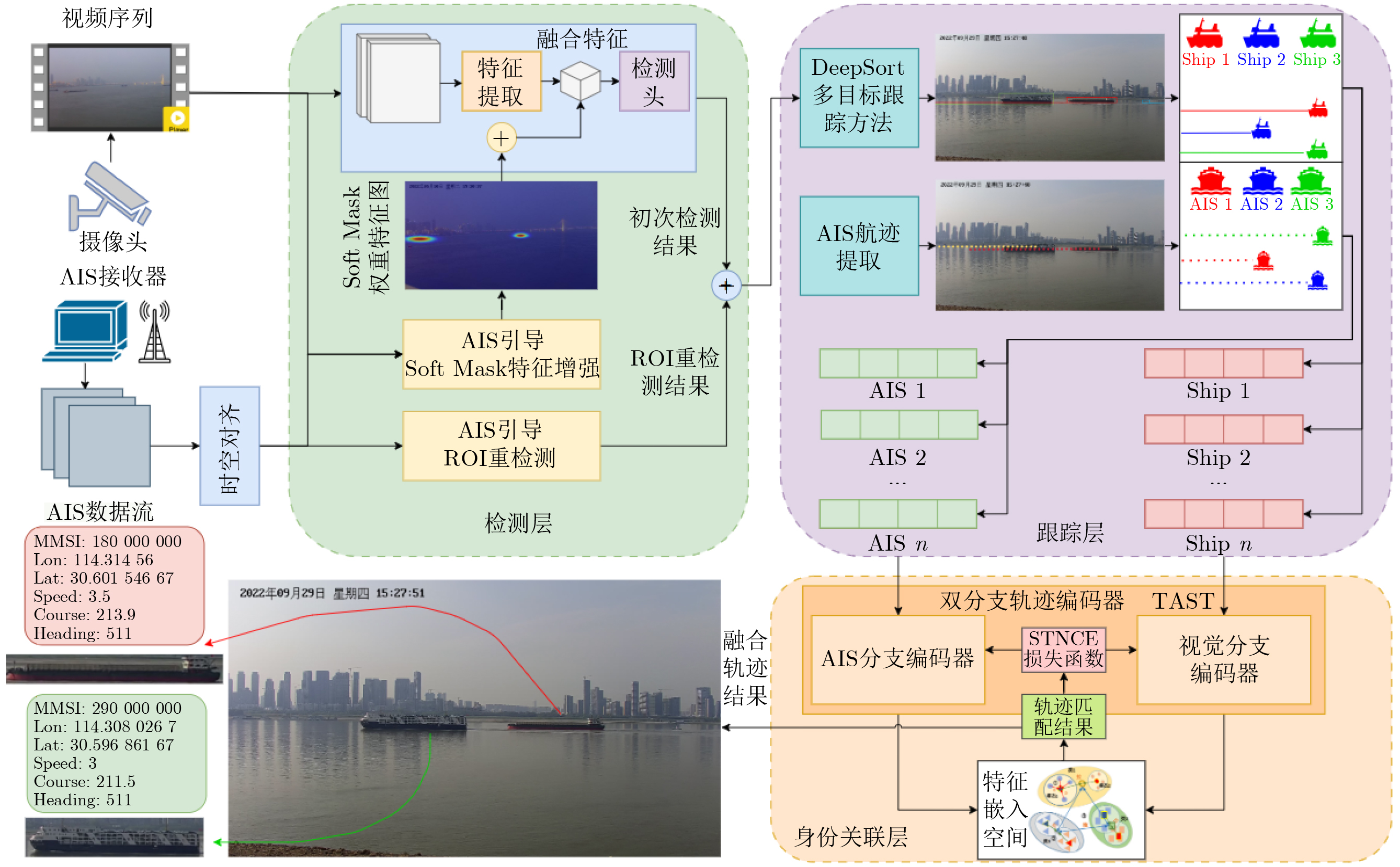
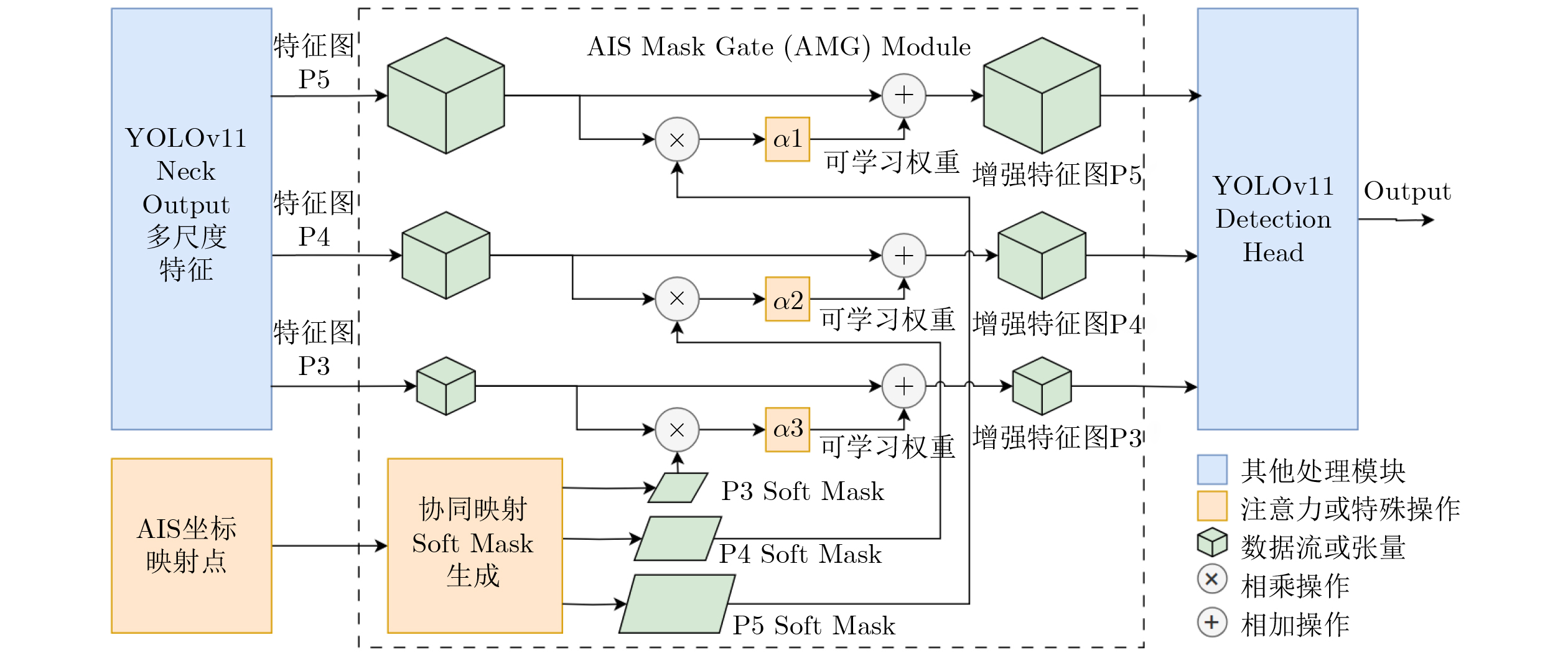
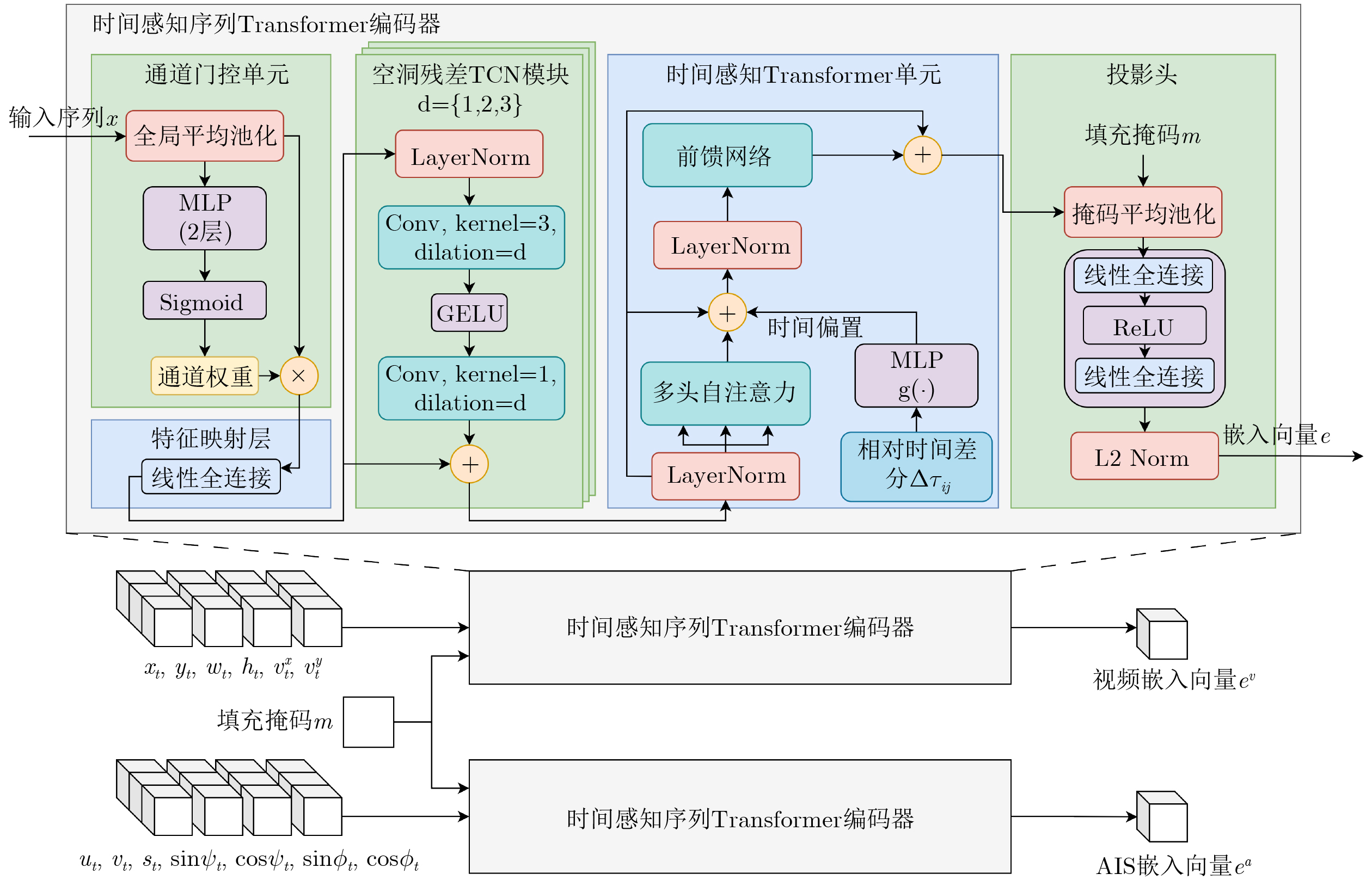
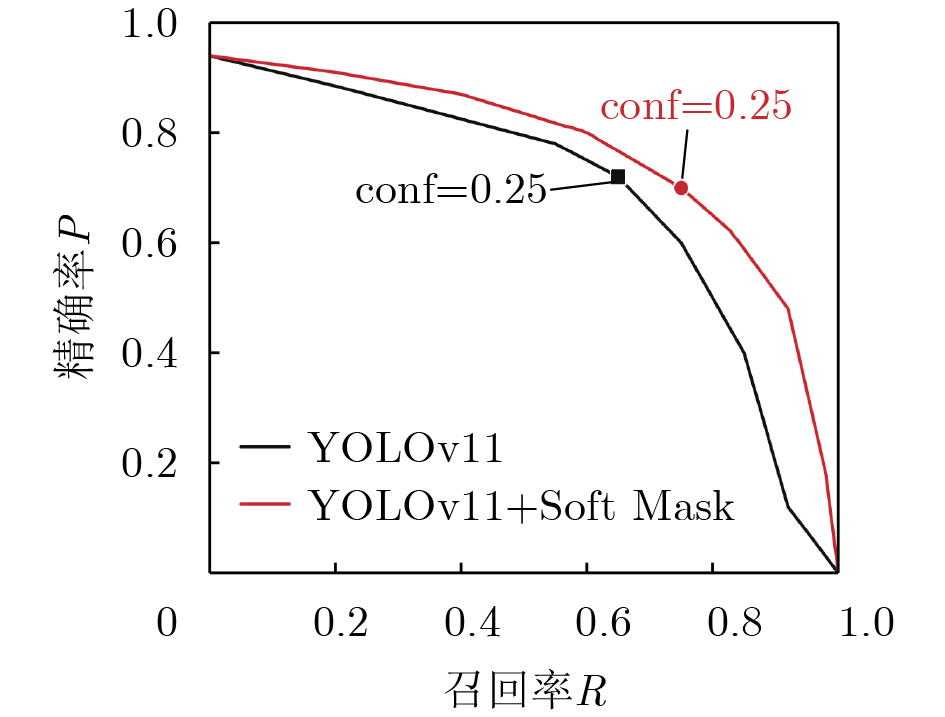
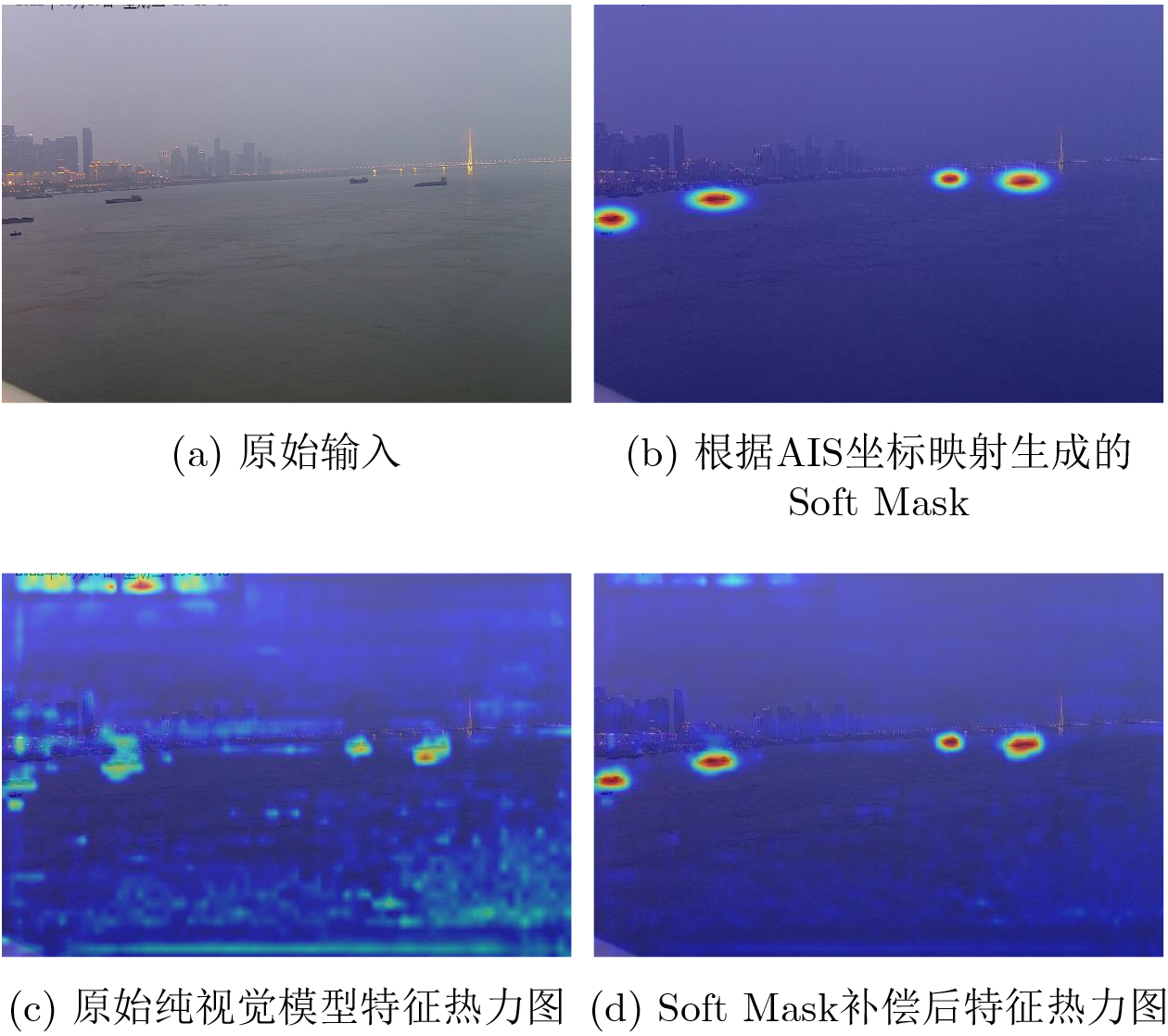
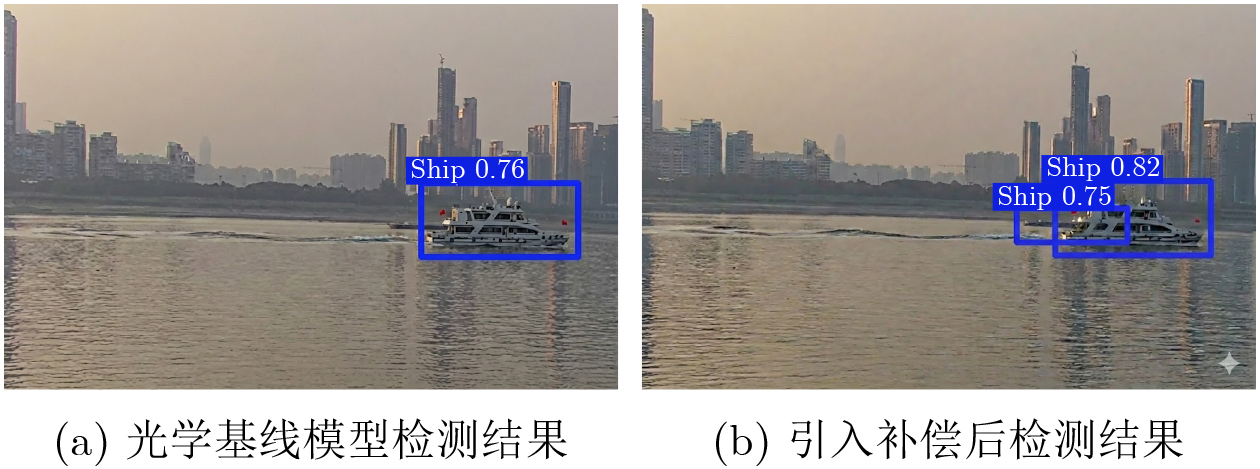
Objective As maritime ship density increases and the demand for intelligent maritime supervision rises, utilizing multi-source heterogeneous sensors to achieve continuous and robust target tracking has become a critical means of enhancing navigational perception. In nearshore ship monitoring, visual modalities are highly susceptible to environmental interference such as low visibility and occlusions. Furthermore, traditional tracking methods struggle with the severe temporal asynchrony between Automatic Identification System (AIS) data and video trajectories, as well as the instability of identity association in multi-target tracking. This research aims to address these challenges by proposing a ship tracking algorithm based on the deep fusion of AIS and video information combined with spatio-temporal contrastive learning, referred to as STAVFT. The primary goal is to leverage AIS spatial priors to guide visual detectors in locking onto targets under low-visibility conditions and to ensure stable identity consistency in complex multi-target scenarios. Methods The STAVFT algorithm integrates perception-level enhancement with trajectory-level association to create a unified tracking pipeline. At the detection stage, the algorithm employs a Soft Mask feature enhancement strategy and an ROI re-detection compensation strategy. The Soft Mask strategy maps AIS spatial priors into Gaussian-weighted guidance maps that are injected into the feature extraction and fusion stages of the YOLOv11 detector, forcing the network to focus its representational power on high-probability target regions. For targets missed by the initial detector, the ROI re-detection strategy generates high-confidence candidate windows based on AIS priors to perform secondary detection and recover lost tracks. In the association stage, the algorithm constructs a Spatio-Temporal Aware Sequence Transformer (SAST) encoder to handle the asynchronous nature of AIS and video data. By introducing a continuous time-aware self-attention mechanism, the encoder explicitly models the dynamic intensity of heterogeneous trajectories and maps them into a unified embedding space. Additionally, a Spatio-Temporal Negative-sample Contrastive Estimation (STNCE) loss function is designed to strengthen the discrimination between physically adjacent and confusing targets. This loss function incorporates physical constraints, such as spatial distance and motion similarity, to penalize hard negative samples in the feature space. Results and Discussions Experimental results on the FVessel dataset demonstrate that the STAVFT algorithm significantly improves detection performance, raising the recall rate from 65.6% to 79.4% and the mAP50 to 0.792. The SAST encoder handles asynchronous AIS data effectively, achieving a Multi-Object Fusion Accuracy (MOFA) of 0.934, while the STNCE loss successfully mitigates identity swaps in dense traffic by widening the decision boundaries between confusing targets. Overall, the algorithm maintains a stable MOFA above 95.8% and an identity consistency (IDF1) exceeding 96.8%. Although the integration of AIS guidance and ROI re-detection increases the average processing time to 0.334 seconds per video second, the system remains well within real-time requirements, and its adaptive logic provides superior robustness against clutter and track fragmentation. Conclusions This paper presents the STAVFT algorithm, which successfully fuses AIS and video information through spatio-temporal contrastive learning to achieve robust ship tracking. By addressing the issues of environmental interference, data asynchrony, and identity confusion, the algorithm significantly improves the recall rate and identity consistency compared to current mainstream methods. The experimental results on the FVessel dataset validate the scientific validity of the "perception-guided association" logic. Future research will focus on model lightweighting for edge-cloud collaboration to further optimize the deployment performance of the system on embedded terminals. -
表 1 FVessel数据集AIS信息示例表
序号 MMSI Lon(°) Lat(°) Speed(kn) Course(°) Heading(°) Timestamp(ms) 0 110000000 114.3257 30.60135 1 149.5 511 1654317561796.00 1 130000000 114.3193 30.61538 0 135.0 203 1654317402824.00 2 180000000 114.3146 30.60155 3.5 213.9 511 1654317458915.00 3 200000000 114.3178 30.61404 0.1 139.1 139 1654317352745.00 4 290000000 114.308 30.59686 3 211.5 511 1654317437905.00 5 310000000 114.3226 30.60736 7.8 38.0 38 1654317553618.00 6 320000000 114.3188 30.61311 0.1 57.0 57 1654317275269.00 7 370000000 114.3186 30.61332 0 174.1 174 1654317412483.00 8 440000000 114.2943 30.58661 0 360.0 511 1652181591161.00  下载: 导出CSV
表 3 AIS融合补偿检测方法消融结果表
所用方法 P R mAP50 F1 FLOPs(G) YOLOv11 0.723 0.656 0.688 0.685 6.3 本文方法 机制A 0.696 0.765 0.769 0.751 7.3 机制B 0.735 0.715 0.739 0.729 15.9 机制A+B 0.749 0.794 0.792 0.778 16.9
下载: 导出CSV
表 4 误检类型统计表
误检类型 YOLOv11误检
比例(%)机制A误检
比例(%)水面反光、尾迹及岸线结构 10.8 13.2 AIS投影偏移区域 3.1 5.5 邻近或遮挡船舶混淆 6.2 6.5 同一目标重复框 5.0 5.2 合计 25.1 30.4
下载: 导出CSV
表 5 统计显著性结果
指标 YOLOv11 机制A 差值 95%置信区间 P 0.723 0.696 -0.027 [-0.035,-0.019] R 0.656 0.765 +0.109 [+0.097,+0.121] mAP50 0.688 0.769 +0.081 [+0.073,+0.089] F1 0.685 0.751 +0.066 [+0.057,+0.075]
下载: 导出CSV
表 6 不同方法航迹关联性能对比表
所用方法 Top-1 Top-5 MOFA FLOPs(G) E-Fast DTW 0.794 0.895 0.815 - TCN 0.765 0.862 0.782 0.0012 Transformer 0.842 0.928 0.876 0.0045 SAST 0.895 0.962 0.934 0.0034
下载: 导出CSV
表 7 关键模块单变量消融结果
组别 TCN扩张率 Top-1 Top-5 MOFA 普通残差TCN
(无时间偏置){1,1,1} 0.872 0.912 0.930 空洞残差TCN
(无时间偏置){1,2,3} 0.885 0.943 0.944 普通残差+时间偏置 {1,1,1} 0.878 0.946 0.956 空洞残差+时间偏置 {1,2,3} 0.932 0.987 0.965
下载: 导出CSV
表 8 不同损失函数航迹关联性能对比表
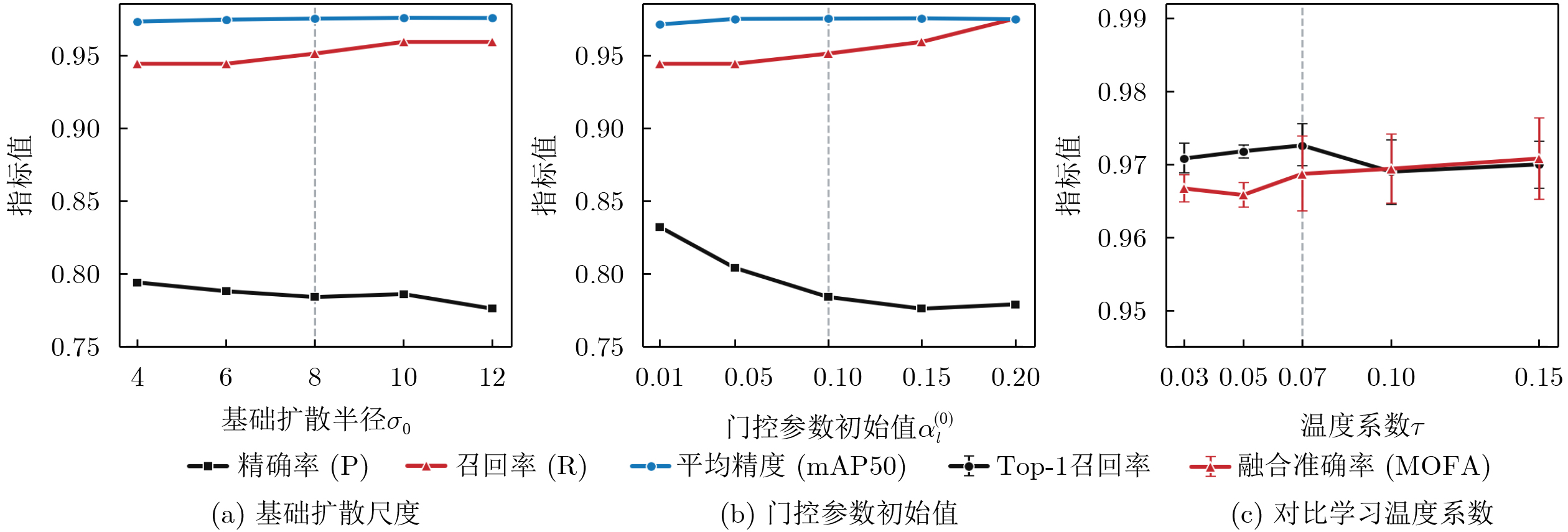
损失函数 Top-1 Top-5 MOFA 单向InfoNCE 0.842 0.932 0.884 对称InfoNCE 0.895 0.962 0.934 STNCE 0.932 0.987 0.965
下载: 导出CSV
表 9 不同轨迹融合方法在FVessel数据集上测试性能对比结果表
视频 方法 MOFA IDP IDR IDF1 Clip01
(夜间低光)欧式融合 0.693 0.887 0.826 0.855 MSDF 0.684 0.886 0.821 0.852 DeepSORVF 0.942 0.961 0.946 0.953 本文算法 0.958 0.972 0.963 0.968 Clip02
(晴天)欧式融合 0.697 0.894 0.885 0.890 MSDF 0.695 0.892 0.882 0.887 DeepSORVF 0.971 0.974 0.969 0.972 本文算法 0.980 0.981 0.973 0.977 Clip03
(多云)欧式融合 0.793 0.969 0.873 0.918 MSDF 0.817 0.971 0.881 0.924 DeepSORVF 0.955 0.972 0.958 0.965 本文算法 0.971 0.982 0.971 0.976 Clip04
(晴天)欧式融合 0.724 0.901 0.892 0.897 MSDF 0.719 0.899 0.889 0.894 DeepSORVF 0.973 0.975 0.970 0.973 本文算法 0.980 0.982 0.975 0.979 Clip05
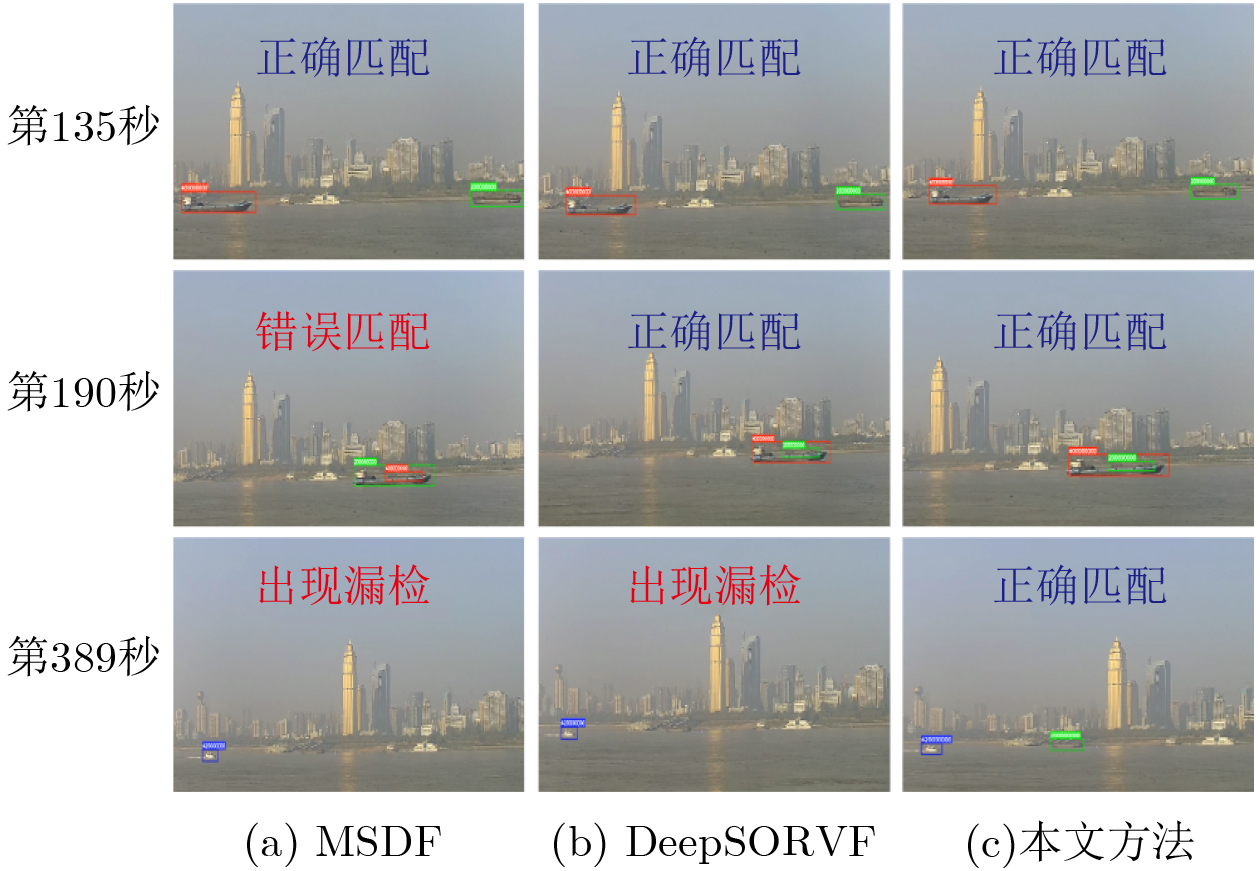
(严重遮挡)欧式融合 0.675 0.880 0.814 0.846 MSDF 0.668 0.874 0.810 0.841 DeepSORVF 0.941 0.959 0.942 0.950 本文算法 0.961 0.975 0.965 0.970
下载: 导出CSV
表 10 不同轨迹融合方法在FVessel数据集平均每秒处理时间
视频 视频长度 DeepSORVF(s) 本文方法(s) Clip01 1m51s 0.245 0.310 Clip02 1m36s 0.251 0.325 Clip03 3m42s 0.260 0.342 Clip04 2m42s 0.275 0.365 Clip05 3m05s 0.255 0.330 Clip06 2m38s 0.248 0.315 Clip07 11m10s 0.265 0.355 Clip08 5m07s 0.252 0.328 Clip09 8m39s 0.258 0.340 Clip10 2m46s 0.253 0.332 平均值 - 0.256 0.334
下载: 导出CSV
-
[1] 严新平, 韩亚, 吴兵, 等. 水路交通系统的发展现状与未来展望[J]. 中国航海, 2024, 47(2): 145–152. doi: 10.3969/j.issn.1000-4653.2024.02.019.YAN Xinping, HAN Ya, WU Bing, et al. Current development and future prospects of waterborne transportation systems[J]. Navigation of China, 2024, 47(2): 145–152. doi: 10.3969/j.issn.1000-4653.2024.02.019. [2] BEWLEY A, GE Zongyuan, OTT L, et al. Simple online and realtime tracking[C]. 2016 IEEE International Conference on Image Processing, Phoenix, USA, 2016: 3464–3468. doi: 10.1109/ICIP.2016.7533003. [3] WOJKE N, BEWLEY A, and PAULUS D. Simple online and realtime tracking with a deep association metric[C]. 2017 IEEE International Conference on Image Processing (ICIP), Beijing, China, 2017: 3645–3649. doi: 10.1109/ICIP.2017.8296962. [4] WANG Zhongdao, ZHENG Liang, LIU Yixuan, et al. Towards real-time multi-object tracking[C]. Proceedings of the 16th European Conference on Computer Vision-ECCV 2020, Glasgow, UK, 2020: 107–122. doi: 10.1007/978-3-030-58621-8_7. [5] ZHANG Yifu, WANG Chunyu, WANG Xinggang, et al. FairMOT: On the fairness of detection and re-identification in multiple object tracking[J]. International Journal of Computer Vision, 2021, 129(11): 3069–3087. doi: 10.1007/s11263-021-01513-4. [6] ZHANG Yifu, SUN Peize, JIANG Yi, et al. ByteTrack: Multi-object tracking by associating every detection box[C]. Proceedings of the 17th European Conference on Computer Vision–ECCV 2022, Tel Aviv, Israel, 2022: 1–21. doi: 10.1007/978-3-031-20047-2_1. [7] CAO Jinkun, PANG Jiangmiao, WENG Xinshuo, et al. Observation-centric SORT: Rethinking SORT for robust multi-object tracking[C]. Proceedings of the IEEE/CVF Conference on Computer Vision and Pattern Recognition, Vancouver, Canada, 2023: 9686–9696. doi: 10.1109/CVPR52729.2023.00934. [8] WU Yong, CHU Xiumin, DENG Lei, et al. A new multi-sensor fusion approach for integrated ship motion perception in inland waterways[J]. Measurement, 2022, 200: 111630. doi: 10.1016/j.measurement.2022.111630. [9] LI Fan, YU Kun, YUAN Chao, et al. Dark ship detection via optical and SAR collaboration: An improved multi-feature association method between remote sensing images and AIS data[J]. Remote Sensing, 2025, 17(13): 2201. doi: 10.3390/rs17132201. [10] XUE Weibao, AI Jiaqiu, ZHU Yanan, et al. AIS-FCANet: Long-term AIS data assisted frequency-spatial contextual awareness network for salient ship detection in SAR imagery[J]. IEEE Transactions on Aerospace and Electronic Systems, 2025, 61(5): 15166–15171. doi: 10.1109/TAES.2025.3588484. [11] CHEN Lihang, HU Zhuhua, CHEN Junfei, et al. SVIADF: Small vessel identification and anomaly detection based on wide-area remote sensing imagery and AIS data fusion[J]. Remote Sensing, 2025, 17(5): 868. doi: 10.3390/rs17050868. [12] QU Jingxiang, LIU R W, GUO Yu, et al. Improving maritime traffic surveillance in inland waterways using the robust fusion of AIS and visual data[J]. Ocean Engineering, 2023, 275: 114198. doi: 10.1016/j.oceaneng.2023.114198. [13] GUO Yu, LIU R W, QU Jingxiang, et al. Asynchronous trajectory matching-based multimodal maritime data fusion for vessel traffic surveillance in inland waterways[J]. IEEE Transactions on Intelligent Transportation Systems, 2023, 24(11): 12779–12792. doi: 10.1109/TITS.2023.3285415. [14] 杜子俊, 贺益雄, 于德清, 等. 视觉与AIS融合的桥区水域船舶自动监测方法[J]. 中国航海, 2025, 48(1): 34–42. doi: 10.3969/j.issn.1000-4653.2025.01.005.DU Zijun, HE Yixiong, YU Deqing, et al. Automatic ship monitoring method in bridge area by fusion of vision and AIS[J]. Navigation of China, 2025, 48(1): 34–42. doi: 10.3969/j.issn.1000-4653.2025.01.005. [15] MEINHARDT T, KIRILLOV A, LEAL-TAIXÉ L, et al. TrackFormer: Multi-object tracking with transformers[C]. Proceedings of the IEEE/CVF Conference on Computer Vision and Pattern Recognition, New Orleans, USA, 2022: 8834–8844. doi: 10.1109/CVPR52688.2022.00864. [16] ZENG Fangao, DONG Bin, ZHANG Yuang, et al. MOTR: End-to-end multiple-object tracking with transformer[C]. Proceedings of the 17th European Conference on Computer Vision–ECCV 2022, Tel Aviv, Israel, 2022: 659–675. doi: 10.1007/978-3-031-19812-0_38. [17] ZHAO Yian, LV Wenyu, XU Shangliang, et al. DETRs beat YOLOs on real-time object detection[C]. Proceedings of the IEEE/CVF Conference on Computer Vision and Pattern Recognition, Seattle, USA, 2024: 16965–16974. doi: 10.1109/CVPR52733.2024.01605. [18] WANG Han, LI Shengyang, YANG Jian, et al. Cross-modal ship re-identification via optical and SAR imagery: A novel dataset and method[C]. Proceedings of the IEEE/CVF International Conference on Computer Vision, Honolulu, USA, 2025: 7873–7883. doi: 10.1109/ICCV51701.2025.00738. [19] HU Songtao, CHEN Guanyu, ZHOU Rui, et al. Fishing vessel behavior pattern recognition using AIS sub-trajectory prototype learning based on Gramian Angular Field[J]. Complex & Intelligent Systems, 2026, 12(2): 68. doi: 10.1007/s40747-025-02187-y. [20] 邵延华, 张铎, 楚红雨, 等. 基于深度学习的YOLO目标检测综述[J]. 电子与信息学报, 2022, 44(10): 3697–3708. doi: 10.11999/JEIT210790.SHAO Yanhua, ZHANG Duo, CHU Hongyu, et al. A review of YOLO object detection based on deep learning[J]. Journal of Electronics & Information Technology, 2022, 44(10): 3697–3708. doi: 10.11999/JEIT210790. [21] HE Wei, HE Wenbo, LEI Jinyu, et al. Multi-source perception data fusion of vessels in visual occlusion scenarios: Leveraging prior knowledge of vessel motion[J]. Engineering Applications of Artificial Intelligence, 2025, 156: 111118. doi: 10.1016/j.engappai.2025.111118. [22] RISTANI E, SOLERA F, ZOU R, et al. Performance measures and a data set for multi-target, multi-camera tracking[C]. Proceedings of the 14th European Conference on Computer Vision-ECCV 2016 Workshops, Amsterdam, The Netherlands, 2016: 17–35. doi: 10.1007/978-3-319-48881-3_2. [23] REN Shaoqing, HE Kaiming, GIRSHICK R, et al. Faster R-CNN: Towards real-time object detection with region proposal networks[J]. IEEE Transactions on Pattern Analysis and Machine Intelligence, 2017, 39(6): 1137–1149. doi: 10.1109/TPAMI.2016.2577031. [24] LIU Wei, ANGUELOV D, ERHAN D, et al. SSD: Single shot MultiBox detector[C]. Proceedings of the 14th European Conference on Computer Vision–ECCV 2016, Amsterdam, The Netherlands, 2016: 21–37. doi: 10.1007/978-3-319-46448-0_2. [25] GE Zheng, LIU Songtao, WANG Feng, et al. YOLOX: Exceeding YOLO series in 2021[Z]. arXiv: 2107.08430, 2021. doi: 10.48550/arXiv.2107.08430. (查阅网上资料,请核对文献类型及格式是否正确). [26] KHANAM R and HUSSAIN M. YOLOv11: An overview of the key architectural enhancements[Z]. arXiv: 2410.17725, 2024. doi: 10.48550/arXiv.2410.17725. (查阅网上资料,请核对文献类型及格式是否正确). [27] BAI Shaojie, KOLTER J Z, and KOLTUN V. An empirical evaluation of generic convolutional and recurrent networks for sequence modeling[Z]. arXiv: 1803.01271, 2018. doi: 10.48550/arXiv.1803.01271. (查阅网上资料,请核对文献类型及格式是否正确). [28] SUN Peize, CAO Jinkun, JIANG Yi, et al. TransTrack: Multiple object tracking with transformer[Z]. arXiv: 2012.15460, 2020. doi: 10.48550/arXiv.2012.15460. (查阅网上资料,请核对文献类型及格式是否正确). [29] ZHANG Jiayu, WANG Mei, KAN Ruixiang, et al. Multi-source heterogeneous data fusion algorithm for vessel trajectories in canal scenarios[J]. Electronics, 2025, 14(16): 3223. doi: 10.3390/electronics14163223. [30] LIU R W, GUO Yu, NIE Jiangtian, et al. Intelligent edge-enabled efficient multi-source data fusion for autonomous surface vehicles in maritime Internet of Things[J]. IEEE Transactions on Green Communications and Networking, 2022, 6(3): 1574–1587. doi: 10.1109/TGCN.2022.3158004. [31] 程伊婷, 董涛, 苏昱玮, 等. 面向通信信号高效接收处理的压缩感知技术综述[J]. 电子与信息学报, 2026, 48(1): 168–182. doi: 10.11999/JEIT250855.CHENG Yiting, DONG Tao, SU Yuwei, et al. A review of compressed sensing technology for efficient receiving and processing of communication signal[J]. Journal of Electronics & Information Technology, 2026, 48(1): 168–182. doi: 10.11999/JEIT250855. [32] 余礼苏, 钟润, 吕欣欣, 等. 压缩感知辅助的低复杂度SCMA系统优化设计[J]. 电子与信息学报, 2024, 46(5): 2011–2017. doi: 10.11999/JEIT231226.YU Lisu, ZHONG Run, LU Xinxin, et al. Optimized design of low complexity SCMA system assisted by compressed sensing[J]. Journal of Electronics & Information Technology, 2024, 46(5): 2011–2017. doi: 10.11999/JEIT231226. [33] 杨春玲, 梁梓文. 静态与动态域先验增强的两阶段视频压缩感知重构网络[J]. 电子与信息学报, 2024, 46(11): 4247–4258. doi: 10.11999/JEIT240295.YANG Chunling and LIANG Ziwen. Static and dynamic-domain prior enhancement two-stage video compressed sensing reconstruction network[J]. Journal of Electronics & Information Technology, 2024, 46(11): 4247–4258. doi: 10.11999/JEIT240295. -

 下载:
下载:


图(9) / 表(10)
计量
- 文章访问数: 20
- HTML全文浏览量: 5
- PDF下载量: 0
- 被引次数: 0
