




A Modulation Recognition Method Based on Gated Recurrent Network Integrating Adaptive Denoising and Aggregation Attention
-
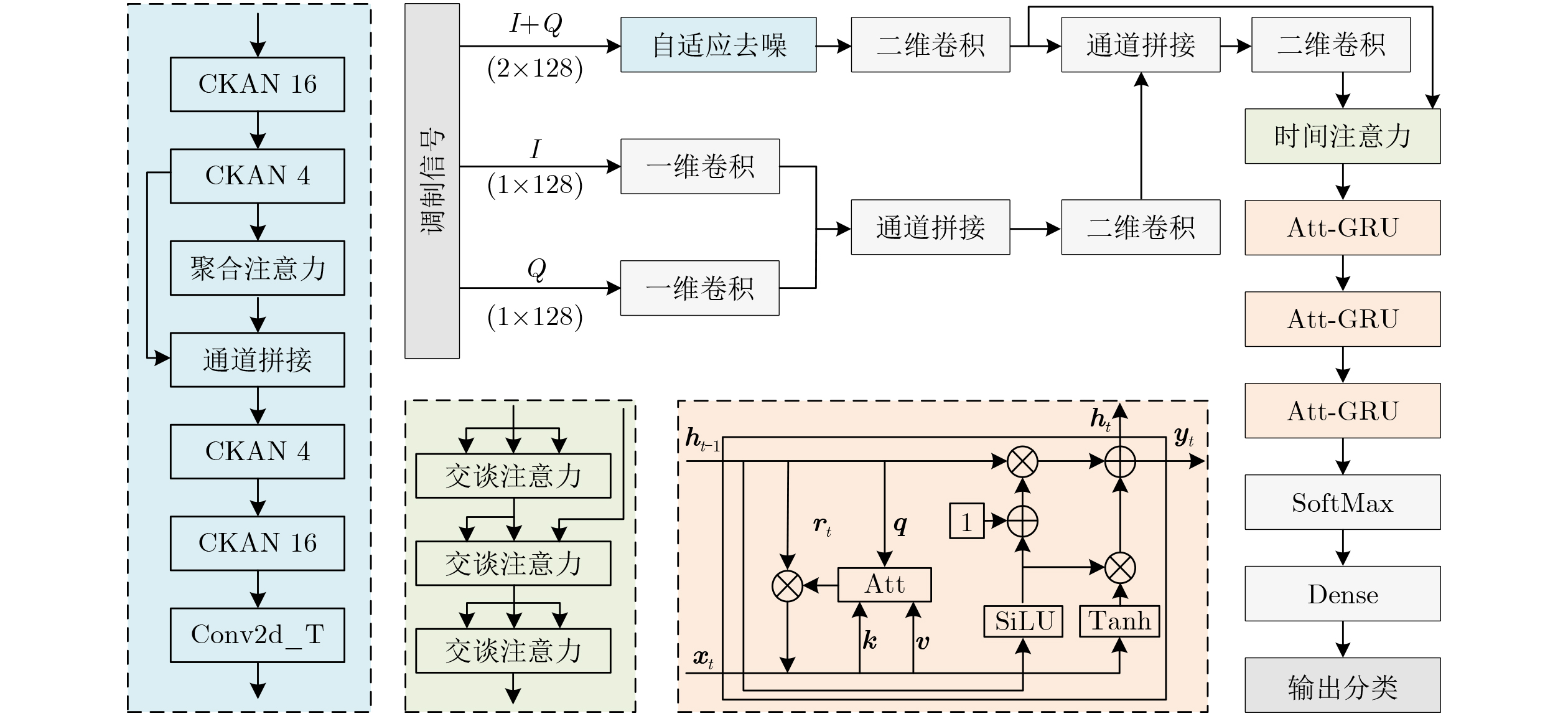
摘要: 针对自动调制分类在低信噪比环境下信号特征可分性下降、多径效应引发非线性失真,以及现有深度学习模型存在低信噪比鲁棒性不足与Transformer类模型复杂度过高的矛盾,该文提出一种结合自适应去噪与聚合注意力增强的门控循环网络调制识别方法。首先,设计基于卷积Kolmogorov-Arnold网络的自适应去噪单元,融合非线性函数逼近特性与卷积局部特征提取能力,自适应解耦信号与噪声的叠加关系,为特征提取提供高纯度输入。其次,构建聚合注意力机制,通过引入聚合矩阵降低传统注意力的计算复杂度,并设计交谈注意力模块与门控循环注意力单元,以强化跨头信息交互与长程时序依赖建模,抑制多径干扰对特征建模的影响。最后,提出正交双通道策略与多尺度特征融合架构,整合全局降噪特征与I/Q分量局部时频特征,提升对信号本质特征的判别能力。在公开数据集RadioML 2016.10a和RML22的实验结果表明,所提方法能够在模型参数量仅0.23 M/平均推理时间为9.1 ms的前提下,分别取得64.36%和71.52%的平均分类准确率。此外,超参数消融实验证实了自适应去噪单元、聚合注意力等核心组件在复杂移动通信环境中的鲁棒性和实用性,为资源受限场景下自动调制识别技术的部署提供了有效支撑。Abstract:
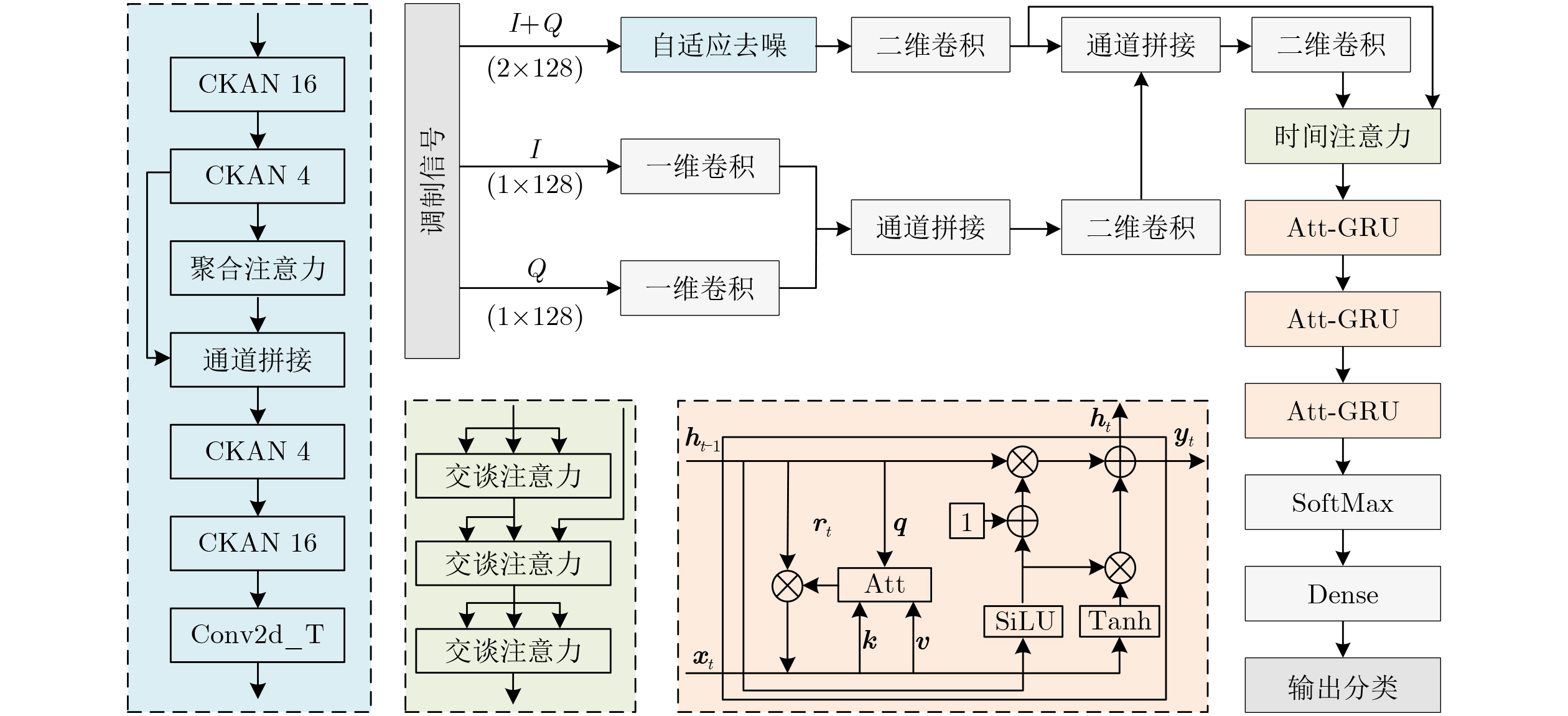
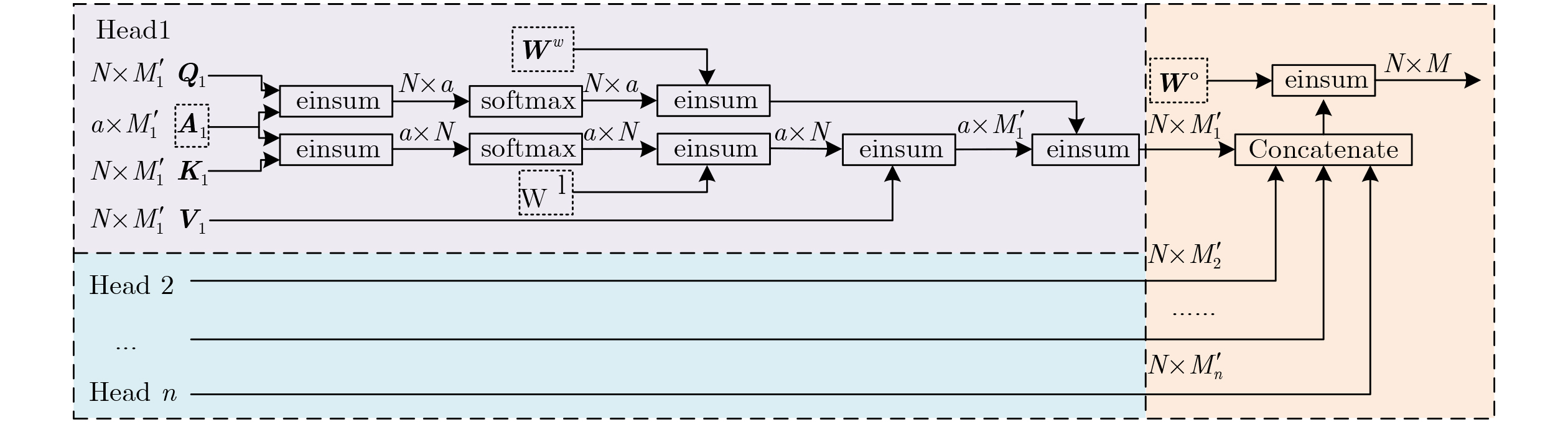
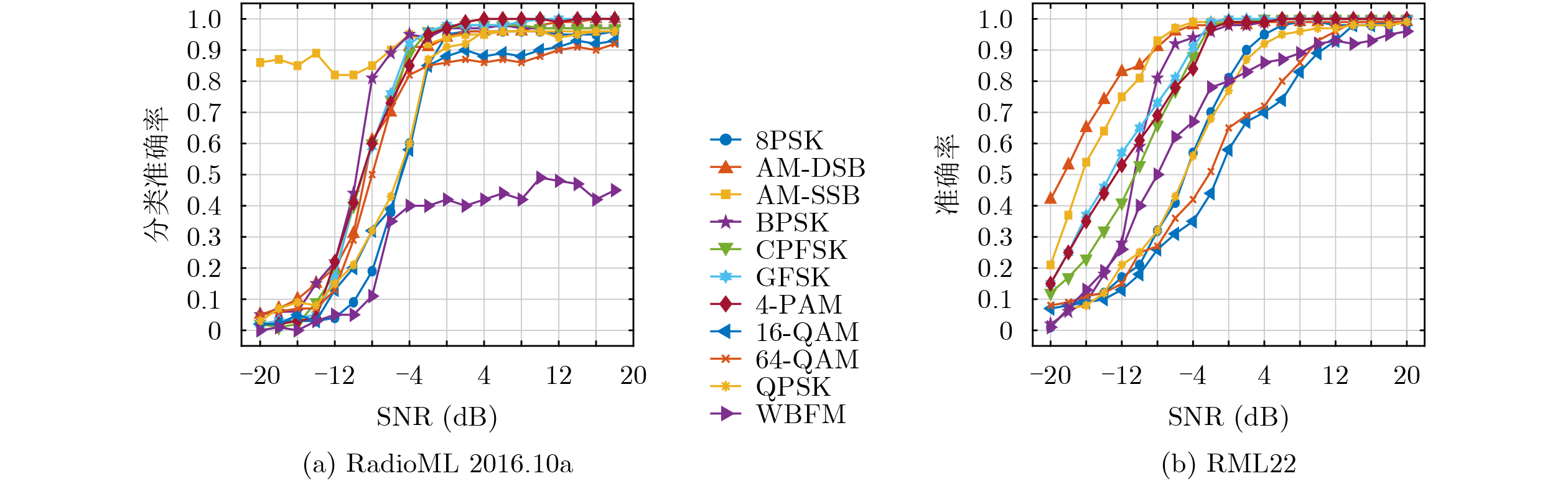
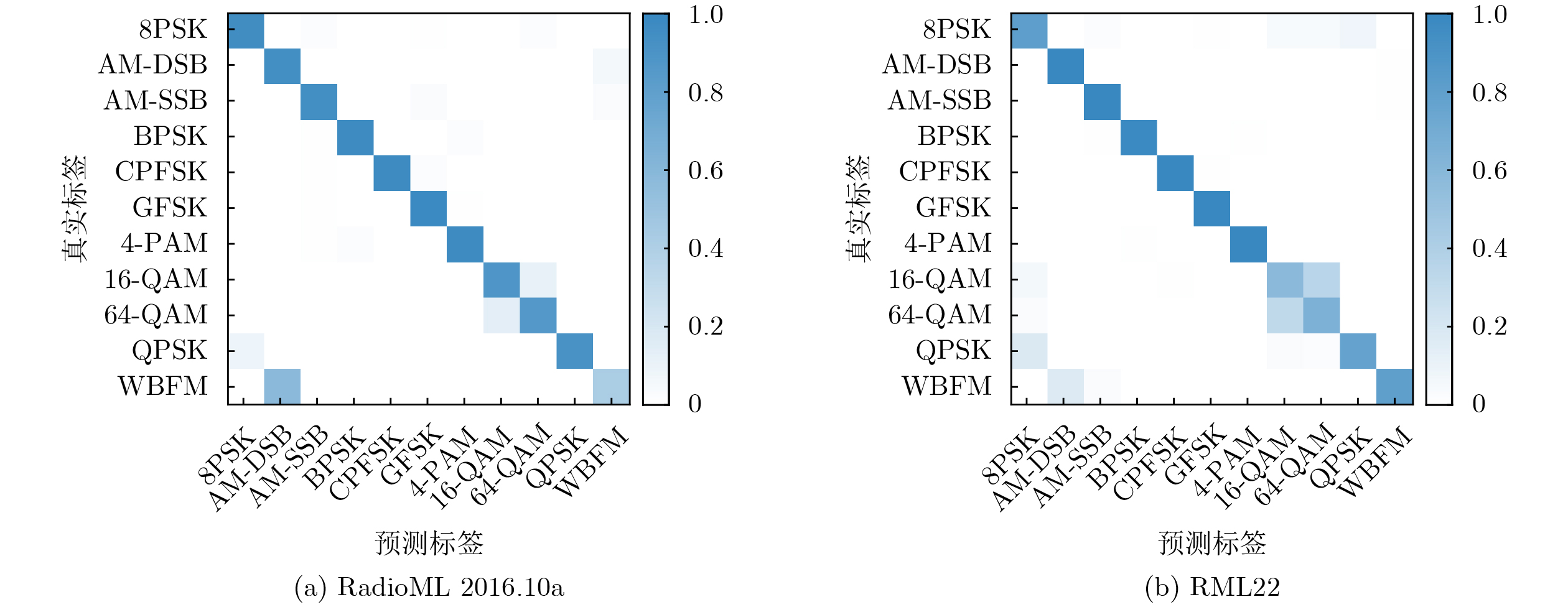
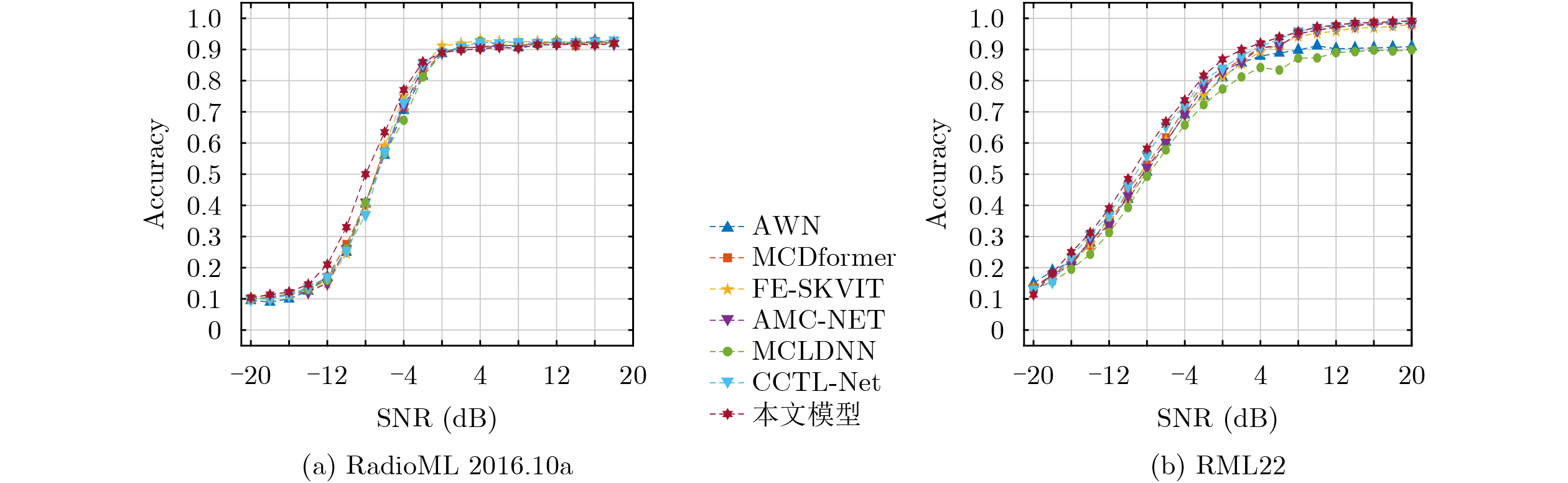
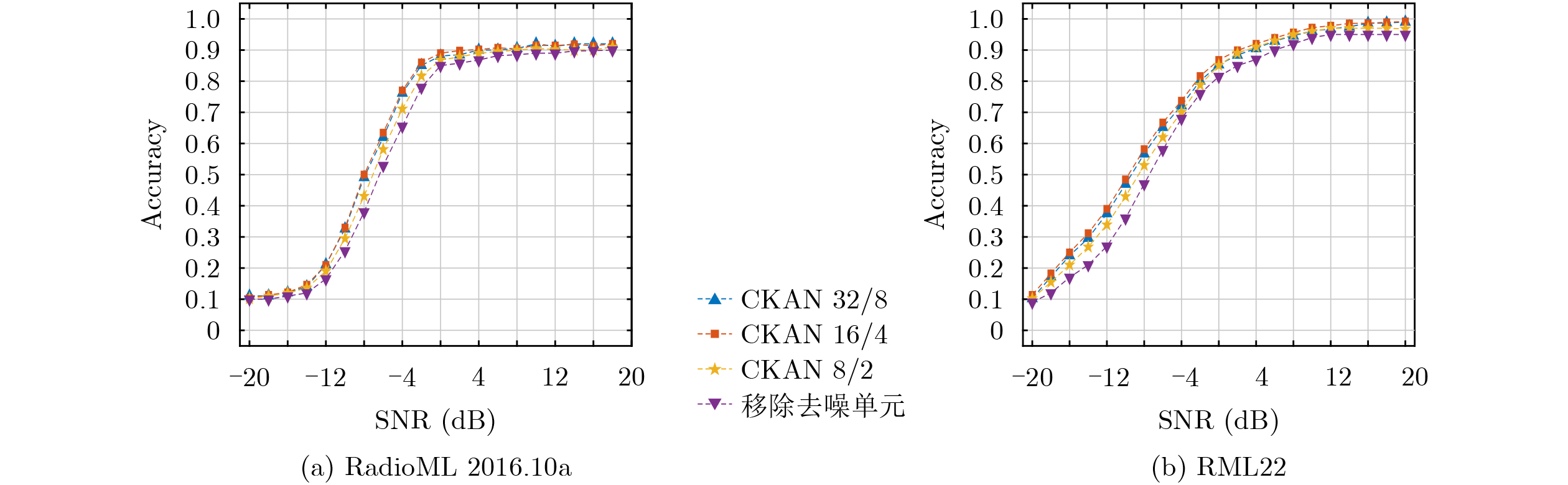
Objective In wireless communication environments under low signal-to-noise ratio (SNR) conditions, the separability of signal features deteriorates, and nonlinear distortion caused by multipath effects poses significant challenges for automatic modulation classification (AMC). Existing deep learning models often suffer from insufficient robustness and generalization under low SNR, while Transformer-based models incur high computational complexity. To address these issues, this paper proposes a gated recurrent network for modulation recognition that integrates adaptive denoising and aggregation attention, aiming to enhance recognition accuracy in low-SNR conditions while maintaining low model complexity. Methods The proposed AMC method consists of three key components. Firstly, an adaptive denoising unit based on a convolutional Kolmogorov-Arnold network (CKAN) is designed to decouple the nonlinear superposition of signals and noise, providing purified input for subsequent feature extraction. The CKAN combines the nonlinear approximation capability of the Kolmogorov-Arnold representation theorem with the local feature extraction ability of convolutional operations. Then an aggregation attention mechanism is introduced to reduce the computational complexity of traditional attention by employing aggregation matrix. Based on this mechanism, a talk-attention module and an attention-gated recurrent unit (Att-GRU) are constructed to enhance cross-head information interaction and long-term temporal dependency modeling, thereby mitigating the impact of multipath interference. Finally, an orthogonal dual-channel strategy and multi-scale feature fusion architecture are adopted to integrate globally denoised features with local time-frequency features of I/Q components, improving the discriminative ability of essential signal characteristics. Results and Discussions The proposed method achieves average classification accuracies of 64.36% and 71.52% on the RadioML 2016.10a and RML22 datasets, respectively, with only 0.23M parameters and an average inference time of 9.1 ms ( Table 2 ). Comparative experiments with existing deep learning models demonstrate the superiority of the proposed approach. It outperforms AWN, MCDformer, FE-SKVIT, AMC-NET, and MCLDNN on RadioML 2016.10a by 2.08%, 1.83%, 1.03%, 1.96%, and 2.15% in average accuracy, respectively (Table 2 ). When SNR > 8 dB, the accuracy exceeds 90% on both datasets, and reaches nearly 100% on RML22 when SNR > 16 dB. Even at low SNR (–10 dB), the model maintains robust accuracies of 48.5% and 33.0% on the two datasets (Figure 5 ). The confusion matrix at SNR = 0 dB reveals that classification difficulties primarily occur between QPSK and 8PSK, AM-DSB and WBFM, and among high-order QAM modulations, due to phase distortion, spectral similarity during silent carrier periods, and reduced symbol spacing (Figure 6 ). Significant improvements are also observed under low SNR conditions (Figure 7 ). Ablation studies confirm the contribution of key components. Removing the adaptive denoising unit reduces accuracy by 2.15–4.30% on RadioML 2016.10a and 3.46–6.02% on RML22, while increasing inference time only marginally (Table 3 ). The CKAN configuration with 16/4 channels achieves the best trade-off between accuracy and efficiency (Figure 8 ).Conclusions In this paper, we present a gated recurrent network that integrates adaptive denoising and aggregation attention for AMC. The method effectively addresses performance degradation in low-SNR wireless communication environments, enhances adaptability to complex channel conditions, and reduces deployment costs. Experimental results on two public datasets validate the superiority of the proposed approach in terms of accuracy, model size, and inference efficiency, especially in challenging low-SNR scenarios. Future work will focus on optimizing the computational efficiency of CKAN-based components to further accelerate inference. -
表 1 信号参数对比
参数 RadioML 2016.10a RML22 频率偏移 0~10–2 0~10–3 相位偏移 0~10–2×2π 0~10–2×2π 信道模型 莱斯+瑞利 3GPP标准 噪声类型 AWGN AWGN 同步误差 0~0.02 0~0.02 信噪比范围 –20:2:18 –20:2:20 样本数量 220k 460k  下载: 导出CSV
表 3 不同结构下的调制识别性能对比
模型 推理时间(ms) 平均分类准确率(%) RadioML 2016.10a RML22 CKAN 32/8 12.7 64.03 70.38 CKAN 16/4 9.1 64.36 71.52 CKAN 8/2 7.6 62.21 68.96 移除去噪单元 6.8 60.06 65.50
下载: 导出CSV
表 4 不同聚合因子下的调制识别性能对比
聚合因子 推理时间(ms) 平均分类准确率(%) RadioML 2016.10a RML22 a = 4 8.1 62.15 69.21 a = 8 8.5 63.80 70.96 a = 16 9.1 64.36 71.52 a = 32 10.2 64.43 71.65 a = 64 12.4 64.19 71.27
下载: 导出CSV
-
[1] LEE B M and YANG Hong. Massive MIMO with massive connectivity for industrial Internet of Things[J]. IEEE Transactions on Industrial Electronics, 2020, 67(6): 5187–5196. doi: 10.1109/TIE.2019.2924855. [2] CHANG Shuo, ZHANG Ruiyun, JI Kejia, et al. A hierarchical classification head based convolutional gated deep neural network for automatic modulation classification[J]. IEEE Transactions on Wireless Communications, 2022, 21(10): 8713–8728. doi: 10.1109/TWC.2022.3168884. [3] AN T T, ARGYRIOU A, PUSPITASARI A A, et al. Efficient automatic modulation classification for next-generation wireless networks[J]. IEEE Transactions on Green Communications and Networking, 2026, 10: 249–259. doi: 10.1109/TGCN.2025.3574278. [4] 闫文康, 闫毅, 范亚楠, 等. 基于小波变换熵值及高阶累积量联合的卫星信号调制识别算法[J]. 空间科学学报, 2021, 41(6): 968–975. doi: 10.11728/cjss2021.06.968.YAN Wenkang, YAN Yi, FAN Ya’nan, et al. A modulation recognition algorithm based on wavelet transform entropy and high-order cumulant for satellite signal modulation[J]. Chinese Journal of Space Science, 2021, 41(6): 968–975. doi: 10.11728/cjss2021.06.968. [5] O’SHEA T and HOYDIS J. An introduction to deep learning for the physical layer[J]. IEEE Transactions on Cognitive Communications and Networking, 2017, 3(4): 563–575. doi: 10.1109/TCCN.2017.2758370. [6] ELSAGHEER M M and RAMZY S M. A hybrid model for automatic modulation classification based on residual neural networks and long short term memory[J]. Alexandria Engineering Journal, 2023, 67: 117–128. doi: 10.1016/j.aej.2022.08.019. [7] 战权海, 张雄伟, 宋磊, 等. 基于改进Transformer的自动调制识别方法[J]. 数据采集与处理, 2024, 39(6): 1410–1419. doi: 10.16337/j.1004-9037.2024.06.010.ZHAN Quanhai, ZHANG Xiongwei, SONG Lei, et al. Automatic modulation recognition method based on improved transformer[J]. Journal of Data Acquisition and Processing, 2024, 39(6): 1410–1419. doi: 10.16337/j.1004-9037.2024.06.010. [8] YIN Peng, ZHOU Jinchao, GE Yizheng, et al. DTSG-Net: Dynamic time series graph neural network and its application in modulation recognition[J]. IEEE Internet of Things Journal, 2025, 12(4): 3742–3754. doi: 10.1109/JIOT.2024.3514875. [9] LYU Bo, YUAN Hang, LU Longfei, et al. Resource-constrained neural architecture search on edge devices[J]. IEEE Transactions on Network Science and Engineering, 2022, 9(1): 134–142. doi: 10.1109/TNSE.2021.3054583. [10] JING Lianyou, DONG Chaofan, HE Chengbing, et al. Adaptive modulation and coding for underwater acoustic OTFS communications based on meta-learning[J]. IEEE Communications Letters, 2024, 28(8): 1845–1849. doi: 10.1109/LCOMM.2024.3418192. [11] THAMEUR H B, DAYOUB I, and HAMOUDA W. USRP RIO-based testbed for real-time blind digital modulation recognition in MIMO systems[J]. IEEE Communications Letters, 2022, 26(10): 2500–2504. doi: 10.1109/LCOMM.2022.3191787. [12] KUMAR S, MAHAPATRA R, and SINGH A. Automatic modulation recognition: An FPGA implementation[J]. IEEE Communications Letters, 2022, 26(9): 2062–2066. doi: 10.1109/LCOMM.2022.3184771. [13] CAI Jingjing, GAN Fengming, CAO Xianghai, et al. Signal modulation classification based on the transformer network[J]. IEEE Transactions on Cognitive Communications and Networking, 2022, 8(3): 1348–1357. doi: 10.1109/TCCN.2022.3176640. [14] LIU Bingjie, ZHENG Qiancheng, WEI Heng, et al. Deep hybrid transformer network for robust modulation classification in wireless communications[J]. Knowledge-Based Systems, 2024, 300: 112191. doi: 10.1016/j.knosys.2024.112191. [15] 梁坤, 刘战胜. 基于联合残差网络和Bottleneck Transformer的调制格式识别方法[J]. 光通信技术, 2024, 48(3): 13–17. doi: 10.13921/j.cnki.issn1002-5561.2024.03.003.LIANG Kun and LIU Zhansheng. Modulation format identification method based on joint residual network and Bottleneck Transformers[J]. Optical Communication Technology, 2024, 48(3): 13–17. doi: 10.13921/j.cnki.issn1002-5561.2024.03.003. [16] KONG Weisi, JIAO Xun, XU Yuhua, et al. An effective masked transformer model for automatic modulation recognition[J]. IEEE Transactions on Cognitive Communications and Networking, 2025, 12: 128–143. doi: 10.1109/TCCN.2025.3550729. [17] LI Weihao, DENG Wen, WANG Keren, et al. A complex-valued transformer for automatic modulation recognition[J]. IEEE Internet of Things Journal, 2024, 11(12): 22197–22207. doi: 10.1109/JIOT.2024.3379429. [18] ZENG Rui, LU Zhilin, ZHANG Xudong, et al. Convolutional neural network assisted transformer for automatic modulation recognition under large CFOs and SROs[J]. IEEE Signal Processing Letters, 2024, 31: 741–745. doi: 10.1109/LSP.2024.3372770. [19] KE Yang, ZHANG Wancheng, ZHANG Yan, et al. GIGNet: A graph-in-graph neural network for automatic modulation recognition[J]. IEEE Transactions on Vehicular Technology, 2025, 74(6): 10058–10062. doi: 10.1109/TVT.2025.3542494. [20] 王祯, 刘伟, 卢万杰, 等. 面向低信噪比序列的多模态联合自动调制方式识别方法[J]. 电子与信息学报, 2025, 47(12): 5082–5093. doi: 10.11999/JEIT250594.WANG Zhen, LIU Wei, LU Wanjie, et al. Multi-modal joint automatic modulation recognition method towards low SNR sequences[J]. Journal of Electronics & Information Technology, 2025, 47(12): 5082–5093. doi: 10.11999/JEIT250594. [21] 郑庆河, 李秉霖, 于治国, 等. 深度学习使能的自动调制分类技术研究进展[J]. 电子与信息学报, 2025, 47(11): 4096–4111. doi: 10.11999/JEIT250674.ZHENG Qinghe, LI Binglin, YU Zhiguo, et al. Research progress of deep learning enabled automatic modulation classification technology[J]. Journal of Electronics & Information Technology, 2025, 47(11): 4096–4111. doi: 10.11999/JEIT250674. [22] 王旭东, 吴嘉欣, 陈斌斌. 一种高效轻量级网络的低截获概率雷达信号脉内调制识别[J]. 电子与信息学报, 2025, 47(6): 1782–1791. doi: 10.11999/JEIT240848.WANG Xudong, WU Jiaxin, and CHEN Binbin. An efficient lightweight network for intra-pulse modulation identification of low probability of intercept radar signals[J]. Journal of Electronics & Information Technology, 2025, 47(6): 1782–1791. doi: 10.11999/JEIT240848. [23] 郑庆河, 陈斌, 余礼苏, 等. 基于注意力动态融合与混合剪枝Transformer的高速移动通信调制识别方法[J]. 电子与信息学报, 2026, 48(7): 3059–3070. doi: 10.11999/JEIT251211.ZHENG Qinghe, CHEN Bin, YU Lisu, et al. Modulation recognition method for high-speed mobile communication based on attention dynamic fusion and hybrid pruning transformer[J]. Journal of Electronics & Information Technology, 2026, 48(7): 3059–3070. doi: 10.11999/JEIT251211. [24] ZHANG Jiawei, WANG Tiantian, FENG Zhixi, et al. Toward the automatic modulation classification with adaptive wavelet network[J]. IEEE Transactions on Cognitive Communications and Networking, 2023, 9(3): 549–563. doi: 10.1109/TCCN.2023.3252580. [25] CHEN Zhenhua, ZHANG Xinze, and HE Kun. Multi-channel convolutional distilled transformer for automatic modulation classification[C]. Proceedings of International Joint Conference on Neural Networks (IJCNN), Yokohama, Japan, 2024: 1–8. doi: 10.1109/IJCNN60899.2024.10650112. [26] ZHENG Guangyao, ZANG Bo, YANG Penghui, et al. FE-SKViT: A feature-enhanced ViT model with skip attention for automatic modulation recognition[J]. Remote Sensing, 2024, 16(22): 4204. doi: 10.3390/rs16224204. [27] ZHANG Jiawei, WANG Tiantian, FENG Zhixi, et al. AMC-Net: An effective network for automatic modulation classification[C]. Proceedings of IEEE International Conference on Acoustics, Speech and Signal Processing (ICASSP), Rhodes Island, Greece, 2023: 1–5. doi: 10.1109/ICASSP49357.2023.10097070. [28] XU Jialang, LUO Chunbo, PARR G, et al. A spatiotemporal multi-channel learning framework for automatic modulation recognition[J]. IEEE Wireless Communications Letters, 2020, 9(10): 1629–1632. doi: 10.1109/LWC.2020.2999453. [29] WANG Weiwen, ZOU Xia, PAN Zhisong, et al. A complex-valued hybrid deep learning models for automatic modulation recognition[J]. EURASIP Journal on Advances in Signal Processing, 2025, 2025(1): 46. doi: 10.1186/s13634-025-01254-3. -

 下载:
下载:



图(8) / 表(4)
计量
- 文章访问数: 6
- HTML全文浏览量: 1
- PDF下载量: 0
- 被引次数: 0
