




Hyperbolic Heterogeneous Hypergraph Neural Networks
-
摘要: 异质图因其能够表达多种类型的节点及连边,在建模与分析复杂系统方面表现出巨大潜力。异质图节点表示学习通过将异质图中不同类型的节点映射到低维向量空间,旨在保留节点的结构信息、语义关系和属性特征,以支撑节点分类、链路预测和个性化推荐等下游任务。异质图神经网络作为代表性的图节点表示学习方法,在上述图分析任务中表现优异。然而,现有方法大多对图结构的层次性与节点间高阶关系考虑不足,难以充分捕获异质图中丰富的结构与语义信息。为此,本文提出一种双曲空间下的异质超图神经网络表示学习方法。该方法首先根据下游任务确定目标节点,选取相关元路径构建异质超图以建模节点间高阶语义关系;其次,针对特定类型超边构成的同质子超图,将节点原始特征映射至双曲空间,经切空间投影与特征变换后重嵌入双曲空间,以提取该视角下的层次结构信息;最后,设计超边注意力机制,融合不同语义超边视角下的节点嵌入,生成最终节点表示。在多个真实数据集上的实验结果表明,在节点分类、聚类以及链接预测三类代表性图分析任务中,本文方法显著优于基线模型:节点分类准确率较最优基线最大提升4.27%,节点聚类ARI指标较最优基线最大提升9.8%,链路预测AUC指标较最优基线最高提升3.78%。Abstract:
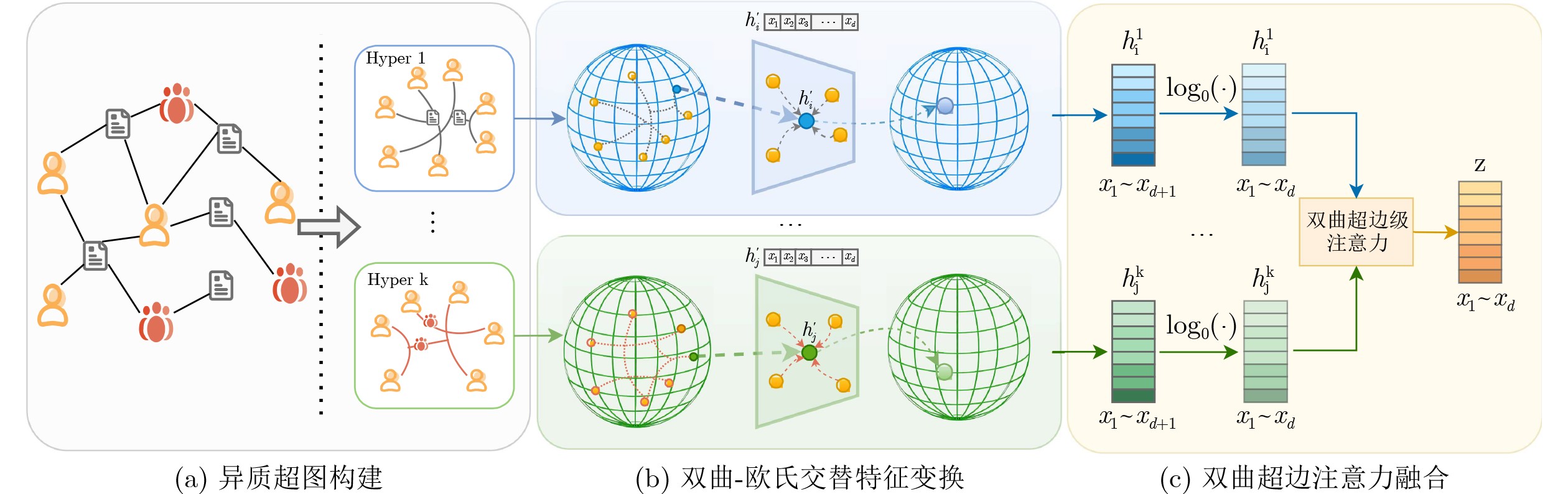
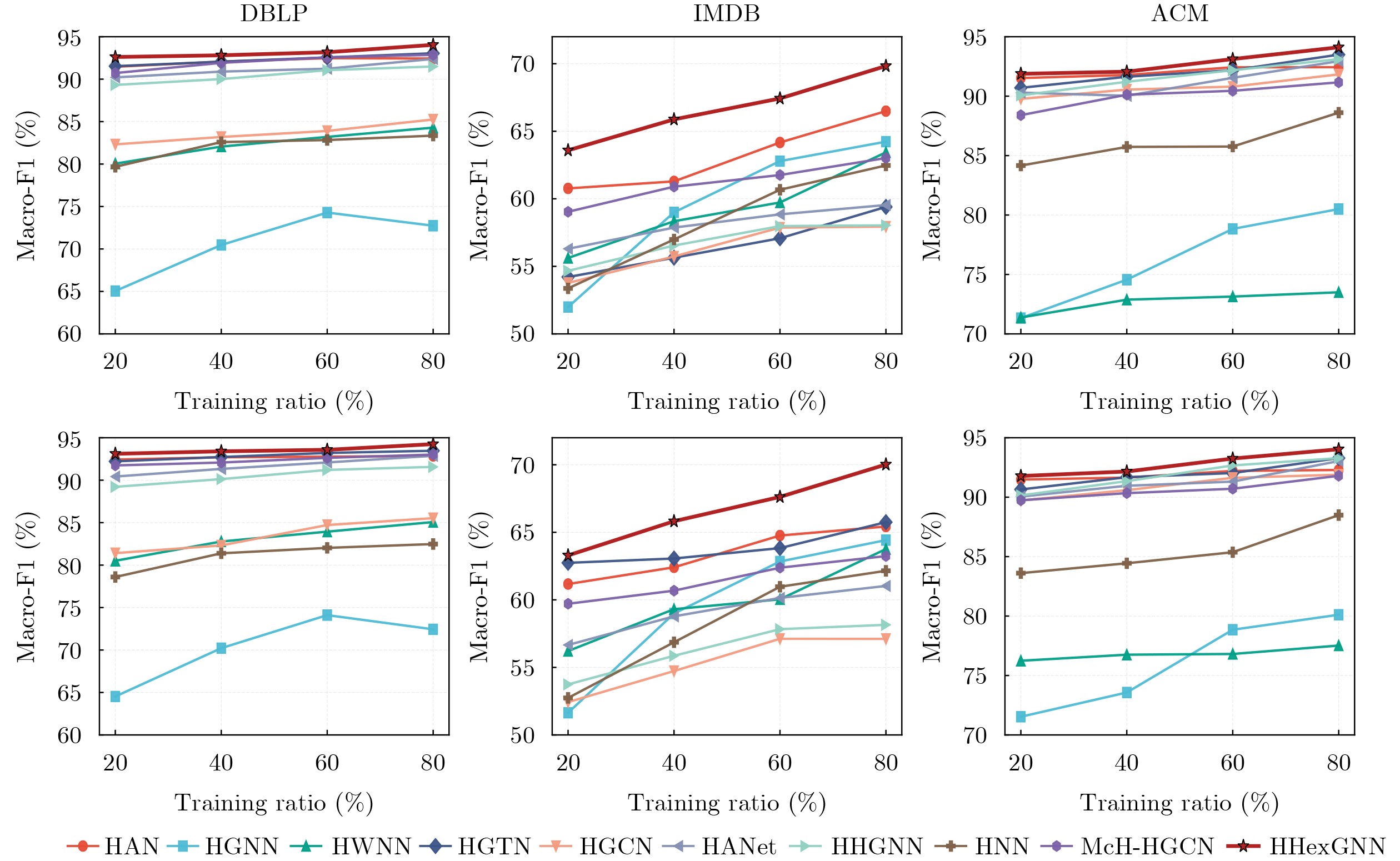
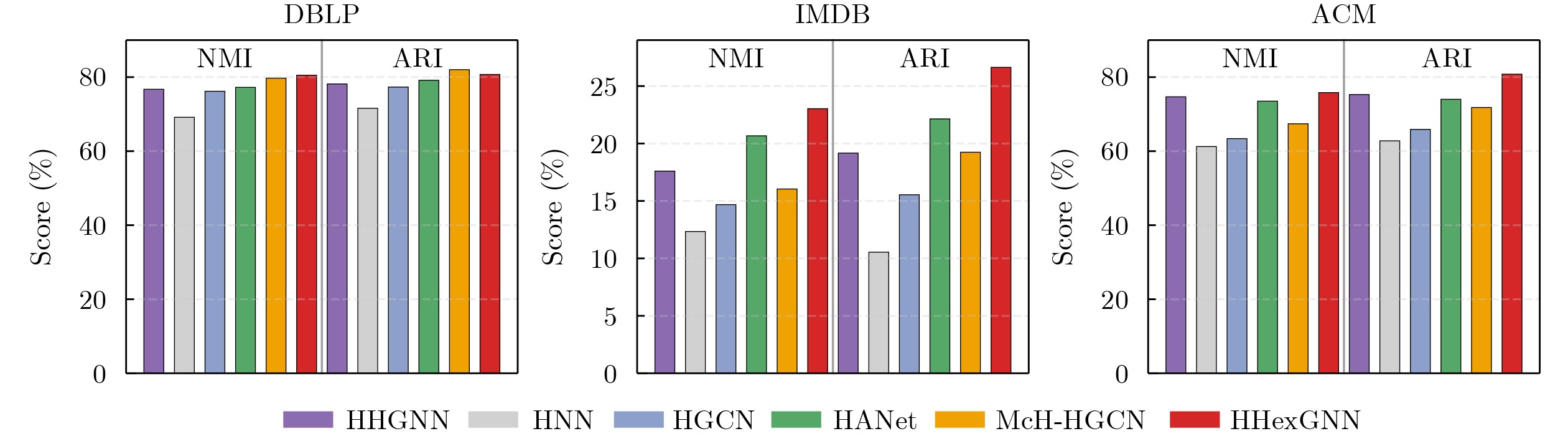
Objective Heterogeneous graphs are characterized by diverse node types and multi-semantic relations, the structural complexity of which presents significant challenges for representation learning. Prevailing international research primarily utilizes meta-paths to characterize semantic relations, learning node representations from both single-semantic and multi-semantic perspectives. However, meta-paths are limited to capturing pairwise relationships, making it difficult to model the latent high-order interaction structures within heterogeneous graphs. Furthermore, most existing heterogeneous graph neural networks are built upon Euclidean embeddings; yet, Euclidean space struggles to capture the pervasive hierarchical nature and exponential expansion of heterogeneous graphs within finite dimensions. This leads to the attenuation of hierarchical semantics during the embedding process, thereby compromising representation quality. This research proposes a novel modeling scheme for heterogeneous graph representation learning that integrates high-order structures with non-Euclidean geometric properties, providing robust theoretical support for semantic mining and knowledge discovery in complex information networks. Methods The proposed algorithm achieves a deep representation of high-order semantics and hierarchical structures in heterogeneous graphs by establishing a hyperbolic-Euclidean alternating transformation architecture. The model first constructs a heterogeneous hypergraph based on task-relevant meta-paths, explicitly capturing high-order semantics within the original graph through the capacity of hyperedges to associate multiple nodes. Subsequently, leveraging the geometric property that the tangent space of hyperbolic space is homeomorphic to Euclidean space, the model facilitates efficient feature learning via the alternating application of exponential and logarithmic mappings, thereby preserving the intrinsic hyperbolic geometric characteristics. Finally, a hyperbolic hyperedge attention mechanism is introduced to adaptively fuse semantic features across multiple views within a non-Euclidean manifold, generating the final node embedding representations. Extensive experimental results validate the significant advantages of this approach in modeling hierarchical relationships through negative curvature structures and in capturing high-order semantic information. Results and Discussions Experimental results demonstrate that the proposed HHexGNN model consistently outperforms baseline models across various downstream tasks over multiple standard datasets. By modeling in hyperbolic space, the framework leverages non-Euclidean geometric properties to achieve more pronounced performance gains compared to Euclidean-based models as node dimensions increase, effectively capturing the intricate hierarchical structures of high-dimensional data. For example, on the IMDB dataset, HHexGNN achieves average improvements of 9.88% in Macro-F1 and 10.29% in Micro-F1 relative to HGCN and HHGNN, validating the inherent advantages of semantic information within the hyperbolic hypergraph framework for capturing hierarchical relations. Furthermore, HHexGNN exhibits superior performance in node clustering tasks. For instance, on the DBLP dataset, with NMI and ARI reaching 80.51% and 80.72%, respectively—representing absolute improvements of 4.33% and 3.40% over HGCN, which only models standard graph structures. This gap reveals that capturing high-order interactions through hypergraphs enables the effective encoding of multivariate interaction semantics that are difficult to represent via simple hyperbolic projections, thereby significantly optimizing the representation quality of heterogeneous academic networks. Conclusions This paper proposes the Hyperbolic Heterogeneous Hypergraph Neural Network (HHexGNN) to address the challenges of high-order interaction modeling and hierarchical structure preservation in heterogeneous graphs. By integrating meta-path-induced hypergraph structures with hyperbolic manifolds, the model effectively enhances the representation capability for complex non-Euclidean topological relationships. HHexGNN significantly outperforms existing baseline models across all datasets and various training ratios in classification, clustering, and link prediction tasks. Specifically, the model achieves a 4.27% improvement in Micro-F1 on the IMDB dataset and a 5.51% increase in ARI on the ACM dataset, with a maximum performance gain of 10.43% in core metrics. Notably, HHexGNN exhibits exceptional data efficiency; its performance with only 20% training data surpasses that of most baselines trained on 80% of the data. These results validate the effectiveness of the model in capturing latent semantic structures and non-Euclidean topologies. Future research will explore adaptive meta-path generation and native hyperbolic algorithms to mitigate potential information loss caused by pre-defined paths and tangent space projections, thereby further refining representation precision in complex networks. -
Key words:
- Heterogeneous Graph /
- Hyperbolic Space /
- Hypergraph /
- Attention Mechanism /
- Node Representation Learning
-
表 1 数据集介绍
数据集 节点数 特征维度 元路径 分类数 DBLP Author*(A): 4057 334 a-p-a,
a-p-c-p-a,
a-p-t-p-a4 Paper(P): 14328 Conference(C):20 Term(T): 7723 IMDB Movie*(M): 4278 3066 m-a-m,
m-d-m3 Director(D): 2081 Actor(A): 5257 ACM Paper*(P): 4025 1903 p-a-p,
p-s-p3 Author(A): 17431 Subject(S):73  下载: 导出CSV
表 2 HHexGNN节点分类实验结果(%)
数据集 评价指标 训练集 HAN HGNN HWNN HGTN HGCN HANet HHGNN HNN McH-HGCN HHexGNN DBLP Macro-F1 20% 91.46 65.05 80.05 91.53 82.32 90.21 89.32 79.68 90.72 92.61 40% 92.07 70.47 82.06 92.06 83.19 90.89 90.01 82.59 91.92 92.81 60% 92.47 74.29 83.20 92.56 83.90 91.23 91.06 82.83 92.57 93.17 80% 92.43 72.74 84.29 93.05 85.25 92.38 91.49 83.35 92.86 94.04 Micro-F1 20% 92.43 64.53 80.51 92.22 81.41 90.43 89.22 78.60 91.74 93.11 40% 92.70 70.22 82.78 92.73 82.32 91.33 90.13 81.39 92.08 93.40 60% 92.77 74.11 83.94 93.21 84.72 92.09 91.21 82.03 92.63 93.58 80% 92.86 72.44 85.07 93.47 85.53 92.87 91.57 82.48 93.02 94.25 IMDB Macro-F1 20% 60.77 51.99 55.62 54.21 53.77 56.30 54.67 53.37 59.04 63.59 40% 61.29 59.00 58.34 55.64 55.73 57.87 56.54 56.99 60.90 65.88 60% 64.17 62.79 59.73 57.08 57.87 58.85 57.98 60.67 61.76 67.43 80% 66.49 64.23 63.44 59.40 57.94 59.54 58.04 62.47 63.02 69.83 Micro-F1 20% 61.17 51.64 56.21 62.74 52.43 56.66 53.74 52.74 59.71 63.29 40% 62.41 58.99 59.31 63.06 54.73 58.78 55.86 56.86 60.68 65.82 60% 64.76 62.84 60.04 63.83 57.12 60.14 57.83 60.97 62.38 67.62 80% 65.43 64.42 63.76 65.75 57.11 61.03 58.15 62.15 63.24 70.02 ACM Macro-F1 20% 91.52 71.33 71.38 90.70 89.77 90.30 90.07 84.16 88.40 91.88 40% 91.78 74.56 72.88 91.63 90.55 90.03 91.21 85.73 90.12 92.06 60% 92.43 78.83 73.14 92.18 90.80 91.54 92.18 85.76 90.45 93.12 80% 92.44 80.50 73.50 93.49 91.83 92.94 93.11 88.61 91.16 94.11 Micro-F1 20% 91.48 71.53 76.24 90.65 89.72 90.05 90.15 83.61 89.74 91.78 40% 91.65 73.57 76.75 91.68 90.59 90.96 91.35 84.44 90.34 92.16 60% 92.21 78.85 76.81 92.03 91.63 91.31 92.67 85.37 90.71 93.25 80% 92.29 80.11 77.52 93.29 91.89 93.04 93.29 88.49 91.80 94.03
下载: 导出CSV
表 3 HHexGNN聚类实验结果(%)
数据集 指标 HHGNN HNN HGCN HANet McH-HGCN HHexGNN DBLP NMI 76.72 69.15 76.18 77.24 79.72 80.51 ARI 78.16 71.59 77.32 79.15 82.02 80.72 IMDB NMI 17.60 12.34 14.68 20.67 16.04 23.03 ARI 19.17 10.54 15.54 22.14 19.24 26.63 ACM NMI 74.68 61.24 63.39 73.51 67.40 75.82 ARI 75.29 62.79 65.88 74.01 71.80 80.80
下载: 导出CSV
表 4 HHexGNN链路预测实验结果(%)
数据集 指标 HAN HGNN HGTN HGCN HHGNN HHexGNN DBLP AUC 93.67 87.11 93.75 90.33 92.74 94.67 AP 93.22 86.37 93.26 89.51 91.92 94.23 IMDB AUC 80.65 75.95 81.77 75.48 77.26 84.86 AP 79.83 74.79 80.94 74.32 76.39 83.92 ACM AUC 93.89 89.63 94.70 93.29 93.56 95.87 AP 93.14 88.82 94.18 92.56 93.31 95.31
下载: 导出CSV
-
[1] 韩虎, 范雅婷, 徐学锋. 面向方面情感分析的多通道增强图卷积网络[J]. 电子与信息学报, 2024, 46(3): 1022–1032. doi: 10.11999/JEIT230353.HAN Hu, FAN Yating, and XU Xuefeng. Multi-channel enhanced graph convolutional network for aspect-based sentiment analysis[J]. Journal of Electronics & Information Technology, 2024, 46(3): 1022–1032. doi: 10.11999/JEIT230353. [2] 夏计强, 赵键锦, 王子豪, 等. 融合流数据压缩与图自监督学习的异常流量检测方法[J]. 电子与信息学报, 2026, 48(8): 3486–3496. doi: 10.11999/JEIT260118.XIA Jiqiang, ZHAO Jianjin, WANG Zihao, et al. An anomalous traffic detection method integrating flow data compression and self-supervised graph learning[J]. Journal of Electronics & Information Technology, 2026, 48(8): 3486–3496. doi: 10.11999/JEIT260118. [3] GUAN Mingyu, STOKES J W, LUO Qinlong, et al. Heterogeneous graph neural network on semantic tree[C]. Proceedings of the 39th AAAI Conference on Artificial Intelligence, Philadelphia, USA, 2025: 16924–16932. doi: 10.1609/aaai.v39i16.33860. [4] LI Shibin, GONG Jun, KE Shengnan, et al. Graph transformer-based heterogeneous graph neural networks enhanced by multiple meta-path adjacency matrices decomposition[J]. Neurocomputing, 2025, 629: 129604. doi: 10.1016/j.neucom.2025.129604. [5] 高文超, 索建华, 张傲. 基于图和代码切片的可解释性漏洞检测方法[J]. 电子与信息学报, 2026, 48(1): 311–320. doi: 10.11999/JEIT250363.GAO Wenchao, SUO Jianhua, and ZHANG Ao. An interpretable vulnerability detection method based on graph and code slicing[J]. Journal of Electronics & Information Technology, 2026, 48(1): 311–320. doi: 10.11999/JEIT250363. [6] FENG Yifan, YOU Haoxuan, ZHANG Zizhao, et al. Hypergraph neural networks[C]. Proceedings of the 33rd AAAI Conference on Artificial Intelligence, Honolulu, USA, 2019: 3558–3565. doi: 10.1609/aaai.v33i01.33013558. [7] YADATI N, NIMISHAKAVI M, YADAV P, et al. HyperGCN: A new method of training graph convolutional networks on hypergraphs[C]. Proceedings of the 33rd International Conference on Neural Information Processing Systems, Vancouver, Canada, 2019: 135. [8] WANG Yuxin, GAN Quan, QIU Xipeng, et al. From hypergraph energy functions to hypergraph neural networks[C]. Proceedings of the 40th International Conference on Machine Learning, Honolulu, USA, 2023: 1481. [9] SUN Xiangguo, YIN Hongzhi, LIU Bo, et al. Heterogeneous hypergraph embedding for graph classification[C]. Proceedings of the 14th ACM International Conference on Web Search and Data Mining, Vancouver, Canada, 2021: 725–733. doi: 10.1145/3437963.3441835. (查阅网上资料,无法确认出版地信息是否正确). [10] PENG Wei, VARANKA T, MOSTAFA A, et al. Hyperbolic deep neural networks: A survey[J]. IEEE Transactions on Pattern Analysis and Machine Intelligence, 2022, 44(12): 10023–10044. doi: 10.1109/TPAMI.2021.3136921. [11] CHEN Ying, ZHANG Lianming, LI Jiusheng, et al. Hyperbolic graph representation learning: Methods, applications and challenges—A survey[J]. Neurocomputing, 2025, 652: 131044. doi: 10.1016/j.neucom.2025.131044. [12] LIU Qi, NICKEL M, and KIELA D. Hyperbolic graph neural networks[C]. Proceedings of the 33rd International Conference on Neural Information Processing Systems, Vancouver, Canada, 2019: 739. [13] ZHANG Yiding, WANG Xiao, SHI Chuan, et al. Hyperbolic graph attention network[J]. IEEE Transactions on Big Data, 2022, 8(6): 1690–1701. doi: 10.1109/TBDATA.2021.3081431. [14] CHAMI I, YING R, RE C, et al. Hyperbolic graph convolutional neural networks[C]. Proceedings of the 33rd International Conference on Neural Information Processing Systems, Vancouver, Canada, 2019: 438. [15] LIU Yanxi and LANG Bo. McH-HGCN: Multi-curvature hyperbolic heterogeneous graph convolutional network with type triplets[J]. Neural Computing and Applications, 2023, 35(20): 15033–15049. doi: 10.1007/s00521-023-08473-5. [16] PARK J, HAN S, SHIN W Y, et al. Metapath-based hyperbolic contrastive learning for heterogeneous graph embedding[EB/OL]. https://arxiv.org/abs/2506.16754, 2025. [17] SUN Yizhou, HAN Jiawei, YAN Xifeng, et al. PathSim: Meta path-based top-K similarity search in heterogeneous information networks[J]. Proceedings of the VLDB Endowment, 2011, 4(11): 992–1003. doi: 10.14778/3402707.3402736. [18] 李亚聪, 刘皓冰, 蒋若冰, 等. 异质图表征学习综述[J]. 软件学报, 2025, 36(6): 2794–2826. doi: 10.13328/j.cnki.jos.007319.LI Yacong, LIU Haobing, JIANG Ruobing, et al. Survey on heterogeneous graph representation learning[J]. Journal of Software, 2025, 36(6): 2794–2826. doi: 10.13328/j.cnki.jos.007319. [19] GAO Yue, ZHANG Zizhao, LIN Haojie, et al. Hypergraph learning: Methods and practices[J]. IEEE Transactions on Pattern Analysis and Machine Intelligence, 2022, 44(5): 2548–2566. doi: 10.1109/TPAMI.2020.3039374. [20] FAN Haoyi, ZHANG Fengbin, WEI Yuxuan, et al. Heterogeneous hypergraph variational autoencoder for link prediction[J]. IEEE Transactions on Pattern Analysis and Machine Intelligence, 2022, 44(8): 4125–4138. doi: 10.1109/TPAMI.2021.3059313. [21] YANG Menglin, ZHOU Min, ZHANG Tong, et al. Hyperbolic graph neural networks: A review of methods and applications[EB/OL]. https://arxiv.org/abs/2202.13852, 2025. [22] WANG Xiao, JI Houye, SHI Chuan, et al. Heterogeneous graph attention network[C]. Proceedings of the World Wide Web Conference, San Francisco, USA, 2019: 2022–2032. doi: 10.1145/3308558.3313562. [23] LI Mengran, ZHANG Yong, LI Xiaoyong, et al. Hypergraph transformer neural networks[J]. ACM Transactions on Knowledge Discovery from Data, 2023, 17(5): 63. doi: 10.1145/3565028. [24] CHAMI I, YING R, RÉ C, et al. Hyperbolic graph convolutional neural networks[C]. Proceedings of the 33rd International Conference on Neural Information Processing Systems, Vancouver, Canada, 2019: 438. (查阅网上资料, 本条文献与第14条文献重复, 请确认). [25] GÜLÇEHRE Ç, DENIL M, MALINOWSKI M, et al. Hyperbolic attention networks[C]. Proceedings of the 7th International Conference on Learning Representations, New Orleans, USA, 2019. [26] MEI Zhangyu, BI Xiao, WEN Yating, et al. HHGNN: Hyperbolic Hypergraph Convolutional Neural Network based on variational autoencoder[J]. Neurocomputing, 2024, 601: 128225. doi: 10.1016/j.neucom.2024.128225. -

 下载:

图(8) / 表(4)
计量
- 文章访问数: 5
- HTML全文浏览量: 0
- PDF下载量: 0
- 被引次数: 0
