




A Cross-Precision Motion Compensation Technique for Security Surveillance Video Coding
-
摘要: 在现代安防监控领域,高空球形摄像机因部署位置易受外部干扰,导致视频画面出现抖动、模糊等问题,严重影响监控效果与后期分析精度。视频压缩算法中,高精度运动补偿对提升编码效率至关重要,而当前的终极运动矢量表达(UMVE)技术存在精度和自适应调整不足等问题,图像配准编码模式(RCM)等虽能实现高精度运动补偿,但计算量和成本过高。针对这些问题,该研究提出了支持跨精度运动补偿的终极运动矢量表达技术(UMVE_CPMC),该技术融合基础运动矢量(BaseMV)与精细化微调运动矢量(MMV),通过构造扩展的升精度运动矢量(UPMV)提升运动补偿精度,且仅在1/8精度级别提供增量候选,实现计算复杂度与压缩效率的平衡。在步长自适应调整方面,提出6种模式的改进方案,编码器可根据场景灵活切换,以适应不同应用需求。实验表明,UMVE_CPMC在A类高清晰度运动场景下,编码增益显著,同时开启其他高精度运动补偿工具时,部分序列增益达1%~2%,在无其他高精度运动补偿工具时,部分序列增益超10%;在B类低清晰度场景下,通过帧级别自适应调整接口维持原有增益。此外,该技术在计算效率与资源占用间实现良好平衡,为解决高空球形摄像机视频编码问题提供了新的有效途径。Abstract:
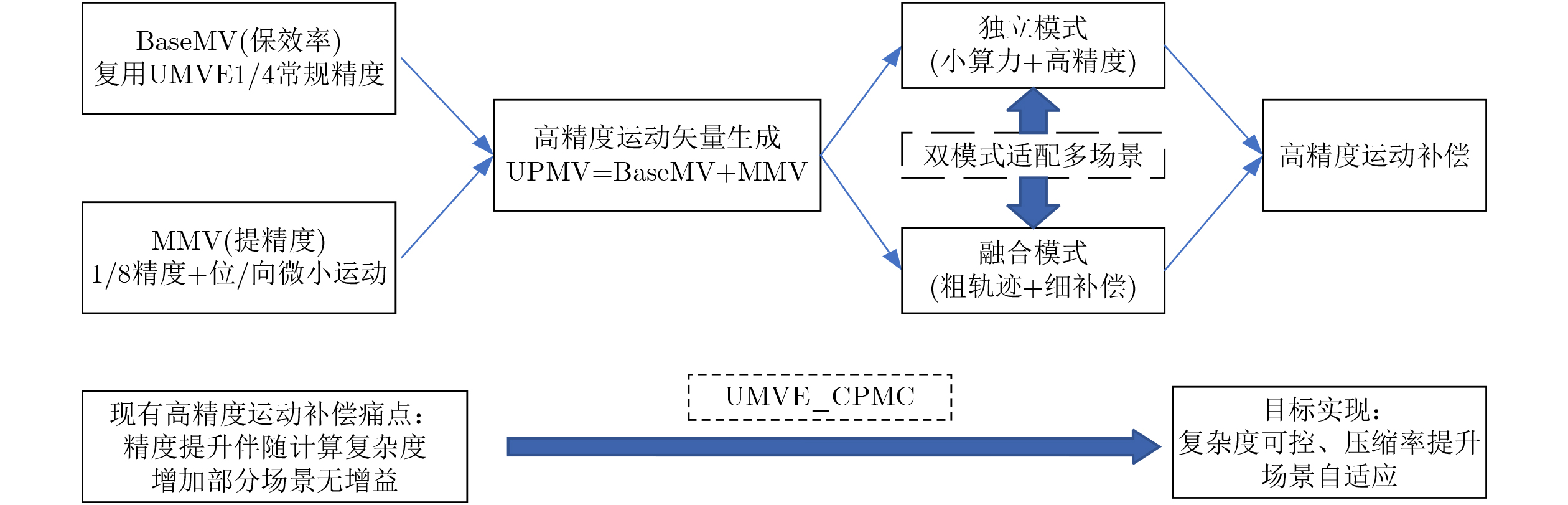
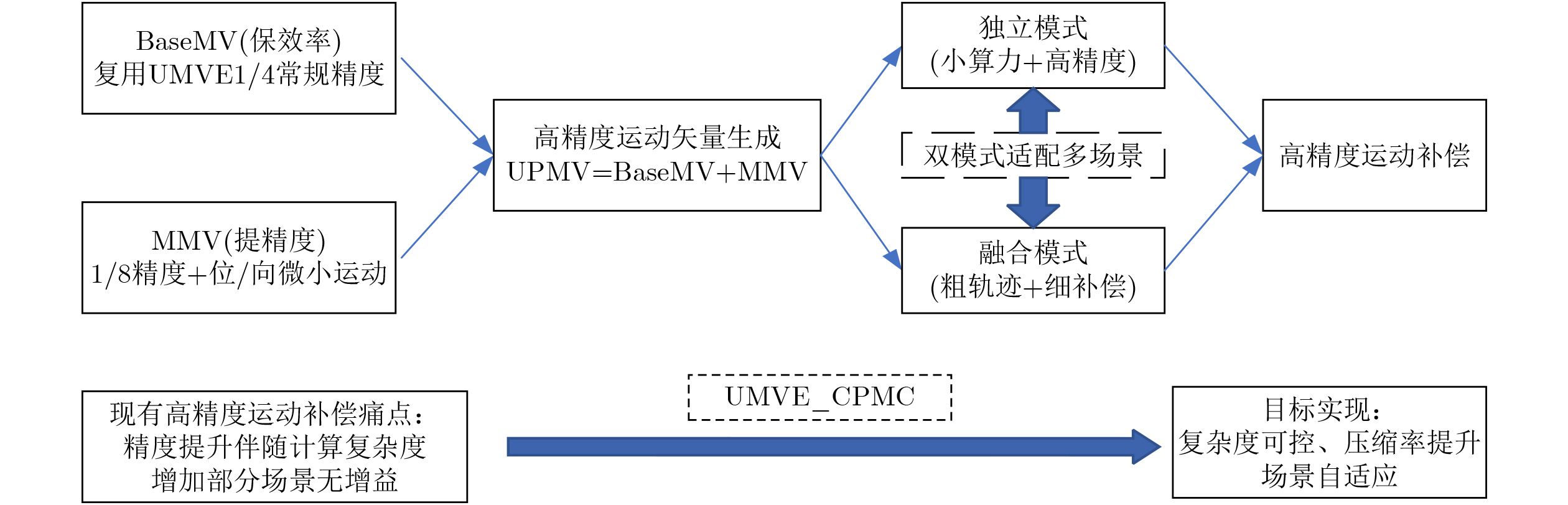
Objective High-altitude dome cameras are widely used in modern security surveillance. They are often deployed at critical locations, such as bridges and tower tops, where they are vulnerable to external interference. Such interference can cause jitter, blur, and distortion in captured videos, creating major challenges for video coding. In video compression, high-precision motion compensation is essential for improving coding efficiency. However, the existing Ultimate Motion Vector Expression (UMVE) technique has limited motion-vector precision and insufficient flexibility in adaptive adjustment. High-precision motion compensation tools, such as Registration Coding Mode (RCM) and Affine Motion Compensation Prediction (AFFINE), can improve compensation accuracy, but they require high computational complexity and hardware cost. These limitations make it difficult to meet the requirements for coding efficiency, power consumption, and real-time processing in high-altitude surveillance scenarios. Therefore, this study aims to design an optimized UMVE scheme that integrates high-precision motion compensation, low computational complexity, and scene adaptability to improve coding efficiency while balancing resource consumption. Methods This study proposes UMVE_CPMC, an Ultimate Motion Vector Expression technique supporting Cross-Precision Motion Compensation. The proposed method improves motion compensation accuracy by constructing an extended Up-Precision Motion Vector (UPMV), expressed as UPMV = BaseMV + MMV(p, angle). Here, Base Motion Vector (BaseMV) denotes the base vector obtained by the existing UMVE method, and Micro-Motion Vector (MMV) denotes the fine-adjustment vector defined by a specific precision p and angle. Incremental candidates are provided only at the 1/8 precision level to balance computational complexity and compression efficiency. For step-size adaptive adjustment, a six-mode improved scheme is proposed. It covers enhanced UMVE, conventional UMVE, and four precision-improved modes, allowing the encoder to switch flexibly according to scene characteristics. The average image gradient is used as an objective evaluation index. Test scenes are divided into Class A, representing high-clarity motion scenes, and Class B, representing low-clarity scenes. Different coding configurations, sequences, and parameters are used to compare coding gains and computational efficiency under different modes. Results and Discussions Experiments show that UMVE_CPMC improves performance under different scenes and modes. In Class A high-clarity motion scenes, with both the adaptive strategy and RCM disabled, the average gains of the Y, U, and V components in Fusion Mode 1 are –2.912%, –1.656%, and –1.654%, respectively. The average coding time is reduced to 94.55% of the baseline. In Independent Mode 1, the average Y-component gain reaches –2.925%, and the coding time is reduced to 91.91% of the baseline. Compared with conventional UMVE, when CPMC Independent Mode 1 is enabled with RCM and other tools working together, the gain improves from –0.276% to –1.310%, indicating higher cost effectiveness. In Class B low-clarity scenes, adaptive adjustment significantly reduces the losses of coding gain in Fusion Mode 1 and Fusion Mode 0. The average losses of coding gain are limited to 0.071% and 0.108%, respectively, which maintains the original coding gain. In multi-scene tests with RCM and AFFINE disabled, 9 of 10 test sequences in adaptive Fusion Mode 1 show positive gains. The Y-component gain reaches –10.691% for the yuxuedaolu sequence and –11.400% for the BQTerrace sequence. When all existing coding tools are enabled, the Y-component gains of the dianjing, yuxuedaolu, and BQTerrace sequences reach –1.29%, –2.05%, and –1.21%, respectively. The coding time is reduced to 94%~96% of the baseline. In addition, correlation analysis shows a clear positive relationship between the average image gradient and the coding gain. Images with a high average gradient, corresponding to high clarity, gain more from UMVE_CPMC, whereas images with a low average gradient, corresponding to low clarity, benefit little. Principle analysis shows that pixel changes in low-clarity images are smooth, so high-precision interpolation cannot generate effective new pixel values. The compensation effect is therefore limited. The performance differences among modes are consistent with their computational complexity. The fusion mode balances gain and stability, whereas the independent mode further reduces computation. The six step-size adaptive modes can meet the real-time and precision requirements of different scenes. Conclusions The proposed UMVE_CPMC technique integrates Cross-Precision Motion Compensation with the UMVE algorithm. It addresses the limited precision of conventional UMVE and the high computational complexity of high-precision motion compensation tools. It also achieves a favorable balance among coding efficiency, computational complexity, and scene adaptability. In Class A high-clarity motion scenes, UMVE_CPMC achieves notable coding gains. The gain exceeds 10% for some sequences when other high-precision motion compensation tools are disabled and reaches 1%~2% when used with other tools. In Class B low-clarity scenes, the original coding gain is maintained through a frame-level adaptive adjustment interface. In addition, the fusion mode does not increase hardware complexity, whereas the independent mode significantly reduces coding time. These features make the proposed method suitable for encoder designs with limited resources or simplified requirements. UMVE_CPMC provides an effective approach for improving the coding efficiency of high-altitude dome camera videos affected by jitter and blur. It also enriches the video coding toolset and provides practical guidance for optimizing video coding technologies in security surveillance. Future work will further optimize the adaptive strategy, explore integration with other advanced coding tools, develop scenario-specific coding schemes, and improve performance in complex scenes. -
表 1 模式步长自适应调整改进方案
模式 现有方案 改进方案 步长范围 总候选数目 步长范围 总候选数目 增强UMVE [1/4, 32] 64 [1/4, 32] 64 普通UMVE [1/4, 4] 40 [1/4, 4] 40 精度提升模式(融合模式1) 不支持 不支持 [1/8, 4] 40 精度提升模式(融合模式0) 不支持 不支持 [1/8, 2] 40 精度提升模式(独立模式1) 不支持 不支持 [1/8, 1/8] 16 精度提升模式(独立模式0) 不支持 不支持 [1/8, 1/8] 8  下载: 导出CSV
表 2 平均梯度作为图像清晰度评价指标的有效性
序列名称 图像平均梯度 重建图像平均梯度 CPMC增益(%) input rec(q33) rec(q40) rec(q47) rec(q52) 平均 dianjing 13.6 11.6 10.7 9.7 8.8 10.2 –1.29 yuxuedaolu 23.8 20.2 18.3 15.7 13.4 16.9 –2.05 BQTerrace 13.1 8.1 7.5 7.0 6.6 7.3 –1.21 qiaoxialuduan1 18.3 14.6 13 11.2 9.9 12.2 –0.55 qiaoxialuduan2 10.1 6.8 6.3 5.6 5.0 5.9 –0.49 tingchechang 10.7 7.7 7.1 6.6 6.2 6.9 –0.23 beihaihumian 7.8 4.4 3.6 2.6 1.9 3.1 0.05 MarketPlace 6.2 3.3 2.9 2.4 2.1 2.7 0.13 Cactus 10.4 5.7 5.2 4.6 4.1 4.9 –0.09 huochezhan 9.3 5.4 4.7 4.2 3.8 4.5 0.00 lijiaoqiao 8.3 5.4 4.7 4.2 3.8 4.5 0.00 DaylightRoad 8.8 3.1 2.9 2.7 2.4 2.8 0.00
下载: 导出CSV
表 3 SD5.0加入CPMC的增益(融合模式1)(%)
RCM关闭 Y U V Enc_time Qiaoxia1 –1.622 –1.571 –3.208 97.59 tingchechang –1.823 –1.759 –2.229 93.75 dianjing –2.502 –1.318 –1.710 93.67 yuxuedaolu –4.910 –2.113 –0.847 92.70 BQTerrace –3.700 –1.520 –0.275 95.05 average: –2.912 –1.656 –1.654 94.55
下载: 导出CSV
表 4 SD5.0加入CPMC增益(融合模式0)(%)
RCM关闭 Y U V Enc_time Qiaoxia1 –1.427 –1.714 –2.705 95.17 tingchechang –1.504 –1.358 –1.870 111.30 dianjing –2.368 –1.327 –1.819 86.07 yuxuedaolu –3.822 –1.735 –0.350 94.47 BQTerrace –2.715 –2.199 –0.194 98.97 average: –2.367 –1.667 –1.388 97.20
下载: 导出CSV
表 5 SD5.0加入CPMC增益(独立模式1)(%)
RCM关闭 Y U V Enc_time Qiaoxia1 –1.778 –1.661 –3.277 88.84 tingchechang –1.768 –2.058 –2.170 98.69 dianjing –2.346 –1.359 –1.431 84.40 yuxuedaolu –4.894 –2.258 –1.639 91.38 BQTerrace –3.840 –0.645 0.007 96.26 平均 –2.925 –1.596 –1.702 91.91
下载: 导出CSV
表 6 SD5.0加入CPMC增益(独立模式1)(%)
RCM开启 Y U V Enc_time Qiaoxia1 –0.479% –0.998% –1.307% 94.778% tingchechang –0.440% –0.229% 0.421% 93.640% dianjing –1.463% –0.618% –0.907% 94.938% yuxuedaolu –2.484% –1.140% –1.673% 90.148% BQTerrace –1.683% –1.065% 1.613% 90.759% 平均 –1.310% –0.810% –0.371% 92.853%
下载: 导出CSV
表 7 SD5.0加入CPMC增益(独立模式0)(%)
RCM关闭 Y U V Enc_time Qiaoxia1 –1.495 –1.103 –2.421 84.68 tingchechang –1.532 –1.659 –2.288 101.56 dianjing –2.309 –1.789 –1.610 85.84 yuxuedaolu –3.774 –1.767 –2.438 75.24 BQTerrace –2.806 –1.156 –1.116 111.89 平均 –2.383 –1.495 –1.975 91.84
下载: 导出CSV
表 8 SD5.0加入CPMC增益(独立模式0)(%)
RCM开启 Y U V Enc_time Qiaoxia1 –0.434 –0.909 –0.378 96.226 tingchechang –0.200 0.150 –0.004 95.931 dianjing –1.463 –0.618 –0.907 94.938 yuxuedaolu –1.887 –1.192 –1.341 93.063 BQTerrace –1.398 –2.266 –0.984 93.708 平均 –1.076 –0.967 –0.723 94.773
下载: 导出CSV
表 9 SD5.0 加入UMVE的增益(%)
RCM开启 Y U V Qiaoxia1 –0.234 0.103 0.527 tingchechang –0.639 –1.211 –0.669 dianjing –0.315 –0.909 –0.708 yuxuedaolu –0.073 0.024 –0.538 BQTerrace –0.119 1.029 –0.680 平均 –0.276 –0.193 –0.414
下载: 导出CSV
表 10 关闭自适应调节的CPMC增益(%)
非自适应独立模式1 非自适应独立模式0 Y U V Y U V beihaihumian 0.605 0.868 0.861 0.427 0.163 0.686 market 0.938 0.131 1.146 0.795 0.264 0.462 平均 0.772 0.499 1.004 0.611 0.214 0.574
下载: 导出CSV
表 11 开启自适应调节的CPMC增益(%)
自适应融合模式1 自适应融合模式0 Y U V Y U V beihaihumian –0.018 0.354 1.232 0.079 –0.043 0.481 market 0.160 0.705 0.438 0.136 –0.060 –0.361 平均 0.071 0.529 0.835 0.108 –0.051 0.060
下载: 导出CSV
表 12 RCM, AFFINE关闭,自适应融合模式1的增益(%)
Y U V Beihaihumian –0.422 0.718 1.017 Qiaoxia1 –2.162 –2.187 –0.884 Qiaoxia2 –0.757 –1.703 –0.543 tingchechang –2.737 –3.025 –2.741 catus –0.221 –0.304 0.087 maket 0.271 –0.215 1.309 NightTraffic3 –0.654 –1.273 –0.868 dianjing –4.131 –3.834 3.751 yuxuedaolu –10.691 –12.265 6.169 BQTerrace –11.400 –12.248 –11.008 平均 –3.290 –3.634 –0.371
下载: 导出CSV
表 13 多场景综合测试结果(%)
V1.1 V1.2 Y U V Enc_time Y U V Enc_time 4k huochezhan 0.25 –0.56 –0.03 - 0.00 0.00 0.00 lijiaoqiao 0.28 0.41 0.72 - 0.00 0.00 0.00 DaylightRoad –0.07 –0.38 –0.53 - 0.00 0.00 0.00 1 080P beihaihumian 0.01 –0.11 –0.91 - 0.05 –0.18 –0.85 100 qiaoxialuduan1 –0.54 –0.62 0.79 - –0.55 –0.98 0.11 95 qiaoxialuduan2 –0.54 –0.46 –0.41 - –0.49 –0.37 –0.72 95 tingchechang –0.26 –0.47 –0.19 - –0.23 –0.54 0.08 96 Cactus –0.08 0.25 –0.24 - –0.09 0.48 –0.37 98 MarketPlace 0.01 0.33 0.54 - 0.13 0.30 0.17 98 NightTraffic3 –0.21 –0.09 –0.24 - –0.43 –0.28 –0.53 94 补充 dianjing –1.29 –1.14 2.84 93 –1.29 –1.30 –0.76 95 yuxuedaolu –2.04 –0.40 9.22 94 –2.05 –0.35 –1.07 93 BQTerrace –1.19 –1.01 –1.57 94 –1.21 –0.56 –1.87 95 平均 –0.44 –0.33 0.77 94 –0.47 –0.29 –0.45 96
下载: 导出CSV
-
[1] GAO Wen and MA Siwei. Video coding optimization and application system[M]. GAO Wen and MA Siwei. Advanced Video Coding Systems. Switzerland: Springer, 2014: 161–176. doi: 10.1007/978-3-319-14243-2_9. [2] ZHU Xizhong, XIANG Guoqing, ZHANG Peng, et al. A hardware-efficient unified motion estimation for video coding[C]. The 31st ACM International Conference on Multimedia, Ottawa, Canada, 2023: 9042–9050. doi: 10.1145/3581783.3613816. [3] HUANG Qian, LU Hao, LIU Wenting, et al. Scalable motion estimation and temporal context reinforcement for video compression using RGB sensors[J]. IEEE Sensors Journal, 2025, 25(10): 18323–18333. doi: 10.1109/JSEN.2025.3550525. [4] MARPE D, WIEGAND T, and SULLIVAN G J. The H. 264/MPEG4 advanced video coding standard and its applications[J]. IEEE Communications Magazine, 2006, 44(8): 134–143. doi: 10.1109/MCOM.2006.1678121. [5] 申滨, 李旋, 赖雪冰, 等. 基于Swin Transformer的宽带无线图传语义联合编解码方法[J]. 电子与信息学报, 2025, 47(8): 2665–2674. doi: 10.11999/JEIT250039.SHEN Bin, LI Xuan, LAI Xuebing, et al. Swin Transformer-based wideband wireless image transmission semantic joint encoding and decoding method[J]. Journal of Electronics & Information Technology, 2025, 47(8): 2665–2674. doi: 10.11999/JEIT250039. [6] CHIEN W J, ZHANG Li, WINKEN M, et al. Motion vector coding and block merging in the versatile video coding standard[J]. IEEE Transactions on Circuits and Systems for Video Technology, 2021, 31(10): 3848–3861. doi: 10.1109/TCSVT.2021.3101212. [7] BROSS B, WANG Yekui, YE Yan, et al. Overview of the versatile video coding (VVC) standard and its applications[J]. IEEE Transactions on Circuits and Systems for Video Technology, 2021, 31(10): 3736–3764. doi: 10.1109/TCSVT.2021.3101953. [8] KAJI S and OCHIAI H. A concise parametrization of affine transformation[J]. SIAM Journal on Imaging Sciences, 2016, 9(3): 1355–1373. doi: 10.1137/16M1056936. [9] LI Li, LI Houqiang, LIU Dong, et al. An efficient four-parameter affine motion model for video coding[J]. IEEE Transactions on Circuits and Systems for Video Technology, 2018, 28(8): 1934–1948. doi: 10.1109/TCSVT.2017.2699919. [10] MEUEL H, FERENZ S, LIU Yiqun, et al. Rate-distortion theory for affine global motion compensation in video coding[C]. 2018 25th IEEE International Conference on Image Processing, Athens, Greece, 2018: 3593–3597. doi: 10.1109/ICIP.2018.8451136. [11] VIANA R, LOOSE M, FERREIRA R, et al. A hardware-friendly acceleration of VVC affine motion estimation using decision trees[C]. 2024 37th SBC/SBMicro/IEEE Symposium on Integrated Circuits and Systems Design, Joao Pessoa, Brazil, 2024: 1–5. doi: 10.1109/SBCCI62366.2024.10703987. [12] ZHOU Chuan, LV Zhuoyi, PIAO Yinji, et al. Adaptive motion vector resolution in AVS3 Standard[C]. 2020 IEEE International Conference on Multimedia & Expo Workshops, London, UK, 2020: 1–4. doi: 10.1109/ICMEW46912.2020.9106046. [13] SULLIVAN G J, OHM J R, HAN W J, et al. Overview of the high efficiency video coding (HEVC) standard[J]. IEEE Transactions on Circuits and Systems for Video Technology, 2012, 22(12): 1649–1668. doi: 10.1109/TCSVT.2012.2221191. [14] CHEN Shushi, HUANG Leilei, ZAN Zhao, et al. Affine motion estimation hardware implementation with 51.7%/67.5% internal bandwidth reduction for versatile video coding[J]. IEEE Transactions on Circuits and Systems for Video Technology, 2025, 35(4): 3837–3852. doi: 10.1109/TCSVT.2024.3507375. [15] CHEN Shushi, HUANG Leilei, LIU Jiahao, et al. An error-surface-based fractional motion estimation algorithm and hardware implementation for VVC[C]. 2023 IEEE International Symposium on Circuits and Systems, Monterey, USA, 2023: 1–5. doi: 10.1109/ISCAS46773.2023.10182170. [16] ZHU Xizhong, XIANG Guoqing, HUANG Xiaofeng, et al. A hardware-friendly CTU-level IME Algorithm for VVC[C]. 2023 Data Compression Conference, Snowbird, USA, 2023: 110–119. doi: 10.1109/DCC55655.2023.00019. [17] 盛庆华, 陶泽浩, 黄小芳, 等. 一种面向AV1粗模式决策的高吞吐量硬件设计方法[J]. 电子与信息学报, 2025, 47(4): 1202–1214. doi: 10.11999/JEIT240823.SHENG Qinghua, TAO Zehao, HUANG Xiaofang, et al. A high-throughput hardware design for AV1 rough mode decision[J]. Journal of Electronics & Information Technology, 2025, 47(4): 1202–1214. doi: 10.11999/JEIT240823. [18] 宋赛, 崔昭, 詹尹僧, 等. 面向深度神经网络图像压缩的高性能算术编码硬件设计[J]. 电子与信息学报, 2025, 47(9): 3230–3240. doi: 10.11999/JEIT250509.SONG Sai, CUI Zhao, ZHAN Yinseng, et al. High-performance hardware design of arithmetic coding for deep neural network-based image compression[J]. Journal of Electronics & Information Technology, 2025, 47(9): 3230–3240. doi: 10.11999/JEIT250509. -

 下载:
下载:


计量
- 文章访问数: 299
- HTML全文浏览量: 153
- PDF下载量: 23
- 被引次数: 0
