




Identification of Novel Protein Drug Targets for Respiratory Diseases by Integrating Human Plasma Proteome with Genome
-
摘要: 呼吸系统疾病严重危害人类健康,其病因学机制解析与新型药物靶点发掘一直是医学研究的重点领域。该文采用蛋白质组孟德尔随机化(MR)与共定位分析,利用大规模蛋白质定量性状位点汇总数据,评估血浆蛋白与27种呼吸系统疾病表型的因果关联,并进行共定位分析以控制混杂因素及连锁不平衡的潜在偏倚。采用验证队列MR分析以及基于汇总数据的孟德尔随机化分析(SMR)验证因果关联,并通过双向MR及Steiger检验评估反向因果关联。结果显示MR分析共识别出600组血浆蛋白-疾病表型关联,其中29组关联共定位分析结果为阳性(PP4>0.8),26组关联SMR分析为阳性。该研究确定了NRX3A等5种蛋白与慢性阻塞性肺病、IL7R等3种蛋白与哮喘、FUT3_FUT5与特发性肺纤维化的显著关联,并发现CSF3与重症COVID-19, BTN2A1等与不同亚型肺癌的因果关联。综上,该研究揭示多种与呼吸系统疾病相关的血浆蛋白,为疾病机制研究及药物研发提供新方向。Abstract:
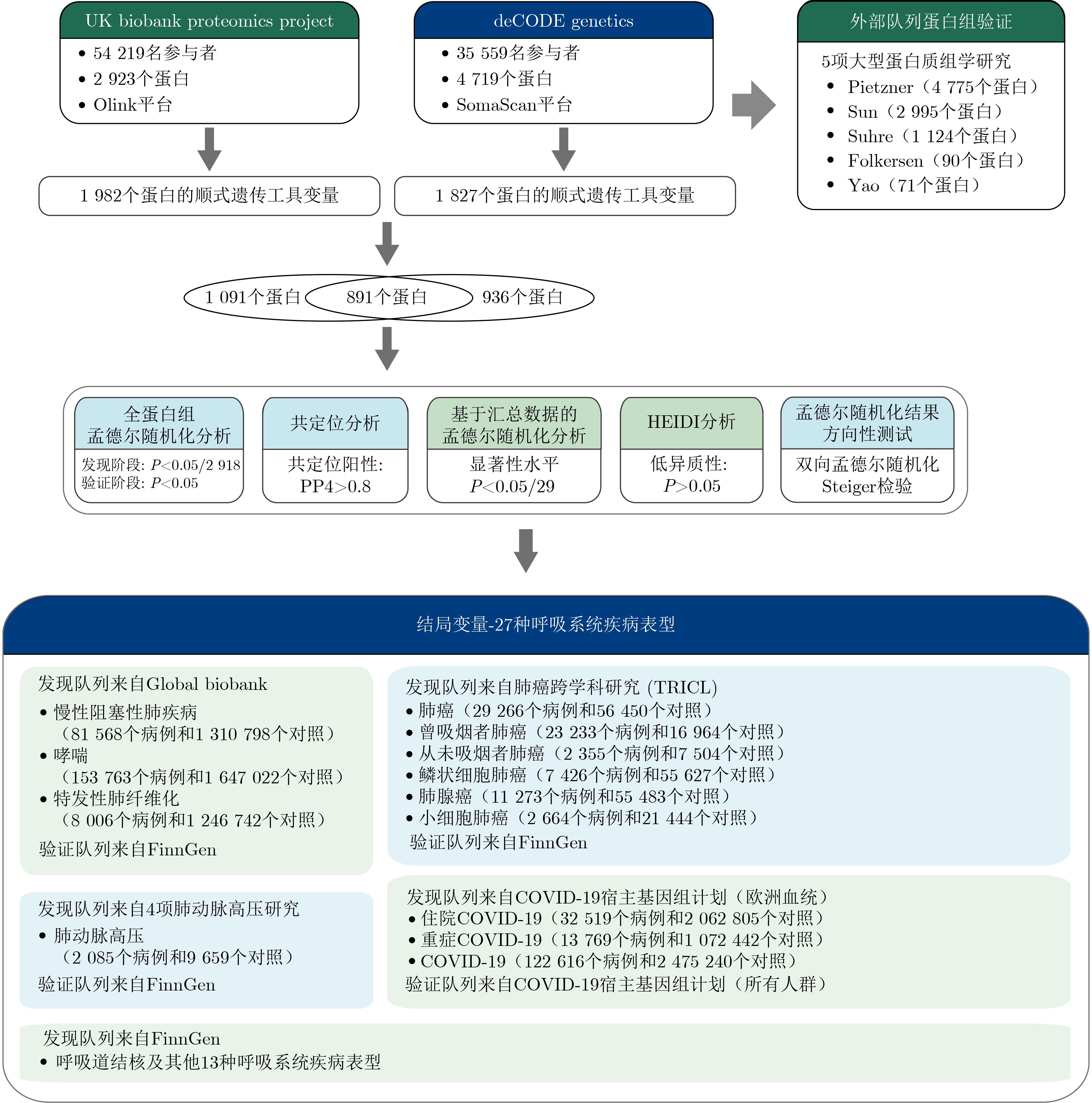
Objective Respiratory diseases are a major cause of global morbidity and mortality and place a heavy socioeconomic burden on healthcare systems. Epidemiological data indicate that Chronic Obstructive Pulmonary Disease (COPD), pneumonia, asthma, lung cancer, and tuberculosis are the five most significant pulmonary diseases worldwide. The COronaVIrus Disease 2019 (COVID-19) pandemic has introduced additional challenges for respiratory health and emphasizes the need for new diagnostic and therapeutic strategies. Integrating proteomics with Genome-Wide Association Studies (GWAS) provides a framework for connecting genetic variation to clinical phenotypes. Genetic variants associated with plasma protein levels, known as protein Quantitative Trait Loci (pQTLs), link the genome to complex respiratory phenotypes. This study evaluates the causal effects of druggable proteins on major respiratory diseases through proteome-wide Mendelian Randomization (MR) and colocalization analyses. The aim is to identify causal associations that can guide biomarker development and drug discovery, and to prioritize candidates for therapeutic repurposing. Methods Summary-level data for circulating protein levels are obtained from two large pQTL studies: the deCODE study and the UK Biobank Pharma Proteomics Project (UKB-PPP). Strictly defined cis-pQTLs are selected to ensure robust genetic instruments, yielding 2,918 proteins for downstream analyses. For disease outcomes, large GWAS summary statistics for 27 respiratory phenotypes are collected from previously published studies and international consortia. A two-sample MR design is applied to estimate the effects of plasma proteins on these phenotypes. To reduce confounding driven by Linkage Disequilibrium (LD), Bayesian colocalization analysis is used to assess whether genetic signals for protein levels and respiratory outcomes share a causal variant. The Posterior Probability of hypothesis 4 (PP4) serves as the primary metric, and PP4 > 0.8 is considered strong evidence of shared causality. Summary-data-based Mendelian Randomization (SMR) and the HEterogeneity In Dependent Instruments (HEIDI) test are used to validate the causal associations. Bidirectional MR and the Steiger test are applied to evaluate potential reverse causality. Protein-Protein Interaction (PPI) networks are generated through the STRING database to visualize functional connectivity and biological pathways associated with the causal proteins. Results and Discussions The causal effects of 2 918 plasma proteins on 27 respiratory phenotypes are evaluated ( Fig. 1 ). A total of 694 protein-trait associations meet the Bonferroni-corrected threshold (P<1.7×10⁻⁵) when cis-instrumental variables are used (Fig. 2 ). The MR-Egger intercept test identifies 94 protein-disease associations with evidence of directional pleiotropy, which are excluded. Colocalization analysis indicates that 29 protein-phenotype associations show high-confidence evidence of a shared causal variant (PP4>0.8), and 39 show medium-level evidence (0.5<PP4<0.8). SMR validation confirms 26 associations (P<1.72×10⁻³), and 21 pass the HEIDI test (P>0.05). The findings provide insights into several respiratory diseases. For COPD, five proteins—NRX3A, NRX3B, ERK-1, COMMD1, and PRSS27—are identified as causal. The association between NRXN3 and COPD suggests a genetic connection between nicotine-addiction pathways and chronic lung decline. For asthma, TEF, CASP8, and IL7R show causal evidence, and the robust association between IL7R and asthma suggests that modulation of T-cell homeostasis may provide a therapeutic opportunity. The FUT3_FUT5 complex is uniquely associated with Idiopathic Pulmonary Fibrosis (IPF). CSF3 and LTBP2 are significantly associated with severe COVID-19. For lung cancer, subtype-specific causal proteins are identified, including BTN2A1 for squamous cell lung cancer, BTN1A1 for small cell lung carcinoma, and EHBP1 for lung adenocarcinoma. These findings provide a basis for the development of subtype-specific precision therapies.Conclusions This study identifies 29 plasma proteins with high-confidence causal associations across major respiratory diseases. Using MR and colocalization, a comprehensive map of molecular drivers of respiratory conditions is generated. These findings may support precision medicine strategies. However, the findings are limited by the focus on European populations and potential heterogeneity arising from different proteomic platforms. The associations are based on computational analysis, and further validation in independent cohorts and animal models is needed. Additional experimental studies and clinical trials are required to clarify the pathogenic roles and biological mechanisms of the identified proteins to support therapeutic innovation in respiratory medicine. -
Key words:
- Respiratory diseases /
- Plasma protein /
- Mendelian randomization /
- Biomarker /
- Drug target
-
[1] LEVINE S M and MARCINIUK D D. Global impact of respiratory disease: What can we do, together, to make a difference?[J]. Chest, 2022, 161(5): 1153–1154. doi: 10.1016/j.chest.2022.01.014. [2] NADA H, CHOI Y, KIM S, et al. New insights into protein-protein interaction modulators in drug discovery and therapeutic advance[J]. Signal Transduction and Targeted Therapy, 2024, 9(1): 341. doi: 10.1038/s41392-024-02036-3. [3] TRAJANOSKA K, BHÉRER C, TALIUN D, et al. From target discovery to clinical drug development with human genetics[J]. Nature, 2023, 620(7975): 737–745. doi: 10.1038/s41586-023-06388-8. [4] FERKINGSTAD E, SULEM P, ATLASON B A, et al. Large-scale integration of the plasma proteome with genetics and disease[J]. Nature Genetics, 2021, 53(12): 1712–1721. doi: 10.1038/s41588-021-00978-w. [5] SUN B B, CHIOU J, TRAYLOR M, et al. Plasma proteomic associations with genetics and health in the UK Biobank[J]. Nature, 2023, 622(7982): 329–338. doi: 10.1038/s41586-023-06592-6. [6] BIRNEY E. Mendelian randomization[J]. Cold Spring Harbor Perspectives in Medicine, 2022, 12(4): a041302. doi: 10.1101/cshperspect.a041302. [7] SANDERSON E, GLYMOUR M M, HOLMES M V, et al. Mendelian randomization[J]. Nature Reviews Methods Primers, 2022, 2(1): 6. doi: 10.1038/s43586-021-00092-5. [8] HINGORANI A and HUMPHRIES S. Nature's randomised trials[J]. The Lancet, 2005, 366(9501): 1906–1908. doi: 10.1016/s0140-6736(05)67767-7. [9] PIETZNER M, WHEELER E, CARRASCO-ZANINI J, et al. Mapping the proteo-genomic convergence of human diseases[J]. Science, 2021, 374(6569): eabj1541. doi: 10.1126/science.abj1541. [10] FOLKERSEN L, GUSTAFSSON S, WANG Qin, et al. Genomic and drug target evaluation of 90 cardiovascular proteins in 30, 931 individuals[J]. Nature Metabolism, 2020, 2(10): 1135–1148. doi: 10.1038/s42255-020-00287-2. [11] SUN B B, MARANVILLE J C, PETERS J E, et al. Genomic atlas of the human plasma proteome[J]. Nature, 2018, 558(7708): 73–79. doi: 10.1038/s41586-018-0175-2. [12] SUHRE K, ARNOLD M, BHAGWAT A M, et al. Connecting genetic risk to disease end points through the human blood plasma proteome[J]. Nature Communications, 2017, 8(1): 14357. doi: 10.1038/ncomms14357. [13] YAO Chen, CHEN G, SONG Ci, et al. Genome-wide mapping of plasma protein QTLs identifies putatively causal genes and pathways for cardiovascular disease[J]. Nature Communications, 2018, 9(1): 3268. doi: 10.1038/s41467-018-05512-x. [14] MONTGOMERY S B and DERMITZAKIS E T. From expression QTLs to personalized transcriptomics[J]. Nature Reviews Genetics, 2011, 12(4): 277–282. doi: 10.1038/nrg2969. [15] HEMANI G, ZHENG Jie, ELSWORTH B, et al. The MR-base platform supports systematic causal inference across the human phenome[J]. eLife, 2018, 7: e34408. doi: 10.7554/eLife.34408. [16] SUN Jing, ZHAO Jianhui, JIANG Fangyuan, et al. Identification of novel protein biomarkers and drug targets for colorectal cancer by integrating human plasma proteome with genome[J]. Genome Medicine, 2023, 15(1): 75. doi: 10.1186/s13073-023-01229-9. [17] ZHOU Wei, KANAI M, WU K H H, et al. Global biobank meta-analysis initiative: Powering genetic discovery across human disease[J]. Cell Genomics, 2022, 2(10): 100192. doi: 10.1016/j.xgen.2022.100192. [18] MCKAY J D, HUNG R J, HAN Younghun, et al. Large-scale association analysis identifies new lung cancer susceptibility loci and heterogeneity in genetic susceptibility across histological subtypes[J]. Nature Genetics, 2017, 49(7): 1126–1132. doi: 10.1038/ng.3892. [19] RHODES C J, BATAI K, BLEDA M, et al. Genetic determinants of risk in pulmonary arterial hypertension: International genome-wide association studies and meta-analysis[J]. The Lancet Respiratory Medicine, 2019, 7(3): 227–238. doi: 10.1016/s2213-2600(18)30409-0. [20] BOWDEN J, SMITH G D, HAYCOCK P C, et al. Consistent estimation in mendelian randomization with some invalid instruments using a weighted median estimator[J]. Genetic Epidemiology, 2016, 40(4): 304–314. doi: 10.1002/gepi.21965. [21] FOLEY C N, STALEY J R, BREEN P G, et al. A fast and efficient colocalization algorithm for identifying shared genetic risk factors across multiple traits[J]. Nature Communications, 2021, 12(1): 764. doi: 10.1038/s41467-020-20885-8. [22] GIAMBARTOLOMEI C, VUKCEVIC D, SCHADT E E, et al. Bayesian test for colocalisation between pairs of genetic association studies using summary statistics[J]. PLoS Genetics, 2014, 10(5): e1004383. doi: 10.1371/journal.pgen.1004383. [23] LIU Boxiang, GLOUDEMANS M J, RAO A S, et al. Abundant associations with gene expression complicate GWAS follow-up[J]. Nature Genetics, 2019, 51(5): 768–769. doi: 10.1038/s41588-019-0404-0. [24] SZKLARCZYK D, KIRSCH R, KOUTROULI M, et al. The STRING database in 2023: Protein-protein association networks and functional enrichment analyses for any sequenced genome of interest[J]. Nucleic Acids Research, 2023, 51(D1): D638–D646. doi: 10.1093/nar/gkac1000. [25] WU Yang, ZENG Jian, ZHANG Futao, et al. Integrative analysis of omics summary data reveals putative mechanisms underlying complex traits[J]. Nature Communications, 2018, 9(1): 918. doi: 10.1038/s41467-018-03371-0. [26] HEMANI G, TILLING K, and SMITH G D. Orienting the causal relationship between imprecisely measured traits using GWAS summary data[J]. PLoS Genetics, 2017, 13(11): e1007081. doi: 10.1371/journal.pgen.1007081. [27] GOMEZ A M, TRAUNMÜLLER L, and SCHEIFFELE P. Neurexins: Molecular codes for shaping neuronal synapses[J]. Nature Reviews Neuroscience, 2021, 22(3): 137–151. doi: 10.1038/s41583-020-00415-7. [28] SUNG Y J, DE LAS FUENTES L, SCHWANDER K L, et al. Gene-smoking interactions identify several novel blood pressure loci in the framingham heart study[J]. American Journal of Hypertension, 2015, 28(3): 343–354. doi: 10.1093/ajh/hpu149. [29] GÜLEÇ G, COŞAN D T, ŞAHIN F M, et al. Association of nicotine use disorder with neurexin 3 gene polymorphisms[J]. Turkish Journal of Psychiatry, 2021, 32(3): 160–166. doi: 10.5080/u25686. [30] SONG Qing, CHEN Ping, and LIU Xiangming. The role of cigarette smoke-induced pulmonary vascular endothelial cell apoptosis in COPD[J]. Respiratory Research, 2021, 22(1): 39. doi: 10.1186/s12931-021-01630-1. [31] WANG Zihan, QIU Yifan, JI Xiang, et al. Effects of smoking cessation on individuals with COPD: A systematic review and meta-analysis[J]. Frontiers in Public Health, 2024, 12: 1433269. doi: 10.3389/fpubh.2024.1433269. [32] MCDONALD F J. COMMD1 and ion transport proteins: What is the COMMection? Focus on "COMMD1 interacts with the COOH terminus of NKCC1 in Calu-3 airway epithelial cells to modulate NKCC1 ubiquitination"[J]. American Journal of Physiology-Cell Physiology, 2013, 305(2): C129–C130. doi: 10.1152/ajpcell.00128.2013. [33] MURATA K, FANG C, TERAO C, et al. Hypoxia-sensitive COMMD1 integrates signaling and cellular metabolism in human macrophages and suppresses osteoclastogenesis[J]. Immunity, 2017, 47(1): 66–79. e5. doi: 10.1016/j.immuni.2017.06.018. [34] BESIKTEPE N, KAYALAR O, ERSEN E, et al. The copper dependent-lysyl oxidases contribute to the pathogenesis of pulmonary emphysema in chronic obstructive pulmonary disease patients[J]. Journal of Trace Elements in Medicine and Biology, 2017, 44: 247–255. doi: 10.1016/j.jtemb.2017.08.011. [35] FRITSCH M, GÜNTHER S D, SCHWARZER R, et al. Caspase-8 is the molecular switch for apoptosis, necroptosis and pyroptosis[J]. Nature, 2019, 575(7784): 683–687. doi: 10.1038/s41586-019-1770-6. [36] FENG Yuanyu, LI Min, YANGZHONG Xiaoting, et al. Pyroptosis in inflammation-related respiratory disease[J]. Journal of Physiology and Biochemistry, 2022, 78(4): 721–737. doi: 10.1007/s13105-022-00909-1. [37] SMITH A K, LANGE L A, AMPLEFORD E J, et al. Association of polymorphisms in CASP10 and CASP8 with FEV1/FVC and bronchial hyperresponsiveness in ethnically diverse asthmatics[J]. Clinical & Experimental Allergy, 2008, 38(11): 1738–1744. doi: 10.1111/j.1365-2222.2008.03095.x. [38] QI X, GURUNG P, MALIREDDI R K, et al. Critical role of caspase-8-mediated IL-1 signaling in promoting Th2 responses during asthma pathogenesis[J]. Mucosal Immunology, 2017, 10(1): 128–138. doi: 10.1038/mi.2016.25. [39] CEREDIG R and ROLINK A G. The key role of IL-7 in lymphopoiesis[J]. Seminars in Immunology, 2012, 24(3): 159–164. doi: 10.1016/j.smim.2012.02.004. [40] KELLY E A B, KOZIOL C, CLAY K J, et al. Potential contribution of IL-7 to allergen-induced eosinophilic airway inflammation in asthma[J]. The Journal of Immunology, 2009, 182(3): 1404–1410. doi: 10.4049/jimmunol.182.3.1404. [41] DU Junwei, XU Zelan, and XU Qinxing. Interaction of interleukin 7 receptor (IL7R) and IL6 gene polymorphisms with smoking associated with susceptibility to asthma in Chinese han adults[J]. Immunological Investigations, 2022, 51(5): 1364–1371. doi: 10.1080/08820139.2021.1941083. [42] LE MAI H, VAN HA NGUYEN T, BOUCHAUD G, et al. Targeting the interleukin-7 receptor alpha by an anti-CD127 monoclonal antibody improves allergic airway inflammation in mice[J]. Clinical & Experimental Allergy, 2020, 50(7): 824–834. doi: 10.1111/cea.13665. [43] VARRICCHI G, FERRI S, PEPYS J, et al. Biologics and airway remodeling in severe asthma[J]. Allergy, 2022, 77(12): 3538–3552. doi: 10.1111/all.15473. [44] POIRIER N, BACCELLI I, BELARIF L, et al. First-in-human study in healthy subjects with the noncytotoxic monoclonal antibody OSE-127, a strict antagonist of IL-7Rα[J]. The Journal of Immunology, 2023, 210(6): 753–763. doi: 10.4049/jimmunol.2200635. [45] ELLIS J, VAN MAURIK A, FORTUNATO L, et al. Anti-IL-7 receptor α monoclonal antibody (GSK2618960) in healthy subjects - a randomized, double-blind, placebo-controlled study[J]. British Journal of Clinical Pharmacology, 2019, 85(2): 304–315. doi: 10.1111/bcp.13748. [46] DUPUY F, GERMOT A, MARENDA M, et al. α, 4-fucosyltransferase activity: A significant function in the primate lineage has appeared twice independently[J]. Molecular Biology and Evolution, 2002, 19(6): 815–824. doi: 10.1093/oxfordjournals.molbev.a004138. [47] NAKANISHI T, CERANI A, FORGETTA V, et al. Genetically increased circulating FUT3 level leads to reduced risk of idiopathic pulmonary fibrosis: A Mendelian randomisation study[J]. European Respiratory Journal, 2022, 59(2): 2003979. doi: 10.1183/13993003.03979-2020. [48] DUFFETT L. Deep venous thrombosis[J]. Annals of Internal Medicine, 2022, 175(9): ITC129–ITC144. doi: 10.7326/aitc202209200. [49] RODRIGUEZ B A T, BHAN A, BESWICK A, et al. A platelet function modulator of thrombin activation is causally linked to cardiovascular disease and affects PAR4 receptor signaling[J]. American Journal of Human Genetics, 2020, 107(2): 211–221. doi: 10.1016/j.ajhg.2020.06.008. [50] ELVERS M, POZGAJ R, PLEINES I, et al. Platelet hyperreactivity and a prothrombotic phenotype in mice with a gain-of-function mutation in phospholipase Cγ2[J]. Journal of Thrombosis and Haemostasis, 2010, 8(6): 1353–1363. doi: 10.1111/j.1538-7836.2010.03838.x. [51] LI Haobo, ZHANG Zhu, QIU Yuting, et al. Proteome-wide mendelian randomization identifies causal plasma proteins in venous thromboembolism development[J]. Journal of Human Genetics, 2023, 68(12): 805–812. doi: 10.1038/s10038-023-01186-6. [52] LEAVIS H L, VAN DE VEERDONK F L, and MURTHY S. Stimulating severe COVID-19: The potential role of GM-CSF antagonism[J]. The Lancet Respiratory Medicine, 2022, 10(3): 223–224. doi: 10.1016/s2213-2600(21)00539-7. [53] BOSTEELS C, VAN DAMME K F A, DE LEEUW E, et al. Loss of GM-CSF-dependent instruction of alveolar macrophages in COVID-19 provides a rationale for inhaled GM-CSF treatment[J]. Cell Reports Medicine, 2022, 3(12): 100833. doi: 10.1016/j.xcrm.2022.100833. [54] CHENG Linling, GUAN Weijie, DUAN Chongyang, et al. Effect of recombinant human granulocyte colony-stimulating factor for patients with coronavirus disease 2019 (COVID-19) and lymphopenia: A randomized clinical trial[J]. JAMA Internal Medicine, 2021, 181(1): 71–78. doi: 10.1001/jamainternmed.2020.5503. [55] KARUNAKARAN M M, WILLCOX C R, SALIM M, et al. Butyrophilin-2A1 directly binds germline-encoded regions of the Vγ9Vδ2 TCR and is essential for phosphoantigen sensing[J]. Immunity, 2020, 52(3): 487–498. e6. doi: 10.1016/j.immuni.2020.02.014. [56] PAYNE K K, MINE J A, BISWAS S, et al. BTN3A1 governs antitumor responses by coordinating αβ and γδ T cells[J]. Science, 2020, 369(6506): 942–949. doi: 10.1126/science.aay2767. [57] CANO C E, PASERO C, DE GASSART A, et al. BTN2A1, an immune checkpoint targeting Vγ9Vδ2 T cell cytotoxicity against malignant cells[J]. Cell Reports, 2021, 36(2): 109359. doi: 10.1016/j.celrep.2021.109359. [58] VYBOROVA A, BERINGER D X, FASCI D, et al. γ9δ2T cell diversity and the receptor interface with tumor cells[J]. The Journal of Clinical Investigation, 2020, 130(9): 4637–4651. doi: 10.1172/jci132489. -
 250796-附表.xlsx
 250796-附录.docx
-


 下载:
下载:


图(2)
计量
- 文章访问数: 984
- HTML全文浏览量: 468
- PDF下载量: 49
- 被引次数: 0
