




Design of a Channel-Adaptive Denoiser for Digital Semantic Communications
-
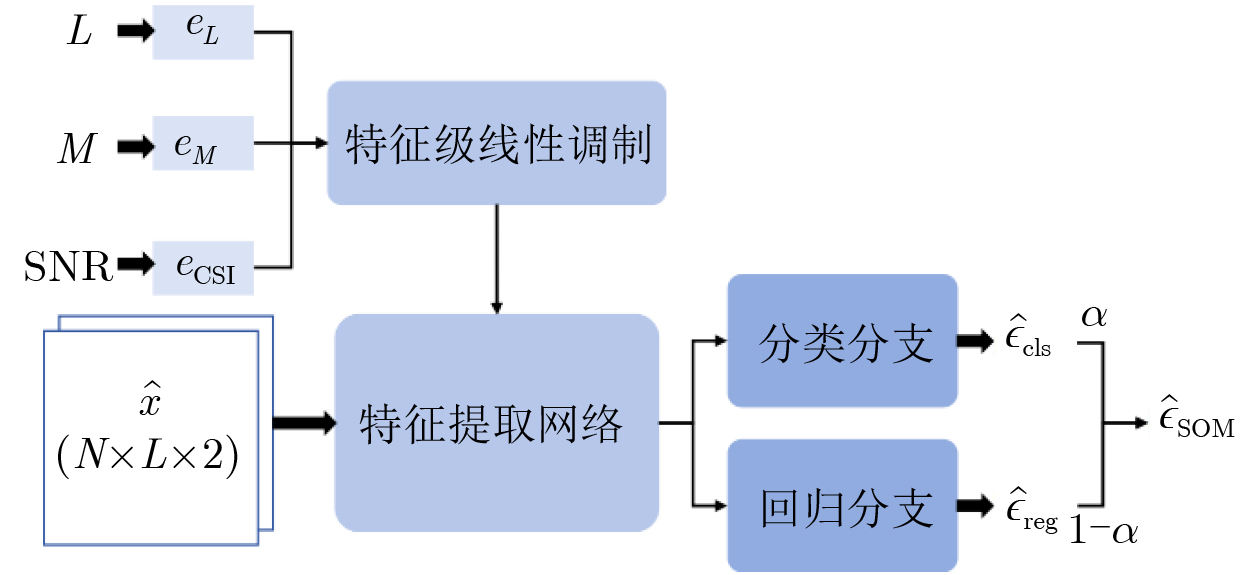
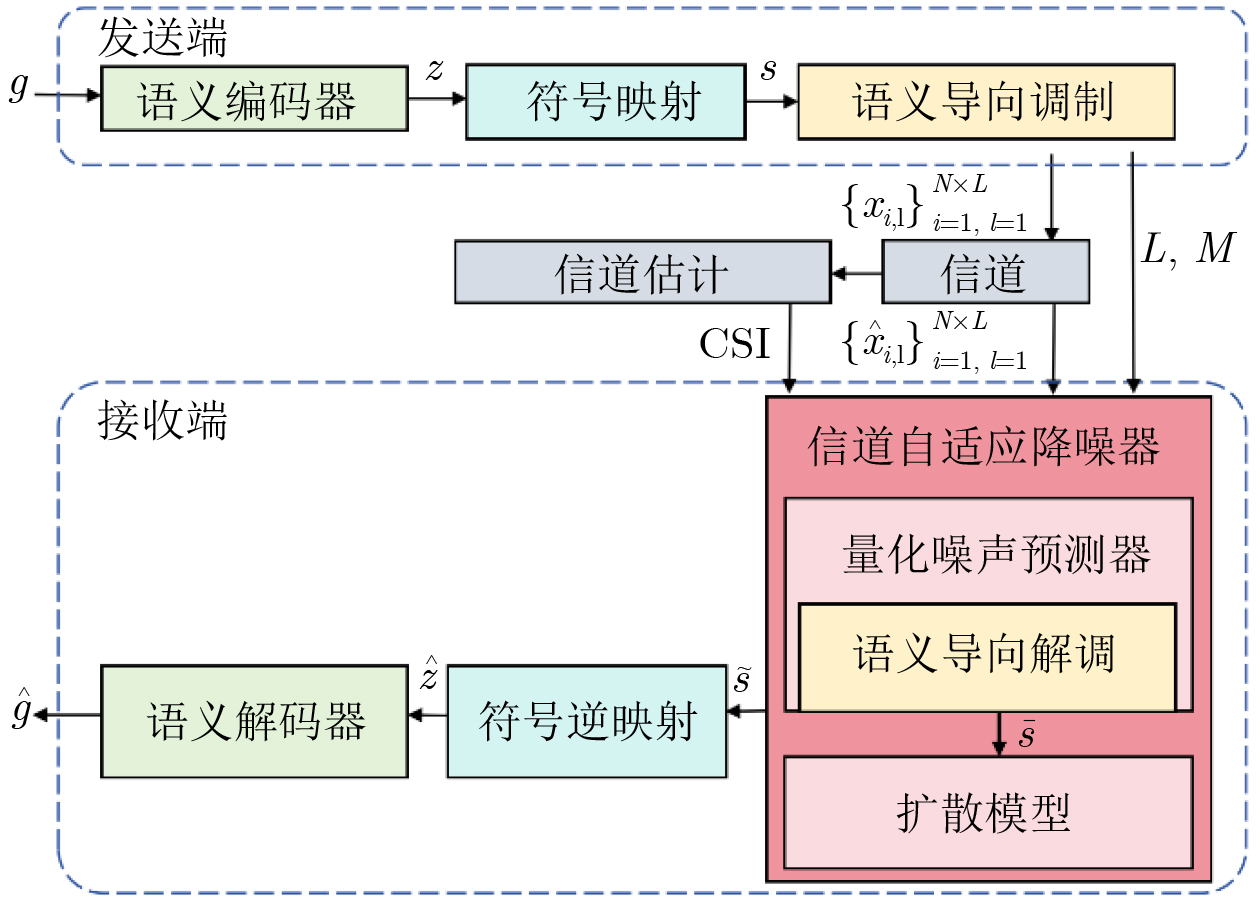
摘要: 语义通信若面向实际系统部署,既需要与现有数字调制体制适配,又需要适应不同信道条件下的传输需求。语义导向调制(Semantic-Oriented Modulation, SOM)能够将连续语义特征映射为分层数字星座符号,但其离散映射与分层量化过程会引入结构化非高斯失真,从而增加数字语义接收端的恢复难度。针对该问题,该文提出一种面向数字语义通信的信道自适应降噪器。该方法由量化噪声预测器(Quantization Noise Predictor, QNP)和扩散恢复模块构成。其中,QNP对SOM引入的结构化量化失真进行前置补偿,扩散模块依据接收信噪比自适应选择降噪步数,对补偿后的语义表示进行进一步恢复。QNP采用分类分支与回归分支相结合的双分支结构,通过特征级线性调制融合SOM参数与信道状态,并在损失函数中引入分布约束项以改善补偿后残差的统计特性。实验结果表明,QNP单独使用可以稳定改善数字语义恢复性能,在不同信道条件下相较于未使用QNP的基线平均提升1.77 dB的PSNR和26.08%的MS-SSIM。在此基础上,与扩散恢复联合后可进一步获得最优效果,相较于未降噪的SOM数字语义基线和仅采用扩散降噪的SOM数字语义基线,PSNR和MS-SSIM平均分别提升3.67 dB、58.79%以及1.89 dB、18.64%。该文结果表明,所提方法能够在保持数字通信体制兼容性的前提下有效缓解SOM结构化失真对后续恢复的不利影响,从而提升数字语义通信系统的恢复性能与信道自适应能力。Abstract:
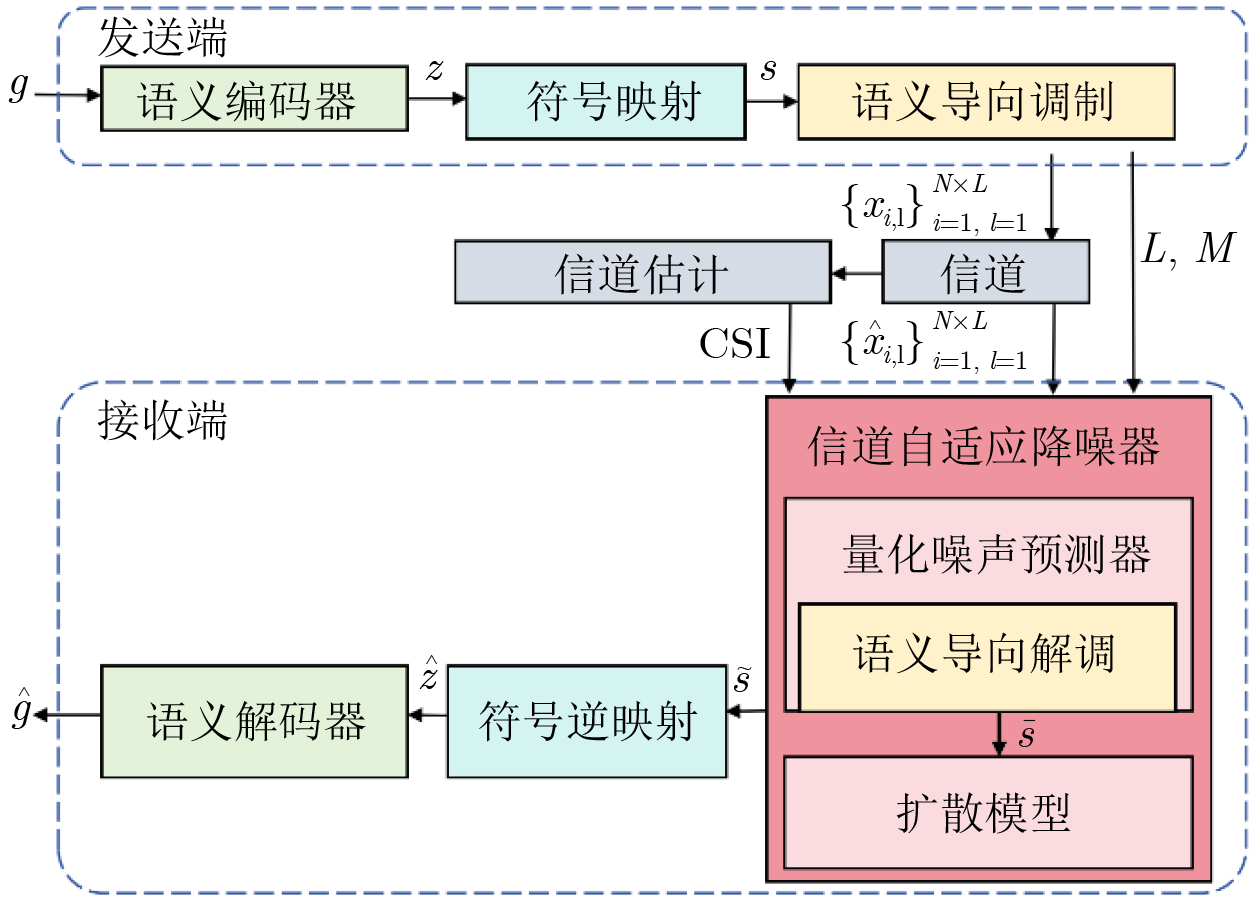
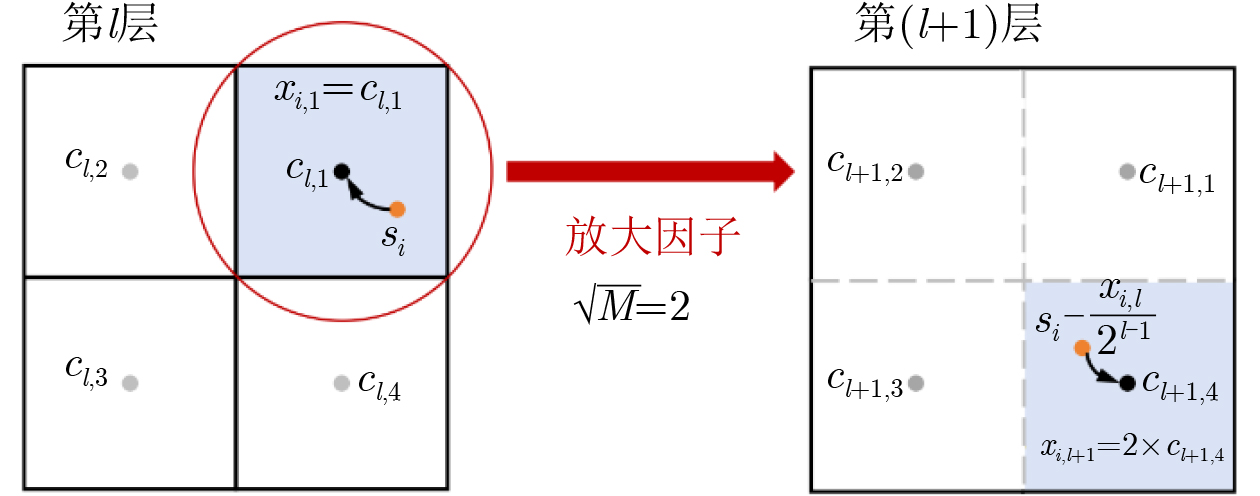
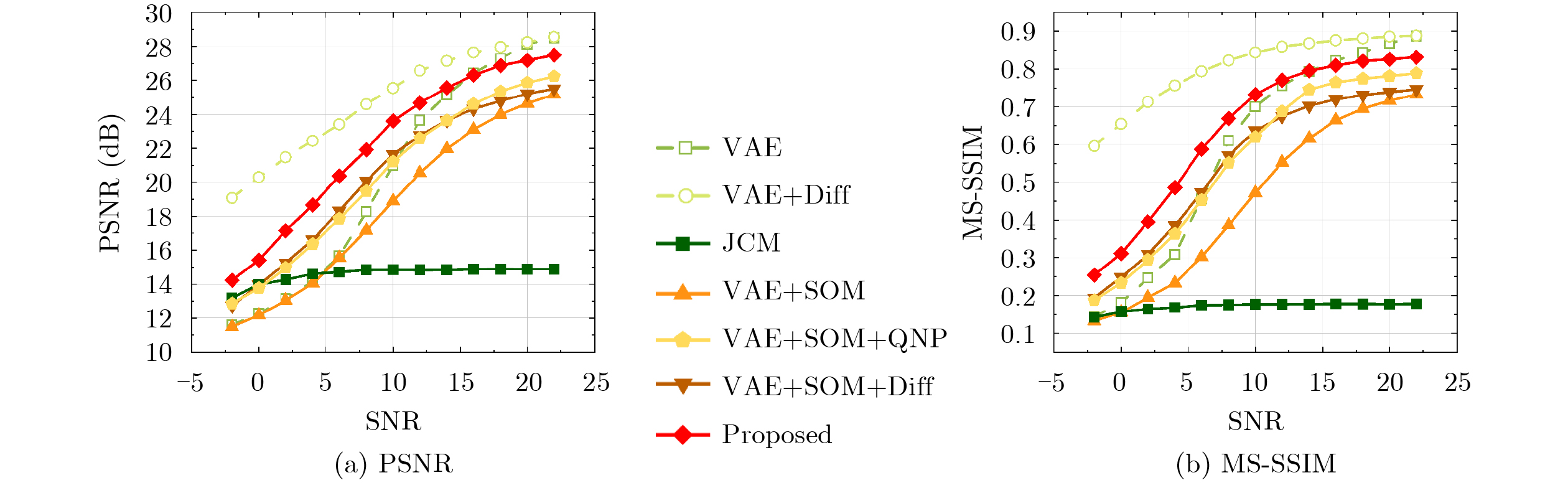
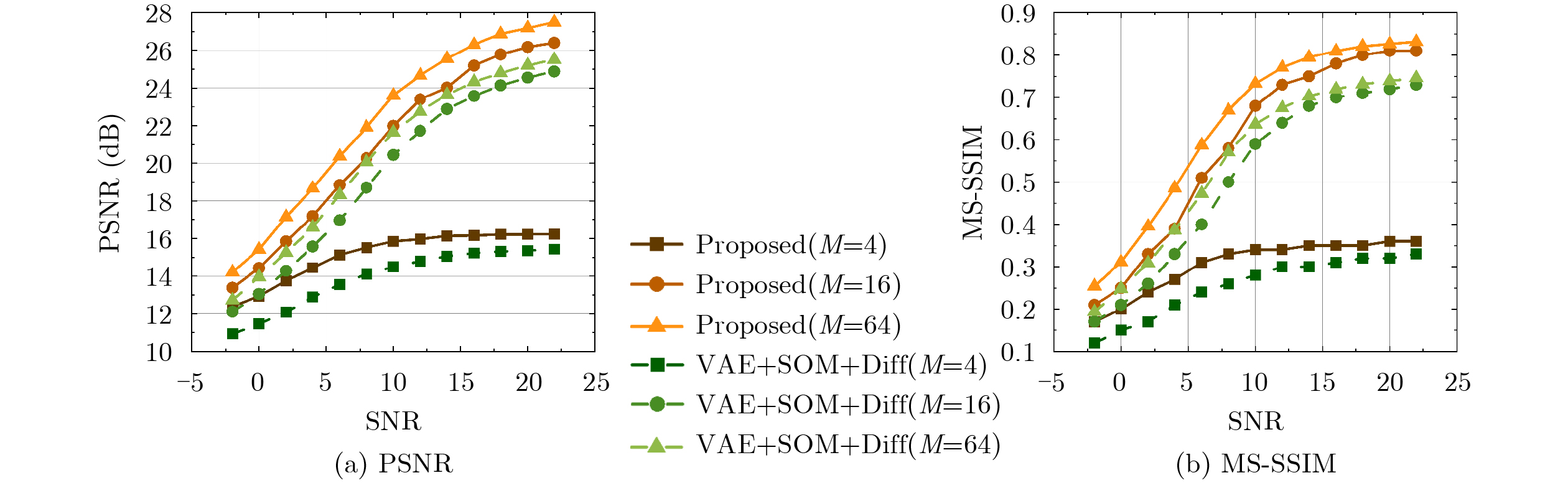
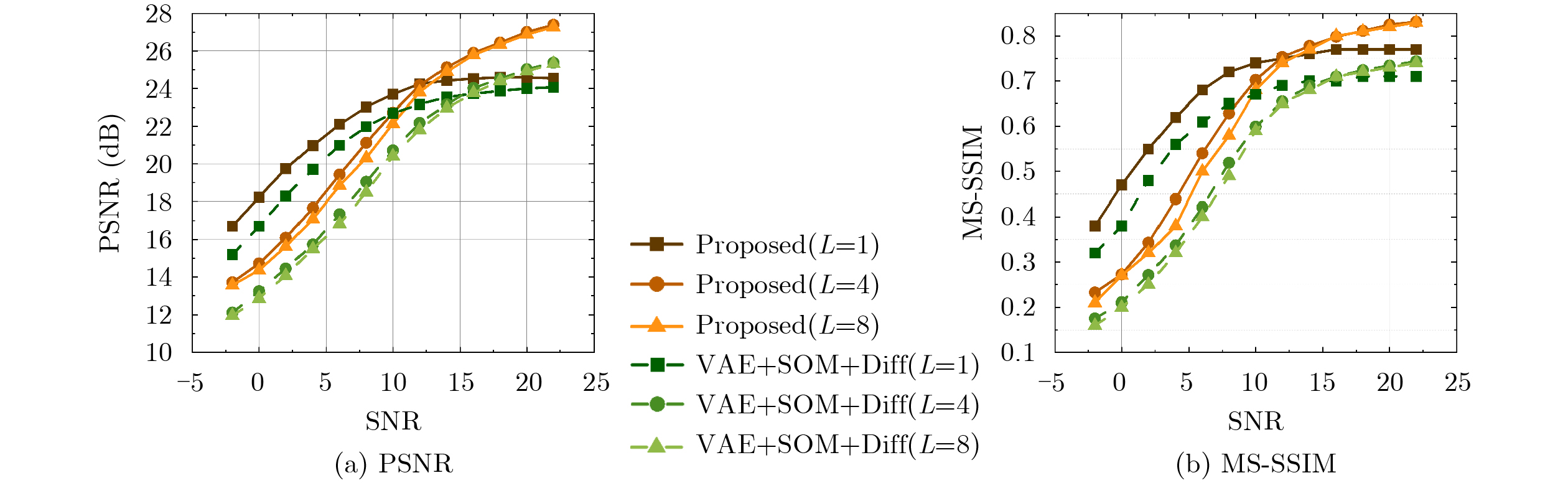
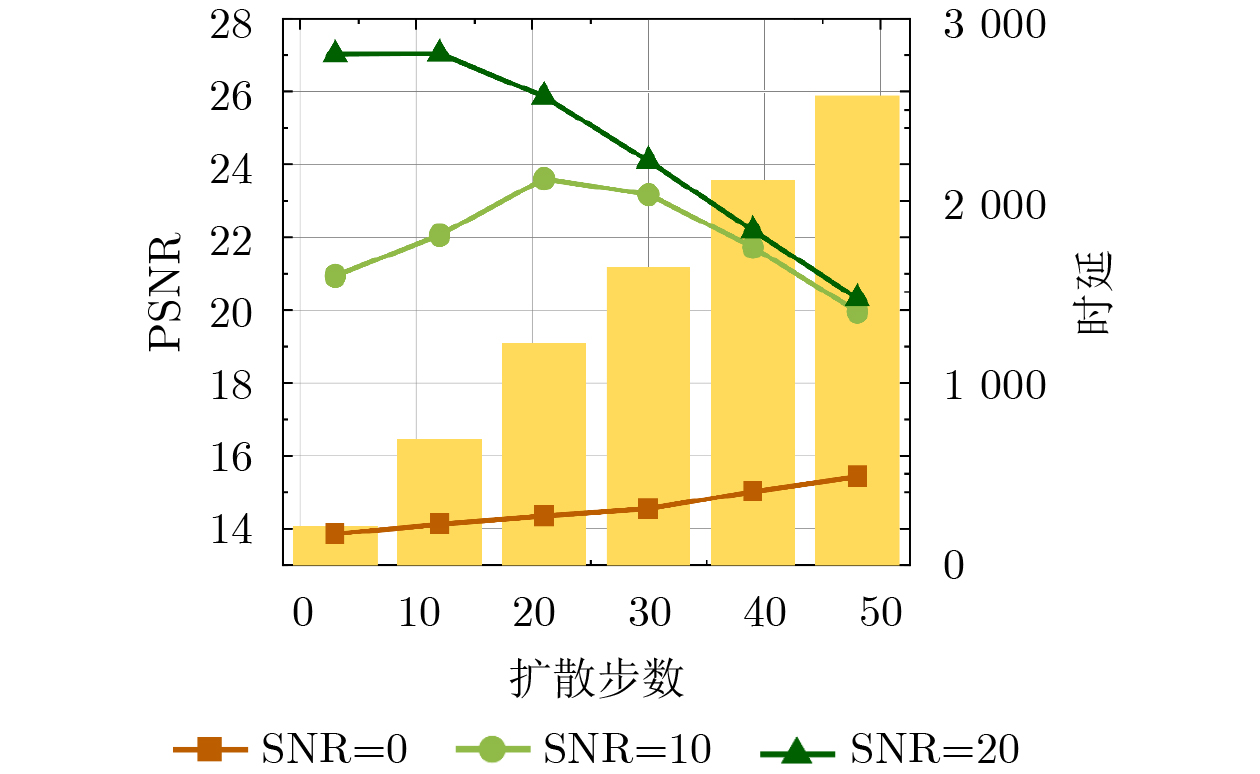
Objective Practical semantic communication should simultaneously satisfy two requirements: compatibility with existing digital communication infrastructures and robustness under varying channel conditions. Semantic-oriented modulation (SOM) provides a feasible way to map continuous semantic features into layered digital constellation symbols, thereby making semantic transmission compatible with conventional digital systems. However, the digitization process also introduces structured quantization distortion, which makes receiver-side recovery more difficult than in continuous semantic transmission. Although diffusion models have shown strong capability in channel-adaptive semantic recovery, directly applying them to SOM-based digital semantic communication is still limited by the structured distortion introduced by SOM. Therefore, this paper focuses on channel-adaptive receiver design for digital semantic communication and investigates how to compensate SOM-induced structured distortion before subsequent recovery. Methods An SOM-based digital semantic communication system for image transmission over an additive white Gaussian noise (AWGN) channel is considered. The proposed receiver adopts a two-stage structure composed of a Quantization Noise Predictor (QNP) and a diffusion recovery module. In the first stage, QNP estimates and compensates the structured quantization distortion introduced by SOM from the layer-wise soft received symbols. In the second stage, the compensated semantic representation is further refined by a diffusion denoiser, whose inference step number is adaptively selected according to the estimated signal-to-noise ratio (SNR). The QNP includes a shared feature extraction frontend, a classification branch exploiting discrete SOM constellation priors, and a regression branch performing fine-grained continuous distortion compensation. A Feature-wise Linear Modulation (FiLM) mechanism is used to incorporate SOM parameters and channel-state information, so that the same QNP can adapt to different modulation configurations and channel conditions. In addition, a composite loss with classification loss, regression loss, and distribution regularization is designed to improve the statistical properties of the compensated residual noise. Results and Discussions Experiments are conducted on the CLIC dataset using PSNR and MS-SSIM. First, the proposed method is compared with VAE, VAE+Diff, VAE+SOM, VAE+SOM+QNP, VAE+SOM+Diff, and JCM. The results show that direct SOM-based digitization causes noticeable performance degradation, while the proposed method consistently improves reconstruction quality over digital semantic baselines. In particular, QNP alone already provides stable gains over the SOM-only receiver, indicating that its effectiveness does not rely on diffusion recovery itself. Moreover, VAE+SOM+QNP achieves performance close to VAE+SOM+Diff while requiring much lower computational cost, and combining QNP with diffusion yields the best overall performance. Second, two training strategies, namely independent QNP training and diffusion-assisted fine-tuning, are compared. The results show that diffusion-assisted fine-tuning provides only limited additional gains but significantly increases training cost and complexity, so independent training offers a more practical balance. Third, experiments under different SOM configurations and different SNR conditions verify that QNP provides stable gains across different modulation orders and SOM layer settings. Latency analysis further shows that QNP introduces only a small fixed overhead, whereas the diffusion module dominates the total inference time; therefore, the adaptive diffusion-step schedule is selected according to the measured latency-PSNR trade-off. Fourth, Gaussianity analysis based on the Kullback-Leibler divergence and Wasserstein distance shows that QNP compensation significantly improves the Gaussianity of the residual noise, while the version with distribution regularization achieves the best statistical consistency. Conclusions This paper proposes a channel-adaptive receiver for digital semantic communication, in which QNP-based front-end compensation is combined with diffusion-based semantic recovery. The main contribution lies in introducing a lightweight and independently effective QNP module to compensate SOM-induced structured quantization distortion before subsequent recovery. Experimental results show that QNP alone can already stably improve digital semantic reconstruction under different SNR conditions and different SOM configurations, while its combination with diffusion recovery yields the best overall performance. Therefore, the proposed method provides an effective way to improve semantic reconstruction quality and channel adaptability while preserving compatibility with existing digital communication infrastructures. -
表 2 不同训练策略的性能与代价比较
SNR(dB) PSNR(dB) MS-SSIM 独立训练 扩散辅助微调 独立训练 扩散辅助微调 0 15.42 15.95 0.3110 0.3205 5 20.37 21.29 0.5874 0.6082 10 23.62 24.65 0.7327 0.7635 15 26.31 27.43 0.8094 0.8406 20 27.18 27.71 0.8263 0.8415  下载: 导出CSV
表 3 不同QNP分支在CLIC测试集上的消融结果
SNR(dB) PSNR(dB) MS-SSIM 分类分支
融合权重$ \overline{\alpha } $分类分支 回归分支 所提QNP 分类分支 回归分支 所提QNP 0 16.00 9.24 15.41 0.449 0.210 0.280 0.006785 5 16.00 17.18 18.23 0.453 0.540 0.550 0.009261 10 16.00 21.73 22.16 0.455 0.720 0.740 0.013954 15 15.99 23.42 24.61 0.455 0.760 0.800 0.029668 20 15.98 25.86 27.18 0.455 0.810 0.870 0.048284
下载: 导出CSV
表 4 QNP补偿前后残余噪声与高斯分布的距离
SNR(dB) KL散度 Wasserstein距离 补偿前
(×10–5)有正则QNP
(×10–5)无正则QNP
(×10–5)补偿前
(×10–3)有正则QNP
(×10–3)不带正则QNP
(×10–3)0 198.1 6.5 6.8 12.8 0.64 5.01 5 299.5 0.6 1.9 53.2 0.40 1.97 10 420.4 0.3 7.0 26.2 0.30 3.82 15 487.8 0.4 14.4 51.4 0.26 6.85 20 652.4 0.5 17.2 83.9 0.25 8.67
下载: 导出CSV
-
[1] SHI Guangming, XIAO Yong, LI Yingyu, et al. From semantic communication to semantic-aware networking: Model, architecture, and open problems[J]. IEEE Communications Magazine, 2021, 59(8): 44–50. doi: 10.1109/MCOM.001.2001239. [2] GÜLER B, YENER A, and SWAMI A. The semantic communication game[J]. IEEE Transactions on Cognitive Communications and Networking, 2018, 4(4): 787–802. doi: 10.1109/TCCN.2018.2872596. [3] LI Yihao, ZHOU Fuhui, YUAN Lu, et al. Cognitive semantic communication: A new communication paradigm for 6G[J]. IEEE Communications Magazine, 2025, 63(6): 122–129. doi: 10.1109/MCOM.005.2400366. [4] SAGDUYU Y E, ERPEK T, YENER A, et al. Will 6G be semantic communications? Opportunities and challenges from task oriented and secure communications to integrated sensing[J]. IEEE Network, 2024, 38(6): 72–80. doi: 10.1109/MNET.2024.3425152. [5] 张祖凡, 尹星然, 周建萍, 等. 面向语义重要性和鲁棒性的RIS增强语义通信系统[J]. 电子与信息学报, 2025, 47(8): 2608–2620. doi: 10.11999/JEIT250159.ZHANG Zufan, YIN Xingran, ZHOU Jianping, et al. RIS-enhanced semantic communication systems oriented towards se-mantic importance and robustness[J]. Journal of Electronics & Information Technology, 2025, 47(8): 2608–2620. doi: 10.11999/JEIT250159. [6] 陈阳, 马欢, 姬智, 等. 面向图像恢复任务的语义通信网络能耗优化[J]. 电子与信息学报, 2026, 48(1): 183–190. doi: 10.11999/JEIT250915.CHEN Yang, MA Huan, JI Zhi, et al. Optimization of energy consumption in semantic communication networks for image recovery tasks[J]. Journal of Electronics & Information Technology, 2026, 48(1): 183–190. doi: 10.11999/JEIT250915. [7] 申滨, 李旋, 赖雪冰, 等. 基于Swin Transformer的宽带无线图传语义联合编解码方法[J]. 电子与信息学报, 2025, 47(8): 2665–2674. doi: 10.11999/JEIT250039.SHEN Bin, LI Xuan, LAI Xuebing, et al. Swin Transformer-based wideband wireless image transmission semantic joint encoding and decoding method[J]. Journal of Electronics & Information Technology, 2025, 47(8): 2665–2674. doi: 10.11999/JEIT250039. [8] BOURTSOULATZE E, KURKA D B, and GÜNDÜZ D. Deep joint source-channel coding for wireless image transmission[J]. IEEE Transactions on Cognitive Communications and Networking, 2019, 5(3): 567–579. doi: 10.1109/TCCN.2019.2919300. [9] KURKA D B and GÜNDÜZ D. DeepJSCC-f: Deep joint source-channel coding of images with feedback[J]. IEEE Journal on Selected Areas in Information Theory, 2020, 1(1): 178–193. doi: 10.1109/JSAIT.2020.2987203. [10] BO Yufei, DUAN Yiheng, SHAO Shuo, et al. Joint coding-modulation for digital semantic communications via variational autoencoder[J]. IEEE Transactions on Communications, 2024, 72(9): 5626–5640. doi: 10.1109/TCOMM.2024.3386577. [11] GUO Lei, CHEN Wei, SUN Yuxuan, et al. Diffusion-driven semantic communication for generative models with bandwidth constraints[J]. IEEE Transactions on Wireless Communications, 2025, 24(8): 6490–6503. doi: 10.1109/TWC.2025.3553851. [12] SONG Mengshu, MA Nan, DONG Chen, et al. Deep joint source-channel coding for wireless image transmission with adaptive models[J]. Electronics, 2023, 12(22): 4637. doi: 10.3390/electronics12224637. [13] CHEN Weixuan, CHEN Yuhao, YANG Qianqian, et al. Deep joint source-channel coding for wireless image transmission with entropy-aware adaptive rate control[C]. GLOBECOM 2023-2023 IEEE Global Communications Conference, Kuala Lumpur, Malaysia, 2023: 2239–2244. doi: 10.1109/GLOBECOM54140.2023.10437482. [14] WANG Yangfan, ZHANG Xuefei, SUN Yao, et al. Semantic-oriented modulation for wireless communication[J]. IEEE Internet of Things Journal, 2025, 12(14): 28259–28273. doi: 10.1109/JIOT.2025.3565017. [15] 宋淼, 陈志强, 王培松, 等. DetDiffRS: 面向细节优化的遥感图像超分辨率扩散模型[J]. 电子与信息学报, 2025, 47(12): 4763–4778. doi: 10.11999/JEIT250995.SONG Miao, CHEN Zhiqiang, WANG Peisong, et al. DetDiffRS: A detail-enhanced diffusion model for remote sensing image super-resolution[J]. Journal of Electronics & Information Technology, 2025, 47(12): 4763–4778. doi: 10.11999/JEIT250995. [16] XU Bingxuan, MENG Rui, CHEN Yue, et al. Latent semantic diffusion-based channel adaptive de-noising SemCom for future 6G systems[C]. GLOBECOM 2023-2023 IEEE Global Communications Conference, Kuala Lumpur, Malaysia, 2023: 1229–1234. doi: 10.1109/GLOBECOM54140.2023.10437849. [17] WU Tong, CHEN Zhiyong, HE Dazhi, et al. CDDM: Channel denoising diffusion models for wireless semantic communications[J]. IEEE Transactions on Wireless Communications, 2024, 23(9): 11168–11183. doi: 10.1109/TWC.2024.3379244. [18] HO J, JAIN A, and ABBEEL P. Denoising diffusion probabilistic models[C]. Proceedings of the 34th International Conference on Neural Information Processing Systems, Vancouver, Canada, 2020: 574. [19] ROMBACH R, BLATTMANN A, LORENZ D, et al. High-resolution image synthesis with latent diffusion models[C]. 2022 IEEE/CVF Conference on Computer Vision and Pattern Recognition (CVPR), New Orleans, USA, 2022: 10674–10685. doi: 10.1109/CVPR52688.2022.01042. [20] PEREZ E, STRUB F, DE VRIES H, et al. FiLM: Visual reasoning with a general conditioning layer[C]. Proceedings of the 32nd AAAI Conference on Artificial Intelligence, New Orleans, USA, 2018: 3942–3951. doi: 10.1609/aaai.v32i1.11671. [21] QIAO Li, MASHHADI M B, GAO Zhen, et al. Latency-aware generative semantic communications with pre-trained diffusion models[J]. IEEE Wireless Communications Letters, 2024, 13(10): 2652–2656. doi: 10.1109/LWC.2024.3429295. -

 下载:
下载:

图(7) / 表(4)
计量
- 文章访问数: 15
- HTML全文浏览量: 3
- PDF下载量: 0
- 被引次数: 0
