




A Survey of Quantum Covert Communication Integration Schemes and Application Scenarios
-
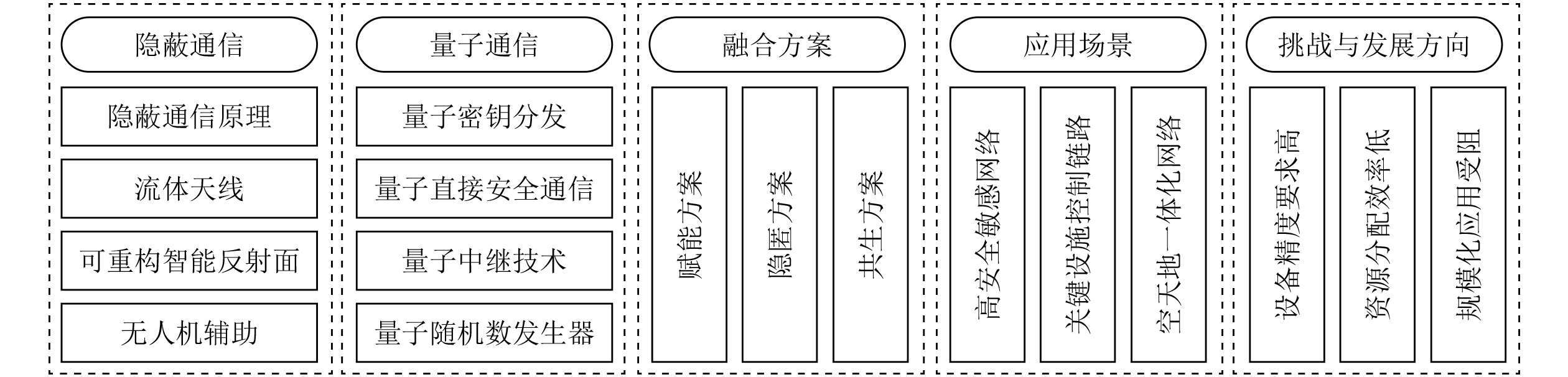
摘要: 随着通信网络安全需求的日益增长,隐蔽通信和量子通信领域技术研发不断演进。然而,当前隐蔽通信仍存在内生安全漏洞与信息泄露风险,且量子通信易受窃听干扰导致传输可靠性受限。因此,兼顾通信行为隐蔽与无条件安全的量子隐蔽通信成为近期研究热点。基于此,该文聚焦于量子隐蔽通信融合方案及应用场景展开综述。首先,介绍了隐蔽通信的原理与典型赋能技术。其次,介绍了量子通信协议与重要技术。进而,针对不同应用场景归纳出三类量子隐蔽通信融合方案:赋能融合方案、隐匿融合方案、共生融合方案。最后,提出了量子隐蔽通信的现有挑战与发展方向。该文对量子隐蔽通信的进一步发展,具有一定的推动作用与参考价值。Abstract:
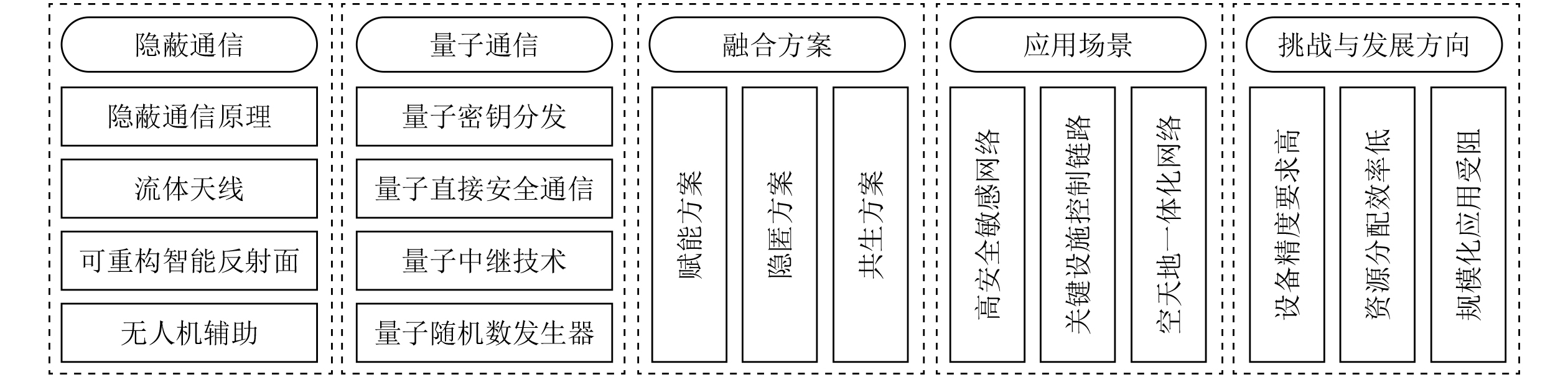
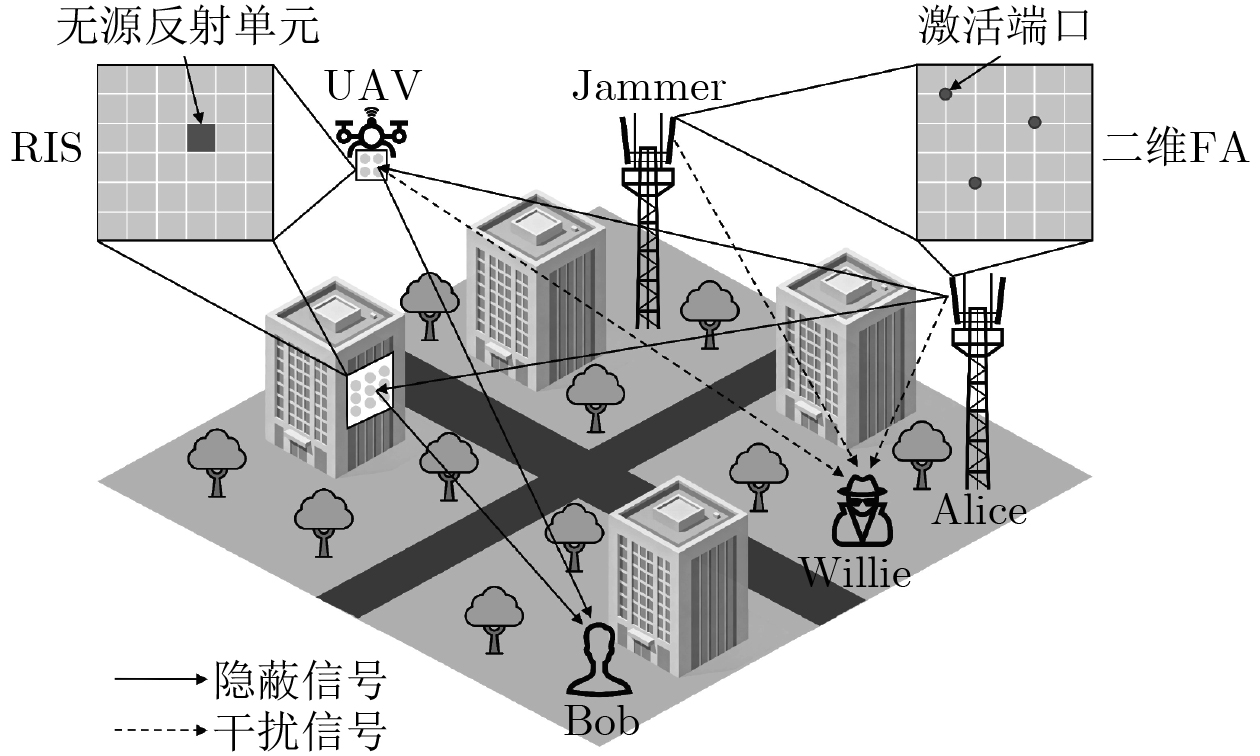
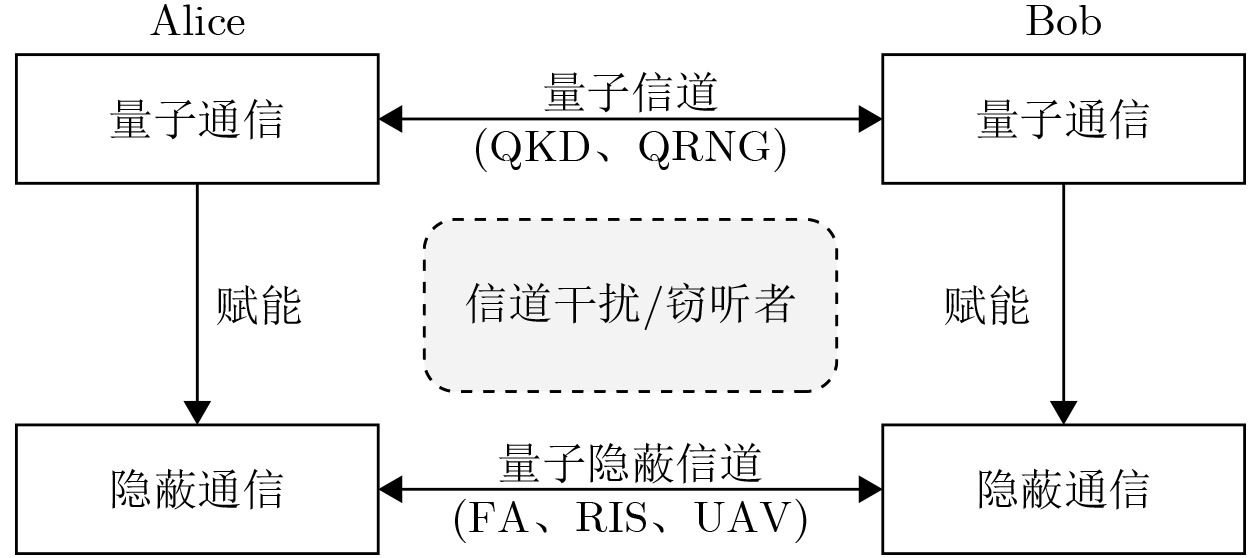
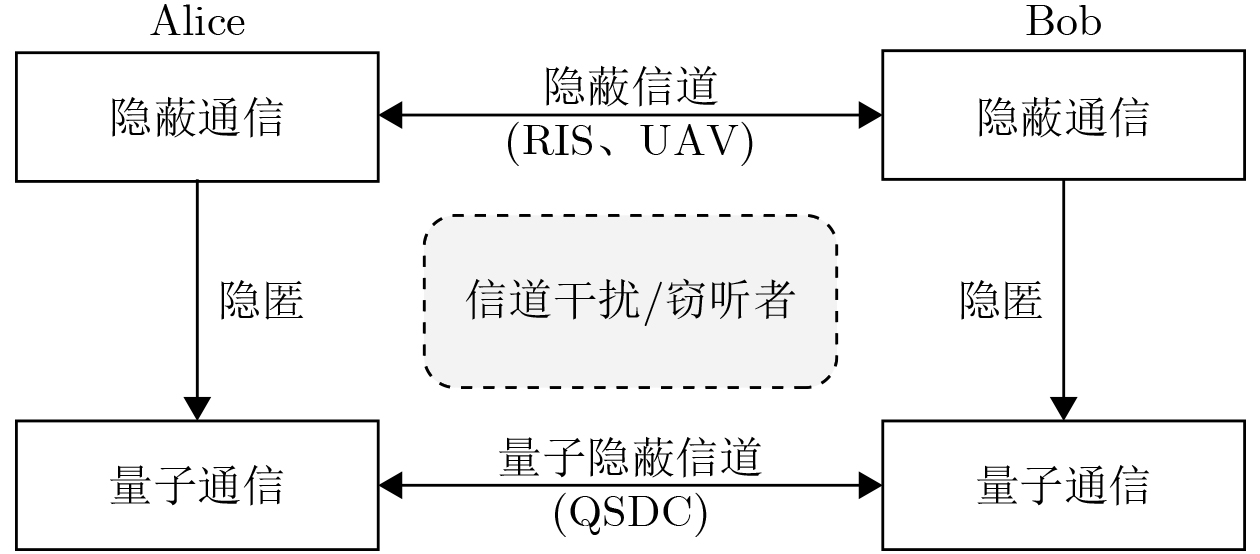
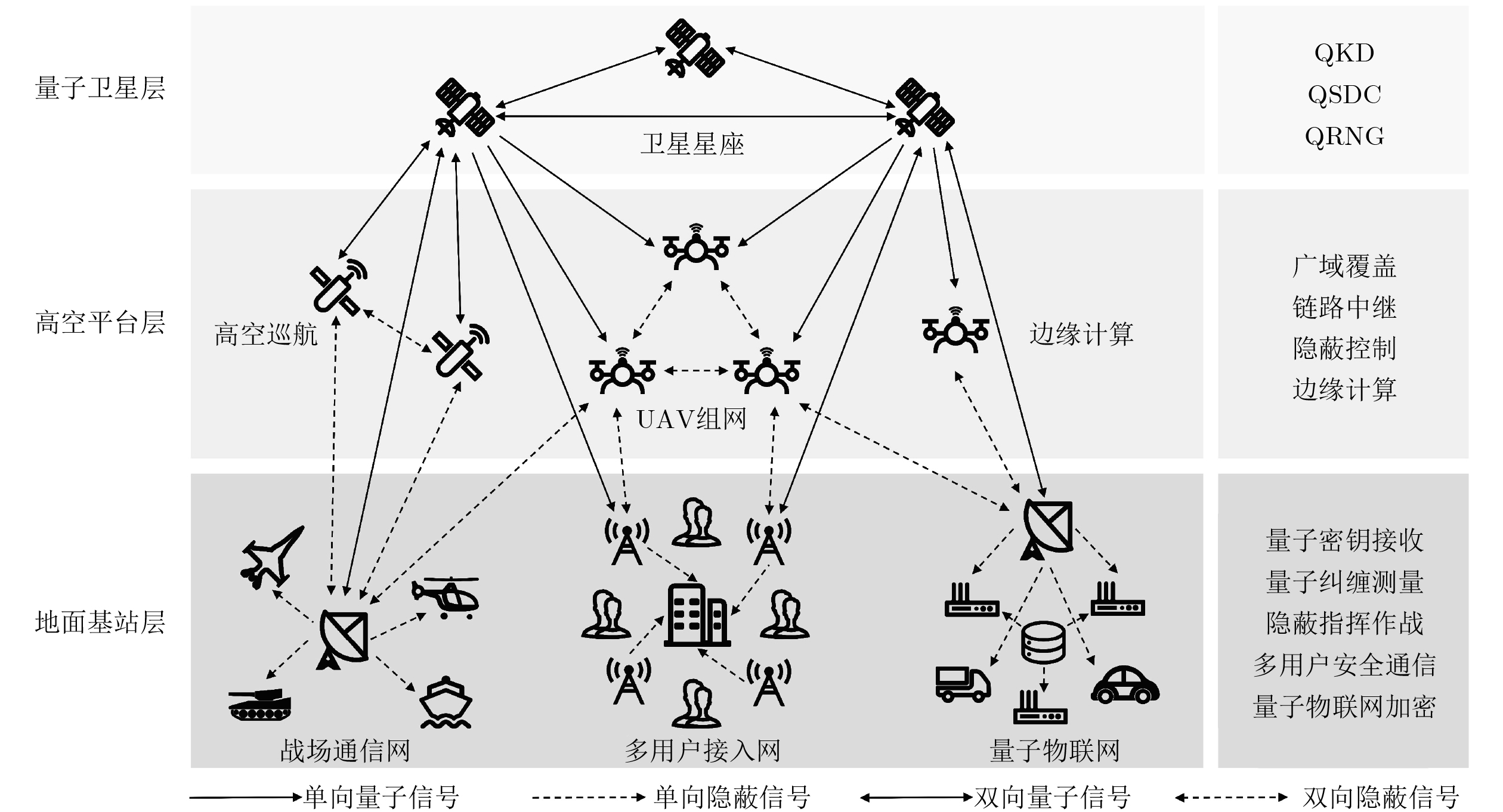
Significance With the growing demand for network communication security, research and development in covert communication and quantum communication have continued to evolve. However, current covert communication suffers from inherent security vulnerabilities; the transmission reliability of quantum communication has been limited by information eavesdropping and harmful interference. Therefore, quantum covert communication has become a research hotspot, integrating the advantages of both covert and quantum communication while addressing their respective security limitations. To this end, this paper provides a comprehensive survey of quantum covert communication integration schemes and application scenarios, including the principles of covert communication and typical enabling techniques; protocols for quantum communication and important quantum techniques; and three types of quantum covert communication integration schemes summarized by different application scenarios. This paper contributes to the design of advanced secure communication networks while offering guidance for the development of future quantum covert communication systems. Progress This paper presents a comprehensive survey of recent advances in quantum covert communication integration schemes and application scenarios, with an in-depth discussion of the principles of covert communication and key enabling techniques, such as Fluid Antenna (FA), Reconfigurable Intelligent Surface (RIS), and Unmanned Aerial Vehicle (UAV). FA actively reshapes wireless channel characteristics, particularly the spatial correlation of multipath components, by dynamically adjusting the transmitter physical configuration, thereby reducing information leakage. In Non-Line-of-Sight (NLoS) scenarios, RIS can dynamically alter the direction of reflected transmission of the incident signal, not only enhancing the Channel State Information (CSI) quality of the covert signal but also reducing signal leakage. In flexible or temporary communication networks, UAVs can increase CSI uncertainty, preventing unauthorized users from establishing a stable monitoring model and thereby complicating eavesdropping. Then, key protocols and significant techniques of quantum communication are introduced, including BB84, B92, and E91 for Quantum Key Distribution (QKD), and BF02, Two-Step for Quantum Secure Direct Communication (QSDC). Additionally, the quantum repeaters and Quantum Random Number Generator (QRNG) are reviewed. Based on different application scenarios, quantum covert communication integration schemes can be categorized into enabling, covert, and symbiotic integration schemes, depending on the integration mechanisms. To be specific, the enabling integration scheme leverages the unconditional security of quantum communication to address the security vulnerabilities in covert communication, the covert integration scheme utilizes enabling techniques in covert communication to reduce the detection probability of quantum communication, and the symbiotic integration scheme combines both advantages of covert communication and quantum communication to achieve mutual empowerment and deep symbiosis. Finally, critical challenges are highlighted, including stringent hardware precision requirements, low resource allocation efficiency, and obstacles in large-scale applications. Promising directions for future research are also identified, including R&D on precision communication equipment, dynamic resource management, cost control during deployment, and the promotion of standardized development. Prospects Despite remarkable progress in preliminary applications and specific scenarios, research on quantum covert communication remains in its infancy. As quantum covert communication scenarios become increasingly diverse and complex, future studies should prioritize challenges that restrict further development and large-scale application of quantum covert communication. The stringent hardware precision requirements are the primary challenge, limiting reliable transmission distance and stability. Low resource allocation efficiency is another challenge, as the quantum covert communication system that generates quantum entanglement over lossy channels remains subject to the Square Root Law (SRL) constraints, while signal transmission exhibits burstiness and dynamics. Additionally, high deployment costs and the lack of standardization present significant hurdles. To address the challenges mentioned, future directions should include R&D on precision communication equipment, dynamic resource management, cost control during deployment, and the promotion of standardized development to facilitate the development of high-performance, large-scale, and multi-scenario quantum covert communication. Conclusions This paper provides a comprehensive survey of quantum covert communication with particular emphasis on integration schemes and application scenarios. The fundamentals and typical enabling techniques of covert communication are first reviewed, highlighting its Low Probability of Detection (LPD) secure paradigm and unique channel characteristics. The typical protocols and important techniques of quantum communication are then examined, including QKD, QSDC, quantum repeaters, and QRNG. Three types of quantum covert communication integration schemes have been further classified by different integration mechanisms and corresponding application scenarios. Finally, several existing challenges are identified, including stringent hardware precision requirements, low resource allocation efficiency, and obstacles to large-scale applications. Relevant research directions are also outlined, including R&D on precision communication equipment, dynamic resource management, cost control during deployment, and the promotion of standardized development. These directions are expected to serve as a valuable reference for advancing and standardizing quantum covert communication in future secure networks. -
表 1 隐蔽通信的典型赋能技术对比
赋能技术 部署环境 通信距离 应用场景 优势 劣势 FA 发送端天线 0.01~0.1 km 短距离通信 空间自由度高 切换延迟较高 RIS 无线信道中继 0.1~10 km NLOS链路 可控性强、部署灵活 CSI获取困难 UAV 空中无线信道中继 0.1~10 km 临时网络覆盖、信号中继 机动性强 续航有限、计算困难  下载: 导出CSV
表 2 量子通信典型协议对比
典型协议 协议类型 实现原理 优势 劣势 BB84 QKD 基于单量子偏振态的非正交编码 成熟度高 密钥生成效率低 B92 QKD 基于两个非正交量子偏振态 实现简单 密钥生成效率低 E91 QKD 基于量子纠缠原理 具有源无关安全性 纠缠源纯度要求高 BF02(乒乓协议) QSDC 单光子往返、进行交替模式通信 预防前向泄露 抗干扰弱、同步性要求高 Two-Step QSDC 先发校验序列,后发编码消息序列 具有高容量通信潜力 高度依赖量子存储技术
下载: 导出CSV
表 3 融合方案及应用场景对比
类型 融合机制 应用场景 赋能融合方案 利用量子通信的无条件安全性来弥补隐蔽通信的安全漏洞 高安全敏感网络、量子物联网等 隐匿融合方案 利用隐蔽通信的赋能技术来降低量子通信行为的暴露概率 金融交易、智能电网等 共生融合方案 量子无条件安全与隐蔽行为共生,兼顾信息安全与行为隐藏 空天地一体化量子隐蔽通信网等
下载: 导出CSV
-
[1] NGO Q T, TANG Z F, JAYAWICKRAMA B, et al. Timeliness of information in 5G nonterrestrial networks: A survey[J]. IEEE Internet of Things Journal, 2024, 11(21): 34652–34675. doi: 10.1109/JIOT.2024.3407105. [2] FANYUAN Guanjie. High-secure quantum communication and networks[C]. 2024 IEEE Opto-Electronics and Communications Conference (OECC), Melbourne, Australia, 2024: 1–3. doi: 10.1109/OECC54135.2024.10975607. [3] SHIM K S, KIM B, and LEE W. Research on quantum key, distribution key and post-quantum cryptography key applied protocols for data science and web security[J]. Journal of Web Engineering, 2024, 23(6): 813–830. doi: 10.13052/jwe1540-9589.2365. [4] TAHMASBI M and BLOCH M R. Covert and secret key expansion over quantum channels under collective attacks[J]. IEEE Transactions on Information Theory, 2020, 66(11): 7113–7131. doi: 10.1109/TIT.2020.3021595. [5] CHEN Xinying, AN Jianping, XIONG Zehui, et al. Covert communications: A comprehensive survey[J]. IEEE Communications Surveys & Tutorials, 2023, 25(2): 1173–1198. doi: 10.1109/COMST.2023.3263921. [6] HUANG Kewen, WANG Huiming, TOWSLEY D, et al. LPD communication: A sequential change-point detection perspective[J]. IEEE Transactions on Communications, 2020, 68(4): 2474–2490. doi: 10.1109/TCOMM.2020.2969416. [7] YAN Shihao, ZHOU Xiangyun, HU Jinsong, et al. Low probability of detection communication: Opportunities and challenges[J]. IEEE Wireless Communications, 2019, 26(5): 19–25. doi: 10.1109/MWC.001.1900057. [8] HUANG Kewen, WANG Huiming, and POOR H V. On covert communication against sequential change-point detection[J]. IEEE Transactions on Information Theory, 2021, 67(11): 7285–7303. doi: 10.1109/TIT.2021.3104601. [9] LV Lu, WU Qingqing, LI Zan, et al. Covert communication in intelligent reflecting surface-assisted NOMA systems: Design, analysis, and optimization[J]. IEEE Transactions on Wireless Communications, 2022, 21(3): 1735–1750. doi: 10.1109/TWC.2021.3106346. [10] XU Yongjun, GUI Guan, GACANIN H, et al. A survey on resource allocation for 5G heterogeneous networks: Current research, future trends, and challenges[J]. IEEE Communications Surveys & Tutorials, 2021, 23(2): 668–695. doi: 10.1109/COMST.2021.3059896. [11] HU Jinsong, JI Mingfeng, WANG Yida, et al. Movable antennas with full-duplex receiver for covert communication[J]. IEEE Transactions on Wireless Communications, 2026, 25: 10589–10603. doi: 10.1109/TWC.2026.3655004. [12] 徐勇军, 邱友静, 张海波. 智能反射面辅助的环境反向散射通信系统信道估计算法研究[J]. 电子与信息学报, 2025, 47(1): 75–83. doi: 10.11999/JEIT240395.XU Yongjun, QIU Youjing, and ZHANG Haibo. Channel estimation for intelligent reflecting surface assisted ambient backscatter communication systems[J]. Journal of Electronics & Information Technology, 2025, 47(1): 75–83. doi: 10.11999/JEIT240395. [13] ZHOU Yi, PAN Cunhua, YEOH P L, et al. Secure communications for UAV-enabled mobile edge computing systems[J]. IEEE Transactions on Communications, 2020, 68(1): 376–388. doi: 10.1109/TCOMM.2019.2947921. [14] SOBERS T V, BASH B A, GUHA S, et al. Covert communication in the presence of an uninformed jammer[J]. IEEE Transactions on Wireless Communications, 2017, 16(9): 6193–6206. doi: 10.1109/TWC.2017.2720736. [15] ZHANG Junyao, LI Xingwang, LEI Xianfu, et al. Covertness performance analysis of STAR-RIS assisted HARQ-RSMA networks[J]. IEEE Transactions on Vehicular Technology, 2026, 75(5): 8777–8782. doi: 10.1109/TVT.2025.3628134. [16] ZHAO Jingwei, LI Geng, CHEN Gaojie, et al. Covert communication of IRS-assisted wireless networks with stochastic geometry approach[J]. IEEE Wireless Communications Letters, 2024, 13(4): 974–978. doi: 10.1109/LWC.2024.3354992. [17] 徐勇军, 高正念, 王茜竹, 等. 基于智能反射面辅助的无线供电通信网络鲁棒能效最大化算法[J]. 电子与信息学报, 2022, 44(7): 2317–2324. doi: 10.11999/JEIT210714.XU Yongjun, GAO Zhengnian, WANG Qianzhu, et al. Robust energy efficiency maximization algorithm for intelligent reflecting surface-aided wireless powered-communication networks[J]. Journal of Electronics & Information Technology, 2022, 44(7): 2317–2324. doi: 10.11999/JEIT210714. [18] XU Yongjun, XIE Hao, WU Qingqing, et al. Robust max-min energy efficiency for RIS-aided HetNets with distortion noises[J]. IEEE Transactions on Communications, 2022, 70(2): 1457–1471. doi: 10.1109/TCOMM.2022.3141798. [19] 张晓茜, 徐勇军, 吴翠先, 等. 智能反射面增强的全双工环境反向散射通信系统波束成形算法[J]. 电子与信息学报, 2024, 46(3): 914–924. doi: 10.11999/JEIT23035.ZHANG Xiaoxi, XU Yongjun, WU Cuixian, et al. Beamforming design for reconfigurable intelligent surface enhanced full-duplex ambient backscatter communication networks[J]. Journal of Electronics & Information Technology, 2024, 46(3): 914–924. doi: 10.11999/JEIT23035. [20] SI Jiangbo, LI Zan, ZHAO Yan, et al. Covert transmission assisted by intelligent reflecting surface[J]. IEEE Transactions on Communications, 2021, 69(8): 5394–5408. doi: 10.1109/TCOMM.2021.3082779. [21] 徐勇军, 徐然, 周继华, 等. 面向窃听用户的RIS-MISO系统鲁棒资源分配算法[J]. 电子与信息学报, 2022, 44(7): 2253–2263. doi: 10.11999/JEIT211537.XU Yongjun, XU Ran, ZHOU Jihua, et al. Robust resource allocation algorithm for RIS-assisted MISO systems with eavesdroppers[J]. Journal of Electronics & Information Technology, 2022, 44(7): 2253–2263. doi: 10.11999/JEIT211537. [22] TANG Xiao, XIONG Zhihao, DONG Limeng, et al. UAV-enabled aerial active RIS with learning deployment for secured wireless communications[J]. Chinese Journal of Aeronautics, 2025, 38(10): 103383. doi: 10.1016/j.cja.2024.103383. [23] BAI Hengzhi, WANG Haichao, HE Rongrong, et al. Multi-hop UAV relay covert communication: A multi-agent reinforcement learning approach[J]. Chinese Journal of Aeronautics, 2025, 38(10): 103440. doi: 10.1016/j.cja.2025.103440. [24] ANDERSON E J D, BULLOCK M S, ROZPĘDEK F, et al. Achievability of covert quantum communication[C]. 2025 IEEE International Symposium on Information Theory (ISIT), Ann Arbor, USA, 2025: 1–6. doi: 10.1109/ISIT63088.2025.11195542. [25] AL-JAWAHRY H M, SIRI D, DIVYA P, et al. Secure and scalable quantum key distribution protocol for next-generation networks[C]. 2024 International Conference on IoT, Communication and Automation Technology (ICICAT), Gorakhpur, India, 2024: 1001–1005. doi: 10.1109/ICICAT62666.2024.10923380. [26] ALI S and KUNDU N K. Quantum code division multiple access based continuous-variable quantum key distribution[C]. 2025 International Conference on Quantum Communications, Networking, and Computing (QCNC), Nara, Japan, 2025: 633–637. doi: 10.1109/QCNC64685.2025.00105. [27] PAN Yan, WU Mingze, WANG Heng, et al. Long-distance discrete-modulated continuous-variable quantum key distribution over 126.56 km of fiber[C]. 2025 Optical Fiber Communications Conference and Exhibition (OFC), San Francisco, USA, 2025: 1–3. [28] PAN Dong, LONG Guilu, YIN Liuguo, et al. The evolution of quantum secure direct communication: On the road to the qinternet[J]. IEEE Communications Surveys & Tutorials, 2024, 26(3): 1898–1949. doi: 10.1109/COMST.2024.3367535. [29] BENNETT C H and BRASSARD G. Quantum cryptography: Public key distribution and coin tossing[J]. Theoretical Computer Science, 2014, 560: 7–11. doi: 10.1016/j.tcs.2014.05.025. [30] HUANG Jinxiang, WANG Yong, WANG Huadeng, et al. Man-in-the-middle attack on BB84 protocol and its defence[C]. 2009 2nd IEEE International Conference on Computer Science and Information Technology, Beijing, China, 2009: 438–439. doi: 10.1109/ICCSIT.2009.5234678. [31] BENNETT C H. Quantum cryptography using any two nonorthogonal states[J]. Physical Review Letters, 1992, 68(21): 3121–3124. doi: 10.1103/PhysRevLett.68.3121. [32] EKERT A K. Quantum cryptography based on Bell's theorem[J]. Physical Review Letters, 1991, 67(6): 661–663. doi: 10.1103/PhysRevLett.67.661. [33] BOSTRÖM K and FELBINGER T. Deterministic secure direct communication using entanglement[J]. Physical Review Letters, 2002, 89(18): 187902. doi: 10.1103/PhysRevLett.89.187902. [34] DENG Fuguo, LONG Guilu, and LIU Xiaoshu. Two-step quantum direct communication protocol using the Einstein-Podolsky-Rosen pair block[J]. Physical Review A, 2003, 68(4): 042317. doi: 10.1103/PhysRevA.68.042317. [35] BENCHASATTABUSE N, HAJDUŠEK M, and VAN METER R. Architecture and protocols for all-photonic quantum repeaters[C]. 2024 IEEE International Conference on Quantum Computing and Engineering (QCE), Montreal, Canada, 2024: 1879–1889. doi: 10.1109/QCE60285.2024.00217. [36] 于景春, 芦文斌, 陈宾, 等. 光子集成的量子密钥分发和量子随机数生成器研究进展[J]. 物理学报, 2025, 74(16): 160304. doi: 10.7498/aps.74.20250791.YU Jingchun, LU Wenbin, CHEN Bin, et al. Recent progress on photon-integrated quantum key distribution and quantum random number generator[J]. Acta Physica Sinica, 2025, 74(16): 160304. doi: 10.7498/aps.74.20250791. [37] KO H, KECHRIMPARIS S, KO Y H, et al. Secure quantum communication with the preservation of optimal measurements[J]. IEEE Journal on Selected Areas in Communications, 2025, 43(8): 2798–2809. doi: 10.1109/JSAC.2025.3568037. [38] LIU Yang, ARRAZOLA J M, LIU Wenzhao, et al. Experimental covert communication over metropolitan fibre optical links[J]. IEEE Wireless Communications, 2024, 31(4): 76–80. doi: 10.1109/MWC.003.2300323. [39] 许华醒. 量子通信网络发展概述[J]. 中国电子科学研究院学报, 2014, 9(3): 259–271. doi: 10.3969/j.issn.1673-5692.2014.03.008.XU Huaxing. Overview of the development of quantum communication networks[J]. Journal of China Academy of Electronics and Information Technology, 2014, 9(3): 259–271. doi: 10.3969/j.issn.1673-5692.2014.03.008. [40] 韦华燊. 基于量子安全的电力通信网资源管理技术研究[D]. [硕士论文], 北京邮电大学, 2022. doi: 10.26969/d.cnki.gbydu.2022.002431.WEI Huashen. Research on resource management technology of power communication networks based on quantum security[D]. [Master dissertation], Beijing University of Posts and Telecommunications, 2022. doi: 10.26969/d.cnki.gbydu.2022.002431. [41] 刘博, 徐博, 虞万荣, 等. 美国量子网络技术研究进展及军事应用展望[J]. 国防科技, 2024, 45(1): 62–71. doi: 10.13943/j.issn1671-4547.2024.01.09.LIU Bo, XU Bo, YU Wanrong, et al. Advancements in quantum networks in the United States: Research progress and military application prospects[J]. National Defense Technology, 2024, 45(1): 62–71. doi: 10.13943/j.issn1671-4547.2024.01.09. [42] SUN Zezhou, CHENG Yuanbin, WANG Min, et al. Quantum blockchain relying on quantum secure direct communication network[J]. IEEE Internet of Things Journal, 2025, 12(10): 14375–14385. doi: 10.1109/JIOT.2025.3526443. -

 下载:
下载:


图(6) / 表(3)
计量
- 文章访问数: 519
- HTML全文浏览量: 241
- PDF下载量: 66
- 被引次数: 0
