




Intelligent Privacy-Aware Computation Offloading Method against Multi-server Joint Inference Attacks
-
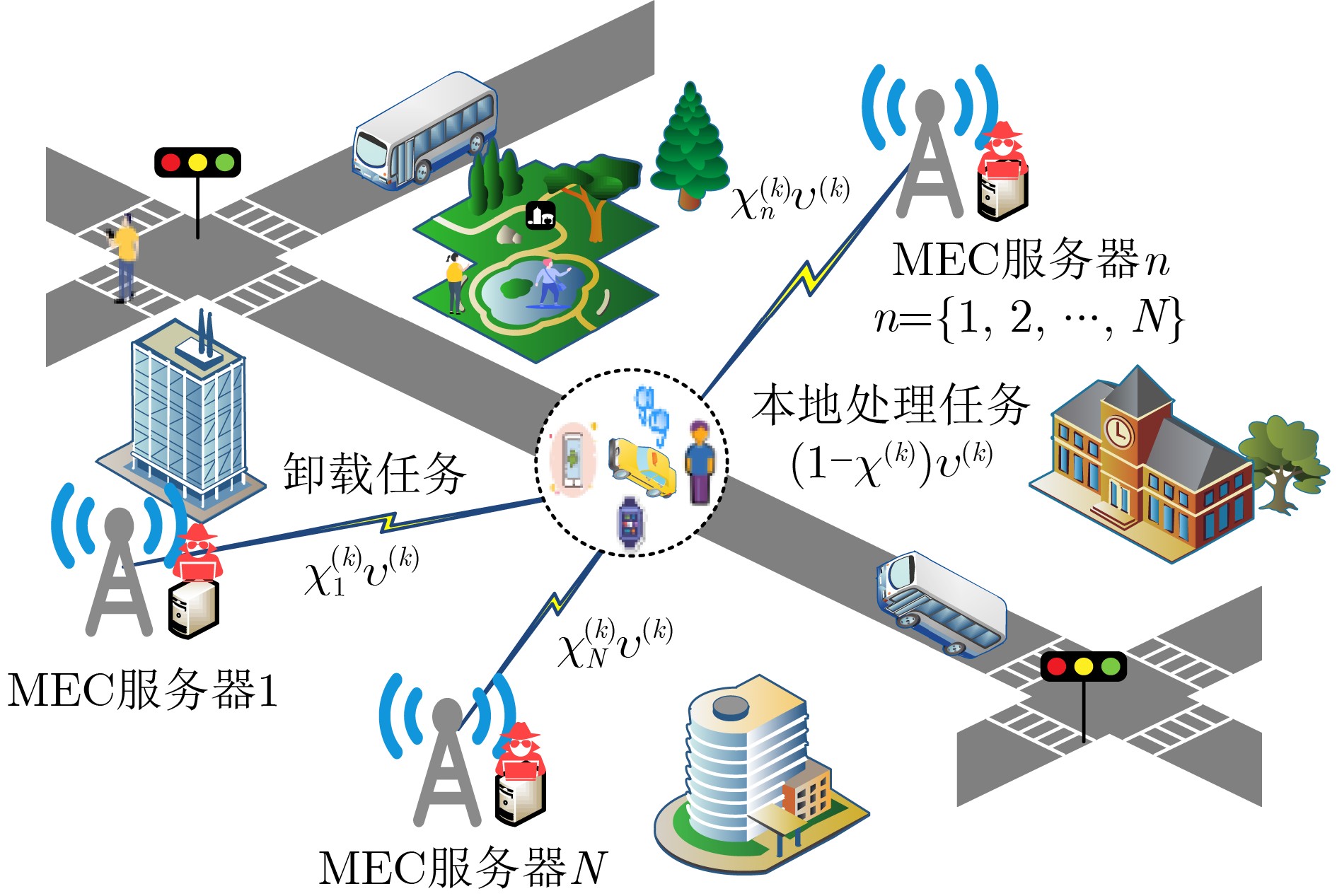
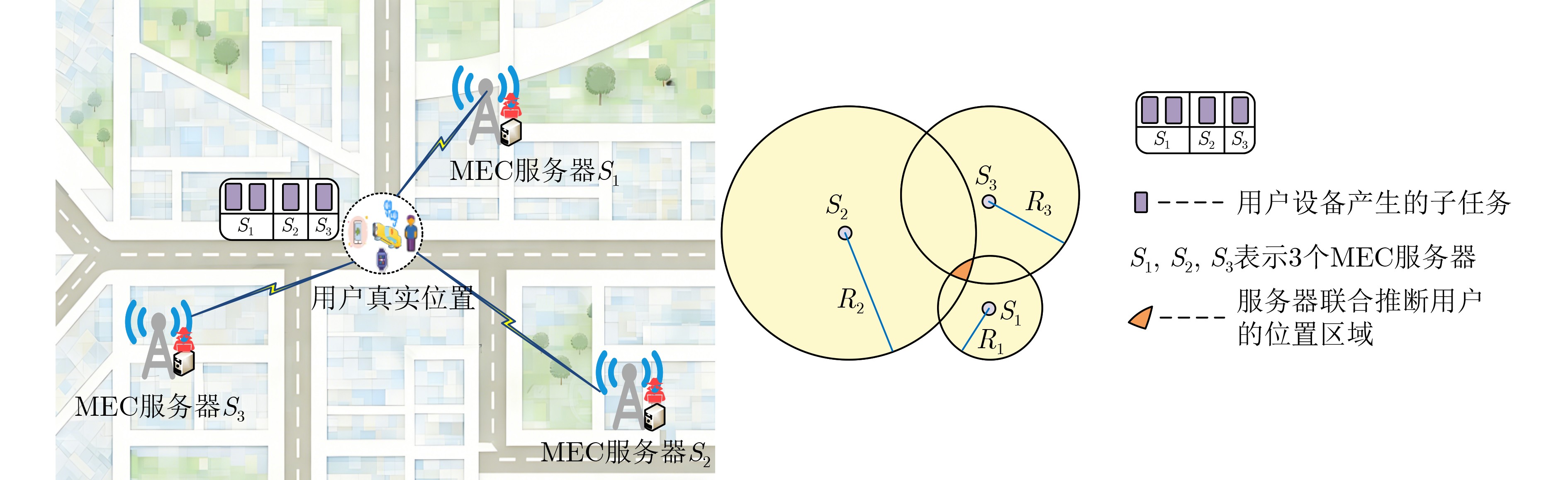
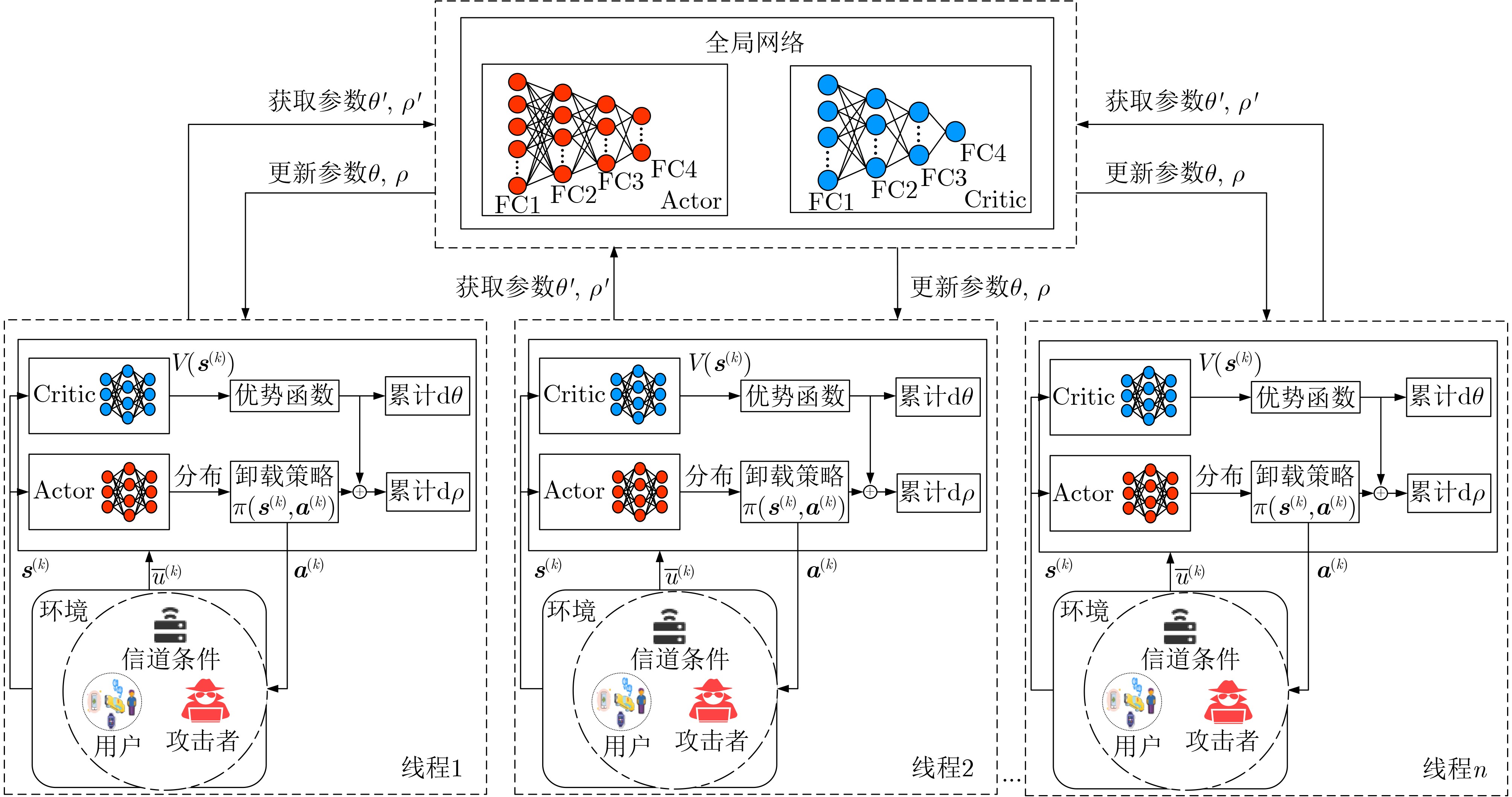
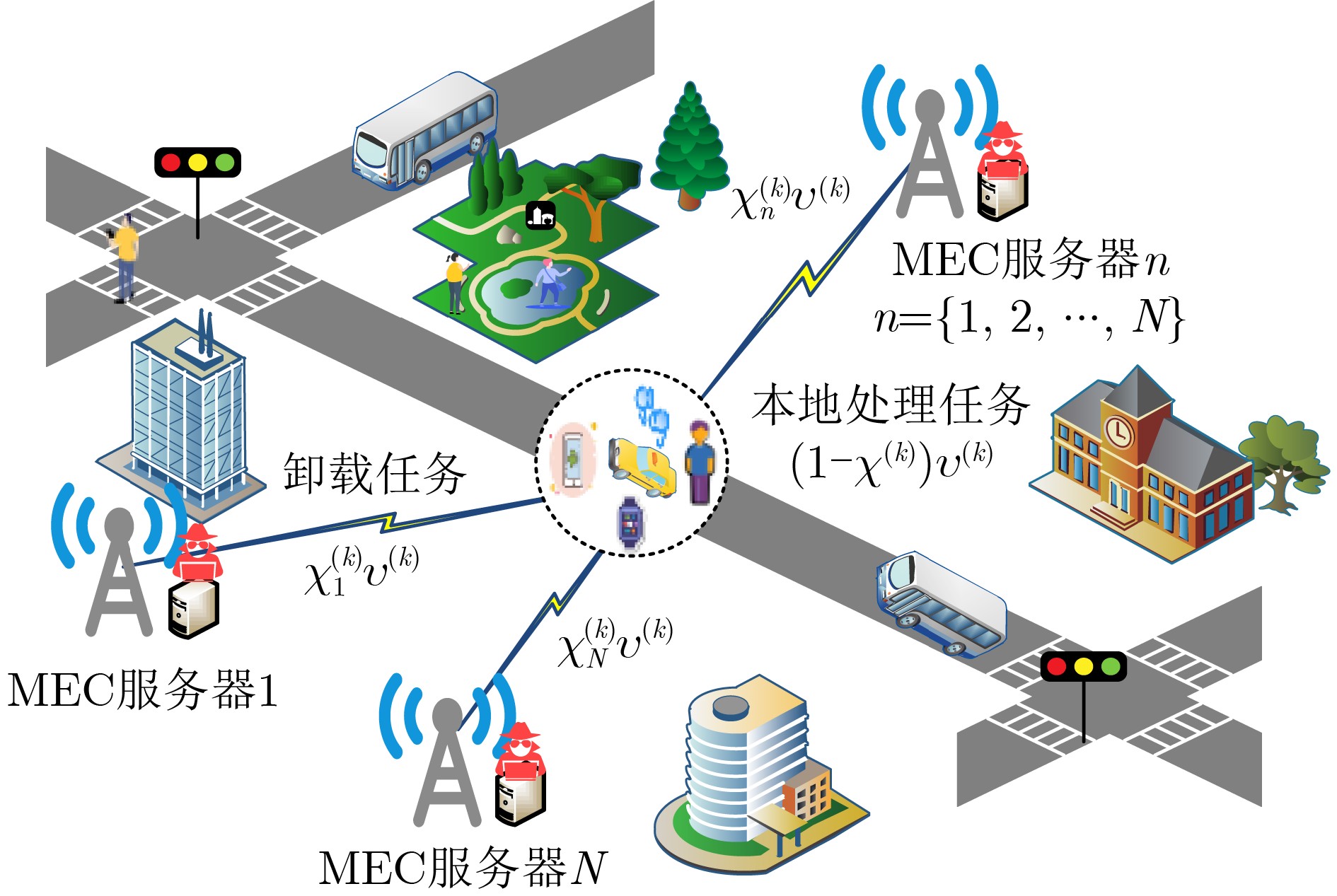
摘要: 物联网(IoT)设备通过移动边缘计算(MEC)技术将任务卸载到附近的MEC服务器以降低处理能耗和时延,多个MEC服务器在辅助单个移动用户处理计算任务时可通过共享信息实施联合推断攻击,带来更加严重的位置隐私泄露风险。因此,该文提出一种抗多服务器联合推断攻击的智能隐私感知计算卸载方法,构建一种基于差分隐私(DP)的任务卸载率扰动方案,通过增加卸载到不同MEC服务器任务量的随机性,实现保护用户位置隐私,同时使用隐私熵评估隐私保护程度;设计截断拉普拉斯机制约束扰动范围并证明其满足DP。此外,为了在隐私感知的计算卸载动态场景中实现系统效益最大化,提出一种基于异步优势演员-评论家(A3C)算法的抗多服务器联合推断攻击的智能隐私感知计算卸载(AIPCO)方案,利用多线程异步训练机制高效获取最优卸载决策。仿真结果表明所提方案相较于基准方案能够保障位置隐私,获得较高的系统效益。
-
关键词:
- 移动边缘计算 /
- 联合推断攻击 /
- 位置隐私 /
- 差分隐私 /
- 异步优势演员-评论家算法
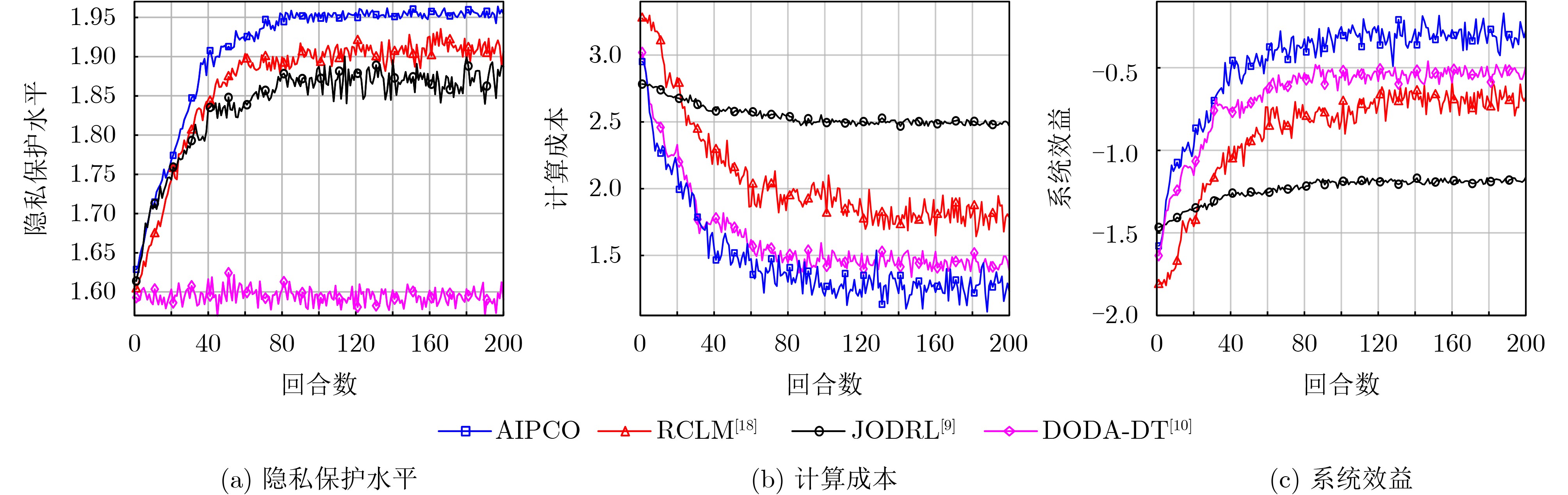
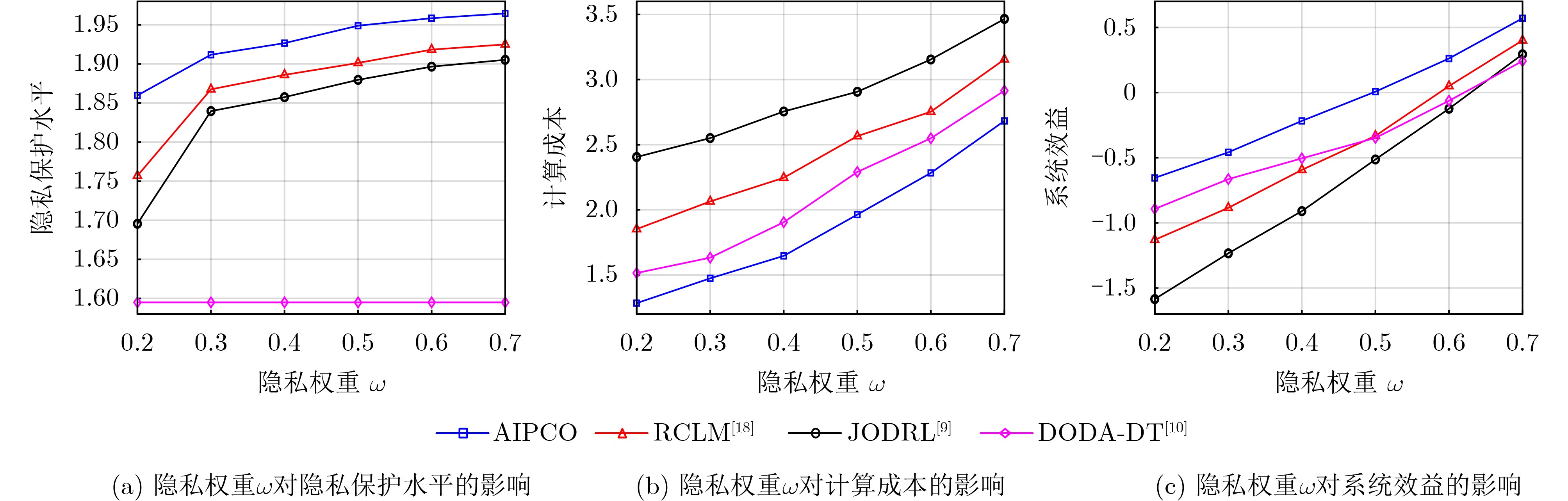
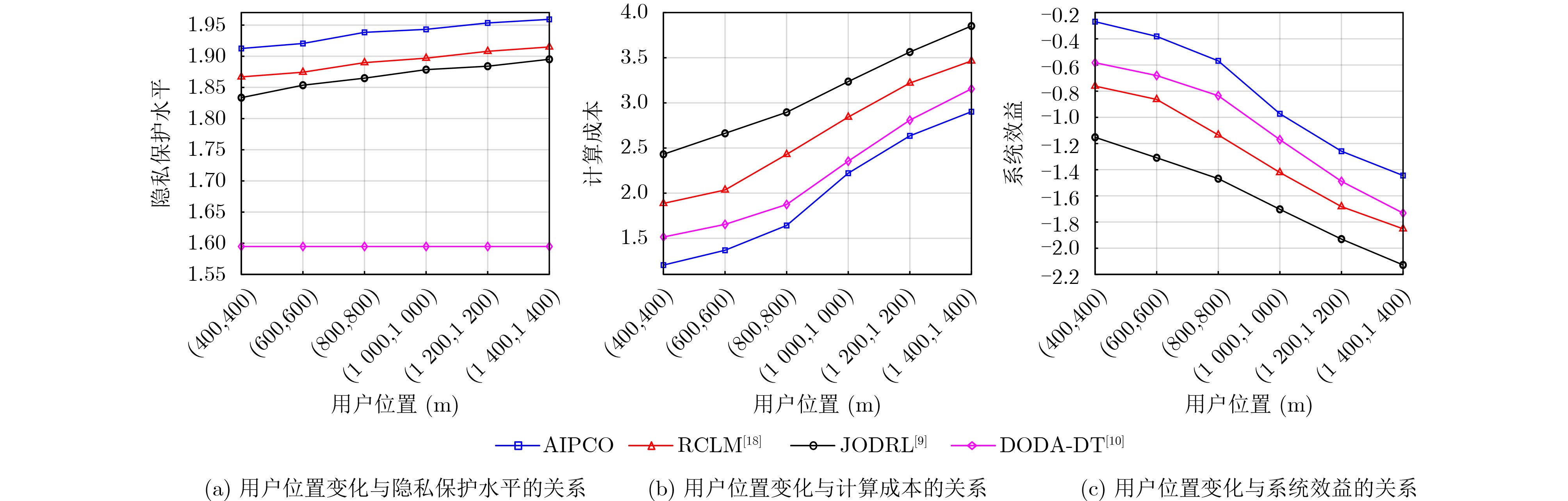
Abstract:Objective With the rapid development of the low-altitude economy, services such as intelligent transportation, smart healthcare, and low-altitude logistics have become increasingly common. Their efficient operation depends on the real-time processing of massive sensing data. Mobile Edge Computing (MEC) improves task execution efficiency and reduces device computational burdens by offloading tasks to nearby servers. However, user privacy and security risks have become increasingly severe. In dynamic scenarios where multiple MEC servers jointly process tasks, information sharing can enable multi-server joint inference attacks and greatly increase the risk of user location privacy leakage. Although existing studies have used Differential Privacy (DP) to protect user location privacy, current DP-based solutions remain limited. These methods inject noise into offloading decisions, but unconstrained noise may reduce task allocation accuracy. In addition, user mobility causes continuous changes in channel states during dynamic computation offloading. Privacy leakage risks and attacker behaviors are also uncertain. Traditional optimization methods based on static system models are therefore unsuitable for such dynamic environments. To address these challenges, this paper proposes an Asynchronous Advantage Actor-Critic (A3C)-based Intelligent Privacy-Aware Computation Offloading (AIPCO) scheme against multi-server joint inference attacks. The proposed scheme protects user location privacy while maximizing the overall utility of the MEC system. Methods This paper proposes a DP-based task offloading rate perturbation mechanism. By adding controlled noise, the mechanism increases the randomness of user task offloading toward multiple MEC servers. A truncated Laplace mechanism is used to constrain the perturbed offloading rates within valid boundaries. This design satisfies the mathematical guarantees of DP and reduces the accuracy of multi-server joint inference attacks on sensitive user locations. Privacy entropy is then introduced to dynamically evaluate the real-time privacy protection level. Finally, the AIPCO scheme is constructed. Through a multi-threaded asynchronous training mechanism, the scheme interacts with the environment through iterative trial and error and efficiently learns the optimal real-time offloading policy online. The proposed scheme dynamically protects user privacy, reduces computational cost, and maximizes comprehensive system utility. Results and Discussions The AIPCO scheme jointly optimizes user privacy and task offloading cost by incorporating multidimensional performance variables into the reinforcement learning reward function. A comprehensive performance analysis ( Fig. 4 ) shows that, when the number of continuous learning iterations reaches 200, the privacy protection level of AIPCO increases by 2.52%, 3.56%, and 22.90% compared with RCLM, JODRL, and DODA-DT, respectively. This advantage is mainly attributed to the DP-based task offloading rate perturbation method, which uses the truncated Laplace mechanism to increase data randomness while strictly constraining the perturbation range. By contrast, RCLM perturbs the task offloading rate through range-limited DP without using the truncated Laplace mechanism. JODRL increases randomness only through network policy optimization, resulting in a lower privacy protection level. DODA-DT focuses on balancing energy consumption and system latency without optimizing user privacy. For the privacy weight parameter (Fig. 5 ), increasing ω improves privacy protection. For example, the privacy protection level increases by 5.64% when ω rises from 0.2 to 0.7, with a clear performance gain at 0.7. As the system agent reduces its focus on computational cost, user utility remains optimal despite increased cost. When the physical distance between users and the MEC server is adjusted (Fig. 6 ), AIPCO shows stronger privacy protection in long-distance scenarios. A greater distance reduces the number of tasks offloaded to the server. Therefore, attackers obtain less information, and privacy protection improves. Although computational cost increases with distance, AIPCO consistently outperforms competing schemes. These results confirm that AIPCO achieves optimal MEC system utility while protecting user privacy.Conclusions To mitigate multi-server joint inference attacks caused by information sharing among collaborative MEC servers, this paper proposes an AIPCO method. A DP-based task offloading rate perturbation scheme is designed to increase randomness, and a truncated Laplace mechanism is used to constrain perturbed rates within reasonable boundaries. The scheme is proven to satisfy strict DP mathematical guarantees, and privacy entropy is introduced to quantitatively evaluate the privacy protection level. In addition, the AIPCO scheme uses a multi-threaded asynchronous training mode, enabling the agent to efficiently learn the optimal perturbed offloading policy in a continuous space and maximize overall system utility. Simulation results show that the proposed scheme outperforms the baselines in both dynamic and average performance. It achieves optimal system utility while protecting user privacy. -
1 基于A3C的抗多服务器联合推断攻击的智能隐私感知计算卸载方案
输入:状态$ {\boldsymbol{s}}^{(k)} $ 输出:策略分布函数$ \pi ({\boldsymbol{s}}^{(k)},{\boldsymbol{a}}^{(k)}) $和状态值$ V({\boldsymbol{s}}^{(k)}) $ 1: 初始化MEC系统的坐标信息和全局网络的权重$ {\rho }^{(0)} $, $ {\theta }^{(0)} $ 2: 用全局网络的权重更新每个线程子网络的权重:$ {\rho }^{'(0)}\leftarrow {\rho }^{(0)} $, $ {\theta }^{'(0)}\leftarrow {\theta }^{(0)} $ 3: $ {k}_{{\mathrm{start}}}=k $ 4: 观察用户当前状态$ {\boldsymbol{s}}^{(k)} $ 5: 根据式(21)计算策略分布$ \pi ({\boldsymbol{s}}^{(k)},{\boldsymbol{a}}^{(k)}) $ 6: 根据$ \pi ({\boldsymbol{s}}^{(k)},{\boldsymbol{a}}^{(k)}) $选择隐私保护卸载策略$ {\boldsymbol{a}}^{(k)} $ 7: 用户完成本地任务处理并将部分任务卸载至多个 MEC 服务器计算,同时开展隐私保护与卸载性能评估 8: 当$ k-{k}_{{\mathrm{start}}}=t $时,执行完$ t $个步骤后开始更新网络参数 (1)$ i=k-1,\cdots,{k}_{{\mathrm{start}}} $时:根据式(24)和式(25)分别计算Actor网络和Critic网络的参数 (2)异步更新全局网络的参数$ {\rho }^{(k)} $和$ {\theta }^{(k)} $ (3)更新每个线程子网络的参数:$ {\rho }^{'(k)}\leftarrow {\rho }^{(k)} $, $ {\theta }^{'(k)}\leftarrow {\theta }^{(k)} $ 9: 判断算法收敛性,若算法未收敛,令$ k=k+1 $,并转移到步骤3,开始下一时隙的学习  下载: 导出CSV
-
[1] 胡钰林, 喻鑫岚, 高伟, 等. 低时延工业物联网中移动边缘计算的安全性与可靠性联合优化[J]. 电子与信息学报, 2025, 47(10): 3492–3504. doi: 10.11999/JEIT250262.HU Yulin, YU Xinlan, GAO Wei, et al. Security and reliability-optimal offloading for mobile edge computing in low-latency industrial IoT[J]. Journal of Electronics & Information Technology, 2025, 47(10): 3492–3504. doi: 10.11999/JEIT250262. [2] YANG Helin, ZHENG Mengting, SHAO Ziling, et al. Intelligent computation offloading and trajectory planning for 3-D target search in low-altitude economy scenarios[J]. IEEE Wireless Communications Letters, 2025, 14(4): 949–953. doi: 10.1109/LWC.2025.3527005. [3] 施建锋, 陈忻阳, 李宝龙. 面向物联网的云边端协同计算中任务卸载与资源分配算法研究[J]. 电子与信息学报, 2025, 47(2): 458–469. doi: 10.11999/JEIT240659.SHI Jianfeng, CHEN Xinyang, and LI Baolong. Research on task offloading and resource allocation algorithms in cloud-edge-end collaborative computing for the internet of things[J]. Journal of Electronics & Information Technology, 2025, 47(2): 458–469. doi: 10.11999/JEIT240659. [4] 闵明慧, 张鹏, 朱浩鹏, 等. 能量收集辅助的矿山物联网智能计算卸载方法[J]. 电子与信息学报, 2023, 45(10): 3547–3557. doi: 10.11999/JEIT220973.MIN Minghui, ZHANG Peng, ZHU Haopeng, et al. Energy harvesting assisted intelligent computation offloading method for the IoT in mining[J]. Journal of Electronics & Information Technology, 2023, 45(10): 3547–3557. doi: 10.11999/JEIT220973. [5] LAN Wenjun, CHEN Kongyang, LI Yikai, et al. Deep reinforcement learning for privacy-preserving task offloading in integrated satellite-terrestrial networks[J]. IEEE Transactions on Mobile Computing, 2024, 23(10): 9678–9691. doi: 10.1109/TMC.2024.3366928. [6] WANG Zhibo, SUN Yunan, LIU Defang, et al. Location privacy-aware task offloading in mobile edge computing[J]. IEEE Transactions on Mobile Computing, 2024, 23(3): 2269–2283. doi: 10.1109/TMC.2023.3254553. [7] MIN Minghui, ZHANG Peng, ZHANG Yue, et al. Personalized location privacy-aware task offloading: A dual-agent DRL approach[J]. IEEE Transactions on Mobile Computing, 2026, 25(4): 5824–5838. doi: 10.1109/TMC.2025.3634361. [8] HE Yulong, HE Xiaofan, JIN Richeng, et al. Location privacy-aware and energy-efficient offloading for distributed edge computing[J]. IEEE Transactions on Wireless Communications, 2023, 22(11): 7975–7988. doi: 10.1109/TWC.2023.3257197. [9] WU Guowen, CHEN Xihang, GAO Zhengjun, et al. Privacy-preserving offloading scheme in multi-access mobile edge computing based on MADRL[J]. Journal of Parallel and Distributed Computing, 2024, 183: 104775. doi: 10.1016/j.jpdc.2023.104775. [10] FANG Juan, QU Dezheng, CHEN Huijie, et al. Dependency-aware dynamic task offloading based on deep reinforcement learning in mobile-edge computing[J]. IEEE Transactions on Network and Service Management, 2024, 21(2): 1403–1415. doi: 10.1109/TNSM.2023.3319294. [11] ZHANG Degan, AN Hongzhan, ZHANG Jie, et al. Novel privacy awareness task offloading approach based on privacy entropy[J]. IEEE Transactions on Network and Service Management, 2024, 21(3): 3598–3608. doi: 10.1109/TNSM.2024.3355967. [12] LI Peisong, XIAO Ziren, GAO Honghao, et al. Reinforcement learning based edge-end collaboration for multi-task scheduling in 6G enabled intelligent autonomous transport systems[J]. IEEE Transactions on Intelligent Transportation Systems, 2025, 26(10): 17624–17637. doi: 10.1109/TITS.2024.3525356. [13] FENG Jun, YANG L T, ZHU Qing, et al. Privacy-preserving tensor decomposition over encrypted data in a federated cloud environment[J]. IEEE Transactions on Dependable and Secure Computing, 2020, 17(4): 857–868. doi: 10.1109/TDSC.2018.2881452. [14] DU Miao, LIU Yinqiu, ZHAO Changyuan, et al. GDP-UAV: A Gaussian differential privacy-empowered multi-UAV task offloading in low-altitude economy networks[J]. IEEE Transactions on Cognitive Communications and Networking, 2026, 12: 5001–5013. doi: 10.1109/TCCN.2025.3638768. [15] MIN Minghui, DUAN Jincheng, LIU Mingcheng, et al. Task offloading with differential privacy in multi-access edge computing: An A3C-based approach[J]. IEEE Transactions on Cognitive Communications and Networking, 2026, 12: 5676–5689. doi: 10.1109/TCCN.2026.3657108. [16] ZHU Bincheng, HUANG Liang, CHI Kaikai, et al. Enhancing energy efficiency in wireless-powered MEC systems through lyapunov-guided deep reinforcement learning[J]. IEEE Transactions on Wireless Communications, 2025, 24(9): 7563–7580. doi: 10.1109/TWC.2025.3561167. [17] GAN Shuying, SIEW M, XU Chao, et al. Differentially private deep Q-learning for pattern privacy preservation in MEC offloading[C]. 2023 IEEE International Conference on Communications, Rome, Italy, 2023: 3578–3583. doi: 10.1109/ICC45041.2023.10278840. [18] PANG Xiaoyi, WANG Zhibo, LI Jingxin, et al. Towards online privacy-preserving computation offloading in mobile edge computing[C]. 2022-IEEE Conference on Computer Communications, London, UK, 2022: 1179–1188. doi: 10.1109/INFOCOM48880.2022.9796748. [19] ZHANG Pengfei, SUN Hong, ZHANG Zhikun, et al. Privacy-preserving recommendations with mixture model-based matrix factorization under local differential privacy[J]. IEEE Transactions on Industrial Informatics, 2025, 21(7): 5451–5459. doi: 10.1109/TII.2025.3555993. [20] FENG Jun, YANG L T, NIE Xin, et al. Edge-cloud-aided differentially private tucker decomposition for cyber-physical-social systems[J]. IEEE Internet of Things Journal, 2022, 9(11): 8387–8396. doi: 10.1109/JIOT.2020.3004826. [21] DEMIR S, STAPPERS B, KOK K, et al. Statistical arbitrage trading on the intraday market using the asynchronous advantage actor–critic method[J]. Applied Energy, 2022, 314: 118912. doi: 10.1016/j.apenergy.2022.118912. [22] 方贤进, 甄雅茹, 张朋飞, 等. 本地差分隐私下技能感知的任务分配算法研究[J]. 电子与信息学报, 2025, 47(11): 4429–4439. doi: 10.11999/JEIT250425.FANG Xianjin, ZHEN Yaru, ZHANG Pengfei, et al. Research on skill-aware task assignment algorithm under local differential privacy[J]. Journal of Electronics & Information Technology, 2025, 47(11): 4429–4439. doi: 10.11999/JEIT250425. [23] CHEN Jiajun, HU Chunqiang, SHENG Weihong, et al. Sensitivity-aware personalized differential privacy guarantees for online social networks[J]. IEEE Transactions on Information Forensics and Security, 2025, 20: 3116–3130. doi: 10.1109/TIFS.2025.3551642. [24] 杨淼焱, 方旭明. 车联网中采用混合分层DRL的无人机辅助移动边缘计算[J]. 电子与信息学报, 2026, 48(4): 1668–1677. doi: 10.11999/JEIT250743.YANG Miaoyan and FANG Xuming. UAV-assisted mobile edge computing based on hybrid hierarchical DRL in the internet of vehicular[J]. Journal of Electronics & Information Technology, 2026, 48(4): 1668–1677. doi: 10.11999/JEIT250743. [25] HUSSAIN A, AKBAR W, HUSSAIN T, et al. Ensuring zero trust IoT data privacy: Differential privacy in blockchain using federated learning[J]. IEEE Transactions on Consumer Electronics, 2025, 71(1): 1167–1179. doi: 10.1109/TCE.2024.3444824. [26] FENG Libo, GUO Junwei, FANG Fake, et al. SEPP-FLBC: A secure and efficient privacy protection scheme using federate learning and blockchain for edge-end-cloud devices[J]. IEEE Transactions on Services Computing, 2026, 19(1): 657–670. doi: 10.1109/TSC.2025.3641964. [27] GAN Ying, XIAO Zhanhui, KE Ting, et al. UAV application with XAI and soft computing methods to protect privacy of power-data in smart grids[J]. IEEE Transactions on Consumer Electronics, 2025, 71(2): 3921–3929. doi: 10.1109/TCE.2025.3551519. -

 下载:
下载:

图(6) / 表(2)
计量
- 文章访问数: 375
- HTML全文浏览量: 169
- PDF下载量: 11
- 被引次数: 0
