




Secure and Covert MIMO Short Packet Communications with Location-Uncertain Malicious Nodes
-
摘要: 面向位置不确定恶意节点,该文研究准静态莱斯衰落下的多输入多输出(MIMO)短包安全隐蔽通信。基于随机几何,将监测节点Willie与窃听节点Eve建模为泊松点过程;Alice采用奇异值分解(SVD)预编码,Bob采用最大比合并(MRC)接收。在有限块长条件下,基于Chernoff界推导平均最小检测错误概率理论下界并推导了平均保密速率近似解析表达式。进一步提出平均有效安全隐蔽速率(AESCR)以统一表征系统隐蔽性、保密性与可靠性。在平均隐蔽约束下,构建AESCR最大化问题,提出包长与功率联合优化方法。仿真表明,AESCR随合法收发天线数增加而提升,随恶意节点密度及恶意节点天线数增加而下降,且系统存在最优包长。Abstract:
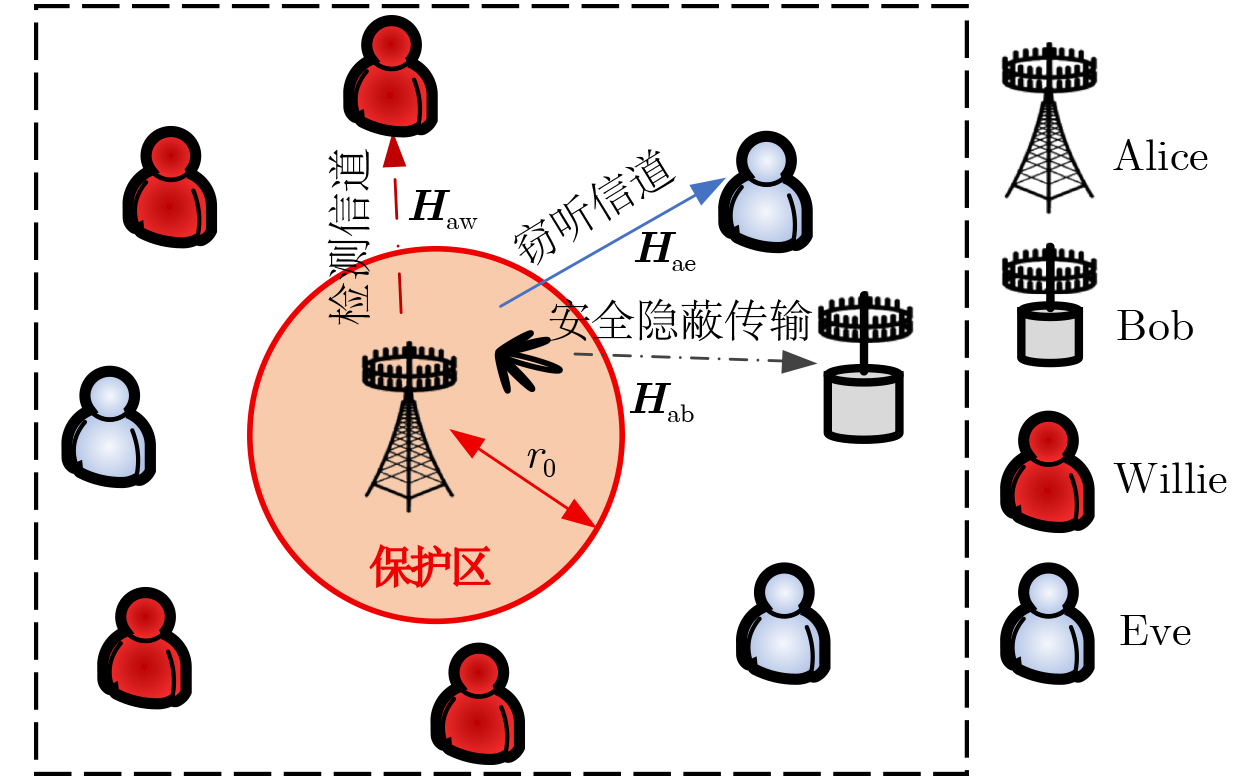
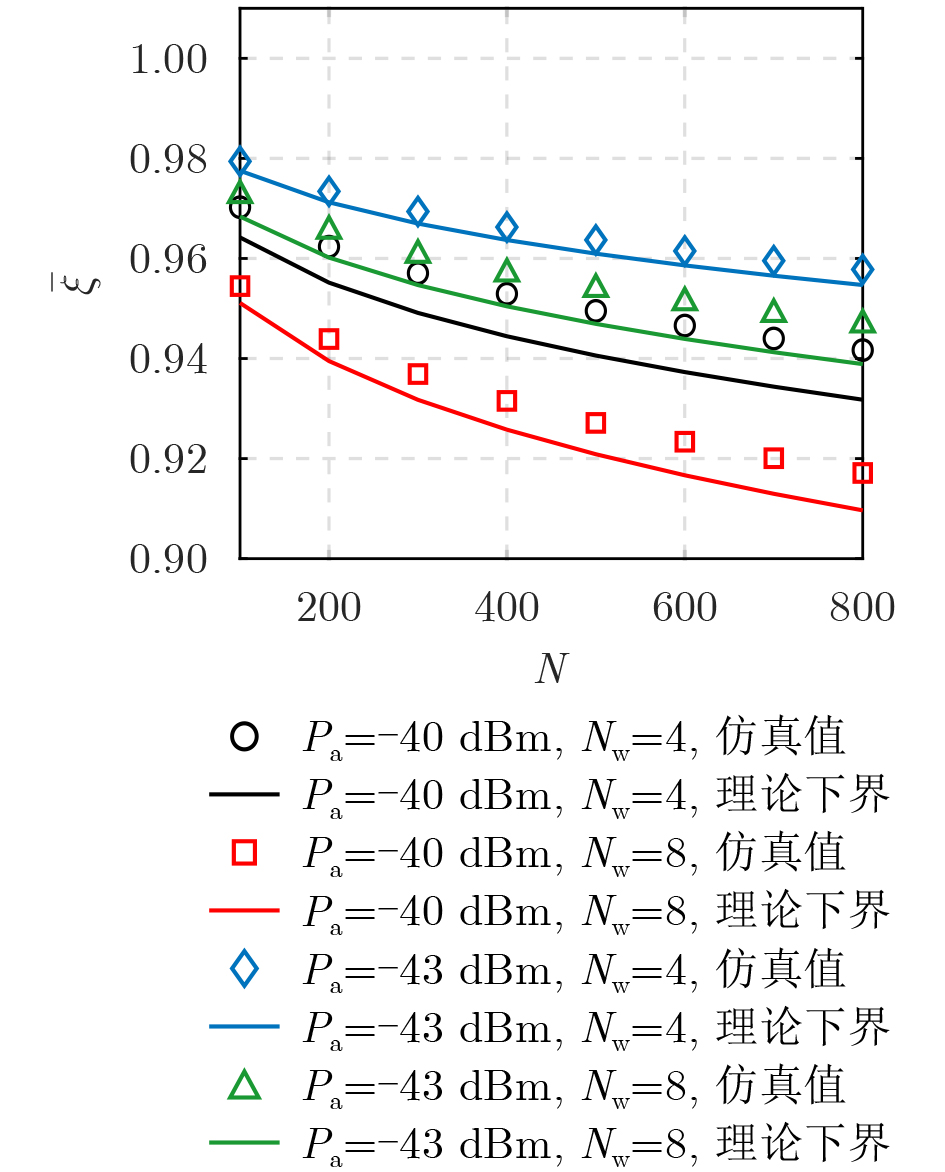
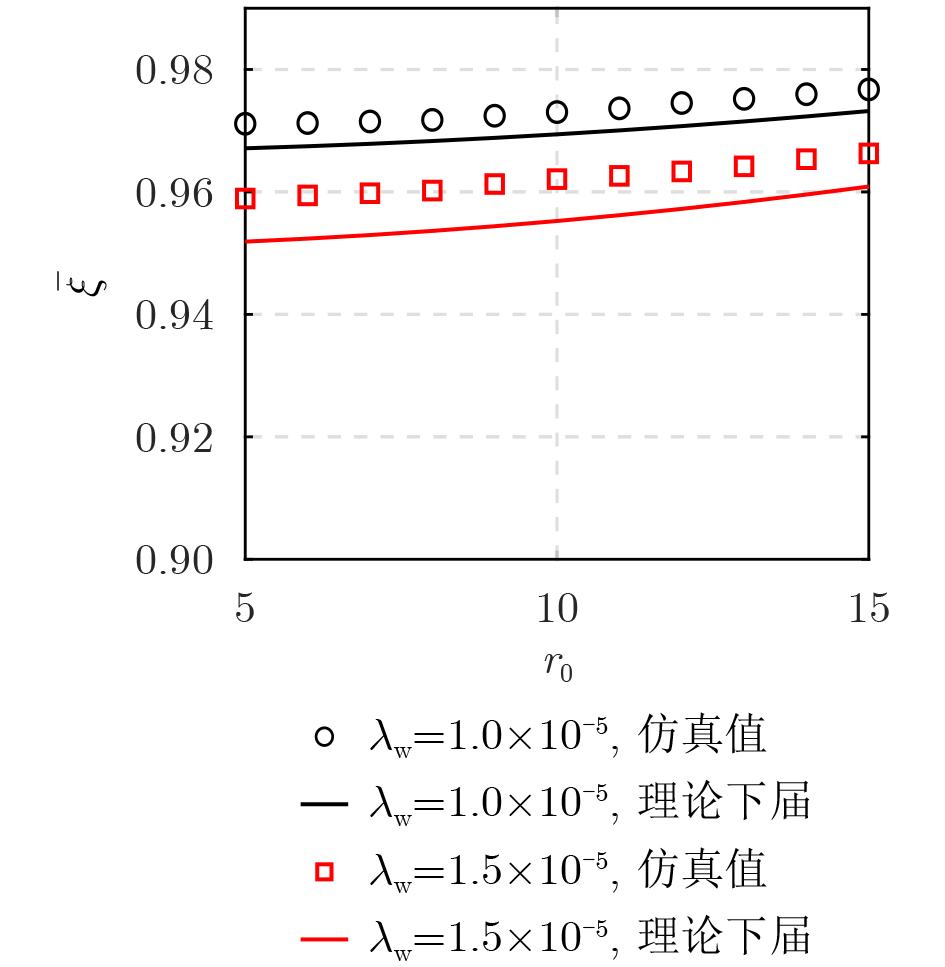
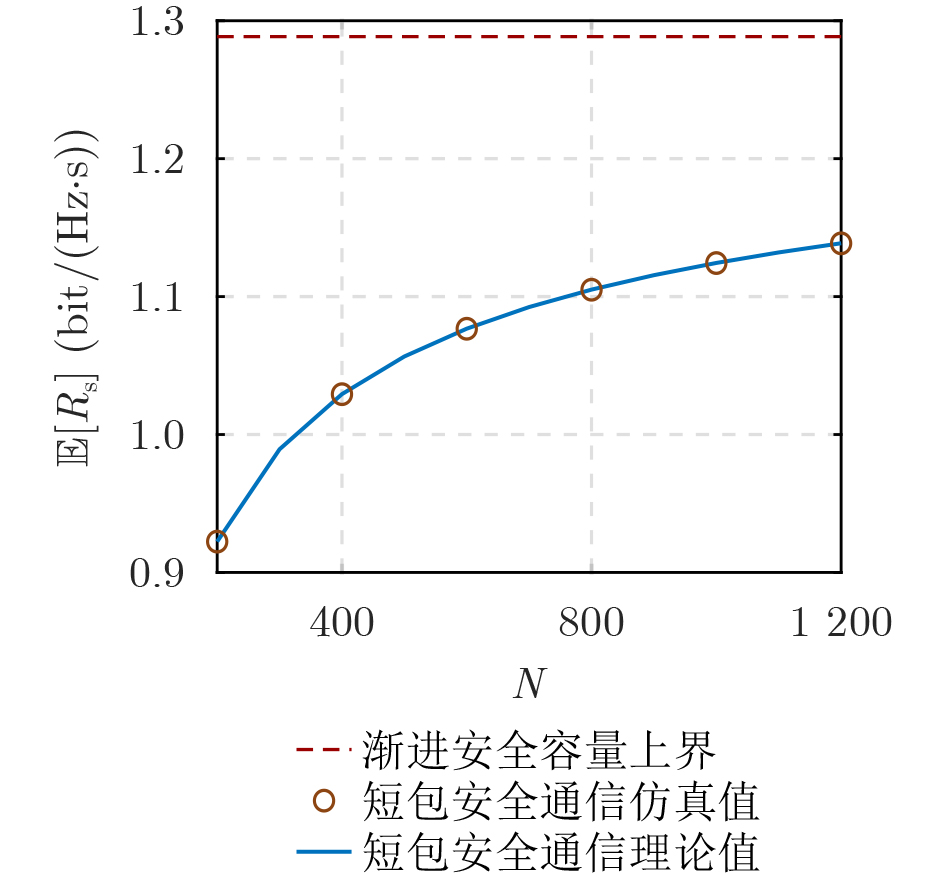
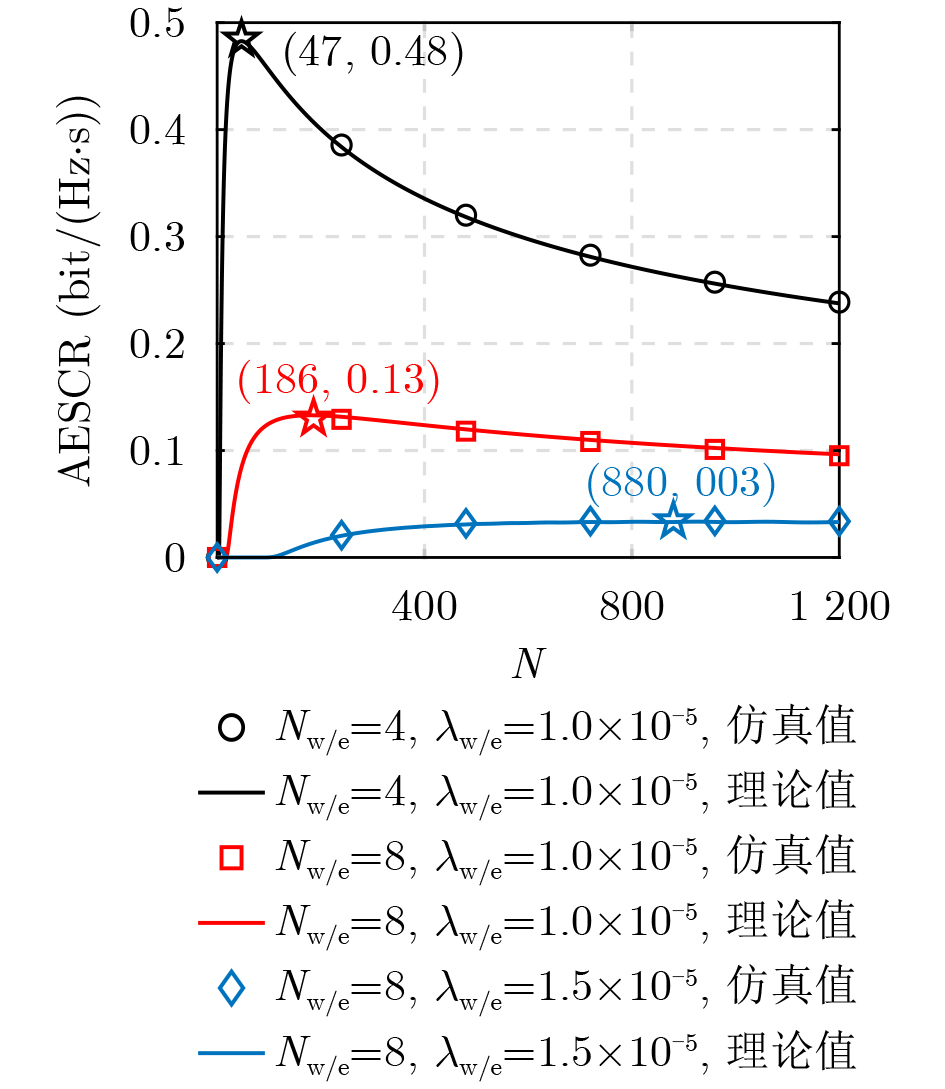
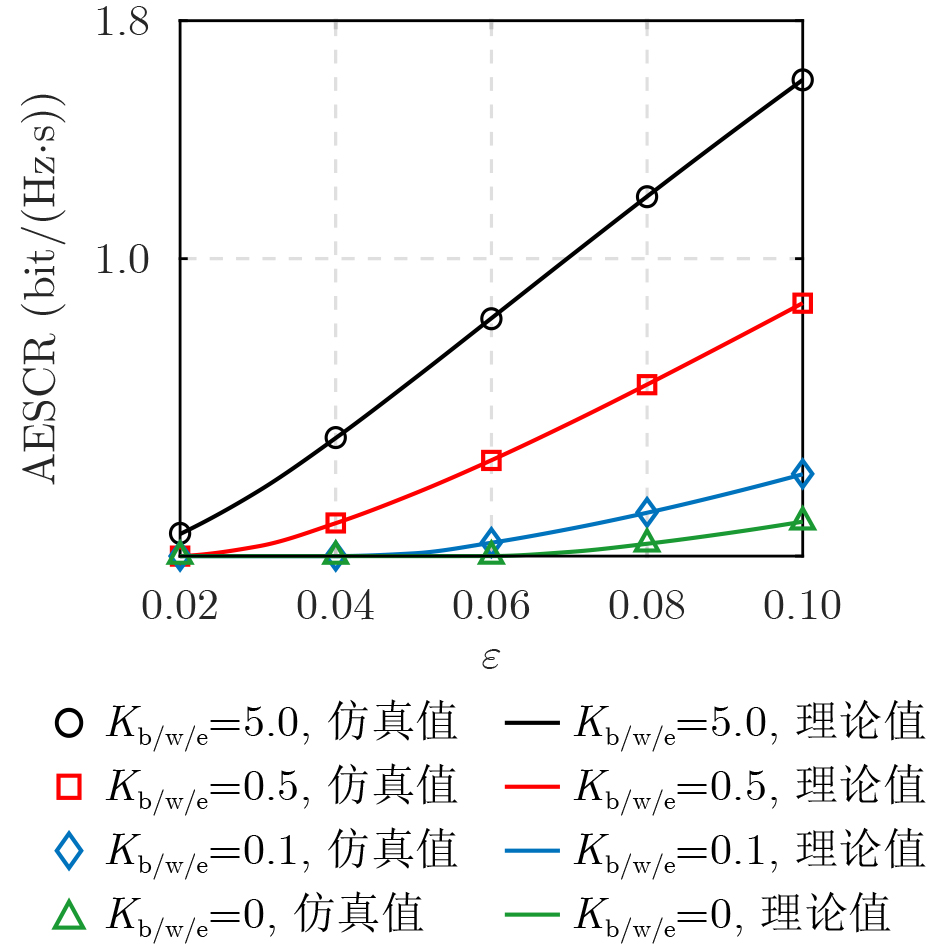
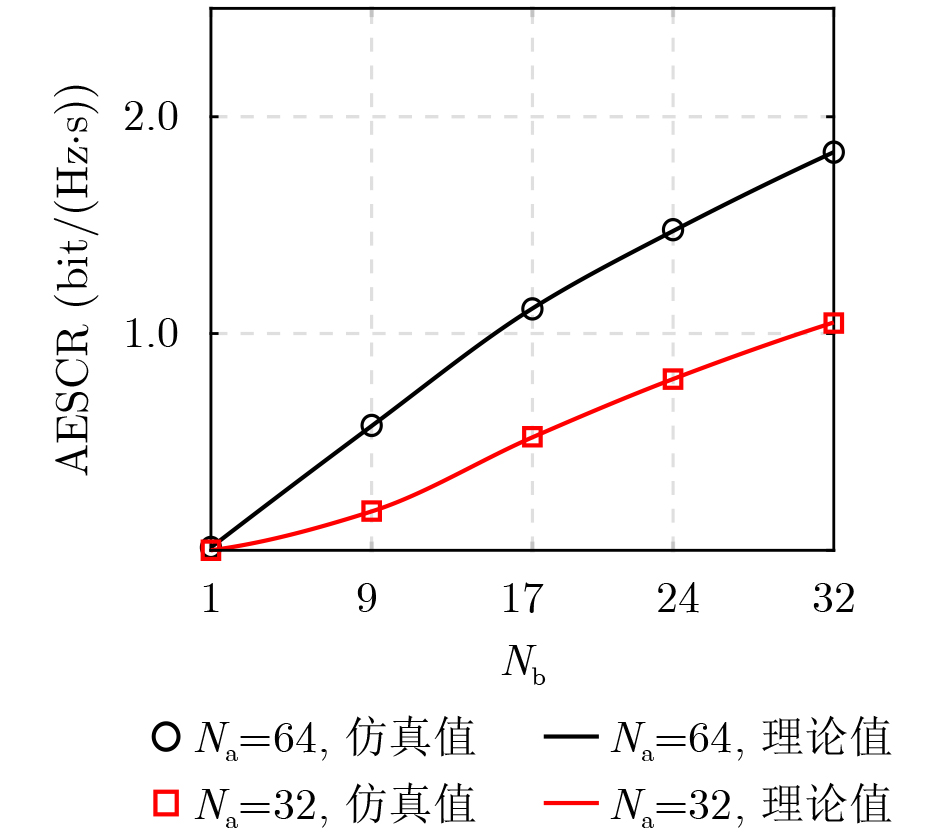
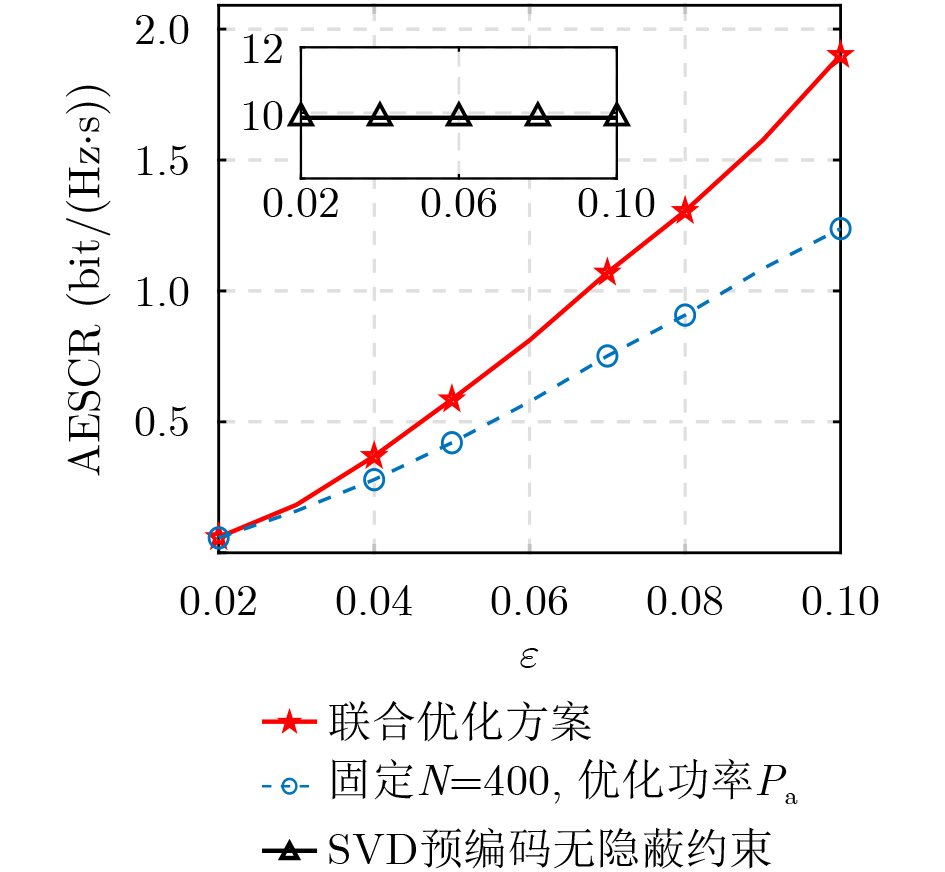
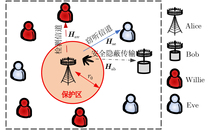
Objective This paper investigates secure and covert short packet communication in multi-input multi-output (MIMO) wireless systems with location-uncertain malicious nodes over quasi-static Rician fading channels. In the considered scenario, a legitimate transmitter sends confidential short packets to a legitimate receiver, while multiple monitoring nodes attempt to detect whether the transmission exists and multiple eavesdropping nodes attempt to intercept the confidential information. Since malicious nodes may remain silent and their exact positions are unavailable to the legitimate system, their spatial uncertainty brings significant challenges to joint covertness and secrecy analysis. To address this problem, this paper establishes a unified analytical and optimization framework for secure covert short packet transmission, aiming to characterize the coupling relationship among covertness, secrecy, and reliability, and to improve the average effective secrecy and covert rate (AESCR). Methods The transmitter adopts singular value decomposition (SVD)-based precoding, and the legitimate receiver applies maximum ratio combining (MRC) to enhance the legitimate link. The monitoring nodes and eavesdropping nodes are modeled as two independent Poisson point processes (PPPs) outside a circular protection zone centered at the transmitter, which captures the spatial randomness of malicious nodes. For covertness analysis, each monitoring node is assumed to perform optimal likelihood ratio detection with full knowledge of the system model, noise power, channel state, and codebook information. By using the Chernoff bound and the Bhattacharyya coefficient, a theoretical lower bound on the minimum detection error probability of a single monitoring node is first derived. Then, by combining stochastic geometry with the distribution of the strongest monitoring node, a tractable lower bound on the average minimum detection error probability is obtained. For secrecy analysis, the finite blocklength normal approximation is used to account for both decoding error and information leakage penalties. The legitimate channel is statistically characterized according to the Rician fading condition, while the strongest eavesdropping node is analyzed through stochastic geometry. Based on these results, an approximate analytical expression for the average secrecy rate is derived. Furthermore, AESCR is introduced as a comprehensive performance metric that jointly reflects reliability, secrecy, and covertness. Under the average covert constraint and the short packet length constraint, a joint optimization problem for transmit power and packet length is formulated. By exploiting the monotonic properties of the objective function and the covert constraint, the original coupled optimization problem is transformed into a one-dimensional search problem. Results and Discussions Simulation results verify the accuracy of the theoretical derivations and reveal the influence of key system parameters. Both the simulated average minimum detection error probability and its theoretical lower bound decrease as the packet length increases, and higher transmit power further reduces the detection error probability, indicating that excessive power makes the transmission more exposed to monitoring nodes ( Fig. 2 ). Increasing the number of monitoring-node antennas strengthens spatial reception capability and further degrades covertness (Fig. 2 ). Enlarging the protection zone improves covertness because malicious nodes are forced to remain farther away from the transmitter, whereas increasing the monitoring-node density weakens this benefit by raising the probability that a strong monitoring node appears near the protection-zone boundary (Fig. 3 ). The average secrecy rate increases with packet length and gradually approaches the asymptotic secrecy-capacity upper bound, because the finite blocklength rate penalty becomes smaller when the packet length grows (Fig. 4 ). The proposed AESCR first increases and then decreases with packet length, confirming the existence of an optimal packet length; this phenomenon results from the tradeoff between reduced finite-blocklength penalty and increased detection exposure (Fig. 5 ). Larger malicious-node density and more malicious-node antennas reduce system performance, since they enhance both monitoring and eavesdropping capabilities (Fig. 5 ). Relaxing the covert constraint improves the achievable AESCR, because the system can select a higher transmit power or a more favorable packet length (Fig. 6 ). The results under different Rician factors also show that the proposed analytical framework is applicable to both Rician and Rayleigh fading conditions (Fig. 6 ). Increasing the number of legitimate receive antennas improves AESCR, and a larger transmit antenna array brings additional SVD precoding gain (Fig. 7 ). Compared with benchmark schemes, the proposed joint optimization of transmit power and packet length consistently outperforms the scheme with fixed packet length and power-only optimization, demonstrating the necessity of jointly balancing reliability, secrecy, and covertness in MIMO short packet transmission (Fig. 8 ).Conclusions This paper develops a stochastic-geometry-based analytical framework for MIMO secure covert short packet communication with location-uncertain multi-antenna malicious nodes. By deriving a lower bound on the average minimum detection error probability, obtaining an approximate analytical expression for the average secrecy rate, and introducing AESCR, the proposed framework reveals the fundamental tradeoff among covertness, secrecy, and reliability under finite blocklength transmission. The results show that increasing the number of legitimate transmit and receive antennas improves secure covert performance, whereas higher malicious-node density and more malicious-node antennas degrade system performance. The existence of an optimal packet length further demonstrates that packet length and transmit power must be jointly designed. Therefore, the proposed joint optimization method provides an effective solution for secure covert short packet transmission in mission-critical and low-latency wireless systems. -
Key words:
- Short packet communication /
- MIMO /
- Rician fading /
- Covert communication /
- Physical layer security
-
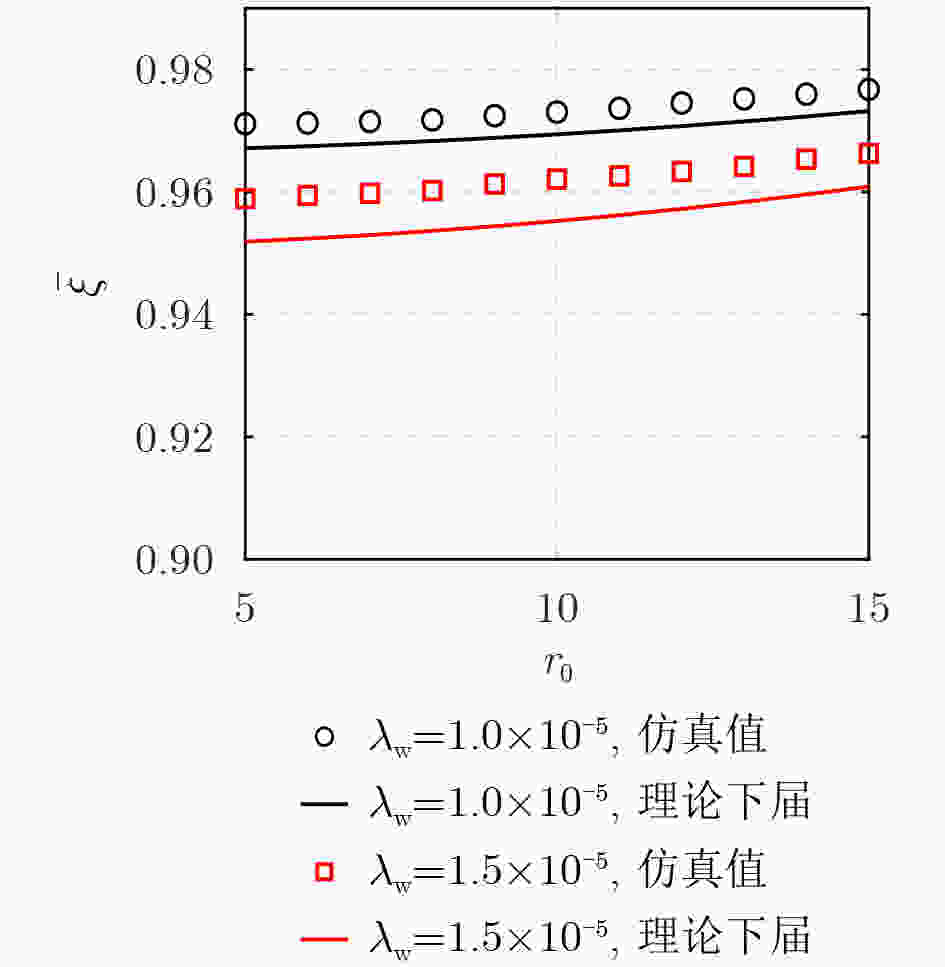
图 3 平均最小检测错误概率$ \overline{\xi } $及理论下界$ {\overline{\xi }}_{\text{LB}} $与保护区$ {r}_{0} $的关系
-
[1] 张洋译, 管新荣, 杨炜伟, 等. 高时效短包通信中的智能反射面部署: 分布式还是集中式部署?[J]. 电子与信息学报, 2026, 48(1): 107–115. doi: 10.11999/JEIT250720.ZHANG Yangyi, GUAN Xinrong, YANG Weiwei, et al. IRS deployment for highly time sensitive short packet communications: Distributed or centralized deployment?[J]. Journal of Electronics & Information Technology, 2026, 48(1): 107–115. doi: 10.11999/JEIT250720. [2] FENG Zhaoxin, YANG Zhutian, LU Huabing, et al. Secure short-packet transmission of UAV relaying via NOMA[J]. IEEE Transactions on Wireless Communications, 2026, 25: 7635–7648. doi: 10.1109/TWC.2025.3632873. [3] 徐勇军, 李晶, 骆东鑫, 等. 近场通信物理层安全技术综述[J]. 电子与信息学报, 2025, 47(11): 4129–4143. doi: 10.11999/JEIT250336.XU Yongjun, LI Jing, LUO Dongxin, et al. A survey on physical layer security in near-field communication[J]. Journal of Electronics & Information Technology, 2025, 47(11): 4129–4143. doi: 10.11999/JEIT250336. [4] GAO Weijun, HAN Chong, and CHEN Zhi. DNN-powered SIC-free receiver artificial noise aided terahertz secure communications with randomly distributed eavesdroppers[J]. IEEE Transactions on Wireless Communications, 2022, 21(1): 563–576. doi: 10.1109/TWC.2021.3098334. [5] ZHENG Tongxing, WANG Huiming, and YIN Qinye. On transmission secrecy outage of a multi-antenna system with randomly located eavesdroppers[J]. IEEE Communications Letters, 2014, 18(8): 1299–1302. doi: 10.1109/LCOMM.2014.2332172. [6] SHANG Zhihui, HU Guojie, WU Qingqing, et al. Joint movable-antenna position and sensor angle optimization for wireless sensor networks[J]. IEEE Transactions on Vehicular Technology, 2026: 1–6. doi: 10.1109/TVT.2026.3657721. [7] BASH B A, GOECKEL D, and TOWSLEY D. Limits of reliable communication with low probability of detection on AWGN channels[J]. IEEE Journal on Selected Areas in Communications, 2013, 31(9): 1921–1930. doi: 10.1109/JSAC.2013.130923. [8] LU Xingbo, YAN Shihao, YANG Weiwei, et al. Covert communication with time uncertainty in time-critical wireless networks[J]. IEEE Transactions on Wireless Communications, 2023, 22(2): 1116–1129. doi: 10.1109/TWC.2022.3201872. [9] CHE Bohan, SHI Hui, LU Xingbo, et al. Covert multi-channel communication against interference-assisted proactive detection[J]. IEEE Transactions on Vehicular Technology, 2024, 73(9): 14033–14037. doi: 10.1109/TVT.2024.3394734. [10] 马越, 马瑞谦, 杨炜伟, 等. 基于时间调制阵列的共孔径干扰辅助短包隐蔽通信[J]. 电子与信息学报, 2024, 46(5): 1977–1985. doi: 10.11999/JEIT231115.MA Yue, MA Ruiqian, YANG Weiwei, et al. Shared-aperture jammer assisted covert communication using time modulated array[J]. Journal of Electronics & Information Technology, 2024, 46(5): 1977–1985. doi: 10.11999/JEIT231115. [11] HU Xiaoyan, ZHAO Pengze, XIAO Han, et al. STAR-RIS-aided full-space covert communications: Resisting the position randomness of eavesdropper[J]. IEEE Transactions on Wireless Communications, 2026, 25: 6035–6049. doi: 10.1109/TWC.2025.3622942. [12] JIANG Yu'e, WANG Liangmin, and CHEN Hsiaohwa. Covert communications with randomly distributed adversaries in wireless energy harvesting enabled D2D underlaying cellular networks[J]. IEEE Transactions on Information Forensics and Security, 2023, 18: 5401–5415. doi: 10.1109/TIFS.2023.3307931. [13] MA Ruiqian, YANG Weiwei, TAO Liwei, et al. Covert communications with randomly distributed wardens in the finite blocklength regime[J]. IEEE Transactions on Vehicular Technology, 2022, 71(1): 533–544. doi: 10.1109/TVT.2021.3128600. [14] LIU Pengpeng, LI Zan, SI Jiangbo, et al. Joint information-theoretic secrecy and covertness for UAV-Assisted wireless transmission with finite blocklength[J]. IEEE Transactions on Vehicular Technology, 2023, 72(8): 10187–10199. doi: 10.1109/TVT.2023.3254882. [15] MAO Haobin, LIU Yanming, XIAO Zhenyu, et al. Energy efficient defense against cooperative hostile detection and eavesdropping attacks for AAV-aided short-packet transmissions[J]. IEEE Transactions on Vehicular Technology, 2025, 74(2): 3082–3095. doi: 10.1109/TVT.2024.3483256. [16] WANG Chao, LI Zan, ZHANG Haibin, et al. Achieving covertness and security in broadcast channels with finite blocklength[J]. IEEE Transactions on Wireless Communications, 2022, 21(9): 7624–7640. doi: 10.1109/TWC.2022.3160051. [17] YAN Shihao, HE Biao, ZHOU Xiangyun, et al. Delay-intolerant covert communications with either fixed or random transmit power[J]. IEEE Transactions on Information Forensics and Security, 2019, 14(1): 129–140. doi: 10.1109/TIFS.2018.2846257. [18] LEHMANN E L and ROMANO J P. Testing Statistical Hypotheses[M]. 4th ed. Cham, Switzerland: Springer, 2022: 709–712. doi: 10.1007/978-3-030-70578-7. [19] COVER T M and THOMAS J A. Elements of Information Theory[M]. 2th ed. Hoboken, USA: John Wiley & Sons, 2006: 384–390. [20] TSYBAKOV A B. Introduction to Nonparametric Estimation[M]. New York, USA: Springer, 2009: 86–87. doi: 10.1007/b13794. [21] YAN Shihao and MALANEY R. Location-based beamforming for enhancing secrecy in rician wiretap channels[J]. IEEE Transactions on Wireless Communications, 2016, 15(4): 2780–2791. doi: 10.1109/TWC.2015.2510635. [22] YANG Wei, SCHAEFER R F, and POOR H V. Finite-blocklength bounds for wiretap channels[C]. 2016 IEEE International Symposium on Information Theory (ISIT), Barcelona, Spain, 2016: 3087–3091. doi: 10.1109/ISIT.2016.7541867. [23] CHIANI M. On the probability that all eigenvalues of gaussian, wishart, and double wishart random matrices lie within an interval[J]. IEEE Transactions on Information Theory, 2017, 63(7): 4521–4531. doi: 10.1109/TIT.2017.2694846. [24] WANG Yuntian, ZHOU Xiaobo, ZHUANG Zhihong, et al. UAV-enabled secure communication with finite blocklength[J]. IEEE Transactions on Vehicular Technology, 2020, 69(12): 16309–16313. doi: 10.1109/TVT.2020.3042791. -

 下载:
下载:

图(8)
计量
- 文章访问数: 23
- HTML全文浏览量: 9
- PDF下载量: 1
- 被引次数: 0
 下载:
下载:
