




A Frequency Domain Self-Attention Guided MultiscaleInverse Lithography Technology
-
摘要: 光刻制程中的光学邻近效应(OPE)会导致晶圆上的打印图像偏离设计版图,需要对光刻掩模进行光学邻近校正(OPC)。该文提出一种频域自注意力机制引导的多尺度逆光刻技术(FMS-ILT)用于掩模优化。FMS-ILT采用基于残差卷积的多尺度编码器-解码器结构,通过残差连接融合局部细节与全局特征,并在编码器末端引入频域自注意力机制,将动态注意力与频域全局建模能力相结合,自适应关注影响打印图像质量的关键信息。在预训练阶段,模型通过掩模生成与目标图像重构增强物理一致性;在主训练阶段,进一步结合光刻仿真对掩模进行精细优化。实验结果表明,FMS-ILT的平均$ \mathcal{L}2 $损失较基准模型降低2%~107%,平均边缘放置误差(EPE)降低47%~
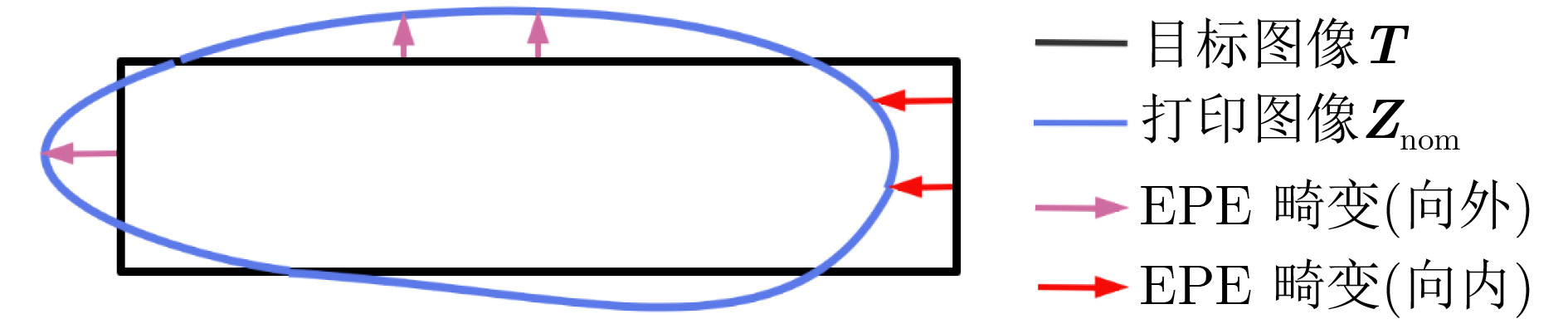
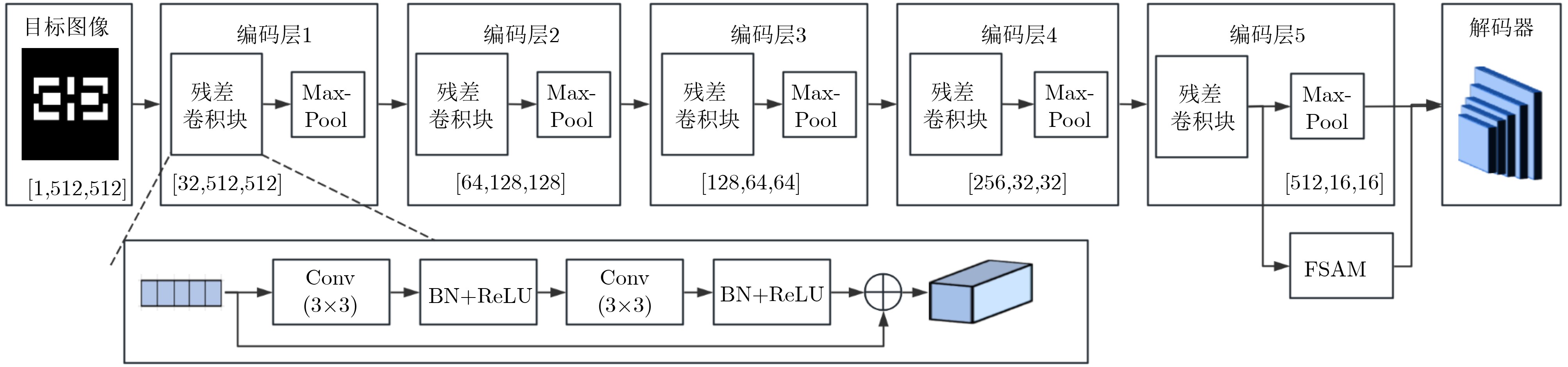
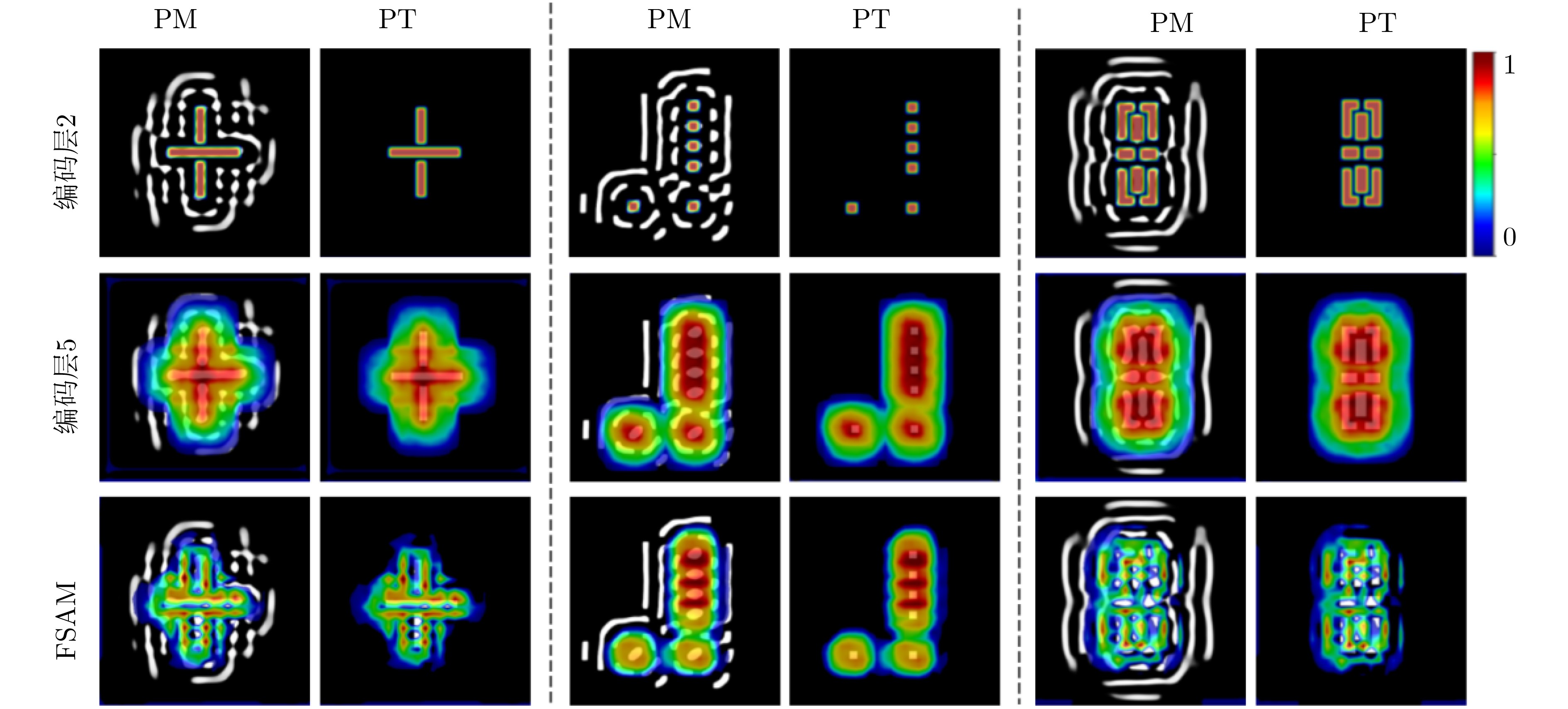
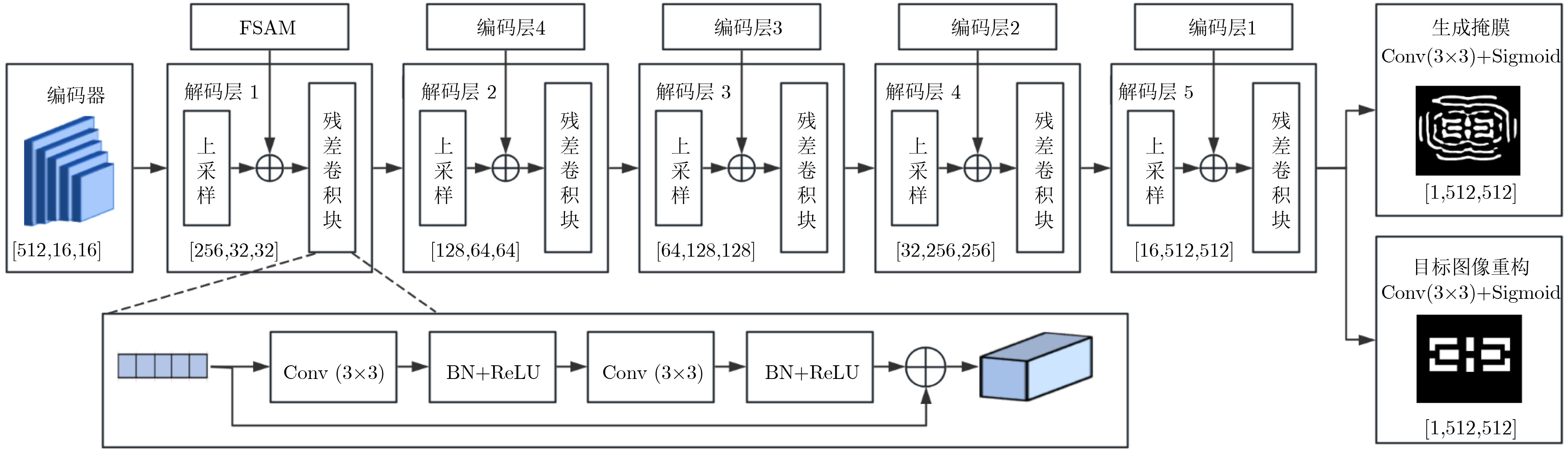
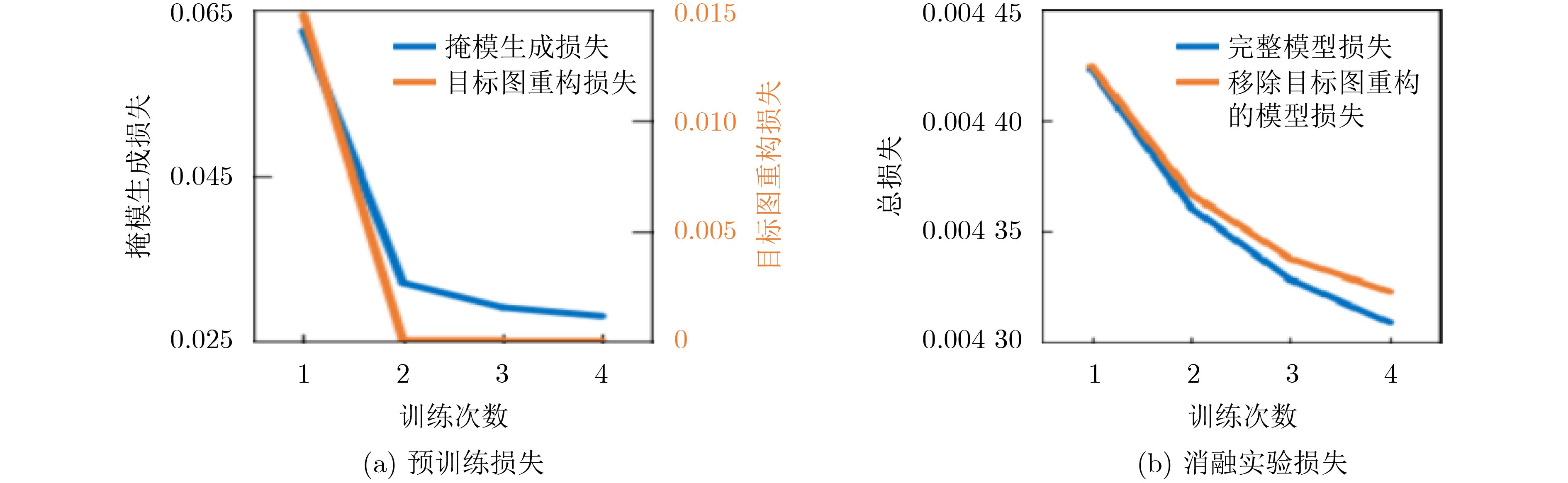
1115 %,显示了FMS-ILT方法在优化掩模方面的显著优势。Abstract:Objective Optical Proximity Effect (OPE) in lithographic processes causes printed wafer patterns to deviate from target layouts. Therefore, Optical Proximity Correction (OPC) is required for mask optimization before exposure. Traditional rule-based OPC methods show reduced accuracy for complex layouts, whereas model-based OPC methods require high computational cost. Deep learning-based methods have recently been used to accelerate mask generation. However, their limited receptive fields make it difficult to model long-range optical interference, which restricts optimization accuracy. To address these limitations, this work proposes Frequency-Domain Self-Attention-Guided Multiscale Inverse Lithography Technology (FMS-ILT). The method jointly models local geometric details and global optical interference to improve printed image fidelity, edge placement accuracy, and process robustness. Methods FMS-ILT uses a residual convolution-based multiscale encoder-decoder architecture. Shallow layers extract fine geometric features, such as edges and corners, whereas deeper layers capture large-scale layout context. Residual blocks and multilevel skip connections are used to preserve high-frequency information and stabilize training. To overcome the limited receptive field of spatial convolutions, a Frequency-domain Self-Attention Mechanism (FSAM) is introduced at the encoder output. Global feature interactions are modeled using the Fourier transform. The resulting attention responses are then mapped back to the spatial domain through the inverse Fourier transform to adaptively reweight feature representations. A two-stage training strategy is adopted. During pretraining, a dual-branch structure jointly learns mask geometry and imaging consistency, providing physically meaningful initialization. During main training, lithography simulation is applied under nominal, maximum, and minimum process corners to refine mask optimization under physical constraints. Results and Discussions The comparison results with baseline models are summarized in Tables 2 and3 . FMS-ILT is used as the reference method (Ratio = 1), and all experiments are conducted on the LithoBench dataset. For the overall imaging $ \mathcal{L}2 $ error, FMS-ILT achieves the lowest value of 19,998, outperforming the baseline models by 2%~107%. For Process Variation Band (PVB), GAN-OPC obtains the best value of 19 156, which is 31% lower than that of FMS-ILT. However, its $ \mathcal{L}2 $ error and Edge Placement Error (EPE) are 107% and 1 115% higher, respectively, indicating an imbalance between imaging fidelity and edge accuracy. The remaining baseline models show PVB performance comparable to that of FMS-ILT. For EPE, FMS-ILT also shows a clear advantage, achieving an average value of 1.95, which is 47%~1 115% lower than those of the baseline models. These improvements are mainly attributed to the multiscale encoder-decoder fusion mechanism, which integrates local and global features; the combination of attention mechanisms and frequency-domain operations, which guides the model toward critical regions; and the dual-branch pretraining strategy, which introduces physical priors into the network. These modules enable FMS-ILT to achieve balanced performance in imaging fidelity, process stability, and edge accuracy.Conclusions This work proposes FMS-ILT for mask optimization in computational lithography. The model uses a residual convolution-based multiscale encoder-decoder architecture to extract rich spatial features. It also incorporates FSAM to jointly model local geometric details and global optical interference. A two-stage training strategy is used. In the pretraining stage, mask generation and target image reconstruction are used as dual-branch tasks to improve the physical consistency between the mask and the printed image. In the main training stage, lithography simulation is introduced to further improve imaging accuracy and process robustness. Experimental results on the public LithoBench dataset show that FMS-ILT achieves strong performance in terms of L2, PVB, and EPE. The method improves printed image quality and provides a feasible and efficient solution for computational lithography. -
Key words:
- Mask optimization /
- Inverse lithography /
- Frequency domain self-attention /
- Multiscale
-
表 1 LithoBench掩模优化数据集统计
MetalSet ViaSet StdMetal StdContact 训练集 14 824 104 733 0 163 测试集 1 648 11 642 271 165  下载: 导出CSV
表 2 掩模优化对比结果
数据集 GAN-OPC [16] Neural-ILT [17] DAMO [18] 本文方法 $ \mathcal{L}2 $ PVB EPE 时间(s) $ \mathcal{L}2 $ PVB EPE 时间(s) $ \mathcal{L}2 $ PVB EPE 时间(s) $ \mathcal{L}2 $ PVB EPE 时间(s) Metalset 43414 41200 8.7 0.070 36670 42666 7.3 0.050 32579 41173 5.4 0.055 32384 40142 3.6 0.066 ViaSet 14767 6686 8.3 0.160 12723 8537 6.2 0.059 5081 9962 0 0.162 4526 7936 0 0.062 StdMetal 25929 23715 4.6 0.004 20045 23548 2.4 0.005 16120 23796 0.2 0.006 17396 22738 1.3 0.009 StdContact 81378 4931 73.2 0.003 25422 41537 3.2 0.003 50445 35673 26.7 0.004 25683 40234 2.9 0.007 平均值 41372 19156 23.7 0.059 23715 29072 4.8 0.029 26056 27651 8 0.057 19998 27763 1.95 0.036 比率 2.07 0.69 12.15 1.63 1.19 1.05 2.46 0.81 1.30 1.00 4.10 1.57 1 1 1 1 数据集 CFNO [19] MultiILT [20] 本文方法 $ \mathcal{L}2 $ PVB EPE 时间(s) $ \mathcal{L}2 $ PVB EPE 时间(s) $ \mathcal{L}2 $ PVB EPE 时间(s) Metalset 47814 46131 6.2 0.061 27272 43304 2.2 - 32384 40142 3.6 0.066 ViaSet 8949 9890 0.1 0.139 5357 9179 0.6 - 4526 7936 0 0.062 StdMetal 26809 26814 4.2 0.010 13814 24928 0.03 - 17396 22738 1.3 0.009 StdContact 70740 17960 55.1 0.006 34813 39997 8.6 - 25683 40234 2.9 0.007 平均值 38578 25196 18 0.054 20314 29352 2.86 - 19998 27763 1.95 0.036 比率 1.93 0.91 9.23 1.49 1.02 1.06 1.47 - 1 1 1 1
下载: 导出CSV
表 3 消融实验对比结果
模型 MetalSet StdMetal $ \mathcal{L}2 $ PVB EPE $ \mathcal{L}2 $ PVB EPE (-)目标图重构模块 46366 47416 9.0 19155 22123 2.4 (-)残差连接 48700 39967 17.4 23874 22974 4.4 (-)频域自注意力模块 36536 41123 6.3 20217 24812 1.9 完整模型 32384 40142 3.6 17396 22738 1.3
下载: 导出CSV
-
[1] MACK C A. Corner rounding and line-end shortening in optical lithography[C]. SPIE 4226, Microlithographic Techniques in Integrated Circuit Fabrication II, Singapore, 2000: 83–92. doi: 10.1117/12.404843. [2] CHOU D and MCALLISTER K. Line end optimization through Optical Proximity Correction (OPC): A case study[C]. SPIE 6154, Optical Microlithography XIX, San Jose, USA, 2006: 61543A. doi: 10.1117/12.651455. [3] STEWART M D, SCHMID G M, POSTNIKOV S V, et al. Mechanistic understanding of line-end shortening[C]. SPIE 4345, Advances in Resist Technology and Processing XVIII, Santa Clara, USA, 2001: 10–18. doi: 10.1117/12.436844. [4] YU Ziyang, ZHENG Su, ZHAO Wenqian, et al. RuleLearner: OPC rule extraction from inverse lithography technique engine[J]. IEEE Transactions on Computer-Aided Design of Integrated Circuits and Systems, 2025, 44(5): 1915–1927. doi: 10.1109/TCAD.2024.3499909. [5] SUZUKI M, KIMURA T, INOUE J, et al. A novel pre-processing approach for OPC using LSMR[C]. SPIE 13425, DTCO and Computational Patterning IV, San Jose, USA, 2025: 1342510. doi: 10.1117/12.3050121. [6] CHEN Guojin, YANG Haoyu, REN H M, et al. Differentiable edge-based OPC[C]. The 43rd IEEE/ACM International Conference on Computer-Aided Design (ICCAD), Newark, USA, 2024: 47. doi: 10.1145/3676536.3676764. [7] HOPKINS H H. On the diffraction theory of optical images[J]. The Royal Society of London. Series A. Mathematical and Physical Sciences, 1953, 217(1130): 408–432. doi: 10.1098/rspa.1953.0071. [8] GOODMAN J W. Introduction to Fourier Optics[M]. 3rd ed. Englewood: Roberts & Company Publishers, 2005: 124–146. [9] ZHENG Su, XIAO Gang, YAN Ge, et al. Model-based OPC extension in OpenILT[C]. 2024 2nd International Symposium of Electronics Design Automation (ISEDA), Xi’an, China, 2024: 568–573. doi: 10.1109/ISEDA62518.2024.10617951. [10] ZHANG Shengen, MA Xu, HUANG Chaojun, et al. Model-driven optical proximity correction via hypergraph convolutional neural networks and its experimental demonstration[J]. Optics & Laser Technology, 2025, 183: 112199. doi: 10.1016/j.optlastec.2024.112199. [11] GIBOU F, FEDKIW R, and OSHER S. A review of level-set methods and some recent applications[J]. Journal of Computational Physics, 2018, 353: 82–109. doi: 10.1016/j.jcp.2017.10.006. [12] ZHENG Su, LIANG Xiaoxiao, YU Ziyang, et al. Curvilinear optical proximity correction via cardinal spline[C]. 2025 62nd ACM/IEEE Design Automation Conference (DAC), San Francisco, USA, 2025: 1–7. doi: 10.1109/DAC63849.2025.11133367. [13] SHEN Yijiang and ZHANG Zhenrong. Variational level-set formulation for lithographic source and mask optimization[J]. Journal of Microelectronic Manufacturing, 2018, 1(2): 18010203. doi: 10.33079/jomm.18010203. [14] HUANG Kai, ZHANG Xiaomeng, ZHENG Dandan, et al. A scalable and adaptable ILP-based approach for task mapping on MPSoC considering load balance and communication optimization[J]. IEEE Transactions on Computer-Aided Design of Integrated Circuits and Systems, 2019, 38(9): 1744–1757. doi: 10.1109/tcad.2018.2859400. [15] ZHENG Su, YANG Haoyu, ZHU Binwu, et al. LithoBench: Benchmarking AI computational lithography for semiconductor manufacturing[C]. The 37th International Conference on Neural Information Processing Systems, New Orleans, USA, 2023: 1315. doi: 10.52202/075280-1315. [16] YANG Haoyu, LI Shuhe, DENG Zihao, et al. GAN-OPC: Mask optimization with lithography-guided generative adversarial nets[J]. IEEE Transactions on Computer-Aided Design of Integrated Circuits and Systems, 2020, 39(10): 2822–2834. doi: 10.1109/TCAD.2019.2939329. [17] JIANG Bentian, LIU Lixin, MA Yuzhe, et al. Neural-ILT: Migrating ILT to neural networks for mask printability and complexity co-optimization[C]. The 39th IEEE/ACM International Conference on Computer-Aided Design, San Diego, USA, 2020: 20. doi: 10.1145/3400302.3415704. [18] CHEN Guojin, CHEN Wanli, MA Yuzhe, et al. DAMO: Deep agile mask optimization for full chip scale[C]. The 39th IEEE/ACM International Conference on Computer-Aided Design, San Diego, USA, 2020: 19. doi: 10.1145/3400302.3415705. [19] YANG Haoyu and REN Haoxing. Enabling scalable AI computational lithography with physics-inspired models[C]. The 28th Asia and South Pacific Design Automation Conference, Tokyo, Japan, 2023: 715–720. doi: 10.1145/3566097.3568361. [20] SUN Shuyuan, YANG Fan, YU Bei, et al. Efficient ILT via multi-level lithography simulation[C]. 2023 60th ACM/IEEE Design Automation Conference (DAC), San Francisco, USA, 2023: 1–6. doi: 10.1109/DAC56929.2023.10247704. [21] 阮东升, 施哲彬, 王嘉辉, 等. 结合跨模态特征激励与双分支交叉注意力融合的左心房疤痕分割方法[J]. 电子与信息学报, 2025, 47(5): 1596–1608. doi: 10.11999/JEIT240775.RUAN Dongsheng, SHI Zhebin, WANG Jiahui, et al. Left atrial scar segmentation method combining cross-modal feature excitation and dual branch cross attention fusion[J]. Journal of Electronics & Information Technology, 2025, 47(5): 1596–1608. doi: 10.11999/JEIT240775. [22] RONNEBERGER O, FISCHER P, and BROX T. U-Net: Convolutional networks for biomedical image segmentation[C]. The 18th International Conference on Medical Image Computing and Computer-Assisted Intervention (MICCAI), Munich, Germany, 2015: 234–241. doi: 10.1007/978-3-319-24574-4_28. [23] ZHU Binwu, ZHENG Su, MA Yuzhe, et al. Bridging hotspot detection and mask optimization via domain-crossing masked layout modeling[J]. ACM Transactions on Design Automation of Electronic Systems, 2025, 30(4): 54. doi: 10.1145/3728468. [24] 古天龙, 张清智, 李晶晶. 基于时-频注意力机制网络的水声目标线谱增强[J]. 电子与信息学报, 2024, 46(1): 92–100. doi: 10.11999/JEIT230217.GU Tianlong, ZHANG Qingzhi, and LI Jingjing. Line spectrum enhancement of underwater acoustic targets based on a time-frequency attention network[J]. Journal of Electronics & Information Technology, 2024, 46(1): 92–100. doi: 10.11999/JEIT230217. [25] 王开正, 曾瑶, 张占喜, 等. FCSNet: 频域感知的跨特征融合烟雾分割网络[J]. 电子与信息学报, 2025, 47(7): 2320–2333. doi: 10.11999/JEIT241021.WANG Kaizheng, ZENG Yao, ZHANG Zhanxi, et al. FCSNet: A frequency-domain aware cross-feature fusion network for smoke segmentation[J]. Journal of Electronics & Information Technology, 2025, 47(7): 2320–2333. doi: 10.11999/JEIT241021. -

 下载:
下载:



图(8) / 表(3)
计量
- 文章访问数: 606
- HTML全文浏览量: 258
- PDF下载量: 40
- 被引次数: 0
