




A Closed-loop Feedback Adaptive Beam Alignment Algorithm for Shipborne Low Earth Orbit Satellite Communication Terminals
-
摘要: 海上风浪扰动导致船舶与低轨(LEO)卫星间产生非线性相对运动,其复杂动态特性加剧了船载相控阵终端与星载相控阵终端间实现波束对准的技术难度,成为制约海洋低轨卫星通信稳定性与可靠性的关键瓶颈。针对船舶与低轨卫星构成的“动动通”通信场景,该文提出一种闭环反馈式自适应对星算法:采用块稀疏贝叶斯学习(block-SBL)算法实现基于粗糙网格的快速目标捕获,再通过自适应牛顿迭代法提升离网估计精度;在此基础上,将离网估计结果输入无迹卡尔曼滤波器(UKF),预测并补偿船体在算法处理时延内新产生的姿态偏差,最终形成捕获与追踪协同的闭环反馈式自适应对星算法。基于真实海况下28000-DWT级散货船实测运动姿态数据的仿真结果表明,在高海况条件下,相较于现有的离网波达方向(DOA)估计算法,所提算法不仅能有效校准估计结果,其计算复杂度亦显著降低。Abstract:
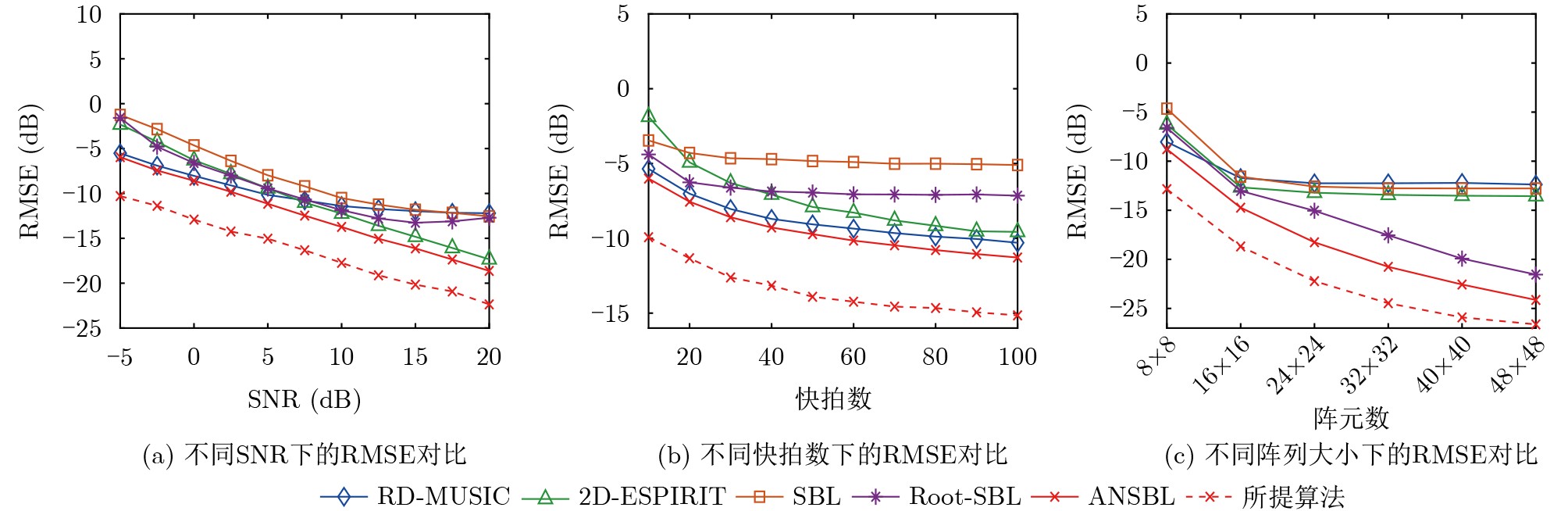
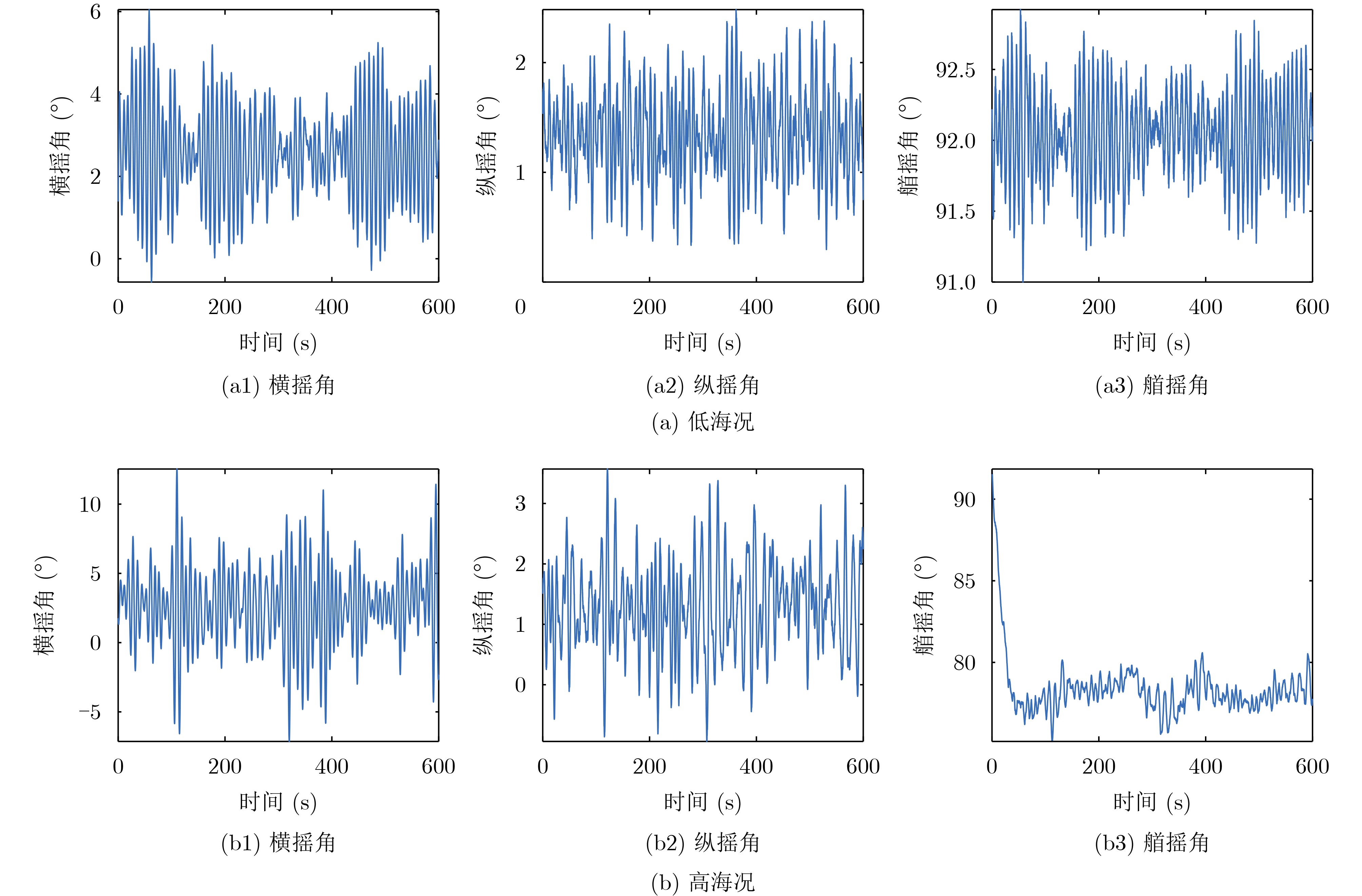
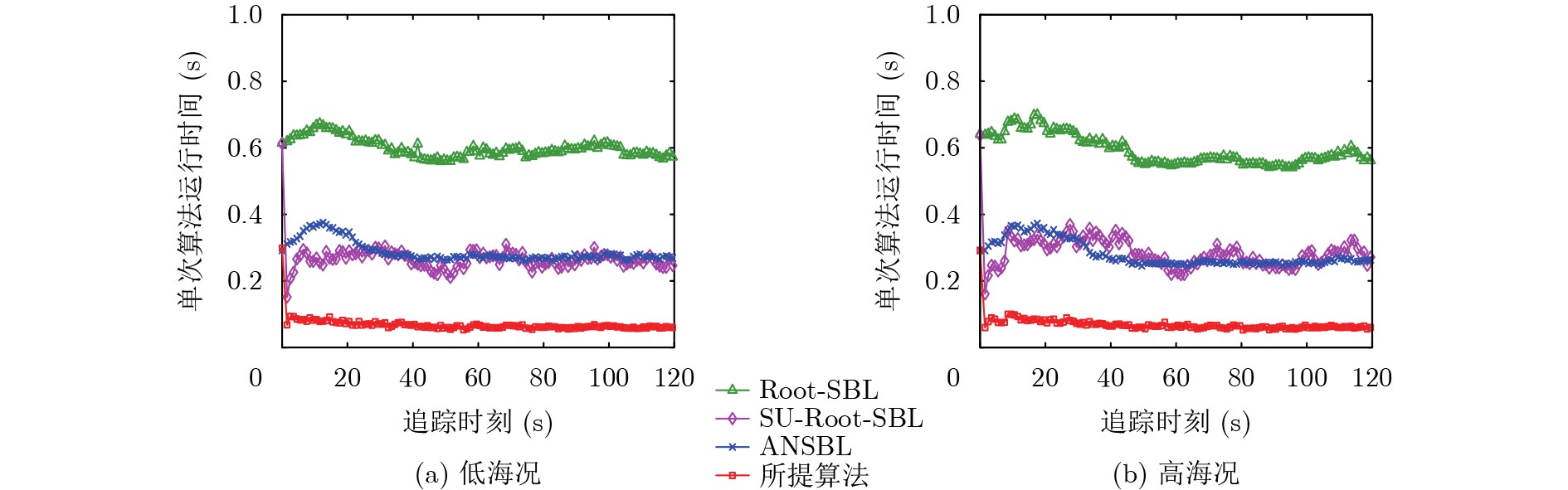
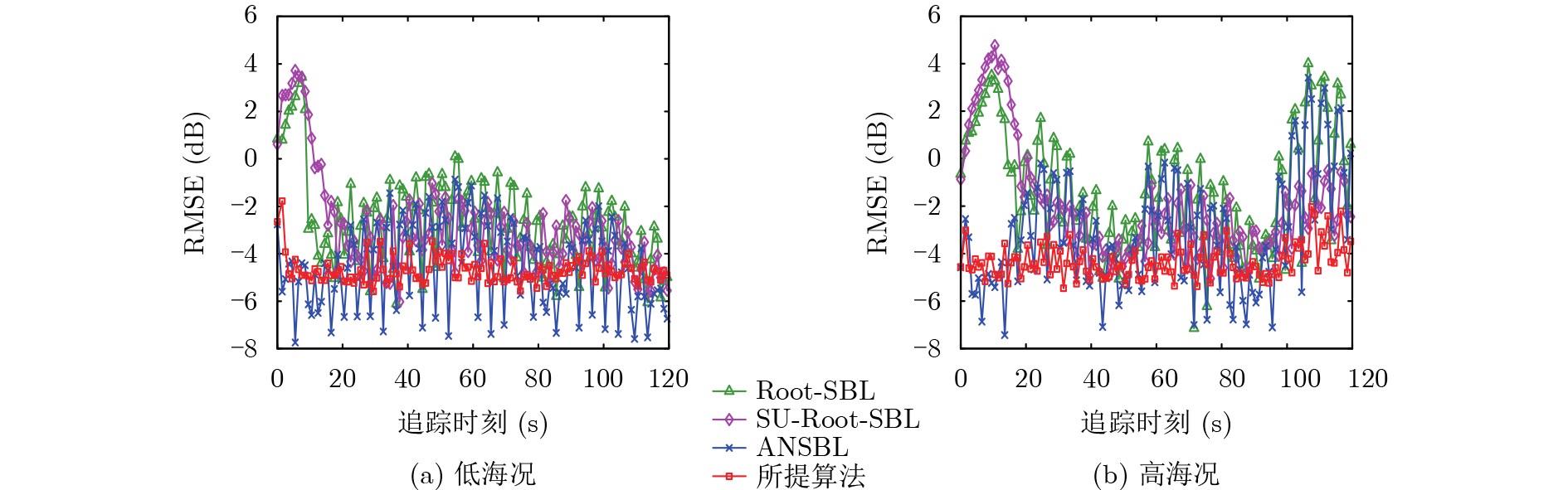
Objective The 6G-based SATellite COMmunication (SATCOM) network has become a primary solution for ubiquitous and oceanic communications. Compared with traditional Geostationary Earth Orbit (GEO) satellites, the latest generation of Low Earth Orbit (LEO) satellites offers higher throughput, lower end-to-end latency, and lower deployment cost. Phased arrays are therefore widely used in LEO SATCOM because of their beam agility. However, maritime wind-wave disturbances cause nonlinear relative motion between shipborne terminals and LEO satellites, which creates major challenges for high-precision satellite acquisition and tracking. To address this issue, a new beam alignment algorithm is required for LEO SATCOM systems. Such an algorithm should first obtain the instantaneous target state and motion characteristics through target acquisition, and then use a multi-target tracking method to predict satellite trajectories on the basis of the target states, thereby compensating for estimation errors caused by severe coupled motions. Methods The proposed closed-loop feedback adaptive beam alignment algorithm consists of two tightly coupled components: target acquisition and target state updating. In the target acquisition stage, a RAnk Reduction Estimator(RARE) is first used to decompose the array factor matrix and convert the original two-dimensional Direction Of Arrival(DOA) estimation problem into two sequential one-dimensional estimation problems. This process greatly reduces the computational complexity of each Sparse Bayesian Learning(SBL) iteration. On the basis of the coarse grid generated by RARE, an Adaptive Newton Sparse Bayesian Learning(ANSBL) method is developed. ANSBL uses block-sparse Bayesian learning to achieve initial target acquisition on the coarse grid, and then performs two-stage Newton refinement to reduce off-grid mismatch. This strategy provides high-accuracy DOA estimation in both $ \theta $ and $ \varphi $ and improves angular observation precision. In the target state updating stage, an Unscented Kalman Filter(UKF)-based ternary joint prediction mechanism is proposed. The UKF simultaneously predicts the target motion state, signal variance, and noise variance for the next target acquisition process. These predicted probability distributions are then used to update the initial grid and hyperparameters of the subsequent SBL acquisition stage, providing more consistent and comprehensive initial values. Through this closed-loop interaction, target acquisition and state tracking are deeply integrated, which substantially reduces the number of SBL iterations required for convergence. This advantage is particularly evident under high sea-state conditions, where reduced beam alignment time is critical. Results and Discussions The proposed closed-loop feedback adaptive beam alignment algorithm first uses on-grid DOA estimation to reduce array factor correlation and improve target acquisition efficiency, and then uses Newton iteration to achieve higher off-grid accuracy ( Fig. 3 ). The proposed method is subsequently validated using real ship attitude data collected from a 28000-DWT bulk carrier under actual sea conditions (Fig. 4 ). The UKF refines the DOA results through state updating. Its predictions of signal position, signal variance, and noise variance provide accurate initial values for the hyperparameters, thereby reducing the number of iterations and enabling faster convergence than other algorithms (Fig. 5 ). Under low sea-state conditions, the proposed method not only achieves satellite alignment in less than 0.2 s, but also reduces the satellite position estimation error from ±1°$ \sim $±0.5° (Fig. 6(a) ). Under high sea-state conditions, the UKF effectively predicts satellite positions and reduces the satellite position estimation error from ±2.5°$ \sim $±0.65°, which verifies the robust tracking accuracy and error mitigation capability of the proposed method in harsh marine environments (Fig. 6(b) ).Conclusions To meet the performance requirements of beam alignment algorithms for LEO communication satellites, this paper proposes a closed-loop feedback adaptive beam alignment algorithm. The algorithm first uses a block-based SBL algorithm to obtain grid-based DOA estimation results, and then achieves super-resolution direction estimation under off-grid conditions through adaptive Newton iteration. Through the UKF, the estimation results are dynamically calibrated in real time. The UKF further predicts the target motion state, signal variance, and noise variance for the next target acquisition process, thereby improving tracking continuity and alignment accuracy. Numerical simulations show that the proposed algorithm outperforms traditional beam alignment methods in both numerical accuracy and robustness, and effectively mitigates severe terminal shaking under complex sea conditions. -
1 SU-ANSBL流程表
1.初始化: 迭代参数:追踪时刻$ t=0 $;追踪总次数:$ {T}_{\text{track}} $;追踪间隔$ {\varDelta }_{t} $ 实施ANSBL,获得初始状态矩阵:$ {\boldsymbol{E}}_{\mathrm{p},0} $, $ {\boldsymbol{E}}_{\boldsymbol{\delta },0} $, $ {\boldsymbol{E}}_{\sigma ,0} $和初始误差协方差矩阵的先验预测值:$ {\boldsymbol{P}}_{\mathrm{p},0} $, $ {\boldsymbol{P}}_{\boldsymbol{\delta },0} $, $ {\boldsymbol{P}}_{\sigma ,0} $ 2. SU-ANSBL: 当$ t\leq {T}_{\text{track}} $时: 更新各均值矩阵和方差矩阵的先验预测值:$ {{\overline{\boldsymbol{\chi }}}}_{\mathrm{p},t|t-1} $, $ {{\overline{\boldsymbol{\chi }}}}_{\boldsymbol{\delta },t|t-1} $, $ {{\overline{\boldsymbol{\chi }}}}_{\sigma ,t|t-1} $, $ {\boldsymbol{P}}_{\text{p},t|t-1} $, $ {\boldsymbol{P}}_{\boldsymbol{\delta },t|t-1} $, $ {\boldsymbol{P}}_{\sigma ,t|t-1} $ 更新字典矩阵$ {\boldsymbol{\boldsymbol{\varPhi }}}_{x} $和$ {{\boldsymbol{\varPhi }}}_{y} $,信号方差向量$ {\boldsymbol{\delta }}_{x} $和$ {\boldsymbol{\delta }}_{y} $,噪声方差$ {\sigma }^{2} $ 实施ANSBL,获得DOA估计结果,计算观测矩阵:$ {{\tilde{\boldsymbol{Z}}}}_{\text{p},{t}} $, $ {{\tilde{\boldsymbol{Z}}}}_{\boldsymbol{\delta },0} $, $ {{\tilde{\boldsymbol{Z}}}}_{\sigma ,0} $ 更新各均值矩阵和方差矩阵的后验预测值:$ {{\overline{\boldsymbol{\chi }}}}_{\text{p},t} $, $ {{\overline{\boldsymbol{\chi }}}}_{\boldsymbol{\delta },t} $, $ {{\overline{\boldsymbol{\chi }}}}_{\sigma ,t} $, $ {\boldsymbol{P}}_{\mathrm{p},t} $, $ {\boldsymbol{P}}_{\boldsymbol{\delta },t} $, $ {\boldsymbol{P}}_{\sigma ,t} $ 根据$ {{\overline{\boldsymbol{\chi }}}}_{\mathrm{p},t} $计算信号源位置的最终估计值并输出:$ \left({\tilde{\theta }}_{k},{\tilde{\varphi }}_{k}\right) $ $ t\leftarrow t+{\varDelta }_{t} $  下载: 导出CSV
表 1 28 000-DWT级散货船,Walker星座参数表
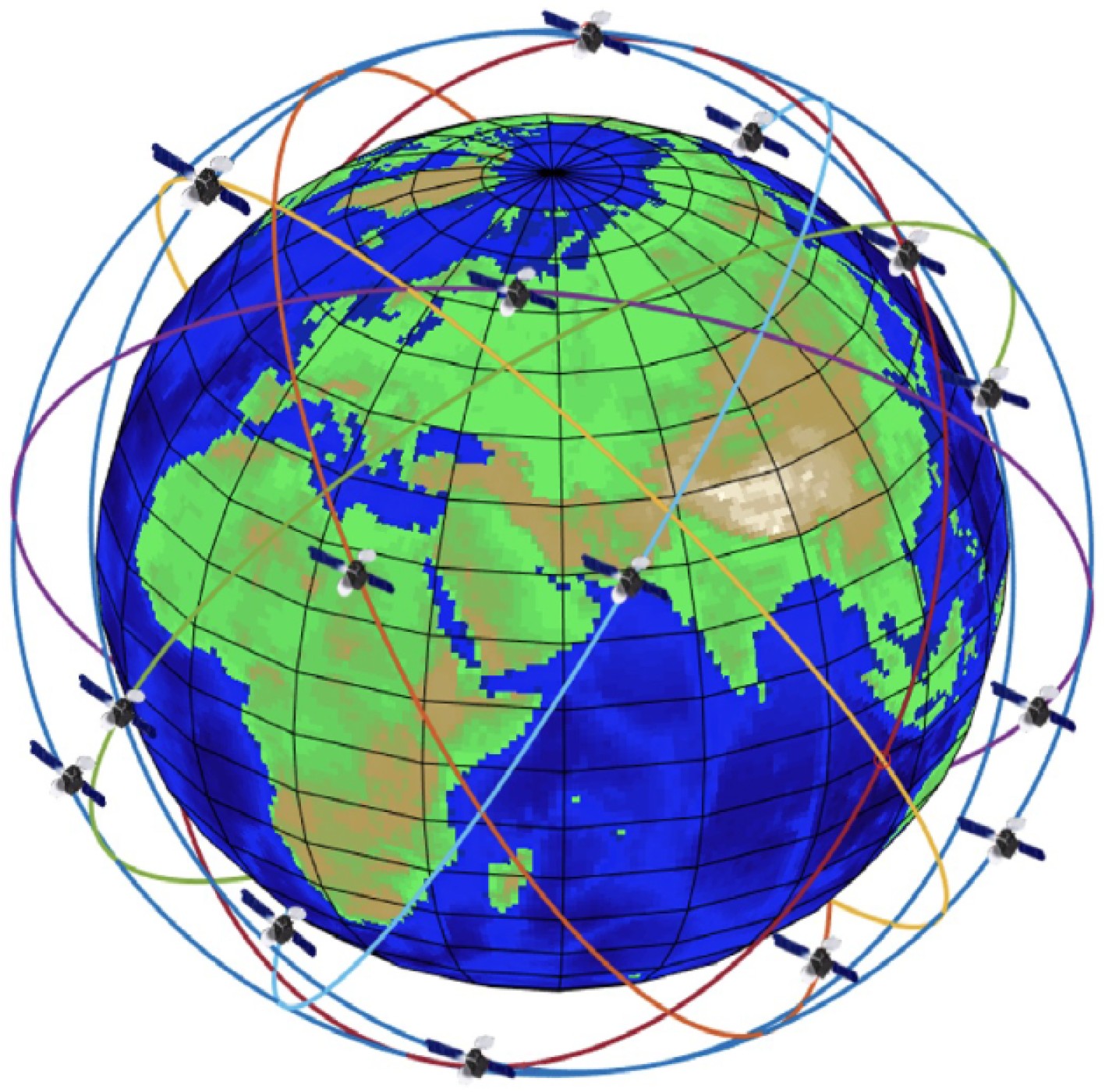
名称 基本参数 数值 28000-DWT级散货船 垂直间长 160.4 m 船宽 27.2 m 平均吃水 8.16 m 常用航速 12节 Walker星座 N/P/F 160/8/0 卫星高度 1200 km轨道倾角 60°
下载: 导出CSV
-
[1] 冯伊凡, 吴畏虹, 孙罡, 等. 天地一体化边缘计算网络服务迁移算法研究[J]. 电子与信息学报, 2026, 48(2): 499–511. doi: 10.11999/JEIT250835.FENG Yifan, WU Weihong, SUN Gang, et al. Service migration algorithm for satellite-terrestrial edge computing networks[J]. Journal of Electronics & Information Technology, 2026, 48(2): 499–511. doi: 10.11999/JEIT250835. [2] GUO Ningxuan, LIU Liang, and ZHONG Xiaoqing. Task-aware distributed inter-layer topology optimization method in resource-limited LEO-LEO satellite networks[J]. IEEE Transactions on Wireless Communications, 2024, 23(4): 3572–3585. doi: 10.1109/TWC.2023.3309379. [3] LIU Ying, ZHANG Wenbo, JIA Yongtao, et al. Low RCS antenna array with reconfigurable scattering patterns based on digital antenna units[J]. IEEE Transactions on Antennas and Propagation, 2021, 69(1): 572–577. doi: 10.1109/TAP.2020.3004993. [4] 梁广, 龚文斌, 余金培. 基于子阵列的低轨星载多波束相控阵天线的设计与实现[J]. 电子与信息学报, 2010, 32(6): 1435–1440. doi: 10.3724/SP.J.1146.2009.00695.LIANG Guang, GONG Wenbin, and YU Jinpei. The design and implementation of sub-arrayed phased array antenna for LEO satellite[J]. Journal of Electronics & Information Technology, 2010, 32(6): 1435–1440. doi: 10.3724/SP.J.1146.2009.00695. [5] WÜNSCHE R, KRONDORF M, and KNOPP A. Investigations of channel capacity loss in LEO satellite systems using phased array beamforming antennas[J]. IEEE Transactions on Aerospace and Electronic Systems, 2024, 60(4): 5373–5394. doi: 10.1109/TAES.2024.3392181. [6] LI Min, GAO Huiyan, LI Nayu, et al. A 17.7–19.2-GHz receiver front end with an adaptive analog temperature- compensation scheme[J]. IEEE Transactions on Microwave Theory and Techniques, 2023, 71(3): 1068–1082. doi: 10.1109/TMTT.2022.3215558. [7] LI Nayu, MA Zixian, XIE Xinhong, et al. A Ka-band 64-element four-beam phased array receiver with inter-beam interference cancellation[J]. IEEE Transactions on Microwave Theory and Techniques, 2025, 73(1): 221–233. doi: 10.1109/TMTT.2024.3418879. [8] HONG Ru, QI Xiaokang, XIE Xinhong, et al. A dual-beam 256-element K-band Active phased array with reconfigurable polarization[J]. IEEE Antennas and Wireless Propagation Letters, 2026. doi: 10.1109/LAWP.2026.3661753. [9] MA Zixian, XIE Xinhong, LI Nayu, et al. Multibeam-assisted cross-polarization suppression with Ka-band 64-element four-beam reconfigurable phased array implementation[J]. IEEE Transactions on Microwave Theory and Techniques, 2025, 73(12): 10814–10826. doi: 10.1109/TMTT.2025.3612979. [10] XIE Xinhong, CHEN Haotian, MA Zixian, et al. A power-only fast calibration method for phased array using convolution neural network[J]. IEEE Antennas and Wireless Propagation Letters, 2024, 23(11): 3972–3976. doi: 10.1109/LAWP.2024.3452268. [11] CHEN Haotian, XIE Xinhong, MA Zixian, et al. A novel fast far-field phased array calibration method utilizing deep residual neural networks[J]. IEEE Transactions on Antennas and Propagation, 2025, 73(4): 2217–2231. doi: 10.1109/TAP.2025.3547915. [12] TAIRA S, TANAKA M, and OHMORI S. High gain airborne antenna for satellite communications[J]. IEEE Transactions on Aerospace and Electronic Systems, 1991, 27(2): 354–360. doi: 10.1109/7.78309. [13] CHEN Qin, XU Yuying, SONG Chunyi, et al. Adaptive tracking for beam alignment between ship-borne digital phased-array antenna and LEO satellite[J]. Journal of Communications and Information Networks, 2019, 4(3): 60–70. doi: 10.23919/JCIN.2019.8917886. [14] 李卓. 面向复杂信号环境GNSS载波相位质量的深组合技术研究[D]. [硕士论文], 武汉大学, 2019.LI Zhuo. Research on deep integration technology for GNSS carrier phase quality in complex signal environment[D]. [Master dissertation], Wuhan University, 2019. [15] 何红丽. 运动平台轨迹计算方法研究[J]. 国际航空航天科学, 2015, 3(2): 13–18. doi: 10.12677/JAST.2015.32002.HE Hongli. Study on trajectory algorithm of motion platform[J]. Journal of Aerospace Science and Technology, 2015, 3(2): 13–18. doi: 10.12677/JAST.2015.32002. [16] YUEN N and FRIEDLANDER B. Asymptotic performance analysis of ESPRIT, higher order ESPRIT, and virtual ESPRIT algorithms[J]. IEEE Transactions on Signal Processing, 1996, 44(10): 2537–2550. doi: 10.1109/78.539037. [17] ZHANG Chen, ZHAO Minjian, and CAI Yunlong. Joint 2-D DOA estimation and mutual coupling calibration for uniform rectangular arrays[C]. 2015 International Conference on Wireless Communications & Signal Processing (WCSP), Nanjing, China, 2015: 1–5. doi: 10.1109/WCSP.2015.7340991. [18] GANGULY S, GHOSH J, MUKHOPADHYAY M, et al. Multi-time snapshot based off-grid DOA estimation of sparse array antennas using MFOCUSS algorithm[C]. 2020 URSI Regional Conference on Radio Science (URSI-RCRS), Varanasi, India, 2020: 1–4. doi: 10.23919/URSIRCRS49211.2020.9113604. [19] CHOO Y and YANG H. Broadband off-grid DOA estimation using block sparse Bayesian learning for nonuniform noise variance[J]. IEEE Journal of Oceanic Engineering, 2022, 47(4): 1024–1040. doi: 10.1109/JOE.2022.3151949. [20] YANG Yang, CHU Zhigang, and PING Guoli. Two-dimensional multiple-snapshot grid-free compressive beamforming[J]. Mechanical Systems and Signal Processing, 2019, 124: 524–540. doi: 10.1016/j.ymssp.2019.02.011. [21] DAI Jisheng, BAO Xu, XU Weichao, et al. Root sparse Bayesian learning for off-grid DOA estimation[J]. IEEE Signal Processing Letters, 2017, 24(1): 46–50. doi: 10.1109/LSP.2016.2636319. [22] LIANG Guolong, LI Chenmu, QIU Longhao, et al. State-updating-based DOA estimation using sparse Bayesian learning[J]. Applied Acoustics, 2022, 192: 108719. doi: 10.1016/j.apacoust.2022.108719. [23] DING Yanwu, MINKLER C, and ZHANG Y D, et al. Single-satellite EMI geolocation via flexibly constrained UKF exploiting Doppler acceleration[J]. IEEE Signal Processing Letters, 2025, 32: 11–15. doi: 10.1109/LSP.2024.3487778. [24] 宋佳蓁, 师卓越, 张晓平, 等. 基于快速无迹卡尔曼滤波的雷达高速目标追踪技术[J]. 电子与信息学报, 2025, 47(8): 2703–2713. doi: 10.11999/JEIT25001.SONG Jiazhen, SHI Zhuoyue, ZHANG Xiaoping, et al. Radar high-speed target tracking via quick unscented Kalman filter[J]. Journal of Electronics & Information Technology, 2025, 47(8): 2703–2713. doi: 10.11999/JEIT25001. [25] JING Qianfeng, SASA K, CHEN Chen, et al. Analysis of ship maneuvering difficulties under severe weather based on onboard measurements and realistic simulation of ocean environment[J]. Ocean Engineering, 2021, 221: 108524. doi: 10.1016/j.oceaneng.2020.108524. -

 下载:
下载:

图(6) / 表(2)
计量
- 文章访问数: 880
- HTML全文浏览量: 426
- PDF下载量: 75
- 被引次数: 0
