




Index Modulation Design with Sparse Spatial Constellation and Dynamic Multi-RIS-Block Selection for RIS-MIMO Systems
-
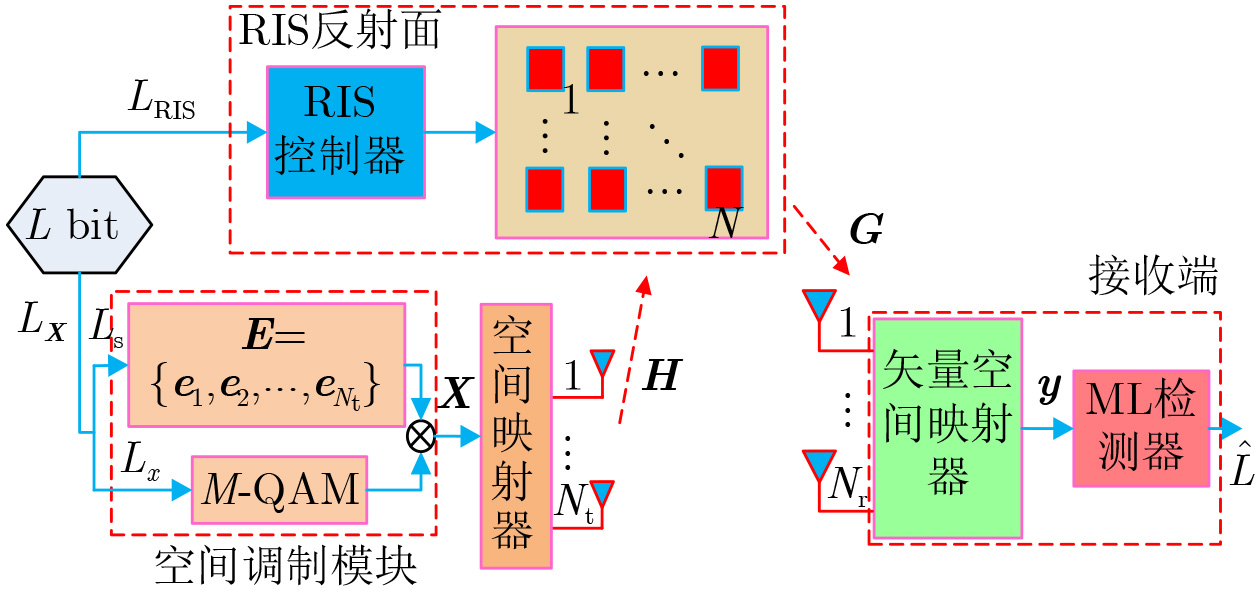
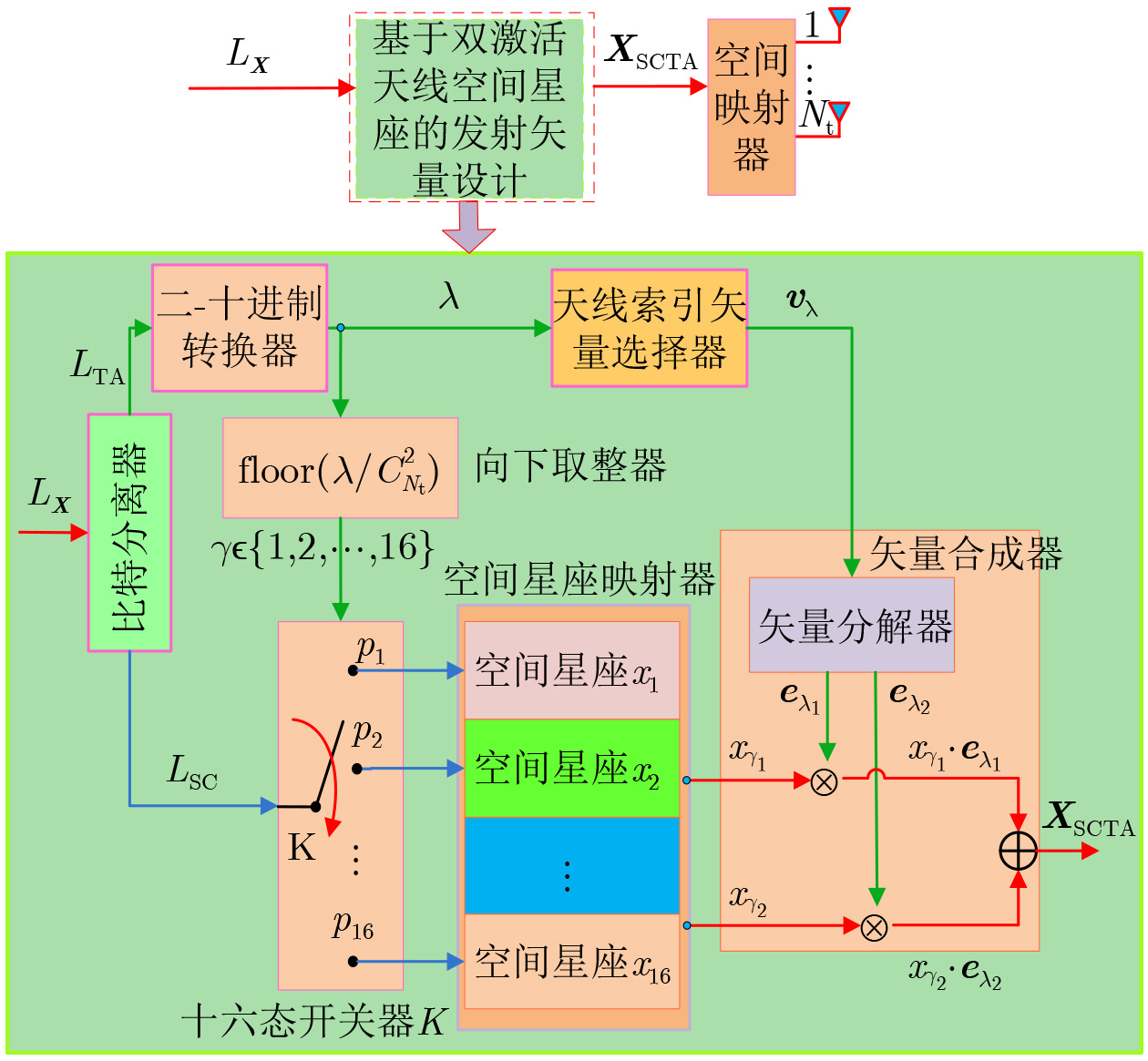
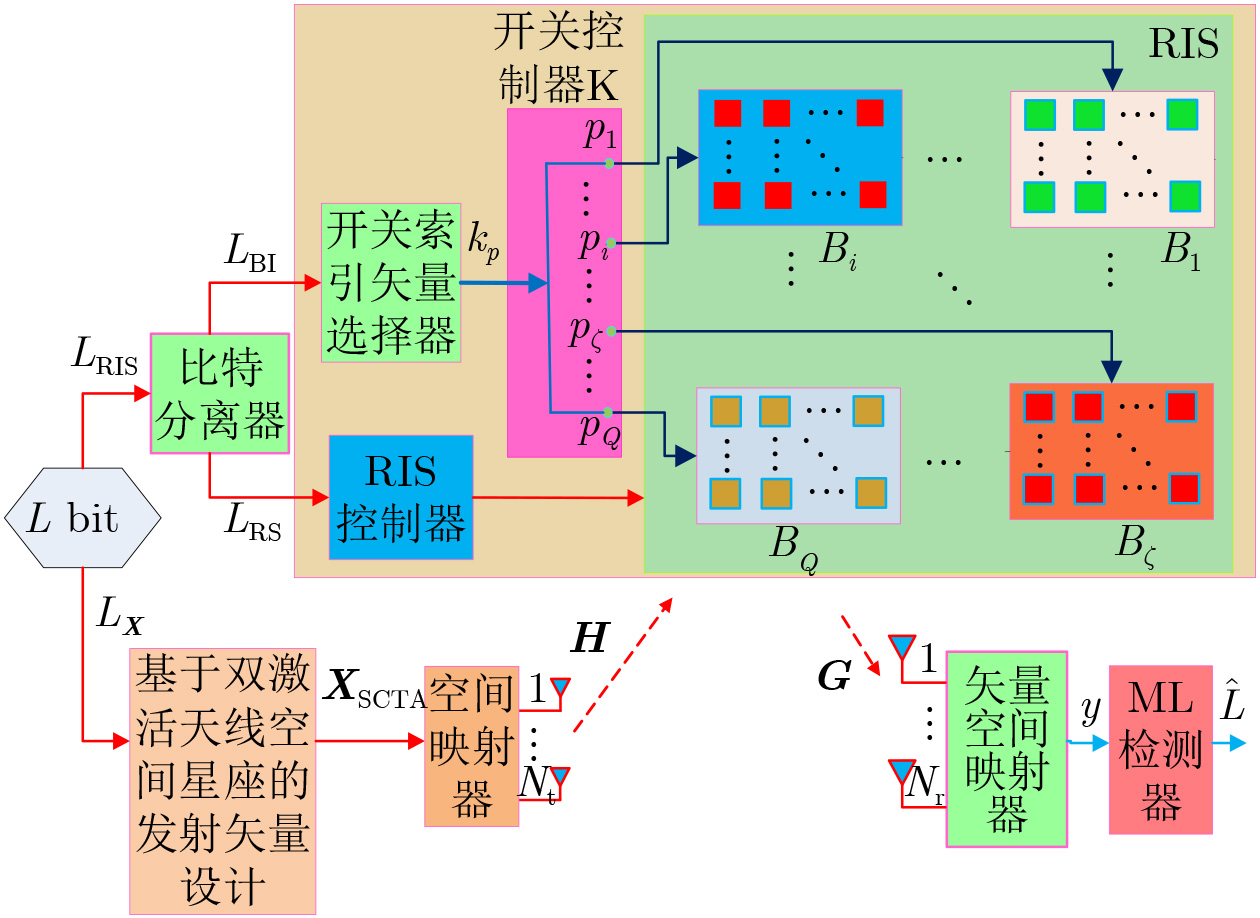
摘要: 针对可重构智能表面(RIS)辅助多输入多输出(MIMO)索引调制系统中单块大规模RIS部署困难和发射端空间信号设计复杂度高的挑战,该文研究一种联合稀疏空间星座-双激活天线(SCTA)与多RIS块(MBRIS)选择的索引调制设计。该研究首先提出一种基于稀疏空间星座-双激活天线的RIS空间调制(SCTA-RIS-SM)系统,其核心是在发射端构造一种基于双激活天线的稀疏空间矢量,通过混合主、次级脉冲幅度调制(PAM)与次级PAM (SPAM)星座设计,优化发射矢量之间的最小欧氏距离,从而显著提升了系统的抗干扰能力。为克服单块RIS的部署瓶颈,进一步提出一种增强型方案:基于稀疏空间星座-双激活天线的多RIS块空间调制(SCTA-MBRIS-SM)系统。该系统采用分布式多RIS块阵列替代传统单块面板,通过动态选择激活一组特定的RIS块进行协同反射,将不同的“RIS块选择组合”状态作为一个新的索引调制维度。此增强型方案在不增加射频链路的条件下,额外提升了频谱效率,同时增强了部署的灵活性。理论分析与蒙特卡罗仿真结果表明,所提的两种系统在误比特率性能与频谱效率方面均优于现有典型方案,为未来高能效、高灵活性的RIS-MIMO通信系统提供了有效的解决方案。Abstract:
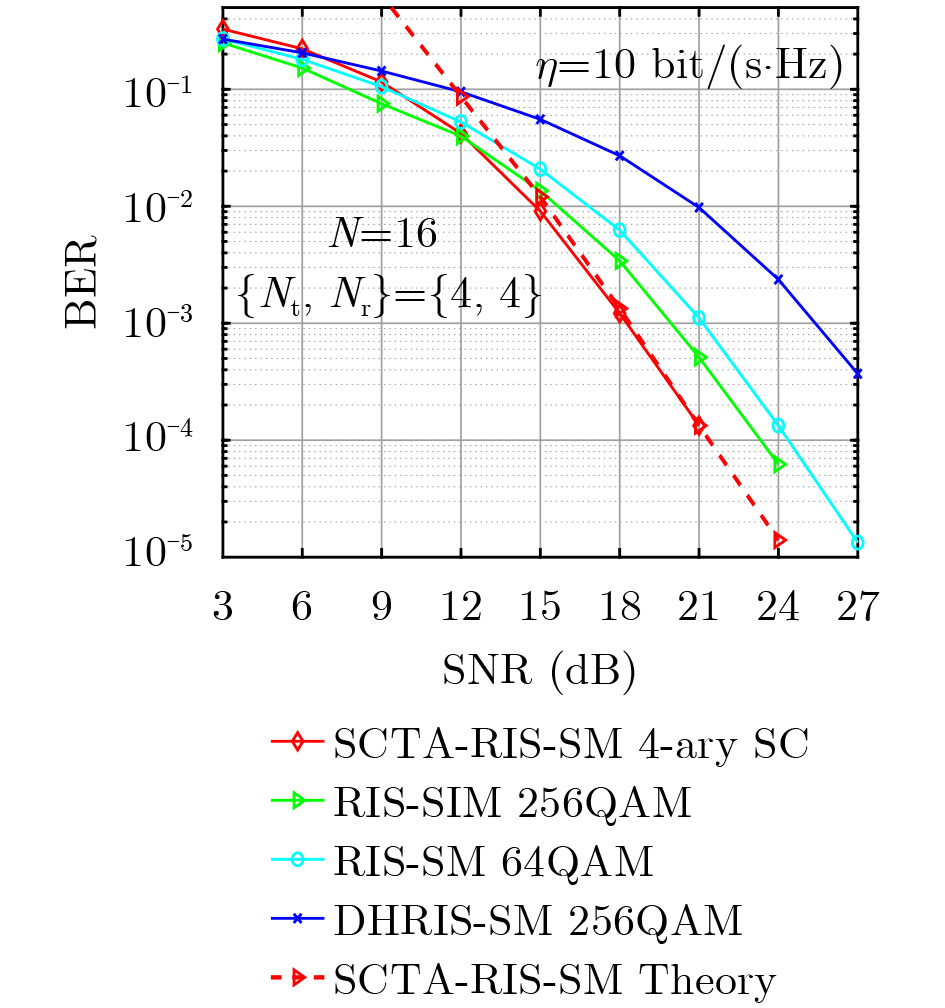
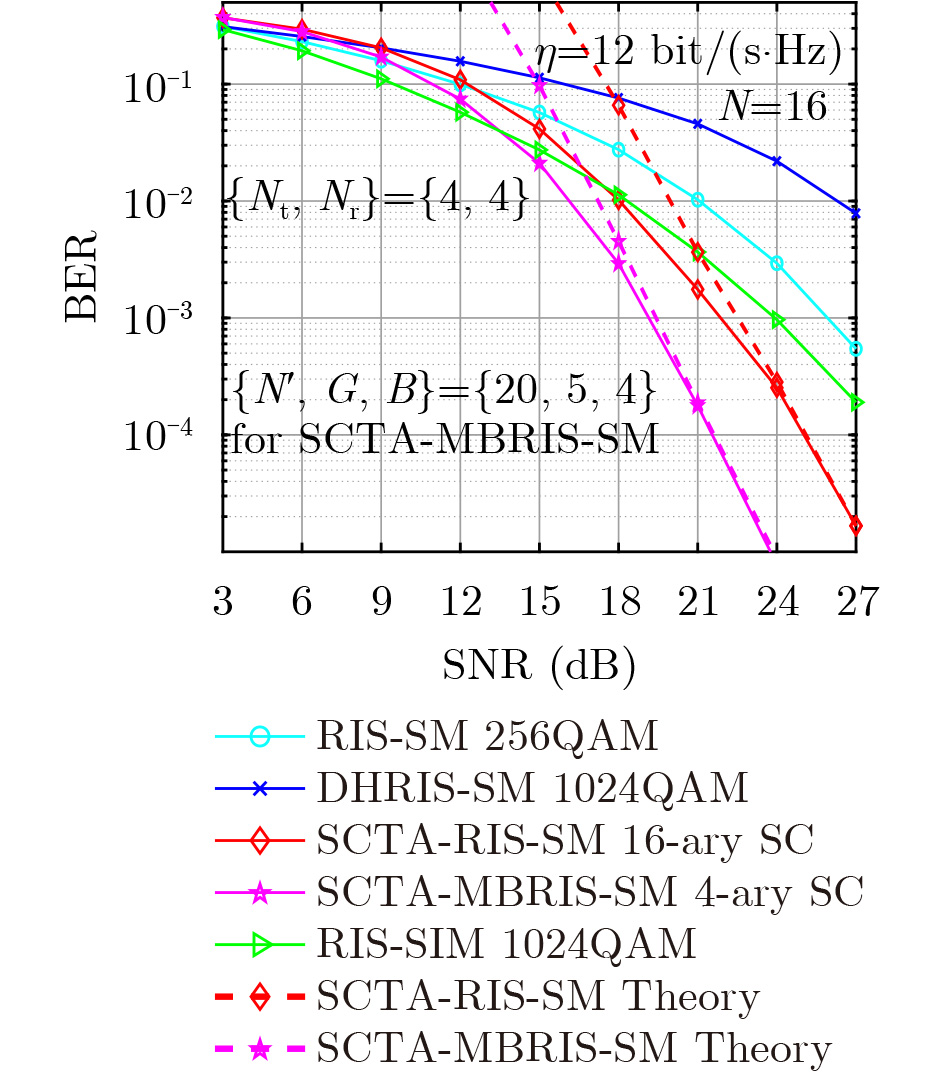
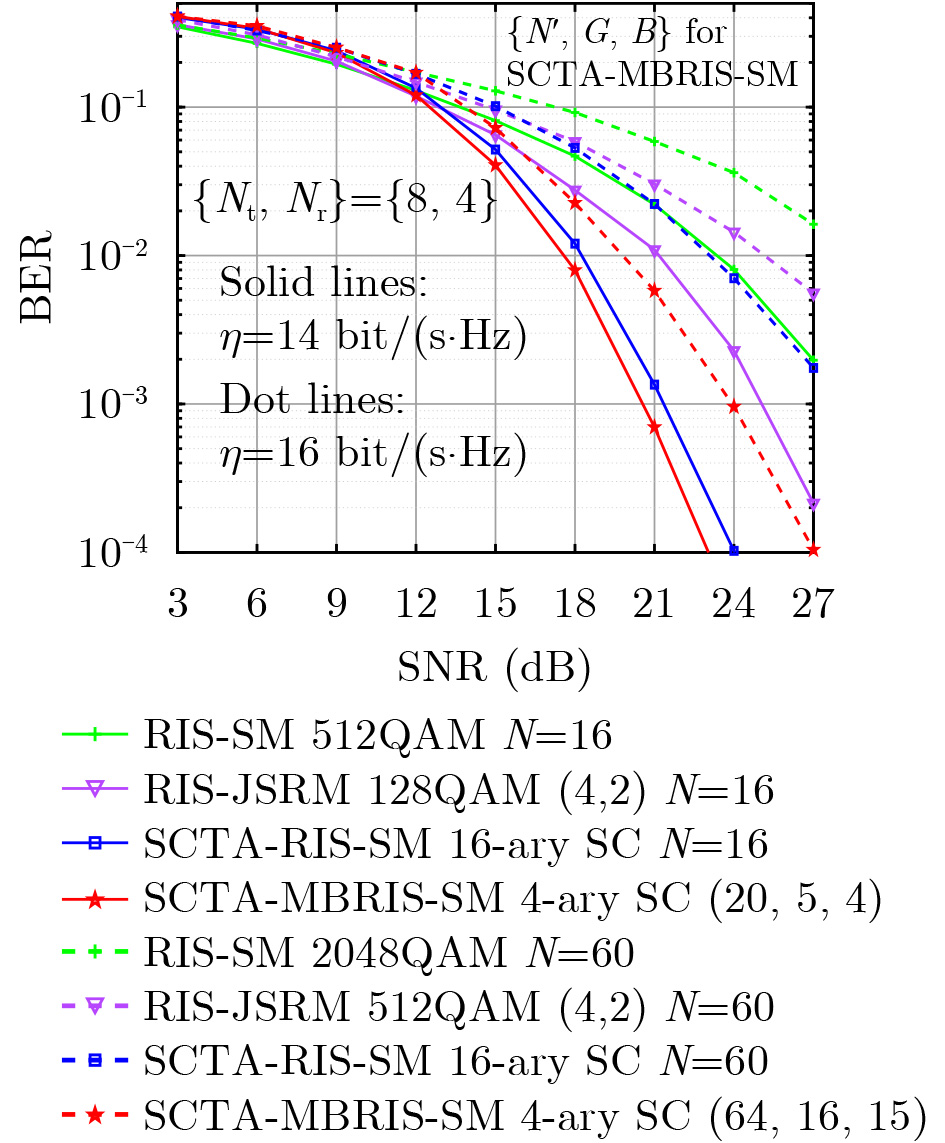
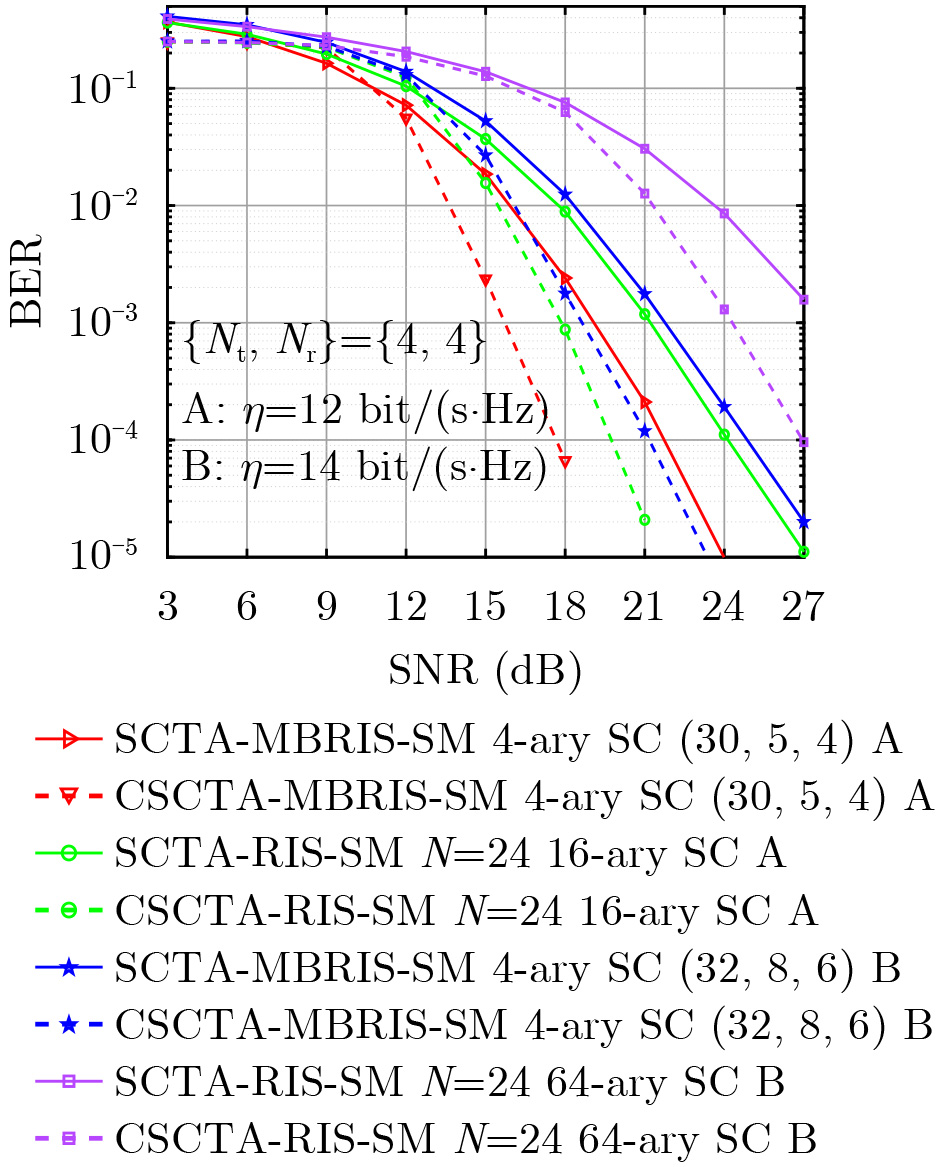
Objective Reconfigurable Intelligent Surface (RIS)-assisted Multiple-Input Multiple-Output (MIMO) Index Modulation (IM) systems face two main challenges: the difficult deployment of a single large-scale RIS panel and the high design complexity of efficient transmit spatial signal vectors. To address these issues, a joint design that combines sparse spatial constellation and dynamic multi-RIS-block selection is proposed. The design improves spectral efficiency, Bit Error Rate (BER) performance, and deployment flexibility. Methods Inspired by the Extended Space Index Modulation (ESIM) paradigm, a sparse Spatial Constellation with Two Active Antennas (SCTA) is proposed, forming the SCTA-RIS-SM system. In this design, Pulse Amplitude Modulation (PAM) and Secondary PAM (SPAM) constellations are combined to construct the spatial constellation vector [x1,x2]T, which is modulated onto two active antennas. This design maximizes the Minimum Euclidean Distance (MED) between transmit vectors and improves the anti-interference capability of the system. To address the deployment difficulty of a single large-scale RIS panel, an enhanced SCTA-MBRIS-SM system is further proposed. The system uses a distributed array of small RIS blocks and dynamically selects a subset of blocks for cooperative reflection. Different RIS block selection combinations are used as a new IM dimension. Spectral efficiency and average BER are then analyzed theoretically. Monte Carlo simulations are conducted to compare the proposed systems with several existing schemes. Results and Discussions The simulation results show that the proposed SCTA-RIS-SM system achieves clear Signal-to-Noise Ratio (SNR) gains over RIS-SIM, RIS-SM, and DHRIS-SM systems at the same spectral efficiency, such as 10–12 bits/(s·Hz). For instance, when BER = 10–3, SCTA-RIS-SM outperforms RIS-SIM by approximately 1.5–2.5 dB and DHRIS-SM by more than 6 dB. By using additional IM from RIS block selection, SCTA-MBRIS-SM further improves BER performance and spectral efficiency compared with SCTA-RIS-SM, without increasing the number of Radio Frequency (RF) chains. With the same total number of reflecting elements, the proposed multi-RIS-block scheme achieves an SNR gain of up to 5 dB over RIS-SIM when BER = 10–3. The theoretical BER curves agree well with the simulation results in the high-SNR region, confirming the validity of the analytical derivations. The results also indicate that the performance advantage is maintained as the number of transmit antennas increases. In addition, the proposed design is compatible with channel coding. Conclusions This paper addresses the challenges of large-scale RIS deployment and high-complexity spatial signal design in RIS-assisted MIMO systems. The proposed SCTA design improves system reliability by optimizing the Euclidean distance distribution in the signal space. Dynamic multi-RIS-block selection transforms hardware deployment constraints into a new dimension for improving spectral efficiency, providing a feasible path for practical large-scale RIS applications. Simulation results confirm that joint optimization of transmit spatial vectors and RIS reflection degrees of freedom is an effective strategy for improving system performance. Future work will focus on robust design under imperfect channel state information, construction of higher-dimensional sparse constellations, extension to extremely large-scale MIMO scenarios, and multi-user communications. -
表 1 归一化发射矢量之间平方MED比较
Nt=4 Nt=8 矢量 R1 R2 R3 R4 R5 R6 XQSM 0.20 0.10 0.05 0.20 0.10 0.05 XESIM 0.33 0.20 0.10 0.33 0.20 0.10 XSCTA 0.38 0.24 0.19 0.44 0.31 0.19  下载: 导出CSV
表 2 IBI比特与4块RIS激活状态的映射关系
输入比特LBI 开关索引矢量$ {\mathbf{k}}_{g} $ B块反射面板编号 0 0 [1,1,1,1,0]T 1,2,3,4 0 1 [1,1,1,0,1] T 1,2,3,5 1 0 [1,1,0,1,1] T 1,2,4,5 1 1 [1,0,1,1,1] T 1,3,4,5
下载: 导出CSV
-
[1] MESLEH R, IKKI S S, and AGGOUNE H M. Quadrature spatial modulation[J]. IEEE Transactions on Vehicular Technology, 2015, 64(6): 2738–2742. doi: 10.1109/tvt.2014.2344036. [2] ZHU Feifei, HAI Han, PENG Yuyang, et al. Extended variable active antenna generalized spatial modulation[J]. IEEE Wireless Communications Letters, 2024, 13(2): 265–269. doi: 10.1109/LWC.2023.3322005. [3] 张丽娟, 沙莎, 钟华乾. 智能反射面辅助的空间调制系统的高效盲检测聚类算法研究[J]. 电子与信息学报, 2025, 47(10): 3518–3527. doi: 10.11999/JEIT250162.ZHANG Lijuan, SHA Sha, and ZHONG Huaqian. Efficient blind detection clustering algorithm for reconfigurable intelligent surface-aided spatial modulation systems[J]. Journal of Electronics & Information Technology, 2025, 47(10): 3518–3527. doi: 10.11999/JEIT250162. [4] HUANG Fuchun and LI Dong. Extended space index modulation[J]. IEEE Wireless Communications Letters, 2022, 11(6): 1171–1175. doi: 10.1109/LWC.2022.3160059. [5] HUANG Fuchun and LI Dong. Spatial modulation with joint permutation, group and antenna indexes[J]. IEEE Wireless Communications Letters, 2023, 12(4): 753–757. doi: 10.1109/LWC.2023.3243433. [6] BASAR E. Reconfigurable intelligent surface-based index modulation: A new beyond MIMO paradigm for 6G[J]. IEEE Transactions on Communications, 2020, 68(5): 3187–3196. doi: 10.1109/TCOMM.2020.2971486. [7] 景小荣, 马玉丹, 万宇, 等. 基于索引调制的RIS辅助SIMO通信系统信号检测算法[J]. 电子与信息学报, 2022, 44(7): 2382–2391. doi: 10.11999/JEIT211468.JING Xiaorong, MA Yudan, WAN Yu, et al. Signal detection algorithm of RIS-Assisted SIMO communication system with index modulation[J]. Journal of Electronics & Information Technology, 2022, 44(7): 2382–2391. doi: 10.11999/JEIT211468. [8] MA Teng, XIAO Yue, LEI Xia, et al. Large intelligent surface assisted wireless communications with spatial modulation and antenna selection[J]. IEEE Journal on Selected Areas in Communications, 2020, 38(11): 2562–2574. doi: 10.1109/JSAC.2020.3007044. [9] GUO Shuaishuai, Lü Shuheng, ZHANG Haixia, et al. Reflecting modulation[J]. IEEE Journal on Selected Areas in Communications, 2020, 38(11): 2548–2561. doi: 10.1109/JSAC.2020.3007060. [10] SANILA K S and RAJAMOHAN N. Joint spatial and reflecting modulation for active IRS assisted MIMO communications[J]. IEEE Transactions on Communications, 2023, 71(5): 3132–3143. doi: 10.1109/TCOMM.2023.3258486. [11] YASIN S H, OMER O A, NOR A M, et al. Reconfigurable intelligent surfaces-assisted enhanced spatial modulation for future wireless networks[J]. IEEE Access, 2023, 11: 142652–142662. doi: 10.1109/ACCESS.2023.3339644. [12] 陈平平, 张云馨, 杜伟庆. 可重构智能表面辅助的联合空间和码索引调制通信系统[J]. 电子与信息学报, 2025, 47(2): 439–448. doi: 10.11999/JEIT240987.CHEN Pingping, ZHANG Yunxin, and DU Weiqing. Reconfigurable intelligent surface-aided joint spatial and code index modulation communication system[J]. Journal of Electronics & Information Technology, 2025, 47(2): 439–448. doi: 10.11999/JEIT240987. [13] VORDONIS D, KOMPOSTIOTIS D, PALIOURAS V, et al. Evaluating beam aweeping for AoA estimation with an RIS prototype: Indoor/outdoor field trials[C]. 2025 IEEE Wireless Communications and Networking Conference, Milan, Italy, 2025. doi: 10.1109/WCNC61545.2025.10978277. [14] GAUTAM P R, ZHANG Li, and FAN Pingzhi. Passive precoding and power allocation for energy efficient reconfigurable intelligent surface enhanced millimeter wave MU-MISO[J]. IEEE Transactions on Vehicular Technology, 2026, 75(4): 5831–5845. doi: 10.1109/TVT.2025.3617379. [15] WIJEKOON D, MEZGHANI A, and HOSSAIN E. Joint communication and sensing in RIS-assisted MIMO system under mutual coupling[EB/OL]. https://arxiv.org/abs/2601.08142, 2026. [16] PEI Xilong, YIN Haifan, TAN Li, et al. RIS-aided wireless communications: Prototyping, adaptive beamforming, and indoor/outdoor field trials[J]. IEEE Transactions on Communications, 2021, 69(12): 8627–8640. doi: 10.1109/TCOMM.2021.3116151. [17] LI Dong. How many reflecting elements are needed for energy- and spectral-efficient intelligent reflecting surface-assisted communication[J]. IEEE Transactions on Communications, 2022, 70(2): 1320–1331. doi: 10.1109/TCOMM.2021.3128544. [18] LI Dong. Ergodic capacity of intelligent reflecting surface-assisted communication systems with phase errors[J]. IEEE Communications Letters, 2020, 24(8): 1646–1650. doi: 10.1109/LCOMM.2020.2997027. [19] SIMON M K and ALOUINI M S. Digital Communication Over Fading Channels[M]. 2nd ed. Hoboken, USA: Wiley, 2005. [20] YU Xianhua and LI Dong. Phase shift compression for control signaling reduction in IRS-aided wireless systems: Global attention and lightweight design[J]. IEEE Transactions on Wireless Communications, 2024, 23(8): 8528–8541. doi: 10.1109/TWC.2024.3351755. -

 下载:
下载:

图(7) / 表(2)
计量
- 文章访问数: 454
- HTML全文浏览量: 184
- PDF下载量: 28
- 被引次数: 0
