




Physical Layer Security Game for Large Language Model-Based Inference in Maritime Networks
-
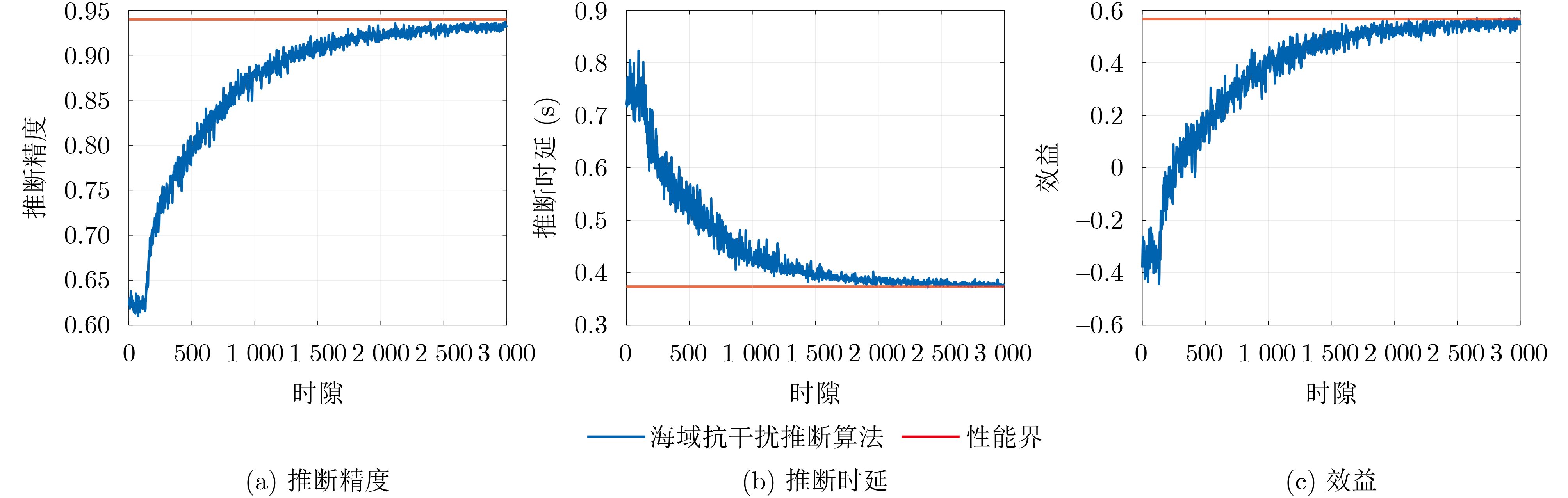
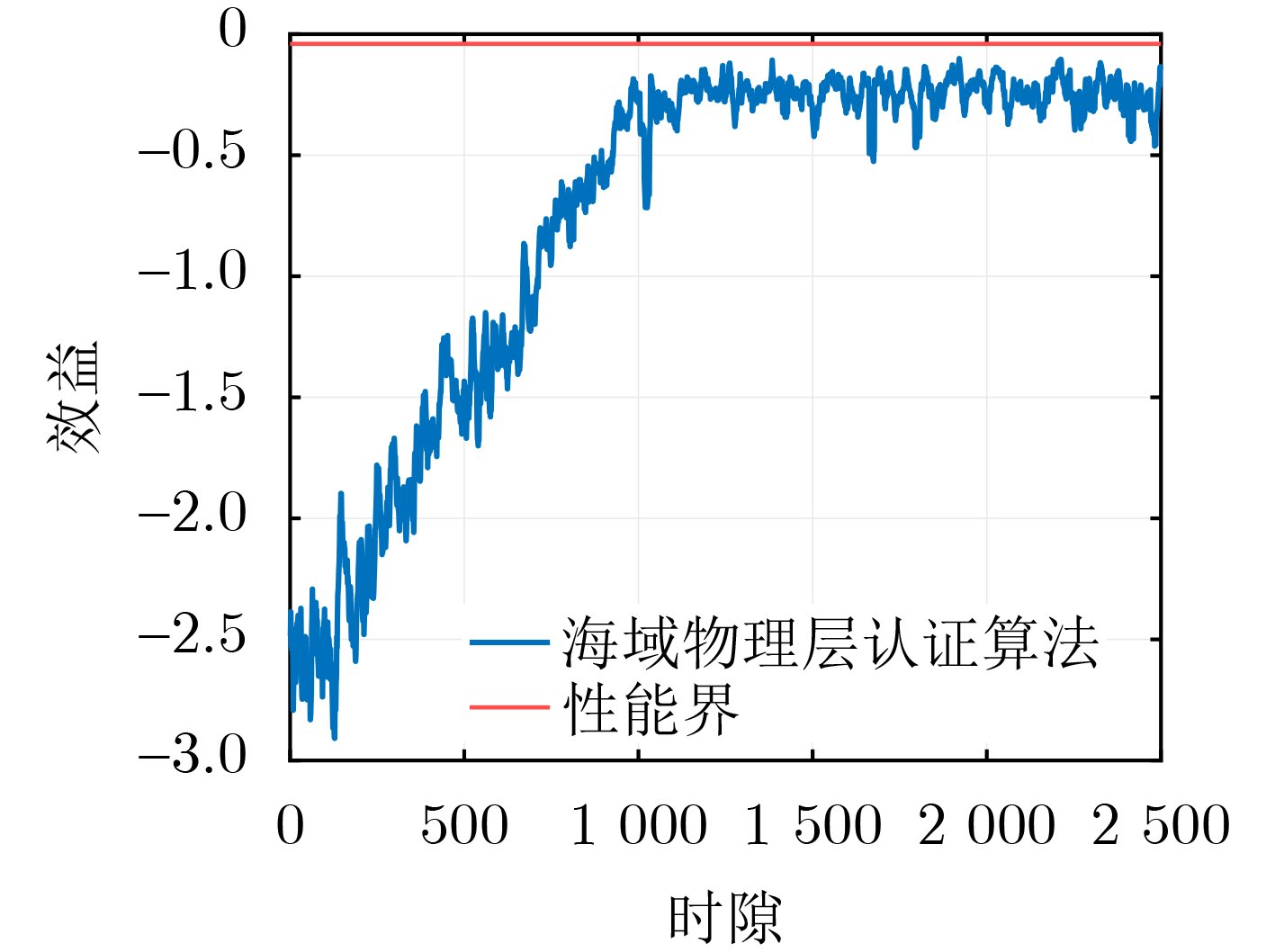
摘要: 物理层安全博弈理论分析终端和攻击者之间的交互机理,基于博弈均衡给出无线抗干扰和物理层认证等算法的性能界。在终端将海域图像等信息发给搭载大模型的岸边控制中心以支撑海域监测等业务场景下,现有博弈模型未考虑受到蒸导效应和海面反射影响的海域无线信道,难以准确分析大模型推断性能的变化。为此,该文构建面向大模型推断的海域抗干扰通信博弈,攻击者选择干扰功率和信道,以较低的干扰开销降低信干噪比,终端选择发射功率、传输信道、大模型稀疏率和岸边控制中心等策略以提高推断精度并降低时延。接着,构建面向大模型推断的海域认证博弈,攻击者选择虚假数据包数量,以较低攻击开销降低认证精度,岸边控制中心选择认证模式和阈值以提高认证精度并降低认证开销。基于包含70亿参数的大模型给出斯塔克伯格均衡,分析智能海域抗干扰推断和物理层认证算法性能极限,指导最大发射功率等系统参数选择,辅助快速设计物理层安全算法。仿真结果表明,基于强化学习的海域抗干扰推断和物理层认证算法分别在2500和1000时隙收敛,与性能界的差异小于1.6%,验证了理论分析的准确性。Abstract:
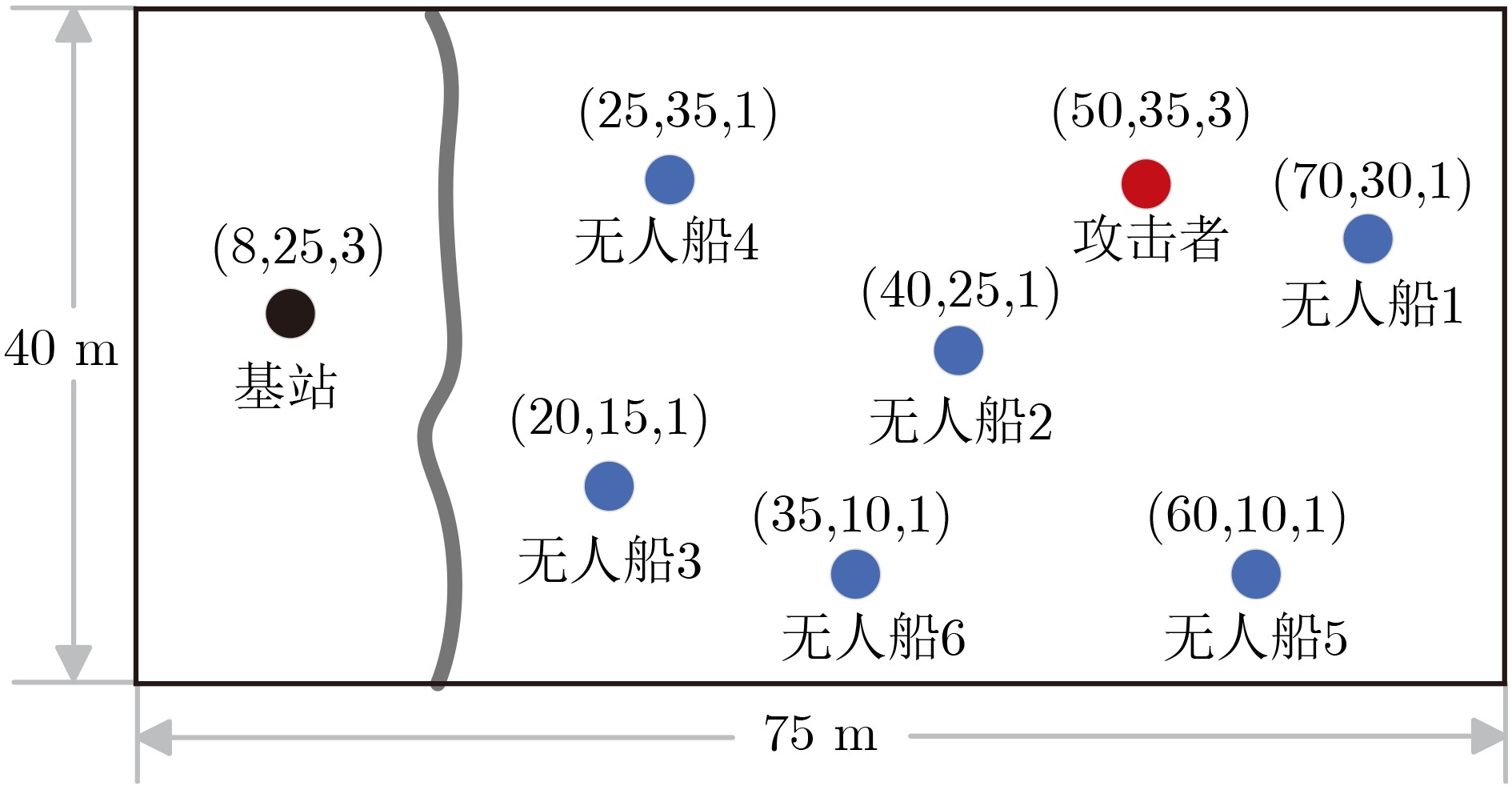
Objective The physical-layer security game is used to reveal the interaction between User Equipment (UE) and attackers, and to provide performance bounds for anti-jamming transmission and physical-layer authentication schemes based on the equilibria. However, existing game models overlook intelligent attackers that transmit jamming or spoofing signals, do not account for maritime wireless channels affected by evaporation ducts and sea wave fluctuations, and do not readily support performance evaluation of Large Language Model (LLM)-based inference tasks such as vessel traffic monitoring. Methods An anti-jamming maritime communication game for LLM inference is formulated. In this game, the jammer first selects the jamming power and channel to reduce the signal-to-interference-plus-noise ratio at the server at lower jamming cost. The UEs then select the transmit power, channel, LLM sparsity ratio, and control center to send sensing data, such as images, temperature, and humidity, so that inference accuracy is improved with lower latency. A physical-layer authentication game for maritime wireless networks with LLM inference is further formulated. The spoofing attacker first selects the number of spoofing packets to reduce authentication accuracy at lower cost. The control center then selects either the fast authentication mode based on channel state or the safe authentication mode based on the received signal strength and packet arrival interval from multiple ambient transmitters, as well as the test threshold, to improve accuracy at lower cost. Results and Discussions Based on the Stackelberg Equilibrium (SE) under an LLM with 7 billion parameters, the performance bounds of the Reinforcement Learning (RL)-based anti-jamming inference scheme are derived to show the effects of evaporation duct height, sea wave height, maximum LLM sparsity ratio, and quantization level on inference accuracy and latency. In addition, the performance bounds of the RL-based maritime spoofing detection scheme are derived from the SE of the physical-layer authentication game to show the effect of the maximum number of spoofing packets on authentication accuracy. Simulations are conducted for five UEs with antenna heights of 3 m, which offload images, temperature, and humidity data using transmit power of up to 200 mW at 5.8 GHz with a bandwidth of 20 MHz, to five control centers with antenna heights of 6 m. The jammer uses a Deep Q-Network to select the jamming power, with a maximum transmit power of 200 mW for each 5.8 GHz channel. The spoofing attacker uses a Deep Q-Network to select the number of spoofing packets, up to 100. The results show that the inference accuracy and latency of the RL-based anti-jamming maritime communication scheme for LLM inference converge to the performance bounds, with gaps of less than 0.6%, after 2,500 time slots. In addition, the RL-based authentication scheme converges after 1,000 time slots, with a gap of less than 1.6%. Conclusions In this paper, a maritime physical-layer security game for LLM inference is formulated to address scenarios including anti-jamming sensing data transmission and spoofing detection. The aim is to investigate how UEs determine the transmit power and channel, and how the control center selects authentication modes and test thresholds to improve physical-layer security. The attacker selects attack modes and parameters to reduce inference accuracy, increase latency, and even cause denial of service. Based on the SE and the related conditions, the performance bounds show that inference accuracy increases with the maximum transmit power and decreases linearly with the sparsity ratio. Furthermore, the effect of the maximum number of spoofing packets on inference accuracy is analyzed. Simulation results show that the RL-based maritime physical-layer security schemes converge to the performance bounds, which validates the accuracy and effectiveness of the game model. -
表 1 系统参数
参数 含义 $ M/N $ 终端/控制中心数量 $ {H}_{\text{T}}/{H}_{\text{C}} $ 终端/控制中心天线高度 $ {H}_{\text{E}} $ 蒸导高度 $ X $ 大模型权重量化精度 $ \boldsymbol{z}_{m}^{\left(k\right)}/{\boldsymbol{x}}^{\left(k\right)}\in {\mathbb{R}}^{3} $ 终端$ m $/攻击者第$ k $时隙位置 $ d_{m,n}^{\left(k\right)} $ 终端$ m $-控制中心$ n $距离 $ p_{m}^{\left(k\right)}\in [0,{P}_{\text{T}}] $ 终端发射功率 $ f_{m}^{\left(k\right)}\in \left\{1,2,\cdots ,F\right\} $ 传输信道 $ \phi _{m}^{\left(k\right)}\in \left[0,R\right] $ 大模型稀疏率 $ h_{m,n}^{\left(k\right)}/g_{n}^{\left(k\right)} $ 终端/攻击者-控制中心信道状态 $ \boldsymbol{\iota }_{m}^{\left(k\right)}/\rho _{m}^{\left(k\right)} $ 推断结果/精度 $ \tau _{m,1/2}^{\left(k\right)} $ 通信/计算时延 $ b_{1}^{\left(k\right)}\in \left\{1,2,\cdots ,U\right\} $ 认证模式 $ b_{2}^{\left(k\right)}\in [0,1] $ 认证阈值 $ q_{j}^{\left(k\right)}\in [0,{P}_{\text{J}}] $ 干扰功率 $ {y}^{\left(k\right)}\in [0,Y] $ 虚假数据包数量  下载: 导出CSV
-
[1] 范超琼, 赵成林, 李斌. 无人机网络中基于分层博弈的干扰对抗频谱接入优化[J]. 通信学报, 2020, 41(6): 26–33. doi: 10.11959/j.issn.1000-436x.2020114.FAN Chaoqiong, ZHAO Chenglin, and LI Bin. Hierarchical game based spectrum access optimization for anti-jamming in UAV network[J]. Journal on Communications, 2020, 41(6): 26–33. doi: 10.11959/j.issn.1000-436x.2020114. [2] 韩晨, 刘爱军, 安康, 等. 干扰环境下基于博弈论的无人机群部署与组网方法[J]. 电子与信息学报, 2022, 44(3): 860–870. doi: 10.11999/JEIT210992.HAN Chen, LIU Aijun, AN Kang, et al. Deployment and networking methods of UAV swarm in jamming environments based on game theory[J]. Journal of Electronics & Information Technology, 2022, 44(3): 860–870. doi: 10.11999/JEIT210992. [3] 李刚, 吴麒, 王翔, 等. 基于样本信息熵辅助的深度强化学习抗干扰策略[J]. 通信学报, 2024, 45(9): 115–128. doi: 10.11959/j.issn.1000-436x.2024161.LI Gang, WU Qi, WANG Xiang, et al. Deep reinforcement learning-empowered anti-jamming strategy aided by sample information entropy[J]. Journal on Communications, 2024, 45(9): 115–128. doi: 10.11959/j.issn.1000-436x.2024161. [4] WANG Haichao, DING Guoru, CHEN Jin, et al. UAV anti-jamming communications with power and mobility control[J]. IEEE Transactions on Wireless Communications, 2023, 22(7): 4729–4744. doi: 10.1109/TWC.2022.3228265. [5] ZHOU Yi, YEOH P L, KIM K J, et al. Game theoretic physical layer authentication for spoofing detection in UAV communications[J]. IEEE Transactions on Vehicular Technology, 2022, 71(6): 6750–6755. doi: 10.1109/TVT.2022.3161006. [6] PIANA M, ARDIZZON F, and TOMASIN S. Challenge-response to authenticate drone communications: A game theoretic approach[J]. IEEE Transactions on Information Forensics and Security, 2025, 20: 4890–4903. doi: 10.1109/TIFS.2025.3566534. [7] LU Xiaozhen, XIAO Liang, XU Tangwei, et al. Reinforcement learning based PHY authentication for VANETs[J]. IEEE Transactions on Vehicular Technology, 2020, 69(3): 3068–3079. doi: 10.1109/TVT.2020.2967026. [8] ABDRABOU M and GULLIVER T A. Game theoretic spoofing detection for space information networks using physical attributes[J]. IEEE Transactions on Communications, 2024, 72(7): 3947–3956. doi: 10.1109/TCOMM.2024.3370433. [9] LV Zefang, XIAO Liang, DU Yousong, et al. Multi-agent reinforcement learning based UAV swarm communications against jamming[J]. IEEE Transactions on Wireless Communications, 2023, 22(12): 9063–9075. doi: 10.1109/TWC.2023.3268082. [10] 苏新, 孟蕾蕾, 周一青, 等. 基于深度强化学习的海洋移动边缘计算卸载方法[J]. 通信学报, 2022, 43(10): 133–145. doi: 10.11959/j.issn.1000-436x.2022197.SU Xin, MENG Leilei, ZHOU Yiqing, et al. Maritime mobile edge computing offloading method based on deep reinforcement learning[J]. Journal on Communications, 2022, 43(10): 133–145. doi: 10.11959/j.issn.1000-436x.2022197. [11] WANG Ziyuan, DU Jun, JIANG Chunxiao, et al. UAV-assisted target tracking and computation offloading in USV-based MEC networks[J]. IEEE Transactions on Mobile Computing, 2024, 23(12): 11389–11405. doi: 10.1109/TMC.2024.3396121. [12] REN Yuzheng, ZHANG Haijun, YU F R, et al. Industrial internet of things with large language models (LLMs): An intelligence-based reinforcement learning approach[J]. IEEE Transactions on Mobile Computing, 2025, 24(5): 4136–4152. doi: 10.1109/TMC.2024.3522130. [13] ZHANG Hanzhong, ZHOU Ting, XU Tianheng, et al. Statistical modeling of evaporation duct channel for maritime broadband communications[J]. IEEE Transactions on Vehicular Technology, 2022, 71(10): 10228–10240. doi: 10.1109/TVT.2022.3187753. [14] 李博, 刘博文, 杨洪娟, 等. 海洋环境下无人机通信感知一体化波形设计[J]. 电子与信息学报, 2025, 47(4): 958–967. doi: 10.11999/JEIT240446.LI Bo, LIU Bowen, YANG Hongjuan, et al. Waveform design of UAV-enabled integrated sensing and communication in marine environment[J]. Journal of Electronics & Information Technology, 2025, 47(4): 958–967. doi: 10.11999/JEIT240446. [15] IM H S and LEE S H. Anti-jamming games in multi-band wireless ad hoc networks[J]. IEEE Transactions on Information Forensics and Security, 2023, 18: 872–887. doi: 10.1109/TIFS.2022.3227422. [16] SHI Bai, SHAO Huaizong, LIN Jingran, et al. Jamming the relay-assisted multi-user wireless communication system: A zero-sum game approach[J]. IEEE Transactions on Information Forensics and Security, 2023, 18: 3198–3211. doi: 10.1109/TIFS.2023.3277222. [17] GARNAEV A, PETROPULU A P, TRAPPE W, et al. A jamming game with rival-type uncertainty[J]. IEEE Transactions on Wireless Communications, 2020, 19(8): 5359–5372. doi: 10.1109/TWC.2020.2992665. [18] 石嘉, 李安童, 李赞, 等. 面向重大活动电磁安全管控的协同电磁压制方法[J]. 电子与信息学报, 2024, 46(5): 1908–1919. doi: 10.11999/JEIT231318.SHI Jia, LI Antong, LI Zan, et al. Collaborative electromagnetic suppression method for electromagnetic security control of major events[J]. Journal of Electronics & Information Technology, 2024, 46(5): 1908–1919. doi: 10.11999/JEIT231318. [19] 周恒杰, 孙闽红, 钟华, 等. 基于不完全信息动态博弈的多信道无线网络抗干扰传输[J]. 电信科学, 2018, 34(2): 39–45. doi: 10.11959/j.issn.1000-0801.2018004.ZHOU Hengjie, SUN Minhong, ZHONG Hua, et al. Anti-jamming transmission in a multi-channel wireless network based on incomplete information dynamic game[J]. Telecommunications Science, 2018, 34(2): 39–45. doi: 10.11959/j.issn.1000-0801.2018004. [20] SHENG Ying, ZHENG Lianmin, YUAN Binhang, et al. FlexGen: High-throughput generative inference of large language models with a single GPU[C]. Proceedings of the 40th International Conference on Machine Learning, Honolulu, USA, 2023: 31094–31116. [21] LIU Haotian, LI Chunyuan, WU Qingyang, et al. Visual instruction tuning[C]. The 37th International Conference on Neural Information Processing Systems, New Orleans, USA, 2023: 1516. [22] 林志平, 肖亮, 陈宏毅, 等. 面向大语言模型的抗干扰协同推断技术[J]. 电子与信息学报, 2025, 47(11): 4572–4582. doi: 10.11999/JEIT250675.LIN Zhiping, XIAO Liang, CHEN Hongyi, et al. Collaborative inference for large language models against jamming attacks[J]. Journal of Electronics & Information Technology, 2025, 47(11): 4572–4582. doi: 10.11999/JEIT250675. [23] YAO Shanliang, GUAN Runwei, WU Zhaodong, et al. WaterScenes: A multi-task 4D radar-camera fusion dataset and benchmarks for autonomous driving on water surfaces[J]. IEEE Transactions on Intelligent Transportation Systems, 2024, 25(11): 16584–16598. doi: 10.1109/TITS.2024.3415772. -


 下载:
下载:



图(5) / 表(1)
计量
- 文章访问数: 608
- HTML全文浏览量: 288
- PDF下载量: 68
- 被引次数: 0
