




Intelligent Protection Method for Personalized Location Privacy in 3D MCS Scenario
-
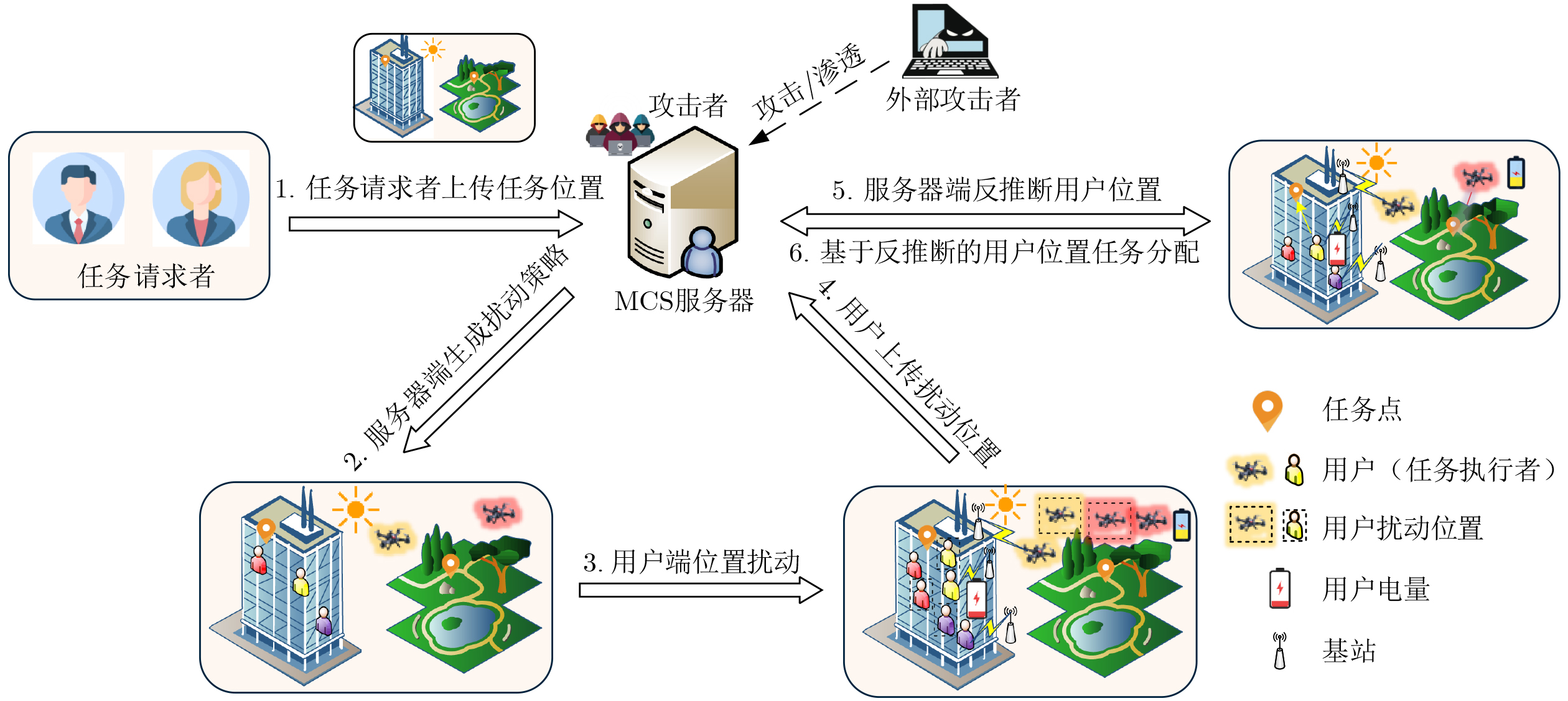
摘要: 针对移动群智感知(MCS)系统中用户执行任务时上传真实位置易被不可信服务器或外部攻击者不当利用,且不同用户在不同地点对位置隐私保护的敏感度存在差异的问题,该文研究基于三维空间地理不可区分性(3DGI)和扭曲隐私的个性化位置隐私感知任务分配方法。同时,为解决动态3D MCS环境下的隐私策略选择问题,综合考虑用户能量状态、任务执行能耗、个性化隐私偏好及攻击者行为,设计了基于近端策略优化(PPO)的3D位置隐私感知任务分配机制(PPOM)。该机制采用Actor-Critic结构进行位置扰动策略学习,通过高斯策略采样与优势函数引导,动态平衡位置隐私保护与服务器利润。为了在位置扰动的前提下尽可能提升服务器利润,该文进一步构建了基于推断位置的任务分配机制,并在模拟数据集和真实GeoLife数据集上,分别设置单用户单任务(S-S)与单用户多任务(S-M)两种分配模式开展仿真实验。结果表明所提PPOM机制在隐私保护强度、服务器系统效益方面均优于对比机制,验证了其在复杂3D MCS场景中的有效性与实用性。Abstract:
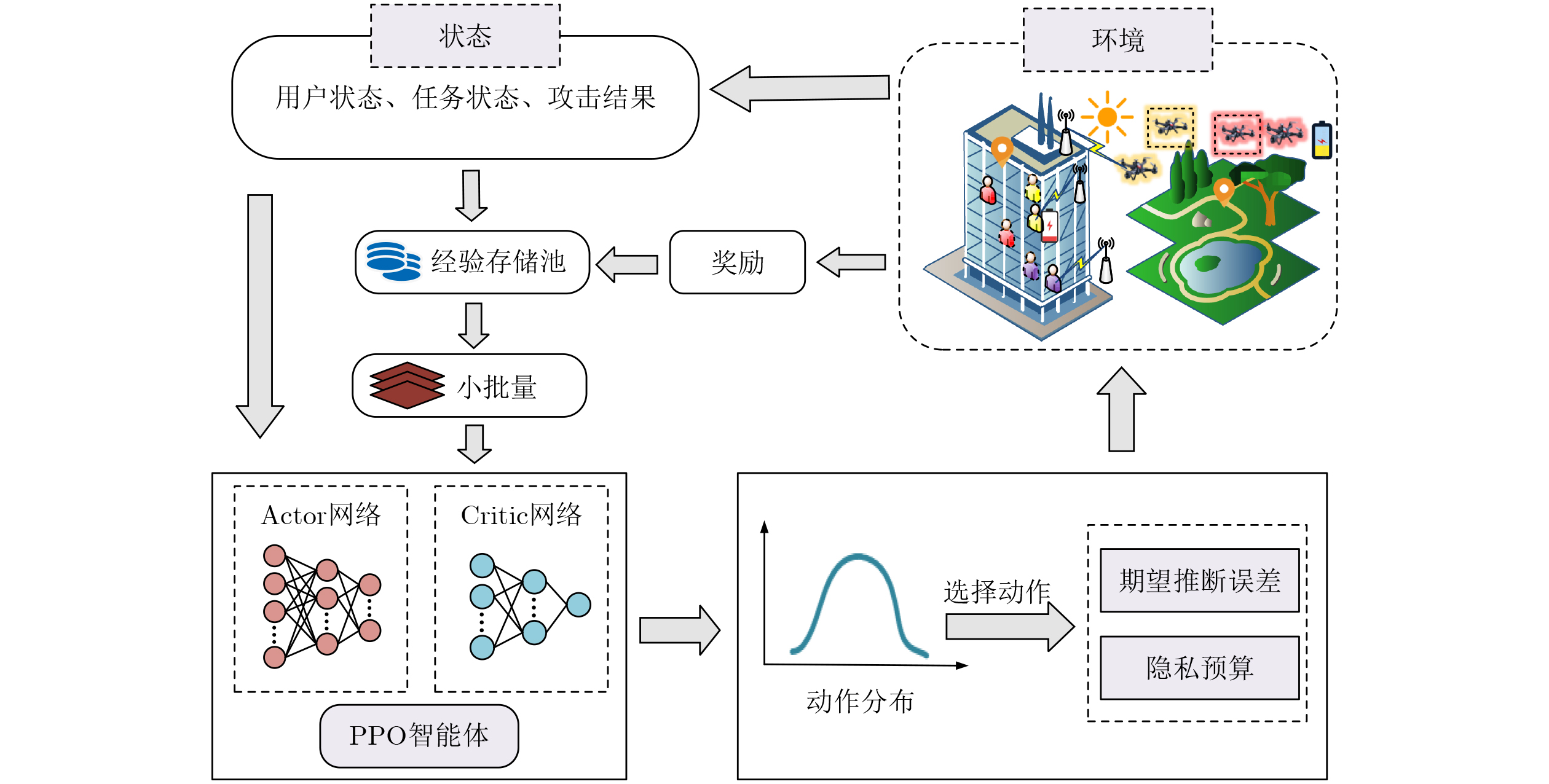
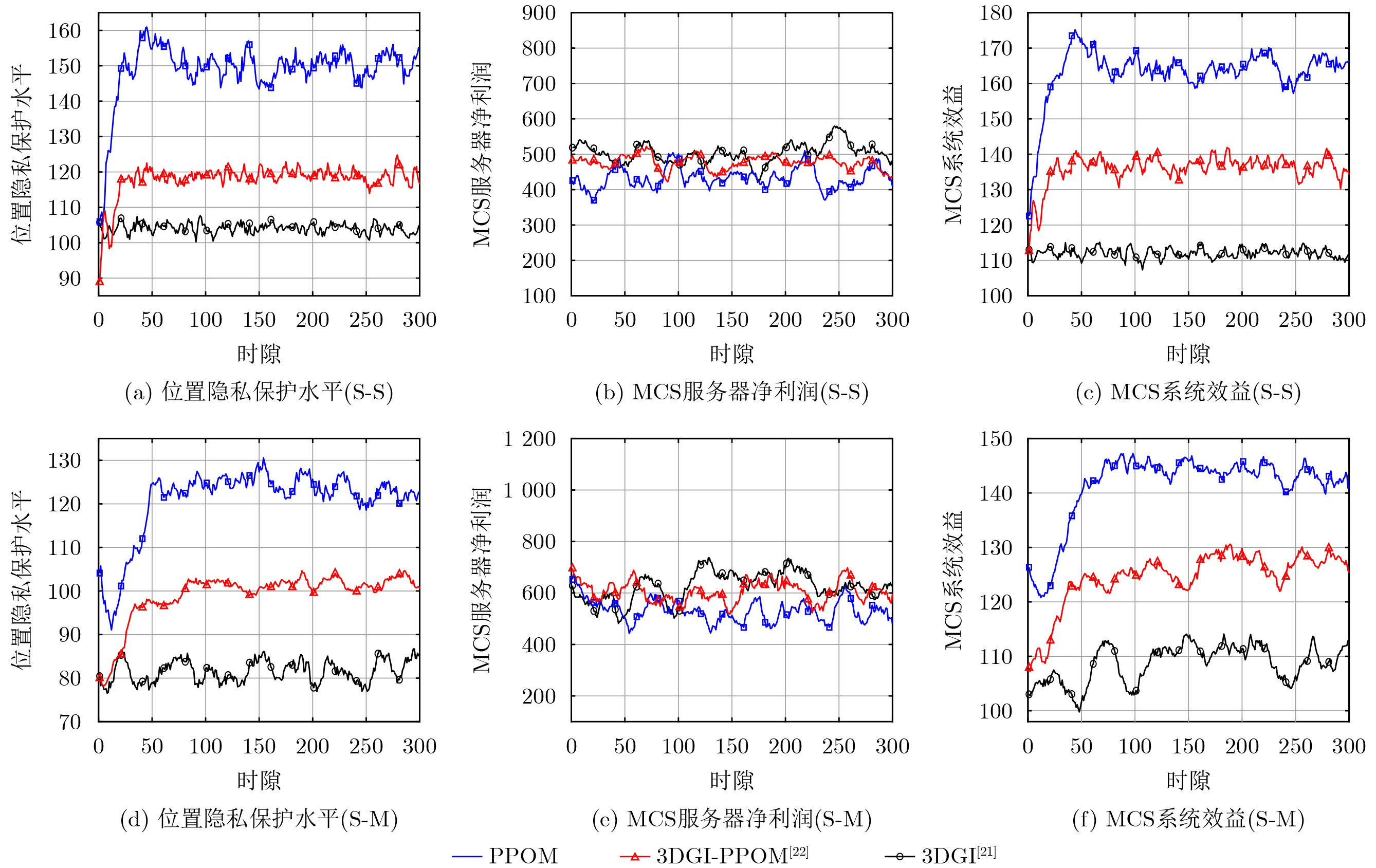
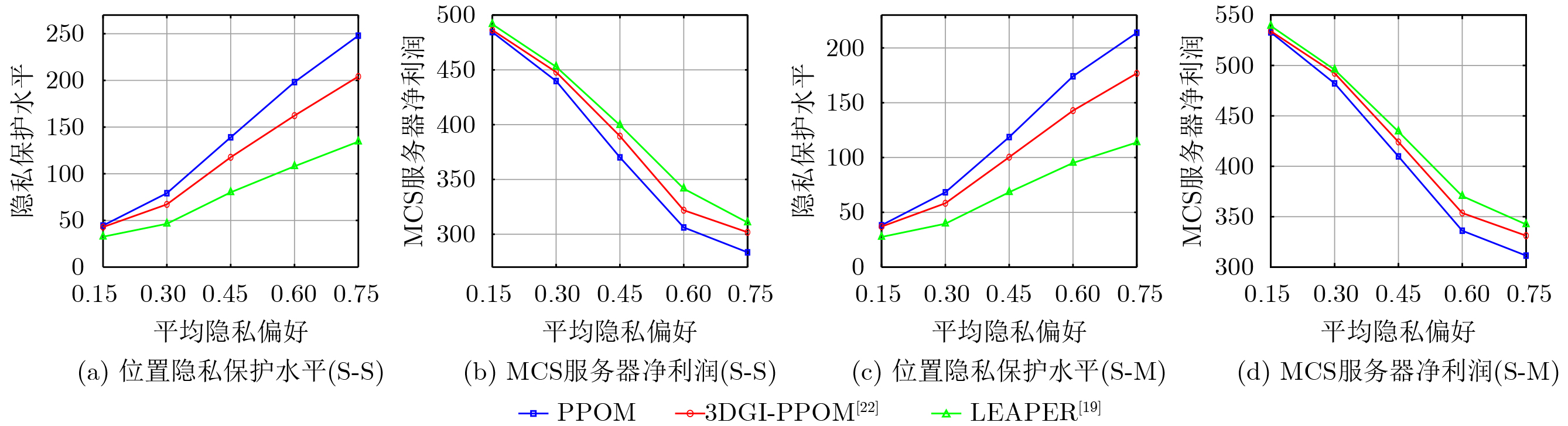
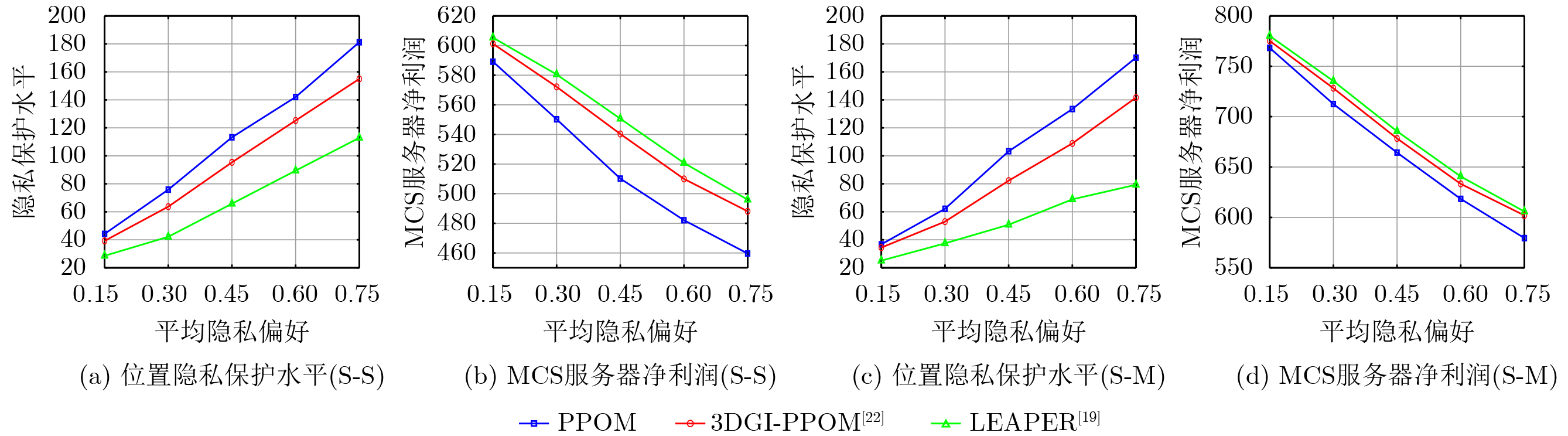
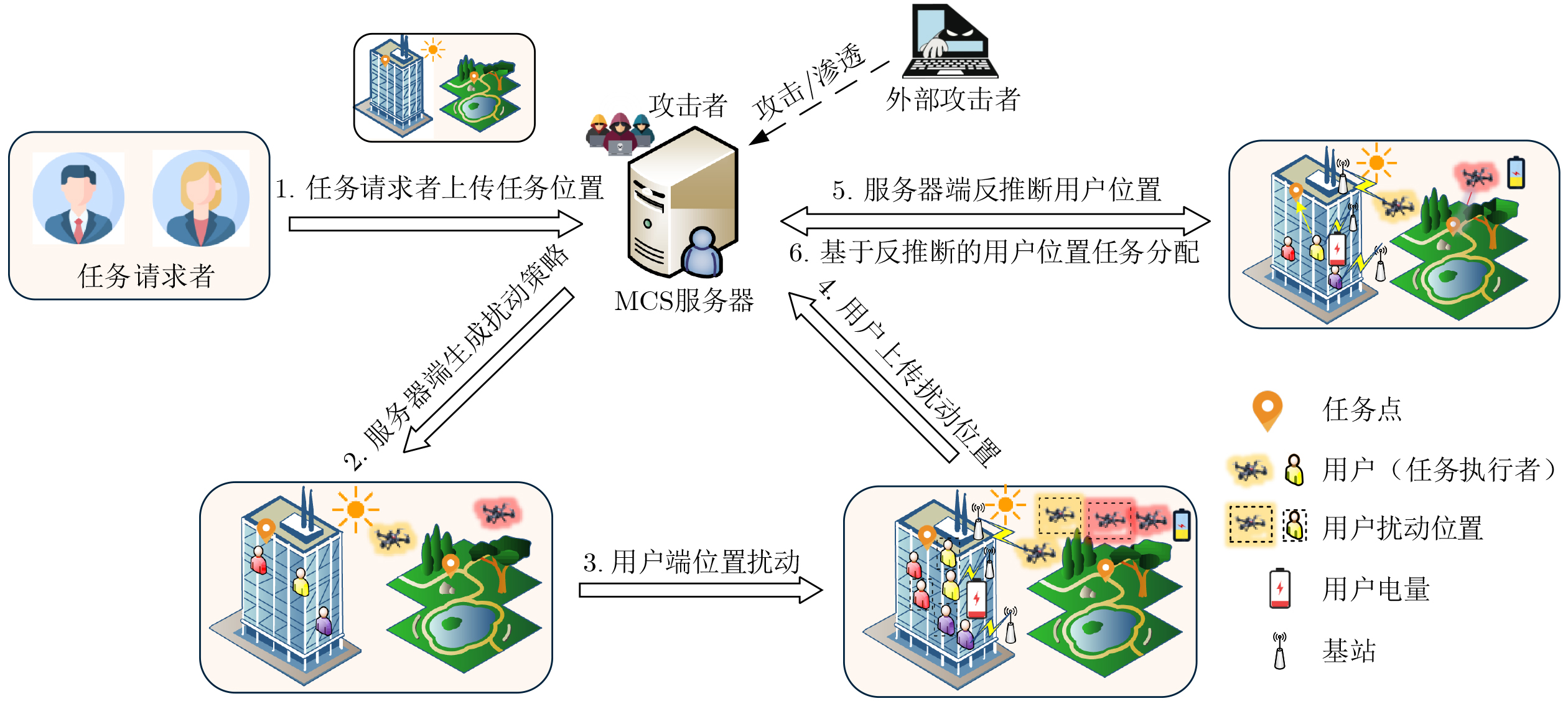
Objective With the widespread adoption of intelligent mobile devices and growing reliance on location-based services, Mobile CrowdSensing (MCS) systems have become a critical infrastructure for urban sensing and smart city applications. In complex 3D environments such as hospitals and shopping malls, real-time user location data uploaded during task execution can be exploited by untrusted servers or external attackers, resulting in severe privacy risks. Existing location privacy protection methods are largely designed for 2D spaces and rely on fixed privacy budgets, lacking adaptability to dynamic user energy states, personalized privacy requirements, and inference attacks. These limitations hinder the simultaneous optimization of location privacy and service quality in 3D MCS systems. This paper proposes a personalized privacy-protection task assignment mechanism that integrates 3D Geo-Indistinguishability (3DGI) and distortion privacy, enabling dynamic optimization of location perturbation strategies and task allocation in complex 3D environments. Methods A dynamic 3D MCS system model is established, incorporating user energy states, task execution costs, individual privacy preferences, and attacker Bayesian inference behaviors. A reinforcement learning approach is adopted to learn personalized location perturbation strategies through continuous interaction with the environment. Specifically, a Proximal Policy Optimization (PPO)-based mechanism, PPOM, is proposed. It employs an Actor-Critic architecture to operate in a continuous action space for effective policy learning. A utility-driven reward function integrating user privacy feedback and server profit allows the system to optimize privacy protection and economic benefit simultaneously. Results and Discussions Extensive simulations on synthetic and GeoLife datasets demonstrate that PPOM outperforms 3DGI, 3DGI-PPOM, and LEAPER under Single-user Single-task (S-S) and Single-user Multi-task (S-M) scenarios. PPOM achieves superior 3D location privacy protection through personalized perturbation and two-dimensional action space design. Server net profit is maintained at a level comparable to 3DGI-PPOM while system utility is significantly improved, even under high user privacy preferences. LEAPER underperforms due to its 2D-oriented design. Overall, PPOM dynamically balances personalized privacy protection and server economic benefits in complex 3D MCS environments. Conclusions This study presents a reinforcement learning-based mechanism for personalized 3D location privacy protection and task assignment in dynamic MCS systems. Key contributions include: (1) a personalized privacy protection framework integrating 3DGI and distortion privacy, accounting for user energy status, task costs, privacy preferences, and attacker Bayesian inference in real time; (2) a perturbation policy optimization mechanism, PPOM, based on the PPO with an Actor-Critic structure, Gaussian sampling, and advantage-based learning to enhance robustness and stability in continuous high-dimensional action spaces; (3) a privacy-aware task assignment model using inferred locations from perturbed data, with a utility function jointly quantifying privacy protection and server profit, achieving dynamic trade-offs between user privacy and service quality under resource constraints. -
1 基于PPO的3D位置隐私感知任务分配机制
初始化系统参数和网络参数 输入:状态$ {\mathbf{s}}^{(k)} $ 输出:扰动策略分布$ {\pi }_{\theta }(\mathbf{a}|{\mathbf{s}}^{(k)}) $和预期值$ V\left({\mathbf{s}}^{(k)}\right) $ 1: For $ k=1,2,\cdots $do 2: MCS服务器观察当前所有用户的系统状态$ {\mathbf{s}}^{(k)} $ 3: 将状态$ {\mathbf{s}}^{(k)} $输入到Actor网络得到$ \boldsymbol{\mu}^{(k)} $和$ \boldsymbol{\xi}^{(k)} $ 4: 通过式(26)得到$ {\pi }_{\theta }(\mathbf{a}|{\mathbf{s}}^{(k)}) $ 5: 根据$ {\pi }_{\theta }(\mathbf{a}|{\mathbf{s}}^{(k)}) $选择扰动策略$ {\mathbf{a}}^{(k)} $ 6: MCS服务器把当前时刻的扰动策略$ {\mathbf{a}}^{(k)} $发送给用户 7: 用户根据3.4节的个性化扰动方法生成扰动位置并将其发
送到MCS服务器8: MCS服务器根据用户上传的扰动位置进行反推断后任务
分配9: 根据式(13)、式(17)和式(18)进行性能评估 10: 将经验序列$ {\varPsi }^{(k)}=({\mathbf{s}}^{(k)},{\mathbf{a}}^{(k)},{R}^{(k)},{\mathbf{s}}^{(k+1)}) $存入经
验存储池中11: If then 12: 从经验池中抽取小批量经验值输入到Actor和
Critic网络中13: 通过式(27)计算优势函数$ \hat{A}({\mathbf{s}}^{(k)},{\mathbf{a}}^{(k)}) $ 14: 通过式(28)更新Actor网络参数$ {\theta }^{(k)} $ 15: 通过式(29)更新Critic网络参数$ {\phi }^{(k)} $ 16: End 17: End  下载: 导出CSV
-
[1] 张朋飞, 安建隆, 程祥, 等. 本地差分隐私下基于混合分布的真值发现算法[J]. 电子与信息学报, 2025, 47(6): 1896–1910. doi: 10.11999/JEIT240936.ZHANG Pengfei, AN Jianlong, CHENG Xiang, et al. Mixture distribution-based truth discovery algorithm under local differential privacy[J]. Journal of Electronics & Information Technology, 2025, 47(6): 1896–1910. doi: 10.11999/JEIT240936. [2] ZHAN Zhongwei, WANG Yingjie, DUAN Peiyong, et al. Enhancing worker recruitment in collaborative mobile crowdsourcing: A graph neural network trust evaluation approach[J]. IEEE Transactions on Mobile Computing, 2024, 23(10): 10093–10110. doi: 10.1109/TMC.2024.3373469. [3] MIRANDA R, RAMOS V, RIBEIRO E, et al. Crowdsensing on smart cities: A systematic review[C]. Proceedings of the 17th Ibero-American Conference on Artificial Intelligence, Cartagena de Indias, Colombia, 2023: 103–106. doi: 10.1007/978-3-031-22419-5_9. [4] YAN Xingfu, NG W W Y, ZHAO Bowen, et al. Fog-enabled privacy-preserving multi-task data aggregation for mobile crowdsensing[J]. IEEE Transactions on Dependable and Secure Computing, 2024, 21(3): 1301–1316. doi: 10.1109/TDSC.2023.3277831. [5] ZHANG Jixian, YANG Xuelin, CHEN Peng, et al. A utility-optimal reverse posted pricing mechanism for online mobile crowdsensing task allocation[J]. IEEE Transactions on Services Computing, 2025, 18(5): 2588–2601. doi: 10.1109/TSC.2025.3592426. [6] WEI Jianhao, LIN Yaping, YAO Xin, et al. Differential privacy-based location protection in spatial crowdsourcing[J]. IEEE Transactions on Services Computing, 2022, 15(1): 45–58. doi: 10.1109/TSC.2019.2920643. [7] 闵明慧, 杨爽, 胥俊怀, 等. 三维空间位置服务中智能语义位置隐私保护方法[J]. 电子与信息学报, 2024, 46(6): 2627–2637. doi: 10.11999/JEIT230708.MIN Minghui, YANG Shuang, XU Junhuai, et al. Intelligent semantic location privacy protection method for location based services in three-dimensional spaces[J]. Journal of Electronics & Information Technology, 2024, 46(6): 2627–2637. doi: 10.11999/JEIT230708. [8] ZHAO Ying and CHEN Jinjun. Vector-indistinguishability: Location dependency based privacy protection for successive location data[J]. IEEE Transactions on Computers, 2024, 73(4): 970–979. doi: 10.1109/TC.2023.3236900. [9] CAI Xingjuan, JI Chen, and ZHAO Tianhao. Constrained many-objective mobile crowdsensing task allocation method considering latent workers[J]. IEEE Internet of Things Journal, 2025, 12(4): 4065–4077. doi: 10.1109/JIOT.2024.3481637. [10] 赵国锋, 吴昊, 王杉杉, 等. 车联网POI查询中的位置隐私和查询隐私联合保护机制[J]. 电子与信息学报, 2024, 46(1): 155–164. doi: 10.11999/JEIT221599.ZHAO Guofeng, WU Hao, WANG Shanshan, et al. A location privacy and query privacy joint protection scheme for POI query in vehicular networks[J]. Journal of Electronics & Information Technology, 2024, 46(1): 155–164. doi: 10.11999/JEIT221599. [11] ZHANG Xian, QIN Xiaolin, XU Haiwen, et al. PPHMA: Privacy-preserving hybrid multi-task allocation for mobile crowd sensing[J]. IEEE Transactions on Network Science and Engineering, 2025, 12(4): 3360–3373. doi: 10.1109/TNSE.2025.3559563. [12] YUAN Dong, LI Qi, LI Guoliang, et al. PriRadar: A privacy-preserving framework for spatial crowdsourcing[J]. IEEE Transactions on Information Forensics and Security, 2020, 15: 299–314. doi: 10.1109/TIFS.2019.2913232. [13] FEI Fan, LI Shu, DAI Haipeng, et al. A k-anonymity based schema for location privacy preservation[J]. IEEE Transactions on Sustainable Computing, 2019, 4(2): 156–167. doi: 10.1109/TSUSC.2017.2733018. [14] DAI Minghui, LI Jiliang, SU Zhou, et al. A privacy preservation based scheme for task assignment in Internet of Things[J]. IEEE Transactions on Network Science and Engineering, 2020, 7(4): 2323–2335. doi: 10.1109/TNSE.2020.2970767. [15] ZHANG Chuan, LUO Xingqi, LIANG Jinwen, et al. POTA: Privacy-preserving online multi-task assignment with path planning[J]. IEEE Transactions on Mobile Computing, 2024, 23(5): 5999–6011. doi: 10.1109/TMC.2023.3315324. [16] SHI Weifan, DENG Qingyong, LI Zhetao, et al. Location and bid privacy preserving-based quality-aware worker recruitment scheme in MCS[J]. IEEE Internet of Things Journal, 2024, 11(12): 21841–21856. doi: 10.1109/JIOT.2024.3376799. [17] ZHANG Chenghao, WANG Yingjie, WANG Weilong, et al. A personalized location privacy protection system in mobile crowdsourcing[J]. IEEE Internet of Things Journal, 2024, 11(6): 9995–10006. doi: 10.1109/JIOT.2023.3325368. [18] WANG Jiandong, LIU Hao, DONG Xuewen, et al. Personalized location privacy trading in double auction for mobile crowdsensing[J]. IEEE Internet of Things Journal, 2023, 10(10): 8971–8983. doi: 10.1109/JIOT.2022.3233052. [19] CAI Hui, LAN Chen, YANG Yuanyuan, et al. Toward personalized location privacy trading for mobile crowd sensing[J]. IEEE Transactions on Dependable and Secure Computing, 2026, 23(1): 1439–1453. doi: 10.1109/TDSC.2025.3617453. [20] 陆音, 刘金志, 张珉. 一种模型辅助的联邦强化学习多无人机路径规划方法[J]. 电子与信息学报, 2025, 47(5): 1368–1380. doi: 10.11999/JEIT241055.LU Yin, LIU Jinzhi, and ZHANG Min. A model-assisted federated reinforcement learning method for multi-UAV path planning[J]. Journal of Electronics & Information Technology, 2025, 47(5): 1368–1380. doi: 10.11999/JEIT241055. [21] MIN Minghui, XIAO Liang, DING Jiahao, et al. 3D geo-indistinguishability for indoor location-based services[J]. IEEE Transactions on Wireless Communications, 2022, 21(7): 4682–4694. doi: 10.1109/TWC.2021.3132464. [22] MIN Minghui, ZHU Haopeng, YANG Shuang, et al. Geo-perturbation for task allocation in 3-D mobile crowdsourcing: An A3C-based approach[J]. IEEE Internet of Things Journal, 2024, 11(2): 1854–1865. doi: 10.1109/JIOT.2023.3295786. [23] SHOKRI R, THEODORAKOPOULOS G, LE BOUDEC J Y, et al. Quantifying location privacy[C]. 2011 IEEE Symposium on Security and Privac, Oakland, USA, 2011: 247–262. doi: 10.1109/SP.2011.18. [24] MIN Minghui, ZHU Haopeng, DING Jiahao, et al. Personalized 3D location privacy protection with differential and distortion geo-perturbation[J]. IEEE Transactions on Dependable and Secure Computing, 2024, 21(4): 3629–3643. doi: 10.1109/TDSC.2023.3335374. [25] CHATZIKOKOLAKIS K, PALAMIDESSI C, and STRONATI M. Constructing elastic distinguishability metrics for location privacy[J]. Proceedings on Privacy Enhancing Technologies, 2015, 2015(2): 156–170. doi: 10.1515/popets-2015-0023. [26] NIU Ben, CHEN Yahong, WANG Zhibo, et al. Eclipse: Preserving differential location privacy against long-term observation attacks[J]. IEEE Transactions on Mobile Computing, 2022, 21(1): 125–138. doi: 10.1109/TMC.2020.3000730. [27] MCKENNA R and SHELDON D. Permute-and-flip: A new mechanism for differentially private selection[C]. The 34th International Conference on Neural Information Processing Systems, Vancouver, Canada, 2020: 17. [28] LI Wen, MA Xuebin, and WANG Xu. DDLP: Dynamic location data publishing with differential privacy in mobile crowdsensing[J]. China Communications, 2025, 22(5): 238–255. doi: 10.23919/JCC.ja.2022-0734. [29] ZHANG Sheng, XUE Yong, ZHANG Heng, et al. Improved Hungarian algorithm–based task scheduling optimization strategy for remote sensing big data processing[J]. Geo-Spatial Information Science, 2024, 27(4): 1141–1154. doi: 10.1080/10095020.2023.2178339. [30] YIN Bo, LI Jiaqi, and WEI Xuetao. Rational task assignment and path planning based on location and task characteristics in mobile crowdsensing[J]. IEEE Transactions on Computational Social Systems, 2022, 9(3): 781–793. doi: 10.1109/TCSS.2021.3095946. -

 下载:
下载:


图(6) / 表(1)
计量
- 文章访问数: 519
- HTML全文浏览量: 329
- PDF下载量: 72
- 被引次数: 0
