




Slice Pricing and Access Control with QoS Guarantee for Vehicular Networks
-
摘要: 随着车辆业务需求的多样性和波动性,车辆网络切片应用面临异构资源分配复杂、QoS保障难度高等挑战。针对上述问题,该文提出一种基于车辆QoS服务需求的双层切片定价机制,其核心创新在于突破现有研究单一资源优化或独立定价的局限。在第1阶段设计切片生成机制,通过联合调度通信、计算与缓存三维资源,解决传统仅优化频谱或计算资源的不足;第2阶段构建基于Stackelberg博弈的切片定价机制,实现“资源预分配-动态定价-切片接入”的双层耦合控制。仿真结果表明了所提出方案在提升系统利润方面的优势。
-
关键词:
- 车联网 /
- 网络切片 /
- 接入控制 /
- Stackelberg博弈
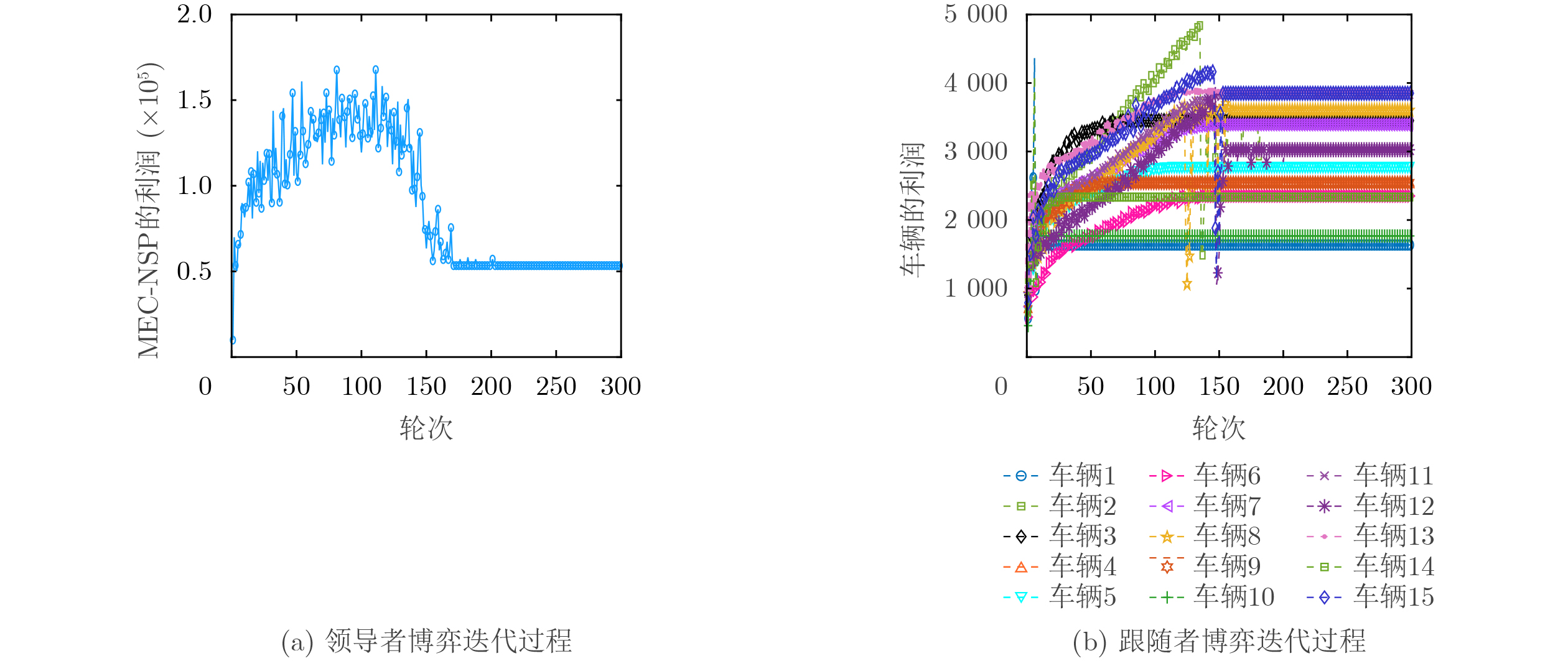
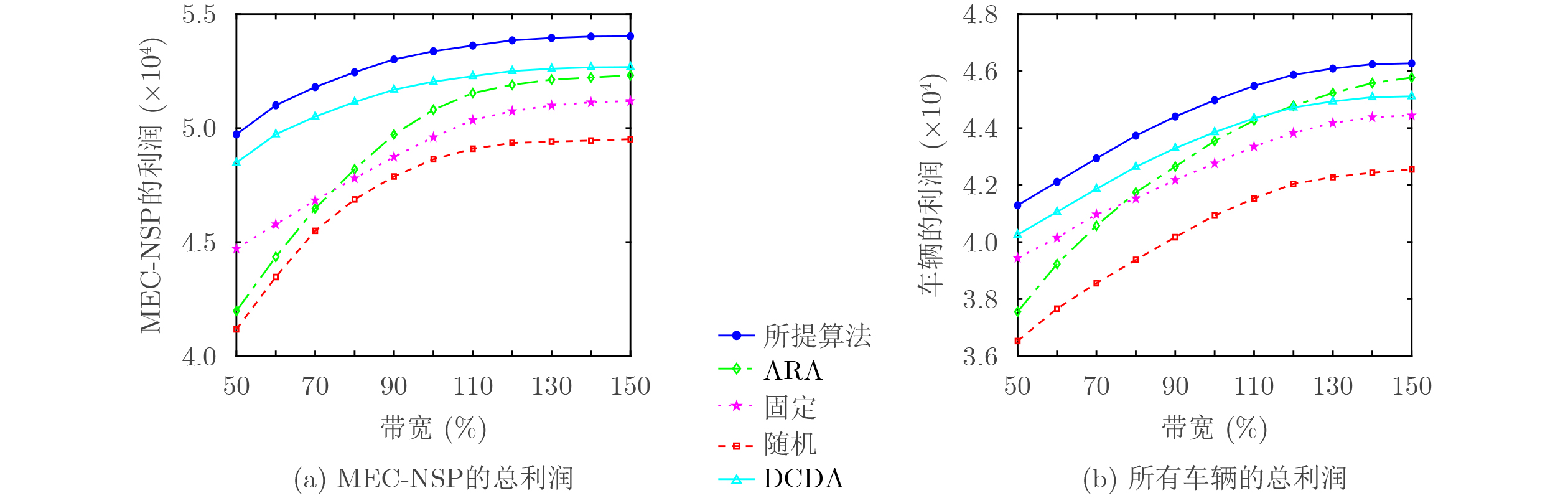
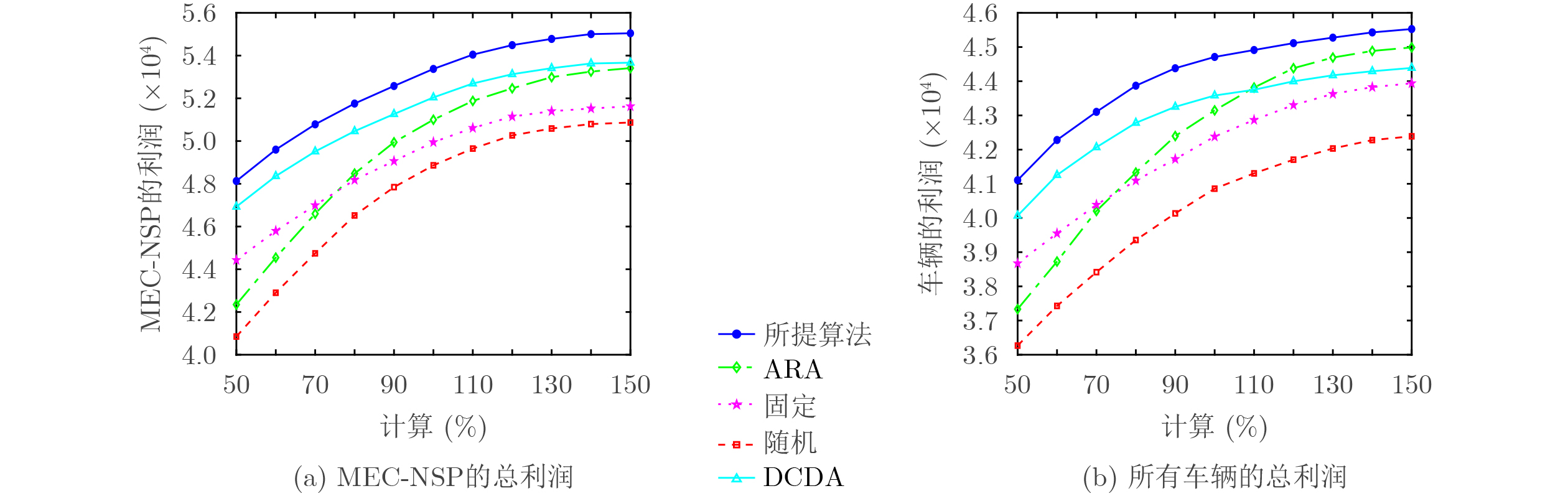
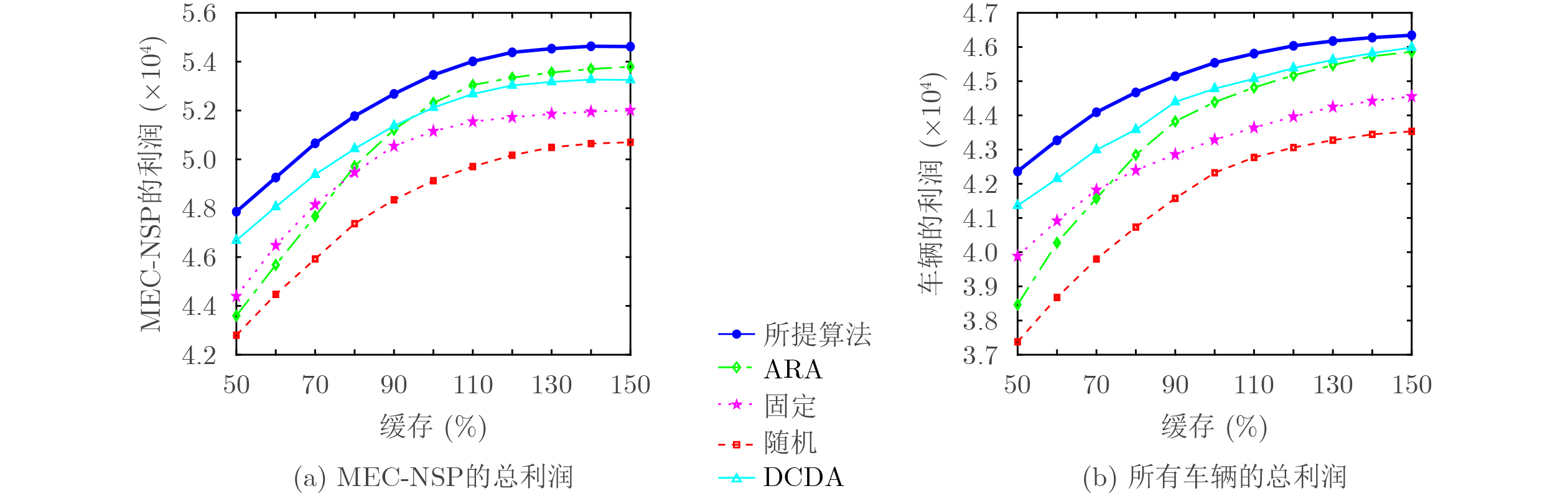
Abstract:Objective Vehicular applications have diverse Quality of Service (QoS) requirements that traditional spectrum-focused networks cannot adequately meet. Although network slicing based on Mobile Edge Computing (MEC) provides customized service provisioning, existing methods often fail to jointly consider slice generation and adaptive access control. To address these limitations, this paper proposes a two-stage vehicular network slicing framework that integrates resource-aware slice generation with dynamic pricing and access control. The framework supports efficient resource allocation and slice access management. It also improves service quality, resource utilization, and system adaptability for both the MEC Network Service Provider (MEC-NSP) and vehicles through a Stackelberg game-based interaction mechanism. Methods The proposed solution uses a two-layer coupled mechanism consisting of resource pre-allocation and Stackelberg game-based pricing and access control. In the first stage, a three-dimensional resource pre-allocation mechanism jointly optimizes communication, computation, and caching resources to satisfy vehicular latency and bandwidth requirements. The resource allocation problem is formulated as a Mixed-Integer Nonlinear Programming (MINLP) problem. It is then decoupled into uplink and downlink subproblems, which are solved using branch-and-bound and interior-point methods, respectively. In the second stage, a Stackelberg game is developed to balance MEC-NSP profit and vehicle QoS. The MEC-NSP acts as the leader and sets dynamic slice prices. The network controller acts as the follower and determines the optimal slice selection probabilities. This interaction is solved using the Iterative Slices Pricing Algorithm (ISPA), which is proven to converge to a Nash equilibrium. Results and Discussions Simulation results show that the proposed framework consistently outperforms baseline algorithms, including Fixed Slice Pricing, Average Resource Allocation, Random Selection, and Dynamic Combinatorial Double Auction (DCDA), under different network conditions. In bandwidth-constrained scenarios, the proposed framework increases MEC-NSP profit by up to 20.77% compared with the Random Selection approach. When resources are abundant, with 150% capacity, it maintains profit gains of 3~9% over other baselines. The ISPA converges to equilibrium after approximately 175 iterations. The flexible pricing mechanism balances network loads, improves cache hit rates, and reduces resource bottlenecks, thereby supporting high QoS satisfaction. Conclusions The proposed dual-layer framework integrates slice generation and pricing for resource-aware network slicing in vehicular MEC environments. By coupling three-dimensional resource pre-allocation with a Stackelberg game-based pricing strategy, the framework improves MEC-NSP profit, resource utilization, and vehicle QoS. Future work will study blockchain-based mechanisms for trusted negotiation and decentralized resource orchestration in cross-domain cooperation under multi-operator and multi-vendor environments. -
Key words:
- Vehicular network /
- Network slicing /
- Access control /
- Stackelberg game
-
1 迭代切片定价算法(ISPA)
输入:总成本$ \text{Cost}_{v,s}^{w,f,c} $,任务数据量$ {D}_{v,s} $,任务计算量$ {C}_{v,s} $,
缓存内容$ {D}_{l,s,v} $输出:切片选择概率$ {x}_{v,s} $,切片价格$ {T}_{s} $,MEC-NSP的效用
$ {U}_{\text{SP}} $,车辆效用$ {U}_{D} $阶段1:初始化策略 1:初始化参与者的策略${\mathcal{X}}$和$ {{\mathcal{T}}} $ 2:计算$ U_{D}^{\ast } $和$ U_{\text{SP}}^{\ast } $的初始值 3:for每个切片$ s $,$s \in {{\mathcal{S}}}$ do 4: 初始化每个切片的价格; 5: for每个车辆$ v $,$v \in {{\mathcal{V}}}$ do 6: 根据$ {D}_{v,s} $,$ {C}_{v,s} $,$ {D}_{l,s,v} $计算车辆的利润$ {\Pr }_{v,s} $ 7: end for 8:end for 阶段2:迭代更新 9:while${\mathcal{X}}$或${{\mathcal{T}}}$不是纳什均衡解do 10: for每个切片$ s $,$s \in {{\mathcal{S}}}$ do 11: for每个车辆$ v $,$v \in {{\mathcal{V}}}$do 12: 计算网络控制器的总利润$ {{{U}^{\prime}}}_{D} $ 13: if$ \exists {U}^{\prime}_{D} \gt U_{D}^{\ast } $ then 14: 更新网络控制器的选择策略${\mathcal{X}}$并且设置
$ U_{D}^{\ast }={{{U}^{\prime}}}_{D} $15: end if 16: end for 17:end for 18:for每个切片$ s $,$s \in {{\mathcal{S}}}$ do 19: for每个车辆$ v $,$v \in {{\mathcal{V}}}$ do 20: 计算MEC-NSP的总利润$ {{{U}^{\prime}}}_{\text{SP}} $ 21: if $ \exists {{{U}^{\prime}}}_{\text{SP}} \gt U_{\text{SP}}^{\ast } $then 22: 更新MEC-NSP的定价策略${{\mathcal{T}}}$并且设置
$ U_{\text{SP}}^{\ast }={{{U}^{\prime}}}_{\text{SP}} $23: end if 24: end for 25: end for 26:end while 27:return Outputs  下载: 导出CSV
表 1 仿真参数设置
参数 取值 参数 取值 BS数量 2 总缓存能力 100 GB 车辆数量 15 车辆任务大小 [300, 600] kb 车辆速度 45 km/h 任务CPU周期数 [50, 100] Mega cycles 噪声功率 –114 dBm 缓存内容数据量 [5, 125] MB BS发射功率 3 W 最大服务时延 [0.02, 0.20] s 车辆发射功率 257~325 mW 最大下载时延 [0.5, 5.0] s 路径损耗因子 3.5 带宽资源价格 15 units/MHz 切片数量 6 计算资源价格 25 unit/Gega cycle 总带宽 100 MHz 缓存资源价格 20 unit/MB 总计算资源 200 GHz - -
下载: 导出CSV
-
[1] SUN Ruijin, CHENG Nan, LI Changle, et al. A comprehensive survey of knowledge-driven deep learning for intelligent wireless network optimization in 6G[J]. IEEE Communications Surveys & Tutorials, 2026, 28: 1099–1135. doi: 10.1109/COMST.2025.3574765. [2] JIANG Kai, JU Zhiyang, HUANG Lingying, et al. Cyber-attack detection framework for connected vehicles in V2X networks based on an iterative UFIR filter[C]. 2023 62nd IEEE Conference on Decision and Control (CDC), Singapore, 2023: 86–91 doi: 10.1109/CDC49753.2023.10383926. [3] WANG Yunfeng, ZHAO Liqiang, CHU Xiaoli, et al. E2E network slicing optimization for control- and user-plane separation-based SAGINs with DRL[J]. IEEE Transactions on Vehicular Technology, 2024, 73(11): 16680–16696. doi: 10.1109/TVT.2024.3415964. [4] KHAN R, KUMAR P, JAYAKODY D N K, et al. A survey on security and privacy of 5G technologies: Potential solutions, recent advancements, and future directions[J]. IEEE Communications Surveys & Tutorials, 2020, 22(1): 196–248. doi: 10.1109/COMST.2019.2933899. [5] PORAMBAGE P, OKWUIBE J, LIYANAGE M, et al. Survey on multi-access edge computing for internet of things realization[J]. IEEE Communications Surveys & Tutorials, 2018, 20(4): 2961–2991. doi: 10.1109/COMST.2018.2849509. [6] DONG Zhiming and WANG Xianpeng. Effective computational resource allocation in evolutionary multi-objective multi-task optimization[C]. 2025 IEEE Congress on Evolutionary Computation (CEC), Hangzhou, China, 2025: 1–7. doi: 10.1109/CEC65147.2025.11043123. [7] GU Xueying, WU Qiong, FAN Pingyi, et al. DRL-based federated self-supervised learning for task offloading and resource allocation in ISAC-enabled vehicle edge computing[J]. Digital Communications and Networks, 2025, 11(5): 1614–1627. doi: 10.1016/j.dcan.2024.12.009. [8] ZHENG Chong, LIU Shengheng, HUANG Yongming, et al. Unsupervised recurrent federated learning for edge popularity prediction in privacy-preserving mobile-edge computing networks[J]. IEEE Internet of Things Journal, 2022, 9(23): 24328–24345. doi: 10.1109/JIOT.2022.3189055. [9] FENG Jie, PEI Qingqi, YU F R, et al. Dynamic network slicing and resource allocation in mobile edge computing systems[J]. IEEE Transactions on Vehicular Technology, 2020, 69(7): 7863–7878. doi: 10.1109/TVT.2020.2992607. [10] 唐伦, 李质萱, 文雯, 等. 基于智能分层切片技术的数字孪生传感信息同步策略[J]. 电子与信息学报, 2024, 46(7): 2793–2802. doi: 10.11999/JEIT230984.TANG Lun, LI Zhixuan, WEN Wen, et al. Digital twin sensing information synchronization strategy based on intelligent hierarchical slicing technique[J]. Journal of Electronics & Information Technology, 2024, 46(7): 2793–2802. doi: 10.11999/JEIT230984. [11] 陈鸣锴, 孙振德, 万雅芳. RIS辅助下的跨模态通信资源分配[J]. 电子与信息学报, 2025, 47(2): 363–374. doi: 10.11999/JEIT240619.CHEN Mingkai, SUN Zhende, and WAN Yafang. Resource allocation for RIS-aided cross-model communications[J]. Journal of Electronics & Information Technology, 2025, 47(2): 363–374. doi: 10.11999/JEIT240619. [12] CHEN Xuanzhi, TANG Yuliang, ZHANG Mingyu, et al. Ran slice selection mechanism based on satisfaction degree[C]. 2020 IEEE Wireless Communications and Networking Conference Workshops (WCNCW), Seoul, Korea (South), 2020: 1–6. doi: 10.1109/WCNCW48565.2020.9124780. [13] KOŁAKOWSKI R, KUKLIŃSKI S, and TOMASZEWSKI L. Time-of-day-aware slice admission control[C]. 2023 IEEE International Mediterranean Conference on Communications and Networking (MeditCom), Dubrovnik, Croatia, 2023: 199–204. doi: 10.1109/MeditCom58224.2023.10266645. [14] OJIJO M O, VENTURA N, and ONDWARI D N. Deep reinforcement learning approach to slice admission control for resilient 5G wireless network with multidimensional state space[C]. 2023 IEEE AFRICON, Nairobi, Kenya, 2023: 1–6. doi: 10.1109/AFRICON55910.2023.10293471. [15] LI Jin, WU Jie, ZHANG Cheng, et al. Hierarchical intelligent radio access network slicing for differential service level agreement guaranteeing[J]. IEEE Transactions on Industrial Informatics, 2024, 20(3): 4124–4136. doi: 10.1109/TII.2023.3318311. [16] AJAYI J, DI MAIO A, BRAUN T, et al. An online multi-dimensional knapsack approach for slice admission control[C]. 2023 IEEE 20th Consumer Communications & Networking Conference (CCNC), Las Vegas, USA, 2023: 152–157. doi: 10.1109/CCNC51644.2023.10060460. [17] YESE S, BERRI S, and CHORTI A. Novel slice admission control scheme with overbooking and dynamic buyback process[C]. 2023 IEEE Conference on Network Function Virtualization and Software Defined Networks (NFV-SDN), Dresden, Germany, 2023: 111–116. doi: 10.1109/NFV-SDN59219.2023.10329608. [18] GUO Jiawen, ZHU Guohai, ZHANG Dingyuan, et al. Resource management algorithm for slicing function in 5G network slicing[C]. 2023 5th International Conference on Natural Language Processing (ICNLP), Guangzhou, China, 2023: 367–372. doi: 10.1109/ICNLP58431.2023.00073. [19] FAN Wenhao. Blockchain-secured task offloading and resource allocation for cloud-edge-end cooperative networks[J]. IEEE Transactions on Mobile Computing, 2024, 23(8): 8092–8110. doi: 10.1109/TMC.2023.3342817. [20] PEREIRA P M R, DE BAIRROS T A M, DE SOUZA R A A, et al. Mobility, path loss, and composite fading: Performance of a conventional and of a non-conventional system with a robust autoencoder[J]. IEEE Transactions on Vehicular Technology, 2023, 72(12): 16725–16730. doi: 10.1109/TVT.2023.3294756. [21] 王汝言, 杨安琪, 吴大鹏, 等. 异步移动边缘计算网络中的联合任务调度与计算资源分配优化策略[J]. 电子与信息学报, 2025, 47(2): 470–479. doi: 10.11999/JEIT240685.WANG Ruyan, YANG Anqi, WU Dapeng, et al. Joint task scheduling and computing resource allocation optimization strategy in asynchronous mobile edge computing networks[J]. Journal of Electronics & Information Technology, 2025, 47(2): 470–479. doi: 10.11999/JEIT240685. [22] CHEN Zhou, WEI Peihong, and LI Yan. Combining neural network-based method with heuristic policy for optimal task scheduling in hierarchical edge cloud[J]. Digital Communications and Networks, 2023, 9(3): 688–697. doi: 10.1016/j.dcan.2022.04.023. [23] XU Xiaolong, HUANG Qihe, YIN Xiaochun, et al. Intelligent offloading for collaborative smart city services in edge computing[J]. IEEE Internet of Things Journal, 2020, 7(9): 7919–7927. doi: 10.1109/JIOT.2020.3000871. [24] LI Qihui, JIA Xiaohua, HUANG Chuanhe, et al. A dynamic combinatorial double auction model for cloud resource allocation[J]. IEEE Transactions on Cloud Computing, 2023, 11(3): 2873–2884. doi: 10.1109/TCC.2022.3231249. -

 下载:
下载:

图(5) / 表(2)
计量
- 文章访问数: 496
- HTML全文浏览量: 273
- PDF下载量: 51
- 被引次数: 0
