




SCUNet-Based Decoding Algorithm for Rayleigh Fading Channels Integrating Feature Extraction and Recovery Mechanisms
-
摘要: 人工智能的快速发展为无线通信系统性能的优化和提升提供了新思路。针对瑞利衰落信道下常规深度神经网络(DNN)译码算法性能受限的问题,该文提出一种融合特征提取与恢复机制的SCUNet译码算法,记为SCUNetDec。该网络设计中融入了数据预处理、特征提取与恢复以及噪声水平图3方面机制:首先通过升维操作将一维信号映射为二维特征图,以挖掘更丰富的结构信息;继而利用特征提取与恢复模块削弱维度转换中产生的不相关干扰,从而提升译码效果;同时引入噪声水平图,使网络能够更敏锐地感知和建模信噪比的变化,进一步增强在复杂信道环境下的适应能力。仿真结果表明,SCUNetDec在瑞利衰落信道下的误码性能优于常规神经网络译码方法,接近传统最优译码算法,且同时具备更快的译码速度。Abstract:
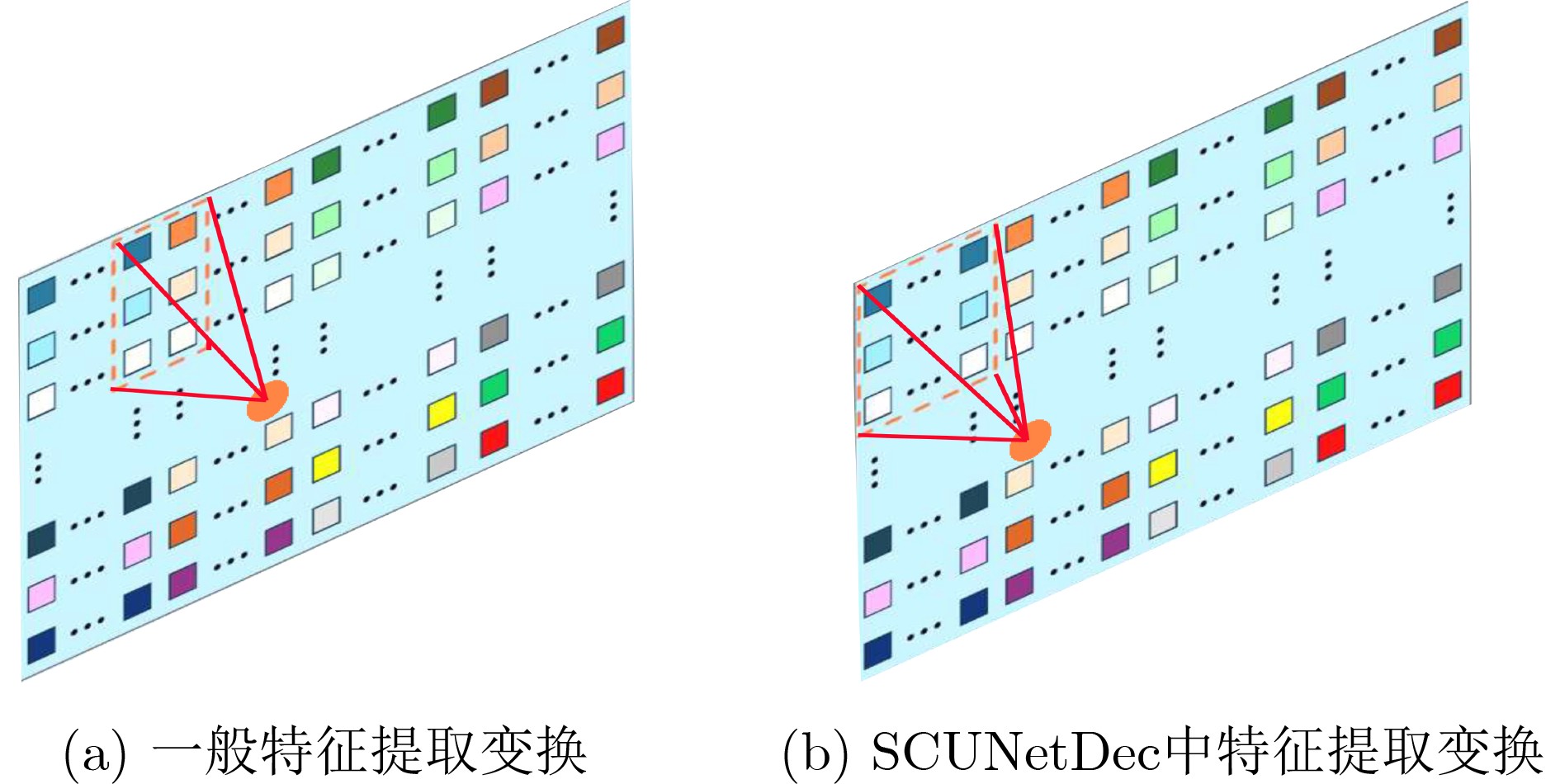
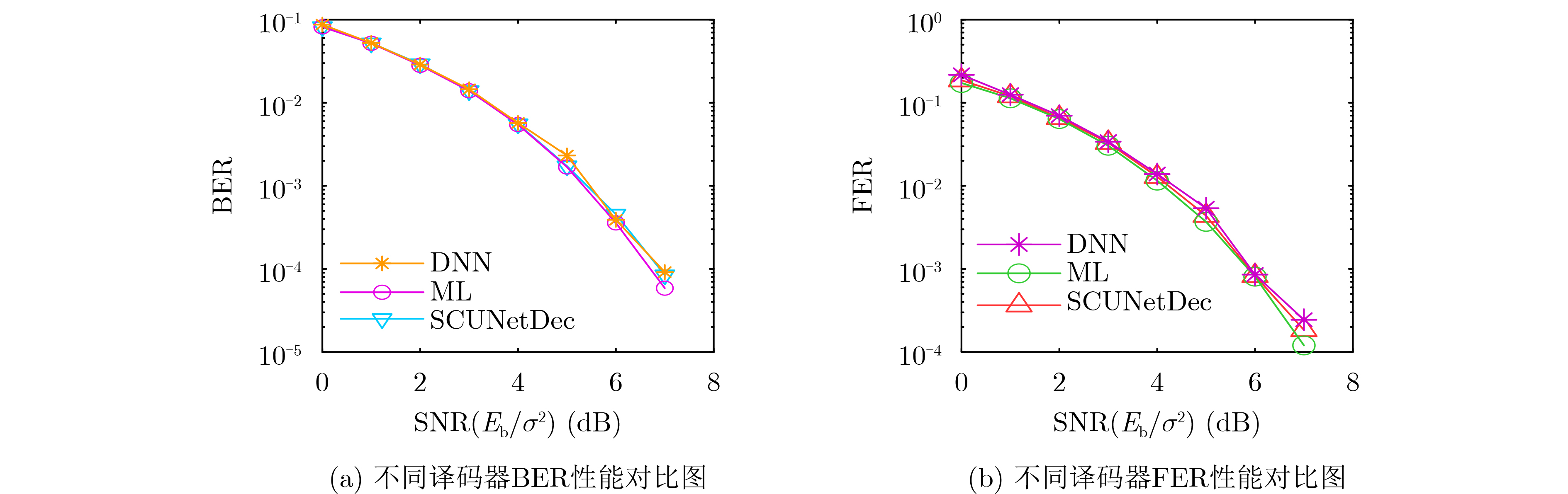
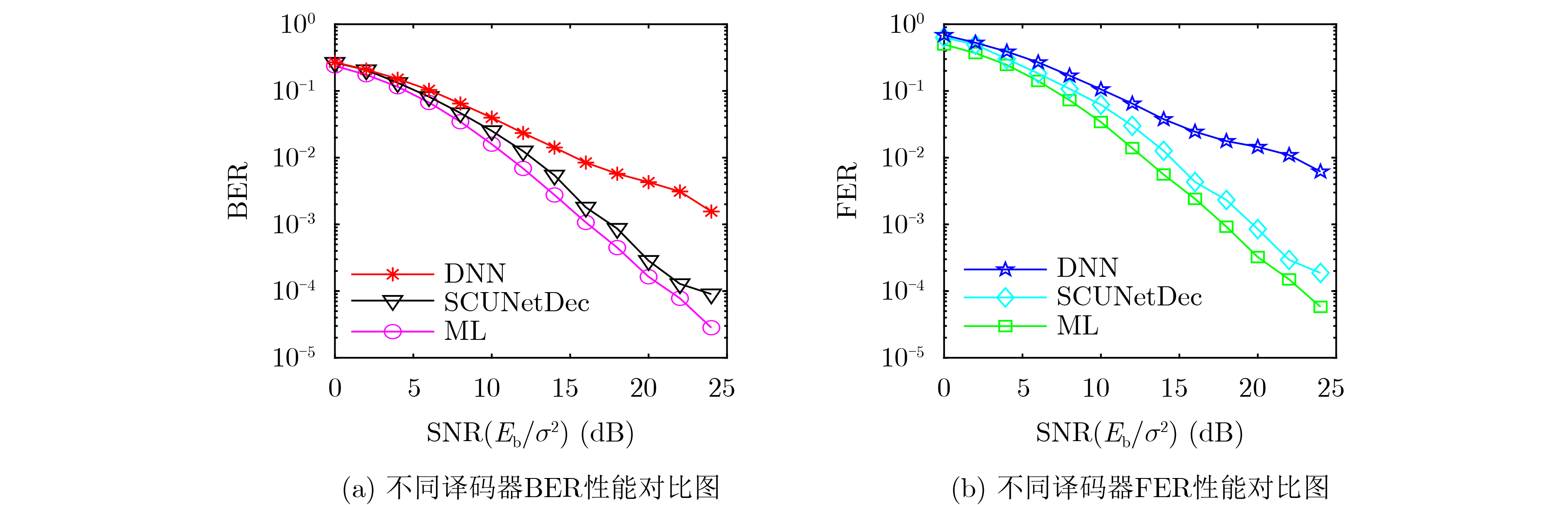
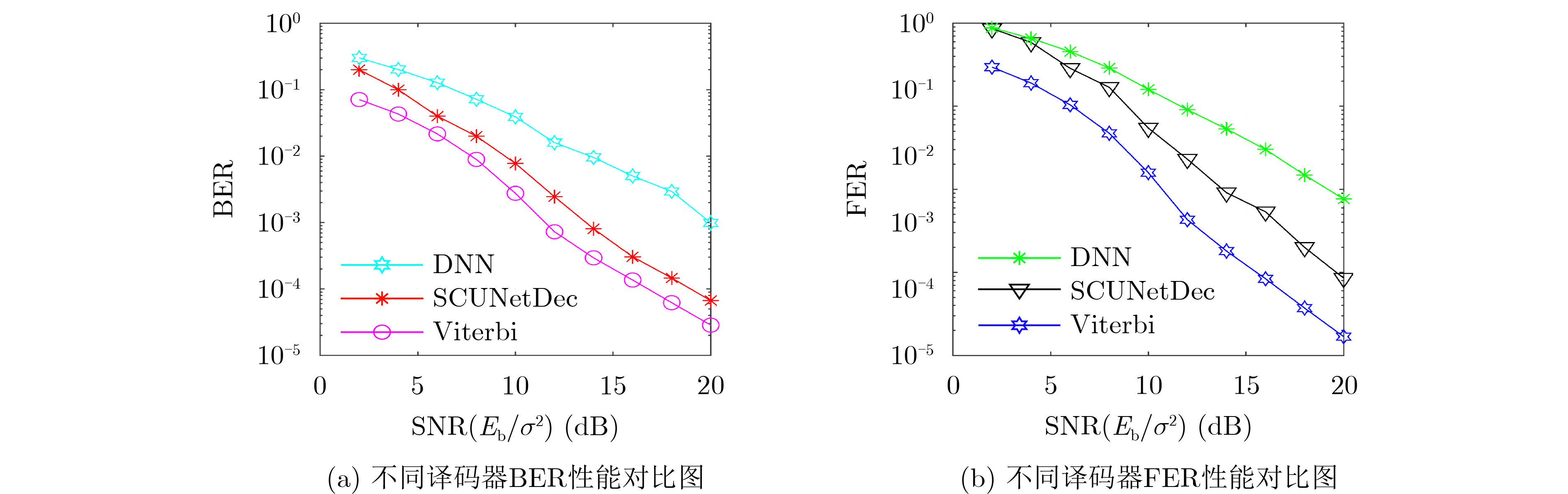
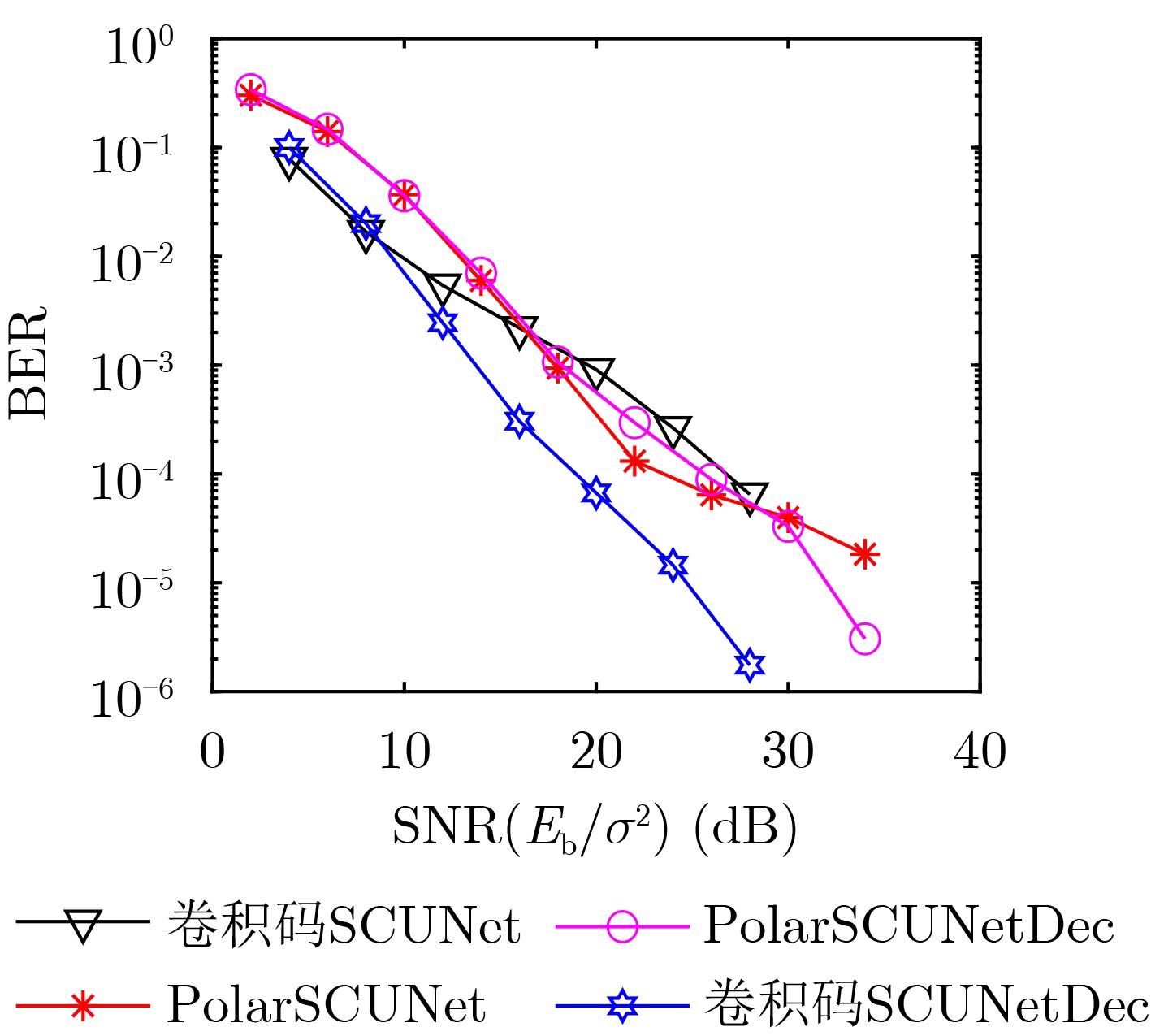
Objective This study examines limitations of conventional Deep Neural Network (DNN) decoding algorithms in Rayleigh fading channels, including constrained performance, limited generalization, and weak fading resistance. To address these issues, a decoding algorithm based on the SCUNet (Swin Conv UNet) architecture, termed SCUNetDec, is proposed. In 6G communication scenarios, wireless channels exhibit strong dynamics and complexity, which restrict the ability of traditional decoding methods to meet requirements for high reliability, low latency, and robustness. Intelligent decoding methods with adaptive feature learning are therefore valuable. SCUNetDec integrates multi-dimensional feature extraction and recovery modules and uses a noise-level map to strengthen channel-state perception. These components enable the network to learn channel characteristics, reduce fading effects, and improve decoding performance. The study provides an approach for intelligent decoding in complex channel environments and supports the development of efficient 6G communication systems. Methods The SCUNetDec network combines three mechanisms—data preprocessing, feature extraction and recovery, and noise-level mapping—to enhance signal representation learning and decoding in Rayleigh fading channels. In the preprocessing stage, dimensionality expansion converts the one-dimensional received signal into a two-dimensional feature map, improving structural visibility and supporting spatial correlation learning. The feature extraction and recovery module uses multi-layer convolution and attention mechanisms to capture essential channel features, whereas deconvolution layers and residual connections suppress interference introduced during dimensionality transformation. This improves reconstruction quality and decoding accuracy. A noise-level map embeds SNR (Signal to Noise Ratio)-related information aligned with the feature maps, allowing the model to adjust to channel variation and adapt decoding strength. The combined effect of these mechanisms increases noise robustness, generalization, and decoding stability, offering a systematic decoding solution for complex 6G wireless environments. Results and Discussions SCUNetDec enhances signal learning and decoding in Rayleigh fading channels through its feature extraction-recovery module and noise-level map. Simulations under different coding schemes validate its effectiveness. For the (7,4) Hamming code, SCUNetDec outperforms conventional DNN decoding and approaches Maximum Likelihood (ML) performance; at BER (Bit Error Rate) = 10–4, the gap to ML is about 1.5 dB, and at FER (Frame Error Rate) = 10–3, the gap is about 2.0 dB ( Fig. 4 ). This indicates that SCUNetDec captures complex signal relationships and learns associations between information and parity-check nodes. For the (2,1,3) convolutional code, SCUNetDec performs close to the Viterbi algorithm at BER = 10–3, with a gap of roughly 2.0 dB, while conventional DNN decoding degrades at high SNRs (Fig. 5 ). For Polar codes with a rate of 0.5, SCUNetDec shows a gain of about 4.0 dB over successive cancellation (SC) decoding at BER = 10–4 and maintains an advantage of about 1.0 dB at FER = 10–3, with SC performing slightly better only in the low-SNR region (Fig. 6 ). Decoding-time comparisons show that SCUNetDec reduces decoding latency relative to traditional methods (Table 1 ). Ablation experiments confirm that integrating the feature extraction and recovery modules into SCUNet improves decoding performance (Fig. 7 ). Overall, results show that SCUNetDec provides robust decoding performance across coding schemes and SNR levels.Conclusions This study proposes SCUNetDec to address performance limitations of DNN decoders in Rayleigh fading channels. The method enhances SCUNet using signal feature extraction and recovery modules. Simulations and ablation experiments on Hamming, convolutional, and Polar codes show strong generalization capability and effectiveness. Compared with traditional DNN models, SCUNetDec achieves decoding performance close to optimal decoding algorithms and reduces decoding time. These findings indicate that SCUNetDec has practical potential for complex channel environments. Future work will examine fusion of neural and traditional algorithms to balance performance and complexity through dynamic parameter optimization and explore intelligent decoding strategies for long codes. Research will also investigate joint modulation-decoding modeling and end-to-end architectures to improve adaptability under high-order modulation and complex channels. -
Key words:
- Intelligent decoding /
- SCUNet /
- Feature extraction /
- Short codes /
- Rayleigh fading channels
-
1 SCUNetDec信号特征提取与恢复译码算法
输入:译码器接收L,信号大小为$ 1\times n $,即$ \boldsymbol{L}=\left({L}_{0},{L}_{1},\cdots ,{L}_{n-1}\right) $, n代表信号点的个数,然后将数量足够多的信号L转换为$ g\times g $大小的 二维信号,其中将每一行信号L的数量记为l,则$ g=n\times l $。 输出:恢复的消息序列$ \hat{\boldsymbol{u}} $。 (1) 初始化f = Conv2d,卷积核大小为(3,2),步幅为(1,2),填充为(1,0); (2) 初始化$ {f}^{-1}=\mathrm{ConvTranspose}2\mathrm{d} $,根据不同消息序列长度选择合适的卷积核大小和步幅; (3) 初始化fSCUNet = SCUNet; (4) if$ n\geq 2 $且$ n\neq {2}^{q} $时,$ q\geq 1 $then 特征提取设计 (5) $ \left({L}_{0},{L}_{1},\cdots ,{L}_{n-1}\right)\rightarrow \left({L}_{0},{L}_{1},\cdots ,{L}_{n-1},0,\cdots ,0\right) $,给信号L尾部补0,将其长度补齐为$ {2}^{q} $,即需补$ {2}^{q}-n $个0,记为$ \overline{\boldsymbol{L}} $; (6) $ {\boldsymbol{L}}_{\mathrm{feature}}=f\cdots f\left(\overline{\boldsymbol{L}}\right) $,f层数为k; (7) $ {\boldsymbol{L}}_{\mathrm{SCUNetfeature}}=f_{\mathrm{SCUNet}}\left({\boldsymbol{L}}_{\mathrm{feature}}\right) $; 信号恢复设计 (8) $ \hat{\boldsymbol{u}}=f{f}^{-1}\cdots {f}^{-1}\left({\boldsymbol{L}}_{\mathrm{SCUNetfeature}}\right) $; else$ n\geq 2 $且$ n={2}^{\mathrm{q}} $时,$ q\geq 1 $ 特征提取设计 (9) $ {\boldsymbol{L}}_{\mathrm{feature}}=f\cdots f\left(\boldsymbol{L}\right) $, f层数为k; (10) $ {\boldsymbol{L}}_{\mathrm{SCUNetfeature}}=f_{\mathrm{SCUNet}}\left({\boldsymbol{L}}_{\mathrm{feature}}\right) $; 信号恢复设计 (11) $ \hat{\boldsymbol{u}}=f{f}^{-1}\cdots {f}^{-1}\left({\boldsymbol{L}}_{\mathrm{SCUNetfeature}}\right) $  下载: 导出CSV
表 1 不同译码器译码时间对比
译码器 编码方式 码长L 译码时间(s) SCUNetDec 汉明码 7 0.65 ML 汉明码 7 149.09 DNN 汉明码 7 0.63 SCUNetDec 卷积码 16 0.60 Viterbi 卷积码 16 5.43 DNN 卷积码 16 1.54 SCUNetDec Polar 16 0.70 SC Polar 16 60.00 DNN Polar 16 0.68
下载: 导出CSV
-
[1] LIU Fan, CUI Yuanhao, MASOUROS C, et al. Integrated sensing and communications: Toward dual-functional wireless networks for 6G and beyond[J]. IEEE Journal on Selected Areas in Communications, 2022, 40(6): 1728–1767. doi: 10.1109/JSAC.2022.3156632. [2] O’SHEA T and HOYDIS J. An introduction to deep learning for the physical layer[J]. IEEE Transactions on Cognitive Communications and Networking, 2017, 3(4): 563–575. doi: 10.1109/TCCN.2017.2758370. [3] CHEN Rongjun, YAO Chengsi, ZENG Xianxian, et al. Large-scale cross-modal hashing via Kolmogorov-Arnold representation theorem and optimal transport[J]. Knowledge-Based Systems, 2025, 330: 114698. doi: 10.1016/j.knosys.2025.114698. [4] YUE Chentao, SHIRVANIMOGHADDAM M, LI Yonghui, et al. Segmentation-discarding ordered-statistic decoding for linear block codes[C]. 2019 IEEE Global Communications Conference (GLOBECOM), Waikoloa, USA, 2019: 1–6. doi: 10.1109/GLOBECOM38437.2019.9014173. [5] YUE Chentao, SHIRVANIMOGHADDAM M, PARK G, et al. Linear-equation ordered-statistics decoding[J]. IEEE Transactions on Communications, 2022, 70(11): 7105–7123. doi: 10.1109/TCOMM.2022.3207206. [6] LIANG Jifan, WANG Yiwen, CAI Suihua, et al. A low-complexity ordered statistic decoding of short block codes[J]. IEEE Communications Letters, 2023, 27(2): 400–403. doi: 10.1109/LCOMM.2022.3222819. [7] WANG Yiwen, LIANG Jifan, and MA Xiao. Local constraint-based ordered statistics decoding for short block codes[C]. 2022 IEEE Information Theory Workshop (ITW), Mumbai, India, 2022: 107–112. doi: 10.1109/ITW54588.2022.9965916. [8] WANG Qianfan, CHEN Yanzhi, LIANG Jifan, et al. A new joint source-channel coding for short-packet communications[J]. IEEE Transactions on Communications, 2024, 72(1): 28–37. doi: 10.1109/TCOMM.2023.3320699. [9] WANG Qianfan, CHEN Yanzhi, LIANG Jifan, et al. A new joint source-channel coding in the short blocklength regime[C]. IEEE Global Communications Conference Workshops (GLOBECOM Workshops), Kuala Lumpur, Malaysia, 2023: 1566–1571. doi: 10.1109/GCWkshps58843.2023.10464813. [10] CHEN Yanzhi, LIANG Jifan, WANG Qianfan, et al. A new joint source-channel coding scheme with overlay spread spectrum transmission[C]. IEEE International Conference on Wireless Communications and Signal Processing (WCSP), Hangzhou, China, 2023: 239–244. doi: 10.1109/WCSP58612.2023.10404761. [11] ZHENG Xiangping, WANG Qianfan, WEI Baodian, et al. Quasi-OSD of binary image of RS codes with applications to JSCC[C]. 2024 IEEE International Symposium on Information Theory (ISIT), Athens, Greece, 2024: 3576–3581. doi: 10.1109/ISIT57864.2024.10619269. [12] WANG Qianfan, WANG Yiwen, WANG Yixin, et al. Random staircase generator matrix codes: Coding theorem, performance analysis, and code design[J]. IEEE Transactions on Information Theory, 2025, 71(5): 3497–3509. doi: 10.1109/TIT.2025.3541734. [13] WANG Qianfan, WANG Yiwen, WANG Yixin, et al. Random staircase generator matrix codes[C]. 2024 IEEE International Symposium on Information Theory (ISIT), Athens, Greece, 2024: 2622–2627. doi: 10.1109/ISIT57864.2024.10619485. [14] WANG Yiwen, LIANG Jifan, WANG Qianfan, et al. Representative ordered statistics decoding of staircase matrix codes[J]. IEEE Transactions on Communications, 2025, 73(4): 2148–2158. doi: 10.1109/TCOMM.2024.3478114. [15] WANG Yiwen, WANG Qianfan, LIANG Jifan, et al. Representative ordered statistics decoding of polar codes[C]. IEEE 99th Vehicular Technology Conference (VTC2024-Spring), Singapore, 2024: 1–5. doi: 10.1109/VTC2024-Spring62846.2024.10683273. [16] WANG Yiwen, WANG Qianfan, LIANG Jifan, et al. Representative OSD with local constraints of CA-polar codes[J]. Chinese Journal of Electronics, 2025, 34(4): 1111–1119. doi: 10.23919/cje.2024.00.220. [17] 钟卓宏, 王千帆, 王义文, 等. 双向叠加BCH码及其高性能译码[J]. 电子学报, 2025, 53(9): 3192–3201. doi: 10.12263/dzxb.20250582.ZHONG Zhuohong, WANG Qianfan, WANG Yiwen, et al. TPST-BCH coding scheme with high-performance decoding[J]. Acta Electronica Sinica, 2025, 53(9): 3192–3201. doi: 10.12263/dzxb.20250582. [18] WANG Yiwen, WANG Qianfan, ZHENG Xiangping, et al. Reduced-complexity guessing codeword decoding of BCH codes with most reliable cyclic basis[C]. The IEEE Global Communications Conference (GLOBECOM), 2025. [19] WANG Qianfan, WANG Yiwen, ZHENG Xiangping, et al. Ordered reliability bits guessing codeword decoding of short codes[J]. IEEE Wireless Communications Letters, 2025, 14(9): 2823–2827. doi: 10.1109/LWC.2025.3580156. [20] ZHENG Xiangping, WANG Qianfan, and MA Xiao. SCL-GCD of short polar codes[C]. GLOBECOM 2024-2024 IEEE Global Communications Conference, Cape Town, South Africa, 2024: 686–691. doi: 10.1109/GLOBECOM52923.2024.10901715. [21] 王义文, 王千帆, 梁济凡, 等. 多矩阵的代表性顺序统计量译码算法[J]. 电子与信息学报, 2026. doi: 10.11999/JEIT250854.WANG Yiwen, WANG Qianfan, LIANG Jifan, et al. Multi-matrix representative ordered statistics decoding[J]. Journal of Electronics & Information Technology, 2026. doi: 10.11999/JEIT250854. [22] 王千帆, 郭延庚, 宋林琦, 等. 基于跳过机制的低复杂度顺序统计译码算法[J]. 电子与信息学报, 2025, 47(11): 4275–4284. doi: 10.11999/JEIT250447.WANG Qianfan, GUO Yangeng, SONG Linqi, et al. Low-complexity ordered statistic decoding algorithm based on skipping mechanisms[J]. Journal of Electronics & Information Technology, 2025, 47(11): 4275–4284. doi: 10.11999/JEIT250447. [23] 王义文, 王千帆, 马啸. 干扰环境下无速率随机码编译码方案及其性能分析[J]. 电子与信息学报, 2024, 46(10): 4017–4023. doi: 10.11999/JEIT230879.WANG Yiwen, WANG Qianfan, and MA Xiao. Rateless random coding scheme and performance analysis in strong interference environments[J]. Journal of Electronics & Information Technology, 2024, 46(10): 4017–4023. doi: 10.11999/JEIT230879. [24] 梁济凡, 王千帆, 宋林琦, 等. 参数列表化置信传播-顺序统计译码算法[J]. 电子与信息学报, 2025, 47(11): 4254–4263. doi: 10.11999/JEIT250552.LIANG Jifan, WANG Qianfan, SONG Linqi, et al. Belief propagation-ordered statistics decoding algorithm with parameterized list structures[J]. Journal of Electronics & Information Technology, 2025, 47(11): 4254–4263. doi: 10.11999/JEIT250552. [25] LIANG Jifan, WANG Qianfan, LI Lüzhou, et al. The BP-LCOSD algorithm for toric codes[C]. IEEE International Symposium on Information Theory Workshops (ISIT-W), Athens, Greece, 2024: 1–6. doi: 10.1109/ISIT-W61686.2024.10591758. [26] LIANG Jifan, WANG Qianfan, LI Lüzhou, et al. A low-complexity BP-OSD algorithm for quantum LDPC codes[J]. The European Physical Journal Special Topics, 2025, 234(20): 6211–6222. doi: 10.1140/epjs/s11734-025-01712-x. [27] LIANG Jifan, WANG Qianfan, LI Lüzhou, et al. A high-performance list decoding algorithm for surface codes with erroneous syndrome[J]. arXiv preprint arXiv: 2409.06979, 2024. doi: 10.48550/arXiv.2409.06979. [28] WANG Qianfan, Liang Jifan, LI Lvzhou, et al. BP-LCGCD: A Gaussian-elimination-free and high-performance decoder for surface codes[J]. IEEE Communications Letters, 2026, 30: 782–786. doi: 10.1109/LCOMM.2025.3646724. [29] 赵生妹, 徐鹏, 张南, 等. 基于CNN扰动的极化码译码算法[J]. 电子与信息学报, 2021, 43(7): 1900–1906. doi: 10.11999/JEIT200136.ZHAO Shengmei, XU Peng, ZHANG Nan, et al. A decoding algorithm of polar codes based on perturbation with CNN[J]. Journal of Electronics & Information Technology, 2021, 43(7): 1900–1906. doi: 10.11999/JEIT200136. [30] FENG Haogang, XIAO Haiyu, ZHONG Shida, et al. Deep-learning-aided fast successive cancellation decoding of polar codes[J]. Journal of Communications and Networks, 2024, 26(6): 593–602. doi: 10.23919/JCN.2024.000070. [31] 周华, 周鸣, 张立康. 低密度奇偶校验码正则化神经网络归一化最小和译码算法[J]. 电子与信息学报, 2025, 47(5): 1486–1493. doi: 10.11999/JEIT240860.ZHOU Hua, ZHOU Ming, and ZHANG Likang. Regularized neural network-based normalized min-sum decoding for LDPC codes[J]. Journal of Electronics & Information Technology, 2025, 47(5): 1486–1493. doi: 10.11999/JEIT240860. [32] GRUBER T, CAMMERER S, HOYDIS J, et al. On deep learning-based channel decoding[C]. IEEE 2017 51st Annual Conference on Information Sciences and Systems (CISS), Baltimore, USA, 2017: 1–6. doi: 10.1109/CISS.2017.7926071. [33] WANG Yaohan, ZHANG Zhichao, ZHANG Shunqing, et al. A unified deep learning based polar-LDPC decoder for 5G communication systems[C]. IEEE 2018 10th International Conference on Wireless Communications and Signal Processing (WCSP), Hangzhou, China, 2018: 1–6. doi: 10.1109/WCSP.2018.8555891. [34] ZHENG Shilian, CHEN Shichuan, and YANG Xiaoniu. DeepReceiver: A deep learning-based intelligent receiver for wireless communications in the physical layer[J]. IEEE Transactions on Cognitive Communications and Networking, 2021, 7(1): 5–20. doi: 10.1109/TCCN.2020.3018736. [35] YE Hao and LI G Y. Initial results on deep learning for joint channel equalization and decoding[C]. IEEE 2017 IEEE 86th Vehicular Technology Conference (VTC-Fall), Toronto, Canada, 2017: 1–5. doi: 10.1109/VTCFall.2017.8288419. [36] TEICH W G, LIU Ruiqi, and BELAGIANNIS V. Deep learning versus high-order recurrent neural network based decoding for convolutional codes[C]. IEEE GLOBECOM 2020-2020 IEEE Global Communications Conference, 2020: 1–7. doi: 10.1109/GLOBECOM42002.2020.9348117. [37] ZHANG Kai, LI Yawei, LIANG Jingyun, et al. Practical blind image denoising via Swin-Conv-UNet and data synthesis[J]. Machine Intelligence Research, 2023, 20(6): 822–836. doi: 10.1007/s11633-023-1466-0. [38] CHEN Kecheng, PU Xiaorong, REN Yazhou, et al. TEMDnet: A novel deep denoising network for transient electromagnetic signal with signal-to-image transformation[J]. IEEE Transactions on Geoscience and Remote Sensing, 2022, 60: 5900318. doi: 10.1109/TGRS.2020.3034752. [39] ZHANG Kai, ZUO Wangmeng, and ZHANG Lei. FFDNet: Toward a fast and flexible solution for CNN-based image denoising[J]. IEEE Transactions on Image Processing, 2018, 27(9): 4608–4622. doi: 10.1109/TIP.2018.2839891. -


 下载:
下载:



图(7) / 表(2)
计量
- 文章访问数: 714
- HTML全文浏览量: 255
- PDF下载量: 59
- 被引次数: 0
