




Mamba-YOWO: An Efficient Spatio-Temporal Representation Framework for Action Detection
-
摘要: 针对时空动作检测中现有方法难以统一框架中高效协同建模外观语义与动态运动特征,以及主流框架往往因高计算复杂度和局部感受野限制,难以兼顾长程时序依赖建模与实时推理效率的问题。该文提出一种基于选择性状态空间模型的Mamba-YOWO轻量化时空动作检测框架。首先,引入Mamba模块重构YOWOv3的时序建模骨干,在保持线性计算复杂度的同时建模长程时序依赖。其次,设计高效多尺度时空融合模块,实现多尺度空间特征与动态时间上下文的有效融合,增强判别性表征。最后,在UCF101-24和JHMDB数据集上进行实验。结果表明,本方法较YOWOv3参数量减少7.3%,计算量(FLOPs)降低5.4%,帧级mAP分别达到90.24%和83.2%,显著优于现有实时检测方法。验证了所提方法在实时时空动作检测任务中的精度-效率平衡上的优势。Abstract:
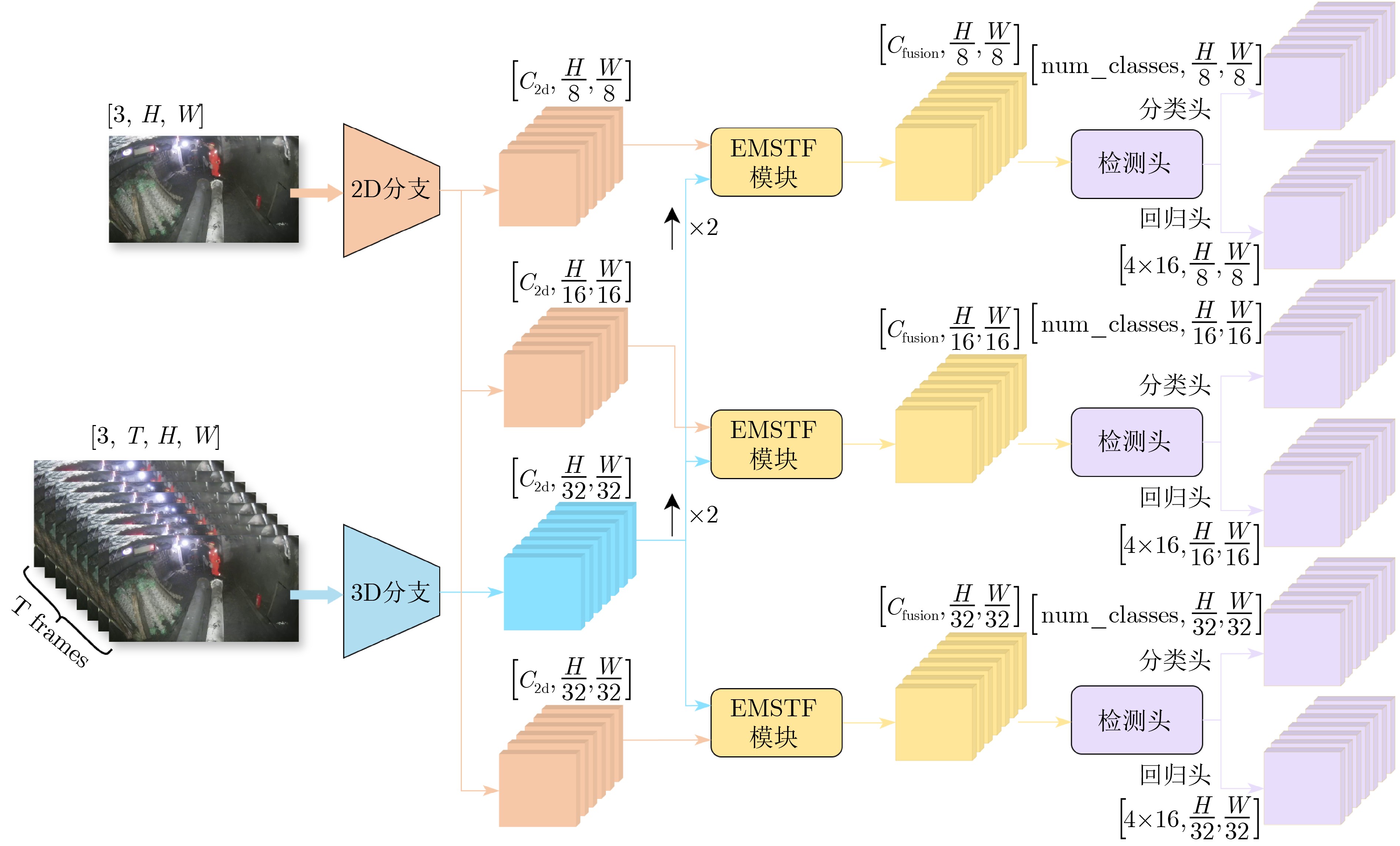
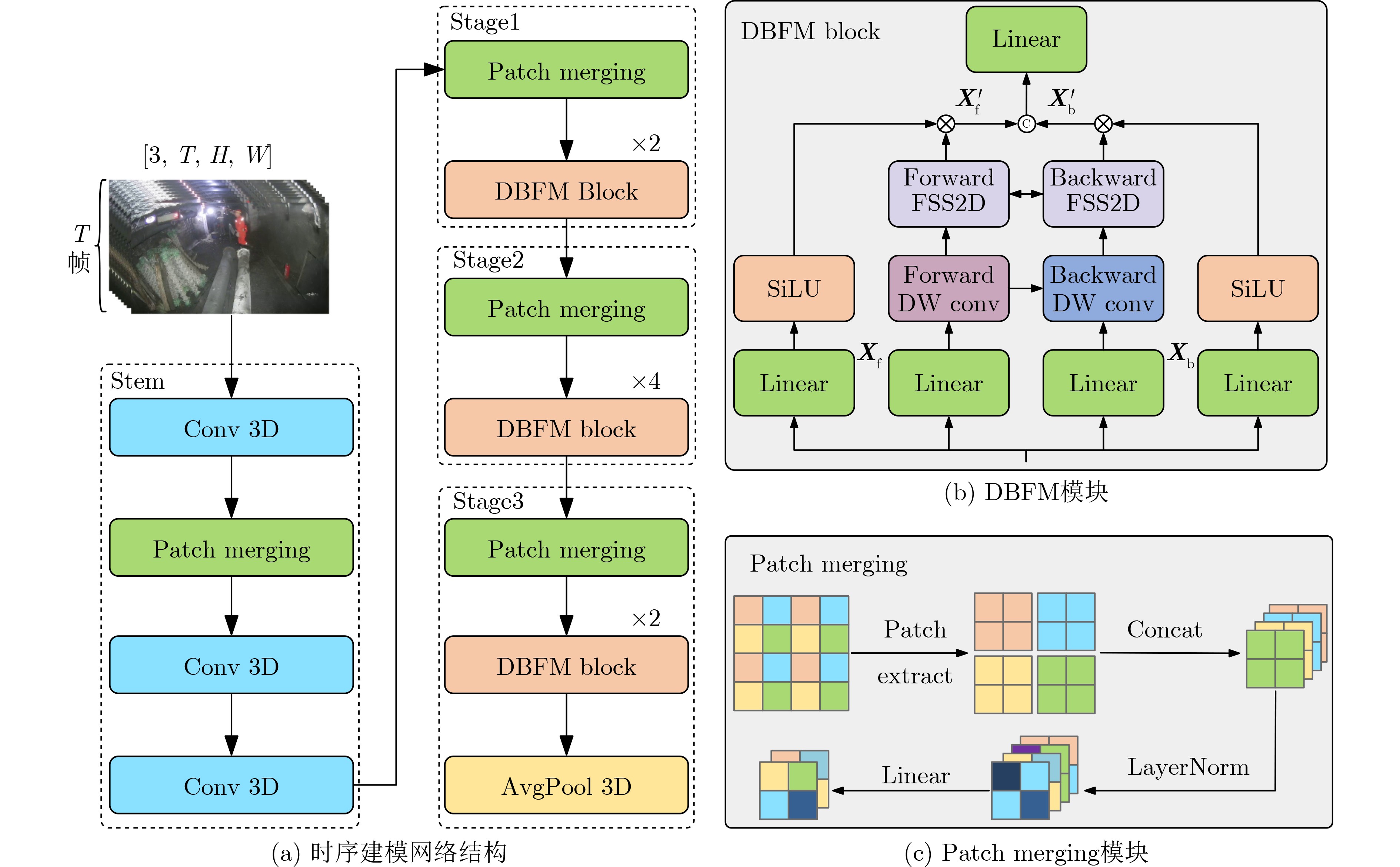
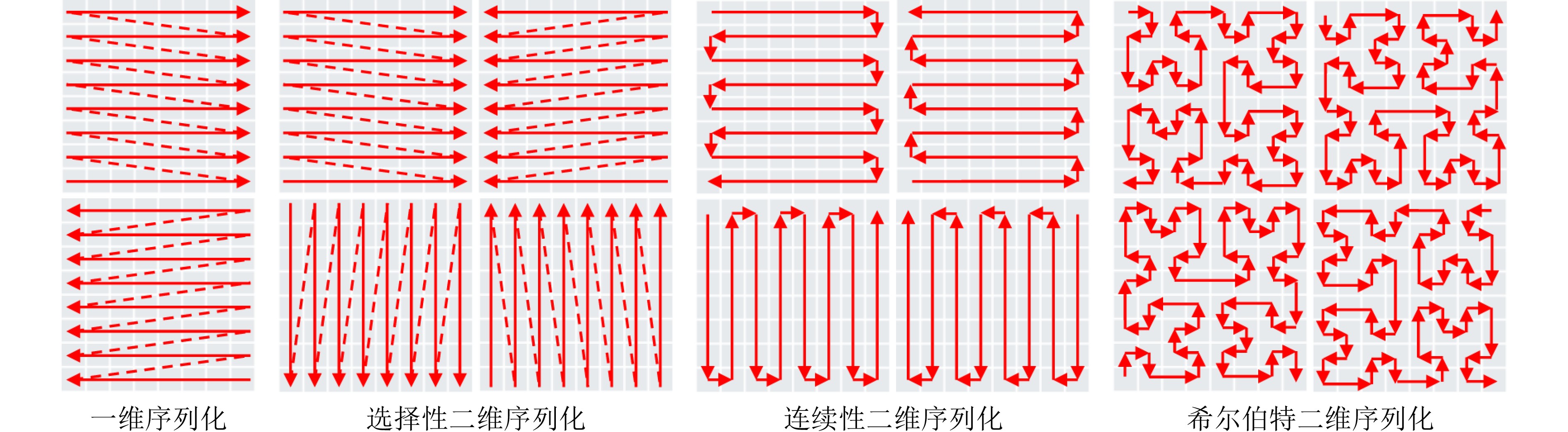
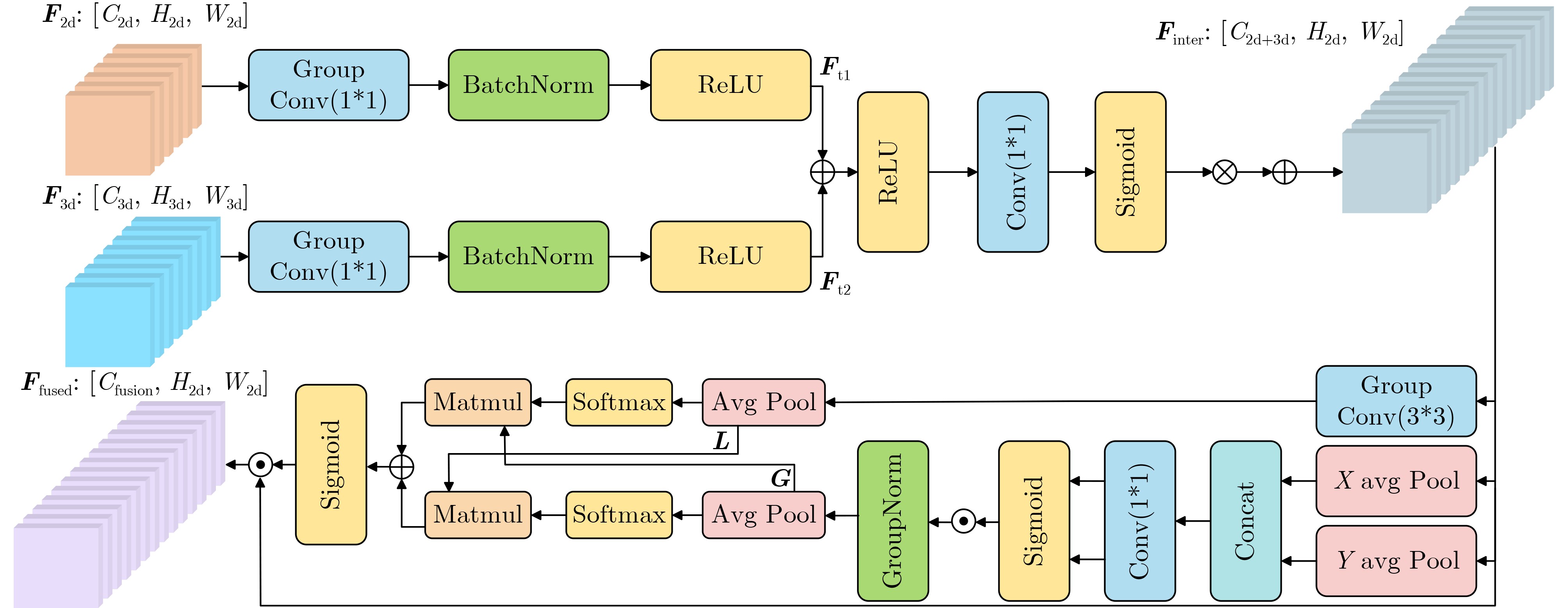
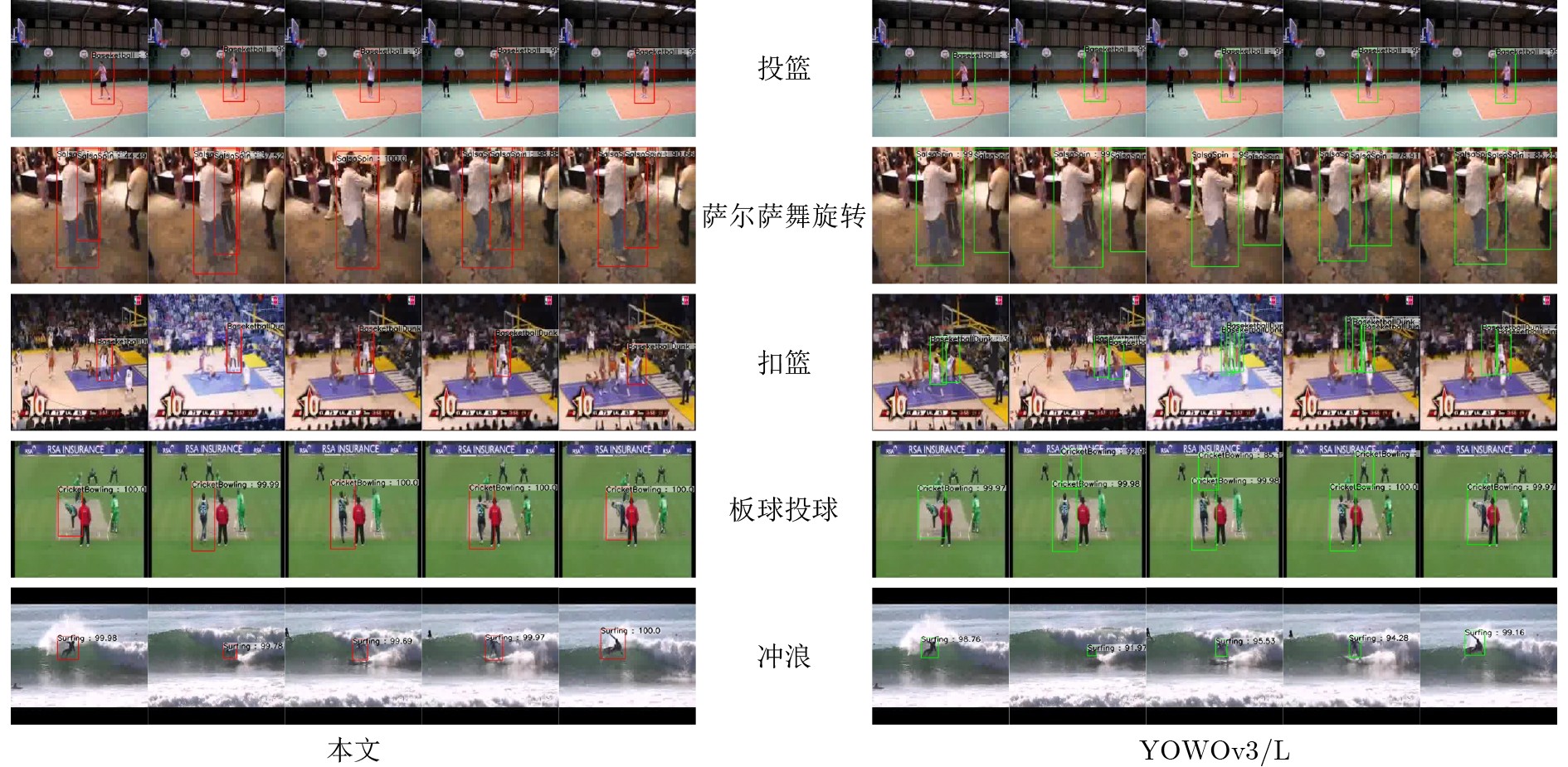
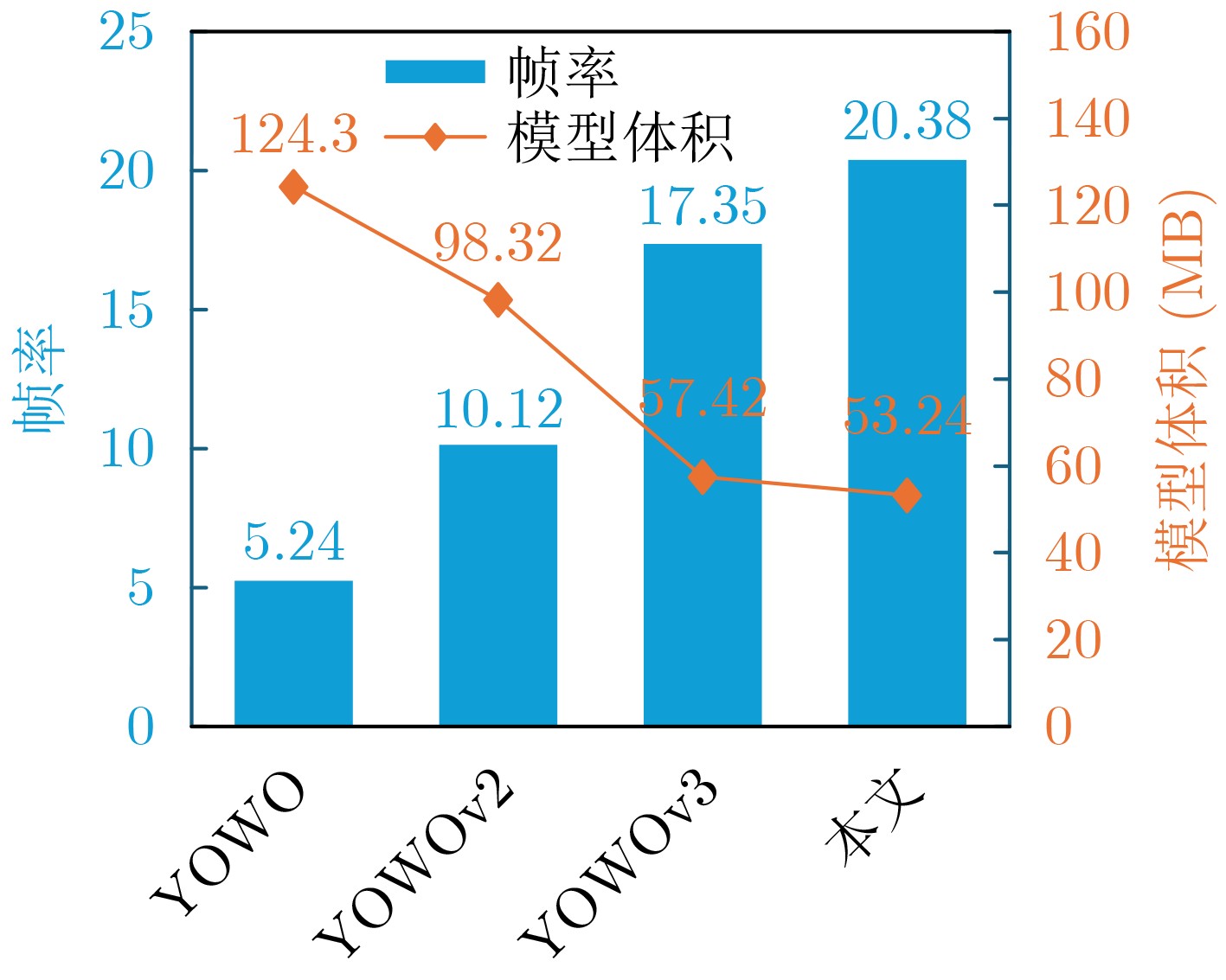
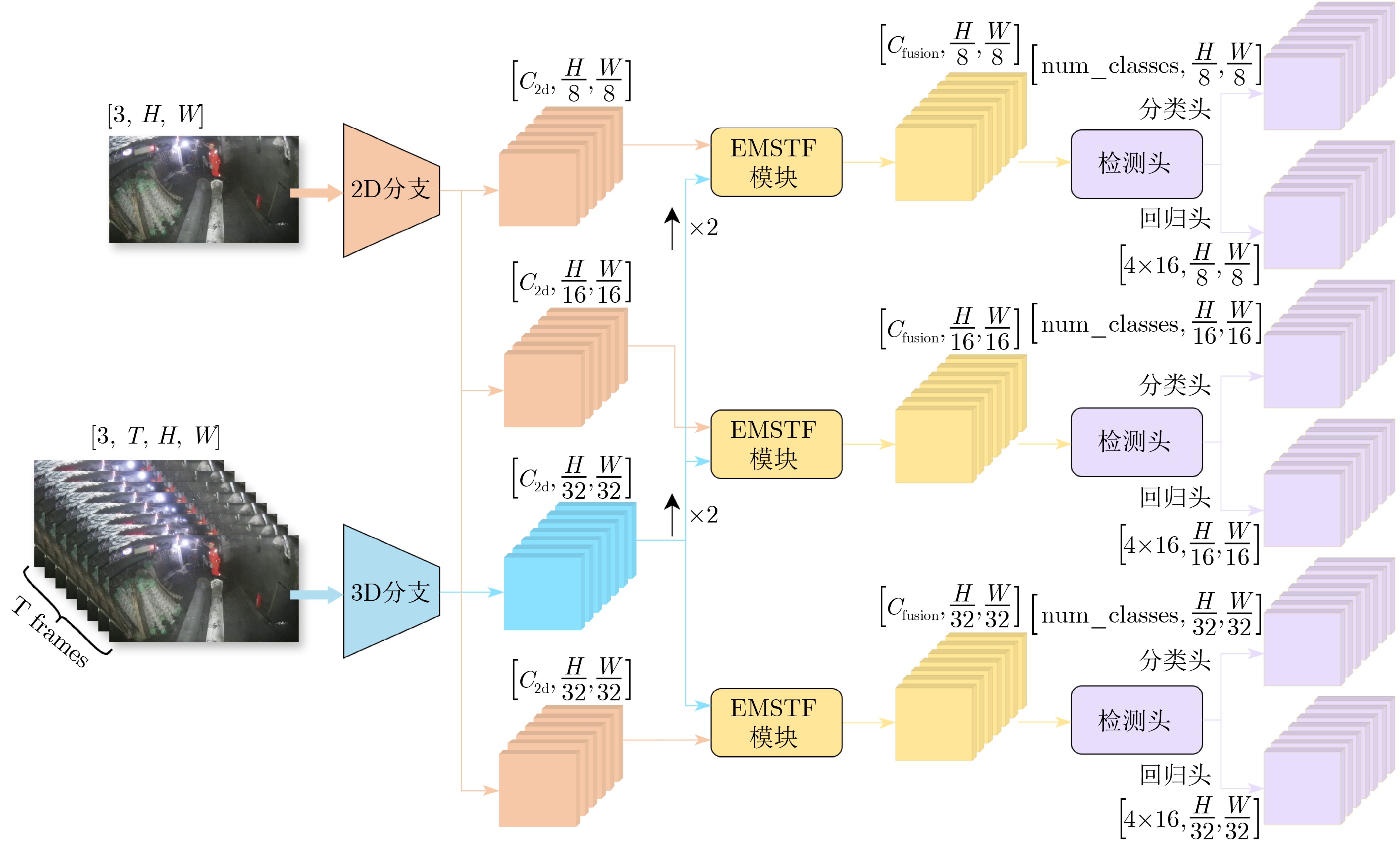
Objective Spatio-temporal action detection aims to localize and recognize action instances in untrimmed videos. This task is essential for applications such as intelligent surveillance and human-computer interaction. Existing methods, particularly those based on 3D convolutional neural networks (3D CNNs) or Transformers, often face difficulty balancing computational cost and the ability to model long-range temporal dependencies. The YOWO series provides efficient detection but relies on 3D convolutions with limited receptive fields. The Mamba architecture, based on a Selective State Space Model (SSM) with linear computational complexity, has shown strong capability for long-sequence modeling. This study integrates Mamba into the YOWO framework to improve temporal modeling efficiency and representation ability while reducing computational cost, addressing the limited application of Mamba in spatio-temporal action detection. Methods The proposed Mamba-YOWO framework is built on the lightweight YOWOv3 architecture. It adopts a dual-branch heterogeneous design for feature extraction. The 2D branch, derived from YOLOv8 with CSPDarknet and PANet structures, processes keyframes to extract multi-scale spatial features. The temporal branch replaces conventional 3D convolutions with a hierarchical architecture composed of a Stem layer and three stages (Stage1–Stage3). Stage1 and Stage2 apply Patch Merging for spatial downsampling and stack Decomposed Bidirectionally Fractal Mamba (DBFM) blocks. The DBFM block employs a bidirectional Mamba structure to capture temporal dependencies in both past-to-future and future-to-past directions. A Spatio-Temporal Interleaved Scan (STIS) strategy is introduced within the DBFM block. This strategy combines bidirectional temporal scanning with spatial Hilbert quad-directional scanning, enabling serialized video representation while maintaining spatial locality and temporal consistency. Stage3 applies 3D average pooling to compress temporal features. An Efficient Multi-scale Spatio-Temporal Fusion (EMSTF) module is designed to integrate features from the 2D and temporal branches. This module applies group convolution–guided hierarchical interaction for preliminary fusion and a parallel dual-branch structure for refined fusion, generating an adaptive spatio-temporal attention map. A lightweight detection head with decoupled classification and regression subnetworks produces the final action tubes. Results and Discussions Extensive experiments were conducted on the UCF101-24 and JHMDB datasets. Compared with the YOWOv3/L baseline on UCF101-24, Mamba-YOWO achieved a Frame-mAP of 90.24% and a Video-mAP@0.5 of 87.90%, which correspond to improvements of 2.1% and 6.0%, respectively ( Table 1 ). These improvements were obtained while reducing model parameters by 7.3% and computational cost (GFLOPs) by 5.4%. On JHMDB, Mamba-YOWO achieved a Frame-mAP of 83.2% and a Video-mAP@0.5 of 86.7% (Table 2 ). Ablation experiments verified the contribution of key components. The optimal number of DBFM blocks in Stage2 was four, whereas additional blocks reduced performance, likely due to overfitting (Table 3 ).Conclusions This study proposes Mamba-YOWO, an efficient spatio-temporal action detection framework that integrates the Mamba architecture into YOWOv3. The model replaces conventional 3D convolutions with a DBFM-based temporal branch that incorporates the STIS scanning strategy, which improves long-range temporal modeling with linear computational complexity. The EMSTF module further improves feature representation through group convolution and dynamic gating mechanisms. Experimental results on UCF101-24 and JHMDB show that Mamba-YOWO achieves higher detection accuracy, such as 90.24% Frame-mAP on UCF101-24, whereas model parameters and computational cost are reduced. Future work will examine the theoretical mechanism of Mamba for temporal modeling, extend its capability to longer video sequences, and support lightweight deployment on edge devices. -
表 1 与现有方法在UCF101-24和JHMDB数据集上的性能对比(%)
发表时间
(年)方法 UCF101-24 JHMDB F-mAP V-mAP F-mAP V-mAP @0.2 @0.5 @0.75 0.5:0.95 @0.2 @0.5 @0.75 0.5:0.95 2020 MOC[31] 78.00 82.80 53.80 29.60 28.30 70.80 77.30 77.20 71.70 59.10 2020 Li et al[32] - 71.10 54.00 21.80 - - 76.10 74.30 56.40 - 2021 SAMOC[33] 79.30 80.50 53.50 30.30 28.70 73.10 79.20 78.30 70.50 58.70 2022 TubeR[34] 81.30 85.30 60.20 - 29.70 - 81.80 80.70 - 2023 HIT[35] 84.80 88.80 74.30 - - 83.80 89.70 88.10 - - 2023 EVAD[36] 85.10 - - - - 83.80 - - - - 2023 STMixer[37] 86.70 - - - - 83.70 - - - - 2024 OSTAD[38] 87.20 - 58.30 - - 78.60 - 86.50 - - 2024 YWOM[39] 84.60 - 49.60 - - 73.30 - 83.70 - - - 本文 90.24 87.90 87.90 31.20 30.20 83.20 87.90 86.70 78.52 59.25  下载: 导出CSV
表 2 与YOWO系列模型在UCF101-24数据集上的性能对比(%)
发表时间
(年)模型 主干网络 参数量(M) 计算量
(GFLOPs)UCF101-24 F-mAP V-mAP @0.2 @0.5 @0.75 0.5:0.95 2019 YOWO[23] DarkNet+ShuffleNetV2 78.98 7.10 71.40 - - - - 2019 YOWO[23] DarkNet+ResNext-101 121.40 43.70 80.40 75.80 48.80 - - 2025 YOWOv2/L[24] FreeYolo-L+ResNext-101 109.70 92.00 85.20 80.42 52.00 23.50 24.76 2026 YOWOv3/L[25] Yolov8-M+I3D 59.80 39.80 88.33 85.20 54.32 28.70 27.24 - 本文 Yolov8-M+DBFM 55.43 37.65 90.24 87.90 60.32 31.20 30.20
下载: 导出CSV
表 3 网络核心模块消融实验(%)
模型配置 3D分支架构 扫描策略 特征融合模块 UCF101-24 JHMDB F-mAP V-mAP@0.5 F-mAP V-mAP@0.5 基线 I3D - CFAM 88.33 54.32 78.62 82.30 变体A DBFM网络(N=4) 1D-Scan CFAM 88.70 58.37 81.30 83.24 变体B DBFM网络(N=4) 1D-Scan EMSTF 89.15 60.54 81.37 85.21 变体C DBFM网络(N=4) STIS CFAM 89.93 75.36 82.47 86.26 完整模型 DBFM网络(N=4) STIS EMSTF 90.24 87.90 83.20 86.70
下载: 导出CSV
-
[1] 王彩玲, 闫晶晶, 张智栋. 基于多模态数据的人体行为识别方法研究综述[J]. 计算机工程与应用, 2024, 60(9): 1–18. doi: 10.3778/j.issn.1002-8331.2310-0090.WANG Cailing, YAN Jingjing, and ZHANG Zhidong. Review on human action recognition methods based on multimodal data[J]. Computer Engineering and Applications, 2024, 60(9): 1–18. doi: 10.3778/j.issn.1002-8331.2310-0090. [2] ZHEN Rui, SONG Wenchao, HE Qiang, et al. Human-computer interaction system: A survey of talking-head generation[J]. Electronics, 2023, 12(1): 218. doi: 10.3390/electronics12010218. [3] SIMONYAN K and ZISSERMAN A. Two-stream convolutional networks for action recognition in videos[C]. The 28th International Conference on Neural Information Processing Systems - Volume 1, Montreal, Canada, 2014: 568–576. [4] WANG Limin, XIONG Yuanjun, WANG Zhe, et al. Temporal segment networks: Towards good practices for deep action recognition[C]. The 14th European Conference on Computer Vision – ECCV 2016, Amsterdam, The Netherlands, 2016: 20–36. doi: 10.1007/978-3-319-46484-8_2. [5] TRAN D, BOURDEV L, FERGUS R, et al. Learning spatiotemporal features with 3D convolutional networks[C]. The IEEE International Conference on Computer Vision, Santiago, Chile, 2015: 4489–4497. doi: 10.1109/ICCV.2015.510. [6] CARREIRA J and ZISSERMAN A. Quo Vadis, action recognition? A new model and the kinetics dataset[C]. The IEEE Conference on Computer Vision and Pattern Recognition, Honolulu, USA, 2017: 4724–4733. doi: 10.1109/CVPR.2017.502. [7] 钱惠敏, 陈实, 皇甫晓瑛. 基于双流-非局部时空残差卷积神经网络的人体行为识别[J]. 电子与信息学报, 2024, 46(3): 1100–1108. doi: 10.11999/JEIT230168.QIAN Huimin, CHEN Shi, and HUANGFU Xiaoying. Human activities recognition based on two-stream NonLocal spatial temporal residual convolution neural network[J]. Journal of Electronics & Information Technology, 2024, 46(3): 1100–1108. doi: 10.11999/JEIT230168. [8] WANG Xiaolong, GIRSHICK R, GUPTA A, et al. Non-local neural networks[C]. The IEEE/CVF Conference on Computer Vision and Pattern Recognition, Salt Lake City, USA, 2018: 7794–7803. doi: 10.1109/CVPR.2018.00813. [9] DONAHUE J, ANNE HENDRICKS L, GUADARRAMA S, et al. Long-term recurrent convolutional networks for visual recognition and description[C]. The IEEE Conference on Computer Vision and Pattern Recognition, Boston, USA, 2015: 2625–2634. doi: 10.1109/CVPR.2015.7298878. [10] 曹毅, 李杰, 叶培涛, 等. 利用可选择多尺度图卷积网络的骨架行为识别[J]. 电子与信息学报, 2025, 47(3): 839–849. doi: 10.11999/JEIT240702.CAO Yi, LI Jie, YE Peitao, et al. Skeleton-based action recognition with selective multi-scale graph convolutional network[J]. Journal of Electronics & Information Technology, 2025, 47(3): 839–849. doi: 10.11999/JEIT240702. [11] DOSOVITSKIY A, BEYER L, KOLESNIKOV A, et al. An image is worth 16x16 words: Transformers for image recognition at scale[C]. The 9th International Conference on Learning Representations, Austria, 2021. [12] BERTASIUS G, WANG Heng, and TORRESANI L. Is space-time attention all you need for video understanding?[C]. The 38th International Conference on Machine Learning, 2021: 813–824. [13] ZHANG Chenlin, WU Jianxin, and LI Yin. ActionFormer: Localizing moments of actions with transformers[C]. The 17th European Conference on Computer Vision – ECCV 2022, Tel Aviv, Israel, 2022: 492–510. doi: 10.1007/978-3-031-19772-7_29. [14] 韩宗旺, 杨涵, 吴世青, 等. 时空自适应图卷积与Transformer结合的动作识别网络[J]. 电子与信息学报, 2024, 46(6): 2587–2595. doi: 10.11999/JEIT230551.HAN Zongwang, YANG Han, WU Shiqing, et al. Action recognition network combining spatio-temporal adaptive graph convolution and Transformer[J]. Journal of Electronics & Information Technology, 2024, 46(6): 2587–2595. doi: 10.11999/JEIT230551. [15] GU A and DAO T. Mamba: Linear-time sequence modeling with selective state spaces[C]. Conference on Language Modeling, Philadelphia, 2024. [16] ZHU Lianghui, LIAO Bencheng, ZHANG Qian, et al. Vision mamba: Efficient visual representation learning with bidirectional state space model[C]. Procedding of Forty-First International Conference on Machine Learning, Vienna, Austria, 2024. [17] LIU Yue, TIAN Yunjie, ZHAO Yuzhong, et al. VMamba: Visual state space model[C]. The 38th International Conference on Neural Information Processing Systems, Vancouver, Canada, 2024: 3273. [18] LI Kunchang, LI Xinhao, WANG Yi, et al. VideoMamba: State space model for efficient video understanding[C]. The 18th European Conference on Computer Vision – ECCV 2024, Milan, Italy, 2025: 237–255. doi: 10.1007/978-3-031-73347-5_14. [19] LEE S H, SON T, SEO S W, et al. JARViS: Detecting actions in video using unified actor-scene context relation modeling[J]. Neurocomputing, 2024, 610: 128616. doi: 10.1016/j.neucom.2024.128616. [20] REKA A, BORZA D L, REILLY D, et al. Introducing gating and context into temporal action detection[C]. The Computer Vision – ECCV 2024 Workshops, Milan, Italy, 2025: 322–334. doi: 10.1007/978-3-031-91581-9_23. [21] KWON D, KIM I, and KWAK S. Boosting semi-supervised video action detection with temporal context[C]. 2025 IEEE/CVF Winter Conference on Applications of Computer Vision, Tucson, USA, 2025: 847–858. doi: 10.1109/WACV61041.2025.00092. [22] ZHOU Xuyang, WANG Ye, TAO Fei, et al. Hierarchical chat-based strategies with MLLMs for Spatio-temporal action detection[J]. Information Processing & Management, 2025, 62(4): 104094. doi: 10.1016/j.ipm.2025.104094. [23] Köpüklü O, WEI Xiangyu, and RIGOLL G. You only watch once: A unified CNN architecture for real-time spatiotemporal action localization[J]. arXiv preprint arXiv: 1911.06644, 2019. [24] JIANG Zhiqiang, YANG Jianhua, JIANG Nan, et al. YOWOv2: A stronger yet efficient multi-level detection framework for real-time spatio-temporal action detection[C]. The 17th International Conference on Intelligent Robotics and Applications, Xi’an, China, 2025: 33–48. doi: 10.1007/978-981-96-0774-7_3. [25] NGUYEN D D M, NHAN B D, WANG J C, et al. YOWOv3: An efficient and generalized framework for spatiotemporal action detection[J]. IEEE Intelligent Systems, 2026, 41(1): 75–85. doi: 10.1109/MIS.2025.3581100. [26] VARGHESE R and M. S. YOLOv8: A novel object detection algorithm with enhanced performance and robustness[C]. 2024 International Conference on Advances in Data Engineering and Intelligent Computing Systems (ADICS), Chennai, India, 2024: 1–6. doi: 10.1109/ADICS58448.2024.10533619. [27] LIU Ze, NING Jia, CAO Yue, et al. Video swin transformer[C]. The IEEE/CVF Conference on Computer Vision and Pattern Recognition, New Orleans, USA, 2022: 3192–3201. doi: 10.1109/CVPR52688.2022.00320. [28] XIAO Haoke, TANG Lv, JIANG Pengtao, et al. Boosting vision state space model with fractal scanning[C]. The 39th AAAI Conference on Artificial Intelligence, Philadelphia, USA, 2025: 8646–8654. doi: 10.1609/aaai.v39i8.32934. [29] SOOMRO K, ZAMIR A R, and SHAH M. UCF101: A dataset of 101 human actions classes from videos in the wild[J]. arXiv preprint arXiv: 1212.0402, 2012. [30] KUEHNE H, JHUANG H, GARROTE E, et al. HMDB: A large video database for human motion recognition[C]. 2011 International Conference on Computer Vision, Barcelona, Spain, 2011: 2556–2563. doi: 10.1109/ICCV.2011.6126543. [31] LI Yixuan, WANG Zixu, WANG Limin, et al. Actions as moving points[C]. The 16th European Conference on Computer Vision – ECCV 2020, Glasgow, UK, 2020: 68–84. doi: 10.1007/978-3-030-58517-4_5. [32] LI Yuxi, LIN Weiyao, WANG Tao, et al. Finding action tubes with a sparse-to-dense framework[C]. The 34th AAAI Conference on Artificial Intelligence, New York Hilton Midtown, USA, 2020: 11466–11473. doi: 10.1609/aaai.v34i07.6811. [33] MA Xurui, LUO Zhigang, ZHANG Xiang, et al. Spatio-temporal action detector with self-attention[C]. 2021 International Joint Conference on Neural Networks (IJCNN), Shenzhen, China, 2021: 1–8. doi: 10.1109/IJCNN52387.2021.9533300. [34] ZHAO Jiaojiao, ZHANG Yanyi, LI Xinyu, et al. TubeR: Tubelet transformer for video action detection[C]. The IEEE/CVF Conference on Computer Vision and Pattern Recognition, New Orleans, USA, 2022: 13588–13597. doi: 10.1109/CVPR52688.2022.01323. [35] FAURE G J, CHEN M H, and LAI Shanghong. Holistic interaction transformer network for action detection[C]. The IEEE/CVF Winter Conference on Applications of Computer Vision, Waikoloa, USA, 2023: 3329–3339. doi: 10.1109/WACV56688.2023.00334. [36] CHEN Lei, TONG Zhan, SONG Yibing, et al. Efficient video action detection with token dropout and context refinement[C]. The IEEE/CVF International Conference on Computer Vision, Paris, France, 2023: 10354–10365. doi: 10.1109/ICCV51070.2023.00953. [37] WU Tao, CAO Mengqi, GAO Ziteng, et al. STMixer: A one-stage sparse action detector[C]. The IEEE/CVF Conference on Computer Vision and Pattern Recognition, Vancouver, Canada, 2023: 14720–14729. doi: 10.1109/CVPR52729.2023.01414. [38] SU Shaowen and GAN Minggang. Online spatio-temporal action detection with adaptive sampling and hierarchical modulation[J]. Multimedia Systems, 2024, 30(6): 349. doi: 10.1007/s00530-024-01543-1. [39] QIN Yefeng, CHEN Lei, BEN Xianye, et al. You watch once more: A more effective CNN architecture for video spatio-temporal action localization[J]. Multimedia Systems, 2024, 30(1): 53. doi: 10.1007/s00530-023-01254-z. -

 下载:
下载:


图(7) / 表(3)
计量
- 文章访问数: 1068
- HTML全文浏览量: 789
- PDF下载量: 127
- 被引次数: 0
