




Ultra-Low-Power IM3 Backscatter Passive Sensing System for IoT Applications
-
摘要: 传统反向散射通信无法同步实现射频能量收集与传感信息读出,而基于有源标签的传感信息回传存在较高通信能耗。该文提出一种新颖的3阶互调(IM3)反向散射式无源传感系统,可在不影响射频能量收集效率的前提下实现传感信息低功耗读出。该文研究了整流电路中反向散射IM3产生机制,通过差频嵌入阻抗调控IM3信号转换效率,传感信息控制嵌入阻抗谐振频率变化,将传感信息映射到IM3信号强度凹陷点变化上,查询器通过扫描该凹陷点反演传感信息。实验结果表明,该系统能准确读取传感信息,能量转换效率仅比纯整流模式下降约5个百分点;在1 m无线传输距离下,反向散射IM3信号反演的传感电压与直接测量值误差小于5%,为解决同步能量收集与模拟量读出、低功耗信息传输问题提供了新方法。
-
关键词:
- 无源传感 /
- 无线数据和能量协同传输 /
- 射频能量收集 /
- 低功耗 /
- 3阶互调
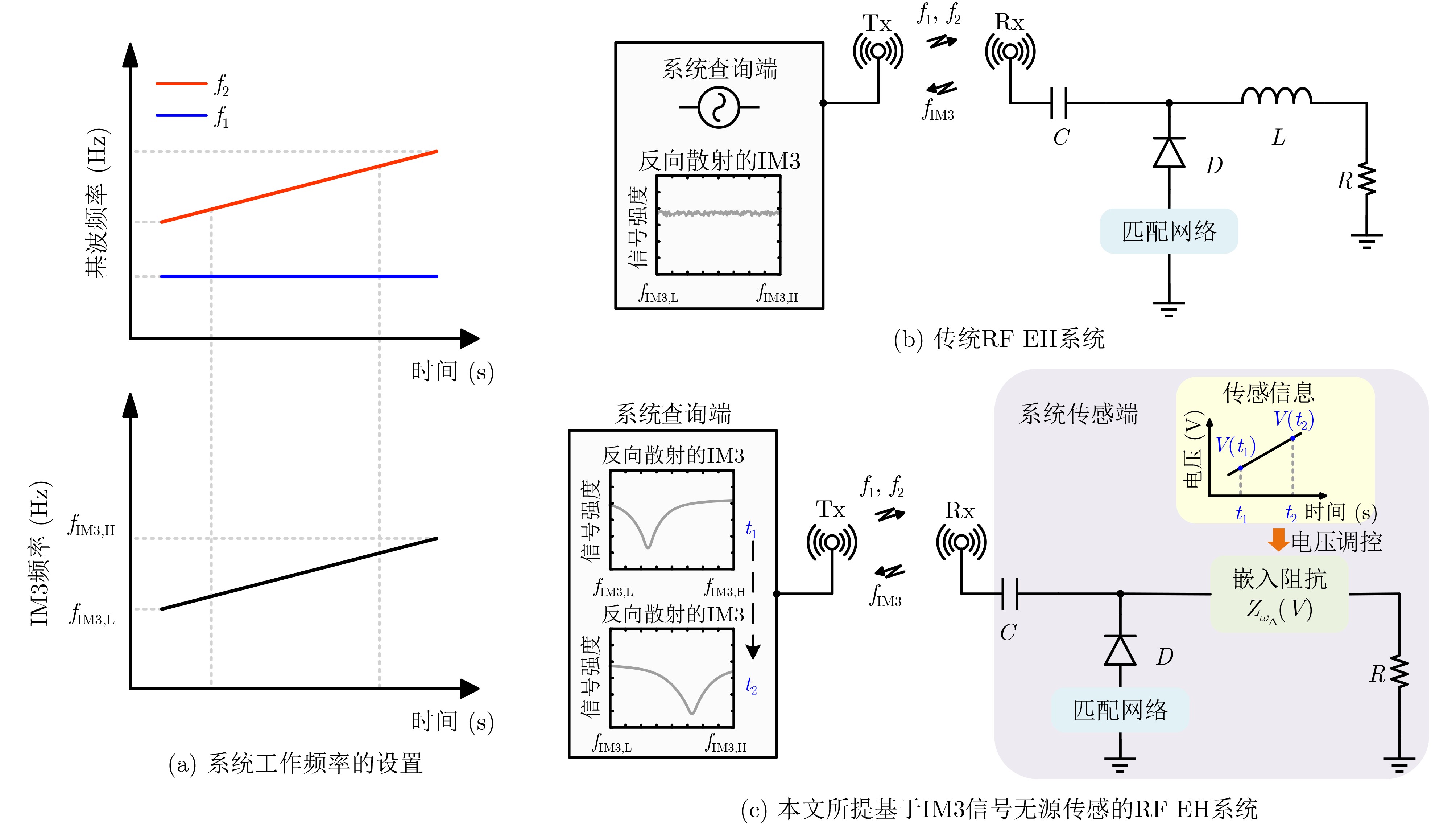
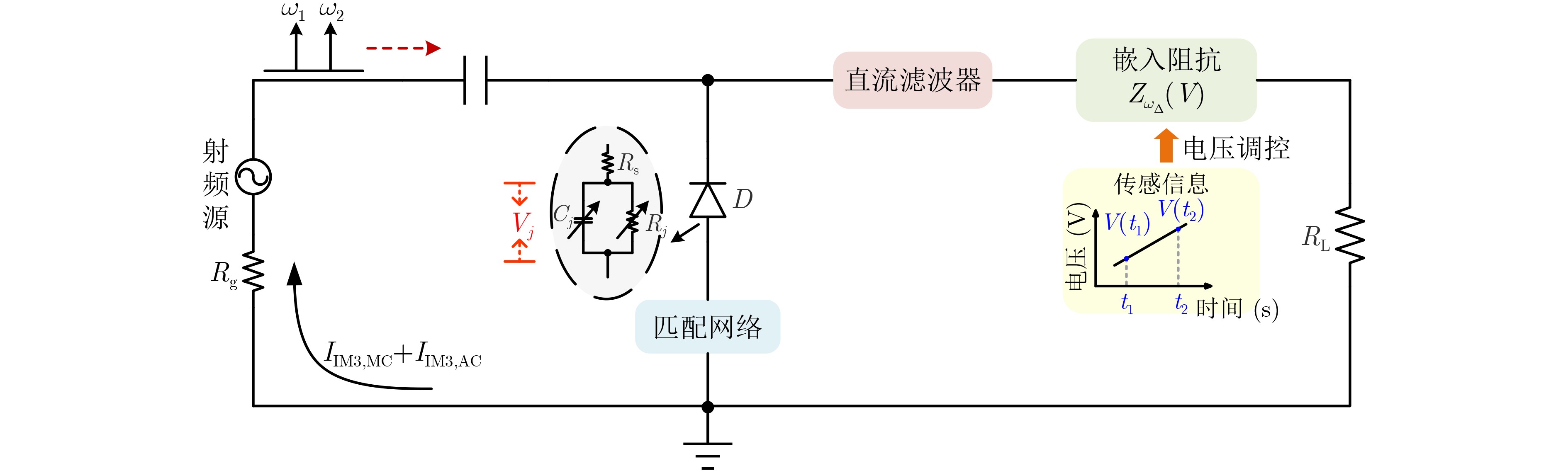
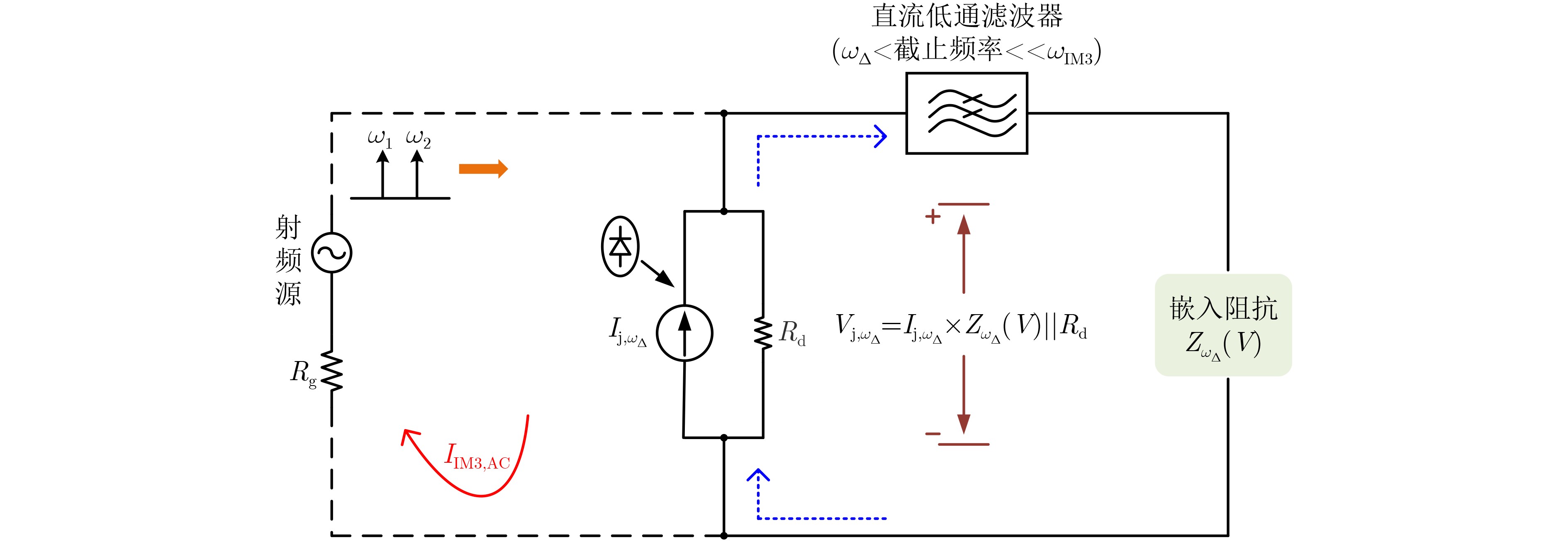
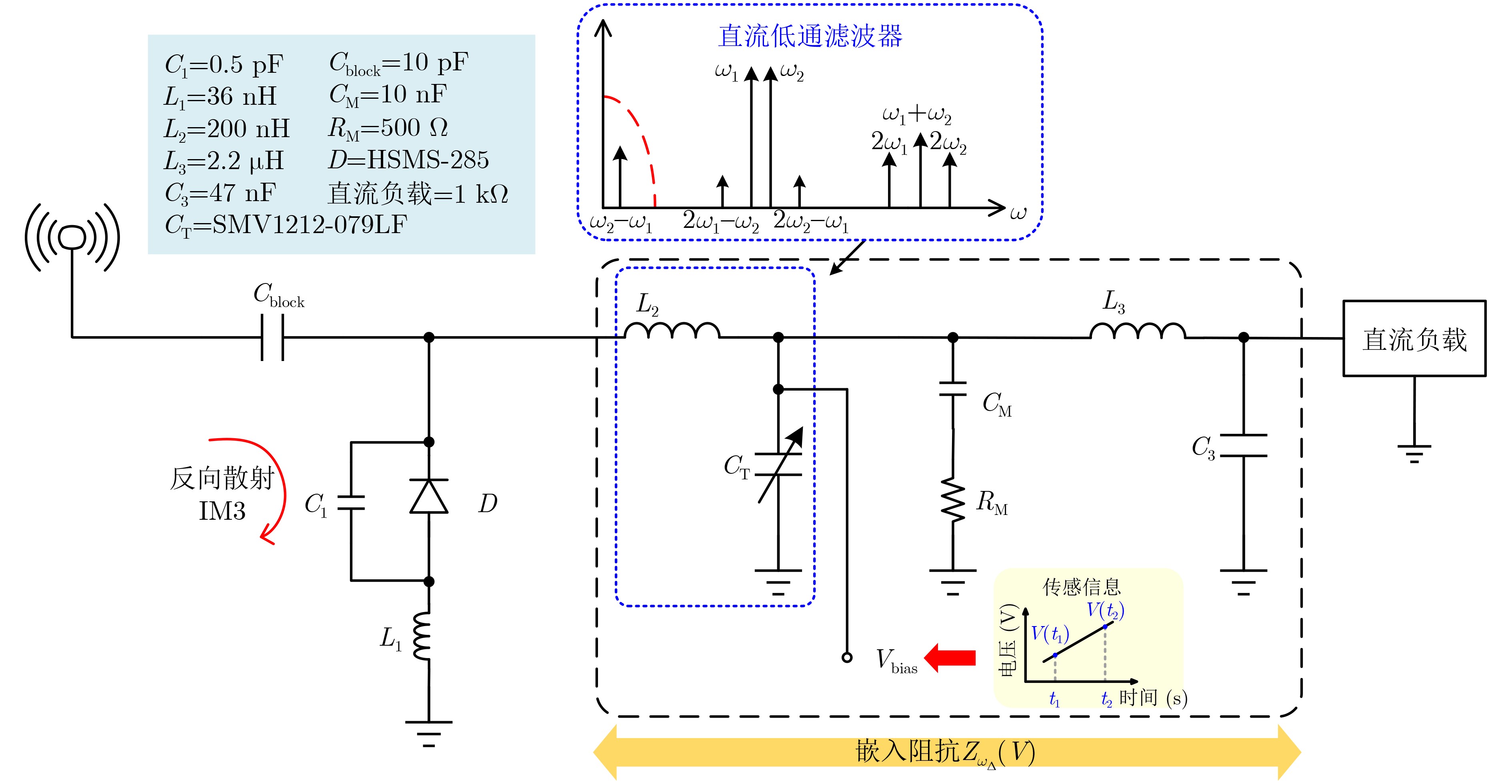
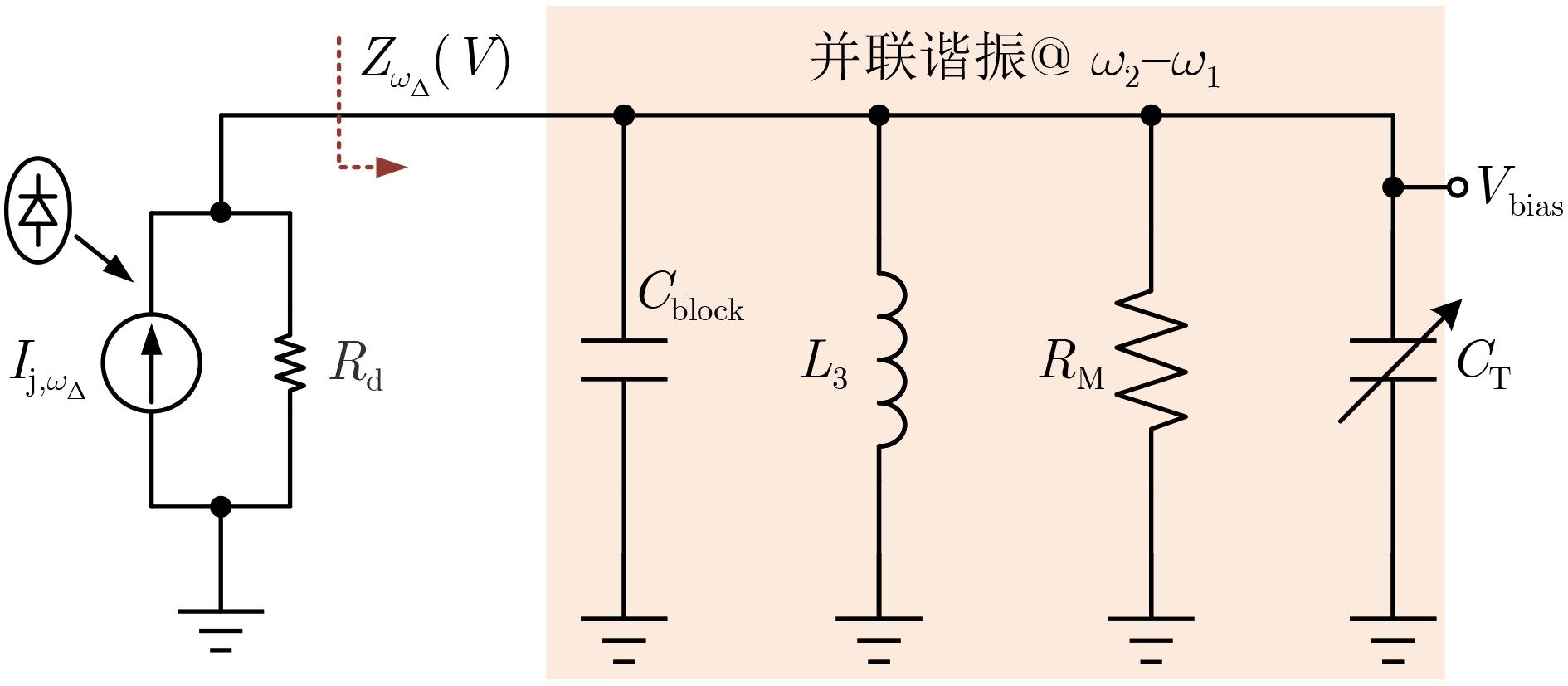
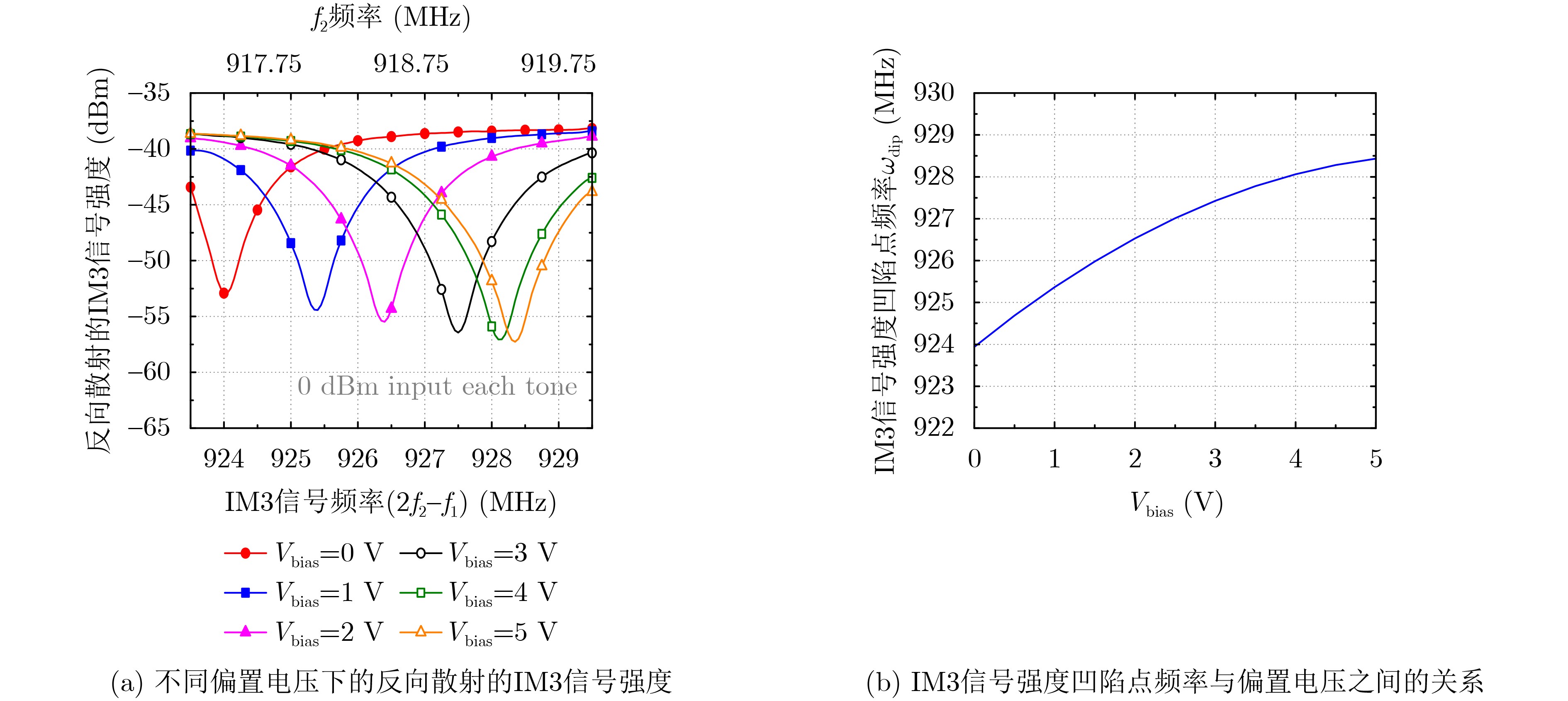
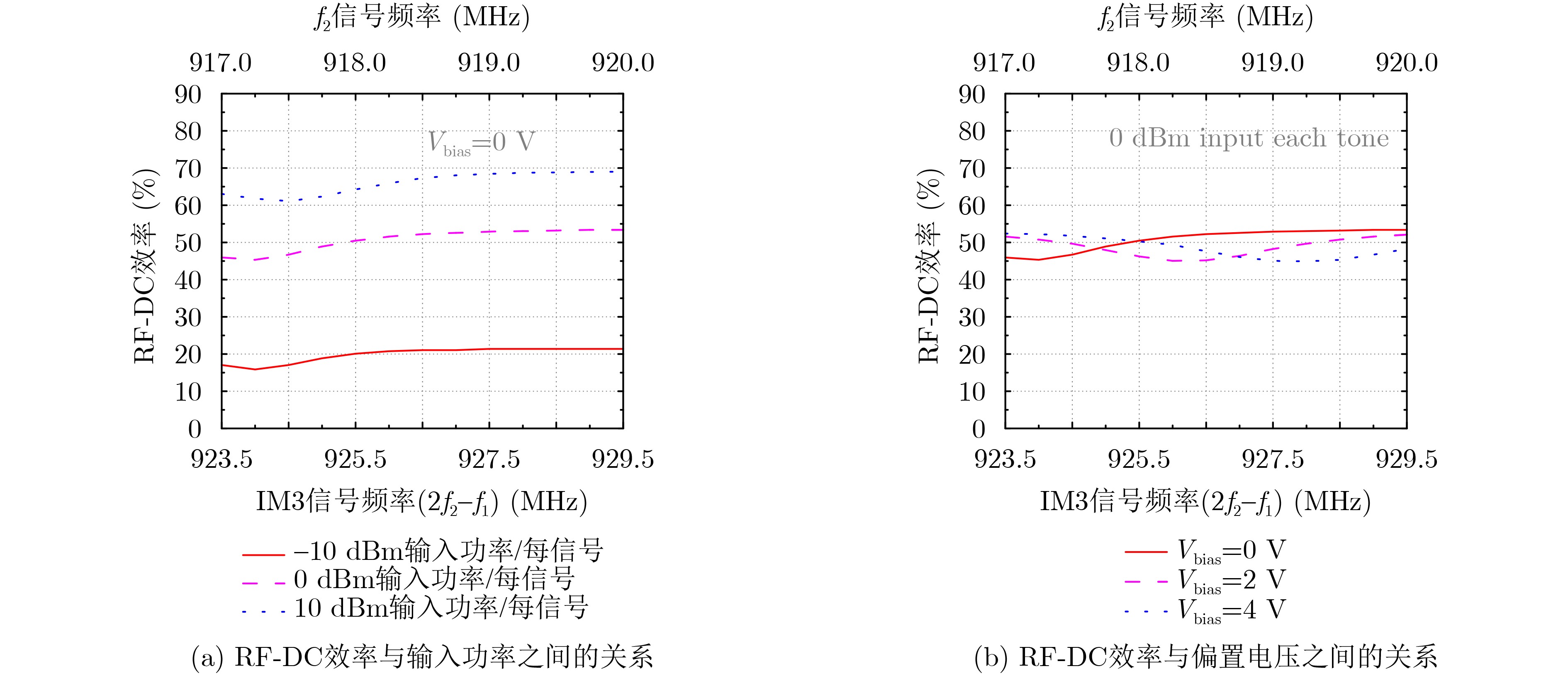
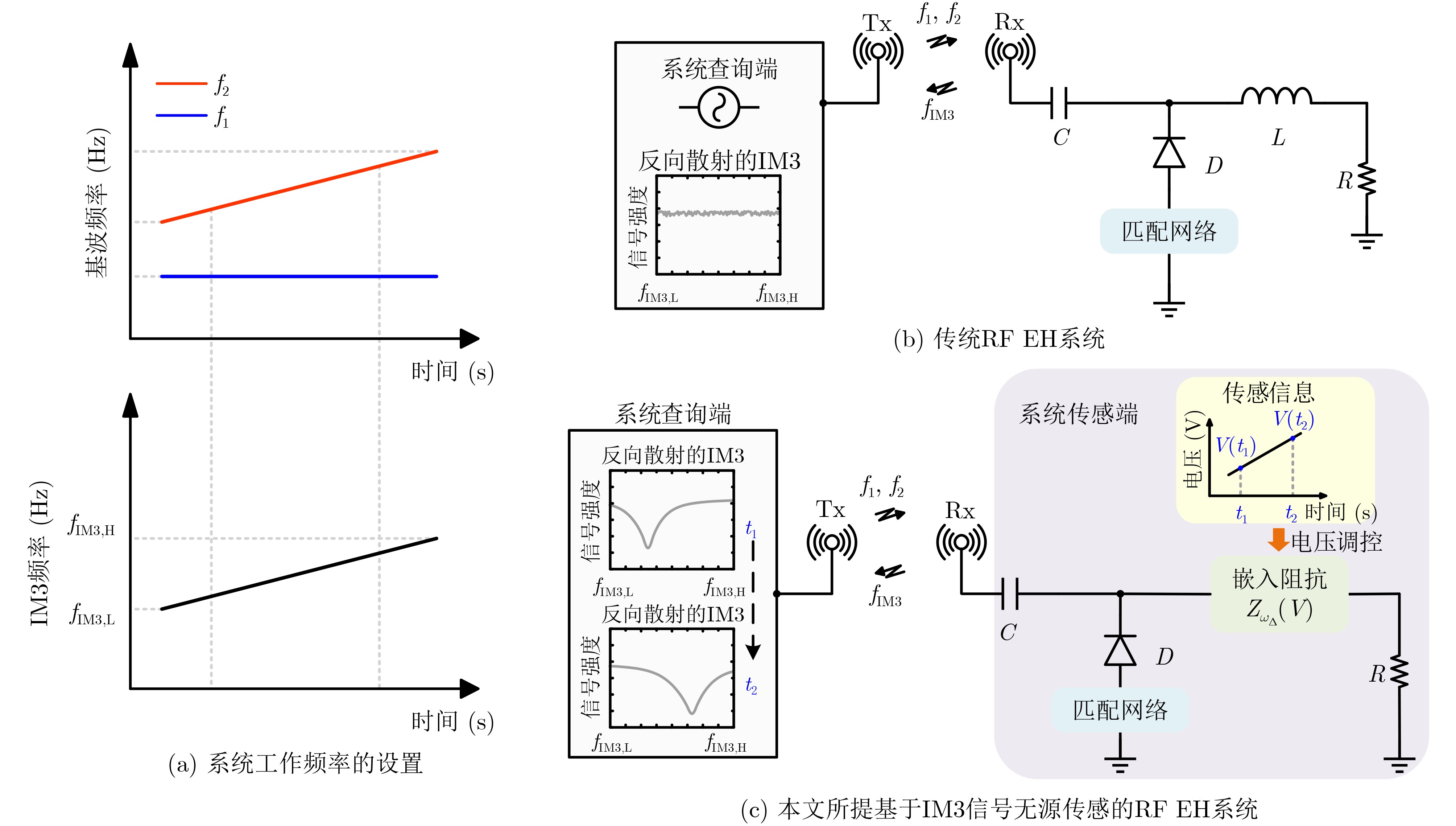
Abstract:Objective With advances in wireless communication and electronic manufacturing, the Internet of Things (IoT) continues to expand across healthcare, agriculture, logistics, and other sectors. The rapid increase in IoT devices creates significant energy challenges, as billions of units generate substantial cumulative consumption, and battery-powered nodes require recurrent charging that raises operating costs and contributes to electronic waste. Energy-efficient strategies are therefore needed to support sustainable IoT deployment. Current approaches focus on improving energy availability and lowering device power demand. Energy Harvesting (EH) technology enables the collection and storage of solar, thermal, kinetic, and Radio Frequency (RF) energy for Ambient IoT (AmIoT) applications. However, conventional IoT devices, particularly those containing active RF components, often require high power, and limited EH efficiency can constrain real-time sensing transmission. To address these constraints, this work proposes an Intermodulation-Product-Third-Order (IM3) backscatter passive sensing system that enables direct analog sensing transmission while maintaining RF EH efficiency. Methods The IM3 signal is a nonlinear distortion product generated when two fundamental tones pass through nonlinear devices such as transistors and diodes, producing components at 2f1–f2 and 2f2–f1. The central contribution of this work is the establishment of a controllable functional relationship between sensor information and IM3 signal frequencies, enabling information encoding through IM3 frequency characteristics. The regulatory element is an embedded impedance module designed as a parallel resonant tank composed of resistors, inductors, and capacitors and integrated into the rectifier circuit. Adjusting the tank’s resonant frequency regulates the conversion efficiency from the fundamental tones to IM3 components: when the resonant frequency approaches a target IM3 frequency, a high-impedance load is produced, lowering the conversion efficiency of that specific IM3 component while leaving other IM3 components unchanged. Sensor information modulates the resonant frequency by generating a DC voltage applied to a voltage-controlled varactor. By mapping sensor information to impedance states, impedance states to IM3 conversion efficiency, and IM3 frequency features back to sensor information, passive sensing is achieved. Results and Discussions A rectifying transmitter operating in the UHF 900 MHz band is designed and fabricated ( Fig. 8 ). One signal source is fixed at 910.5 MHz, and the other scans 917~920 MHz, generating IM3 components in the 923.5~929.5 MHz range. Both sources provide an output power of 0 dBm, and the transmitted sensor information is expressed as a DC voltage. Experimental measurements show a power trough in the backscattered IM3 spectrum; as the DC voltage varies from 0 to 5 V, the trough position shifts accordingly (Fig. 9 ), with more than 10 dB attenuation across the range, giving adequate resolution determined by the varactor diode’s capacitance ratio. The embedded impedance module shows minimal effect on RF-to-DC efficiency (Fig. 10 ): at a fixed DC voltage, efficiency decreases by approximately 5 basis points at the modulation frequency, independent of input power, and under fixed input power, different sampled voltages cause about 5 basis points of efficiency reduction at different frequencies. These results confirm that the rectifier circuit maintains stable efficiency and meets low-power data transmission requirements.Conclusions This paper proposes a passive sensing system based on backscattered IM3 signals that enables simultaneous efficient RF EH and sensing readout. The regulation mechanism between the difference-frequency embedded impedance module and backscattered IM3 intensity is demonstrated. Driven by sensing information, the module links the sensed quantity to IM3 intensity to realize passive readout. Experimental results show that the embedded impedance reduces the target-frequency IM3 component by more than 10 dB, and the RF-to-DC efficiency decreases by only 5 percentage points during readout. Tests in a microwave anechoic chamber indicate that the error between the IM3-derived bias voltage and the measured value remains within 5%, confirming stable operation. The system addresses the energy-information transmission constraint and supports battery-free communication for passive sensor nodes. It extends device lifespan and reduces maintenance costs in Ultra-Low-Power scenarios such as wireless sensor networks and implantable medical devices, offering strong engineering relevance. -
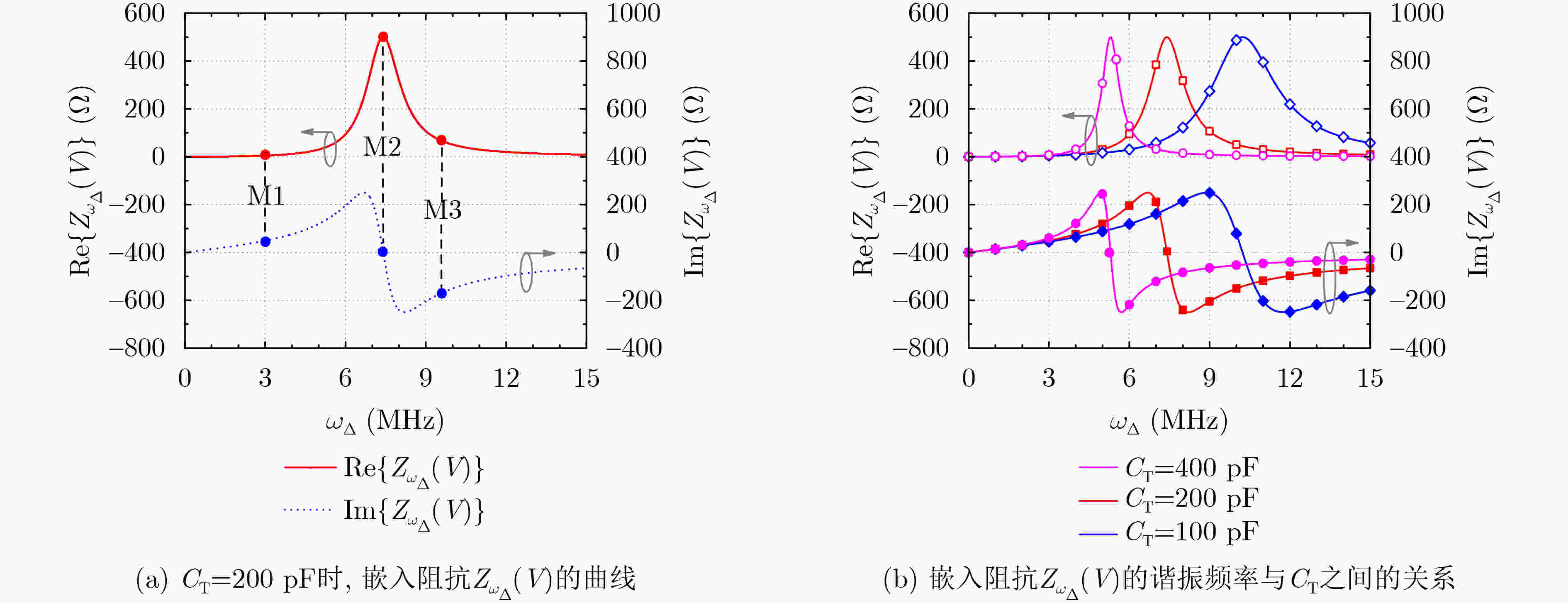
图 7 嵌入阻抗$ {Z}_{{{\omega }_{\Delta }}}\left(V\right) $随差分频率$ {\omega }_{\Delta } $的变化情况
表 1 $ {Z}_{{{\omega }_{\Delta }}}\left(V\right) $与反向散射的IM3信号强度关系的仿真结果(两输入信号功率均为0 dBm)
光标 二极管上的基波电压 (V) 嵌入阻抗$ {Z}_{{{\omega }_{\Delta }}}\left(V\right) $ (Ω) $ {V}_{\text{j,}{{\omega }_{\Delta }}} $ (V) $ {I}_{\text{IM3,MC}}+{I}_{\text{IM3,AC}} $ (10–5A) M1 $ \begin{matrix}{\omega }_{1}=1.11\angle -0.78{^{\circ}}\\ {\omega }_{2}=1.11\angle 0.12{^{\circ}}\\ \end{matrix} $ $ 4.87+\mathrm{j}49.13 $ $ 0.03\angle -78.33{^{\circ}} $ $ 4.52\angle -135.45{^{\circ}} $ M2(谐振点) $ 500 $ $ 0.40\angle -0.97{^{\circ}} $ $ 0.21\angle -116.17{^{\circ}} $ M3 $ 70.91-\mathrm{j}174.43 $ $ 0.09\angle -18.44{^{\circ}} $ $ 3.98\angle -132.66{^{\circ}} $  下载: 导出CSV
-
[1] JOUHARI M, SAEED N, ALOUINI M S, et al. A survey on scalable LoRaWAN for massive IoT: Recent advances, potentials, and challenges[J]. IEEE Communications Surveys & Tutorials, 2023, 25(3): 1841–1876. doi: 10.1109/COMST.2023.3274934. [2] SINHA S. State of IoT 2023: Number of connected IoT devices growing 16% to 16.7 billion globally[EB/OL]. https://iot-analytics.com/number-connected-iot-devices-2023/, 2023. [3] HOPE D. Why your Internet habits are not as clean as you think[EB/OL]. https://blueandgreentomorrow.com/features/why-internet-habits-are-not-as-clean-as-you-think/, 2021. [4] GLICKMAN C. Green IoT: The shift to practical sustainability[EB/OL]. https://cio.economictimes.indiatimes.com/news/internet-of-things/green-iot-the-shift-to-practical-sustainability/101654205, 2023. [5] MA Dong, LAN Guohao, HASSAN M, et al. Sensing, computing, and communications for energy harvesting IoTs: A survey[J]. IEEE Communications Surveys & Tutorials, 2020, 22(2): 1222–1250. doi: 10.1109/COMST.2019.2962526. [6] PECUNIA V, OCCHIPINTI L G, and HOYE R L Z. Emerging indoor photovoltaic technologies for sustainable Internet of Things[J]. Advanced Energy Materials, 2021, 11(29): 2100698. doi: 10.1002/aenm.202100698. [7] GU Bowen, LI Dong, DING Haiyang, et al. Breaking the interference and fading gridlock in backscatter communications: State-of-the-art, design challenges, and future directions[J]. IEEE Communications Surveys & Tutorials, 2025, 27(2): 870–911. doi: 10.1109/COMST.2024.3436082. [8] XU Chenren, YANG Lei, and ZHANG Pengyu. Practical backscatter communication systems for battery-free Internet of Things: A tutorial and survey of recent research[J]. IEEE Signal Processing Magazine, 2018, 35(5): 16–27. doi: 10.1109/MSP.2018.2848361. [9] BLETSAS A, ALEVIZOS P N, and VOUGIOUKAS G. The art of signal processing in backscatter radio for μW (or less) Internet of Things: Intelligent signal processing and backscatter radio enabling batteryless connectivity[J]. IEEE Signal Processing Magazine, 2018, 35(5): 28–40. doi: 10.1109/MSP.2018.2837678. [10] SUN Xueman, LIU Changjun, CHEN Yidan, et al. Low-power wireless uplink utilizing harmonic with an integrated rectifier–transmitter[J]. IEEE Microwave and Wireless Components Letters, 2021, 31(2): 200–203. doi: 10.1109/LMWC.2020.3043793. [11] HÜSSEN L, WEI M D, and NEGRA R. Power efficient simultaneous wireless information transception and power reception through an isolation barrier[C]. 2024 IEEE Wireless Power Technology Conference and Expo (WPTCE), Kyoto, Japan, 2024: 872–875. doi: 10.1109/WPTCE59894.2024.10557398. [12] CHE Dan, LIU Changjun, HE Haoming, et al. Second- and third-harmonic backscatter through a bandstop filter using defected ground structure[J]. IEEE Transactions on Circuits and Systems II: Express Briefs, 2023, 70(11): 4171–4175. doi: 10.1109/TCSII.2023.3279100. [13] LEE N, LEE D, and OH J. Wideband harmonic backscattering rectifier for energy-efficient localization in wireless power transfer systems[J]. IEEE Microwave and Wireless Technology Letters, 2023, 33(11): 1568–1571. doi: 10.1109/LMWT.2023.3317429. [14] TANG Xiaoqing, LIU Xin, XIE Guihui, et al. Prototype implementation and experimental evaluation for LoRa-backscatter communication systems with RF energy harvesting and low power management[J]. IEEE Transactions on Communications, 2025, 73(7): 4811–4825. doi: 10.1109/TCOMM.2024.3522052. [15] TANG Xiaoqing, ZHANG Yunxin, SHAO Xiaodie, et al. Battery-free ultrahigh-frequency wireless temperature sensing tag for IoT applications[J]. IEEE Internet of Things Journal, 2025, 12(18): 37119–37131. doi: 10.1109/JIOT.2025.3586686. [16] KUO N C, ZHAO Bo, and NIKNEJAD A M. Novel inductive wireless power transfer uplink utilizing rectifier third-order nonlinearity[J]. IEEE Transactions on Microwave Theory and Techniques, 2018, 66(1): 319–331. doi: 10.1109/TMTT.2017.2700274. [17] QARAGOEZ Y, POLLIN S, and SCHREURS D. Enhanced two-way communication for battery-free wireless sensors: SWIPT with IM3 backscattering[C]. 2022 IEEE/MTT-S International Microwave Symposium - IMS 2022, Denver, USA, 2022: 48–51. doi: 10.1109/IMS37962.2022.9865269. [18] YANG Changgui, ZHANG Yunshan, CHANG Ziyi, et al. Neural dielet: A 0.4 mm3 battery-less crystal-less neural-recording system on die achieving 1.6 cm backscatter range with 2 mm ×2 mm on-chip antenna[J]. IEEE Transactions on Biomedical Circuits and Systems, 2023, 17(1): 54–66. doi: 10.1109/TBCAS.2022.3232783. [19] POZAR D M. Microwave Engineering[M]. 4th ed. Hoboken John Wiley & Sons, 2012: 537–538. [20] RFM95PW. HOPERF Reliable original manufacturer of IoT key components[EB/OL]. https://www.hoperf.com/modules/lora/RFM95PW.html. [21] Texas Instruments. BQ25504 ultra low-power boost converter with battery management for energy harvester applications[EB/OL]. https://www.ti.com/lit/ds/symlink/bq25504.pdf, 2023. -

 下载:
下载:





图(12) / 表(1)
计量
- 文章访问数: 621
- HTML全文浏览量: 443
- PDF下载量: 89
- 被引次数: 0
