Advanced Search
Turn off MathJax
Article Contents
LIAO Xi, HE Xiangni, ZHANG Zhe, WANG Yang. Channel Estimation for MIMO-OFDM Based on Adaptive Transformer Network in High-Speed Mobile Scenarios[J]. Journal of Electronics & Information Technology. doi: 10.11999/JEIT260075
Citation: LIAO Xi, HE Xiangni, ZHANG Zhe, WANG Yang. Channel Estimation for MIMO-OFDM Based on Adaptive Transformer Network in High-Speed Mobile Scenarios[J]. Journal of Electronics & Information Technology. doi: 10.11999/JEIT260075

Channel Estimation for MIMO-OFDM Based on Adaptive Transformer Network in High-Speed Mobile Scenarios

doi: 10.11999/JEIT260075 cstr: 32379.14.JEIT260075
Funds:  Chongqing Natural Science Foundation (No.CSTB2025YITP-QCRC0045)
  • Received Date: 2026-01-21
  • Accepted Date: 2026-07-13
  • Rev Recd Date: 2026-07-13
  • Available Online: 2026-07-24
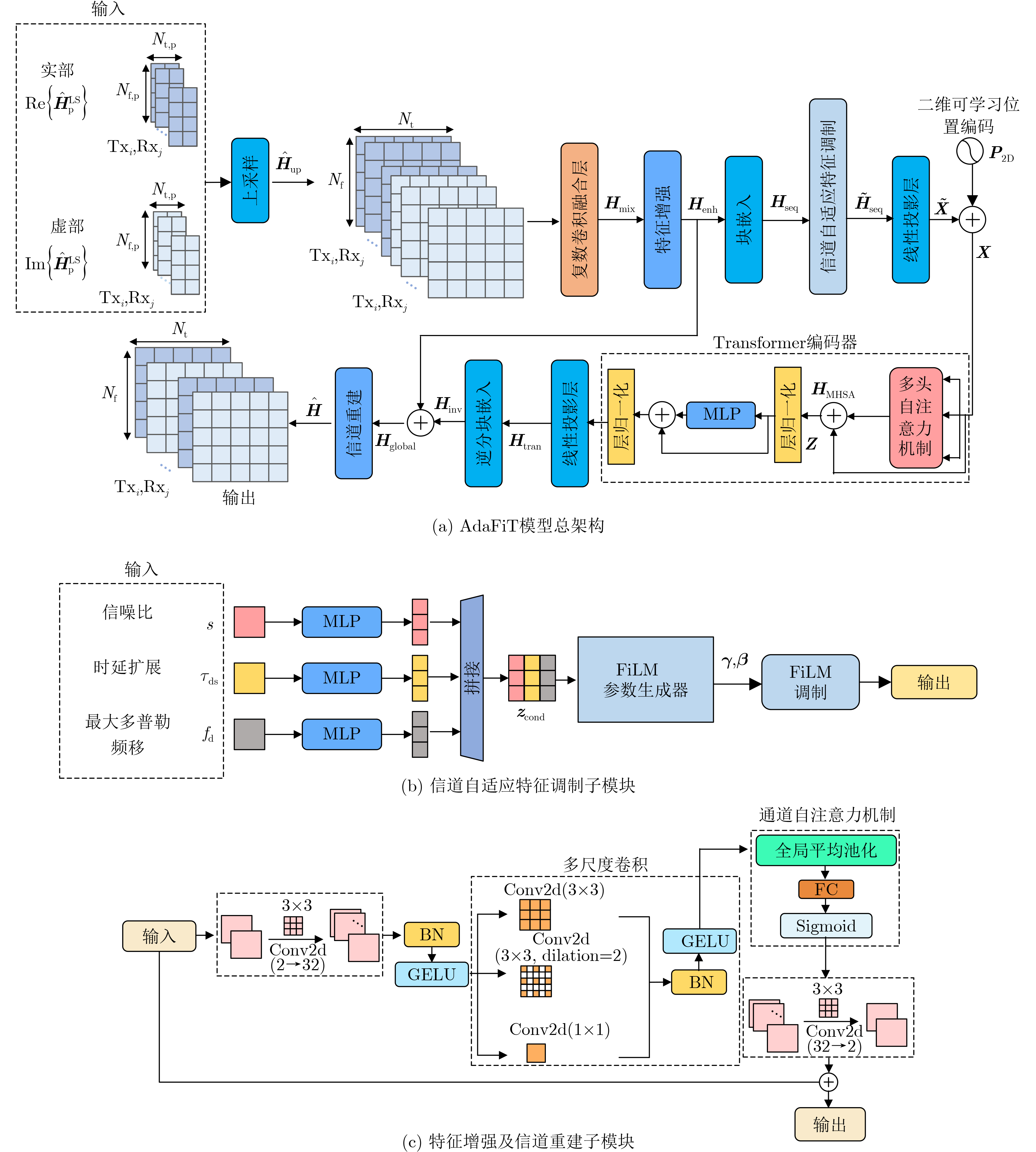
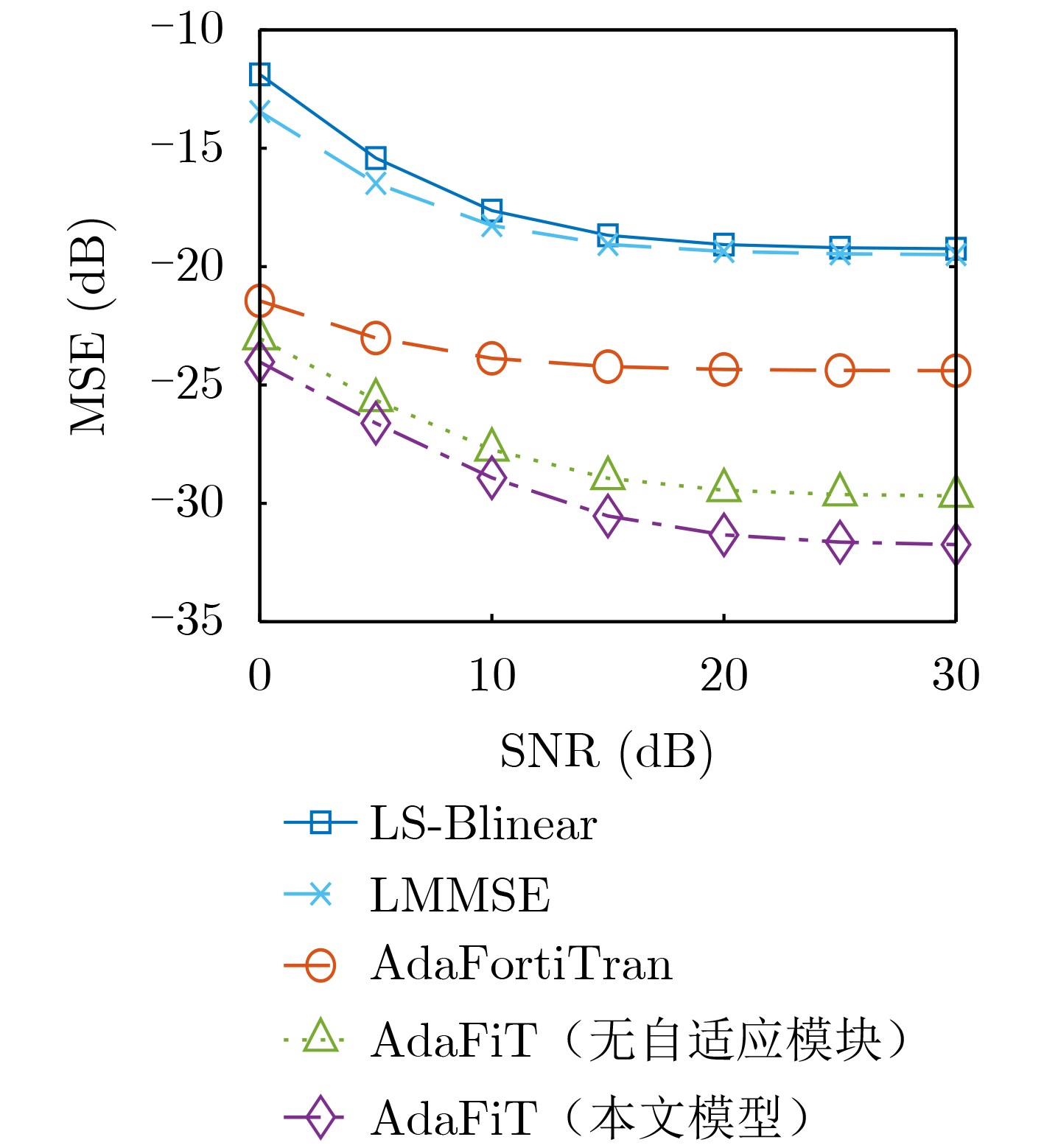
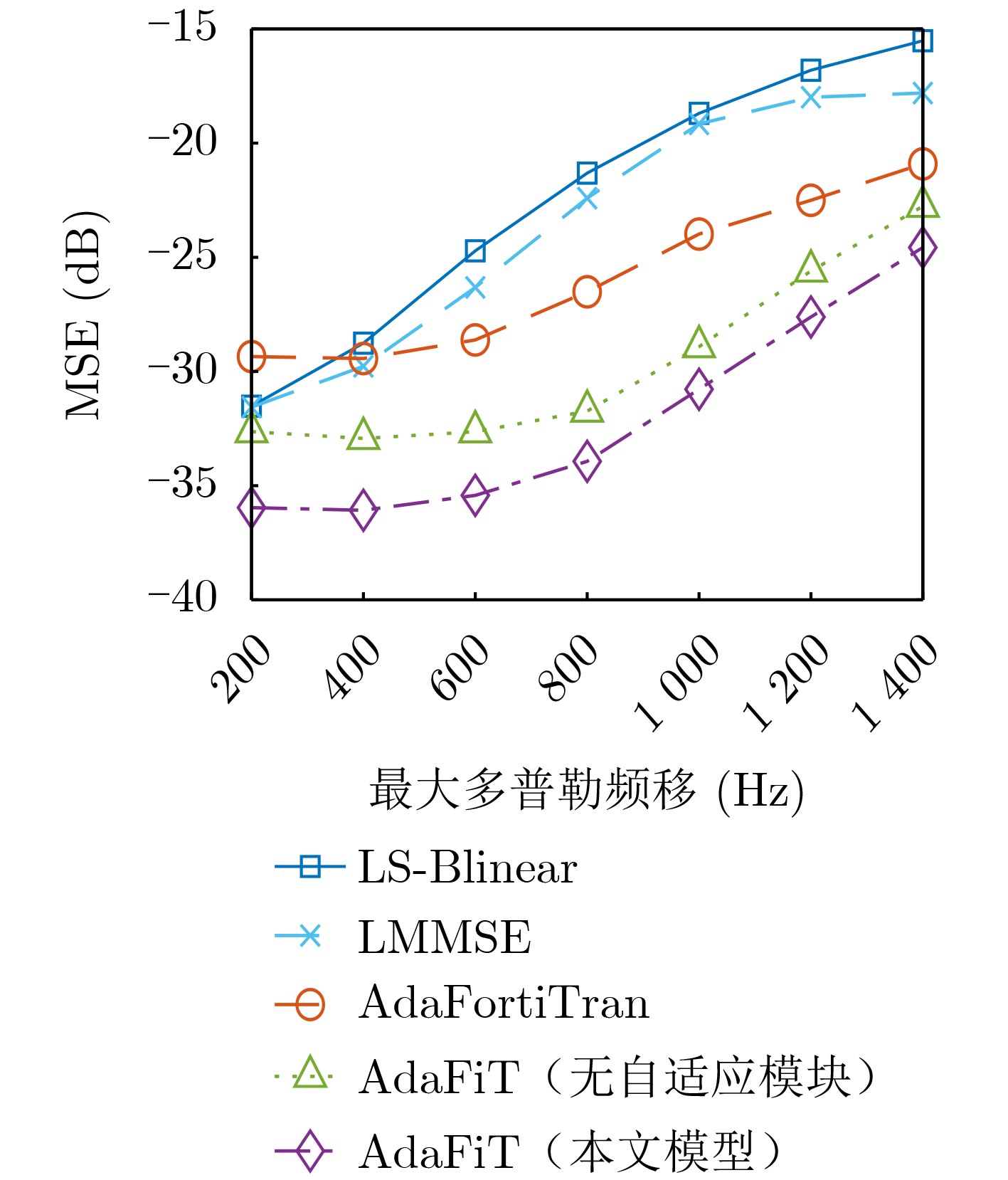
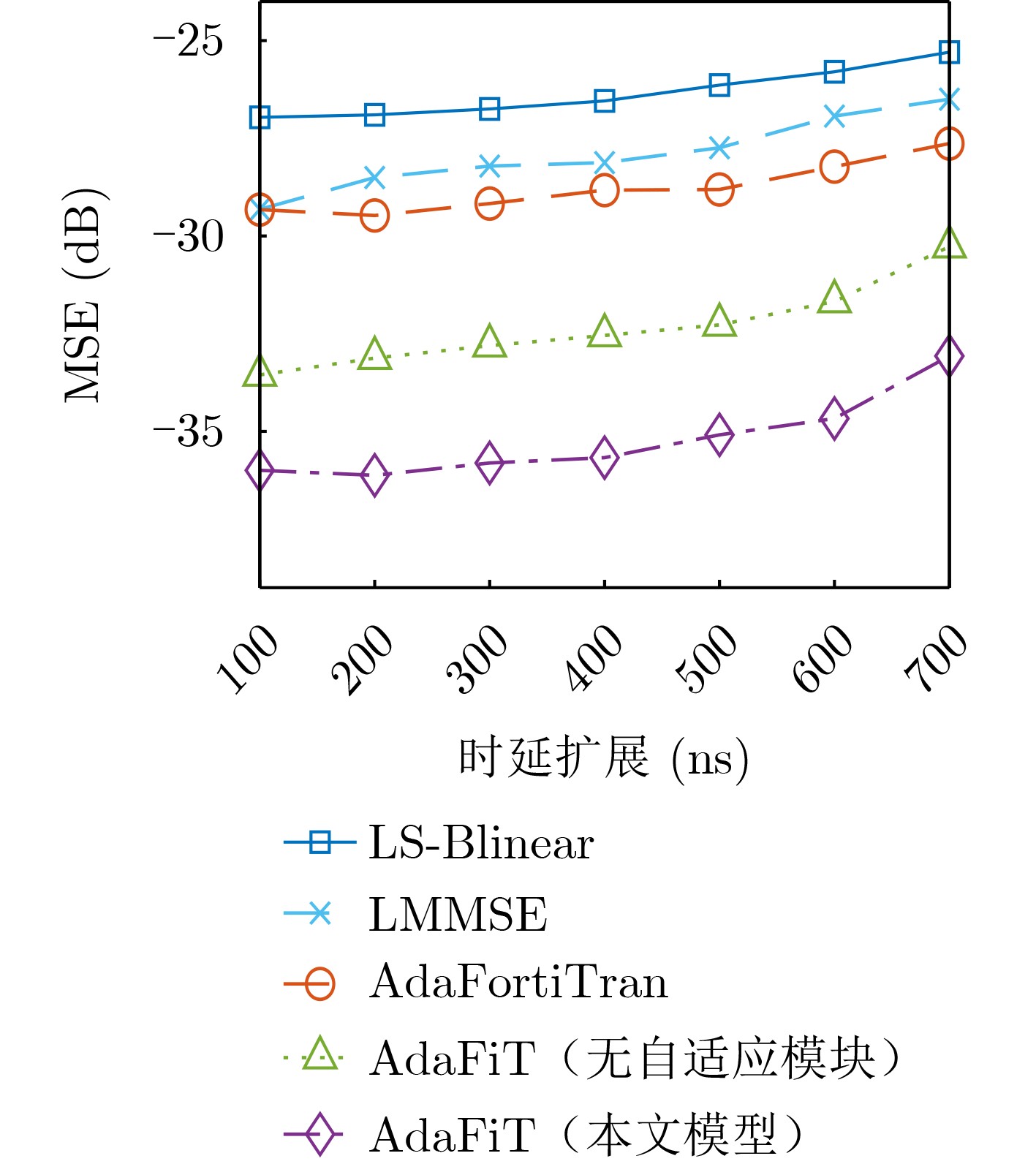
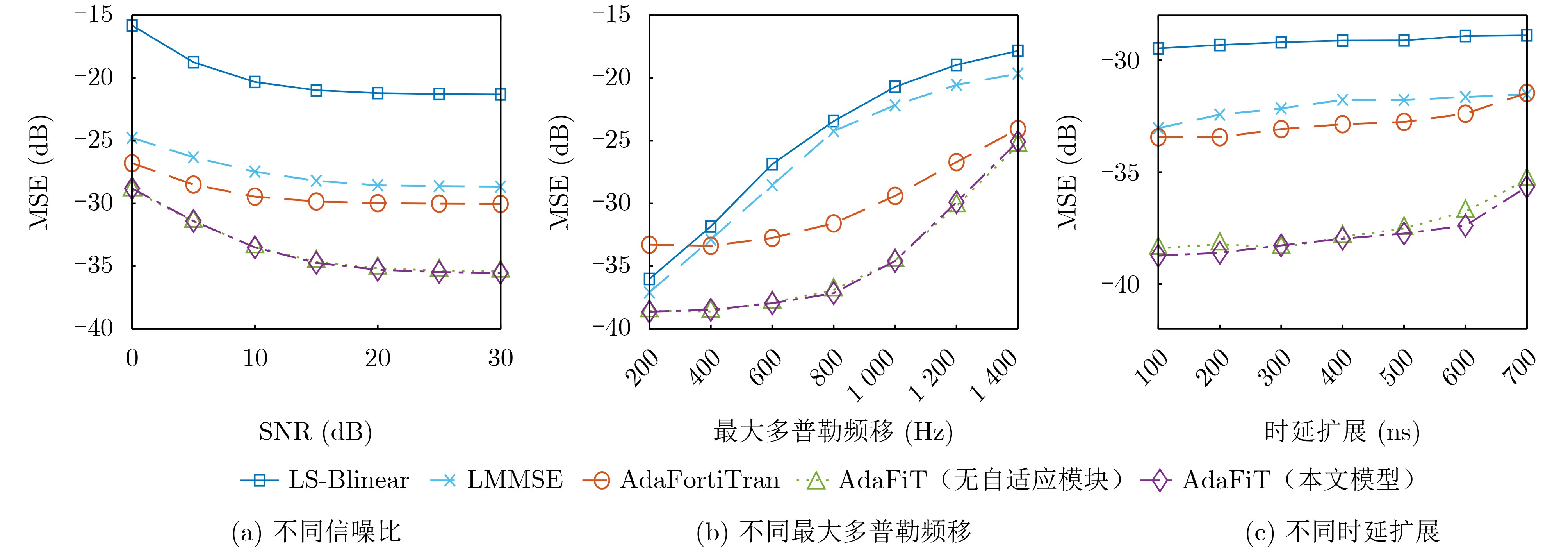
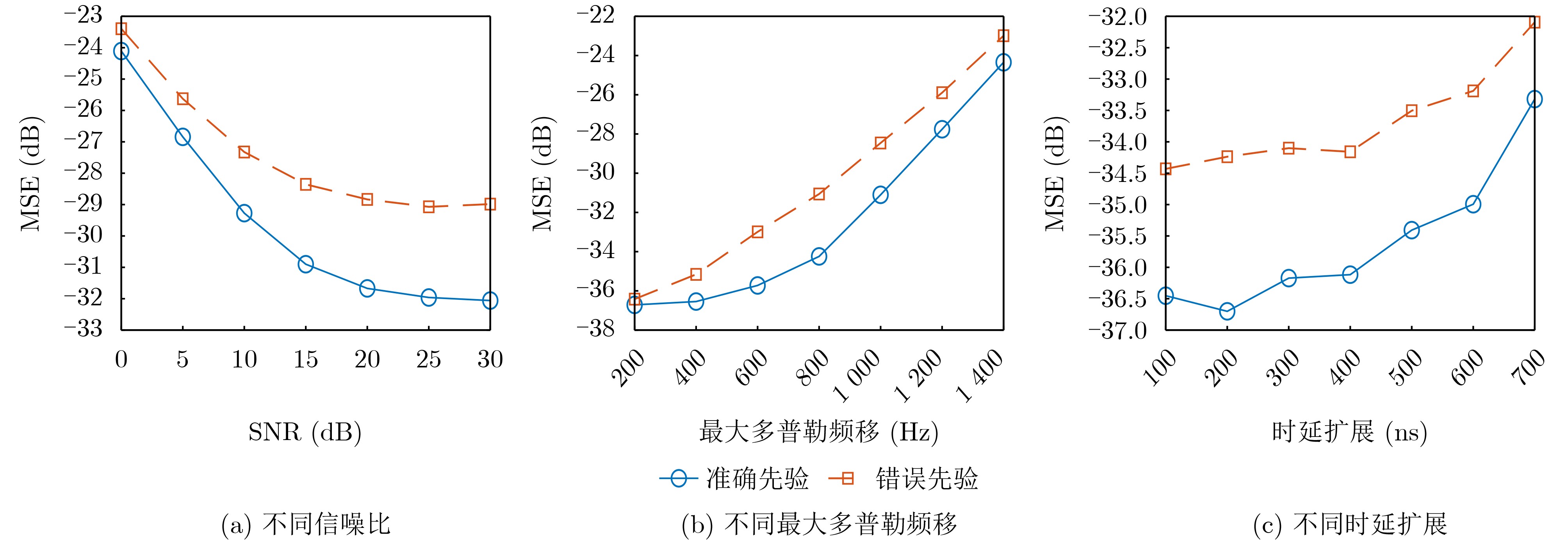
  •   Objective  Accurate channel state information (CSI) is essential for coherent detection, beamforming, and adaptive resource allocation in multiple-input multiple-output orthogonal frequency division multiplexing (MIMO-OFDM) systems. In high-mobility environments, large Doppler shifts and multipath propagation jointly cause doubly selective fading, destroy subcarrier orthogonality, and aggravate inter-carrier interference. Consequently, conventional least squares (LS) and linear minimum mean square error (LMMSE) estimators suffer substantial performance degradation. Existing deep learning estimators provide strong nonlinear modeling capability, but often show insufficient adaptability to variations in signal-to-noise ratio (SNR), delay spread, and Doppler shift, or inefficiently incorporate physical channel priors. To address these problems, a Transformer network with adaptive feature modulation, termed AdaFiT, is proposed for channel estimation in high-mobility MIMO-OFDM systems.  Methods  The proposed AdaFiT framework performs channel estimation by jointly exploiting local time-frequency correlations, global dependencies, and explicit channel-aware adaptation. It takes least squares (LS) estimates at pilot positions, together with signal-to-noise ratio (SNR), delay spread, and maximum Doppler shift, as inputs. A separable two-dimensional linear upsampling module first interpolates the sparse pilot estimates to the full OFDM time-frequency grid by independently processing the real and imaginary components along the frequency and time dimensions. A convolutional feature enhancement module then extracts robust local representations: a complex feature mixing layer fuses multi-antenna real and imaginary components, while multi-scale convolutional blocks with channel attention capture short-range time-frequency correlations and suppress noise. Next, a feature-wise linear modulation (FiLM)-based channel-adaptive module embeds the three channel parameters through independent multilayer perceptrons and combines them into a channel-state representation. This representation generates scaling and shifting coefficients to dynamically recalibrate the block-embedded sequences according to varying channel statistics. Finally, the modulated sequences are processed by a Transformer encoder with learnable two-dimensional positional encoding to model long-range dependencies across the time-frequency grid and antenna dimensions. A residual reconstruction structure fuses the global features with locally enhanced representations, yielding accurate channel estimates with global consistency and preserved local details.  Results and Discussions  Simulation analyses are conducted based on the CDL-C and CDL-A channel models. The LS-based bilinear interpolation method, the LMMSE method, the AdaFortiTran model, and the AdaFiT model without the adaptive module are selected as comparison schemes. The mean squared error (MSE) performance of these models is compared under different signal-to-noise ratio (SNR), maximum Doppler shift, and delay spread conditions. Under the CDL-C channel model, AdaFiT achieves the lowest MSE over the entire SNR range (Fig. 3). At an SNR of 0 dB, its MSE is approximately 2.5 dB lower than that of AdaFortiTran, and the performance gain increases to approximately 7 dB at an SNR of 30 dB. Compared with the AdaFiT model without the adaptive module, AdaFiT achieves a maximum MSE gain of approximately 2.1 dB, which verifies the effectiveness of the proposed channel-adaptive feature modulation module. When the maximum Doppler shift increases from 200 Hz to 1400 Hz, AdaFiT consistently maintains the lowest MSE (Fig. 4). In the high-Doppler range of 10001400 Hz, AdaFiT outperforms the AdaFiT model without the adaptive module and AdaFortiTran by approximately 2 dB and 3.5 dB, respectively, demonstrating improved robustness against rapid channel variations. For delay spreads ranging from 100 ns to 700 ns, AdaFiT also maintains the lowest MSE over the entire range (Fig. 5), achieving approximately 3 dB and 5.5 dB gains over the AdaFiT model without the adaptive module and AdaFortiTran, respectively. These results demonstrate that the proposed adaptive feature modulation mechanism effectively improves the adaptability of the model to time-selective and frequency-selective fading.To further evaluate the performance of the AdaFiT model under different channel models, simulation analysis is conducted based on the 3GPP CDL-A channel model. At SNRs of 0–5 dB, AdaFiT outperforms LMMSE by approximately 4–5 dB, while the performance gain reaches approximately 7 dB at SNRs of 20–30 dB (Fig. 6(a)). Compared with AdaFortiTran, AdaFiT achieves an MSE gain of approximately 2 dB under low-SNR conditions, and the gain increases to approximately 5.5 dB under high-SNR conditions. In the maximum Doppler shift experiment, the MSE of AdaFiT remains between approximately –38 dB and –37 dB over the range of 200–800 Hz and is approximately 5 dB lower than that of AdaFortiTran (Fig. 6(b)). Although the MSE of AdaFiT increases when the maximum Doppler shift exceeds 1000 Hz, it still achieves an approximately 6 dB gain over LMMSE at 1400 Hz and remains superior to AdaFortiTran. Over the entire delay spread range, AdaFiT achieves approximately 4–6 dB gain over LMMSE and approximately 4–5.5 dB gain over AdaFortiTran (Fig. 6(c)).  Conclusions  The proposed AdaFiT framework performs channel estimation by jointly exploiting local time-frequency correlations, global dependencies, and an explicit channel-aware adaptation mechanism. Simulation results under the CDL-C and CDL-A channel models show that AdaFiT consistently achieves lower MSE than the LS-based bilinear interpolation method, LMMSE, AdaFortiTran, and the AdaFiT model without the adaptive module under different SNR, maximum Doppler shift, and delay spread conditions. These results verify the effectiveness of the proposed adaptive feature modulation mechanism and demonstrate that AdaFiT maintains high estimation accuracy and stable performance under different channel models, indicating good adaptability to varying channel environments.
  • loading
  • [1]
    SINGH S, KUMAR S, MAJHI S, et al. Blind carrier frequency offset estimation techniques for next-generation multicarrier communication systems: Challenges, comparative analysis, and future prospects[J]. IEEE Communications Surveys & Tutorials, 2025, 27(1): 1–36. doi: 10.1109/COMST.2024.3472109.
    [2]
    GUO Jiajia, CHEN Tong, JIN Shi, et al. Deep learning for joint channel estimation and feedback in massive MIMO systems[J]. Digital Communications and Networks, 2024, 10(1): 83–93. doi: 10.1016/j.dcan.2023.01.011.
    [3]
    XU Jiarui, LI Lianjun, ZHENG Lizhong, et al. Learning to Estimate: A real-time online learning framework for MIMO-OFDM channel estimation[J]. IEEE Transactions on Wireless Communications, 2025, 24(4): 2634–2646. doi: 10.1109/TWC.2024.3487111.
    [4]
    CAI Jun, YIN Chuan, and DING Youwei. Optimization of resource allocation in FDD massive MIMO systems[J]. Digital Communications and Networks, 2024, 10(1): 117–125. doi: 10.1016/j.dcan.2022.11.017.
    [5]
    李一兵, 汤云鹤, 简鑫, 等. 面对高速移动场景的OTFS系统导频设计方法[J]. 电子与信息学报, 2025, 47(2): 490–497. doi: 10.11999/JEIT240349.

    LI Yibing, TANG Yunhe, JIAN Xin, et al. Pilot design method for OTFS system in high-speed mobile scenarios[J]. Journal of Electronics & Information Technology, 2025, 47(2): 490–497. doi: 10.11999/JEIT240349.
    [6]
    蒲旭敏, 刘雁翔, 宋米雪, 等. 基于模型驱动深度学习的OTFS信道估计[J]. 电子与信息学报, 2024, 46(2): 680–687. doi: 10.11999/JEIT230072.

    PU Xumin, LIU Yanxiang, SONG Mixue, et al. Orthogonal time frequency space channel estimation based on model-driven deep learning[J]. Journal of Electronics & Information Technology, 2024, 46(2): 680–687. doi: 10.11999/JEIT230072.
    [7]
    廖勇, 罗渝, 荆亚昊. 6G新型时延多普勒通信范式: OTFS的技术优势、设计挑战、应用与前景[J]. 电子与信息学报, 2024, 46(5): 1827–1842. doi: 10.11999/JEIT231133.

    LIAO Yong, LUO Yu, and JING Yahao. 6G new time-delay Doppler communication paradigm: Technical advantages, Design challenges, applications and prospects of OTFS[J]. Journal of Electronics & Information Technology, 2024, 46(5): 1827–1842. doi: 10.11999/JEIT231133.
    [8]
    KIM D, PARK S, KANG J, et al. Block-fading non-stationary channel estimation for MIMO-OFDM systems via meta-learning[J]. IEEE Communications Letters, 2022, 26(12): 2924–2928. doi: 10.1109/LCOMM.2022.3204763.
    [9]
    GHEREKHLOO S, ARDAH K, and HAARDT M. SALSA: A sequential alternating least squares approximation method for MIMO channel estimation[J]. IEEE Transactions on Vehicular Technology, 2024, 73(5): 7430–7435. doi: 10.1109/TVT.2023.3347290.
    [10]
    GIZZINI A K and CHAFII M. A survey on deep learning based channel estimation in doubly dispersive environments[J]. IEEE Access, 2022, 10: 70595–70619. doi: 10.1109/ACCESS.2022.3188111.
    [11]
    DOHA S R and ABDELHADI A. Deep learning in wireless communication receivers: A survey[J]. IEEE Access, 2025, 13: 113586–113605. doi: 10.1109/ACCESS.2025.3584000.
    [12]
    JIANG Peiwen, WEN Chaokai, JIN Shi, et al. Dual CNN-based channel estimation for MIMO-OFDM systems[J]. IEEE Transactions on Communications, 2021, 69(9): 5859–5872. doi: 10.1109/TCOMM.2021.3085895.
    [13]
    LEE J, AHN S, PARK S I, et al. Alternative meta-learning with 3D dual-CNN for MIMO channel estimation[J]. IEEE Wireless Communications Letters, 2025, 14(11): 3650–3654. doi: 10.1109/LWC.2025.3600061.
    [14]
    GAO Wei, ZHANG Wei, LIU Libin, et al. Deep residual learning with attention mechanism for OFDM channel estimation[J]. IEEE Wireless Communications Letters, 2025, 14(2): 250–254. doi: 10.1109/LWC.2022.3232378.
    [15]
    FOLA E, LUO Yang, and LUO Chunbo. AttenReEsNet: Attention-aided residual learning for effective model-driven channel estimation[J]. IEEE Communications Letters, 2024, 28(8): 1855–1859. doi: 10.1109/LCOMM.2024.3412802.
    [16]
    LI Jinbao and PENG Qi. Lightweight channel estimation networks for OFDM systems[J]. IEEE Wireless Communications Letters, 2022, 11(10): 2066–2070. doi: 10.1109/LWC.2022.3193199.
    [17]
    LIU Fangyu, ZHANG Jing, JIANG Peiwen, et al. CE-ViT: A robust channel estimator based on vision transformer for OFDM systems[C]. GLOBECOM 2023-2023 IEEE Global Communications Conference, Kuala Lumpur, Malaysia, 2023: 4798–4803. doi: 10.1109/GLOBECOM54140.2023.10436847.
    [18]
    GULER B and JAFARKHANI H. AdaFortiTran: An adaptive transformer model for robust OFDM channel estimation[C]. ICC 2025-IEEE International Conference on Communications, Montreal, Canada, 2025: 3797–3802. doi: 10.1109/ICC52391.2025.11160810.
    [19]
    TURKOGLU M O, BECKER A, GÜNDÜZ H A, et al. FiLM-Ensemble: Probabilistic deep learning via feature-wise linear modulation[C]. The 36th Annual Conference on Neural Information Processing Systems (NeurIPS 2022), New Orleans, USA, 2022: 22229–22242.
  • 加载中

Catalog

    通讯作者: 陈斌, bchen63@163.com
    • 1. 

      沈阳化工大学材料科学与工程学院 沈阳 110142

    1. 本站搜索
    2. 百度学术搜索
    3. 万方数据库搜索
    4. CNKI搜索

    Figures(7)  / Tables(2)

    Article Metrics

    Article views (26) PDF downloads(1) Cited by()
    Proportional views
    Related

    /

    DownLoad:  Full-Size Img  PowerPoint
    Return
    Return