Advanced Search
Turn off MathJax
Article Contents
XIE Wenwu, HUANG Xiangyu, HUANG Nenghui, YANG Liang. Joint Optimization Method for Covert Communication Based on Movable Antenna and Deep Unfolding Network[J]. Journal of Electronics & Information Technology. doi: 10.11999/JEIT260706
Citation: XIE Wenwu, HUANG Xiangyu, HUANG Nenghui, YANG Liang. Joint Optimization Method for Covert Communication Based on Movable Antenna and Deep Unfolding Network[J]. Journal of Electronics & Information Technology. doi: 10.11999/JEIT260706

Joint Optimization Method for Covert Communication Based on Movable Antenna and Deep Unfolding Network

doi: 10.11999/JEIT260706 cstr: 32379.14.JEIT260706
Funds:  Guiding Project of the Scientific Research Program of the Hubei Provincial Department of Education (B2025378), Research and Innovation Projects in Hunan Province (2025JJ70287,2026JJ80275)
  • Received Date: 2026-06-01
  • Accepted Date: 2026-11-02
  • Rev Recd Date: 2026-11-02
  • Available Online: 2026-11-09
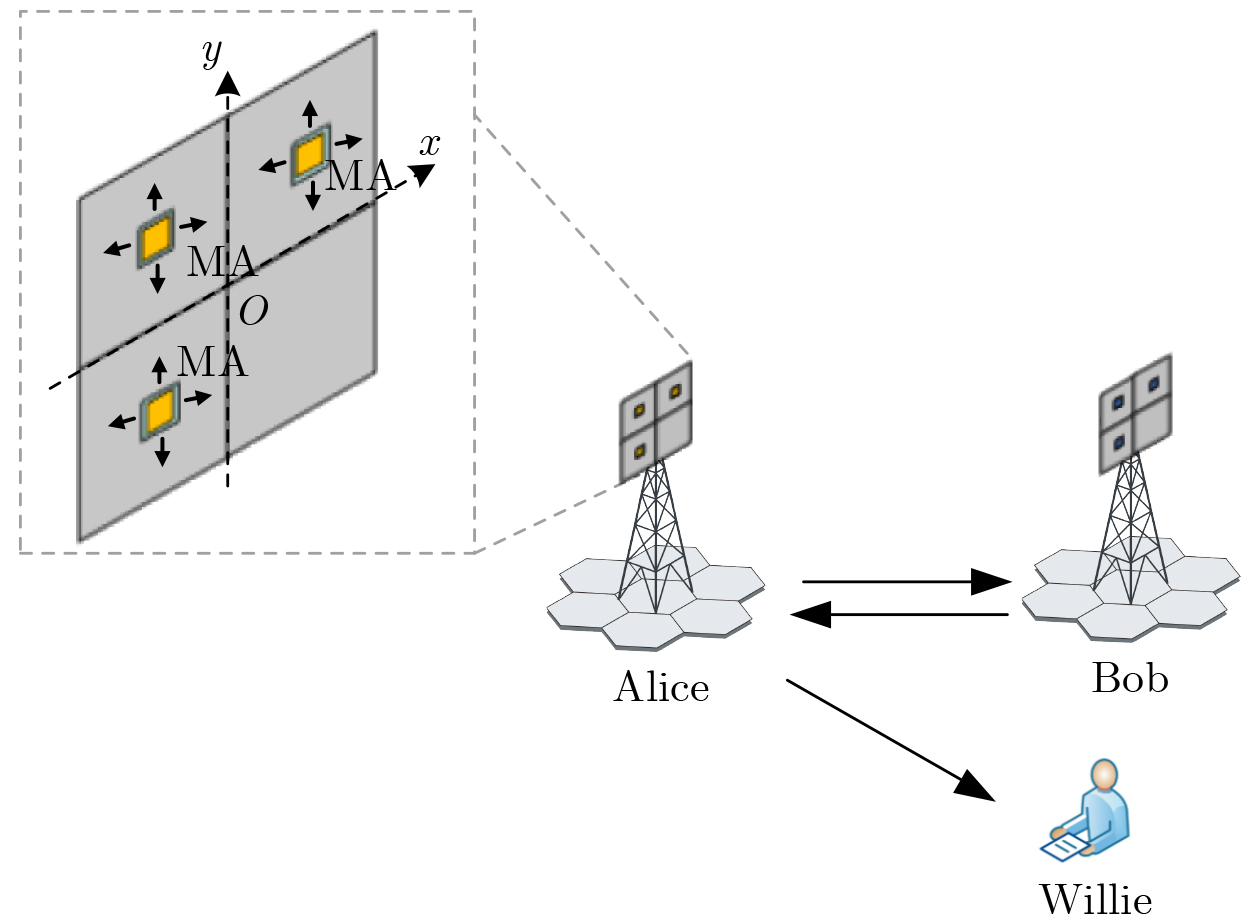
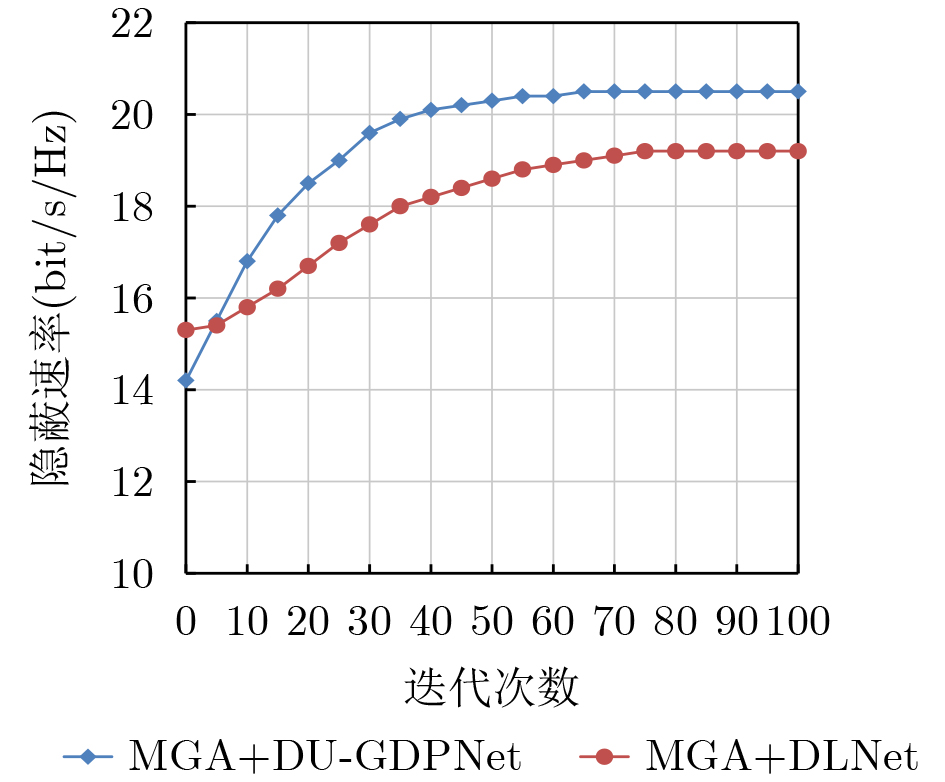
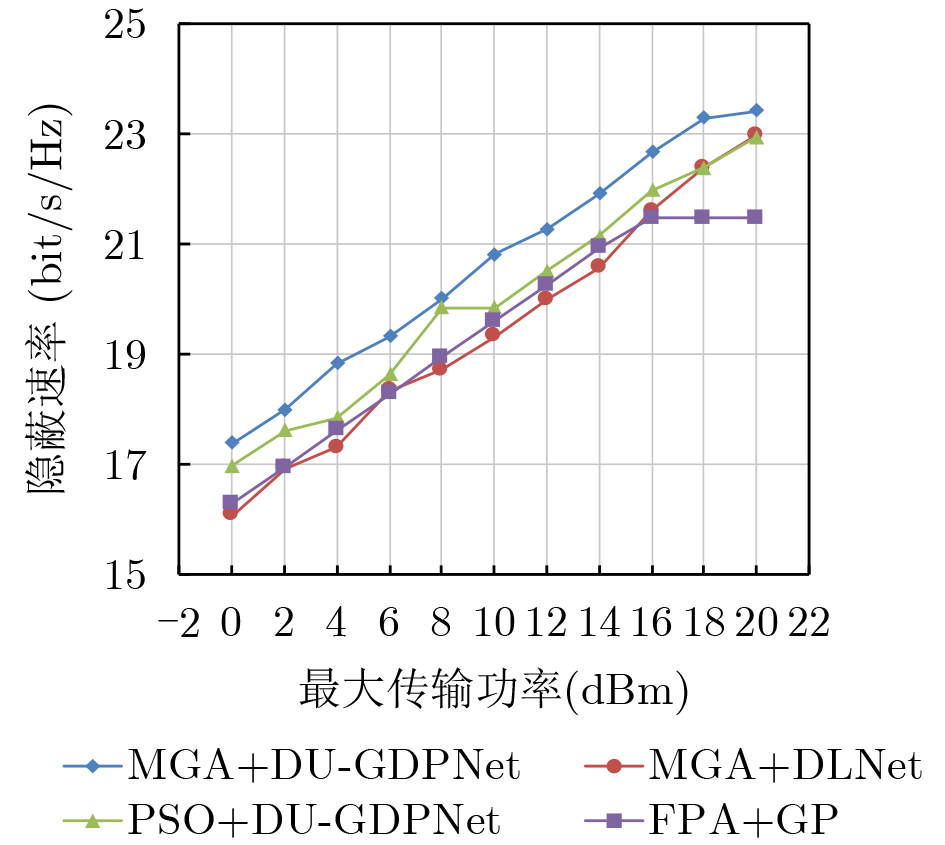
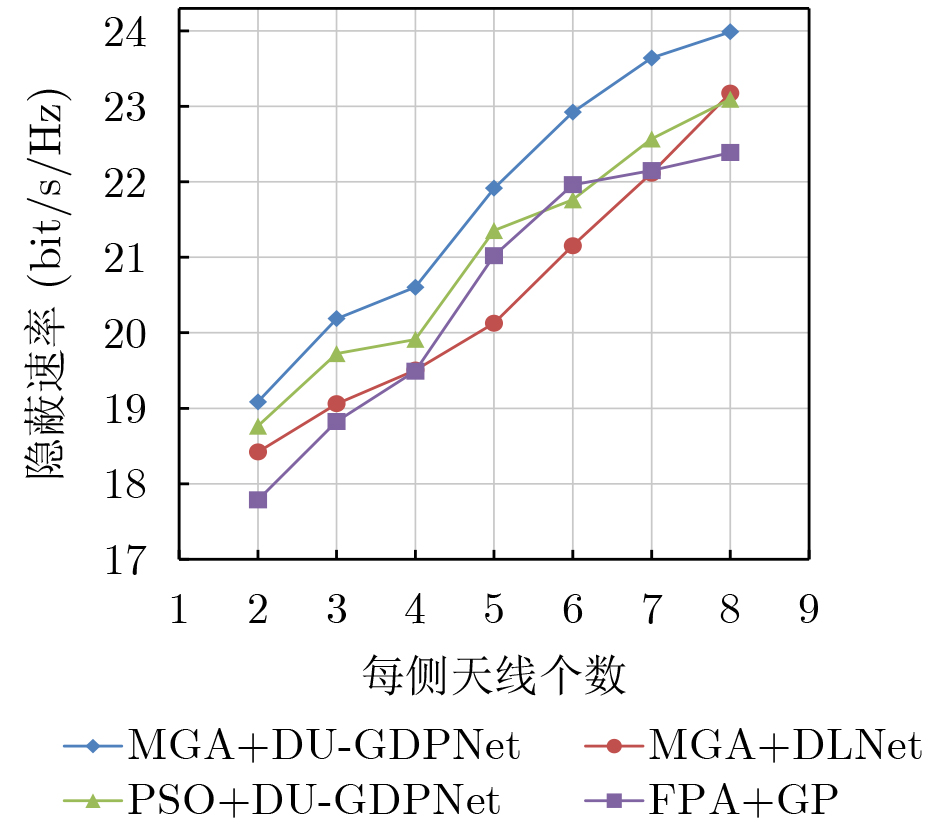
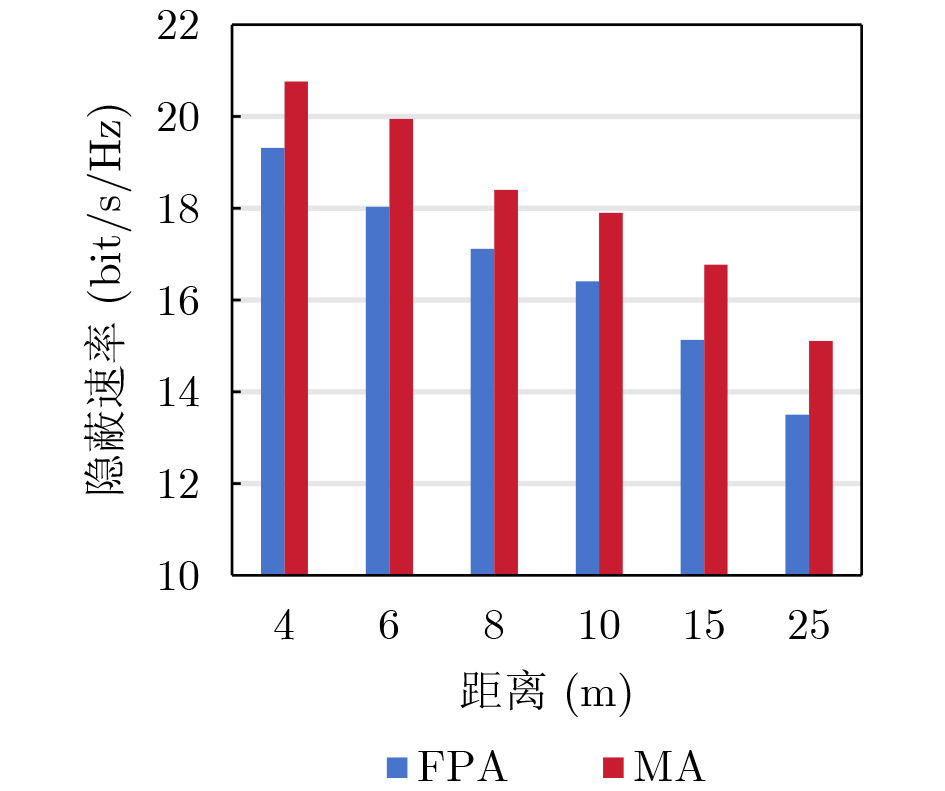
  • This paper proposes a joint optimization method for covert wireless communication based on movable antenna (MA) arrays and deep unfolding networks. By exploiting the spatial degrees of freedom provided by MAs, the proposed system jointly optimizes the transmit and receive antenna positions as well as the transmit beamforming vector to maximize the average achievable rate of the legitimate user under the warden’s covertness constraint. Specifically, a Kullback-Leibler (KL) divergence-based constraint is adopted to characterize the distinguishability of the warden’s observations under the hypotheses of transmission absence and presence, and is further transformed into a tractable received signal power constraint. To solve the resulting non-convex problem, a block coordinate descent framework is developed, where the original problem is decomposed into beamforming and antenna position optimization subproblems. The beamforming subproblem is handled by a deep-unfolded gradient projection network (DU-GDPNet), while the antenna position subproblem is solved by an improved genetic algorithm (MGA) with multiple restarts, elitist preservation, and local search to enhance global optimization capability. Simulation results show that the proposed MGA+DU-GDPNet scheme achieves higher average achievable rates under different transmit power levels and antenna configurations while consistently satisfying the covertness constraint.  Objective  With the rapid development of sixth-generation wireless networks, covert communication has become increasingly important for protecting the existence of wireless transmissions in adversarial electromagnetic environments. However, conventional fixed-position antenna systems have limited capability to actively reshape wireless channels, resulting in a restricted achievable rate under stringent covertness constraints. Although movable antennas provide additional spatial degrees of freedom, jointly optimizing the transmit beamforming vector and the positions of the transmit and receive antennas leads to a highly coupled and non-convex problem. Traditional iterative optimization methods may therefore incur considerable computational complexity, while black-box deep learning approaches generally lack interpretability and constraint-awareness. To address these challenges, this paper develops a joint optimization method based on movable antenna arrays and a deep unfolding network. The objective is to maximize the average achievable rate of the legitimate receiver while satisfying the transmit power, antenna movement, minimum antenna spacing, and warden covertness constraints. This research provides an efficient and interpretable solution for movable-antenna-assisted covert communication systems.  Methods  A covert multiple-input multiple-output communication system is established in which movable antenna arrays are deployed at both the transmitter and the legitimate receiver. The transmit beamforming vector and the antenna positions at the transmitter and receiver are jointly optimized. The covertness requirement is characterized using the Kullback-Leibler divergence between the probability distributions of the warden's observations under the hypotheses of transmission absence and transmission presence. This constraint is subsequently transformed into a tractable received-signal-power constraint. To solve the resulting non-convex optimization problem, a block coordinate descent framework is designed to decompose the original problem into two subproblems. With the antenna positions fixed, the beamforming subproblem is solved using a deep-unfolded gradient projection network, termed DU-GDPNet. The iterative operations of the conventional gradient projection algorithm are mapped onto learnable network layers, and the power and covertness constraints are embedded into the network structure and loss function. With the beamforming vector fixed, the transmit and receive antenna positions are optimized using an improved genetic algorithm. Multiple restarts, elitist preservation, adaptive Gaussian mutation, local search, and constraint-handling mechanisms are incorporated to improve the global search capability and maintain feasible antenna configurations. The two subproblems are alternately updated until the average achievable rate converges.  Results and Discussions  Simulation results demonstrate that the proposed combination of the improved genetic algorithm and DU-GDPNet achieves faster convergence and a higher final achievable rate than the genetic-algorithm-based conventional deep learning method (Fig. 2). Under different maximum transmit powers, the proposed method consistently provides the highest average achievable rate among the evaluated schemes. Specifically, its achievable rate increases from 17.3755 bit/s/Hz at 0 dBm to 23.4214 bit/s/Hz at 20 dBm (Fig. 3). The slower rate growth in the high-power region indicates that the covertness constraint becomes the dominant limiting factor because increasing the transmit power also raises the signal energy observed by the warden. When the number of antennas on each side increases from 2 to 7, the covert communication rate of the proposed method improves from 19.0837 bit/s/Hz to 23.6415 bit/s/Hz (Fig. 4), confirming that the additional spatial degrees of freedom can be effectively exploited for array gain, spatial diversity, and leakage suppression. Moreover, when the communication distance increases from 4 m to 25 m, the achievable rates of both fixed-position and movable antenna systems decrease because of increased path loss. Nevertheless, the movable antenna scheme maintains a higher covert rate over the entire distance range, decreasing from 20.76 to 15.11 bit/s/Hz, whereas the fixed-position antenna scheme decreases from 19.32 to 13.50 bit/s/Hz (Fig. 5). These results verify that the proposed joint optimization framework improves covert communication performance under different transmit powers, antenna configurations, and communication distances while consistently satisfying the covertness constraint.  Conclusions  This paper proposes a block coordinate descent framework for joint optimization of transmit beamforming and transceiver antenna positions in a covert communication system assisted by a movable antenna. In this framework, the beamforming subproblem is solved by a designed deep unfolding gradient projection network, which maps the iterative steps of the traditional projection gradient algorithm to learnable network layers, combining the advantages of model-driven interpretability and data-driven low complexity. Meanwhile, the antenna position subproblem is solved using an improved genetic algorithm. By designing a reasonable fitness function and constraint handling mechanism, the algorithm effectively searches the location configuration space while satisfying the feasible range of antenna movement. Simulation results show that the proposed joint design significantly improves the achievable rate of covert communication under different system parameters. Specifically, this method and the benchmark deep learning method both exhibit significant advantages in convergence speed and final performance, verifying the effectiveness of the deep unfolding structure in such non-convex problems. It should be noted that the current model in this paper assumes ideal channel information. However, in practical deployment, movable antenna systems inevitably face uncertainties in channel state information in the angular domain and robust resource allocation issues. Extending the proposed framework to scenarios considering angle uncertainties related to Willie, Bob, or MA arrays is a valuable research direction for the future.
  • loading
  • [1]
    CHEN Xinying, AN Jianping, XIONG Zehui, et al. Covert communications: A comprehensive survey[J]. IEEE Communications Surveys & Tutorials, 2023, 25(2): 1173–1198. doi: 10.1109/COMST.2023.3263921.
    [2]
    LIU Pengpeng, SI Jiangbo, CHENG Zihao, et al. Movable-antenna enabled covert communication[J]. IEEE Wireless Communications Letters, 2025, 14(2): 280–284. doi: 10.1109/LWC.2024.3494865.
    [3]
    XIE Wenwu, LI Zilong, YU Chao, et al. Movable-antenna-assisted covert communications with reconfigurable intelligent surfaces[J]. IEEE Internet of Things Journal, 2025, 12(9): 12369–12382. doi: 10.1109/JIOT.2024.3520710.
    [4]
    HU Jinsong, JI Mingfeng, WANG Yida, et al. Movable antennas with full-duplex receiver for covert communication[J]. IEEE Transactions on Wireless Communications, 2026, 25(6): 10589–10603. doi: 10.1109/TWC.2026.3655004.
    [5]
    MAO Haobin, PI Xiangyu, ZHU Lipeng, et al. Sum rate maximization for movable antenna enhanced multiuser covert communications[J]. IEEE Wireless Communications Letters, 2025, 14(3): 611–615. doi: 10.1109/LWC.2024.3514199.
    [6]
    HU Jinsong, LIN Qingzhuan, YAN Shihao, et al. Covert transmission via integrated sensing and communication systems[J]. IEEE Transactions on Vehicular Technology, 2024, 73(3): 4441–4446. doi: 10.1109/TVT.2023.3326455.
    [7]
    谢文武, 张沁可, 梁锡涛, 等. 双RIS辅助的MISO系统吞吐量最大化研究[J]. 电子与信息学报, 2025, 47(2): 353–362. doi: 10.11999/JEIT240612.

    XIE Wenwu, ZHANG Qinke, LIANG Xitao, et al. Throughput maximization for double RIS-assisted MISO systems[J]. Journal of Electronics & Information Technology, 2025, 47(2): 353–362. doi: 10.11999/JEIT240612.
    [8]
    谢文武, 张沁可, 杨亮, 等. 基于同时透射与反射可重构智能表面的通感一体化全空间隐蔽传输[J]. 电子与信息学报, 2026, 48(8): 3627–3637. doi: 10.11999/JEIT260145.

    XIE Wenwu, ZHANG Qinke, YANG Liang, et al. Full-space covert integrated sensing and communications assisted by simultaneous transmitting and reflecting reconfigurable intelligent surface[J]. Journal of Electronics & Information Technology, 2026, 48(8): 3627–3637. doi: 10.11999/JEIT260145.
    [9]
    孙怡恒, 徐勇军, 张海波, 等. 量子隐蔽通信融合方案及应用场景综述[J]. 电子与信息学报, 2026, 48(9): 3721–3729. doi: 10.11999/JEIT260282.

    SUN Yiheng, XU Yongjun, ZHANG Haibo, et al. A survey of quantum covert communication integration schemes and application scenarios[J]. Journal of Electronics & Information Technology, 2026, 48(9): 3721–3729. doi: 10.11999/JEIT260282.
    [10]
    徐勇军, 李晶, 骆东鑫, 等. 近场通信物理层安全技术综述[J]. 电子与信息学报, 2025, 47(11): 4129–4143. doi: 10.11999/JEIT250336.

    XU Yongjun, LI Jing, LUO Dongxin, et al. A survey on physical layer security in near-field communication[J]. Journal of Electronics & Information Technology, 2025, 47(11): 4129–4143. doi: 10.11999/JEIT250336.
    [11]
    BASH B A, GOECKEL D, and TOWSLEY D. Limits of reliable communication with low probability of detection on AWGN channels[J]. IEEE Journal on Selected Areas in Communications, 2013, 31(9): 1921–1930. doi: 10.1109/JSAC.2013.130923.
    [12]
    HE Xiuli, XU Hongbo, WANG Ji, et al. Joint active and passive beamforming in RIS-assisted covert symbiotic radio based on deep unfolding[J]. IEEE Transactions on Vehicular Technology, 2024, 73(9): 14021–14026. doi: 10.1109/TVT.2024.3393724.
    [13]
    SHI Shuhan, CAI Yunlong, HU Qiyu, et al. Deep-unfolding neural-network aided hybrid beamforming based on symbol-error probability minimization[J]. IEEE Transactions on Vehicular Technology, 2023, 72(1): 529–545. doi: 10.1109/TVT.2022.3201961.
    [14]
    ZHU Lipeng, MA Wenyan, and ZHANG Rui. Modeling and performance analysis for movable antenna enabled wireless communications[J]. IEEE Transactions on Wireless Communications, 2024, 23(6): 6234–6250. doi: 10.1109/TWC.2023.3330887.
    [15]
    李振东, 巴建乐, 苏洲, 等. 可移动天线赋能的ISAC系统中波束赋形与天线位置联合优化[J]. 电子与信息学报, 2025, 47(10): 3482–3491. doi: 10.11999/JEIT250146.

    LI Zhendong, BA Jianle, SU Zhou, et al. Joint beamforming and antenna position optimization in movable antenna empowered ISAC systems[J]. Journal of Electronics & Information Technology, 2025, 47(10): 3482–3491. doi: 10.11999/JEIT250146.
    [16]
    ZHANG Zhonghe, WEN Youquan, WONG S W, et al. Continuous endfire to broadside beamforming millimeter-wave antenna array[J]. IEEE Antennas and Wireless Propagation Letters, 2026, 25(4): 1812–1816. doi: 10.1109/LAWP.2026.3665238.
    [17]
    LIU Shicong, YU Xianghao, XU Jie, et al. Near-field communication with massive movable antennas: A functional perspective[J]. IEEE Transactions on Wireless Communications, 2026, 25: 14455–14470. doi: 10.1109/TWC.2026.3677546.
    [18]
    HU Guojie, WU Qingqing, XU Kui, et al. Secure wireless communication via movable-antenna array[J]. IEEE Signal Processing Letters, 2024, 31: 516–520. doi: 10.1109/LSP.2024.3359894.
    [19]
    XU Wei, ZHU Lipeng, MA Wenyan, et al. Movable antenna enhanced multiuser communications with mutual coupling[J]. IEEE Communications Letters, 2026, 30: 1954–1958. doi: 10.1109/LCOMM.2026.3689632.
    [20]
    HAMZA A, SHEIKH S I M, and ATTIA H. Efficient design of super-directive antenna array using Schelkunoff method and genetic algorithm[J]. IEEE Canadian Journal of Electrical and Computer Engineering, 2024, 47(4): 168–174. doi: 10.1109/ICJECE.2024.3396287.
    [21]
    周小波, 阮丹阳, 周修颖, 等. IRS辅助的感知与隐蔽通信一体化资源分配算法[J]. 电子与信息学报, 2025, 47(2): 375–385. doi: 10.11999/JEIT240643.

    ZHOU Xiaobo, RUAN Danyang, ZHOU Xiuying, et al. Resource allocation algorithm for intelligent reflecting surface-assisted integrated sensing and covert communication[J]. Journal of Electronics & Information Technology, 2025, 47(2): 375–385. doi: 10.11999/JEIT240643.
    [22]
    WANG Chen, PENG Lin, MA Jing, et al. Multiobjective integrated optimization design of lens antenna based on a competition and cooperation model with neural network and evolutionary algorithm[J]. IEEE Antennas and Wireless Propagation Letters, 2024, 23(12): 4698–4702. doi: 10.1109/LAWP.2024.3466248.
    [23]
    刘学敏, 钱玉文, 宋耀良, 等. 一种基于无人机与智能反射面的隐蔽通信系统研究[J]. 电子与信息学报, 2025, 47(2): 386–396. doi: 10.11999/JEIT240663.

    LIU Xuemin, QIAN Yuwen, SONG Yaoliang, et al. An intelligent reflecting surface assisted covert communication system with a cooperative unmanned aerial vehicle[J]. Journal of Electronics & Information Technology, 2025, 47(2): 386–396. doi: 10.11999/JEIT240663.
    [24]
    NI Hao, XU Yongjun, LI Xingwang, et al. Robust resource allocation for movable antenna-enabled MISO communication systems with angular uncertainties[J]. IEEE Transactions on Vehicular Technology, 2026, 75(4): 6904–6909. doi: 10.1109/TVT.2025.3617569.
  • 加载中

Catalog

    通讯作者: 陈斌, bchen63@163.com
    • 1. 

      沈阳化工大学材料科学与工程学院 沈阳 110142

    1. 本站搜索
    2. 百度学术搜索
    3. 万方数据库搜索
    4. CNKI搜索

    Figures(5)

    Article Metrics

    Article views (29) PDF downloads(4) Cited by()
    Proportional views
    Related

    /

    DownLoad:  Full-Size Img  PowerPoint
    Return
    Return