Advanced Search
Turn off MathJax
Article Contents
ZHANG Zhilin, PU Zhanqing, ZHU Yunan, LI Xueying, TIAN Jie, HUANG Haining. Random-Linear-Network-Coding-Based Cooperative Reliable Transmission Protocol for Underwater Acoustic Communication Networks[J]. Journal of Electronics & Information Technology. doi: 10.11999/JEIT260648
Citation: ZHANG Zhilin, PU Zhanqing, ZHU Yunan, LI Xueying, TIAN Jie, HUANG Haining. Random-Linear-Network-Coding-Based Cooperative Reliable Transmission Protocol for Underwater Acoustic Communication Networks[J]. Journal of Electronics & Information Technology. doi: 10.11999/JEIT260648

Random-Linear-Network-Coding-Based Cooperative Reliable Transmission Protocol for Underwater Acoustic Communication Networks

doi: 10.11999/JEIT260648 cstr: 32379.14.JEIT260648
Funds:  National Program for the Promotion of Young People’s Excellence under Grant 1S2024000478, National Natural Science Foundation of China under Grant 62501589, Special Research Assistant Funding Program of the Chinese Academy of Sciences
  • Received Date: 2026-05-19
  • Accepted Date: 2026-07-29
  • Rev Recd Date: 2026-07-29
  • Available Online: 2026-08-08
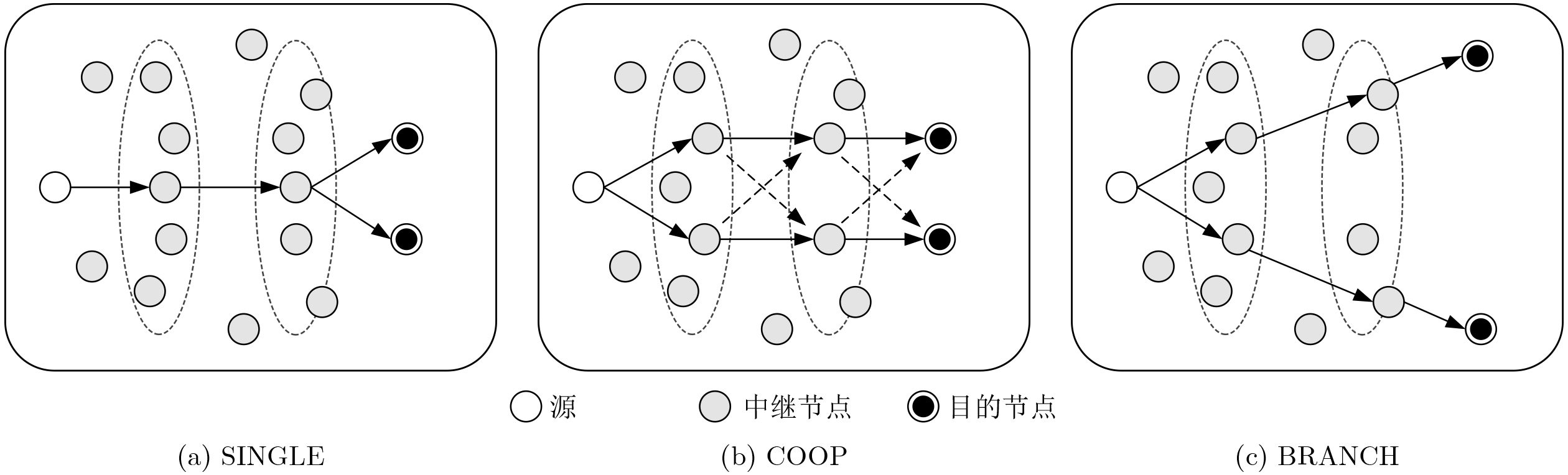
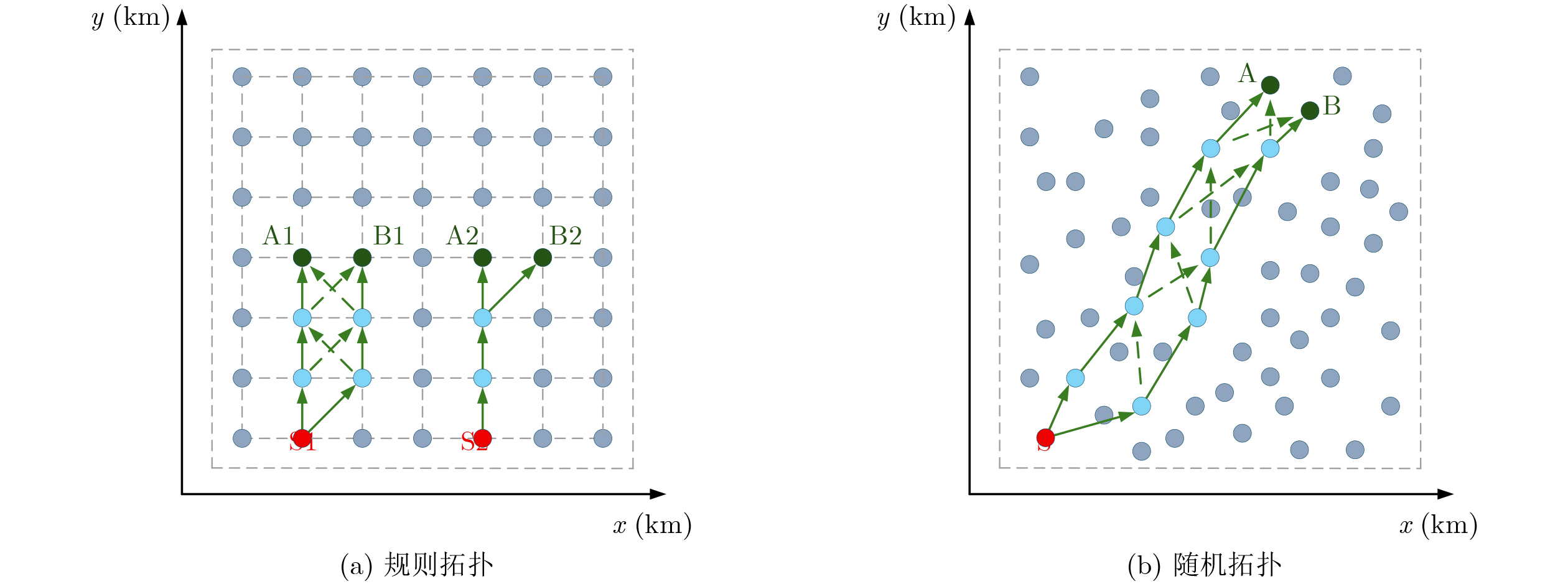
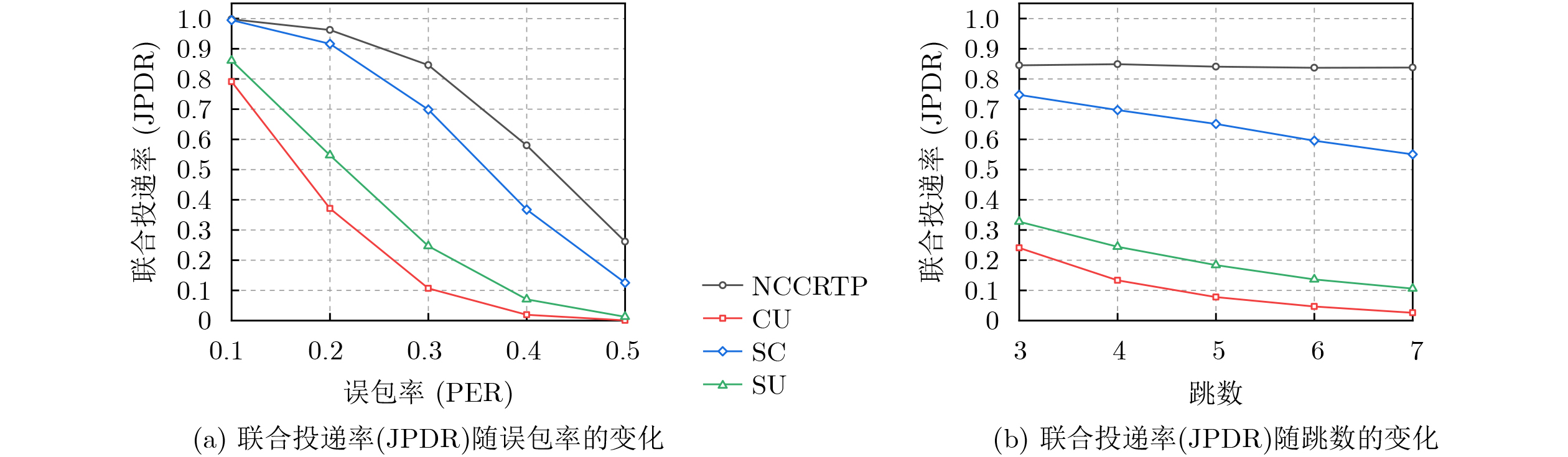
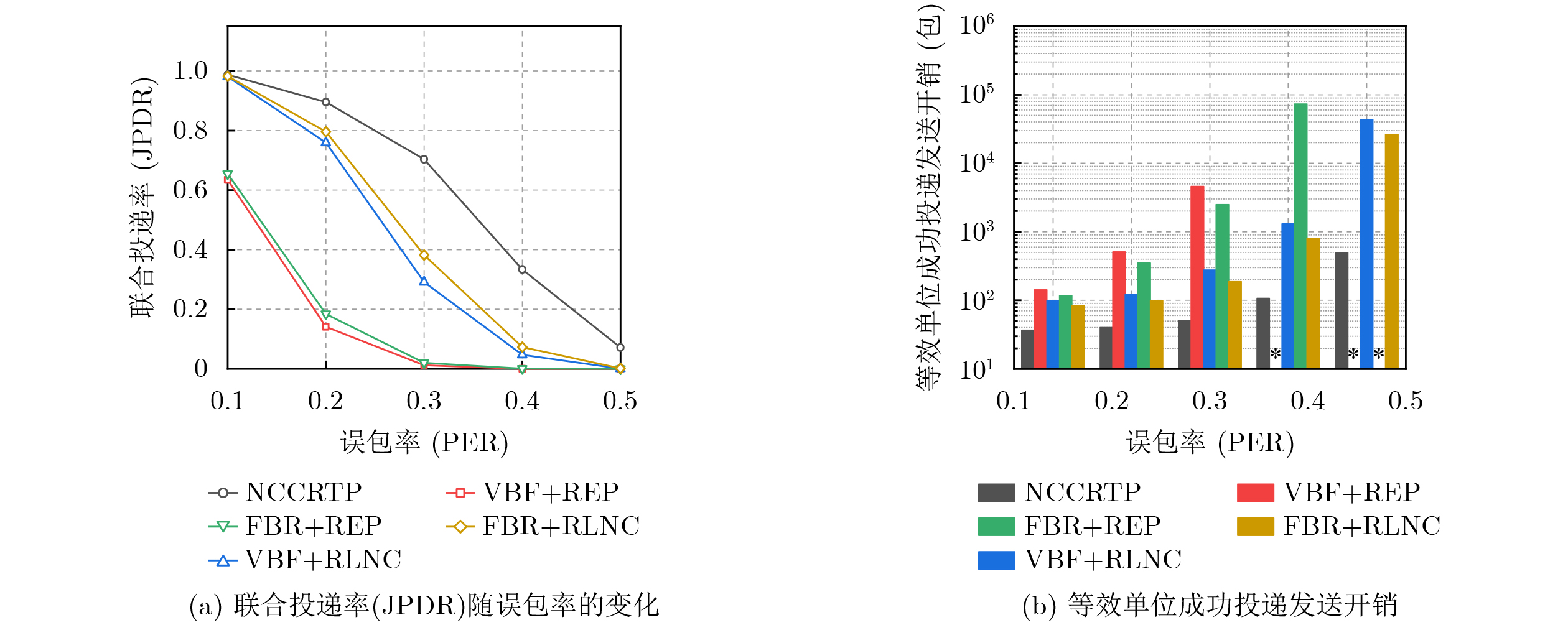
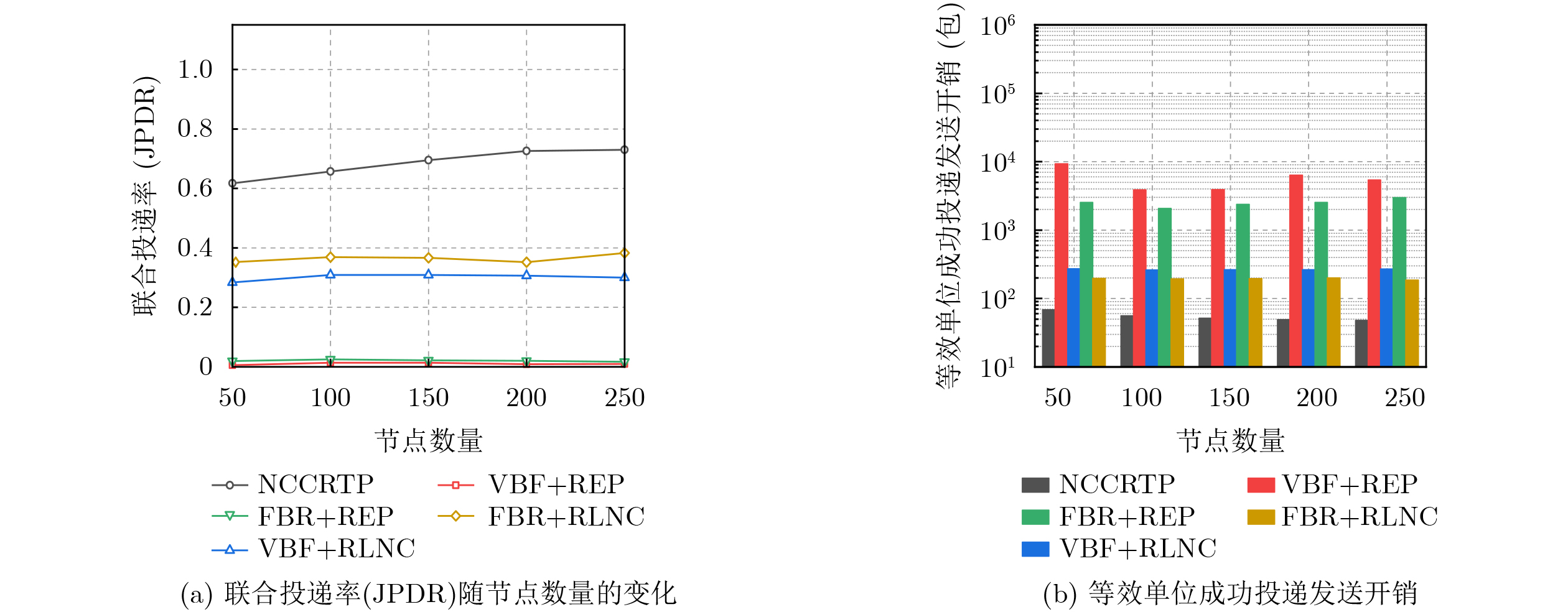
  •   Objective  Reliable data delivery in underwater acoustic communication networks is constrained by high packet error rates, long propagation delays, limited bandwidth, and topology variations. In single-source dual-sink multi-hop transmission, the same data generation must be reliably delivered to two destination nodes, and single-hop packet losses can accumulate across multi-hop forwarding and joint recovery at the two destinations, making reliable delivery more difficult. Existing reliability-enhancement mechanisms, such as retransmission, redundant forwarding, forward error correction, and multipath redundant transmission, usually rely on predetermined forwarding structures or fixed redundancy configurations. These mechanisms have limited ability to exploit the complementary coded information distributed among multiple relay nodes, and therefore still suffer from insufficient joint recovery capability and high redundancy overhead. To address this problem, this paper proposes a network-coded cooperative reliable transmission protocol, namely the Network-Coded Cooperative Reliable Transmission Protocol for Underwater Acoustic Communication Networks (NCCRTP), for underwater acoustic communication networks.  Methods  NCCRTP operates on a generation basis and employs random linear network coding (RLNC) over the Galois field $ \text{GF}({2}^{8}) $. To reduce coding overhead, each packet carries a code identifier (CodeID) rather than the full global coding vector, and relay nodes recover the corresponding coding vector from a shared local dictionary. During hop-by-hop forwarding, NCCRTP generates forward candidates under a residual-hop decreasing constraint and adaptively selects among three transmission modes: SINGLE, COOP, and BRANCH. SINGLE maintains a shared forwarding process toward the two destinations, COOP enables two relay nodes to jointly utilize linearly independent coded packets, and BRANCH splits the transmission toward different destinations. For each candidate structure, NCCRTP estimates link success probability, computes the required transmission budget, and uses a two-hop structural utility evaluation to select the forwarding mode with a better tradeoff between recovery capability and transmission cost.  Results and Discussions  Simulation results show that NCCRTP achieves the highest joint packet delivery ratio (JPDR) under both regular and random deployments. In the controlled comparison with cooperative uncoded transmission (CU), single-branch uncoded transmission (SU), and single-branch coded transmission (SC), NCCRTP consistently outperforms the schemes using only cooperative forwarding or only RLNC, indicating that the reliability gain comes from the joint effect of distributed relay cooperation and linearly independent coded-packet recovery (Fig. 5). When the packet error rate increases or the transmission depth grows from 3 to 7 hops, NCCRTP maintains a higher JPDR, demonstrating better robustness under lossy multi-hop conditions (Figs. 5(a) and 5(b)). In random deployments, vector-based forwarding (VBF) and focused beam routing (FBR) are each combined with packet replication (REP) or RLNC to form the VBF+REP, VBF+RLNC, FBR+REP, and FBR+RLNC schemes (Figs. 6 and 7). In medium-to-high packet error rate scenarios, its JPDR increases by up to approximately 50%, while the equivalent transmission cost per successful joint delivery is reduced by up to approximately 40% (Fig. 6). These results indicate that NCCRTP improves dual-sink reliability not by simply increasing redundant transmissions, but by adaptive forwarding-structure selection, link-quality-driven transmission budgeting, and joint utilization of linearly independent coded packets.  Conclusions  This paper addresses the reliability and redundancy-overhead challenges in single-source dual-sink underwater acoustic multi-hop transmission by designing a cooperative transmission structure that enables random linear network coding to exploit distributed reception and complementary coded information among relay nodes. The proposed NCCRTP protocol adaptively selects SINGLE, COOP, and BRANCH forwarding modes according to residual-hop constraints, link-quality-driven transmission budgeting, and two-hop structural utility evaluation. In addition, a lightweight coding-vector representation based on CodeID is introduced to reduce the header overhead caused by carrying full global coding vectors. The protocol is evaluated under both regular and random deployments, and the results show that: (1) NCCRTP achieves the highest joint packet delivery ratio among all compared schemes, demonstrating stronger joint recovery capability for the two destination nodes; (2) under medium-to-high packet error rates or multi-hop transmission conditions, NCCRTP improves the joint delivery ratio by up to approximately 50%; (3) the equivalent transmission cost per successful joint delivery is reduced by up to approximately 40%, indicating that the reliability gain mainly comes from adaptive structure selection, transmission-budget control, and joint utilization of linearly independent coded packets rather than excessive redundant transmissions. Future work will extend NCCRTP to more complex multi-source multi-sink multi-hop scenarios, and further investigate its implementation and performance under node mobility and realistic underwater acoustic channel dynamics.
  • loading
  • [1]
    李宇, 黄海宁. 水声网络通信性能分析[J]. 电子与信息学报, 2010, 32(7): 1564–1568. doi: 10.3724/SP.J.1146.2009.00888.

    LI Yu and HUANG Haining. Performance analysis on communication of underwater acoustic networks[J]. Journal of Electronics & Information Technology, 2010, 32(7): 1564–1568. doi: 10.3724/SP.J.1146.2009.00888.
    [2]
    AWAN K M, SHAH P A, IQBAL K, et al. Underwater wireless sensor networks: A review of recent issues and challenges[J]. Wireless Communications and Mobile Computing, 2019, 2019(1): 6470359. doi: 10.1155/2019/6470359.
    [3]
    杨健敏, 王佳惠, 乔钢, 等. 水声通信及网络技术综述[J]. 电子与信息学报, 2024, 46(1): 1–21. doi: 10.11999/JEIT230424.

    YANG Jianmin, WANG Jiahui, QIAO Gang, et al. Review of underwater acoustic communication and network technology[J]. Journal of Electronics & Information Technology, 2024, 46(1): 1–21. doi: 10.11999/JEIT230424.
    [4]
    LI Zhengnan, CHITRE M, and STOJANOVIC M. Underwater acoustic communications[J]. Nature Reviews Electrical Engineering, 2025, 2(2): 83–95. doi: 10.1038/s44287-024-00122-w.
    [5]
    KHAN H, HASSAN S A, and JUNG H. On underwater wireless sensor networks routing protocols: A review[J]. IEEE Sensors Journal, 2020, 20(18): 10371–10386. doi: 10.1109/JSEN.2020.2994199.
    [6]
    LUO Junhai, CHEN Yanping, WU Man, et al. A survey of routing protocols for underwater wireless sensor networks[J]. IEEE Communications Surveys & Tutorials, 2021, 23(1): 137–160. doi: 10.1109/COMST.2020.3048190.
    [7]
    金志刚, 梁嘉伟, 羊秋玲. 融合深度调整和自适应转发的水声网络机会路由[J]. 电子与信息学报, 2024, 46(1): 49–57. doi: 10.11999/JEIT230026.

    JIN Zhigang, LIANG Jiawei, and YANG Qiuling. Opportunistic routing in underwater acoustic networks fusing depth adjustment and adaptive forwarding[J]. Journal of Electronics & Information Technology, 2024, 46(1): 49–57. doi: 10.11999/JEIT230026.
    [8]
    KHAN M U, AAMIR M, and OTERO P. Reliable, energy-optimized, and void-aware (REOVA), routing protocol with strategic deployment in mobile underwater acoustic communications[J]. Journal of Marine Science and Engineering, 2024, 12(12): 2215. doi: 10.3390/jmse12122215.
    [9]
    LIU Songzuo, KHAN M A, BILAL M, et al. Low probability detection constrained underwater acoustic communication: A comprehensive review[J]. IEEE Communications Magazine, 2025, 63(2): 21–30. doi: 10.1109/MCOM.001.2400008.
    [10]
    YANG Chi, WANG Lei, PENG Cong, et al. A robust time-frequency synchronization method for underwater acoustic OFDM communication systems[J]. IEEE Access, 2024, 12: 21908–21920. doi: 10.1109/ACCESS.2024.3361845.
    [11]
    PELEKANAKIS K and CAZZANTI L. On adaptive modulation for low SNR underwater acoustic communications[C]. Proceedings of OCEANS 2018 MTS/IEEE Charleston, Charleston, USA, 2018: 1–6. doi: 10.1109/OCEANS.2018.8604521.
    [12]
    XIE Peng, ZHOU Zhong, PENG Zheng, et al. SDRT: A reliable data transport protocol for underwater sensor networks[J]. Ad Hoc Networks, 2010, 8(7): 708–722. doi: 10.1016/j.adhoc.2010.02.003.
    [13]
    LIN Ajun, CHEN Huifang, and XIE Lei. Performance analysis of ARQ protocols in multiuser underwater acoustic networks[C]. Proceedings of OCEANS 2015-MTS/IEEE Washington, Washington, USA, 2015: 1–6. doi: 10.23919/OCEANS.2015.7401870.
    [14]
    CHEN Weiqi, YU Hua, GUAN Quansheng, et al. Reliable and opportunistic transmissions for underwater acoustic networks[J]. IEEE Network, 2018, 32(4): 94–99. doi: 10.1109/MNET.2018.1700280.
    [15]
    AHLSWEDE R, CAI Ning, LI S Y R, et al. Network information flow[J]. IEEE Transactions on Information Theory, 2000, 46(4): 1204–1216. doi: 10.1109/18.850663.
    [16]
    FAROOQI M Z, TABASSUM S M, REHMANI M H, et al. A survey on network coding: From traditional wireless networks to emerging cognitive radio networks[J]. Journal of Network and Computer Applications, 2014, 46: 166–181. doi: 10.1016/j.jnca.2014.09.002.
    [17]
    HAO Kun, JIN Zhigang, SHEN Haifeng, et al. An efficient and reliable geographic routing protocol based on partial network coding for underwater sensor networks[J]. Sensors, 2015, 15(6): 12720–12735. doi: 10.3390/s150612720.
    [18]
    REN Jie, WU Yanbo, ZHU Min, et al. Cross-layer cooperative design of network coding and distributed opportunistic routing for underwater acoustic sensor networks[J]. IEEE Sensors Journal, 2026, 26(1): 1329–1346. doi: 10.1109/JSEN.2025.3633275.
    [19]
    GUO Zheng, WANG Bing, XIE Peng, et al. Efficient error recovery with network coding in underwater sensor networks[J]. Ad Hoc Networks, 2009, 7(4): 791–802. doi: 10.1016/j.adhoc.2008.07.011.
    [20]
    CAI Shaobin, YAO Nianmin, and GAO Zhenguo. A reliable data transfer protocol based on twin paths and network coding for underwater acoustic sensor network[J]. EURASIP Journal on Wireless Communications and Networking, 2015, 2015(1): 28. doi: 10.1186/s13638-015-0263-z.
  • 加载中

Catalog

    通讯作者: 陈斌, bchen63@163.com
    • 1. 

      沈阳化工大学材料科学与工程学院 沈阳 110142

    1. 本站搜索
    2. 百度学术搜索
    3. 万方数据库搜索
    4. CNKI搜索

    Figures(7)  / Tables(2)

    Article Metrics

    Article views (36) PDF downloads(2) Cited by()
    Proportional views
    Related

    /

    DownLoad:  Full-Size Img  PowerPoint
    Return
    Return