Advanced Search
Turn off MathJax
Article Contents
FU Weiqi, ZHAO Xiaoyu, JIN Lei, WANG Li, FEI Aiguo. Channel-Adaptive Conditional Diffusion Generation for Task-Oriented Semantic Communication[J]. Journal of Electronics & Information Technology. doi: 10.11999/JEIT260410
Citation: FU Weiqi, ZHAO Xiaoyu, JIN Lei, WANG Li, FEI Aiguo. Channel-Adaptive Conditional Diffusion Generation for Task-Oriented Semantic Communication[J]. Journal of Electronics & Information Technology. doi: 10.11999/JEIT260410

Channel-Adaptive Conditional Diffusion Generation for Task-Oriented Semantic Communication

doi: 10.11999/JEIT260410 cstr: 32379.14.JEIT260410
Funds:  The National Natural Science Foundation of China (62525106), BUPT-China Unicom Joint Innovation Center (2025-STHZ-BJYDDX-004)
  • Received Date: 2026-04-08
  • Accepted Date: 2026-10-28
  • Rev Recd Date: 2026-10-20
  • Available Online: 2026-10-30
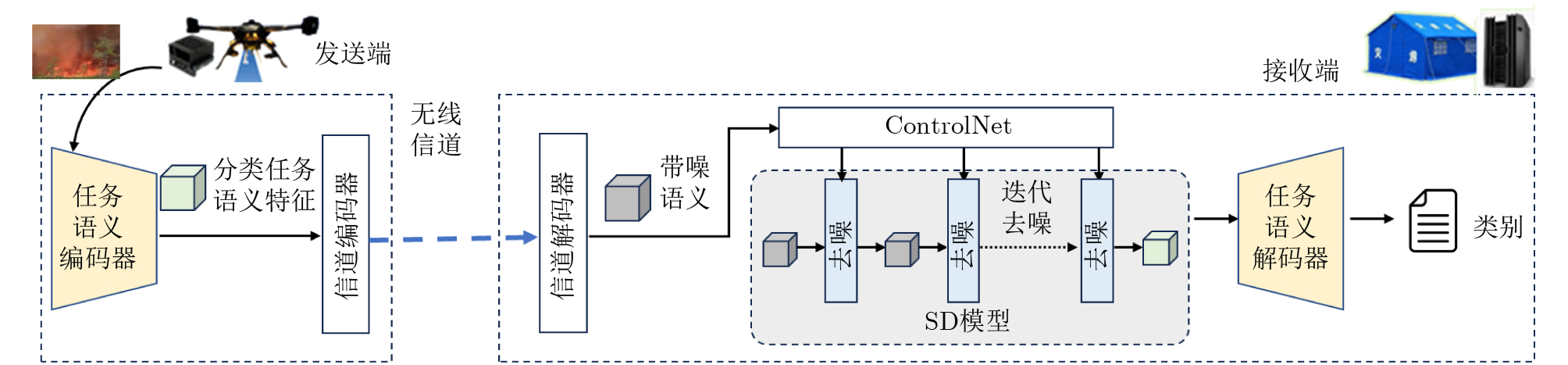
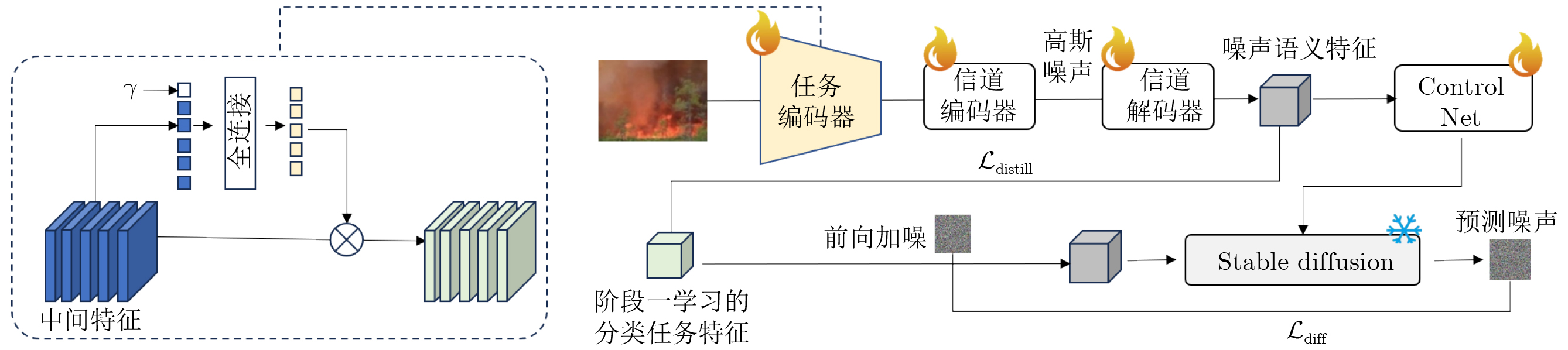
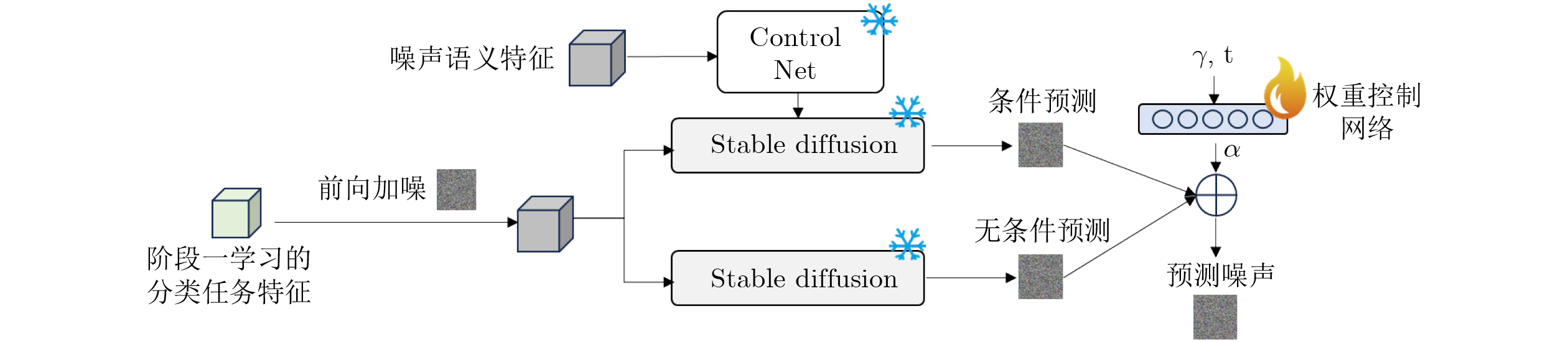
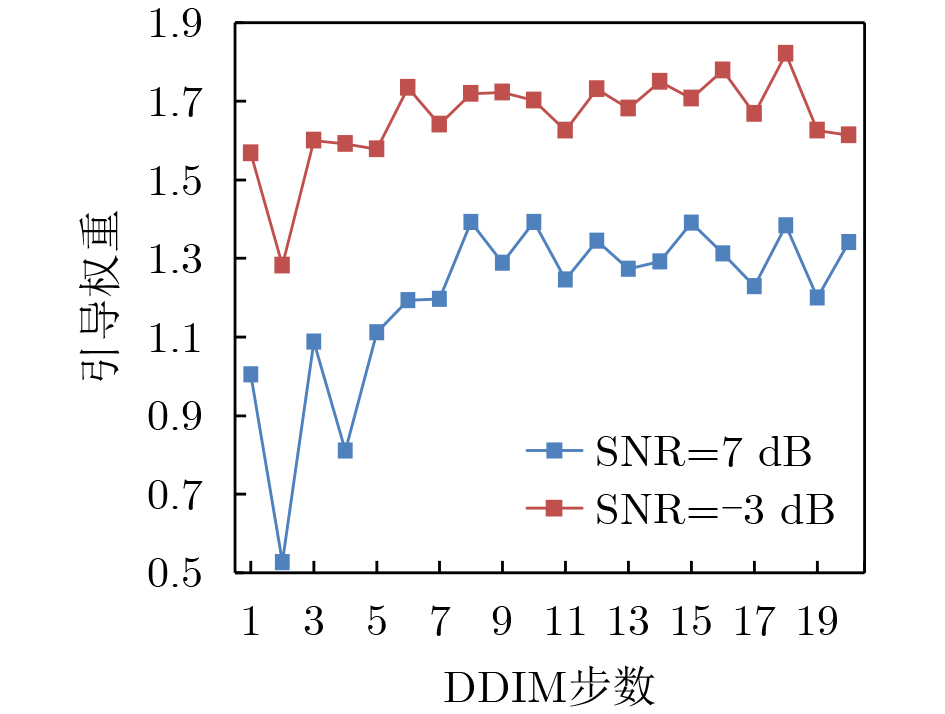
  •   Objective  In emergency rescue scenarios, on-site unmanned aerial vehicles and other intelligent equipment often lack sufficient computing power to perform complex perception tasks, such as disaster identification and personnel detection. Meanwhile, the transmission of raw image data to edge servers is constrained by limited bandwidth and degraded channel conditions. Task-oriented semantic communication systems address these challenges by transmitting only task-relevant semantic features, thereby achieving high compression ratios and robust performance under adverse channel conditions. However, conventional end-to-end training becomes computationally prohibitive when large generative models, such as Stable Diffusion (SD), are incorporated into these systems. Moreover, channel noise can accumulate during the reverse diffusion process and cause semantic drift, reducing task accuracy. To address these limitations, a channel-adaptive conditional diffusion generation method is proposed for task-oriented semantic communication, with a focus on image classification under low Signal-to-Noise Ratio (SNR) conditions. The objective is to achieve robust semantic feature transmission and accurate classification by using a pretrained diffusion model at the receiver while reducing training complexity and adapting dynamically to varying channel conditions.  Methods  The proposed framework comprises three key components: a task-channel joint sensing encoder at the transmitter, an SD-based conditional diffusion generator with ControlNet at the receiver, and an adaptive conditional guidance strategy. At the transmitter, the encoder extracts task-relevant semantic features from the input image according to the current SNR. An attention-based modulation module enables the encoder to adaptively adjust feature extraction to channel conditions. The semantic features are transmitted over an Additive White Gaussian Noise (AWGN) channel, resulting in noisy received features. At the receiver, a pretrained SD model serves as the core generator, whereas a trainable ControlNet takes the noisy features as input and produces residual corrections to guide the reverse diffusion process. After a fixed number of Denoising Diffusion Implicit Model (DDIM) sampling steps, the generated features are processed by a task decoder to produce classification results. To avoid the high computational cost of end-to-end backpropagation through the multistep diffusion chain, a two-stage training framework is proposed. In the first stage, an information bottleneck is used to learn task-relevant semantic features and train the task decoder in a noise-free environment. The loss function combines cross-entropy classification loss with Kullback-Leibler (KL) divergence to implement a variational information bottleneck. In the second stage, the SD backbone is frozen, whereas the task encoder, channel encoder, and ControlNet are trained to adapt to channel noise. The training loss combines a standard diffusion denoising loss with a distillation loss that minimizes the difference between the received semantic features and the task-relevant features learned in the first stage. To reduce semantic drift caused by noise accumulation during reverse diffusion, an adaptive conditional guidance strategy is introduced. A learnable weight network takes the current denoising timestep and SNR as inputs and produces a scaling factor ranging from 0 to 2. This factor adaptively controls the balance between conditional and unconditional noise predictions. When the scaling factor equals 1, the conditional residual is injected without modification. Values below 1 weaken conditional guidance, whereas values above 1 enhance it.  Results and Discussions  Experiments are conducted on the ImageNet-100 dataset, which contains approximately 130 000 training images and 5 000 validation images across 100 classes. All images are resized to 256 × 256 pixels and compressed into latent feature maps of size 4 × 32 × 32, corresponding to a 48-fold compression ratio. The SD v1.5 backbone is frozen during the second training stage, whereas the task encoder, channel encoder, and ControlNet are trained for 15 epochs with a learning rate of 1e–4. The adaptive weight network is trained during DDIM sampling for 5 epochs with a batch size of 96, a learning rate of 1e–4, and 20 sampling steps. The proposed method is compared with two baselines: T-DeepSC, a single-task semantic communication system without diffusion, and Diffusion-Driven Semantic Communication (DDSC) combined with VGG16 (DDSC+VGG16), which maps channel noise to forward diffusion steps and uses VGG16 for subsequent classification. Under AWGN channel conditions with SNR values ranging from –3 dB to 7 dB, the proposed method achieves the highest classification accuracy across all tested conditions. Specifically, at –3 dB, the proposed method achieves an accuracy of 44.0%, exceeding the 39.8% accuracy of T-DeepSC by 4.2 percentage points. At –1 dB, its accuracy reaches 53.2%, exceeding the 40.0% accuracy of T-DeepSC by 13.2 percentage points. At 7 dB, the proposed method achieves an accuracy of 66.8%, exceeding the 58.4% accuracy of DDSC+VGG16 by 8.4 percentage points. These results demonstrate that the proposed two-stage training framework, combined with adaptive conditional guidance, effectively recovers task-relevant semantic features from noisy transmissions and maintains high classification accuracy under severe AWGN channel conditions. Under Rayleigh fading conditions, the proposed method achieves lower classification accuracy than T-DeepSC at –3 dB and –1 dB but higher accuracy at moderate and high SNRs. At 7 dB, its classification accuracy reaches 55.2%, compared with 39.2% for T-DeepSC, indicating improved robustness as channel quality increases. Ablation experiments further confirm the contributions of the individual components. Configuration B, which excludes adaptive weight control, achieves classification accuracies that are 3.5 and 3.6 percentage points lower than those of the complete method (configuration C) at –3 dB and –1 dB, respectively. Configuration C achieves corresponding accuracies of 44.0% and 53.2%. Compared with configuration A (DDSC+VGG16), introducing the task encoder and ControlNet in configuration B increases classification accuracy from 58.4% to 65.0% at 7 dB, an improvement of 6.6 percentage points. These findings confirm that the two-stage training framework effectively learns task-relevant semantic features and adapts to channel noise without requiring end-to-end backpropagation through the multistep diffusion chain.  Conclusions  A channel-adaptive conditional diffusion generation method is proposed for task-oriented semantic communication, with a focus on image classification under bandwidth and computing resource constraints. The proposed framework integrates a task-channel joint sensing encoder, a ControlNet-guided SD generator, and a two-stage training strategy that separates task-relevant feature learning from channel noise adaptation. This design reduces training complexity by avoiding backpropagation through the multistep diffusion chain. The adaptive conditional guidance strategy dynamically adjusts the strength of noisy conditional information during reverse diffusion, thereby reducing semantic drift and improving classification robustness. Experimental results on ImageNet-100 demonstrate that the proposed method outperforms both T-DeepSC and DDSC+VGG16 across all tested SNR conditions under AWGN channels. Under Rayleigh fading conditions, the method achieves higher classification accuracy than T-DeepSC at moderate and high SNRs, although its performance remains limited at low SNRs. In addition to producing classification results, the framework can generate reconstructed images at the receiver, which may serve as auxiliary visual evidence for human verification in emergency rescue scenarios. Future research will focus on multimodal semantic information fusion, lightweight model deployment, and extensions to more complex tasks, such as object detection and visual question answering, to support practical applications in emergency rescue and other mission-critical scenarios.
  • loading
  • [1]
    王博文, 郑建, 孙彦景, 等. 应急场景无人机自组网部分重叠信道动态分配方法[J]. 电子与信息学报, 2024, 46(12): 4373–4382. doi: 10.11999/JEIT240377.

    WANG Bowen, ZHENG Jian, SUN Yanjing, et al. Partially overlapping channels dynamic allocation method for UAV Ad-hoc networks in emergency scenario[J]. Journal of Electronics & Information Technology, 2024, 46(12): 4373–4382. doi: 10.11999/JEIT240377.
    [2]
    王文远, 周明宇, 王朝炜, 等. 面向空天地网络的弹性语义通信[J]. 电子与信息学报, 2025, 47(10): 3646–3657. doi: 10.11999/JEIT250077.

    WANG Wenyuan, ZHOU Mingyu, WANG Chaowei, et al. Resilient semantic communication for space-air-ground networks[J]. Journal of Electronics & Information Technology, 2025, 47(10): 3646–3657. doi: 10.11999/JEIT250077.
    [3]
    ZHANG Guangyi, HU Qiyu, QIN Zhijin, et al. A unified multi-task semantic communication system for multimodal data[J]. IEEE Transactions on Communications, 2024, 72(7): 4101–4116. doi: 10.1109/TCOMM.2024.3364990.
    [4]
    BOURTSOULATZE E, KURKA D B, and GÜNDÜZ D. Deep joint source-channel coding for wireless image transmission[J]. IEEE Transactions on Cognitive Communications and Networking, 2019, 5(3): 567–579. doi: 10.1109/TCCN.2019.2919300.
    [5]
    LOKUMARAMBAGE M U, GOWRISETTY V S S, REZAEI H, et al. Wireless end-to-end image transmission system using semantic communications[J]. IEEE Access, 2023, 11: 37149–37163. doi: 10.1109/ACCESS.2023.3266656.
    [6]
    GETU T M, KADDOUM G, and BENNIS M. A survey on goal-oriented semantic communication: Techniques, challenges, and future directions[J]. IEEE Access, 2024, 12: 51223–51274. doi: 10.1109/ACCESS.2024.3381967.
    [7]
    邓梓焌, 何相腾, 彭宇新. 文本到视频生成: 研究现状、进展和挑战[J]. 电子与信息学报, 2024, 46(5): 1632–1644. doi: 10.11999/JEIT240074.

    DENG Zijun, HE Xiangteng, and PENG Yuxin. Text-to-video generation: Research status, progress and challenges[J]. Journal of Electronics & Information Technology, 2024, 46(5): 1632–1644. doi: 10.11999/JEIT240074.
    [8]
    HU Jiangjing, WU Haotian, ZHANG Wenjing, et al. Zero-shot semantic communication with multimodal foundation models[J]. IEEE Transactions on Vehicular Technology, 2026, 75(5): 8759–8764. doi: 10.1109/TVT.2025.3632893.
    [9]
    JIANG Feibo, PENG Yubo, DONG Li, et al. Large AI model-based semantic communications[J]. IEEE Wireless Communications, 2024, 31(3): 68–75. doi: 10.1109/MWC.001.2300346.
    [10]
    ZHANG Lvmin, RAO Anyi, and AGRAWALA M. Adding conditional control to text-to-image diffusion models[C]. 2023 IEEE/CVF International Conference on Computer Vision, Paris, France, 2023: 3813–3824. doi: 10.1109/ICCV51070.2023.00355.
    [11]
    GRASSUCCI E, BARBAROSSA S, and COMMINIELLO D. Generative semantic communication: Diffusion models beyond bit recovery[J]. IEEE Transactions on Cognitive Communications and Networking, 2026, 12: 8171–8185. doi: 10.1109/TCCN.2026.3689849.
    [12]
    YUAN Weiwen, REN Jinke, WANG Chongjie, et al. Generative semantic communication for joint image transmission and segmentation[C]. 2025 IEEE International Conference on Communications Workshops, Montreal, QC, Canada, 2025: 1110–1115. doi: 10.1109/ICCWorkshops67674.2025.11162317.
    [13]
    LI Ming, YANG Taojiannan, KUANG Huafeng, et al. ControlNet++: Improving conditional controls with efficient consistency feedback[C]. 18th European Conference on Computer Vision, Milan, Italy, 2024: 129–147. doi: 10.1007/978-3-031-72667-5_8.
    [14]
    CHEN Shoufa, SUN Peize, SONG Yibing, et al. Diffusiondet: Diffusion model for object detection[C]. 2023 IEEE/CVF International Conference on Computer Vision, Paris, France, 2023: 19773–19786. doi: 10.1109/ICCV51070.2023.01816.
    [15]
    GUO Lei, CHEN Wei, SUN Yuxuan, et al. Diffusion-driven semantic communication for generative models with bandwidth constraints[J]. IEEE Transactions on Wireless Communications, 2025, 24(8): 6490–6503. doi: 10.1109/TWC.2025.3553851.
    [16]
    HO J and SALIMANS T. Classifier-free diffusion guidance[Z]. arXiv: 2207.12598, 2022. doi: 10.48550/arXiv.2207.12598.
    [17]
    MEI Kangfu, NAI N G, and PATEL V M. Improving conditional diffusion models through re-noising from unconditional diffusion priors[C]. 2025 IEEE/CVF Winter Conference on Applications of Computer Vision, Tucson, AZ, USA, 2025: 3792–3801. doi: 10.1109/WACV61041.2025.00373.
    [18]
    ALEMI A A, FISCHER I, DILLON J V, et al. Deep variational information bottleneck[C]. 5th International Conference on Learning Representations, Toulon, France, 2017.
    [19]
    XU Jialong, AI Bo, CHEN Wei, et al. Wireless image transmission using deep source channel coding with attention modules[J]. IEEE Transactions on Circuits and Systems for Video Technology, 2022, 32(4): 2315–2328. doi: 10.1109/TCSVT.2021.3082521.
  • 加载中

Catalog

    通讯作者: 陈斌, bchen63@163.com
    • 1. 

      沈阳化工大学材料科学与工程学院 沈阳 110142

    1. 本站搜索
    2. 百度学术搜索
    3. 万方数据库搜索
    4. CNKI搜索

    Figures(6)  / Tables(4)

    Article Metrics

    Article views (125) PDF downloads(21) Cited by()
    Proportional views
    Related

    /

    DownLoad:  Full-Size Img  PowerPoint
    Return
    Return