Advanced Search
Turn off MathJax
Article Contents
TIAN Xinyu, CHEN Xiaoyu, ZHANG Jitao. Construction and Performance Analysis of Optimal Low-Hit-Zone Frequency Hopping Sequence Sets[J]. Journal of Electronics & Information Technology. doi: 10.11999/JEIT260343
Citation: TIAN Xinyu, CHEN Xiaoyu, ZHANG Jitao. Construction and Performance Analysis of Optimal Low-Hit-Zone Frequency Hopping Sequence Sets[J]. Journal of Electronics & Information Technology. doi: 10.11999/JEIT260343

Construction and Performance Analysis of Optimal Low-Hit-Zone Frequency Hopping Sequence Sets

doi: 10.11999/JEIT260343 cstr: 32379.14.JEIT260343
Funds:  The Natural Science Foundation of Hebei Province (F2025203055), The Science Research Project of Hebei Education Department (ZD2022026), The Key Laboratory Project of Hebei Province 202250701010046)
  • Received Date: 2026-03-25
  • Accepted Date: 2026-06-29
  • Rev Recd Date: 2026-06-29
  • Available Online: 2026-07-11
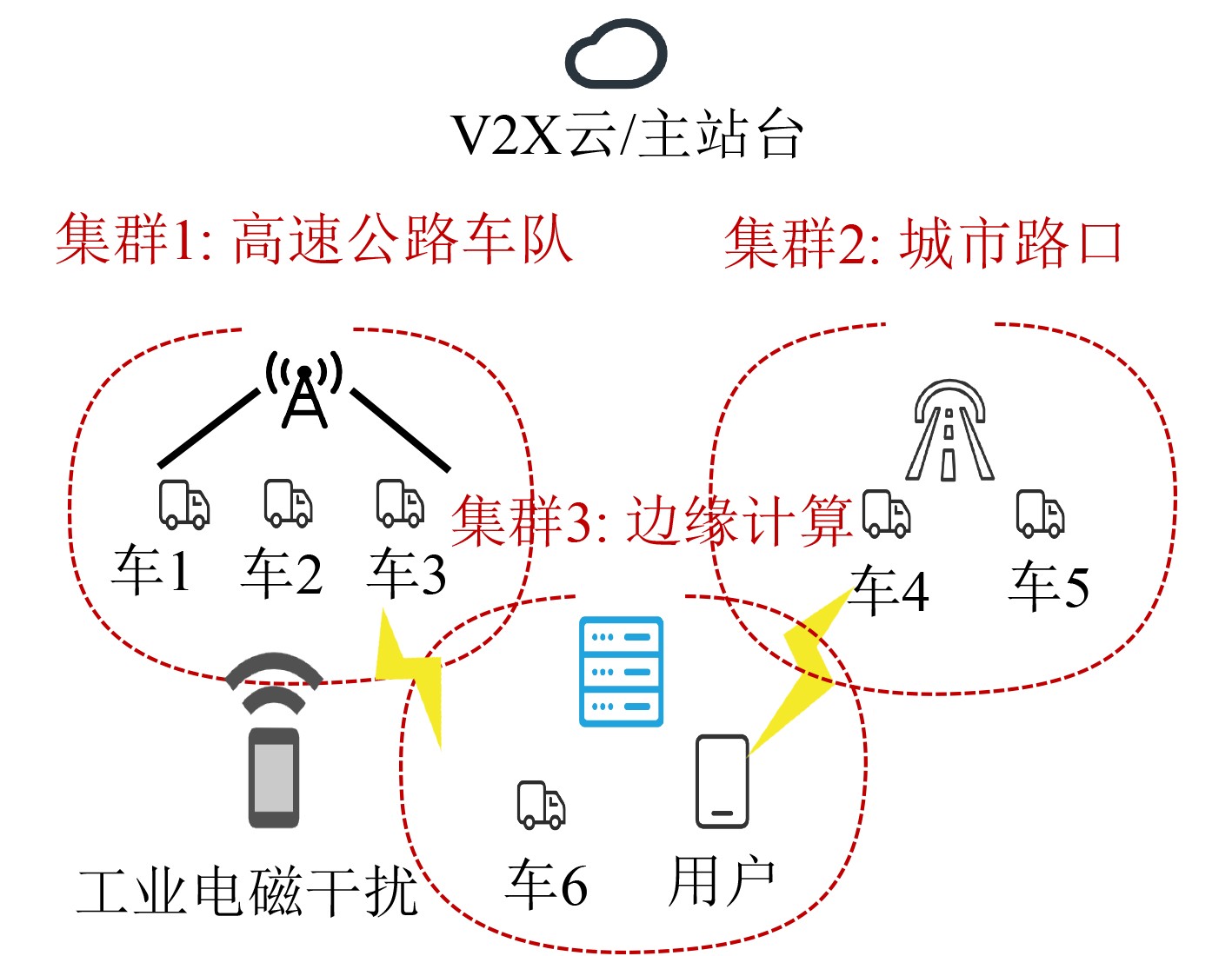
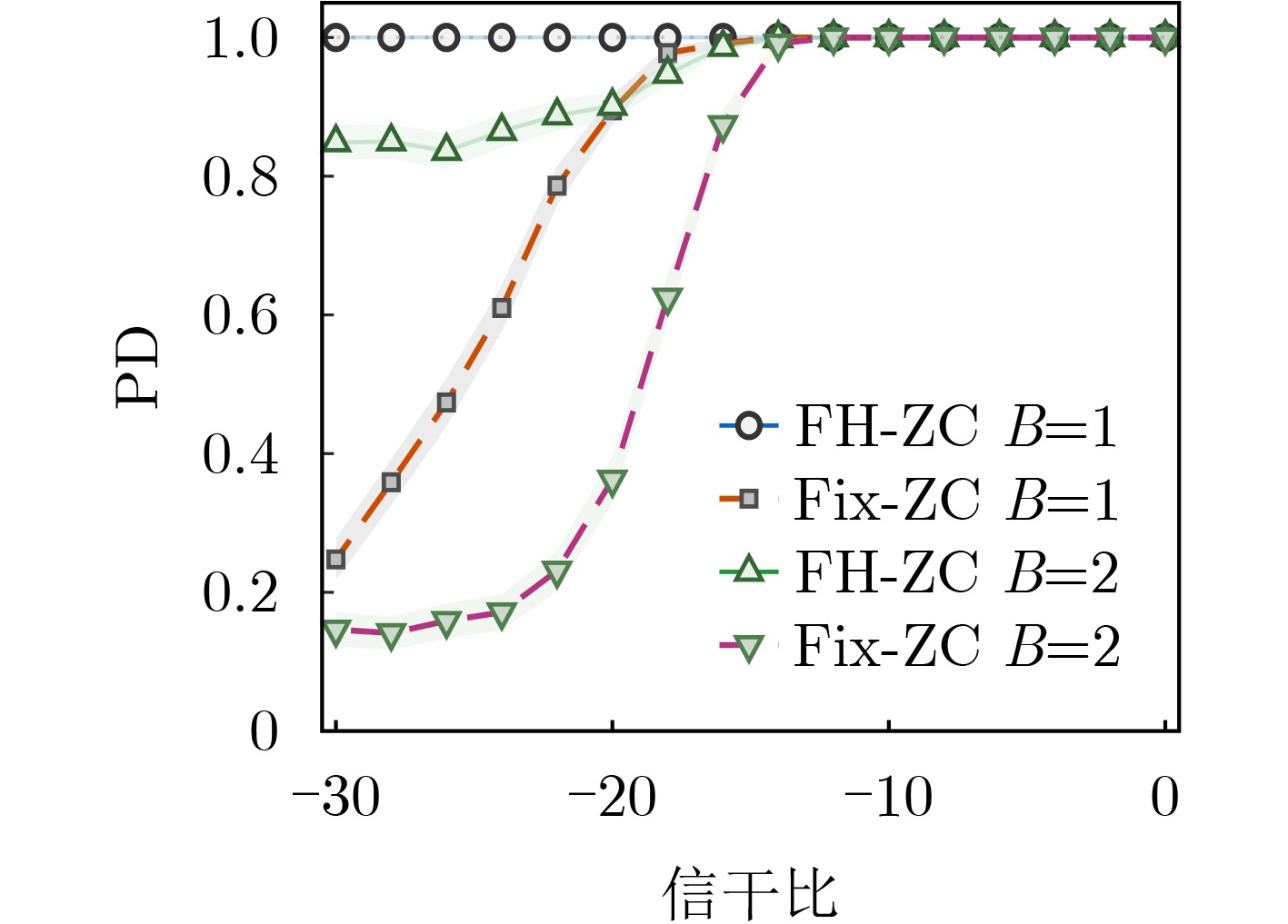
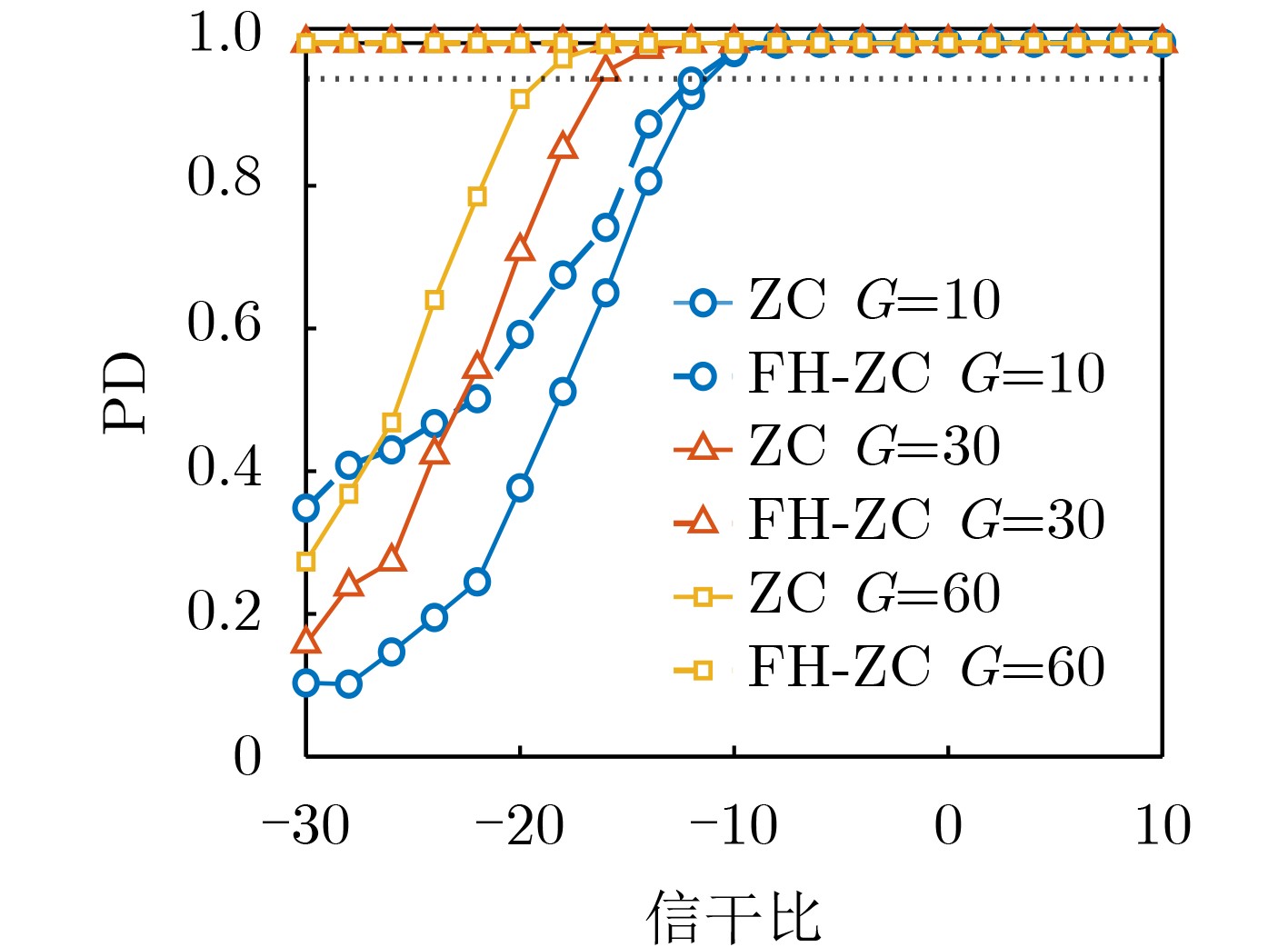
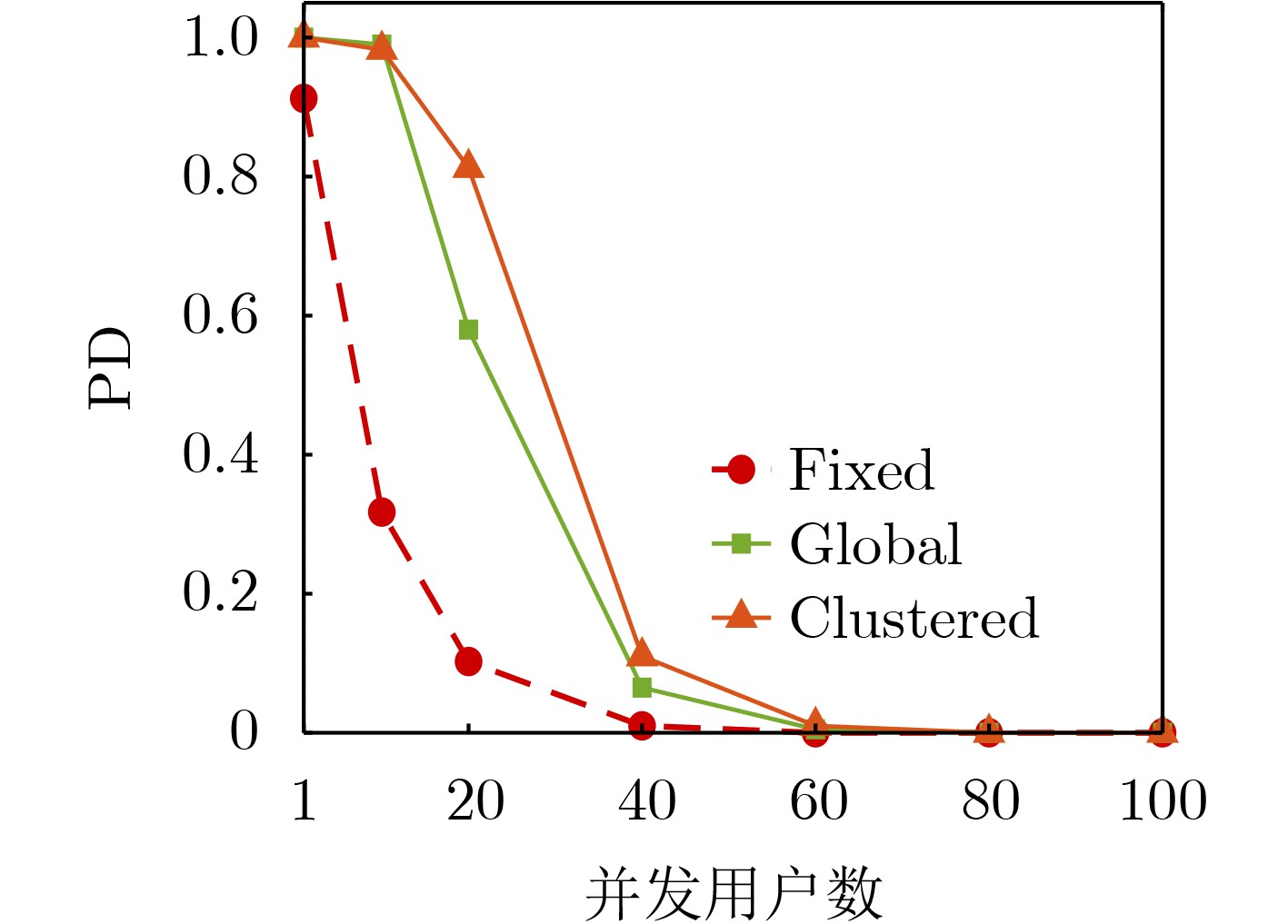
  •   Objective  ElectroMagnetic Interference (EMI) is a critical factor limiting the reliability of synchronization systems. Existing Fifth-Generation (5G) synchronization schemes extensively employ Zadoff-Chu (ZC) sequences to distinguish users through cyclic shifts. However, finite sequence lengths and limited orthogonal resources create substantial capacity bottlenecks in high-density access scenarios. To address these challenges, this paper investigates the problem from two perspectives. At the system level, a synchronization framework is developed by integrating Frequency Hopping (FH) with ZC sequences. By jointly exploiting code, time, and frequency-domain resources, the proposed framework improves concurrent access capability for local clusters while enhancing robustness against complex EMI through frequency diversity. At the sequence-design level, a class of multi-subset Low-Hit-Zone (LHZ) Frequency Hopping Sequence (FHS) sets is constructed to provide an efficient sequence allocation scheme for local-cluster synchronization.  Methods  Based on the theoretical framework proposed by Cai et al., the sequence mapping mechanism is reconstructed, and a disjoint Cyclic Perfect Mendelsohn Difference Family (CPMDF) is introduced to construct FHS sets that are optimal with respect to the Peng-Fan bound. The generating units are further expanded through Cartesian products, and a column-incoherent partitioning strategy is proposed to construct multi-subset LHZ FHS sets. It is proved that every nonempty subset satisfies the Peng-Fan-Lee bound with equality. Compared with Global-LHZ-FH-ZC, Clustered-LHZ-FH-ZC provides higher synchronization detection robustness by better matching the local-cluster competition structure. At the system level, an FH-ZC synchronization architecture is developed by combining predefined FH patterns with the frequency-domain correlation properties of ZC sequences for subband signal detection. A Peak-to-SideLobe Ratio (PSLR) decision metric and an early-termination strategy are adopted to evaluate synchronization preamble detection under interference. Furthermore, a multi-user simulation model is established to evaluate synchronization detection performance under accumulated co-channel collisions and EMI.  Results and Discussions  The proposed construction generates an FHS set that is optimal with respect to the Peng-Fan bound and a class of multi-subset LHZ FHS sets in which every nonempty subset is optimal with respect to the Peng-Fan-Lee bound. Example 2 demonstrates the construction procedure and the intra-subset and inter-subset Hamming correlation properties of the proposed multi-subset LHZ FHS sets. Table 1 shows that, under the same frequency-resource constraints, the proposed construction generates more sequences than existing methods under the compared parameter settings, indicating higher sequence-resource utilization. Table 2 compares the parameters of the proposed sequence sets with representative constructions reported previously and demonstrates that the proposed multi-subset optimal sequence family provides a new parameter combination. To the best of our knowledge, an optimal sequence family with a multi-subset structure has not been reported previously. Figures 2 and 3 demonstrate that the proposed FH-ZC synchronization architecture achieves a higher synchronization detection probability than the conventional full-band Fixed-ZC baseline under subband-selective blocking interference caused by EMI. Figure 4 shows that the synchronization detection probability decreases as the number of active users increases because accumulated co-channel collisions degrade synchronization performance. Compared with Global-LHZ-FH-ZC, Clustered-LHZ-FH-ZC provides higher synchronization detection robustness by better matching the local-cluster competition structure characterized by strong intra-cluster competition and weak inter-cluster coupling.  Conclusions  To satisfy the sequence-capacity requirements of massive-access scenarios, this paper proposes a class of multi-subset LHZ FHS sets. By expanding the generating sequence sets through Cartesian products and partitioning subsets using a column-incoherent strategy, the proposed construction achieves both a large family size and optimal LHZ performance. The proposed multi-subset structure is well suited to local-cluster synchronization and substantially improves sequence family size and sequence-resource utilization, thereby providing a richer sequence resource pool for high-density multi-user systems. Simulation results under the considered physical-layer model demonstrate that the proposed LHZ FHS subsets reduce the effect of frequency collisions during multi-user synchronization detection. Furthermore, the FH-ZC synchronization scheme achieves a higher synchronization preamble detection probability than the conventional full-band Fixed-ZC baseline under subband-selective blocking interference caused by EMI.
  • loading
  • [1]
    王诗雨, 汪西明, 可臻怡, 等. 无人机通信多模抗干扰: 融合二维迁移强化学习的协同决策方法[J]. 电子与信息学报, 2025, 47(11): 4200–4210. doi: 10.11999/JEIT250566.

    WANG Shiyu, WANG Ximing, KE Zhenyi, et al. Multi-mode anti-jamming for UAV communications: A cooperative mode-based decision-making approach via two-dimensional transfer reinforcement learning[J]. Journal of Electronics & Information Technology, 2025, 47(11): 4200–4210. doi: 10.11999/JEIT250566.
    [2]
    应宗辰, 桂琳, 杨佳翰, 等. TTSPD: 一种融合轮胎数据的多模态交通场景感知数据集[J/OL]. 电子与信息学报. https://link.cnki.net/urlid/11.4494.TN.20260314.1610.002, 2026.

    YING Zongchen, GUI Lin, YANG Jiahan, et al. TTSPD: A multimodal traffic scene perception dataset integrating tire data[J/OL]. Journal of Electronics & Information Technology. https://link.cnki.net/urlid/11.4494.TN.20260314.1610.002, 2026.
    [3]
    齐子森, 张梓轩, 许华, 等. 利用无线电极化特征的跳频网台分选方法[J]. 电子与信息学报, 2024, 46(4): 1286–1295. doi: 10.11999/JEIT230315.

    QI Zisen, ZHANG Zixuan, XU Hua, et al. Frequency-hopping network station sorting method using radio polarization characteristics[J]. Journal of Electronics & Information Technology, 2024, 46(4): 1286–1295. doi: 10.11999/JEIT230315.
    [4]
    CHEN Miling, CHAI Rong, HU Hang, et al. Performance evaluation of C-V2X mode 4 communications[C]. 2021 IEEE Wireless Communications and Networking Conference, Nanjing, China, 2021: 1–6. doi: 10.1109/WCNC49053.2021.9417517.
    [5]
    GROW J, OGLESBY N, HATCHER G, et al. Wireless interference and regulatory frameworks for frequency allocation in V2X communication systems[C]. 8th International Conference on Intelligent Transport Systems, Pisa, Italy, 2024: 265–278. doi: 10.1007/978-3-031-86370-7_16.
    [6]
    PAUL C R, SCULLY R C, and STEFFKA M A. Introduction to Electromagnetic Compatibility[M]. 3rd ed. Hoboken: Wiley, 2022.
    [7]
    IEC. IEC 61000-4-3: 2020 Electromagnetic compatibility (EMC) - Part 4-3: Testing and measurement techniques - Radiated, radio-frequency, electromagnetic field immunity test[S]. Geneva: International Electrotechnical Commission, 2020.
    [8]
    XIE Chun and WANG Changyuan. Constructions of low-hit-zone frequency-hopping sequence set with strictly optimal periodic partial Hamming correlation[J]. IEEE Access, 2025, 13: 105394–105400. doi: 10.1109/ACCESS.2025.3580293.
    [9]
    ZHOU Limengnan, PENG Daiyuan, LIANG Hongbin, et al. Constructions of optimal low-hit-zone frequency hopping sequence sets[J]. Designs, Codes and Cryptography, 2017, 85(2): 219–232. doi: 10.1007/s10623-016-0299-z.
    [10]
    WANG Changyuan, ZHANG Yi, YANG Wanan, et al. Optimal constructions of low-hit zone frequency-hopping sequence set based on m-sequence[J]. Mathematics, 2025, 13(14): 2228. doi: 10.3390/math13142228.
    [11]
    TIAN Xinyu, HAN Hongyu, and PARAMPALLI U. Construction of low-hit-zone frequency-hopping sequence sets with strictly optimal partial Hamming correlation based on Chinese Remainder Theorem[J]. Cryptography and Communications, 2025, 17(1): 15–25. doi: 10.1007/s12095-024-00738-7.
    [12]
    ZEYDAN E, TURK Y, and DEV K. Driving cluster-level trust for artificial intelligence in V2X communications[J]. IEEE Internet of Things Magazine, 2026, 9(1): 88–95. doi: 10.1109/MIOT.2025.3582670.
    [13]
    AMER A A, TALKHAN I E, ABUTARBOUSH H F, et al. Joint vehicle clustering and dynamic power allocation optimization in sectorized 6G networks for V2X communication[J]. Vehicular Communications, 2026, 57: 100983. doi: 10.1016/j.vehcom.2025.100983.
    [14]
    WU Weihua, HUANG Yanxiu, TENG Wei, et al. Robust beamforming and resource allocation for multiantenna cellular vehicle-to-everything (C-V2X) networks[J]. IEEE Internet of Things Journal, 2026, 13(2): 2731–2747. doi: 10.1109/JIOT.2025.3631632.
    [15]
    CAI Han, YANG Yang, ZHOU Zhengchun, et al. Strictly optimal frequency-hopping sequence sets with optimal family sizes[J]. IEEE Transactions on Information Theory, 2016, 62(2): 1087–1093. doi: 10.1109/TIT.2015.2512859.
    [16]
    PENG Daiyuan and FAN Pingzhi. Lower bounds on the Hamming auto- and cross correlations of frequency-hopping sequences[J]. IEEE Transactions on Information Theory, 2004, 50(9): 2149–2154. doi: 10.1109/TIT.2004.833362.
    [17]
    PENG Daiyuan, FAN Pingzhi, and LEE M H. Lower bounds on the periodic Hamming correlations of frequency hopping sequences with low hit zone[J]. Science in China Series F: Information Sciences, 2006, 49(2): 208–218. doi: 10.1007/s11432-006-0208-6.
    [18]
    LIU Xing, SHU Qin, and ZENG Qi. Low-hit-zone frequency/time hopping sequence sets with large family size[J]. IEEE Access, 2019, 7: 181733–181739. doi: 10.1109/ACCESS.2019.2959718.
    [19]
    ZHENG Jingze, SHI Zhiguo, GUO Xiuzhen, et al. A tutorial on SDR-based NB-IoT PHY: Synchronization, demodulation, and validation[J]. IEEE Communications Surveys & Tutorials, 2026, 28: 4458–4484. doi: 10.1109/COMST.2026.3654924.
  • 加载中

Catalog

    通讯作者: 陈斌, bchen63@163.com
    • 1. 

      沈阳化工大学材料科学与工程学院 沈阳 110142

    1. 本站搜索
    2. 百度学术搜索
    3. 万方数据库搜索
    4. CNKI搜索

    Figures(4)  / Tables(2)

    Article Metrics

    Article views (136) PDF downloads(7) Cited by()
    Proportional views
    Related

    /

    DownLoad:  Full-Size Img  PowerPoint
    Return
    Return